ISHOUSEHOLDDECISION-MAKING POWERASSOCIATED WITH USEOFMODERN
CONTRACEPTIVEMETHODS AMONGIORDANIANWOMEN?
BY
LeilaDalSanto
Apaperpresentedtothefaculty ofTheUniversity ofNorth Carolina atChapelHillin partial fulfillment of the requirementsforthedegreeof Master ofPublicHealthin
theDepartment ofMaternaland Child Health. Chapel Hill,N.C.
(April 4,2015]
Approvedby:
FirstReader
Is household decision-making power associated with use of modern contraceptive methods among Jordanian women?
Abstract
Background: In light of growing economic and resource-constraints and a stagnant total fertility rate of 3.5, the government of Jordan has doubled its efforts to improve uptake of contraceptive
methods. To date, only qualitative studies have explored the socio-cultural and health system factors that influence use of family planning services.
Objectives: To explore the relationship between autonomy—as measured through proxy household decision-making indicators—and the use of contraceptive methods in Jordan.
Methods: Data from the 2012 Jordan Population and Family Health Survey (JPFHS) was used
for this study. Multivariate logistic regression was used to examine the association between autonomy and contraceptive use controlling for confounders.
Results: A total of 8,838 women were included in the study, 28% of whom were not currently using contraception despite citing a desire for spacing or limiting births. After controlling for
confounders, women with a higher level of autonomy had 1.20 times the odds (95% CI: 1.07-1.35) of contraceptive use (traditional or modern methods) compared to women with low autonomy.
Conclusion: Autonomy was associated with higher rates of contraceptive use, but not of use of
Background
The Cairo consensus was a landmark victory for the international women’s rights movement: the analytical framework developed in the International Conference on Population and Development’s Programme of Action offered critical recognition of the underlying
sociopolitical factors that influence women’s reproductive health and advocated for a human rights-based approach to reproductive health.1 However, despite the global commitment to
improving universal access to reproductive health services, 215 million women in the developing world still cite an unmet need for contraceptive methods2: these women, as per the WHO definition for unmet need, are those who are fecund and sexually active, are not using any
method of contraception, and do not wish to have more children or wish to delay the birth of their next child.3 In the Arab world, high rates of unmet need for family planning—27% in
Libya4 and 29% in Yemen,5 for example,—place women at risk of unintended pregnancies and adverse outcomes, including poor reproductive health outcomes. Curbing unmet need for family planning in this region will require both demand and supply-side interventions to increase
acceptability of and accessibility to family planning services.
In Jordan, high birth rates (total fertility rate of 3.5 in 2012) overburden the health,
economic, and education sectors and strain food, water, energy, and environmental resources.6 In light of these challenges—challenges only exacerbated by the influx of refugees to Jordan in the wake of the Arab Spring—, Jordan has reaffirmed the importance of improving access to family
planning services and increasing the demand for these services. Indeed, this emphasis on curbing the fertility rate is appropriate given the country’s stagnant contraceptive prevalence
1%, from 41% to 42% in this same period.i Contraceptive knowledge, utilization, and access vary between the central, northern, and southern regions of Jordan. Women living in the
southern region are consistently reported to have the lowest levels of education (8.2%, of women had no education compared to 2.9% and 2.0% in northern and central regions, respectively), the lowest rates of current contraceptive use (53.8%, 58.3%, and 60.5%, respectively), and limited
contact with health providers (8.6%, 24.6%, and 20.8%, respectively).8 Lack of knowledge of family planning services was examined in a 2012 study of contraceptive prevalence in rural
southern communities in Jordan. Mahadeen et al. found that women in the rural southern region did not have an adequate understanding of the concept of family planning.9 Consequently, only 37.0% of female respondents had ever used a contraceptive method, which underscores the need
for education-based interventions.
Research to date has offered several explanations for such poor progress in increasing
contraceptive uptake, ranging from socio-cultural factors (e.g. religious interdiction, spousal influence) to physical barriers to family planning services. The role of gender norms and spousal influence on contraceptive use have also been highlighted in recent studies of family planning
utilization in Jordan.10,11 In an observational study of over 350 women at reproductive health clinics, Clark et al. explored the relationship between patriarchal cultural norms and family
planning-seeking practices. The study found that women who cited experiencing physical violence were 2.4 times as likely (no confidence interval reported) to report spousal interference in attempts to avert pregnancy through contraceptive use.11 A similar analysis of 2007 Jordan
DHS data by O’Hara et al. found that the effects of intimate partner violence (IPV) on current
contraceptive use varied according to the type of violence perpetrated (i.e. women who experienced physical violence were less likely to use contraceptive methods whereas those who
had experienced sexual violence were more likely to use contraception).12 Even in households where no IPV was reported, women still lacked decision-making power with respect to health care decisions. In a 2002 qualitative study with Jordanian men, Petro-Nustas and Al-Qutob
found that despite spousal communication about family planning, the husband ultimately made the final decision.13 Similarly, research with female respondents revealed that these women were
under immense pressure from their husbands and extended family (mother-in-laws) to bear children and were often restricted from using contraceptive methods by these individuals.14
The role of religion in shaping contraceptive accessibility has been the focus of other
family planning studies and initiatives in Jordan. Given the saliency of religious leaders’ worldview on the lifestyle choices of community members, researchers have stressed the need to
include religious leaders in national family planning initiatives.15,16 While the literature demonstrates that imamsii widely support the general concept of family planning (which includes traditional family planning methods),17 there is still considerable uncertainty within this
population of the consonance of modern contraceptive methods with Islam.16
Finally, women residing in remote regions of the country often face a heightened burden
with respect to accessing quality family planning services. Most notable among these supply-side barriers is the chronic shortage of female physicians (to provide contraceptive services such as IUD insertion)18,19—this is problematic due to socio-cultural norms that dictate the provision
of reproductive health-related services by female providers. Another supply-side challenge is the failure of health workforce providers in low-resource clinics (particularly in rural regions) to
adequately discuss possible side effects of and to address myths/misconceptions about modern contraceptive methods.20 Results of focus group discussions with women from the central,
northern, and southern regions of the country emphasize the important role health care providers play with respect to women’s adoption of family planning services: study participants cited that knowledgeable health workers would influence their decisions to start or continue to use modern
contraceptive methods.21 Similarly, in a qualitative study involving policy makers, Bedouins, and clinic providers, Hundt et al. found that rural communities’ limited accessibility to family
planning services, compounded by health workers’ poor communication skills, are largely responsible for limited contraceptive use among this population.22
The existing literature on the determinants of unmet need among Jordanian women
underscores the significant effects of socio-cultural and geographical factors on contraceptive use and unmet need for family planning. Indeed, the gender norms lens through which the
authors aim to understand family planning uptake (including the interaction of gender norms and supply-side factors such female health workforce capacity) is highly relevant. However, despite the very salient role of gender in shaping healthcare use and access, very few studies have
explored whether autonomy is predictive of contraceptive use. Furthermore, none of these studies have explored the possible moderating effect of “access to health care” on contraceptive
method uptake. This study aims to bridge this gap in our understanding of how a key gender factor (women’s autonomy) and access to health facilities interact with or contribute to contraceptive use—particularly modern method use—in Jordan. The primary hypothesis is that
high autonomy is associated with greater contraceptive use (modern and traditional) as well as greater modern method use. In addition, this study hypothesizes that the ease of access to health
2012 DHS data set, the following analysis will provide a comprehensive understanding of these systemic factors, with the goal of better informing supply-side and demand-side initiatives to
increase contraceptive prevalence and reduce unmet need in Jordan.
Methods
Sample
Data for the present study come from the 2012 Jordan Population and Family Health
Survey (JPFHS) the sixth DHS undertaken in the kingdom. This nationally representative survey aims to capture the country’s maternal and child health profile as well as other information related to fertility, mortality, and family planning. In an effort to ensure the nationally
representative nature of the sample—urban and rural, each of the twelve governorates, and Badia and refugee populations (special populations)—, multi-stage probability sampling was conducted
using the 2004 Jordan Population and Housing census as a sampling frame. In the first of a two-stage sampling procedure, 806 clusters, each comprised of 30 or more households, were selected following stratification by urban and rural areas; household listing operations were subsequently
undertaken to serve as the sampling frame for stage-two selection. In the second stage, systematic random sampling was used to identify 20 households in each cluster for participation.
In total, 16,120 households were selected for the survey, 15,722 of which were occupied. Of the total households interviewed (15,190), 11,673 ever-married women between the ages of 15 and 49 were identified for participation in the woman’s questionnaire; 15,190 women agreed
to participate—a response rate of 97 percent. For the purposes of the present study— investigation of the relationship between autonomy and contraceptive use—, only currently
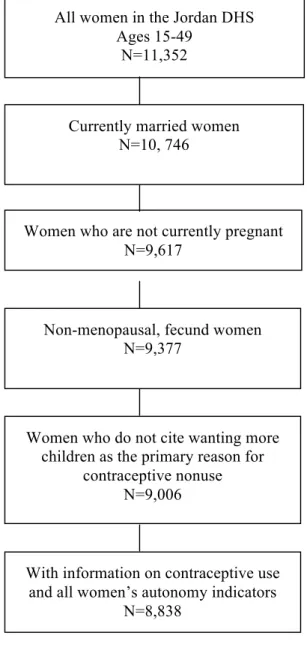
more children were excluded from the present study. The final sample size, as shown in Figure 1, was 8,838 women.
Variables
The two dependent variables included in this analysis were current contraceptive use and use of a modern contraceptive method. Women who cited using either traditional or modern
contraceptive methods were classified as currently using contraceptive methods; women who indicated non-use or folkloric methods of contraception were categorized as not currently using
modern contraceptive methods. Modern methods of contraception included the pill, female and male sterilization, IUD, injectables, implants, male and female condom, diaphragm, and emergency contraception. Traditional methods included abstinence and withdrawal. The
independent variable, autonomy, measured the household decision-making power of female respondents. A scale variable was created to evaluate autonomy based on five questions related
to household decisions: respondent’s earnings, respondent’s health care, large household purchases, visits to family or relatives, and husband’s earnings; these questions are included in appendix B. As has been done elsewhere,23 for questions where women cited sole
decision-making authority or joint decision-decision-making authority, one point was scored; no points were awarded in cases where the husband or others made decisions on behalf of the respondent. The
sum of the five autonomy questions was averaged, and women with scores of four or five were considered to have a high level of autonomy. The mean of this autonomy average scale variable was 3.28 (SD: + 1.13)
Ease of access to health care services was hypothesized to be a moderator in the association between autonomy and unmet need. Ease of access was measured based on whether
covariates were assessed in the analysis: Urban or rural residence, education, parity, SES, and age. Education was categorized into no education, primary, secondary, or higher. Parity was
dichotomized so that women with greater than three children were classified as high parity and women with three or fewer children as low parity. Socioeconomic status was based on the DHS stratification of SES into poorest, poorer, middle, richer, and richest quintiles. Age was measured
in 10 year increments: 15-24 years, 25-34 years, 35-44 years, and older.
Analysis
STATA version 13.1 (Stata Corporation, College Station, TX) was used to conduct the
analysis. Descriptive statistics on the entire population (n=8838) were run to describe the characteristics of this population. Cross tabs and chi-square tests were then performed to report bivariate associations between the independent variable (autonomy), covariates, and outcome
(contraceptive use). All chi-square tests were conducted using a 95% confidence level.
To test the hypothesis that high levels of autonomy are associated with higher odds of
contraceptive use and modern method use, unadjusted logistic regression models were run to analyze the relationship between high autonomy and contraceptive use. To determine the moderating effect of access on the relationship between autonomy and contraceptive use, a third
logistic regression model was run, which included an interaction term. A multivariate logistic regression model was then performed to examine whether a statistically significant relationship persisted between “high autonomy” and contraceptive use/modern method use after controlling
Results
Of the 8,838 women included in this study, 6,341 (71.8%) womeniii reported use of a contraceptive method and just under half of the women (n=4,365, 49.4%) responded that they used modern methods (Table 1). Nearly 90% (n=7,863) of women had attained at least a
secondary level of education. Approximately 30% of the respondents resided in rural areas, and just over one quarter of those interviewed cited distance as problematic in obtaining medical
help. Half of the respondents cited high levels of decision-making ability (i.e. an average autonomy score of 4 or 5) (Table 1).
Contraceptive use increased with parity (Table 2): less than 3% of women with no
children cited using contraceptive methods, whereas 80% of women with three or more children reported current contraceptive use. Rural residence was not associated with contraceptive use:
1,845 (71%) rural respondents cited current contraceptive use compared with 4,496 (72%) urban respondents. Women ages 35 to 44 were most likely to be using contraceptive methods (77.2%), and women between the ages of 15 and 24 were the least likely (57.0%) to be using
contraceptive methods. Modern method use was highest among women with secondary education (52%) and lowest among women with no education (37%) (Table 3).
Table 4 illustrates the frequencies of autonomy according to socio-demographic characteristics. Women at each end of the age spectrum reported lower levels of autonomy compared with women between the ages of 25 and 44. The most autonomous women were also
the most likely to have completed secondary education or higher: 68% of highly autonomous
women had completed post-secondary education while only 32% of women with low autonomy had completed post-secondary education.
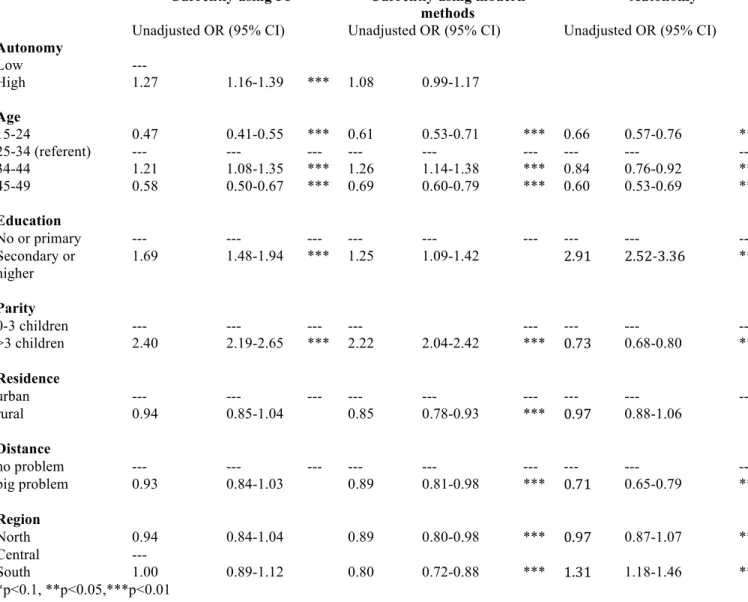
Autonomy was related to current contraceptive use, though the same association did not hold for modern method use. In the unadjusted logistic model, women with high levels of autonomy had 1.27 times the odds (95% CI, 1.16-1.39) of current contraceptive use compared
with their counterparts with low autonomy (Table 5). The same direction of effect was seen with respect to modern method use, though the effect was much smaller and not statistically
significant: highly autonomous women had only 1.08 times the odds (95% CI, 0.99-1.17) of using modern methods compared to women with low autonomy.
The likelihood ratio test comparing a multivariate model with and without an interaction
term for autonomy and health services supported the hypothesis that distance to health services moderates the relationship between autonomy and contraceptive use, but not the relationship
between autonomy and modern method use; the likelihood-ratio test of 0.0425 did meet the 10% a priori criterion for moderation (Table 6). After controlling for confounders, women with high levels of autonomy were 1.20 (95% CI, 1.07-1.35) times more likely to be currently using
contraceptive methods compared to women with low autonomy (Table 6). However, autonomy had no effect on respondents’ use of modern methods—autonomous women were 1.09 times
more likely to be using modern contraceptive methods (95% CI, 0.99-1.19).
Discussion
The main finding of this study—that higher autonomy is associated with greater use of family planning services—give credence to an emerging body of literature that underscores the
decision-making autonomy among women in Pakistan was significantly associated with current contraceptive use.24 Similarly, studies in Eritrea and Uganda showed that women who reported
higher decision-making power were also more likely to use contraceptive methods.25,26 Nevertheless, the finding that women with higher levels of autonomy were not more likely to use modern contraceptive methods is peculiar: the association between decision-making power and
modern method use has been substantiated by a number of recent studies in other contexts. In a study of contraceptive use among Nigerian women, OlaOlorun and Hindin reported that women
with the highest levels of decision-making power had over 1.5 times the odds of modern method use compared with women with low decision-making power.27 An additional study among urban Nigerian women showed that women with more greater decision-making power were more likely
to be modern family planning users (OR=1.21, 95% CI 1.12-1.31).23 In the case of Jordan, the positive association between autonomy and contraceptive use yet lack of association between
autonomy and modern method use warrants further exploration. It is possible that supply-side factors, such as lack of female service providers and facility stock outs, limit women’s access to modern methods; however, such an explanatory framework for this finding is beyond the scope
of this analysis. Future studies that employ qualitative research methods might provide the context within which these findings could be better understood. Specifically, how do availability
of contraceptive methods and providers in various health facilities (government, private, NGO, and pharmacies) and the cost of modern methods affect Jordanian women’s modern method use? If the effect of access for each group (traditional versus modern method users) could be assessed
A few limitations of the present study are noteworthy. The first major limitation of this study is the use of secondary data, which de facto precludes the ability to measure autonomy and
other cultural factors using indicators that are perhaps more common or acceptable in Jordan (i.e. more culturally relevant to that population). At present, DHS household decision-making questions capture day-to-day aspects of autonomy—e.g. who decides on household expenses or
family visits—rather than the autonomy of women vis-à-vis strong cultural norms. For example, is the respondent afforded the right to choose her husband? Does she have decision-making
power with respect to her reproductive health (not general health care)—These types of questions would provide a more nuanced understanding of the respondent’s ability to navigate Jordanian cultural norms. Similarly, another limitation is the lack of consensus within the field
regarding the precise measurement of autonomy. The DHS has inconsistently measured autonomy over the years, at times including education and employment characteristics in the
composite measure, while other times limiting autonomy to include household decision-making or respondents’ perceptions of wife-beating.
Despite these limitations, there are several strengths of the present study. The survey
data is nationally representative, capturing outcome differences across urban and rural divides, as well as across the south, central, and northern regions and socioeconomic groups. Furthermore,
Conclusions
The findings of this study suggest that the relationship between Jordanian women’s autonomy and utilization of family planning services warrants further exploration. Given significant national and international investment in women’s empowerment initiatives over the
past decade, it is important to better understand the relationship between empowerment and reproductive health outcomes. As underscored in this study’s findings, engaging women alone
in such initiatives may be beneficial for increasing the use of family planning, but may not be sufficient to increase the use of the most effective forms of family planning (i.e. modern methods) and to tackle the deep-rooted cultural norms that dictate a woman’s right to
reproductive health. Future research would benefit from qualitative studies to understand women’s perceptions of family planning methods, particularly of modern methods of
Appendix A: Tables and Figures
Figure 1: Final analysis sample, Women’s Autonomy and Contraceptive Use, Jordan DHS, 2011-2012.
All women in the Jordan DHS Ages 15-49
N=11,352
Currently married women N=10, 746
Women who are not currently pregnant N=9,617
With information on contraceptive use and all women’s autonomy indicators
N=8,838
Non-menopausal, fecund women N=9,377
Women who do not cite wanting more children as the primary reason for
Table 1: Socio-demographic, health, and access characteristics of Jordanian women who participated in the 2011-2012 DHS survey (n=8,838)
Variable Frequency (%)
Contraceptive Use (Modern/Traditional) Not currently using FP method
Currently using FP method
Modern Method Use No Yes Autonomy Low High Maternal Education No education Primary Secondary Higher Maternal Age 15-24 25-34 35-44 45-49 Residence Urban Rural Parity No children 1-3 children >3 children
Access to medical help Big problem Not a big problem
Table 2: Socio-demographic characteristics of Jordanian women stratified by outcome (contraceptive use); n=8,838
Currently using FP Not currently using FP
Total
N % N % N p value*
Socio-demographic Characteristics
Autonomy 0.0001
Low autonomy 3,068 69.33 1,357 30.67 4,425 High autonomy 3,273 74.17 1,140 25.83 4,413
Maternal Education 0.0001
No education 157 53.77 135 46.23 292 Primary 460 64.79 250 35.21 710 Secondary 3,723 73.30 1,356 26.70 5,079 Higher 2,001 72.58 756 27.42 2,757
Maternal Age 0.0001
15-24 560 56.97 423 43.03 983 25-34 2,496 73.72 890 26.28 3,386 35-44 2,611 77.20 771 22.80 3,382 45-49 674 62.01 413 37.99 1,087
Residence 0.257
Urban 4,496 72.10 1,740 27.90 6,236 Rural 1,845 70.91 757 29.09 2,602
Parity 0.0001
No children 13 2.71 467 97.29 480 1-3 children 2,427 70.12 1,034 29.88 3,461 >3 children 3,901 79.66 996 20.34 4,897
Distance 0.171
Big problem 1,694 70.67 703 29.33 2,397 Not a big problem 4,647 72.15 1,794 27.85 6,441
Region
North 2,285 72.22 879 27.78 3,164 0.401 Central 2,194 70.87 902 29.13 3,096
Table 3: Socio-demographic characteristics of Jordanian women stratified by outcome (modern method use); n=8,838
Currently using modern method
Not currently using modern method
Total
N % N % N p value*
Socio-demographic Characteristics
Autonomy 0.071
Low autonomy 2,143 49.10 2,282 51.02 4,425 High autonomy 2,222 50.90 2,191 48.98 4,413
Maternal Education 0.0001
No education 108 36.99 184 63.01 292 Primary 338 47.61 372 52.39 710 Secondary 2,652 52.22 2,427 47.78 5,079 Higher 1,267 45.96 1,490 54.04 2,757
Maternal Age 0.0001
15-24 370 37.64 613 62.36 983 25-34 1,682 49.68 1,704 50.32 3,386 35-44 1,872 55.35 1,510 44.65 3,382 45-49 674 40.57 646 59.43 1,087
Residence 0.001
Urban 3,153 50.56 3,083 49.44 6,236 Rural 1,212 46.58 1,390 53.42 2,602
Parity 0.0001
No children 3 0.63 477 99.38 480 1-3 children 1,514 43.74 1,947 56.26 3,461 >3 children 2,848 58.16 2,049 41.84 4,897
Distance 0.017
Big problem 1,134 47.31 1,263 52.69 2,397 Not a big problem 3,231 50.16 3,210 49.84 6,441
Region
North 1,521 49.13 1,575 50.87 3,164 0.0001 Central 1,648 52.09 1,516 47.91 3,096
Table 4: Socio-demographic characteristics of Jordanian women stratified by exposure (autonomy); n=8,838
*p-‐value from the Pearson chi-‐square test.
AUTONOMY
Low (0-3) High (4-5) Total
N % N % N p value*
Socio-demographic Characteristics
Maternal Education 0.0001
No education 231 79.11 61 20.89 292 Primary 493 69.44 217 30.56 710
Secondary 2,831 55.74 2,248 44.26 5,079
Higher 870 31.56 1,887 68.44 2,757
Maternal Age 0.0001
15-24 551 56.05 432 43.95 983
25-34 1,548 45.72 1,838 54.28 3,386
35-44 1,693 50.06 1,689 49.94 3,382
45-49 633 58.23 454 41.77 1,087
Residence 0.506
Urban 3,108 49.84 3,128 50.16 6,236
Rural 1,317 50.61 1,285 49.39 2,602
Parity 0.0001
No children 228 47.50 252 52.50 480
1-3 children 1,577 45.56 1,884 54.44 3,461
>3 children 2,620 53.50 2,277 46.50 4,897
Access 0.058
Table 5: Unadjusted odds ratios for bivariate associations between socio-demographic variables and unmet need and socio-demographic variables and autonomy (n=8,838)
Currently using FP Currently using modern methods
Autonomy
Unadjusted OR (95% CI) Unadjusted OR (95% CI) Unadjusted OR (95% CI) Autonomy
Low ---
High 1.27 1.16-1.39 *** 1.08 0.99-1.17
Age
15-24 0.47 0.41-0.55 *** 0.61 0.53-0.71 *** 0.66 0.57-0.76 *** 25-34 (referent) --- --- --- --- --- --- --- --- --- 34-44 1.21 1.08-1.35 *** 1.26 1.14-1.38 *** 0.84 0.76-0.92 *** 45-49 0.58 0.50-0.67 *** 0.69 0.60-0.79 *** 0.60 0.53-0.69 ***
Education
No or primary --- --- --- --- --- --- -‐-‐-‐ --- --- Secondary or
higher
1.69 1.48-1.94 *** 1.25 1.09-1.42 2.91 2.52-‐3.36 ***
Parity
0-3 children --- --- --- --- --- -‐-‐-‐ --- --- >3 children 2.40 2.19-2.65 *** 2.22 2.04-2.42 *** 0.73 0.68-0.80 ***
Residence
urban --- --- --- --- --- --- -‐-‐-‐ --- --- rural 0.94 0.85-1.04 0.85 0.78-0.93 *** 0.97 0.88-1.06
Distance
no problem --- --- --- --- --- --- -‐-‐-‐ --- --- big problem 0.93 0.84-1.03 0.89 0.81-0.98 *** 0.71 0.65-0.79 ***
Region
North 0.94 0.84-1.04 0.89 0.80-0.98 *** 0.97 0.87-1.07 ***
Central ---
Table 6. Multi-logistic regressions predicting contraceptive use and modern method use among currently married women in Jordan, 2012*
Contraceptive use Modern method use
Characteristic
Adjusted ORa
(95% CI)
Adjusted ORb
(95% CI) Autonomy Low High 1.00 [Referent] 1.20 (1.07-1.35) 1.00 [Referent] 1.09 (1.00-1.19) Age 15-24 25-34 35-44 45-49 0.853 (0.73-0.99) 1.00 [Referent] 0.80 (0.71-0.89) 0.43 (0.37-0.50) Education
No or primary Secondary 1.00 [Referent] 2.04 (1.77-2.36) 1.00 [Referent] 1.37 (1.19-1.57) Parity 0-3 children >3 children 1.00 [Referent] 2.69 (2.43-2.97) 1.00 [Referent] 2.79 (2.50-3.12) Residence Urban Rural Distance No problem Big problem 1.00 [Referent] 0.85 (0.73-0.98) Region North Central South
a. Adjusted for education, parity, and distance b. Adjusted for parity, age, and education
Appendix B:DHS Household Decision-making Questions
1. Who usually decides how the money you earn will be used: mainly you, mainly your husband, or you and your husband jointly?
• Respondent………...1 • Husband………...2 • Respondent and Husband Jointly….3 • Someone else………....4 • Other ________________________6
(SPECIFY)
2. Who usually decides how your husband’s earnings will be used: you, your husband, or you and your husband jointly?
• Respondent………...1 • Husband………...2 • Respondent and Husband Jointly….3 • Someone else………....4 • Other ________________________6
(SPECIFY)
3. Who usually makes decisions about health care for yourself: you, your husband, you and your husband jointly, or someone else?
• Respondent………...1 • Husband………...2 • Respondent and Husband Jointly….3 • Someone else………....4 • Other ________________________6
(SPECIFY)
4. Who usually makes decisions about making major household purchases?
• Respondent………...1 • Husband………...2 • Respondent and Husband Jointly….3 • Someone else………....4 • Other ________________________6
(SPECIFY)
5. Who usually makes decisions about visits to your family or relatives?
• Respondent………...1 • Husband………...2 • Respondent and Husband Jointly….3 • Someone else………....4 • Other ________________________6
REFERENCES
1. United Nations. 1992-1994. Report of the International Conference on Population and Development, A/CONF. 171/13, 18 October. New York: United Nations.
2. Singh, S., Darroch, J.E., Ashford, L.S., Vlassoff, M. Adding it up: the costs and benefits of investing in family planning and maternal and newborn health. 2009. New York: Guttmacher Institute and United Nations Population Fund.
3. Sexual and reproductive health: Unmet need for family planning. World Health Organization Web site. http://www.who.int/reproductivehealth/topics/family_planning/unmet_need_fp/en/ Published 2014. Accessed October 7, 2014.
4. Roudi-Fahimi F, Monem AA, Ashford L, El-Adawy M. Women’s Need for family planning in Arab countries. 2012. UNFPA, PRB, Pan Arab Project for Family Health. Accessed on September 24, 2014 at: http://www.unfpa.org/worldwide/family-planning-arab-countries-2.pdf
5. Ministry of Public Health & Population & Central Statistical Organization, Pan Arab Program for Family Health (PAPFAM), ICF International. (2014). Yemen National Health and Demographic Survey 2013. Sana’a, Yemen: Central Statistical Organization (CSO). 6. Higher Population Council. National Reproductive Health/Family Planning Strategy
2013-2017. 2013. Amman, Jordan. Accessed on October 3, 2014 at: https://data.unhcr.org/syrianrefugees/download.php?id=4774
7. Department of Statistics [Jordan] and ICF Macro. 2012. 2012 Jordan Population and Family Health Survey (JPFHS) Fact Sheet. Calverton, Maryland, USA: Department of Statistics and ICF Macro.
8. Department of Statistics [Jordan] and ICF Macro. 2010. Jordan Population and Family Health Survey 2009. Calverton, Maryland, USA: Department of Statistics and ICF Macro.
9. Mahadeen AI, Khalil AO, Hamdan-Mansour AM, Sato T, Imoto A. Knowledge, attitudes and practices towards family planning among women in the rural southern region of Jordan. EMHJ. 2012; 18(6):567-572.
10.Gharaibeh MK, Oweis A, Shakatreh FMN, Froelicher ES. Factors associated with contraceptive use among Jordanian Muslim women: Implications for health and social policy. JIWS. 2011;12(3):168-184.
12.O’Hara K, Tsai LC, Carlson CE, Haidar YM. Experiences of intimate-partner violence and contraception use among ever-married women in Jordan. Eastern Mediterranean Health Journal. 2013;19(10):876-882.
13.Petro-Nustas W, Al-Qutob R. Jordanian men’s attitudes and views of birth-spacing and contraceptive use (a qualitative approach). Health Care Women Int. 2002;23(6-7):516-529. 14.Libbus, K. & Kridli, S. (1997). Contraceptive decision making in a sample of Jordanian
Muslim women: Delineating salient beliefs. Health Care for Women International, 18, 85-94.
15.Sueyoshi S, Al-Khozahe HO, Ohtsuka R. Effects of reproduction norms on contraception practice among Muslim women in Amman, Jordan. Eur J Contraception and Reproductive Health Care. 2006; 11(2):138-145
16.Underwood C. Islamic precepts and family planning: The perceptions of Jordanian religious leaders and their constituents. International Family planning Perspectives. 2000;26(3):110-117&136.
17.Shaikh BT, Azmat SK, Mazhar A. Family planning and contraception in Islamic countries: a critical review of the literature. J Pak Med Assoc. 2013;64(4 Suppl 3):S67-72.
18.Hasna FS. Utilization of family planning services in the governorate of Zarqa, Jordan. Journal of Transcultural Nursing. 2006;17:365-374.
19.Kamhawi S, Underwood C, Murad H, Jabre B. Client-centered counseling improving client satisfaction with family planning visits: evidence from Irbid, Jordan. Global Health Sci Pract. 2013;1(2):180-192.
20.Youssef RM. Contraception use and probability of continuation: community-based survey of women in southern Jordan. Eastern Mediterranean Heath Journal, 2005;11(4):545-558. 21.Khalaf IA. Exploring the use of modern contraceptive methods among Jordanian women: a
qualitative study. Dirasat Medical and Biological Sciences. 2004;31(1):46-65.
22.Hundt GL, Alzaroo S, Hasna F, Alsmeiran. The provision of accessible, acceptable health care in rural remote areas and the right to health: Bedouin in the North East region of Jordan. Social Science & Medicine. 2012;74(10):36-43.
23.Corroon M., Speizer I.S., Fotso J.C., Akiode A., Saad A., Calhoun L, Irani L. The role of gender empowerment on reproductive health outcomes in urban Nigeria. Matern Child Health J, 2014;18(1):307-15.
25.DeRose LF, Ezeh AC. Decision- making patterns and contraceptive use: Evidence from Uganda. Popul Res Policy Rev, 2010;29: 423–39.
26.Woldemicael G. Women's autonomy and reproductive preferences in Eritrea. J Biosoc Sci, 2009;41(2):161-181.