ABSTRACT
In communities of all sizes across the United States, multifamily residents have lower levels of access to recycling services than single-family residents (SPC, 2016). To address this challenge and widely promote the practice of recycling, many states and municipalities have enacted recycling mandates. This thesis aims to answer two main research questions: “How effective are existing municipal recycling mandates for providing access to recycling services to residents of multifamily properties?” and “How do different payment structures used to fund multifamily recycling services distribute costs amongst residents of single-family and
multifamily properties? Is this cost distribution perceived as fair?” Two primary methods of data
collection were used to answer these questions: first, the content of municipal recycling
ACKNOWLEDGEMENTS
First, I would like to thank my advisor Douglas Mackay for his unwavering support, thoughtful feedback, and constant kindness throughout the entirety of the year. Professor Mackay has taught me not only to think more critically about policy issues, but also to have more confidence in my research and writing. With Professor Mackay’s guidance and patience, I was able to produce a thesis that I can be proud of for many years to come.
I would also like to thank my second reader, Carol Hee, who has been a constant source of compassion, support, and environmental expertise throughout my years at UNC Chapel Hill. Professor Hee’s passion for sustainability has inspired me in my pursuit of a career in
environmental policy and sustainable waste management. I am exceptionally grateful to have had the opportunity to learn from her and will always carry positive memories of being her student. Thank you to Blair Pollock, the Orange County Solid Waste Management Department, and the Durham Solid Waste Management Department for so kindly taking the time to meet with me and participate in my research. Without their assistance and involvement, this research could never have been accomplished.
Thank you to my friends for your unceasing support and willingness to learn more about multifamily recycling and municipal codes than you probably ever wanted. Will, I appreciate you and your encouragement more than words can say. Thank you to my roommates for your love and camaraderie throughout this entire process. Rachel and Megan—we finally did it! Anna—I promise that there will be no more conversations about our theses in the apartment. Thank you to my parents and brothers who have supplied me with an endless amount of love and affirmation that I can accomplish anything that I put my mind to. I owe everything that I do to you all and am eternally grateful for your humor and support.
Finally, to my cousin Deb, who always believed in me and supported my passion for recycling— thank you. You left the world a nicer place than it was before, which is a legacy that I aspire to follow as I embark on my career in recycling.
TABLE OF CONTENTS
Abstract………2
Acknowledgements….……….3
Table of Figures and Tables……….5
Chapter I. Significance……….6
Introduction………...…...…6
Defining “Multifamily” ………...…7
Why Multifamily Recycling Matters………8
Stakeholders of Multifamily Recycling……….….10
Objectives of Research………11
Organization of Paper………...11
Chapter II. Literature Review………...13
Definition of “Access” to Recycling Services……….………13
Availability of Recycling Services in the United States……….14
Regulatory Landscape of Multifamily Recycling in the United States………...17
Measuring Access to Recycling Services for Multifamily Residents...………...25
Payment Structures Used to Finance Municipal Recycling Services....……….34
Chapter III. Methods………...39
Overview of Methods... ………...39
Content Analysis: Municipal Recycling Mandates for Multifamily Properties...39
Case Study: Multifamily Recycling Payment Structures and Cost Distribution...40
Limitations of Methods………...42
Chapter IV. Findings and Analysis………...44
Municipal Ordinances: Location and Political Affiliation...44
Municipal Ordinances: Convenience Stipulations………...47
Municipal Ordinances: Capacity Stipulations………...49
Municipal Ordinances: Compliance Agent Stipulations………...51
Multifamily Recycling Payment Structures………...53
Chapter V. Recommendations and Conclusion ...57
Research Findings and Initial Research Questions ...57
Generalizability of Findings………...……...58
Policy Implications and Suggestions for Future Research...59
References………...62
TABLE OF FIGURES AND TABLES
Table 1. Availability of Recycling Programs by Community Size/Type...15
Figure 1. Disposal Bans and Recycling Requirements in the U.S...22
Figure 2. Multifamily Recycling Policy in the U.S...24
Figure 3. State Recovery Averages (lbs/household/year) ...32
Figure 4. Map of 100 Largest Municipalities (Recycling Ordinances) ...45
Table 2. Geographic Distribution of Municipal Ordinances...45
Table 3. Municipal Ordinances and State Legislation...46
Table 4. Categorization of Convenience Stipulations...48
Table 5. Categorization of Capacity Stipulations...50
CHAPTER I. SIGNIFICANCE Introduction
A recent study conducted by the Sustainable Packaging Coalition found that in communities of all sizes across the United States, multifamily residents have lower levels of access to recycling services than single-family residents (SPC, 2016). Where municipal recycling services are offered and technically available to multifamily residents, many barriers unique to multifamily properties prevent their residents from having a real opportunity to use such services. Multifamily properties, comprising 17.6% of the total U.S. housing stock with more than 20 million occupied housing units in the country (U.S. Census Bureau, 2016), pose a significant challenge to recycling programs and their waste reduction goals nationwide that is costly to ignore.
To address this challenge and widely promote the practice of recycling, many states and municipalities have enacted recycling mandates that effectively require recycling services to be made directly available to residents of multifamily properties. The effectiveness of these mandates is unclear; even in municipalities where recycling mandates exist, multifamily residents are still reported to have less access to recycling services than their counterparts that live in single-family residences. This discrepancy of access leads to an additional problem of cost distribution and fairness for multifamily residents. It is common for municipalities to fund their municipal recycling collection services by imposing a universal fee or tax on its
constituents. This raises a fairness concern if multifamily residents are paying the same amount of money for recycling services as single-family residents, but consistently receive lower levels of access to those services across the country.
municipal recycling mandates for providing access to recycling services to residents of multifamily properties?” and “How do different payment structures used to fund multifamily recycling services distribute costs amongst residents of single-family and multifamily properties? Is this cost distribution perceived as fair?” Two primary methods of data collection were used to answer these questions. First, the content of municipal recycling mandates for multifamily properties was analyzed using three standards for measuring access to recycling services:
convenience, capacity, and compliance agent stipulations. Second, a case study was conducted to describe and compare the payment structures used to fund multifamily recycling in two North Carolinian municipalities and to determine the fairness of how their costs were distributed. The analysis of municipal recycling mandates found that the majority of municipal recycling
mandates proved to be ineffective by at least one of the three standards for measuring access to recycling services—particularly capacity and convenience stipulations. The case study confirmed that a payment structure was considered to have a less fair cost distribution if multifamily
residents were required to pay the same amount as single-family residents for lesser or no access to municipal recycling services.
Defining “Multifamily”
The term multifamily housing, residence, or property is used in this paper to describe a residential building with 5 or more separate housing units. The term “multifamily” is used interchangeably with “multiunit,” “multitenant,” and “multi-dwelling” by states and
condominiums, often overseen by a property manager, are some of the most common types of multifamily properties. Despite the fact that multifamily residential properties exist primarily to provide lodging for individuals, they are frequently classified as commercial properties and treated as such under the law. Because of this, such properties are typically ineligible to receive residential garbage and recycling collection services offered by a municipality to single-family homes. The majority of multifamily properties relies on permitted or franchised haulers to provide recycling service through an open market system.
Why Multifamily Recycling Matters
The practice of recycling is motivated by environmental and ethical reasons as well as economic incentives. In the United States, the benefits of recycling have been widely
acknowledged by the general public and supported by government action since the early 1990’s.
The practice of recycling achieves environmental aims through two avenues: first by reducing waste sent to landfills where it will break down and release pollutants in the form of greenhouse gases and leachate; and second by reducing the amount of virgin resources that need to be
extracted from the natural environment and utilized for human consumption (Hird, 2013). Even a marginal improvement in access to recycling services produces significant benefits; increasing multifamily residents’ access to recycling services offers great potential for increasing capture
rates, decreasing contamination levels, and reducing greenhouse gas emissions.
The motivation for achieving such environmental aims is strongly reinforced by common moral and religious obligations. Placing value on natural resources beyond their market price is supported by virtues of environmental stewardship and extended responsibility of common property. Pope Francis’ encyclical Laudato si’ highlights the relationship between environmental
ecological approach always becomes a social approach; it must integrate questions of justice in debates on the environment, so as to hear both the cry of the earth and the cry of the poor”
(Catholic Church and McDonagh, 2016). Outside of a religious context, recycling is often perceived as an altruistic pro-social behavior since the costs of participation are private and the benefits are distributed across society (Thøgersen, 1996). While members of society have often advocated for recycling on moral grounds, most governmental agencies endorse the practice for its economic benefits.
The economic impacts of recycling municipal solid waste are numerous and widely experienced amongst the public and private sector. Recycling creates “green jobs” and workers’ wages at each of its collection, processing, and transportation stages. A recent report issued by the Institute of Scrap Recycling Industries (ISRI) found that the recycling industry provides employment for over 470,000 citizens in the United States (Dunham, 2017). In addition to creating employment opportunities for people, recycling services also create opportunities to generate revenue for state and local governments. In the state of Texas alone, municipal recycling produced $194.3 million of revenue through recycling-related sales taxes, property taxes, and other taxes and fees (TCEQ, 2017). The Environmental Protection Agency’s
Recycling Economic Information (REI) report emphasizes that recycling and reuse activities nationwide accounted for 757,000 jobs, generated $36.6 billion in wages, and produced $6.7 billion in tax revenues (EPA, 2016). The EPA’s statistics account for economic activity
Stakeholders of Multifamily Recycling
The most directly involved stakeholders of multifamily recycling are the providers of recycling services to multifamily properties (typically either private waste haulers or public employees of a municipal recycling program), the residents of multifamily properties, and the property management or other designated party who is responsible for arranging and/or paying for recycling collection services at multifamily properties. The implementation of a successful recycling program at multifamily properties is uniquely complex compared to single-family properties because of the addition of property managers as a key stakeholder. Multifamily residents almost always forgo the ability to independently set-up or subscribe to recycling services for themselves whether it be through a municipal recycling program or a private
collection service. This can be a source of frustration and even moral distress when residents feel that they are obligated to participate in recycling but lack the autonomy to ensure that they have the opportunity to do so (Jameton, 2013).
services in most areas of the world, some models of extended producer responsibility (EPR) are gradually becoming more common. EPR legislation requires that manufacturers be held
accountable for the environmental impacts of the full life-cycle of their products, and thus pins the responsibilities for funding and administering municipal waste and recycling services on the producers of disposable goods.
Objectives of Research
The ultimate goal of this research is twofold: first to assess the effectiveness of municipal recycling mandates for providing access to recycling services to multifamily residents, and second to explore the cost distribution and fairness of different payments structures used to fund multifamily recycling services. The effectiveness of municipal recycling mandates is measured using three standards: the convenience of recycling services available to residents of multifamily properties, the container capacity of recycling collection receptacles at multifamily properties, and who the designated agent is for compliance with the recycling mandate. Little to no research exists that has analyzed the appropriate level of convenience, capacity, and compliance agent stipulations that would best serve the needs of a successful multifamily recycling program. The fairness of multifamily recycling payment structures is then evaluated by comparing who pays for the provision of recycling services with who receives and/or benefits from the provision of the recycling services that are funded. An exploratory case study of Orange County and the City of Durham’s multifamily recycling payment structure will illuminate two different approaches
used to fund and provide recycling services to multifamily properties across the United States. Organization of Paper
municipal solid waste policy and waste management regulation in the United States is provided alongside a summary of the current state of multifamily recycling policy in the United States. Existing literature is then referenced and synthesized to examine what circumstances are necessary for an individual to truly have “access” to recycling services. The literature review concludes by considering different payment structures used to fund recycling services for multifamily properties. Chapter 3 explains the methodology used to firstly analyze the
effectiveness of municipal recycling mandates for providing residents of multifamily properties with access to recycling as well and secondly conduct an exploratory case study of the payment structures used to fund multifamily recycling in two North Carolinian municipalities and the fairness of their cost distributions. This chapter also discusses the limitations and generalizability of the research methods used. Chapter 4 presents a discussion of the research’s empirical
findings and describes the major themes that illustrate the effectiveness of current multifamily recycling mandates in the United States as well as the fairness of their affiliated recycling fees and payment structures for residents of multifamily properties. Chapter 5 concludes by
CHAPTER II. LITERATURE REVIEW
This chapter provides the following background information: an overarching definition of access to recycling services; a summary of the availability of recycling services in the United States; an overview of the regulatory landscape of MSW recycling in the United States, an explanation for using convenience, capacity, and compliance agent standards to measure access to recycling services for residents of multifamily properties; and a consideration of the different payment structures used to finance municipal recycling services and their cost distribution. Previous research has calculated the availability of recycling services and the implementation of municipal recycling mandates across the United States. This thesis fills a knowledge gap
conducting the first study of its kind to assess the effectiveness of municipal recycling mandates as a mechanism for increasing multifamily residents’ access to recycling services and the
fairness of different payment structures used to fund multifamily recycling services. The information provided in this chapter lays the groundwork for the discussion of the research methodology in the third chapter.
Definition of “Access” to Recycling Services
Two necessary conditions must be met for a recycling program to be successful: 1) widespread residential access to recycling services and 2) high participation levels in residential recycling programs. Merriam-Webster Online defines access as the “freedom or ability to obtain or make use of something” (n.d.). A resident who has access to recycling services does not
measuring levels of access to recycling service, not rates of participation in recycling programs. Differentiating Between “Access” and “Availability” of Recycling Services
While the terms “accessible” and “available” can be used synonymously in most settings,
this thesis uses the two to differentiate between recycling services that offer merely a formal opportunity to recycle and recycling services that offer an effective, real opportunity to recycle. Where recycling collection services are present and legally compliant with municipal recycling mandates, even in minimalistic fashion, they are considered to be “available” to multifamily residents. The term “accessible” is reserved to describe recycling services that are deemed
reasonably usable according to standards for convenience, capacity, and compliance agent
designation. These standards are supported by the existing body of literature on recycling and are discussed in further detail later on in the chapter.
Availability of Recycling Services in the United States
increased convenience, curbside recycling collection is almost always preferable over drop-off recycling collection.
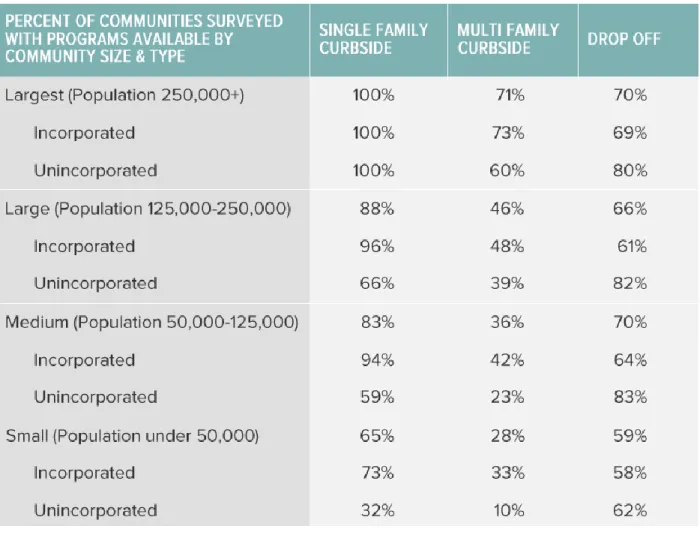
TABLE 1. AVAILABILITY OF RECYCLING PROGRAMS BY COMMUNITY SIZE/TYPE
SOURCE: SUSTAINABLE PACKAGING COALITION, 2016.
(SPC, 2016, p.10). This definition more accurately describes a situation in which curbside recycling is available to property managers—not the multifamily resident who is subject to their property manager’s decision to offer such collection at their complex.
Quality of Recycling Services Available to Multifamily Residents
The SPC categorizes municipal recycling services for multifamily and single-family residents into three types of collection systems: automatic, opt-in, and subscription. In automatic programs, all residents are provided municipal recycling services as a matter of
course. These services can be provided directly through the municipality using public employees or provided by a private contractor. Opt-in recycling programs offer municipal recycling services to all residents but require that they sign up to receive service and, in some cases, pay an
additional fee to participate. A subscription service leaves all responsibility to a resident to hire a curbside recycling service of their choice from the private market (SPC, 2016, p.7). Automatic recycling collection is widely considered to provide the highest quality of service and garner the highest levels of participation. Opt-in collection services are considered to provide the second-best quality of service and opportunity to participate, and subscription collection services are ranked least favorably for doing so. It ought to be noted that automatic recycling collection is rarely provided to residents of multifamily properties. In many instances, where municipal recycling services are offered automatically or on an opt-in basis to all single-family residents, multifamily residents are altogether excluded from receiving any municipal recycling service on the basis that they belong to a commercial and not residential entity.
poor for residents of multifamily properties. Single-family residents and multifamily residents seldom experience the same availability of recycling programs; approximately one-fifth of residents in the United States live in a community with a standardized recycling program for both single-family and multifamily homes (SPC, 2016, p.24). One of the key findings of the SPC’s study was that despite 94% of residents nationwide having some form of recycling
services available to them, only 53% of residents were found to have curbside recycling collection provided to their home automatically. Relying on anecdotal claims, the Sustainable Packaging Coalition explained this measured disparity as a result of multifamily complexes being less likely to receive automatic recycling services as well as being subject to their property manager’s decision to subscribe for service where services are offered on an opt-in basis (SPC,
2016, p.24).
In order to increase the overall availability of recycling services and reduce the discrepancy observed between single-family and multifamily residents, several state and municipal governments have enacted recycling mandates for multifamily properties. Before providing an overview of the current regulatory landscape of multifamily recycling in the United States, the following section provides a concise history of national MSW legislation in the United States. This history is necessary to better understand the current role of states and
municipalities for regulating recycling as well as the different policy mechanisms that are used. Regulatory Landscape of Multifamily Recycling in the United States
A Brief History of National MSW Legislation in the United States
of the size and composition of the MSW stream throughout the 20th century. Due to the booming population and rising popularity of paper and plastic packaging, society began generating greater quantities of waste than ever before. The waste stream grew not only in quantity, but also in the variety of materials it contained; paper, plastic, toxic chemicals, and synthetic materials became progressively more common in the households and waste bins of American citizens. While the waste stream itself evolved, the methods for its disposal did not. Many citizens and localities continued to practice open-burning of MSW, consequently emitting noxious fumes into the atmosphere and threatening the health of humans and their natural environments (Louis, 2004, p. 315). Solid waste management slowly made its way onto the national political agenda as the risks of improper waste disposal became increasingly perceptible to the public.
The Solid Waste Disposal Act (SWDA) of 1965 was the federal government’s first endeavor to develop sound waste management practices across the country. The Public Health Service (Department of Health, Education, and Welfare) and the Bureau of Mines (Department of the Interior) jointly administered the SWDA until 1970 when the EPA was established and assumed full responsibility for the Act’s implementation (Hunsaker-Clark, 2012). One of the primary objectives of the SWDA (as cited in Louis, 2004) was to “initiate and accelerate a
national research programme to develop these [solid waste management and resource recovery] systems and provide guidelines and training for their effective implementation” (Government
Printing Office, 1966). This research, funded by the federal government, uncovered a national need for a more comprehensive approach to MSW management and advanced regulation of disposal practices—prompting major amendments to the SWDA (Hunsaker-Clark, 2012).
The most influential amendment was enacted in 1976 when Congress passed the
for a robust national system of solid waste management with the following goals: “protecting
human health and the natural environment from the potential hazards of waste disposal;
conserving energy and natural resources; reducing the amount of waste generated through source reduction and recycling; and ensuring the management of waste in an environmentally sound manner” (“EPA History,” 2018). This legislation was one of the first to acknowledge the role of
recycling in achieving a federal governmental goal. Subtitle D of the RCRA grants the EPA explicit authority for developing national standards and guidelines for the management of MSW landfills and other solid waste disposal facilities (“EPA History,” 2018).
Despite a few additional amendments designed to update the regulatory criteria set out by the RCRA in 1976, solid waste management and policy in the modern United States largely resembles the foundations laid out by the SWDA and RCRA. The EPA advocates for recycling as a means of waste reduction, touting the environmental and economic benefits of recycling in published reports and on its main website. The EPA’s Sustainable Materials Management
The Current Role of States and Municipalities in Regulating Recycling
While the EPA is responsible for the standardization and establishment of national minimum technical standards and regulatory criteria, state and local governments assume nearly full responsibility for MSW management. There is no federal legislation that mandates the recycling of municipal solid waste (MSW) in the United States. Motivated by their constituents and the EPA, many policymakers and government officials have sought to reduce the amount of MSW being sent to landfills for final disposal by advancing recycling through policy. Across the country, states and localities have implemented a variety of such policy mechanisms including government subsidization of recycling programs, legal recycling requirements, mandatory recycled content standards for products and/or materials, taxes on the use of virgin
(non-recycled) materials and resources, universal fees for recycling, and volumetric unit-based pricing systems (aka “Pay-As-You-Throw”) for residential trash disposal.
The term “legal recycling requirements” is used loosely to include any governmental
stipulation that holds an individual or entity liable for matters involving participation in MSW recycling. Such requirements vary across the country both in who they define as the legally responsible party for compliance with the requirement and to what extent participation in recycling is required. One example of a recycling requirement is a municipality that requires all of the permitted waste haulers operating within their municipality to offer recycling services to all of their clients. In this example, permitted waste haulers, not their clients, would be
designated as the responsible party for compliance with the requirement. Permitted waste haulers are not required to actually provide recycling services to their clients, but only to offer recycling services as an available option that their clients can choose to use.
the legal recycling requirements that require recycling services be made directly available for use. This study focuses exclusively on recycling mandates at the municipal level and their effectiveness for increasing multifamily residents’ level of access to recycling services. While
recycling mandates have been enacted at both the state and municipal level, municipalities typically assume the responsibility of enforcing the specific standards used to implement state recycling mandates. Likewise, payment structures used to fund multifamily recycling services are typically agreed upon and established by local governments and can vary greatly across municipal borders.
Legal Recycling Requirements in the United States
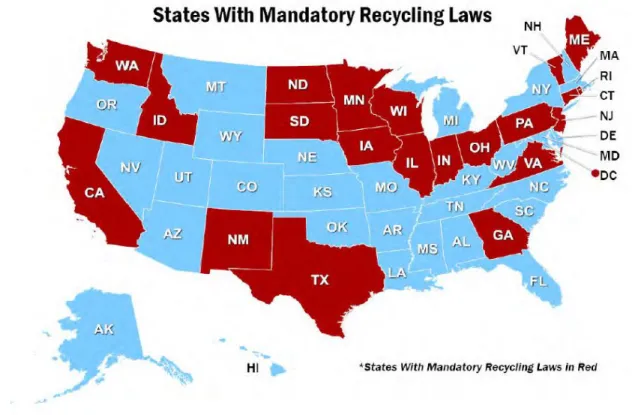
In the absence of federal legislation that mandates the recycling of MSW in the United States, many states and municipalities have enacted statutes or ordinances that mandate recycling in their respective geographic entities. The nationwide regulatory landscape for MSW recycling consequently appears to be a confusing patchwork of requirements and restrictions. In 2017, the Northeast Recycling Council compiled documentation of all disposal bans and mandatory recycling laws for each of the 50 states. These disposal bans and laws were not necessarily specific to components of the MSW stream—listed regulations affected materials ranging from recyclable paper and plastic containers to friable asbestos and lead acid batteries. The materials most commonly affected by disposal bans and recycling laws were non-traditional, non-MSW recyclables such as mercuric oxide batteries, computers, cathode ray tubes (CRTs), and mercury-containing products (NERC, 2017).
Each state specified whether their disposal ban(s) apply to disposal facilities or
for recyclables. The term “generators” typically refers to the sources of waste production—
including haulers, municipalities, commercial entities (i.e. restaurants, hotels), and residences— whose activities generate waste. Statewide disposal bans hold the designated party as legally responsible (and therefore punishable) for ensuring that proper disposal methods are used for the relevant material(s). The study found that 22 states have at least one mandatory recycling
requirement and 49 states have at least one item subject to a disposal ban in solid waste facilities—the most common banned item being a lead-acid battery (NERC, 2017). The distribution of these mandatory recycling laws as recorded by NERC is displayed in Figure 1. FIGURE 1. DISPOSAL BANS AND RECYCLING REQUIREMENTS IN THE U.S.
SOURCE: NERC, 2017.
Multifamily Recycling Policies in the United States
their relation to recycling services at multifamily properties. The Recycling Partnership underwent a research process similar to the one used by the Northeast Recycling Council, conducting interviews with all 50 state recycling program leaders to complete a comprehensive evaluation of the nation’s recycling policies. The Recycling Partnership’s study had a narrower
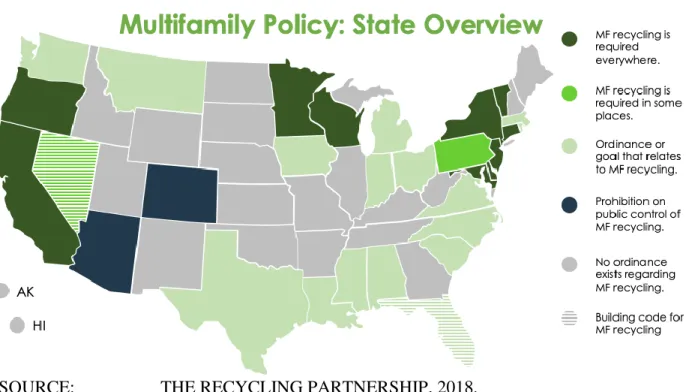
focus on MSW and multifamily properties, focusing only on state policies that impacted, directly or indirectly, the collection of only traditional recyclables (paper, bottles, cans, cardboard, etc.) at multifamily properties. The organization found that 15 out of 50 states had a statewide policy that directly targeted the collection of recyclables at multifamily properties. These 15 statewide policies were subcategorized into the following groups: universal mandatory recycling laws (10 states), mandatory recycling laws in areas of the state that met a specified population
requirement (2 states), universal building codes that require a designated recycling collection zone at any newly constructed or majorly renovated multifamily property (2 states), and a prohibition on public control of multifamily recycling (2 states). Statewide policies that indirectly targets the collection of recyclables at multifamily properties (i.e. a waste reduction goal or landfill disposal ban on common recyclable materials) were found in 25 of 50 states (Schwartz, 2018). Figure 2 displays the different state regulations and policies affecting multifamily recycling in the United States, using variations in both color and shading to demarcate the different categories of direct policy.
The Recycling Partnership’s research extended beyond the scope of state legislation to
than the rest of the country and their characteristics were suspected to be less applicable to the rest of the country. Of the 100 municipalities that fell within the population parameters, 67 completed an interview with The Recycling Partnership. A second category of municipalities were also selected for interviews, but not used to generate descriptive statistics about the current multifamily recycling landscape in the United States. This category was comprised of cities, counties, or waste management districts that were recommended by state recycling leaders for having engaged in efforts to improve multifamily recycling (Schwartz, 2018).
FIGURE 2. MULTIFAMILY RECYCLING POLICY IN THE U.S.
SOURCE: THE RECYCLING PARTNERSHIP, 2018.
cities, the option to offer recycling service was ensured by a permitting requirement for all private haulers to offer recycling services at multifamily properties; for the third city, the option to offer recycling service was ensured by a building code that required a designated recycling collection zone at any newly constructed or majorly renovated multifamily property (Schwartz, 2018).
While prior research conducted by NERC and The Recycling Partnership explains where recycling mandates and other legislation affecting multifamily residents exist, it does not address how effective these policies are for securing access to recycling services for multifamily
residents. This thesis helps to fill this knowledge gap in the research by conducting a unique analysis of municipal recycling mandates as a mechanism for increasing multifamily residents’
access to recycling services. To conduct such an analysis, it is first essential to clarify what circumstances constitute proper “access” to recycling services and how they can be measured. The following section offers a summary of existing literature on recycling and signifies the importance of using capacity, convenience, and compliance agent standards for measuring access to recycling services at multifamily properties.
Measuring Access to Recycling Services for Multifamily Residents
multifamily properties, one must understand the common barriers associated with recycling services that residents of multifamily properties encounter.
Barriers to Recycling Access Faced by Multifamily Residents
Members of the recycling industry have long worked to overcome the challenges presented by multifamily properties. In 2001, the EPA conducted research on multifamily recycling programs in the United States and published “Multifamily Recycling: A National Study.” This publication offered the first comprehensive analysis of multifamily recycling
programs across the country and remains as one of the only bodies of work to identify both the characteristics of successful multifamily recycling programs in the United States as well as the barriers that multifamily recycling programs face. The EPA highlighted a high turnover rate of residents, diverse populations of multifamily properties, and uninterested property managers as some of the most common problems experienced by communities working with multifamily recycling across the country (EPA, 2001).
Nearly two decades later, these barriers are still prevalent in discussions about
multifamily recycling. As part of their research on multifamily recycling in 2018, The Recycling Partnership asked leaders of state and municipal recycling programs to report any unique barriers affecting recycling collection at multifamily properties in their respective communities. The Recycling Partnership’s study found the most commonly cited barriers to be the following: limited space, illegal dumping and contamination, and difficulty working with property
properties. Numerous cities have sought to resolve this issue through the implementation of a building code requirement that requires any new or majorly renovated multifamily residence to construct a designated on-site location for an adequately sized recycling receptacle (Schwartz, 2018).
The issues of illegal dumping and contamination are unfortunate byproducts of working with large residential populations in which one individual’s behavior is oftentimes virtually indistinguishable from another’s (Schwartz, 2018). Since so many individuals share the use of waste containers at a multifamily property, it can be hard to track or know who is using them in a lawful manner and who is not. Where there is inadequate or inconvenient container capacity for garbage and traditional waste, residents oftentimes turn to dumping their additional waste in recycling receptacles (Schwartz, 2018). Where illegal dumping and contamination is a product of inadequate container capacity or inconvenient location, there is both an issue of access to and participation in recycling services on multifamily properties.
Measures taken to enforce lawful disposal practices and exclude non-residents from access to on-site waste services can be costly and inconvenient to both property managers and residents. Where multifamily properties are considered commercial entities, municipalities are often unable to freely distribute educational materials on the private grounds of the property. This leaves property managers with a great deal of responsibility and power over the
maintenance of recycling services on multifamily properties. An invested property manager that is dedicated to furthering the success of a recycling program on their property can help a
efficient program (Schwartz, 2018).
The barriers discussed above are used as a basis for justifying the use of convenience, capacity, and compliance agent designation standards for measuring the level of access to recycling services that multifamily residents experience. These standards have important implications for both assessing the effectiveness of municipal recycling mandates as well as evaluating the fairness of different payments structures used to fund multifamily recycling services. Each of these standards is discussed in greater detail below.
Measuring Access to Recycling: Convenience Standard
A crucial component of measuring access to recycling service is the convenience of the service provided. Previous studies have shown that the convenience of a recycling program is the strongest determinant of recycling behavior, along with social norms and moral considerations (Miafodzyeva and Brandt, 2013). While the majority of municipalities do not offer curbside collection service to their residents that live at multifamily properties, many offer a drop-off center to which any member of the public may bring the recyclables they have generated.
Looking strictly at the share of the population with only drop-off recycling programs available to them, multifamily residents are grossly overrepresented—making up 44% of the drop-off only population versus 17% of the total population (SPC, 2016, p. 18).
option for the collection of recyclables. Valet recycling services typically operate by collecting a designated container for recycling left at the doorstep of each participating housing unit in the complex.
The decreased level of convenience that characterizes so much of multifamily recycling ought to be considered not only as an inhibiting factor for participation, but also as a key determinant of the level of access to recycling programs experienced by residents. Once
participation in a recycling program falls below a reasonable threshold of convenience, residents might as well not even be considered to have access to recycling services. Different policies establish opposing views on whether or not the availability of drop-off centers to multifamily residents is sufficient in meeting a requirement for all residents to have access to recycling services. An ideal level of convenience for recycling services may differ geographically in the same way that it does for other waste services like garbage. This thesis takes the first step in formulating what constitutes an acceptable threshold of convenience for recycling programs at multifamily properties by analyzing the existing literature regarding the convenience of recycling receptacles and their placement.
The most frequently cited statistic for proper placement of waste receptacles was actually produced by Walt Disney in the process of designing his Disneyworld park. Disney observed individuals in other theme parks to see how many steps people would be willing to take on average before choosing to litter instead. Disney determined that the magic number was somewhere between 25 and 30 steps. Averaging one step as one foot, there was not to be a stretch of more than 30 feet in Disneyworld without a trash can present (Burnley, 2015). This stipulation, termed as the “Disneyland theory,” is best applied to the placement of waste
on a large residential property.
In 2003, Jenkins et al. conducted household surveys to measure the effects that the presence of a curbside program for a given recyclable material has on the probability that the material would be recycled at the participating household. The results were astoundingly in favor of curbside programs, stating that the existence of a curbside program for a given recyclable material would increase the probability by 25-50% that over 95% of the material would be recycled (p.311). A later study designed to expand on Jenkins findings determined that the most effective policy for fostering recycling was to improve the convenience of services through one of two means: “providing curbside recycling services (the preferred approach) or locating drop-off recycling centers close enough to people’s residences” (Saphores and Nixon, 2014). A measure for “close enough” was not specified by the authors or the data they collected.
Finally, a study conducted specifically on recycling in multifamily properties found that “factors that decrease the time cost of recycling have significant positive correlations with recycling rates in multifamily dwellings” (Ando and Gosselin, 2005). The two most important
elements that positively affect recycling behavior were noted: having an adequate amount of interior space available for sorting and storing the recyclables, and reducing the lateral distance (relative to distance of trash disposal) that multifamily residents must travel to recycling bins to participate (Ando and Gosselin, 2005). This study’s findings reiterate the importance of having convenient multifamily recycling collection—both in respect to the relative location and capacity of in-unit and centralized collection receptacles.
Measuring Access to Recycling: Capacity Standard
recycling receptacles at multifamily properties. As a result, there are a surfeit of cases across the country where a virtually nonexistent, albeit legally compliant, opportunity for recycling is provided to multifamily residents. One example would be an apartment complex with over 500 units having only a single 96-gallon cart for recyclables for all of its residents to use. This apartment complex would fulfill any legal obligation where recycling service is required to be offered on a property without a stated minimum capacity volume; however, residents of that apartment are not truly able to make use of the recycling service that are technically available to them.
A minimum threshold for the necessary capacity of recycling containers and frequency of recycling collection to provide true access to recycling for multifamily residents ought to be defined using tonnage data for multifamily properties and the generation rate of recyclables per-unit. Unfortunately, such data is extraordinarily difficult to find. Zero states currently require that multifamily recycling tonnages be reported separately from other commercial and/or residential properties; as a result, haulers maximize the cost-efficiency of their routes by servicing
multifamily properties on the same collection route as commercial businesses and even single-family residences. The compounding of multisingle-family recyclable tonnages with commercial or single-family tonnages makes it exceptionally difficult to measure or estimate the tonnage of recyclables generated and captured by a multifamily property—much less a single multifamily residential unit (Schwartz, 2018). The EPA’s “Multifamily Recycling: A National Study” established an arbitrary recommended container capacity of at least 90-gallons with a single set of 2-3 containers for every 15-20 residential units at a multifamily property. No explanation or data analysis was offered as a justification for choosing that amount (p. 53).
a considerable amount of data exists to describe the tonnage of recyclables generated and captured at a single-family residence. The Recycling Partnership’s “2016 State of Curbside Report” compiled the annual state recovery averages measured as pounds of recyclables per
household per year (lbs/hh/yr), as displayed in Figure 3.
FIGURE 3. STATE RECOVERY AVERAGES (LBS/HOUSEHOLD/YEAR)
SOURCE: THE RECYCLING PARTNERSHIP, 2016.
The national average for recyclables captured by recycling programs from households across the United States was 357 lbs/hh/yr (p.5). These averages are likely to include data collected from tonnages reported at multifamily properties, however, it is unknown whether multifamily
residents differ from the average waste generation characteristics of the rest of the nation. Future research ought to explore whether or not a multifamily household unit is likely to generate more, less, or the same number of pounds of recyclables as does a single-family household unit.
Measuring Access to Recycling: Compliance Agent Standard
single-family recycling is that individual residents have restricted agency to arrange for on-site recycling services. Nearly all residents of multifamily properties do not have the ability to independently set-up or subscribe to recycling services for themselves. Instead, it is the role of a designated third party—typically the property management, to arrange for the collection of recyclables that are generated by the residents at a multifamily property. Recycling collection at multifamily properties thus typically presents a principal-agent problem in which multifamily property management (or a different third party) is empowered to make decisions on behalf of their residents who might have conflicting interests with their own (Kenton, 2018). While it is not universally true, many multifamily properties operate as commercial entities whose
economic bottom line is to fill rooms with tenants and generate a profit. Enrolling in sustainable waste management practices such as recycling are oftentimes an additional cost to multifamily properties and thus don’t align with the primary motivations of property management. Where recycling services are not required to be offered directly to the residents of multifamily properties, residents who wish to recycle may find that convincing their property managers to provide recycling services may be a cumbersome if not impossible task.
Even where multifamily recycling requirements have been implemented, the principal-agent problem can still exist. One prominent example of this is the state of Oregon’s
“Opportunity to Recycle Act of 1983” which required that every person in the state be provided
with an opportunity to recycle. The law used vague wording regarding multifamily residents and didn’t clarify what an opportunity to recycle meant for them. In practice, municipalities often
managers who consistently choose to abstain from recycling services when it cost more money than trash collection (Schwartz, 2018). In 2015, the Oregon legislature amended the act to require that all “residential and commercial tenants”—not simply the landlord or property manager who owns their property—must have the individual opportunity to participate in recycling by July 1, 2022 (ORS 459A.005, 2017).
The principal-agent problem affecting multifamily recycling is emblematic of the general nature of the relationship between multifamily residents and their property managers. For
administrative and economic efficiency, it is sensible that a property manager (or other third party) is responsible for orchestrating the on-site waste collection for all of its residents. Public policy need not be used to try and alter the relationship between multifamily residents and their property managers, but rather to acknowledge and accept the role of property managers as a key agent for providing access to recycling services to multifamily residents. For recycling mandates to be effective, it is important that they contain specific and appropriate language that clarifies 1) who is required to have access to recycling services and 2) who is designated as the responsible party for providing access to recycling services at multifamily properties and thus complying with the mandate.
Payment Structures Used to Finance Municipal Recycling Services Evaluating Fairness of Cost Distribution for Multifamily Recycling Services
Municipal governments use a number of different strategies to pay for public recycling services. These payment strategies can differ in how these payments are carried out, who is required to pay, and the amount that is required to be paid. Across North Carolina, local
number of different expenses such as solid waste fees, recycling fees, bulk waste removal fees, and availability fees. General tax revenue is usually derived from property taxes that are paid by all owners of improved property—commercial or residential—and typically scaled to the value of the property owned.
Where fees are used instead of general tax revenue, residents are sometimes able to abstain from paying fees for services they do not use. Voluntary user fees allow for individuals to take the liberty of deciding whether or not they would like to pay to participate in or subscribe to a service such as recycling collection. In other words, user fees allow residents the opportunity to choose whether or not they would like to pay to use a service that the government provides. Residents are not afforded such liberties where taxes are used to fund government services such as recycling. Where municipal recycling services are funded by tax revenue, every taxpaying constituent is required to contribute financially to the program regardless of whether or not they intend to make use of such services. This restriction of liberty, especially as it relates to payment structures used to fund recycling services, is often justified using paternalistic principles.
Because recycling is a pro-social behavior with positive economic and environmental benefits, many believe that all constituents ought to be provided with automatic recycling collection and sometimes even legally obligated to participate in recycling. This belief is highly controversial and strikes a timeless debate over the proper role of government for providing access to and mandating participation in pro-social activities such as recycling.
property. Where opt-in or subscription recycling services exist, property management usually makes a decision on behalf of all of its residents to either pay for or abstain from using municipal recycling services. Since the interests of property management and the residents they represent might not always align, this can create a frustrating situation for management and residents alike. Where recycling mandates require recycling services to be provided to multifamily properties, neither residents of multifamily properties or their respective property management are given the autonomy to decide to pay for such a service.
As aforementioned, residents of multifamily properties routinely experience lower levels of access to recycling service than residents of single-family homes. Since multifamily properties are often classified as commercial entities and considered ineligible to receive municipal
recycling services, residents of multifamily properties face a much greater likelihood of paying into a municipal recycling program whose service they are excluded from using. This is
especially true where recycling services are funded by a tax or fee that is universally distributed amongst residents, but recycling services are not provided automatically to multifamily and single-family residents alike.
Other Factors that Affect Payment Structures Used for Multifamily Recycling Services
for recycling service would be able to use it. To try and restrict consumption would be a time and energy-consuming initiative that would serve very little communal good. Different payment strategies and their cost distributions ought to be evaluated not only with an idealistic consideration of fairness, but also with the real-world consideration of factors that affect the feasible and effective implementation of municipal recycling services at multifamily properties. Linking Recycling Mandates and Fees with Access to Recycling at Multifamily Properties
In “Multifamily Recycling: A National Study,” the EPA measured the success of a
multifamily recycling program by the percentage of its recyclable waste that was diverted from the landfill—aka a program’s waste-diversion rate. One shared characteristic of these programs was the implementation of a mandatory participation sanction, which the EPA noted as a
common theme of 90% of communities with high diversion rates at multifamily properties (EPA, 2001, p. 53). Furthermore, “higher fees and a greater likelihood of a fee for multifamily
recycling is associated with higher diversion rates…the proportion of communities paying for
this service from taxes decreases from 50 percent of those with the lowest diversion rate to 27 percent of those with the highest diversion rate” (p. 45).
While the recommendations and findings of EPA’s report are helpful in setting the stage
for multifamily recycling policy and describing the technical components correlated with high-diversion rates, the causal link between such components and high-high-diversion rates remains largely unexplored. Furthermore, nearly two decades have passed since the publication of the study’s results. With an ever-changing waste stream and evolving collection system logistics, the
results of the study are at risk of being outdated.
between the recycling mandates implemented across the United States and their effectiveness for providing access to recycling at multifamily properties. While the EPA’s study reports a strong
correlation between higher diversion rates and the enforcement of recycling mandates, it is unclear through which mechanisms these policies are affecting the level of access to recycling programs experienced by residents of multifamily properties or the fairness of how multifamily recycling program costs are distributed. This study analyzes the effectiveness of current
CHAPTER III. METHODS Overview of Methods
This thesis aims to answer two main research questions: “How effective are existing municipal recycling mandates for providing access to recycling services to multifamily residents?” and “How do different payment structures used to fund multifamily recycling services distribute costs amongst residents of single-family and multifamily properties? Is this cost distribution perceived as fair?” Two different methods of data collection were used to answer these research questions accordingly. First, the municipal codes of the 100 largest
municipalities in the United States were examined to determine whether or not they contained an ordinance mandating that recycling services be provided for residents of multifamily properties. These recycling mandates were then evaluated using the three standards for measuring access to recycling services at multifamily properties that were described in the second chapter:
convenience, capacity, and compliance agent designation. Second, an exploratory case study was carried out to compare the fairness of the payment structures used to fund multifamily recycling services in two North Carolinian municipalities: Orange County and the City of Durham. These data collection methods are discussed in more detail throughout this chapter.
available in larger communities with populations of more than 125,000 people (2016). First, the recycling programs operated by the largest 100 municipalities in the United States were researched extensively online to determine whether or not there was a municipal recycling mandate for multifamily properties. Where recycling mandates for multifamily
properties had been implemented, the respective municipality’s online code was searched for the relevant ordinances. The content of these governmental texts was then analyzed for any wording or stipulation that acknowledged one of the standards for measuring access to recycling services: the convenience, capacity, or compliance agent designation for the required recycling services.
A numerical value of “0” was assigned to municipal recycling mandates that failed to
incorporate any acknowledgement of the relevant standard, and a “1” was assigned for mandates that explicitly mentioned the relevant criterion. For every municipal ordinance that was assigned a “1” for at least one of the three categories of standards, either the exact wording or a
paraphrased summary of each stipulation was recorded. It was then documented whether or not these stipulations were considered to be vaguely worded in a manner that would make it difficult for a municipality to enforce. Mandates with unambiguous, enforceable stipulations were
considered to be more effective than those with vague wording for providing access to recycling services to residents of multifamily properties.
Case Study: Evaluating Multifamily Recycling Payment Structures and Cost Distribution A case study, as defined by the U.S. Government Accountability Office, is “a method of learning about a complex instance based on a comprehensive understanding of the instance”
(1990, p. 79). Payment strategies for multifamily recycling constitute as a complex instance; a number of different factors affect the financial mechanisms that governments use to fund
services are distributed amongst residents of single-family and multifamily properties. It is also difficult to measure the relationship between the financial mechanisms used to fund multifamily recycling services and the level of access to recycling services that they provide to residents of multifamily properties. This case study serves a descriptive and exploratory purpose by
explaining how different payment structures used to fund multifamily recycling services
distribute costs amongst residents of single-family and multifamily properties and attempting to gauge how fair this cost distribution is perceived to be.
The “fairness” of each payment structure will be assessed by comparing the parties that pay into a recycling program with the parties that have access to using the recycling program’s
service. Individual preferences, societal benefits and harms, cost-efficiency, and the voluntary nature of transactions are given consideration when evaluating the different payment structures. This evaluation does not justify one strategy of payment over another as being more correct; instead, it lays out the different values that are endorsed by each strategy so that a governmental entity may knowingly select a preferred method that aligns with its political goals.
Two municipalities in North Carolina were included in this case study: City of Durham, and Orange County. These municipalities were selected on the basis of convenience and
policies for multifamily recycling, which provide important variations to represent in the case study. Beyond the representative advantages these municipalities have to offer, the close proximity of their geographic locations made them well-suited for in-person interviews.
In-person interviews were preferable to phone interviews since they provide an
opportunity for a thorough exchange of information and ability to contextualize responses. The interviews were conducted with at least one employee of the respective municipality’s solid waste management department to learn about the different payment structure that is used to fund multifamily recycling services and its distribution of costs to both residents of single-family and multifamily properties. Each interview consisted primarily of open-ended questions regarding the strategy of payment used for recycling services at multifamily properties in the municipality (see Appendix A for interview questionnaire). Follow-up questions on the observed degree of accessibility and quality of this recycling service were used to evaluate the costs and benefits of each structure—particularly for different styles and classifications of multifamily buildings. This case study serves an important role for grounding the policy recommendations provided by this research in the responses of interviewees who have real-world considerations of payment strategies for multifamily recycling and its associated costs.
Limitations of Methods
The methodology used for both assessing the effectiveness of municipal recycling mandates and the fairness of different payment structures’ cost distribution have important
CHAPTER IV. FINDINGS AND ANALYSIS
The municipal codes of the 100 largest municipalities in the United States were examined to determine whether or not they contained an ordinance mandating that recycling services be provided for residents of multifamily properties. In addition, an exploratory case study was conducted to compare the fairness of the payment structures used to fund multifamily recycling services in two municipalities in North Carolina, Orange County and the City of Durham. The empirical results of this analysis were organized into two categories, Municipal Ordinances and Multifamily Recycling Payment Structures. The empirical results regarding Municipal
Ordinances were then sorted into four distinct subcategories: Location and Political Affiliation, Convenience Stipulations, Capacity Stipulations, and Compliance Agent Stipulations. While the findings from each of the categories of research are distinct from one another, they can be interwoven to reveal major themes that illustrate the effectiveness of current multifamily recycling mandates in the United States as well as the fairness of their affiliated recycling fees and payment structures for residents of multifamily properties.
Municipal Ordinances: Location and Political Affiliation
Of the 100 largest municipalities in the United States, 41 municipalities had ordinances that mandated recycling services be offered at multifamily properties. These recycling mandates were either targeted mandates that required recycling at multifamily properties specifically or were universal mandates recycling at all properties in the respective municipality. Three criteria were used to evaluate the 41 municipal ordinances that mandated recycling at multifamily properties: the geographic distribution of municipal ordinances across the U.S. Census Bureau’s regions, the presence of a statewide recycling mandate in conjunction with the municipal
FIGURE 4. MAP OF 100 LARGEST MUNICIPALITIES WITH RECYCLING ORDINANCES
TABLE 2. GEOGRAPHIC DISTRIBUTION OF MUNICIPAL ORDINANCES Geographic Region
(Census Bureau)
Number of Ordinances
Percentage of Total Number of Ordinances Northeast New England Middle Atlantic 6 0 6 14.6% 0.0% 14.6% Midwest
East North Central West North Central
6 3 3 14.6% 7.3% 7.3% South South Atlantic East South Central West South Central
West
Mountain Pacific
20 1 19
48.8% 2.4% 46.3% SOURCE: U.S. CENSUS BUREAU, N.D.
As evidenced by Figure 4 and Table 2 above, the majority of municipal ordinances were located in the coastal areas of the country including the West Pacific, South Atlantic, and Middle Atlantic divisions. Nearly half of the ordinances (20/41) were found in the Pacific West with California municipalities comprising 17 of them. It is important to remember that these statistics are not necessarily representative of the entire United States but rather only the 100 largest municipalities, of which the majority are located in coastal regions.
TABLE 3. MUNICIPAL ORDINANCES AND STATE LEGISLATION
Of the 41 municipalities with ordinances that mandated recycling at multifamily properties, 30 municipalities (including Washington, D.C.) were located in states that had a statewide recycling mandate which required all respective municipalities to have an ordinance in compliance with the state legislation. The 11 municipal ordinances that were not required by state legislation were located in the following cities: Atlanta, GA; Durham, NC; Seattle, WA; Des Moines, IA; Albuquerque, NM; Austin, TX; Fort Worth, TX; Dallas, TX; San Antonio, TX;
73%
27%
Municipal Ordinances
State Legislation
Chicago, IL; Miami, FL. These 11 municipal codes are primarily located in the South, with 4 in the South West Central division and 3 in the West South Central division. These findings suggest that the majority of recycling mandates that affect multifamily properties are products of state legislation rather than an independent initiative of the individual municipality.
Finally, data was gathered on the recent political affiliation of the states where
municipalities with ordinances that mandated recycling at multifamily properties were located. State party affiliation data was retrieved from a 2017 table composed from Gallup Daily tracking. All of the 41 municipalities with ordinances that mandated recycling at multifamily properties were located in states that were classified as “Solid Democratic” (12/41) or
“Competitive” (29/41). Zero municipalities were located in states that were classified as “Solid Republican.” In recent years, environmental issues and concerns are typically more prominent on
and associated with more liberal political agendas. The absence of recycling mandates in states that are classified as “Solid Republican” may be explained by different political aims, or simply
by the fact that most of the 100 largest municipalities in the United States are found in competitive or liberal-leaning states.
Municipal Ordinances: Convenience Stipulations
enforce (i.e. simply using the term “location that is convenient” or “reasonably accessible”). In Table 4, the 14 municipal ordinances that were considered as non-vague are sorted into the following categories of stipulations for the convenience of recycling receptacles: located on-site, located near trash, similar nature to trash, and distance from dwelling unit.
TABLE 4. CATEGORIZATION OF CONVENIENCE STIPULATIONS
Convenience Stipulation for Recycling Receptacles
Number of Ordinances
Percentage of Total Number of Ordinances Located On-site*
With State Legislation Without State Legislation
5 1 4 12.2% 2.4% 9.8% Located Near Trash
With State Legislation Without State Legislation
9 7 2 22.0% 17.1% 4.9% Similar Nature to Trash
With State Legislation Without State Legislation
4 2 2 9.8% 4.9% 4.9% Distance from Dwelling Unit
With State Legislation Without State Legislation
2 2 0 4.9% 4.9% 0.0%
*One ordinance used the wording “on-site or on a property immediately adjacent thereto”
located near each other,” “recycling located as near to the trash as is feasible,” and “recycling is adjacent or in close proximity to refuse.” This stipulation is sensible for application to a wide
array of potential housing and waste collection situations; setting a universal measure such as maximum allowed distance from dwelling units, while most easily enforceable, may be less feasible and/or practical for some multifamily properties than others. “Twinning the bins,” or
placing similar recycling and trash receptacles immediately besides one another, is a commonly recommended practice that is proven to increase recycling rates (University of British Columbia, 2017). Amongst all of the ordinances, the correlation of state legislation is unclear. Ordinances that required recycling receptacles to be on-site of the multifamily property were largely found in municipalities where there was not a statewide recycling mandate, while ordinances that required recycling receptacles to be near to trash receptacles were largely found in municipalities where there was indeed a statewide recycling mandate. One potential explanation for this finding may be that municipalities located in states with statewide recycling mandates may be more inclined to impose higher standards for recycling receptacle collection container location than
municipalities located in states without such mandates. Municipal Ordinances: Capacity Stipulations
Prior research has raised concerns that where a minimum capacity volume for recycling receptacles at a multifamily property is not established, residents are at greater risk of having diminished levels of access to recycling service (Schwartz, 2018). Of the 41 municipal
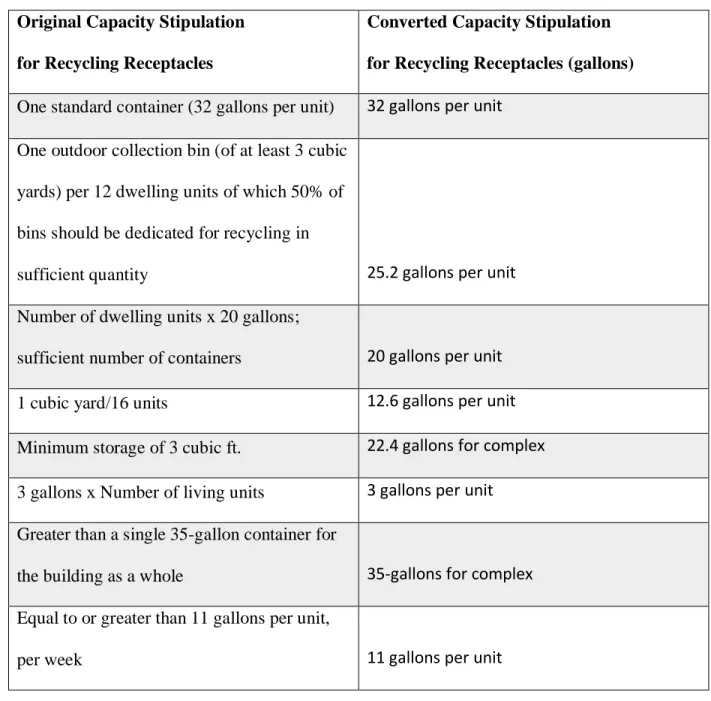
ordinances examined in this research, 28 included a minimum capacity requirement for recycling receptacles provided to residents. Of these 28 minimum capacity requirements, 20 were
“sufficient number of bulk containers,” and “of appropriate number and size.” Concrete
definitions for the terms “sufficient” and “appropriate” were not provided, leaving a great deal of
room for potential debate over what might consitute a violation of such policy. TABLE 5. CATEGORIZATION OF CAPACITY STIPULATIONS
Original Capacity Stipulation for Recycling Receptacles
Converted Capacity Stipulation for Recycling Receptacles (gallons) One standard container (32 gallons per unit) 32 gallons per unit
One outdoor collection bin (of at least 3 cubic yards) per 12 dwelling units of which 50% of bins should be dedicated for recycling in
sufficient quantity 25.2 gallons per unit Number of dwelling units x 20 gallons;
sufficient number of containers 20 gallons per unit
1 cubic yard/16 units 12.6 gallons per unit
Minimum storage of 3 cubic ft. 22.4 gallons for complex 3 gallons x Number of living units 3 gallons per unit
Greater than a single 35-gallon container for
the building as a whole 35-gallons for complex Equal to or greater than 11 gallons per unit,
per week 11 gallons per unit