1 What’s the Issue?
Significant health disparity exists among the low resource citizens of the District of Columbia. The prevalence of obesity and chronic disease is disproportionately high in these communities and continues to rise causing both a health and financial burden on the citizens as well as the District. Prevention strategies are necessary to reduce health disparities and increase positive health outcomes among low resource citizens. An effective way to reach low resources citizens is through faith based organizations which serve as the heart of their community. Given the numerous opportunities that the District of Columbia has in place regarding health and wellness, it is essential to leverage the key provisions that currently exist and bridge the knowledge gap so that available resources may reach communities in need. It is recommended to amend the HHS Partnership Center regulation in an effort to enforce the goals of the HHS Partnership Center to coordinate and strengthen outreach efforts to faith based organizations and support effective, sustainable health promotion programs among faith based organizations. This initiative will be implemented in the District of Columbia as a pilot test with the potential to be adapted and implemented in other states. In light of the serious health consequences and increasing health care costs associated with obesity and related chronic disease, engaging the faith based community in promotion of better weight management through healthier diets and increased physical activity is imperative for improving the health of District residents.
Background
Over 50% of the population in DC is overweight or obese and five of the top ten causes of death associated with overweight. 8,13,15
2 Figure 1. Leading Causes of Mortality in DC, 2010
Source: Davies-Cole John. District of Columbia Department of Health Center for Policy, Planning and Evaluation. District of Columbia Health Profile. PowerPoint. July 2012.
The cause of excess weight and associated chronic disease risk is complex and multi-factorial. The physical and social environments where individuals live greatly impacts eating behavior and physical activity levels, which significantly affects health outcomes (18, 21, 23). Furthermore, determinants such as income, education level and stress as well as access to quality healthcare, healthy food and
transportation significantly impact health outcomes. The communities with higher income and access to resources have better health outcomes than communities with lower income and access to resources (14). For example, in DC’s Ward 3, the mean income is $71,875, the population is 85% Caucasian and the obesity rate is 7.5%; compared to Ward 8, where the mean income is $25,017, the population is 97% African American and the obesity rate is 44.4% (8,14).
3 Figure 2. Death Rate of Chronic Diseases by Ward in DC, 2010
2a. 2b.
2c.
The Cost of Obesity and Chronic Diseases is High and Rising
Obesity and associated chronic diseases are extremely prevalent and costly. Obesity related chronic diseases such as heart disease, diabetes, cancer and stroke are responsible for nearly 75% of the nation’s health spending (31). The direct medical cost of adult obesity and associated diseases in the United States ranges from $147 billion to $210 billion per year (6,17,34). Obesity and associated chronic diseases are also responsible for indirect costs through decreased worker productivity and increased absenteeism in the amount of $4.3 billion annually (7,34 ).
As rates of obesity and chronic diseases continue to rise, the health and financial burden on our country and its citizens continues to rise. In the District of Columbia, it is predicted that if rates of obesity continue on the same upward trend, obesity rates will be 32.6% by 2030 (compared to 23.7% in 2011). On this track, obesity-related health care costs in DC are estimated to increase by 18.8% by 2030 (34).
Figure 2a. Death Rate of Heart Disease is highest in Wards 5 & 7
Figure 2b. Death Rate of Cancer is highest in Ward 5
Figure 2c. Death Rate of Diabetes highest in Ward 5,7 and 8
4 However, reducing the average BMI in DC by 5% could lead to health care savings of more than $360 million in 10 years and $1 billion in 20 years (figure 3) (34,35).
Figure 3. Projections for Annual Obesity-Related Health Spending in District of Columbia, 2010-2030
Source: Trust for America’s Health. Bending the Obesity Cost Curve in District of Columbia. Issue Brief September 2012.
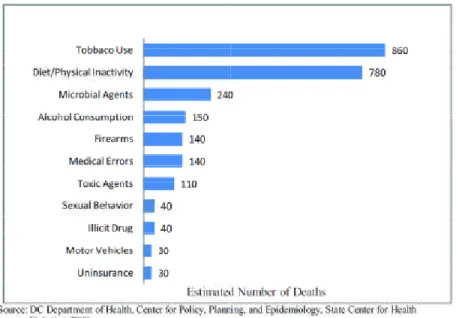
Prevention of chronic diseases through public health initiatives saves money, improves health and saves lives. According to a 2011 Robert Wood Johnson Foundation report, “Preventing disease is the most cost-effective, common-sense way to improve health in the United States” (31). Chronic disease prevention significantly reduces medical costs (31). Moreover, public health prevention efforts provide a significant return on investment. Analysis estimates that in DC an investment of $10 per person per year in proven community-based prevention programs would produce a total net savings of more than $57 million annually in 5 years. That amounts to a return of nearly $10 (ROI 9.86) for every $1 spent (33). Obesity and associated chronic diseases are strongly associated with poor diet and physical inactivity. Poor diet and physical inactivity is the second leading cause of preventable death in DC (figure 4) (15). Altering the physical and social environments where individuals live can effectively promote healthier diets and increased activity and improve health outcomes (23). Therefore, we must take action to promote healthy eating and increased physical activity to prevent the rise of obesity and chronic diseases.
Source: DC Department of Health, Center for Policy, Planning and Epidemiology, State Center for Health Statistics. Preventable Risk Factors Attributed to Preventable Causes of Death in the District of Columbia, 2007. February 2010 Benefits of Addressing Health Disparities through Faith Based Organizations
Community
Faith based organizations provide a
subject to health disparities (1). There is a high density communities experiencing health disparities
reach with traditional community health based interventions (
Figure 5. Density of Faith Based Organizations in DC
Source: The Association of Religious Data Archives. Religion, 2009 County % of Population Who are
http://www.thearda.com/DemographicMap/displayIGMap.asp?ZipCode=20001
Source: DC Department of Health, Center for Policy, Planning and Epidemiology, State Center for Health Statistics. Preventable Risk Factors Attributed to Preventable Causes of Death in the District of Columbia, 2007. February 2010
isparities through Faith Based Organizations- the Heart of the
provide access to communities at high risk for many chronic diseases and There is a high density of faith based organizations among the xperiencing health disparities in wards 5, 7 and 8. This population is commonly reach with traditional community health based interventions (5).
Figure 5. Density of Faith Based Organizations in DC
The Association of Religious Data Archives. Religion, 2009 County % of Population Who are Members of a Congregation.
http://www.thearda.com/DemographicMap/displayIGMap.asp?ZipCode=20001
5 Source: DC Department of Health, Center for Policy, Planning and Epidemiology, State Center for Health Statistics.
Preventable Risk Factors Attributed to Preventable Causes of Death in the District of Columbia, 2007. February 2010 Heart of the
at high risk for many chronic diseases and of faith based organizations among the
population is commonly hard to
6 Faith based organizations are often the heart of these communities, serving as the spiritual, support and social nucleus. Therefore, providing health and wellness interventions and policies through faith based organizations is the most effective way to reach this population and with health and wellness initiatives (5).
Faith based organizations have an essential role in public health by bringing about change to reduce health disparities in vulnerable communities (5,13). Faith based organizations are considered among the most trusted and credible environment in these communities (1,5,24). Individuals in the faith community have much trust and respect for their faith leaders and look to them for guidance and support through life’s challenges (5,32). Therefore, health guidance from faith leaders will have a more significant impact on individuals in these communities compared to individuals from outside the faith community.
Faith based organizations serve as an environment of social support which is effective in bringing about behavior change regarding health and wellness (10). The impact of the health messaging and
interventions will be strengthened by the support and empowerment that community members share with each other.
The research literature indicates that health and wellness initiatives at faith based organizations have been effective in creating positive health outcomes among participants (3, 11, 27, 28, 30). These studies were conducted in faith communities with a large population of low income, overweight or obese African American adults. The results from one study indicate that nearly half of the intervention participants reported increasing their fruit and vegetable intake while nearly one third increased their physical activity. Furthermore, numerous faith communities enacted policy and environmental changes regarding healthy food and physical activity (3, 11, 27, 28, 30). Another two studies were effective in improving health behaviors such as increased consumption of fruits and vegetables (3,27,28,30). One of the previously mentioned interventions was expanded to a national scale as part of the National Cancer institute initiative to increase fruit and vegetable consumption (27, 30). These studies have created a foundation for others to adopt evidence based strategies to reach other faith based organizations in pursuit health based outcomes.
History and Evolution of the Relationship between Religion and Politics
The relationship between faith and politics has a rich and controversial history. After numerous debates, national and state agencies are now partnering with faith based organizations and leadership to carry out social services including health and wellness in the community. Faith based organizations are now allowed to compete for government funding on an even playing field with other non-profit organizations (22,29).
There has been a separation between church and state that only recently has been remedied. According to the Supreme Court, the Establishment Clause of the Bill of Rights created a “wall of separation” between church and state that implies “no tax in any amount, large or small, can be levied to support any religious activities or institutions” (29). Numerous court cases have debated this issue.
7 In 2001, President George W. Bush expanded the Charitable Choice laws by leveling the playing field so that faith based and smaller groups would have an equal opportunity with secular and large groups to apply for Federal funding from any program (22,29). The Bush administration initiated the White House Office of Faith Based Initiatives (OFBI) which forms partnerships between government and both secular and faith based non-profit organizations to better serve Americans in need. The OFBI called for twelve federal agencies to have an office of faith based initiatives which would form partnerships between its agency and faith based and neighborhood organizations to accomplish the agency’s specific goals (42).
In 2009, President Barack Obama altered the name and revised the goals for the now Office of Faith Based and Neighborhood Partnerships and maintained the twelve Federal Centers for Faith-Based and Community Initiatives. President Obama created the President’s Advisory Council on Faith-Based and Neighborhood Partnerships which makes recommendations on how the Federal Government can more effectively partner with faith based and neighborhood organizations (41).
Numerous Opportunities to Leverage
There are numerous opportunities on the national, district and community level that must be leveraged to efficiently implement this initiative. Moreover, it is essential to bridge the knowledge gap to make communities in need aware of the opportunities in existence.
Opportunities at the National Level
Recent national initiatives have made efforts to build partnerships with between government agencies and faith based organizations to better serve those in need. The Federal Centers for Faith Based and Neighborhood Partnerships including that of the Department of Health and Human Services (HHS Partnership Center) provide opportunities for the formation of new partnerships between government agencies and faith based organizations to more effectively provide social services to communities in need (36,42). The HHS Partnership Center is committed to “Coordinating a comprehensive
departmental effort to incorporate faith based and other community organizations in health programs and initiatives to the greatest extent possible” (39). However, they have yet to implement programs to effectively carry out their goals. It is necessary to design and implement mechanisms that will leverage HHS’s resources and commitment to engage faith based communities in health and wellness initiatives.
Faith based organizations now have the opportunity to apply and compete on an even playing field for grant funding at the federal, state and local level. This creates an opportunity for faith based
organizations to have financial support while they continue to serve the most vulnerable communities. In an effort to address health behaviors and outcomes, funding from HHS will be especially beneficial (37).
Furthermore, the HHS Partnership Center offers numerous resources for faith based organizations through its website and newsletters. These resources include funding information, training
opportunities, toolkits, and best practices (39). Access to this information will promote sustainability of the program with minor technical support.
8 Encouraged by her initiative, faith based organizations all over the country including some in DC, have made positive health changes in their faith community regarding nutrition and physical activity (34,40). This initiative, championed by a national figurehead brings positive attention and support to the issue of obesity prevention nation-wide. The Let’s Move! website provides comprehensive and practical
guidance in the form of information, toolkits, and success stories to assist faith based organizations create and implement wellness initiatives in their community (40).
Opportunities at the District Level
The Department of Health (DOH) functions as the main public health organization in DC. It serves as a foundation of knowledge regarding available health and wellness programs, partnerships and resources available to organizations and individuals. The DOH can direct mini-grants toward non-governmental organizations for appropriate health and wellness initiatives (13).
Faith based organizations have the opportunity to build their capacity to identify and compete for grant funding through technical assistance and funding alerts provided by the DC Mayor’s Office of
Partnerships and Grant Services (16). Additionally, the Foundation Center of DC hosts free grant writing classes and provides support for non-profit organizations (19).
The DC Faith Based Wellness website clearinghouse contains a comprehensive, sustainable source of information regarding health and wellness programs and resources in the DC area, grant funding opportunities appropriate for faith communities, tools for grant writing, tools for building capacity, and evidence based strategies for health promotion in faith based organizations. Providing information on existing health and wellness programs and resources in the DC area helps bridge the knowledge gap allowing faith based organizations to be aware of the numerous wellness programs that are available in their community, many of which are free of charge. Furthermore, knowledge of available programs and resources will prevent duplication of efforts and allow sharing of resources, strategies and ideas.
The University of District of Columbia (UDC) Cooperative Extension provides services and training to community organizations to contribute to their wellness initiatives. Cooperative Extension staff and UDC students are available to provide nutrition classes and training to support the faith based wellness initiatives. UDC Cooperative Extension is currently partnering with one church in Ward 8 to teach nutrition classes and provide gardening training as a health and wellness pilot program. They are willing to expand their efforts to other faith based organizations in DC.
Opportunities at the Community Level
An essential asset in the DC faith community is the Leadership Council for Healthy Communities led by a well known and respected Reverend. The Council consists of faith leaders in DC who are interested in health ministry. Because of the importance of developing trust in the faith based community, it is essential to have a trusted leader such as Reverend as a champion the implementation of health ministries and wellness initiatives. Furthermore, the connectivity of the greater faith community in DC, as evidenced by the numerous faith based leadership groups in existence is an asset to this initiative.
9 health ministry can benefit from sharing best practices and partnering with other faith based
organizations.
Significant Barriers Must be Recognized and Overcome
Working with faith based organizations raises some significant and complex challenges that must be addressed in order to effectively implement health and wellness programming in the faith community.
Faith based organizations serve their community to the best of their ability but often lack sufficient funding to fully accomplish their goals. Faith based organizations are now able to compete on a level playing field for grants to fund health and wellness initiatives. However, most faith based organizations are not aware of the grant opportunities that may be available for the projects they want to pursue. Furthermore, faith based organizations may not have the capacity to write grant proposals as they may lack time and/or trained personnel. Therefore, it is necessary to make faith based organizations aware of funding opportunities available to them and provide technical assistance to faith based organizations to build their capacity to compete for grant funding.
Faith communities may not be aware of the numerous opportunities available in the DC area
encouraging healthy eating and physical activity especially for low resource individuals. It is essential to bridge the knowledge gap regarding these opportunities to connect people in need to the programs and opportunities in existence.
Faith based organizations are particularly busy serving as both the spiritual and support center of the community. They have competing priorities which makes it difficult to engage in health initiatives (5). While faith leaders acknowledge that health is important, and are interested in tackling health related programming, they lack the time, resources, personnel and technical assistance necessary to fully implement effective health programming. It is necessary to engage volunteers and lay leaders from the faith community to help implement the wellness programming so as to remove the sole responsibility from the faith leadership.
The faith community’s lack of trust in the public health and medical community many inhibit their willingness to participate in health and wellness programs (5,25). Sources of mistrust, particularly from the African American community, stem from a history of medical research teams that tend to use the community to do their research and drop the community without leaving any resources behind (1,5). While health promotion interventions usually provide immediate benefits to the community, they very rarely provide long term, sustainable benefits that the community can use after the research or intervention team has left. Therefore it is essential to build trust with the faith community by
maintaining continuous relationships and engaging trusted faith leadership to champion the initiative. Furthermore, it is critical to ensure program sustainability. The faith community offers a wonderful
venue for program sustainability but the program must be designed and implemented appropriately (1).
RECOMMENDATION
10 Columbia as a pilot test with the potential to be adapted and implemented in other states. The initiative will enforce and implement the following goals laid out by the HHS Partnership Center (36).
• Facilitate coordination across existing structures to support successful, sustainable heath promotion programs and policies among faith based organizations
• Coordinate a comprehensive effort to incorporate faith based and other community organizations in health programs and initiatives to the greatest extent possible
• Develop and coordinate outreach efforts to disseminate health and funding information more effectively to faith based and other community organizations on initiatives and opportunities • Encourage and develop technical assistance so that faith based and community organizations
can participate in health promotion and disease prevention activities.
• Develop programs to increase the participation of faith based and other community organizations in health promotion and service provision
The following approach is recommended to effectively and efficiently implement this initiative.
It is essential to bridge the gap between the resources available and the community in need. The DC DOH will serve as a liaison between the HHS Partnership Center and the Leadership Council for Healthy Communities to disseminate information and resources in an effort to reach out to faith based
communities concerning health and wellness. A temporary full-time staff position is recommended to accomplish this task. The DC DOH staff person will provide technical support services to increase the participation of faith-based organizations in health and wellness initiatives. In doing so, the DC DOH staff will work closely with the HHS Partnership Center to extend their goals and resources to the DC faith based community. The DC DOH staff person will extend information, resources and technical assistance to the Leadership Council for Healthy Communities. The Leadership Council for Healthy Communities will then disseminate this information to faith based organizations in an effort to implement health promotion initiatives. The Council will support the health and wellness changes at specific faith based organizations using faith guidance and encouragement as well as health resources from DC DOH. Each interested faith based organization will be encouraged to appoint a health ministry leader who will be in charge of organizing and implementing the wellness activities for his/her faith community. Health ministry leaders will develop wellness policies that best fit their faith community’s needs and assets.
Faith based organizations will benefit from technical assistance and training initially, and as they acquire the appropriate knowledge and capacity they will be able to sustain their wellness initiatives on their own. Faith based organizations will benefit Faith based organizations as well as the Leadership Council for Healthy Communities will utilize the DC Faith based Wellness website clearinghouse as a
comprehensive and sustainable source of health and wellness information and resources. The website will help to coordinate wellness efforts among organizations and communities to aid in building
11 Faith based organizations will develop a wellness policy, using recommended components informed by evidence based strategies, to promote healthy eating and physical activity. It is important to combine education, social support and environmental change to ensure effective behavior change and positive health outcomes (10,13,14). Each wellness policy will be tailored to the faith community’s specific needs. The faith based community will have ownership of their wellness policy as well as support from trusted faith leadership. Faith based organizations will be encouraged to train and utilize lay educators and counselors from the faith community to facilitate wellness activities as this has been effective in numerous other faith based wellness initiatives (3, 11, 27, 28, 30). It is essential to leverage the existing environment of social support in faith communities which is effective in encouraging healthy behavior change (10,11). Increasing access and availability of healthy foods within the faith community combined with increasing individual knowledge about healthy eating and cooking, encourages individuals to make healthy choices (10,11). Similarly, efforts to increase physical activity are most effective when
combining increased access to physical activity and social support (10,11).
Conclusion:
12 References
1. Ammerman A, et al. 2002. The Praise Project: A Church Based Nutrition Intervention Designed for Cultural Appropriateness, Sustainability, and Diffusion. Health Promotion Practice, 3(2): 286-301
2. The Association of Religious Data Archives. Religion, 2009 County % of Population Who are Members of a Congregation. Accessed November 2012 at
http://www.thearda.com/DemographicMap/displayIGMap.asp?ZipCode=20001
3. Campbell MK, Denmark-Wahnefried W, Symons M, et al. Fruit and vegetable
consumption and prevention of cancer: the black churches united for better health
project. Am J Public Health.1999;89:1390–1396.
4. Campbell M, Havas S, Demark W, Damron D, Jackson B, et al. 2001. Five a Day interventions in special populations. In 5 a Day for Better Health Program. Washington, DC: Natl. Cancer Inst. Monogr. 151–187
5. Campbell, M., Hudson, M., Paxton, A., Renisco, K., Blakeney, N., & Baskin, M. (2007). Church-based health promotion interventions: evidence and lessons learned. Annual Review of Public Health, 28(5),213-234.
6. Cawley J and Meyerhoefer C. The Medical Care Costs of Obesity: An Instrumental Variables Approach. Journal of Health Economics, 31(1): 219-230, 2012
7. Cawley J, Rizzo JA, and Haas K. Occupation-specific Absenteeism Costs Associated with Obesity and Morbid Obesity. Journal of Occupational and Environmental Medicine, 49(12):1317–24, 2007.
8. Centers for Disease Control and Prevention. Behavioral Risk Factor Surveillance System (BRFSS) Annual Report 2010, accessed October 2012 at
http://doh.dc.gov/sites/default/files/dc/sites/doh/publication/attachments/BRFSS_Annual_Report_ 2010.pdf
9. Centers for Disease Control and Prevention. Adult Obesity Facts. Accessed November 2012 at http://www.cdc.gov/obesity/data/adult.html
10. Center of Excellence for Training and Research Translation, UNC Center for Health Promotion and Disease Prevention. Intervention Strategies. Accessed November 2012 at:
http://centertrt.org/?p=find_strategies
11. Center of Excellence for Training and Research Translation, UNC Center for Health Promotion and Disease Prevention. Faithful Families Eating Smart and Moving More Accessed October 2012 at: http://centertrt.org/content/docs/Intervention_Documents/Intervention_Templates/FFESMM_Temp late.pdf
13 13. District of Columbia Department of Health. State Health Plan: Addressing the District of Columbia’s
Health Priorities. Washington, DC; 2007.
14. District of Columbia Department of Health. Obesity in the District of Columbia. Washington, DC; 2009.
15. District of Columbia Department of Health, Center for Policy, Planning and Epidemiology, State Center for Health Statistics. Preventable Risk Factors Attributed to Preventable Causes of Death in the District of Columbia, 2007. February 2010
16. District of Columbia Office of Partnerships and Grant Services. Accessed November 2012 at http://opgs.dc.gov/
17. Finkelstein EA, Trogdon JG, Cohen JW, Dietz W. Annual medical spending attributable to obesity: payer-and service-specific estimates. Health Aff (Millwood). 2009 Sep-Oct;28(5):w822-31.
18. French SA, Story M, Jeffery RW. Environmental influences on eating and physical activity. Annual reviews of Public Health 2001;22:309-335.
19. Foundation Center Washington DC. Accessed November 2012 at http://foundationcenter.org/washington/resources.html#consult
20. Hardison-Moody A, Dunn C, Hall D, Jones L, Newkirk J, Thomas C. Multi-Level Partnerships Support a Comprehensive Faith-Based Health Promotion Program. Journal of Extension [Online], 49(6). Available at: http://www.joe.org/joe/2011december/iw5.php
21. Insitute of Medicine. Preventing Childhood Obesity, Health in the Balance. National Academies of Sciences Press, 2005.
22. Institutional Religious Freedom Alliance. President Obama’s Faith-Based Initiative. Accessed November 2012 at http://www.irfalliance.org/president-obamas-fbi.html
23. Koplan J, Liverman CT, Kraak VA. Preventing Childhood Obesity: Health in the Balance. Washington, DC: National Academies Press; 2005.
24. Lincoln C, Mamiya L. 1990. The Black Church in the African American Experience. Durham: Duke University Press.
25. Markens S, Fox SA, Taub B, Gilbert ML. 2002. Role of Black churches in health promotion programs: lessons from the Los Angeles Mammography Promotion in Churches Program. Am. J. Public Health 92(5):805–10
26. Must A, Spadano J, Coakley EH, Field AE, Colditz G. The disease burden associated with overweight and obesity. Journal of the American Medical Association 1999;282:1523-1529.
14 28. National Cancer Institute, Research Tested Intervention Programs. North Carolina Black Churches
United for Better Health Project. Accessed November 2012 at http://rtips.cancer.gov/rtips/programDetails.do?programId=203202
29. The Pew Research Center. The Pew Forum on Religion and Public Life. Shifting Boundaries. Accessed November 2012 at
http://www.pewforum.org/Church-State-Law/Shifting-Boundaries-The-Establishment-Clause-and-Government-Funding-of-Religious-Schools-and-Other-Faith-Based-Organizations.aspx
30. Resnicow K, Kramish Campbell M, Carr C, McCarty F, Wang T, Periasamy S, Rahotep S, Doyle C, Williams A, Stables G. (2004). Body and Soul. A Dietary Intervention Conducted Through African-American Churches. African-American Journal of Preventive Medicine, 27(2), 97-105.
31. Robert Wood Johnson Foundation. How does an investment in prevention improve public health? Health Policy Snapshot Issue Brief September 2011. Accessed March 2013 at
http://www.rwjf.org/en/research-publications/find-rwjf-research/2011/09/how-does-an-investment-in-prevention-improve-public-health-.html
32. Thomas SB, Quinn SC, Billingsley A, Caldwell C. 1994. The characteristics of northern black churches with community health outreach programs. Am. J. Public Health 84(4):575–79
33. Trust for America’s Health. Prevention for a Healthier America: Investments in Disease Prevention Yield Significant Savings, Stronger Communities. Accessed March 2013 at
http://www.healthyamericans.org.
34. Trust for America’s Health. F as in Fat 2012: How Obesity Threatens America’s Future. Accessed November 2012 at http://www.healthyamericans.org.
35. Trust for America’s Health. Bending the Obesity Cost Curve in District of Columbia. Issue Brief September 2012. Accessed March 2013 at http://www.healthyamericans.org.
36. U.S. Department of Health and Human Services. About Faith-based and Neighborhood Partnerships. Accessed November 2012 at http://www.hhs.gov/partnerships/about/index.html
37. U.S. Department of Health and Human Services. Faith-based and Neighborhood Partnerships. HHS Equal Treatment Regulations. Accessed November 2012 at http://www.gpo.gov/fdsys/pkg/FR-2004-07-16/html/04-16130.htm
38. U.S. Department of Health and Human Services. Faith-based and Neighborhood Partnerships. Grants Information. Accessed November 2012 at
http://www.hhs.gov/partnerships/grants/index.html
39. U.S. Department of Health and Human Services. Faith-based and Neighborhood Partnerships. Tools and Resources. Accessed November 2012 at
http://www.hhs.gov/partnerships/resources/index.html
40. U.S. Department of Health and Human Services. Faith-based and Neighborhood Partnerships. Let’s Move Faith and Communities. Communities on the Move. Accessed November 2012 at
15 41. Washington Post. Faith-Based Office to Expand Its Reach. Pub February 6, 2009. Accessed
November 2012 at http://www.washingtonpost.com/wp-dyn/content/article/2009/02/05/AR2009020500834.html