Order quantity optimization in a two-level pharmaceutical supply
chain
Sayeh Foladi-Mahani
1, Saeed Yaghoubi
1*, Seyyed-Mahdi
Hosseini-Motlagh
1,Mohammadreza Nematollahi
1School of Industrial Engineering, Iran University Science & Technology, Tehran, Iran 1
[email protected], [email protected] (Corresponding Author), [email protected], [email protected]
Abstract
Drug has a great and crucial role in both the health systems and the quality of life, and therefore its shortage can cause great damages. In order to the important role of drugs, pharmaceutical supply chain (PSC) should ensure that drugs are delivered to people in the right time with the best quality. The supply chain (SC) members have a great dependence to each other and share resources and information. This dependence increases in recent times due to outsourcing, globalization and rapid innovations in information technologies. This increase brings some extent of risk and uncertainty along with benefits for them and so, SC coordination is a crucial issue. This paper studies a PSC model with a single active pharmaceutical ingredients and a single finish pharmaceutical product. For this purpose, decentralized and centralized structures are investigated and a coordination mechanism is developed. This mechanism is based on the buyback contract in order to encourage the SC members to make decision by considering each other's profit to simulate the condition of decentralized SC versus centralized one. In order to demonstrate the effect of the proposed coordination model, numerical examples and sensitivity analysis are provided. The results show that by applying buy back contract, in coordination structure the order amount of raw material and the profits of the pharmaceutical supply chain will increase so it can effect on the amount of manufacturing orders. By using buy back contract, the profit of each SC member increases in comparison with the decentralized decision-making structure. Keywords: Supply chain coordination, buyback contract, pharmaceutical products.
1-Introduction
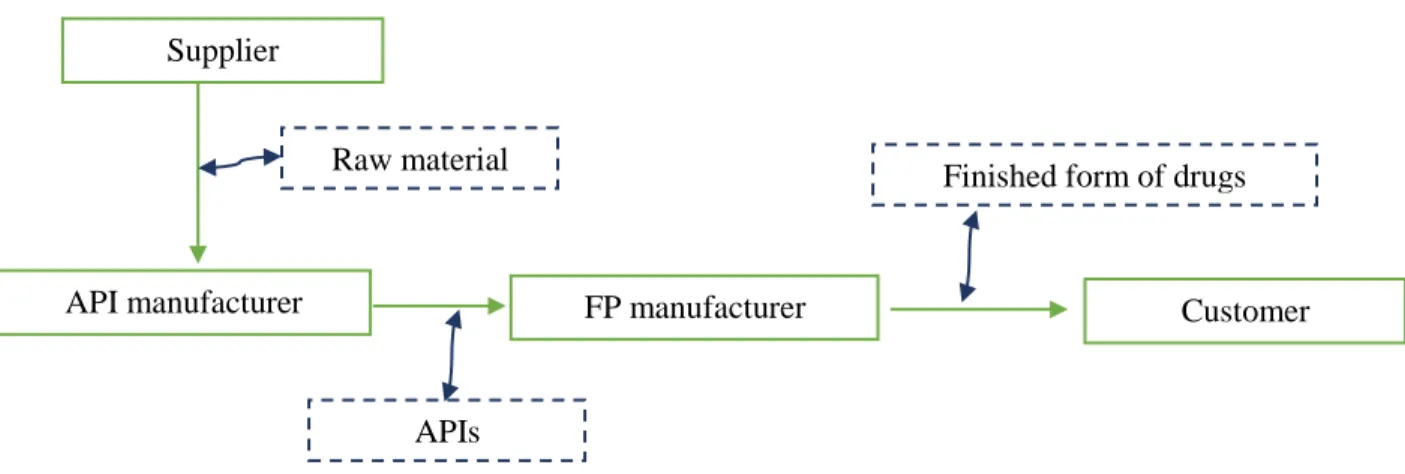
Pharmaceutical supply chain plays an essential role in keeping and enhancing the health of society which reveals the significant distinction of this chain compared to another chains. As the medicines are critical and strategic products; procuring them is one of the major challenges specifically in developing countries (Jaberidoost et al., 2013). According to (Sundaramoorthy et al., 2004) the PSC includes two production levels: primary and secondary. The primary production level makes the basic molecules called the active pharmaceutical ingredients (APIs).One of the most important features of APIs is that the time of expired date for APIs product can be extended. Whereas, the secondary production level involves formulating APIs into final medicines and supplying finished form of medicines to various end users like drug stores, hospitals and etc., called finish product manufacturer (FP).The final part of PSC is customers. *Corresponding author
ISSN: 1735-8272, Copyright c 2018 JISE. All rights reserved
Journal of Industrial and Systems Engineering
Vol. 11, No. 1, pp. 127-143 Winter (January) 2018
128
Figure 1 illustrates a pharmaceutical supply chain flow chart.
Fig 1. Flowchart of pharmaceutical produce
The main goal of pharmaceutical supply chains is to provide sufficient medicine in the right time under the best quality with an appropriate price (Jaberidoost et al., 2013). Hence, optimal PSC policies can ensure that the appropriate medicines under standard conditions will be delivered to people at the right time (Jaberidoost et al., 2013) and (Kaufmann et al. 2005). However, supply chain optimization is now a major discipline for operations and management. The PSC optimization problem requires to be extended by sophisticated supply chain optimization techniques (Shah, 2004). The existing knowledge about PSC is mostly limited to individual’s personal experiences and thus, technical basis has been less considered in the literature.According to Privett et al. (2014), interviews with experts in pharmaceutical industries illustrated that ten major challenges exist in the PSC field of study, which are as follows, respectively;(1) lack of coordination in the pharmaceutical supply chain, which has been recognized as the first and most fundamental issue, (2) Inventory Management, (3) Lack of demand information, (4) Depending on human resources, (5) Order Management, (6) Shortages in the supply chain, (7) Expiration date, (8) Warehouse management, (9) Temperature control, and (10) Transportation. As a result, proposing a coordinated model in a pharmaceutical supply chain could be of high significance. In the pharmaceutical industry, for raw material or API, it is possible to extend the expiration date which is known as retest date by using their chemical properties which is approved by the international guidelines like WHO1 and PICs2. The API manufacturer can extend the retest date of a specific batch by reprocess or rework the expired API based on good science and long-term stability results for that API and also testing the specific batch stored according to the label conditions. The purpose of a retest date is to ensure the API is suitable for using. In real world pharmaceutical systems in IRAN, FP manufacturers such as DarouPakhsh Pharmaceutical Mfg Company face challenges regarding the expiration of purchased raw materials in their inventory systems. On the other hand, API manufacturers such as Temad Company are able to extend the expiration of raw materials by spending money. Therefore, the FP and API manufacturers could make an agreement to jointly reduce the risk of expiring raw materials in the system.
This paper tries to provide a model for coordinating a two echelon PSC by using the purchasing return contract (buy back contract). Our SC consists of one API manufacturer as an upstream member and one FP manufacturer as a downstream member. The decision variable for the downstream is the order quantity. Our SC will be investigated in three structures: (1) decentralized decision-making, (2) centralized decision-making, and (3) coordination decision-making. In decentralized SC each member makes a decision according to its benefit regardless of the other SC's profit. However, the upstream 1World Health Organization
2Pharmaceutical Inspection Co-operation Scheme Supplier
API manufacturer FP manufacturer Customer
Raw material
APIs
Finished form of drugs
member has no decision variable, but the downstream decision will directly affect his benefit. In centralized structure a central manager makes decision by considering all the aspects of SC. However, by joint-making one can find the optimal profit of the SC, but implementing this structure for real situation is complex and also not feasible due to the independent nature of SC entities. Finally in a coordinated SC we try to simulate the condition of decentralized SC to centralized oneby using contract. The buyback contract is applied as a coordination mechanism in order to increase SC profits along with the both SC members. In our model, the order quantity is considered as downstream decision variable. In addition, market demand is assumed to be stochastic and has a normal distribution. FP manufacturer orders less than optimal order quantity, because of time limitation for using raw material. The purpose of developing buy back contract is to encourage the downstream member to increase the number of its orders based on the entire SC perspective.
The remainder of the paper is organized as follows; section 2 provides a literature review, section 3 discusses the problem statement, section 4 presents the model in centralized, decentralized and coordination structures, section 5 presents numerical examples and sensitivity analysis. Finally, section 6 presents the conclusion.
2-Literature review
Supply chain decision-making structures include; decentralized and centralized structures. Under decentralized structure, each member decides based on his own profits regardless of the other SC members. While under centralized decision-making structure, a decision maker (DM) makes decisions by considering all the aspects of a SC. Although, the centralized structure is more efficient for the whole SC but it may not provide an optimum condition for all the SC members. Also, in real situations, most of the pharmaceutical supply chains are managing under decentralized decision-making structure. There are various methods to coordinate the supply chain, such as delay in payment (Heydari et al., 2017-1) and (Heydari , 2015-1) and (Hojati et al., 2017) , cost sharing (Johari et al., 2018), sales rebate contract (Heydari et al., 2016-1), collaborative model (Nematollahi et al., 2017-1), discount contract (Heydari et al., 2015-2) and (Heydari, , 2014-1) and (Johari et al., 1) and Pricing scheme (Heydari et al., 2017-2) and (Heydari et al., 2016-2017-2), lead time contract and aggregation (Heydari et al., 2014-2017-2) and (Heydari et al., 2016-3) and (Johari et al., 2017-2) and buyback contracts (Heydari et al., 2017-3). Mechanism of applying buyback contract in a two echelon supply chain consists of one upstream and one downstream can be defined as; due to the demand uncertainties, surplus inventory which can be led to extra costs for the SC downstream member at the end of period. Thus, downstream member generally orders less quantity than the optimal order quantity in the decentralized structure, which has negative effects on the supply chain performance and profitability. Hence, the upstream member offers buying back the surplus inventory at a lower price (Nan et al., 2016). Xiong et al (2011) considered a two echelon supply chain and introduced a composite contract by combining a buy back contract with quantity flexibility contract. Wei and tang (2013), analyzed the coordination of a Stackelberg model based on the buyback contract predominated by the supplier. Then they obtained the Nash equilibrium solution to this model where the wholesale price and maximum buyback rate are determined by the supplier and the order quantity is determined by the retailer with respect to the market stochastic demand. Li et al., (2012) developed two stochastic models for centralized channel and a decentralized one to handle new fashion and off-season product sales. They investigated optimal pricing and order policies in supply chain management of fashion products with considering product return between supply chain partners (B2B). The authors proposed the Stackelberg game model in the decentralized channel to derive the optimal equilibrium solution and then designed a buyback contract to coordinate the channel. The authors motivated by the actuality of supply chain channel issues in the fashion product industry, especially in the clothing industry. Yao et al. (2008), presented an analytical model. They used numerical methods with Stackelberg game to analyze the impact of stochastic and price dependent demand on buyback contract in a single-period model. (Yanhong et al., 2013) realized that supply chain decision makers are not completely rational and their behavior will be affected by some factors such as fairness preference, loss aversion, sympathy and disgust. But most of the related articles did not consider fairness preference. Yan (2012)
130
constructed a reverse chain system with one manufacturer and one retailer under demand uncertainty, by using buyback contract as coordination mechanism in a reverse supply chain. Devangan et al. (2013) designed an individually rational buyback contract that coordinates the supply chain when the retailer faces inventory-level-dependent demand and any leftover inventory at the retailer can be returned to the supplier at a pre-specified terms. In return policy of purchasing, upstream member re-buy the part or all of the remained or not sold products of downstream with a determined price, as a result a downstream persuades to order more. Upstream wants to increase service levels of downstream member and also to increase the sale amount of the entire chain by this policy. One of the most important effects of the supply chain coordination (SCC) is to improve the customer service level (Wang et al., 2015). Nematollahi et al (2017-2) investigated a two echelon PCS, including one manufacturer and one retailer with stochastic demand, they showedthat collaborative decision-making on visit interval and service level could be more profitable socially and economically, also they (Nematollahi et al., 2017-1) develop a model for coordination social responsibility and quantity order in a two level supply chain. In the previous literature in the field of supply chain coordination, there are few researches which are dealt withhealth systems and pharmaceutical supply chain. Obviously, pharmaceutical supply chain has a critical role in developing the health of each society. Due to the unique features observed in the pharmaceutical systems, it is of high importance to customize the coordination methods by considering real assumptions. Reprocess technology and ability to extend the expiration date of raw materials in the pharmaceutical industry can be considered as specific issues in this industry. Using this opportunity, an API manufacturer could reduce the risk of expiration of raw materials for the FP manufacturer by spending money. To create a more realistic model, in this study, we propose a customized buy-back contract in which an API manufacturer and a FP manufacturer coordinate their decisions regarding order quantity using reprocess technology. Although buy-back contract has been widely investigated in the literature, this is the first study that applies the buy-back contract for coordinating order quantity based on the unique features of pharmaceutical industry. Minimum and maximum amounts of buy-back price are extracted.
3- Problem statement
3-1- Notations
A supply chain including an API manufacture as an upstream member and a FP manufacturer as a downstream member is studied which relates to B2B3 supply chain. The SC structure is decentralized and each SC member makes decisions by optimizing its own objective. The aim of the FP and API objectives in the PSC is to maximize their own expected profits. The SC provides single type of product. The FP inventory model can be described by newsvendor model.
Notations are as follows: Parameters
purchase cost for Active ingredients
MA
The cost of producing raw material
CA
The Price for API
PA
The cost of producing drug
CF
The Price of finished form of drugs
PF
Market demand that has a normal distribution function
D
Mean of the drug demand per unit of time
𝜇𝜇
Standard deviation of the drug demand
𝜎𝜎
Reprocessing cost
X
Unsatisfied demand γ
The cost of annihilation
θ
The percent of surplus quantity of raw material after reprocessing
α
3Business-to-business (B2B) refers to a situation where one business makes a commercial transaction with another. This typically occurs when: A business is sourcing materials for their production process.
Decision Variables
The buyback price
b
Order quantity of raw material form FP Q
3-2- Definition
In decentralized structure each SC member makes a decision due to his income. At the beginning of each time period the downstream member orders raw material from the upstream member. The amount of his order is lower than the optimum amount of quantity order since the demand is probabilistic and the surplus inventory remaining after the expiration date must be annihilated which bring costs. In this case the upstream member has no decision variable. Therefore the downstream decision has two consequences: first one is the negative effect on profit of the both upstream and the whole SC and the other is having lower amount than the optimum order quantity which will cause to lose some part of demands.
According to the international guide lines, API manufacturer can reprocess the expired raw material and extend the consumption time. By considering this option; API manufacturer can motivate the FP manufacturer to increase the amount of order quantity by ensuring him to reprocess the surplus remained inventory in order to eliminate the annihilation cost.
According to the expiration status of this PSC it seems that the best contract for making coordination is a buyback contract. In buy back contract, the upstream member buys surplus inventory and persuade the downstream member to increase his order amount by decreasing the risk of remaining inventory at the end of each period. So API manufacture will buy the expired raw material and reprocess it to be used again. Reprocessing is a chemical process, as it is known the efficiency of processes are lower than 100 percent so by reprocessing, some part of the raw material will be lost due to the nature of chemical processes. The percent of the crops that will remain after processing is shown with α. After reprocessing,α will be sold to FP manufacture again with the PA.
3-3-Basic assumptions
The other assumptions in this study are as follows:
1. The distribution of drug demand is probabilistic and follows a normal distribution with the parameters𝜇𝜇 𝑎𝑎𝑎𝑎𝑎𝑎 𝜎𝜎2.
2. The SC studied in this paper consists of an API and a FP with one type of production. 3. API can be used again even after expiration date.
4. API pharmaceutical can provide the option to FP manufacturer and develop the consumption time of drugs.
5. It is possible to extend the expiration date or retest date of a raw material and by using this option can extend the profit of each member of SC.
4- Model
In this section, mathematical models are developed for decentralized, centralized and coordinated structures of SC. According to the existing literature, the best structure of decision making in PSC is decentralizing.
4-1- Decentralized SC model
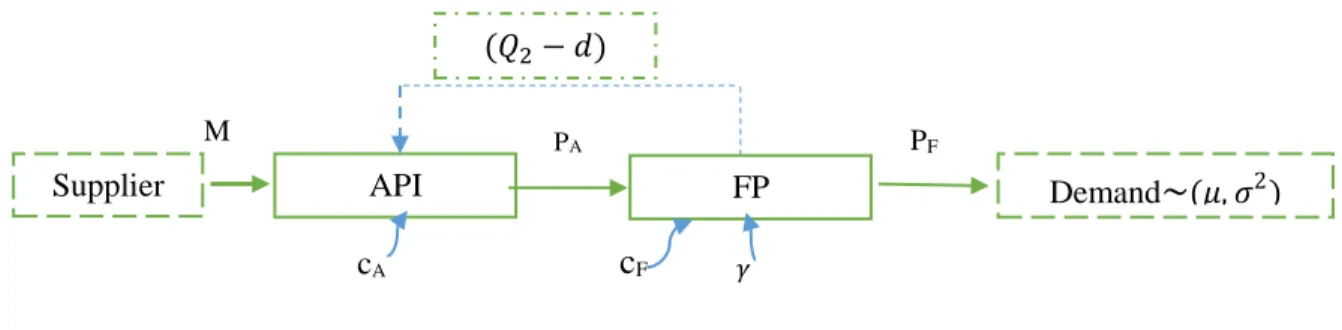
Figure 2 shows the decentralized decision making structure of the supply chain.
Fig 2. Decentralized SC
API FP
F
P
A P
Demand
~(𝜇𝜇,
𝜎𝜎2) AM
Supplier
A
c
c
F 𝛾𝛾 𝜃𝜃In traditional form of decision making in SC, each member attempts to maximize his own profit. But value of some variables affect the profit of the other member in SC and it’s a challenge for each SC to optimize the profit of each member by considering the SC's efficiency.
4-1-1-Optimization FP profit in decentralized structure
At the beginning of each period, FP orders a quantity of Q raw material according to the market demand, which is described by a Normal distribution and the API produces Q and delivers it to the FP. The FP sales drugs at the fixed price of𝑃𝑃𝐴𝐴 which is determined based on the required regulations. The API sales raw material at the price 𝑃𝑃𝐴𝐴 which is determined by considering the world price, costs of production and the price of FP. The marginal cost of producing API and drugs is 𝐶𝐶𝐴𝐴 and 𝐶𝐶𝐹𝐹respectively. The cost of purchasing pharmacy active ingredients is 𝑀𝑀𝐴𝐴.At the end of each period surplus amount of raw material will be annihilated with cost of 𝜃𝜃 and the SC can have unsatisfied demand with the cost of𝛾𝛾.
γ=𝑃𝑃F−PA−CF+ 1 (1)
θ=𝑃𝑃A+ CF (2)
According to the classic newsvendor model, when there is no coordination between the API and the FP manufacturer, the FP's profit function will be as Eq.(3). As it is obvious, the profitability of FP formula consists of the deviation between the cost of productionCFQ1, cost of purchasing raw materialPAQ1 , cost of annihilation θE[(Q1−D)+] and cost of unsatisfied demand γE[(D−Q1)+]and the income quantity which is showed by PFE[min (Q1. D)].
E[πFP] = PFE[min (Q1. D)]−CFQ1−PAQ1− θE[(Q1−D)+]− γE[(D−Q1)+] (3)
As calculations are shown in appendix, the profit will be achieved as follows;
(4)
E[πFP] = PFE[D] +θE[D]−CFQ1−PAQ1− θQ1−(PF+θ+γ){�σfs�Q1σ ��− µ
+ (µ −Q1)(1−FS(Q1σ− µ))}
Where fsand FS are the probability density function and the cumulated probability function, respectively, for standard normal distribution.
In order to maximize profit of FP manufacturer, it must be shown differentiable profit function of FP is concave; then the optimal order quantity can be calculated as follows:
The first and second derivatives of the FP profit function related to Q1 are as follows, respectively. (5)
∂π
∂Q1=−(CF+ PA+θ)−(PF+θ+γ)(FS�
Q1− µ
σ � −1)
(6)
∂2π
∂Q12=−(PF+θ+γ)(fs�
Q1− µ
σ �) < 0
The second derivative is negative, so the profit function is concave. By setting the first derivative of a FP profit function, the optimal order quantity can be obtained as:
(7)
Q1= F−1�−(P(CF+ PA+θ)
F+θ+γ) + 1� σ+µ
4-1-2-Optimization API profit in decentralized structure
API profit function under decentralized structure includes the difference between the cost of producing and cost of purchasing the API ingredients and income of API and is as follows;
(8)
πAPI= PAQ1−CAQ1−MAQ1
In decentralized structure, the upstream member has no decision parameter so the downstream decision will directly effect on the API profit.
4-2- Centralized Supply chain
In centralized structure, one main central organizer makes decision for all members of the SC, so the decision variables of SC are globally optimized. In this paper the main assumption in centralized SC is that in this structure the upstream member can provide the option of reprocessing the raw material sold to downstream member and receiving the retest date. Figure 3 displays the centralized structure of the supply chain. In the centralized SC, the amount of surplus raw material reprocessed with cost of x is equal to 𝑀𝑀𝐴𝐴+𝐶𝐶𝐴𝐴
2 , the reprocessing of raw material is a chemical process, as mentioned before the inherent
feature of processes is that the efficiency of them are lower than 100 percent, by doing reprocess on raw material, the percentage part remained after reprocessing is shown by𝛼𝛼(which is related to the process efficiency).
Fig 3. Centralized SC
Moreover, the cost of annihilation is removed in this structure. Therefore, the SC profit is expressed as follows. The first part is income of SC by selling the products which is calculated by the production of the price of FP to the selling quantity, the next term is the cost of producing raw material, next one is the purchasing cost of starting material for producing raw material, next part is the reprocessing cost of expired raw material, the 6th part is the cost of missed customers and the final part show the income of SC obtained by selling the reprocessed raw material.
(9)
E[πSC] = PFE[min (Q2. D)]−CAQ2−MAQ2−CFQ2−xE[(Q2−D)+]−γE[(D−Q2)+]
+αPFE[(Q−D)+]
Some simplifications are as follows (for detailed see Appendix):
(10)
E[πSC] = PFE[D] + (X−∝PF)E[D]−CAQ2−MAQ2−CFQ2−(X−∝PF)Q2−(PF+γ+
X−∝PF)](σfs(Q2σ−μ) + (μ−Q2)(1−FS(Q2σ−μ))
The first order derivative of the SC profit function with respect to Q2 is:
(11)
∂π
∂Q2 =−(CF+ X−∝PF+ CA+ MA)−(X−∝PF)Q2−(PF+γ+ X−
∝PF)(FS�Q2σ−μ� −1)
The second order derivative of the SC profit function with respect to Q2 is:
(12)
∂2π
∂Q22=−(X−∝PF)Q2−(PF+γ+ X−∝PF)(fs�
Q2−μ
σ �) < 0
The second derivative of the SC profit function is negative, so the profit function is concave. For calculating the optimal order quantity, the first derivative function must be equal to zero.
(13)
Q2 = F−1�(CF−(P+ X−∝PF+ CA+ MA)
F+γ+ X−∝PF) + 1�σ+µ
The optimal amount of quantity order is calculated as Q2 . Although Q2is an optimal amount of order quantity, but it can't be used in decentralized supply chain since the independent economic entity of SC
API FP
F
P
A P
Demand
~
(𝜇𝜇,𝜎𝜎2)M
Supplier
A
c
c
F 𝛾𝛾(𝑄𝑄2− 𝑎𝑎)
downstream members make a decision according to his profit. As being explained downstream member order lower than the optimal order because of the uncertain demand and cost of surplus inventory, and upstream member has no decision variable in this situation in order to simulate a condition of decentralized SC to centralized one. Finally it is recommended that optimum decision for a SC is to use coordination contract such as buy back contract.
4-3- Coordinated supply chain
The aim of implementing coordination contract is to encourage SC members to make a decision by considering the profit of the other members in a SC to simulate a decentralized SC to a centralized one which is ideal for a specific SC. There is much difference between coordination contracts which can coordinate the structure of SC for example buy back, quantity discount, delay in payment and etc. The main reason of accepting a contract is that the profit of each member by using the contract is equal or more than the decentralized structure.
In this paper the API is a perishable product since the FP manufacture order less than the optimal order quantity by using this strategy which will effect on the profit of API manufacturer. By considering this fact that API manufacture can reprocess the Expired API and sell it to use again by putting this option for FP manufacture can persuade the FP manufacture to buy more. According to the condition of SC the best choice of contract which can be used is buy back contract.
For supply chain coordination the equation𝑄𝑄 ∗=𝑄𝑄2 must be hold. This means that the optimal order quantity in centralized SC is the same under coordinated SC. In the coordinated SC, the API manufacturer buys surplus raw material from the FP manufacturer with price b which is lower than 𝑃𝑃𝐴𝐴 and reprocess them and the volume of production has been reprocessed, the cost of reprocess is x, After reprocessing the API can produce finished form of drugs and sale with price 𝑃𝑃𝐴𝐴.The FP profit function is the difference between summation of cost and income. The cost includes the cost of production, the cost of purchasing raw material, cost of unsatisfied demand and consequently the incomes is equal to the summation of sold products to customers and remained raw material to API with price of b, where the function is as follows;
(14)
πFP∗∗ = PF𝐸𝐸[min{Q2, D}]−PAQ2−CFQ2+ bE[(Q2−D)+]− γE[(D−Q2)+
By some simplifications the profit function of FP will be achieved as follows;
(15)
πFP∗∗ = PFE[D]−bE[D]−PAQ2−CFQ2+ bQ2−(PF+γ −b)(σfs�Q2σ �− µ
+ (µ −Q2)�1−Fs�Q2σ ��− µ
Similarly, the profit function of API manufacture is shown in equation 16. The API profit function in a coordinated structure equals the difference between costs which include purchasing cost of API raw material ingredients, producing cost of API, purchasing cost of surplus raw material from FP at the end of each time period and reprocessing cost of surplus material with incomes of sale API to FP.
(16)
πAPI∗∗ = PAQ2−MAQ2−CAQ2−bE[(Q2−D)+] +αPAE[(Q2−D)+]−XE[(Q2−D)+]
(17)
πAPI∗∗ = (b + x− αP
A)E[D] + Q2(PA−CA−MA−b−x +αPA)−(b + x
− αPA)(σfs�Q2σ �− µ + (µ −Q2)�1−Fs�Q2σ ��− µ
Both members accept a coordination plan if their profit under coordination model is equal or more than decentralized one. We applied buy back contract as the coordination mechanism. The coordination parameter is b. Then for calculating b, we used conditions which are appealing for each SC member.
The minimum acceptable of b is determined according to the downstream member’s perspective. And therefore, the minimum amount of b is determined by the inequity of FP manufacturer profit function under the coordination and decentralized models.
πFP∗∗ ≥ πFP (18)
PFE[D]−bE[D]−PAQ2−CFQ2+ bQ2−(PF+γ −b)(σfs�Q2σ �− µ
+ (µ −Q2)�1−Fs�Q2σ ��− µ
≥PFE[D] +θE[D]−CFQ1−PAQ1− θQ1−(PF+θ+γ){�σfs�Q1σ ��− µ
+ (µ −Q1)�1−FS�Q1σ ��− µ }
(19)
The minimum value of b is;
b≥θE[D]−Q1(PA+ CF+θ)−−E[D] + QA(PF+θ+γ) + Q2(PA+ CF) + B(PF+γ)
2+ B =𝑏𝑏𝑚𝑚𝑚𝑚𝑚𝑚 (20)
In which,
A = (σfs(Q1σ− µ) + (µ −Q1∗)(1−FS�Q1σ �− µ ) (21)
B = (σfs(Q2σ− µ) + (µ −Q2)(1−FS�Q2σ �− µ ) (22)
The maximum acceptable amount of b is obtained based on upstream member's view point. Hence, the maximum amount of b is calculated by the inequity of API manufacturer profit function in the coordination and decentralized models.
πAPI∗∗ ≥ πAPI (23)
(b + x− αPA)E[D] + Q2(PA−CA−MA−b−x +αPA)−(b + x− αPA)(σfs�Q2σ �− µ
+ (µ −Q2)�1−Fs�Q2σ �� ≥− µ PAQ1−CAQ1−MAQ1
(24)
The maximum value of b is (the amount of A and B is calculated in formula no.8 and no.9)
b≤−PAQ1+ MAQ1+ CAQ1+ (x− αPA)E[D] + P−E[D] + QAQ2−MAQ2−CAQ2−XQ2+αPAQ2−B(X− αPA)
2+ B
=𝑏𝑏𝑚𝑚𝑚𝑚𝑚𝑚
(25)
If the interval [bmin,bmax] is not empty, then by using each value in this interval as the buyback price, channel will reach coordination.
5- Numerical example
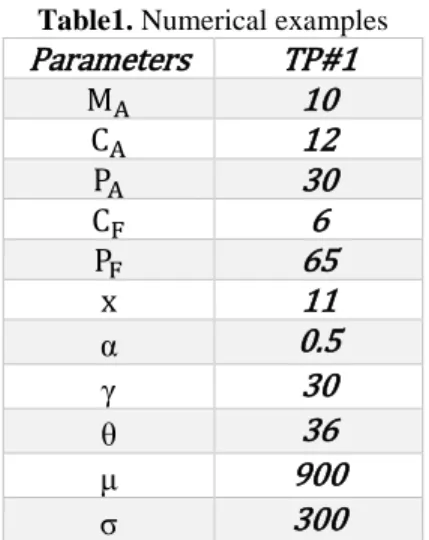
In order to investigate the performance of the developed models, a set of test problems is provided using Matlab 2008a to solve the model. Associated data for the three investigated test problems are indicated in table (1).
Table1. Numerical examples
TP#1 Parameters
10
MA
12
CA
30
PA
6
CF
65
PF
11 x
0.5
α
30
γ
36
θ
900
μ
300
σ
The results of the models implementation for three numerical examples are shown in table (2). Table 2. Results of solving the numerical examples
TP#1 Decentralized SC model 863 𝑄𝑄1
6900.7 𝜋𝜋𝐴𝐴𝐴𝐴𝐴𝐴
10543 𝜋𝜋𝐹𝐹𝐴𝐴
17443.7 𝜋𝜋𝑆𝑆𝐶𝐶
Centralized SC model 1305 𝑄𝑄2
29766 𝜋𝜋𝑆𝑆𝐶𝐶
Coordination SC model 0.4608 𝑏𝑏𝑚𝑚𝑚𝑚𝑚𝑚
12.4821 𝑏𝑏𝑚𝑚𝑚𝑚𝑚𝑚
6.4714 b
9397 𝜋𝜋𝐴𝐴𝐴𝐴𝐴𝐴∗∗
13064 𝜋𝜋𝐹𝐹𝐴𝐴∗∗
22461 𝜋𝜋𝑆𝑆𝐶𝐶
The investigated pharmaceutical supply chain can be coordinated using each value of b in the interval [bmin, bmax]. In the numerical example, we assume that both members agree to set b=(bmin+bmax)/2.According to table (2), it can be concluded that by using the buyback contract the SC's profit in coordinated structures is more than decentralized one. Logical relationship between the amounts of profits can be shown as follows;
𝜋𝜋
𝑑𝑑𝑑𝑑𝑑𝑑𝑑𝑑𝑚𝑚𝑑𝑑𝑑𝑑𝑚𝑚𝑑𝑑𝑚𝑚𝑑𝑑𝑑𝑑𝑑𝑑𝑚𝑚𝑚𝑚𝑑𝑑𝑑𝑑𝑑𝑑<
𝜋𝜋
𝑑𝑑𝑚𝑚𝑚𝑚𝑑𝑑𝑑𝑑𝑚𝑚𝑚𝑚𝑚𝑚𝑑𝑑𝑑𝑑𝑑𝑑𝑚𝑚𝑚𝑚𝑑𝑑𝑑𝑑𝑑𝑑<
𝜋𝜋
𝑑𝑑𝑑𝑑𝑚𝑚𝑑𝑑𝑑𝑑𝑚𝑚𝑑𝑑𝑚𝑚𝑑𝑑𝑑𝑑𝑑𝑑𝑚𝑚𝑚𝑚𝑑𝑑𝑑𝑑𝑑𝑑The order quantity, Q in the centralized SC is equal to the coordination structure and more than decentralized ones. The increase in order quantity reduces the risk of unsatisfied demand in the supply chain. Especially in pharmaceutical supply chain where pharmaceutical products have direct impact on maintaining and restoring society health. As a result, increasing the order quantity is of great achievement in the buyback contract. Both the upstream and downstream profits increased so it can be concluded that the proposed contract is successful to achieve coordination in a supply chain.
Parameter b show the price of expired raw material which is sold by FP manufacturer to API manufacturer, to calculate the parameter b, this feature is used to implement the contract in the supply chain where the profit of each member must be equal to or more than its profit in decentralized structure. The coordination parameter is b. The minimum amount of b is determined by downstream and the maximum amount of b is determined by upstream member, any b in this range is feasible in the model.
5-1- Sensitivity analysis
A set of sensitivity analyses are examined. And parameters for sensitivity analysis are taken from test problem 1.
5-1-1- Price of buy-back
Figure 4 illustrate how the surplus profit of implementation buyback contract divided between upstream and downstream member according to amount of b. As it's obvious in figure4, the total expected profit of SC in the coordinated structure is 𝜋𝜋𝐴𝐴+𝜋𝜋𝐹𝐹= 22461regardless of the b value. Sharing the deviation profit [(about 5017) between coordinated SC's profit (22461) and decentralized SC's profit (17444)] depends on the value of b. If b is defined at its lower bound (0.4608) then the expected FP profit is the same as before having contract (i.e. 10543). All of the increased profits are received by API. On the contrary, if the b is defined at its upper bound (12.4824), the expected profit of the API is the same as before having contract (6900.7). All of the increased profits are obtained by FP. Any value outside the range of [0.4608-12.4824] is not acceptable, because one of the SC members will receive the worse expected profit in such a contract.
Fig 4. Distribution of profit in a coordinated SC
5-1-2- Uncertainty
Figure 5 shown the relation between SC profit and uncertainty which is shown by 𝜎𝜎. In real world uncertainty is a most important parameter which is effect on make a decision, in figure 5 illustrated, the deviation between SC profit in the coordinated and decentralized structures will increase.by noting this result and this fact that uncertainty is an inherent item of real world it could be concluded in real world applying the coordination model is efficient.
0 5000 10000 15000 20000 25000
b
m
in
۰٫۵ ۱ ۱٫۵ ۲ ۲٫۵ ۳ ۳٫۵ ۴ ۴٫۵ ۵ ۵٫۵ ۶ ۶٫۵ ۷ ۷٫۵ ۸ ۸٫۵ ۹ ۹٫۵ ۱۰ ۱۰٫۵ ۱۱ ۱۱٫۵ ۱۲
b
m
ax
S
C
.pr
of
it
b
Coordinated.πa coordinated.πf
Fig 5.The trend of increasing uncertainty and its impact on the SC profit
5-1-3- The percent of surplus quantity of raw material after reprocessing
Figure 6 illustrates the changes of b by increasing𝛼𝛼.As shown in figure 6, by increasing 𝛼𝛼 the interval [bmin,bmax] tightens. In other word, the distance between bmin and bmax becomes smaller. In addition, on the high value of𝛼𝛼, the difference between bmin and bmax is minimized and b is so smaller than the price of sale and the cost of annihilation which is more appropriate in practice and can motivate the API and the FP to accept coordination policy.
Fig 6.The trend of increasing α and its effect on b
5-1-4- The Price for API
To investigate the impacts of increasing the price of API which is shown by Pa on the profit of the entire supply chain and its members, a set of sensitivity analyses are conducted. Figures 7, 8, and9, illustrate the changes of supply chain and their members' profitability in the decentralized, centralized and coordinated structures over increasing Pa respectively. As the expected profit of API increases that is showed in figure 5. According to figure 6, the profit of FP decreased in both coordinated and decentralized structures. But the reduction in coordinated structure is smaller than the decentralized ones. The profitability of the supply chain is examined in the figure 9. The supply chain profit in the
5000 10000 15000 20000 25000 30000 35000
150 175 200 225 250 275 300 325 350 375 400 425 450 475 500
S
C.
P
RO
F
IT
UNCERTAINITY
Decent.πSC Cent.πSC Coordinated.πSC
0 2 4 6 8 10 12 14 16
0.49 0.5 0.51 0.52 0.53 0.54 0.55 0.56 0.57 0.58 0.59 0.6
b
ALPHA
bmin bmax
coordinated structure reaches to the centralized model by increasing the PA, which implies the efficiency
of increasing PA strategy in the coordinated supply chain.
It can be concluded that in a decentralized structure the result of increasing PA is missing the market but
in coordinated structure it's feasible to increase the API price without missing market. So it's one of the nest strategies can be used to increase profit from API manufacturer without putting great effects on the API market.
Fig 7.The trend of an increase in the price of raw material on the profit of the API producer
Fig 8.The trend of an increase in the price of raw material on the profit of the FP producer 0
5000 10000 15000 20000 25000
29 30 31 32 33 34 35 36 37 38 39 40 41 42 43 44 45 46 47 48 49 50
A
P
I.pr
of
it
PA
Decent.πa Coordinated.πa
-2000 0 2000 4000 6000 8000 10000 12000 14000
29 30 31 32 33 34 35 36 37 38 39 40 41 42 43 44 45 46 47 48 49 50
F
P
.pr
of
it
PA
Decent.πf coordinated.πf
Fig 9.The trend of an increase in the price of raw material on the profit of the SC producer
6- Conclusion
Supply chain management and optimization is a critical aspect of modern enterprises and a flourishing research area. Recent changes in the operating environment reveal that companies are revisiting the components of their supply chains and identifying the way of extracting additional benefits from them. In this paper a two level pharmaceutical supply chain, including one API manufacturer as upstream member and one FP manufacturer as downstream member are investigated. The aim of the proposed model is the coordination of supply chain by using the buyback contract. The major contribution of this paper is considering the retest date in API pharmaceutical which means after touching the expiration date or decreasing the product quality over the time, it can reprocess the raw material and use the primary material for producing finished form of drugs. The buyback contract can improve not only the API profit, but also the profit of both individual SC actors and the wholesale SC. In other words, a win-win situation is achieved in this situation. The buyback price b is expressed as a feasible range; this implies that a buyback contract has flexibility when put into practice. The choice of b depends on the relative contractual power of the SC actors. Also an appropriate buyback contract can increase FP order quantity in the SC which in turn improves the SC service level and its efficiency respectively.
By noting the result of sensitivity analysis, it shows that the buyback contract is more effective under high demand uncertainty.
To extend the current model, it can be interesting to consider the coordination scheme for complicated SC decisions such as multi echelons inventory policies. Moreover, considering more than one product in a SC is suggested for the future directions.
References.
Devangan, L., Amit, R. K., Mehta, P., Swami, S., & Shanker, K. (2013). Individually rational buyback
International Journal of Production
inventory level dependent demand. contracts with
387. -(2), 381
142
,
Economics
level delay in payments contract for supply
-1). A two
-Heydari, J., Rastegar, M., & Glock, C. H. (2017
International Journal of Production
. dependent demand
-chain coordination: The case of credit 36.
-, 26
191
,
Economics
2). Reverse and closed loop supply chain coordination by
-Heydari, J., Govindan, K., & Jafari, A. (2017
398. -379 ,
52
,
Transportation Research Part D: Transport and Environment
considering government role.
3). Pareto improving supply chain coordination under a
-Heydari, J., Choi, T. M., & Radkhah, S. (2017
105. -(2), 91
9
,
Service Science
back guarantee service program.
-money
0 5000 10000 15000 20000 25000 30000 35000
29 30 31 32 33 34 35 36 37 38 39 40 41 42 43 44 45 46 47 48 49
S
C
.pr
of
it
P
ADecent.πSC Cent.πSC Coordinated.πSC
echelon supply chain
-two 1). Coordinating inventory decisions in a
-Najafi, J. (2016
-Heydari, J., & Asl
69. -(1), 49
3
,
International Journal of Inventory Research
through the target sales rebate contract.
2). Coordination of pricing, ordering, and lead time decisions in a
-Heydari, J., & Norouzinasab, Y. (2016
16. -, 1
9
,
Journal of Industrial and Systems Engineering
in. manufacturing supply cha
echelon
-3). Lead time aggregation: A three
-Heydari, J., Mahmoodi, M., & Taleizadeh, A. A. (2016
. 233 -, 215 89 ,
Transportation Research Part E: Logistics and Transportation Review
supply chain model.
stage supply chain by considering
-1). Coordinating replenishment decisions in a two
-Heydari, J. (2015
-(10), 1897
46
,
International Journal of Systems Science
truckload limitation based on delay in payments. 1908.
level discount model for coordinating a decentralized
-A two 2). -Heydari, J., & Norouzinasab, Y. (2015
Journal of Industrial Engineering
sensitive demand.
-supply chain considering stochastic price 542. -(4), 531 11 , International Computers
ary price discounts. based tempor
-1). Supply chain coordination using time
-Heydari, J. (2014
101. -, 96
75
,
& Industrial Engineering
׳ reorder point: A coordination mechanism for supply chains supplier‘s
2). Coordinating
-Heydari, J. (2014
101. -, 89
48
,
Computers & Operations Research
with long supplier lead time.
Motlagh, S. M., & Nematollahi, M. (2017). Coordination and
-Hojati, S., Seyedhosseini, S. M., Hosseini
level supply chain under periodic review inventory policy with delay in payments
-profit sharing in a two
131. -, 109 10 , eering Journal of Industrial and Systems Engin
contract.
Jaberidoost, M., Nikfar, S., Abdollahiasl, A., & Dinarvand, R. (2013). Pharmaceutical supply chain risks: (1), 69.
21
,
DARU Journal of Pharmaceutical Sciences
a systematic review.
of cooperative promotion efforts with Motlagh, S. (2018). Coordination
-Johari, M., & Hosseini
(1),
6
,
Uncertain Supply Chain Management
retailer supply chain.
-competing retailers in a manufacturer 48.
-25
1). Simultaneous coordination of review
-Motlagh, S. M., & Nematollahi, M. (2017
-Johari, M., Hosseini
Journal of Industrial and Systems
retailer chain.
-level in a manufacturer -to -up -nd order period a 17. -, 1 10 , Engineering
2). Supply Chain Coordination using
-Motlagh, S. M., & Nematollahi, M. (2017
-Johari, M., Hosseini
Dependent Demand and Periodic Review
-tochastic Price Different Modes of Transportation Considering S
165. -(2), 137
5
,
International Journal of Transportation Engineering
Replenishment Policy.
Kaufmann, L., Thiel, C., & Becker, A. (2005). Supply chain management in the Mexican pharmaceutical
16th annual North American research/teaching symposium on purchasing and supply chain
industry. In
353). -(pp. 327
management
Li, Y., Wei, C., & Cai, X. (2012). Optimal pricing and order policies with B2B product returns for 646. -(2), 637 135 , oduction Economics International Journal of Pr
fashion products.
Privett, N., & Gonsalvez, D. (2014). The top ten global health supply chain issues: perspectives from the 230.
-(4), 226
3
,
Operations Research for Health Care
field.
the Supply Chain Coordination of the Buyback Nan, Z., & Fang, Z. Z. (2016). A Literature Review on
Contract.
1). Coordination of social responsibility
-Motlagh, S. M., & Heydari, J. (2017
-Nematollahi, M., Hosseini
making
-echelon supply chain: A collaborative decision
-and order quantity in a two
121. -, 107
184
,
International Journal of Production Economics
perspective.
2). Economic and social collaborative
-Motlagh, S. M., & Heydari, J. (2017
-Nematollahi, M., Hosseini
Journal
n. echelon pharmaceutical supply chai
-making on visit interval and service level in a two -decision 3969. -, 3956 142 ,
of cleaner production
Computers &
Shah, N. (2004). Pharmaceutical supply chains: key issues and strategies for optimisation. 941. -7), 929 -(6 28 , chemical engineering
eutical supply chains with outsourcing Sundaramoorthy, A., & Karimi, I. A. (2004). Planning in pharmac
8306. -(26), 8293
43
,
Industrial & engineering chemistry research
and new product introductions.
Wang, Y., Wallace, S. W., Shen, B., & Choi, T. M. (2015). Service supply chain management: A review 698.
-(3), 685
247
,
European Journal of Operational Research
of operational models.
Wei, J., & Tang, J. (2013). ANALYSIS ON THE STACKELBERG GAME MODEL AND RISK
Journal of Theoretical & Applied Information
SHARING BASED ON BUYBACK CONTRACT. (2).
48
,
Technology
& Xie, J. (2011). A composite contract based on buy back and quantity flexibility Xiong, H., Chen, B.,
567. -(3), 559
210
,
European Journal of Operational Research
contracts.
Yan, N. (2012). Dynamic models and coordination analysis of reverse supply chain with 1363. -, 1357 24 , hysics procedia P remanufacturing.
Yanhong, Q., Yaxian, Y., & Guangxing, W. (2013). Buy Back Contract Considering Fairness Preference
International Journal of
Bargain in a Two Stage Supply Chain.
-under the Framework of Nash
1305. -(3), 1298 3 , ns (IJERA) Engineering Research and Applicatio
Yao, Z., Leung, S. C., & Lai, K. K. (2008). Analysis of the impact of price-sensitivity factors on the returns policy in coordinating supply chain. European Journal of Operational Research, 187(1), 275-282.
Appendix
−𝜃𝜃𝐸𝐸[(𝑄𝑄 − 𝐷𝐷)+]− 𝜃𝜃[(𝑄𝑄 − 𝐷𝐷)−] =𝜃𝜃 �∞(𝑄𝑄 − 𝐷𝐷)𝑓𝑓(𝐷𝐷)𝑎𝑎(𝐷𝐷)
𝑄𝑄 − 𝜃𝜃 � (𝑄𝑄 − 𝐷𝐷)𝑓𝑓(𝐷𝐷)𝑎𝑎(𝐷𝐷) 𝑄𝑄
−∞
=� (𝑄𝑄 − 𝐷𝐷)𝑓𝑓(𝐷𝐷)𝑎𝑎(𝐷𝐷) =𝜃𝜃 � 𝑄𝑄𝑓𝑓(𝐷𝐷)𝑎𝑎(𝐷𝐷)∞
−∞ − 𝜃𝜃 � 𝐷𝐷𝑓𝑓(𝐷𝐷)𝑎𝑎(𝐷𝐷) ∞
−∞ =
∞
−∞ 𝜃𝜃 − 𝜃𝜃𝐸𝐸[𝐷𝐷]
𝐸𝐸[(𝐷𝐷 − 𝑄𝑄)+] =�∞(𝐷𝐷 − 𝑄𝑄)𝑓𝑓(𝐷𝐷)𝑎𝑎(𝐷𝐷)
𝑄𝑄 =� 𝐷𝐷𝑓𝑓(𝐷𝐷)𝑎𝑎(𝐷𝐷)
∞
𝑄𝑄 − � 𝑄𝑄𝑓𝑓(𝐷𝐷)𝑎𝑎(𝐷𝐷) ∞
𝑄𝑄
𝐸𝐸[(𝐷𝐷 − 𝑄𝑄)+] =� 𝐷𝐷𝑓𝑓(𝐷𝐷)𝑎𝑎(𝐷𝐷)∞
𝑄𝑄 − � 𝑄𝑄𝑓𝑓(𝐷𝐷)𝑎𝑎(𝐷𝐷) ∞
𝑄𝑄 − � 𝑄𝑄𝑓𝑓(𝐷𝐷)𝑎𝑎(𝐷𝐷) 𝑄𝑄
−∞ +� 𝑄𝑄𝑓𝑓(𝐷𝐷)𝑎𝑎(𝐷𝐷) 𝑄𝑄
−∞
𝐸𝐸[(𝐷𝐷 − 𝑄𝑄)+] =� 𝐷𝐷𝑓𝑓(𝐷𝐷)𝑎𝑎(𝐷𝐷)∞
𝑄𝑄 − � 𝑄𝑄𝑓𝑓(𝐷𝐷)𝑎𝑎(𝐷𝐷) ∞
−∞ +� 𝑄𝑄𝑓𝑓(𝐷𝐷)𝑎𝑎(𝐷𝐷) 𝑄𝑄
−∞
𝐸𝐸[(𝐷𝐷 − 𝑄𝑄)+] =� 𝐷𝐷𝑓𝑓(𝐷𝐷)𝑎𝑎(𝐷𝐷)∞
𝑄𝑄 − 𝑄𝑄+𝑄𝑄𝑓𝑓(𝑄𝑄)
𝐷𝐷 − 𝜇𝜇
𝜎𝜎 =𝑧𝑧 𝐷𝐷 =𝜎𝜎𝑧𝑧+𝜇𝜇 𝑎𝑎𝐷𝐷=𝜎𝜎𝑎𝑎𝑧𝑧 𝑎𝑎𝑧𝑧= 𝑎𝑎𝐷𝐷
𝜎𝜎 𝐸𝐸[(𝐷𝐷 − 𝑄𝑄)+] =� (𝜎𝜎𝑧𝑧+𝜇𝜇)
𝜎𝜎√2𝜋𝜋 𝑒𝑒 −𝑧𝑧2
2 𝜎𝜎𝑎𝑎𝑧𝑧
∞
𝑄𝑄−𝜇𝜇 𝜎𝜎
− 𝑄𝑄+𝑄𝑄𝑓𝑓(𝑄𝑄) 𝐸𝐸[(𝐷𝐷 − 𝑄𝑄)+] =� (𝜎𝜎𝑧𝑧+𝜇𝜇)
√2𝜋𝜋 𝑒𝑒 −𝑧𝑧2
2 𝑎𝑎𝑧𝑧
∞
𝑄𝑄−𝜇𝜇 𝜎𝜎
− 𝑄𝑄+𝑄𝑄𝑓𝑓(𝑄𝑄) 𝐸𝐸[(𝐷𝐷 − 𝑄𝑄)+] =� 𝜎𝜎𝑧𝑧
√2𝜋𝜋𝑒𝑒 −𝑧𝑧2
2 𝑎𝑎𝑧𝑧+� 𝜇𝜇
√2𝜋𝜋𝑒𝑒 −𝑧𝑧2
2 𝑎𝑎𝑧𝑧
∞
𝑄𝑄−𝜇𝜇 𝜎𝜎
∞
𝑄𝑄−𝜇𝜇 𝜎𝜎
− 𝑄𝑄+𝑄𝑄𝑓𝑓(𝑄𝑄) 𝐸𝐸[(𝐷𝐷 − 𝑄𝑄)+] =� 𝜎𝜎𝑧𝑧
√2𝜋𝜋𝑒𝑒 −𝑧𝑧2
2 𝑎𝑎𝑧𝑧+𝜇𝜇(1− 𝐹𝐹𝑆𝑆(𝑄𝑄 − 𝜇𝜇 𝜎𝜎 ))
∞
𝑄𝑄−𝜇𝜇 𝜎𝜎
− 𝑄𝑄(1− 𝐹𝐹𝑆𝑆(𝑄𝑄 − 𝜇𝜇𝜎𝜎 ))
𝐸𝐸[(𝐷𝐷 − 𝑄𝑄)+] = 𝜎𝜎
√2𝜋𝜋(−𝑒𝑒 −𝑧𝑧2
2 ) +𝜇𝜇(1− 𝐹𝐹𝑆𝑆(𝑄𝑄 − 𝜇𝜇
𝜎𝜎 ))− 𝑄𝑄(1− 𝐹𝐹𝑆𝑆( 𝑄𝑄 − 𝜇𝜇
𝜎𝜎 )) 𝐸𝐸[(𝐷𝐷 − 𝑄𝑄)+] = 𝜎𝜎
√2𝜋𝜋(−𝑒𝑒−∞− 𝑒𝑒 −(𝑄𝑄−𝜇𝜇)2
2𝜎𝜎 ) +𝜇𝜇(1− 𝐹𝐹𝑆𝑆(𝑄𝑄 − 𝜇𝜇
𝜎𝜎 ))− 𝑄𝑄(1− 𝐹𝐹𝑆𝑆( 𝑄𝑄 − 𝜇𝜇
𝜎𝜎 )) 𝐸𝐸[(𝐷𝐷 − 𝑄𝑄)+] =𝜎𝜎𝑓𝑓
𝑠𝑠(𝑄𝑄 − 𝜇𝜇𝜎𝜎 ) + (𝜇𝜇 − 𝑄𝑄)(1− 𝐹𝐹𝑆𝑆(𝑄𝑄 − 𝜇𝜇𝜎𝜎 ))