Total Synthesis of a Natural Product Analogue of (–)-Pironetin and Efforts
Towards a Synthesis of Aquatolide
Honors Thesis, Department of Chemistry Glynis L. Coyne
Class of 2016 Submitted May 4, 2016
Contents
Chapter 1: Synthesis of Natural Product Analogue of (–)-Pironetin
Chapter 2: Efforts Towards a Synthesis of Aquatolide
Chapter 3: Experimental Methods and Supporting Data for Chapter 1
Chapter 4: Experimental Methods and Supporting Data for Chapter 2
Chapter 1
Synthesis of Natural Product Analogue of (-)-Pironetin
1. IntroductionFigure 1: (a) (–)-pironetin, natural product (b) pironetin analogue, target of synthesis
The natural product (–)-pironetin was originally isolated from the fermentation broth of the bacteria Streptomyces prunicolor PA-48153 and Streptomyces sp. NK 10958 by two
independent groups, the Kobayashi and Yoshida groups, in 1994(1)(2). While initially its biological activity was recognized as a plant growth regulator(2), further investigation
determined that it demonstrated the potential for tumor-inhibiting activity(3)(4). Specifically, it has been indicated that pironetin and pironetin derivatives bind α-tubulin(4). The protein α-tubulin, along with β-α-tubulin, are subunits which make up microtubules, polymeric cell components which play important roles in cell structure, cell growth, and mitotic division(4). Unlike other tubulin-targeting molecules which bind β-tubulin, (–)-pironetin has been shown to bind to α-tubulin, thus preventing tubulin assembly and inhibiting the mitotic phase of the cell cycle(4). This activity demonstrates potential applications against tumor growth.
Figure 2: Summary of the (a) Crimmins, (b) Cossy, and (c) Enders Syntheses of (–)-pironetin
chain, with lactone formation being the final step(5). The key steps of the Cossy synthesis (Figure 2b) are the titanium-mediated crotylation and methylation of an aldehyde, followed by ozonolysis and titanium-mediated allylation, and use of Grubbs’ II catalyst ring-closing
mechanism to generate the lactone ring in the final step(6). The Enders synthesis (Figure 2c) is based on their SAMP/RAMP methodology and is a two-part synthesis where the chain and the lactone are synthesized in separate pathways and combined to produce the final product(8).
Various efforts have been made to synthesize derivatives of pironetin(9). The first part of the work I have completed is the synthesis of an analogue of pironetin (Figure 1a) whose chain is truncated so that carbon 10 is dimethyl-substituted and no longer a stereocenter (Figure 1b; structure 1, scheme 1, below), using the Crimmins iterative aldol addition methodology. The advantage of this iterative aldol approach is that it can be easily adapted to the synthesis of simplified pironetin analogues.
By examining the biological activity of this pironetin analogue, greater insight into the binding mechanism of pironetin and its derivatives on α-tubulin could be gained. An improved understanding of the biologically relevant site of the pironetin molecule could help advance the development of a potential cancer treatment. In addition, if the biological activity of this
truncated pironetin analogue were found to be similar to that of pironetin, this molecule could theoretically be more conducive to pharmaceutical development than pironetin, as the reduction in number of stereocenters reduces the need for stereoselectivity.
2. Thiazolidinethione Aldol Chemistry and Diastereoselectivity
This research work followed the scheme for pironetin synthesis as described by Anne-Marie Dechert Schmitt, a graduate student in the Crimmins group (5) (7). An advantage of the
Figure 3: Access to Evans and non-Evans aldol adducts from thiazolidinethione auxiliary esters
However, for acetate aldol additions, high stereoselectivity has historically been more difficult to achieve, due to the unsubstituted α carbon (11). To account for this, an approach developed by Mariam Shamszad, another student in the Crimmins lab, was adopted, where it was found that a highly sterically hindered substituent on the thiazolidinethione auxiliary would improve diastereoselectivity (11). While there are multiple reasonable possibilities for the
mechanism, one proposed transition state resembles the “non-Evans” enolate mechanism (Figure 3), forming an analogous “chelated chair” structure X seen in figure 4 (11).
Figure 4: Possible transition state for selectivity of mesityl-substituted thiazolidinethione auxiliary acetate aldol chemistry
3. Retrosynthesis
Scheme 1.1: Retrosynthetic analysis of pironetin isopropyl analogue
Retrosynthetically, pironetin analogue 1 can be ultimately synthesized through a series of aldol addition reactions, such as the reaction between 3 and 4, which itself can be prepared from
5 and 6, itself prepared from 7 and 8. At its most basic level, this synthesis is a series of repeated aldol reactions.
4. Completed Work
Scheme 1.2: Synthesis of L-valinol derived thiazolidinethione auxiliary
My synthetic work began with the preparation of thiazolidinethione 10 from L-valinol 9
under standard thiazolidinethione formation conditions. Then, thiazolidinethione 10 was acylated with propionyl chloride and base to give acylated thione 7.
Scheme 1.3: Acetal aldol addition towards synthesis of pironetin analogue
In preparation for the aldol addition step, aldehyde 11 was converted to its dimethyl acetal 8
thiazolidinethione 12 and unreacted starting material, thione 7. Initially, due to difficulty of removing this starting material and out of concern over the storage stability of aldehyde 6, thiazolidinethione 12 was reduced with NaBH4 to alcohol 13. Alcohol 13 was then oxidized with
oxalyl chloride to give aldehyde 6; however, the product of this reaction could not be
satisfactorily purified. Instead, a direct approach was attempted wherein thiazolidinethione 12
was reduced with DIBAL to aldehyde 6. This approach gave a satisfactory yield of aldehyde 6, and this product was taken forward.
Scheme 1.4: Towards the synthesis of mesityl-substituted auxiliary 5
In order to ensure high diastereoselectivity of aldehyde 4 in the acetate aldol addition, a mesityl-substituted thiazolidinethione 5 was used. To begin the synthesis of thione 5, first indanol-derived chiral ligand 16 was formed by imide addition of indanol 14 and benzaldehyde 15. Vanadium-mediated monoxidation of disulfide 17 gave thiosulfinate 18.Next, thiosulfinate 18
was taken to sulfinamide 19 through the formation of lithium amide and displacement of the tert-butyl thiol. Sulfinamide 19 was then reacted with chloroacetaldehyde to form imine 20.
Scheme 1.5: Completion of the synthesis of mesityl-substituted auxiliary 5
Scheme 1.6: Acetal aldol addition towards synthesis of pironetin analogue
Titanium mediated acetate aldol addition of thiazolidinethione 5 and aldehyde 6 was carried out to give thiazolidinethione 23. In order to protect the primary alcohol group during the next DIBAL reduction step, TES triflate was added to thione 23 in the presence of base 2,6-lutidine, yielding TES-protected thione 24. This TES-protected thione 24 was then reduced with DIBAL to give aldehyde 4.
Next, titanium mediated aldol addition of thiazolidinethione auxiliary 3 and TES-protected aldehyde 4 was carried out, yielding thiazolidinethione 25, which underwent TES-protection as above to yield TES-protected thione 26. This thione 26 was then reduced with DIBAL to yield TES-protected aldehyde 2. Next, a Horner-Wadsworth-Emmons reaction was carried out with aldehyde 2 and a phosphonate ester 27 with sodium hydride and excess sodium to yield
Chapter 2
Towards a Synthesis of Aquatolide
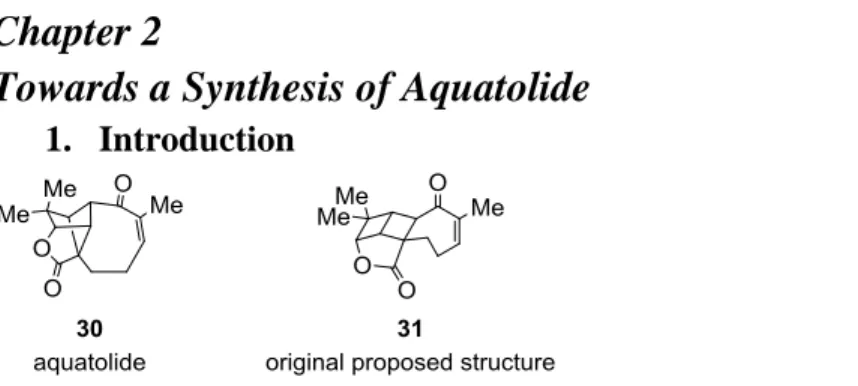
1. IntroductionFigure 5: Correct (left) and originally proposed (right) structures of aquatolide
Aquatolide 30 is a sesquiterpene lactone, originally isolated from the aquatic plant
Astericus aquaticus. Its structure was originally proposed as 31, but Lodewyk et al.(12) were able to determine the correct structure. Recently, Hiemstra and his coworkers (13) were able to complete a total synthesis of this molecule, using a [2+2] photocycloaddition as the key step for the formation of the fused tricyclic core.
Scheme 2.1: Hiemstra synthesis of aquatolide
The goal of my latter work has been to attempt this same synthesis using similar chemistry but a novel approach. In approaching this synthesis, the target molecule was
considered as having two main structural motifs: first, the fused tricyclic core, which Hiemstra et al. achieved through the [2+2] photocycloaddition chemistry; and the eight-membered ring, which they achieved through an intramolecular aldol reaction. Therefore, it was decided that the first goal of this project would be to synthesize a model system for aquatolide, focusing on the tricyclic core rather than the eight-membered ring. Thus the first synthetic goal for this research work was structure 32, shown below.
Scheme 2.2: Planned [2+2] photocycloaddition synthesis of model system 32
2. Retrosynthesis
Scheme 2.3: Retrosynthesis of aquatolide model system 32
Retrosynthetically, model system 32 can be synthesized via a [2+2] photocycloaddition from 33, which is achievable through a number of steps culminating in a ring closing metathesis.
Ultimately, the precursors for these structures can be achieved through aldol addition chemistry.
3. Completed Work
Scheme 2.4: Attempts towards a synthesis of a dimethyl ester
45 was attempted with imidazole and catalytic DMAP in absolute ethanol, but was not able to be isolated in sufficient yield.
Scheme 2.5: Towards the synthesis of aldehyde 36
The previous step was repeated, with the addition of acrolein to thione 39 to yield thione
Chapter 3
Experimental Methods and Supporting Data for Chapter 1
10
(S)-4-isopropylthiazolidine-2-thione To a 1 L flask was added KOH (50.0 g, 891 mmol) and 300 mL of water. The solution was cooled to rt with an ice bath. L-valinol (15.3 g, 148 mmol) and CS2 (44 mL, 741 mmol) were added to the reaction. The reaction was heated, with stirring,
under reflux overnight. The reaction was then allowed to cool to rt and then extracted 3x with CH2Cl2 (125 mL). The combined organic layers were dried over Na2SO4 and condensed by the
removal of the solvent with a rotary evaporator. No purification was undertaken to yield the final product 10 (18.31 g, 85%).
7
(S)-1-(4-isopropyl-2-thioxothiazolidin-3-yl)propan-1-one In a 1 L flask, thiazolidinethione 10
(18.3 g, 113 mmol) was dissolved in 200 mL dry CH2Cl2 and cooled to 0 °C under argon with
stirring. Pyridine (11.4 mL, 141 mmol) was added via syringe. Propionyl chloride (11.9 mL, 136 mmol) was added dropwise via syringe, yielding a yellow solution. The reaction was allowed to stir at 0 °C for an additional 30 min, then allowed to return to rt and stirred overnight. The reaction was then washed with 100 mL DI water, and this aqueous layer was extracted with 50 mL CH2Cl2. The combined organic layers were washed with 1 N H2SO4, dried over MgSO4, and
condensed on a rotary evaporator to give a yellow oil. This crude product was purified by flash chromatography (10% EtOAc/ hexanes) to yield the final product, thione 7 (17.95 g, 73%). 1H NMR (CDCl3, 400 MHz, ppm) δ 5.16 (t, J = 6.8, 1H), 3.50 (m, 1H), 3.35 (m, 1H), 3.34 (m, 1H),
3.01 (m, 1H), 2.36 (m, 1H), 1.16 (t, J = 7.2, 3H), 1.05 (d, J = 6.8, 3H), 0.96 (d, J = 7.0, 3H).
1,1-dimethoxy-2-methylpropane A 50 mL volume of impure isobutyraldehyde was dried over MgSO4 and NaHCO3 and purified by distillation to give the dried, purified aldehyde. This
purified isobutyraldehyde (24.89 g, 345.2 mmol) was added to a 250 mL flask, along with 70mL of methanol, and cooled to 0°C. The flask was then allowed to return to rt, and TsOH∙H2O (3.28
g, 17.3 mmol) was added. The reaction stirred overnight at rt. The reaction was quenched with a solution of 10 mL saturated NaHCO3 in 140 mL water. The organic layer was collected, and the
aqueous layer extracted with pentane (2 x 100 mL, 1 x 50 mL). The combined organic layers were dried over MgSO4 and condensed. The crude product was purified by distillation to give
acetal 8 (19.67 g, 48%). 1H NMR (CDCl3, 400 MHz, ppm) δ 3.95 (d, J = 6.9, 1H), 3.34 (s, 6H),
1.88 (m, 1H), 0.91 (d, J = 6.7, 6H).
12
(2R,3R)-1-((S)-4-isopropyl-2-thioxothiazolidin-3-yl)-3-methoxy-2,4-dimethylpentan-1-one
Acylated thione 7 (15.9 g, 73.2 mmol) was dissolved in 366 mL CH2Cl2, under argon. The flask
was cooled to 0 °C, and TiCl4 (8.85 mL, 80.52 mmol) was added via syringe and allowed to stir
for 10 min, followed by i-Pr2NEt (14.02 mL, 80.52 mmol) dropwise via syringe. The dark red
reaction stirred for 1 h at 0 °C. After 1 h, the reaction was cooled to –78 °C, and SnCl4 (8.57 mL,
73.2 mmol) and acetal 8 (8.65 g, 73.2 mmol) were added via syringe. The reaction stirred for –78 °C for another 30 min, and then was transferred to –20 °C overnight. The reaction was quenched with saturated ammonium chloride solution, and the aqueous layer extracted 2x with CH2Cl2.
The combined organic layers dried over MgSO4 and evaporated. 1H NMR (CDCl3, 400 MHz,
ppm) δ 5.27 (t, J = 6.8, 1H), 5.09 (m, 1H), 3.44 (m, 2H), 3.38 (s, 3H), 2.97 (d, J = 11.4, 1H), 2.33 (m, 1H), 1.87 (m, 1H), 1.05 (m, 9H), 1.00 (d, J = 7.0, 3H), 0.89 (d, J = 6.8, 3H)
6
(2R,3R)-3-methoxy-2,4-dimethylpentanal In a flame dried 500 mL RBF cooled to –78 °C, thione 12 (7.42 g, 24.4 mmol) was dissolved in 244 mL dry CH2Cl2, with stirring, under argon. i
-Bu2AlH, 1 M in hexanes (48.8 mL, 48.8 mmol), was added slowly via syringe until the yellow
MgSO4 and evaporated. The crude product was purified by flash chromatography (10%
EtOAc/hexanes) to yield a colorless oil, aldehyde 6 (2.56 g, 82%). 1H NMR (CDCl3, 400 MHz,
ppm) δ 9.77 (d, J = 2.3, 1H), 3.42 (s, 3H), 3.10 (t, J = 5.65, 3H), 2.61 (m, 1H), 1.87 (m, 1H), 1.09 (d, J = 7.05, 3H), 0.94 (dd, J = 8.5, 6.9, 6H).
16
(1S,2R)-1-(((E)-3,5-di-tert-butyl-2-hydroxybenzylidene)amino)-2,3-dihydro-1H-inden-2-ol
In a 100 mL flame dried RBF equipped with a stir bar, (1S, 2R)-(-)-cis-1-amino-2-indanol (448 mg, 3.00 mmol) and 3,5-di-tert-butylsalicylaldhehyde (703 mg, 3.00 mmol) were dissolved in 18.8 mL absolute ethanol and stirred at rt for 2 h. The yellow solution was then condensed, re-dissolved in 18.8 mL of CH2Cl2, and condensed again. The flask was then placed under vacuum
to give the solid product, ligand 16. 1H NMR (CDCl3, 400 MHz, ppm) δ 8.62 (s, 1H), 7.46 (d, J
= 2.4, 1H), 7.32 (m, 2H), 7.21 (m, 3H), 4.85 (d, J = 5.3, 1H), 4.68 (q, J = 5.2, 1H), 3.25 (dd, J = 16.0, 5.8, 1H), 2.14 (dd, J = 16.0, 4.8, 1H), 2.49 (br, 1H), 1.43 (s, 9H), 1.33 (s, 9H).
18
S-(tert-butyl) (R)-2-methylpropane-2-sulfinothioate In a 3-neck 500 mL RBF, ligand 16 (472 mg, 1.29 mmol) and VO(acac)2 (337 mg, 1.27 mmol) were dissolved in 64 mL of acetone. The
resulting dark green mixture was stirred at rt open to air for 30 min. After 30 min, t-butylsulfide (50 mL, 254.8 mmol) was added, and the solution was cooled to ~4 °C. Once cooled, 30% H2O2
(32 mL, 396.8 mmol) was added over the course of 20 h, with stirring. At the end of the addition, the dark red solution was quenched at 0 °C by adding 75 mL saturated aqueous Na2S2O3 over the
course of 1 h. The resulting light teal mixture was tested with starch/iodine paper to confirm that no peroxide remained. The layers were separated and the aqueous layer was extracted 3x with hexanes. The combined organic layers were washed with brine, dried over Na2SO4, and
condensed, to yield thiosulfinate 18, an oil that was clean by NMR. 1H NMR (CDCl3, 400 MHz,
19
(R)-2-methylpropane-2-sulfinamide About 1.0 L of liquid NH3 was condensed into a flask at –
78°C and flushed with argon. Fe(NO3)3·9H2O (514.7 mg, 1.27 mmol) was added. Pieces of solid
metallic lithium (8.842 g, 1.274 mol) were added in ~1 g portions, slowly, with constant adjustment of the –78°C bath to control refluxing. After all the lithium was added, the reaction was allowed to reflux for 15 min then cooled to –78°C. Thiosulfinate 18 (99.05 g, 509.6 mmol) was dissolved in 163 mL dry THF and added to the reaction via addition funnel over 45 min, with vigorous stirring. The reaction was stirred at –78°C for another 1 h. The reaction was then allowed to return to rt overnight with slow stirring, under argon. The reaction was then cooled to 0°C, and ice (275.2 g, 15.29 mol) was added and stirred until mixture was homogenous.
Chloroacetic acid (52.97 g, 560.6 mmol) was added slowly and the reaction stirred at rt over 48 h. After 48 h, the dark red reaction was extracted 3x with 400 mL of CH2Cl2. The combined
organic layers were dried over MgSO4 and condensed. The resulting red solid was dissolved in
75 mL hexanes and condensed. This step was repeated once more before the resulting product was dried under vacuum to give a combination of white and red solids. The solid was then triturated with 125 mL hexanes. The precipitate was recrystallized in 75 mL of boiling hexanes, cooled to –20°C, and the solid collected by filtration. This recrystallization step was repeated once again to give a white solid product, sulfinamide 19 (34.25 g, 55.4%). 1H NMR (CDCl3, 400
MHz, ppm) δ 4.06 (s, 2H), 1.14 (s, 9H).
20
(Z)-N-(2-chloroethylidene)-2-methylpropane-2-sulfinamide In a 3-neck 1 L RBF, 220.7 g CuSO4∙5H2O was flame dried to yield grey solid. The flask was equipped with a mechanical
stirrer and placed under argon. To the flask was added 282.5 mL dry CH2Cl2, followed by
sulfinamide 19 (17.13 g, 141.3 mmol) and chloroacetaldehyde (29.6 mL, 169.5 mmol) via syringe. The resulting sea green solution was allowed to stir overnight. The reaction was then filtered over celite and the resulting dark orange filtrate was dried over MgSO4 and condensed to
give a crude product. This crude product was filtered through silica gel (25% EtOAc/hexanes) to give a final product imine 20 (17.44 g, 82%). 1H NMR (CDCl3, 400 MHz, ppm) δ 8.04 (t, J =
22
(S)-4-mesitylthiazolidine-2-thione Into a flame-dried 3-neck 1 L RBF with stirring under argon, the mesityl Grignard was prepared in 120 mL diethyl ether from mesityl bromide (36.86 mL, 240.85 mmol) and metallic Mg (5.85 g, 240.85 mmol). The flask was cooled to –78°C, and imine 20 (8.72 g, 48.17 mmol) in 241 mL toluene was added via addition funnel over 30 min. The reaction was allowed to stir for another 3 h. After 3 h, the reaction was quenched with 120.5 mL of 4 M aqueous HCl solution and stirred overnight at rt. The quenched reaction was
extracted 3x with water (100 mL). The combined layers were titrated to pH ~9 by the dropwise addition of 50% aqueous NaOH solution, with stirring, causing precipitation of a solid. The mixture was extracted 3x with diethyl ether (100 mL). The combined organic layers were dried over MgSO4 and condensed. This intermediate product was dissolved in minimal CH2Cl2 and
transferred to a 500 mL RBF, and condensed on a rotary evaporator to remove the solvent. To this flask was added 241 mL of 1 M aqueous KOH solution and then CS2 (14.5 mL, 240.85
mmol) via syringe. The flask was placed in an oil bath and allowed to stir, with heating, at reflux overnight. The reaction was then extracted 3x with CH2Cl2 (100 mL). The combined organic
layers were dried over MgSO4 and condensed to give the crude product 22 which was taken
forward (5.94 g, 52%). 1H NMR (CDCl3, 400 MHz, ppm) δ 7.30 (br, 1H), 6.88 (s, 2H), 5.84 (t, J
= 10.4, 1H), 3.66 (dd, J = 10.29, 1.2, 2H), 2.40 (s, 6H), 2.27 (s, 3H).
5
(S)-1-(4-mesityl-2-thioxothiazolidin-3-yl)ethan-1-one In a flame-dried 500 mL flask, thione 22
was dissolved in 100 mL CH2Cl2, under argon, with stirring. The flask was cooled to 0°C, and
excess triethylamine (16.8 mL, 120.5 mmol) was added via syringe. The flask was then allowed to return to rt and acyl chloride (2.14 mL, 30.02 mmol) was added via syringe and allowed to stir at rt overnight. The reaction was quenched with 100 mL of saturated aqueous NH4Cl solution
and extracted 2x with CH2Cl2 (50 mL). The combined organic layers were washed with 100 mL
DI water, and then dried over MgSO4 and condensed. The crude product was purified by flash
chromatography (7.5% EtOAc/hexanes) to give the final product thione 5 (5.35 g, 77%). 1H NMR (CDCl3, 400 MHz, ppm) δ 6.85 (s, 2H), 6.35 (t, J = 10.1, 1H), 3.55 (dd, J = 11.3, 10.4,
23
(3R,4S,5R)-3-hydroxy-1-((S
)-4-mesityl-2-thioxothiazolidin-3-yl)-5-methoxy-4,6-dimethylheptan-1-one In a flame-dried 250 mL RBF, thione 5 was dissolved in 87 mL dry CH2Cl2, with stirring, under argon. The flask was cooled to –78°C, and TiCl4 (2.12 mL, 19.17
mmol) was added via syringe. After stirring 5 min, i-Pr2Net (4.10 mL, 23.53 mmol) was added
via syringe, and the reaction stirred for 30 min. Aldehyde 6 was dissolved in minimal CH2Cl2
and added to the reaction, which was allowed to stir for 1 h. The reaction was quenched by the addition of 90 mL of half-sat ammonium chloride, with stirring, and allowed to return to rt. The mixture was extracted 3x with CH2Cl2 (100 mL). The combined organic layer was dried over
MgSO4 and condensed. The crude product was purified by flash chromatography (25%
EtOAc/hexanes) to give a yellow solid product, thione 23 (3.93 g, 55.4%). 1H NMR (CDCl3, 400
MHz, ppm) δ 6.83 (s, 2H), 6.39 (t, J = 9.95, 1H), 4.35 (m, 1H), 3.59 (m, 2H), 3.43 (s, 3H) 3.33 (dd, J = 11.28, 9.52, 1H), 3.24 (d, J = 2.54, 1H), 3.12 (dd, J = 17.21, 4.46, 1H), 2.82 (t, J = 5.86, 1H), 2.40 (s, 6H), 2.23 (s, 3H), 1.84 (m, 1H), 1.40 (m, 1H), 0.88 (dd, J = 14.98, 6.89, 6H), 0.77 (d, J = 6.81, 3H); 13C NMR (CDCl3, 100 MHz, ppm) δ 201.54, 174.28, 137.84, 132.77, 90.94,
68.15, 67.44, 62.05, 45.03, 38.64, 32.52, 30.52, 20.86, 20.36, 20.34, 20.31, 19.93, 17.42, 11.28; IR (thin film) ν 3480, 2968, 2872, 1713, 1610, 1456, 1260, 1174, 909, 729.
24
(3R,4R,5R)-1-((S
)-4-mesityl-2-thioxothiazolidin-3-yl)-5-methoxy-4,6-dimethyl-3-((triethylsilyl)oxy)heptan-1-one In a flame dried 50 mL RBF, thione 23 (3.39 g, 9.65 mmol) was dissolved in 20 mL of dry CH2Cl2, and the flask cooled to 0°C, with stirring and under
argon. To this was added 2,6-lutidine (2.26 mL, 19.3 mmol) followed by TES triflate (2.89 mL, 12.55 mmol). The reaction progress was monitored by TLC (10% EtOAc/90% hexanes), with points taken at 45 min and 75 min. After 75 min a further 300 μL TES triflate was added and stirred for an additional 15 min before being quenched with 20 mL saturated sodium bicarbonate solution and allowed to return to rt. The quenched reaction was extracted 3x with CH2Cl2. The
purified by flash chromatography (7.5% EtOAc/hexanes) to yield the final product 24 (5.03 g, 96%) with some contamination by 2,6-lutidine starting material by NMR. Unprotected thione starting material was recovered from the column by flushing with 30% EtOAc/hexanes. 1H NMR (CDCl3, 400 MHz, ppm) δ 6.84 (s, 2H), 6.38 (t, J = 10.09, 1H), 4.59 (m, 1H), 3.71 (dd, J = 17.84,
4.80, 1H), 3.56 (t, J = 10.88, 1H), 3.38 (s, 3H), 3.28 (m, 2H), 2.85 (d, J = 8.90, 1H), 2.44 (s, 6H), 2.25 (s, 3H), 1.73 (m, 1H), 0.98 (m, 16H), 0.63 (m, 14H); 13C NMR (CDCl3, 100 MHz, ppm) δ
200.71, 172.89, 137.74, 132.46, 129.01, 128.21, 125.30, 86.95, 68.09, 67.90, 60.72, 46.03, 39.51, 32.29, 26.92, 20.96, 20.71, 15.14, 9.89, 7.07, 6.81, 6.46, 5.54; IR (thin film) ν 3405, 2956, 2830, 2731, 2244, 1714, 1611, 1456, 1260, 850, 741.
4
(3R,4R,5R)-5-methoxy-4,6-dimethyl-3-((triethylsilyl)oxy)heptanal In a flame dried 250 mL RBF cooled to –78 °C, thione 24 (4.87 g, 9.34 mmol) was dissolved in 93.4 mL dry CH2Cl2,
with stirring, under argon. To this, 1 M i-Bu2AlH in hexanes (18.67 mL, 18.67 mmol) was added
via syringe. The yellow color of the solution persisted, so another 3 mL (3 mmol) of i-Bu2AlH in
hexanes was added. The reaction was allowed to stir for 3 min, and then was quenched by addition to saturated Rochelle salt solution. The quenched reaction mixture was stirred
vigorously at room temperature for 45 min. The aqueous layer was extracted 3x with CH2Cl2 and
the combined organic layers washed first with DI water and then with brine. The final organic layers were dried over MgSO4 and condensed. The crude product was purified by flash
chromatography (5% EtOAc/hexanes) to give the final product aldehyde 4 (1.52 g, 53%). 1H NMR (CDCl3, 400 MHz, ppm) δ 9.78 (t, J = 2.5, 1H), 4.60 (td, J = 6.3, 2.5, 1H), 3.47 (s, 3H),
2.95 (dd, J = 8.6, 2.9, 1H), 2.61 (m, 2H), 1.86 (m, 1H), 1.55 (m, obscured by HOH peak), 0.97 (m, 15H), 0.84 (t, J = 7.0, 6H), 0.62 (q, J = 8.0, 6H); 13C NMR (CDCl3, 100 MHz, ppm) δ
201.37, 87.38, 67.57, 61.01, 50.84, 42.27, 30.16, 21.04, 15.71, 10.68, 7.00, 6.49, 5.55; IR (thin film) ν 2958, 2877, 2718, 1730, 1461, 1385, 1299, 1093, 1009, 742.
25
(2S,3R,5R,6R,7R)-1-((S )-4-benzyl-2-thioxothiazolidin-3-yl)-2-ethyl-3-hydroxy-7-methoxy-6,8-dimethyl-5-((triethylsilyl)oxy)nonan-1-one In a flame dried 250 mL RBF, thione auxiliary
3 (1.404 g, 5.02 mmol) was dissolved in 50 mL dry CH2Cl2 and cooled to 0°C, under argon, with
i-Pr2NEt (1.84 mL, 10.54 mmol) was added, and the reaction stirred for 30 min. After 30 min,
the reaction was cooled to –78°C and NMP (0.603 mL, 6.28 mmol) was added and the reaction stirred another 10 min. Aldehyde 4 was dissolved in 5 mL CH2Cl2 and added to the reaction, and
stirred for 1 h. The reaction was quenched with half-sat ammonium chloride, and extracted 3x CH2Cl2. The combined organic layers were dried over MgSO4 and condensed. The crude product
was purified by flash chromatography (15% EtOAc/hexanes) to give the yellow final product 25
(1.59 g, 54%). 1H NMR (CDCl3, 400 MHz, ppm) δ 7.30 (m, 5H), 5.33 (m, 1H), 4.90 (m, 1H),
4.16 (m, 1H), 4.11 (m, 1H), 3.48 (d, J = 10.2, 1H), 3.48 (s, 1H), 3.34 (dd, J = 11.3, 7.0, 1H), 3.25 (m, 2H), 3.07 (dd, J = 13.1, 10.7), 2.87 (m, 2H), 1.99 .. 1.60 (br m, 7H), 0.79 (m, 16H), 0.87 (m, 6H), 0.63 (m, 6H); 13C NMR (CDCl3, 100 MHz, ppm) δ 201.89, 176.40, 136.78, 129.58, 129.04,
127.33, 87.88, 71,93, 70.45, 69.53, 60.62, 50.62, 40.87, 39.94, 37.02, 32.01, 30.18, 21.37, 20.19, 16.56, 12.02, 11.91, 7.16, 5.51; IR (thin film) ν 3437, 2959, 2875, 2359, 1696, 1456, 1340, 1264, 1164, 742.
26
(2S,3R,5R,6R,7R)-1-((S )-4-benzyl-2-thioxothiazolidin-3-yl)-2-ethyl-7-methoxy-6,8-dimethyl-3,5-bis((triethylsilyl)oxy)nonan-1-one Thione 25 (1.59 g, 2.73 mmol) was dissolved in 14 mL of dry CH2Cl2, and the flask cooled to 0°C, with stirring and under argon. To this was added
2,6-lutidine (0.639 mL, 5.46 mmol) followed by TES triflate (0.907 mL, 4.01 mmol). The reaction stirred at room temperature for 30 min. The reaction progress was checked by TLC (10% EtOAc/90% hexanes) and an additional 0.64 mL (5.5 mmol) of 2,6-lutidine and 0.91 mL (4.1 mmol) of TES triflate were added. The reaction stirred for an additional 15 min before being quenched with 20 mL saturated sodium bicarbonate solution and allowed to return to rt. The quenched reaction was extracted 3x with CH2Cl2. The combined organic fractions were dried
over MgSO4 and condensed. The crude product was purified by flash chromatography (1.5%
EtOAc/hexanes) to yield the final product 26 (1.52 g, 80%). 1H NMR (CDCl3, 400 MHz, ppm) δ
7.31 (m, 5H), 5.24 (m, 1H), 4.75 (m, 1H), 4.10 (dd, J = 8.6, 4.5), 3.99 (q, J = 5.6, 1H), 3.46 (s, 3H), 3.33 (m, 2H), 3.06 (dd, J = 13.1, 10.9, 1H), 2.97 (dd, J = 9.5, 1.8, 1H), 2.85 (d, J = 11.4, 1H), 1.99 .. 1.76 (br m, 5H), 1.73 .. 1.62 (br m, 2H), 1.56 (m, 1H), 0.97 (m, 28H), 0.81 (dd, J = 32.2, 6.8, 6H), 0.64 (m, 14H), 0.52 (q, J = 8.0, 1H); 13C NMR (CDCl3, 100 MHz, ppm) δ 201.13,
2
(2S,3R,5R,6R,7R)-2-ethyl-7-methoxy-6,8-dimethyl-3,5-bis((triethylsilyl)oxy)nonanal Thione
26 (1.52 g, 2.18 mmol) was dissolved in 22 mL dry CH2Cl2, in a flame dried 50 mL RBF under
argon, and cooled to –78°C. i-Bu2AlH (4.80 mL, 4.80 mmol) was added via syringe. After all the
yellow color had disappeared, the reaction was quenched by addition to sat. Rochelle salt, with vigorous stirring, and allowed to stir for 1 h. The quenched reaction was then extracted 3x with CH2Cl2, and the combined organic layers washed with DI water and with brine. The organic
layer was dried over MgSO4 and condensed. This crude product was filtered through silica gel
with 2.5% EtOAc/hexanes to give a clear oil for the pure product 2 (0.645 g, 61%). 1H NMR (CDCl3, 400 MHz, ppm) δ 9.71 (s, 1H), 4.12 (td, J = 7.1, 2.5, 1H), 3.99 (t, J = 7.3, 1H), 3.44 (s,
3H), 2.96 (dd, J = 9.6, 1.9, 1H), 2.17 (d, J = 9.4, 1H), 1.81 (m, 4H), 1.56 .. 1.41 (br m, 2H), 0.94 (m, 26H), 0.79 (dd, J = 23.7, 6.9, 6H), 0.59 (m, 13H); 13C NMR (CDCl3, 100 MHz, ppm) δ
205.29, 86.76, 69.50, 69.12, 61.44, 57.81, 40.39, 40.17, 30.02, 21.29, 16.25, 15.04, 12.78, 9.31, 7.21, 7.10, 6.98, 6.95, 6.59, 6.01, 5.27; IR (thin film) ν 2958, 2877, 2829, 2713, 2360, 1725, 1450, 1090, 1007, 742.
28
Ethyl (4R,5R,7R,8R,9R,Z )-4-ethyl-9-methoxy-8,10-dimethyl-5,7-bis((triethylsilyl)oxy)undec-2-enoate Phosphonate ester 27 (550 mg, 1.72 mmol) was dissolved in 9 mL THF in a 50 mL RBF under argon, with stirring. NaI (197.7 mg, 1.319 mmol) was added and the reaction cooled to 0°C. After 5 min, NaH as a 60% dispersion in mineral oil (75 mg, 1.88 mmol) was added and stirred for 15 min. After 15 min, the reaction was cooled to –78°C, and aldehyde 2 (645 mg, 1.319 mmol) dissolved in 3 mL THF was added. The reaction, having turned yellow, was warmed to 0°C and stirred for 1.5 h. The cloudy yellow reaction was quenched with 15 mL sat ammonium chloride solution. The resulting orange mixture was worked up with diethyl ether, dried over MgSO4, and condensed. The crude product was purified by flash chromatography (2%
EtOAc/hexanes) to give an off-clear oil for the final pure product 28 (546 mg, 74%). 1H NMR (CDCl3, 400 MHz, ppm) δ 6.11 (dd, J = 11.6, 10.4, 1H), 5.82 (d, J = 11.7, 1H), 4.13 (m, 3H),
61.40, 59.81, 44.50, 41.31, 40.06, 30.13, 21.68, 21.46, 15.19, 14.41, 11.85, 9.44, 7.25, 7.20, 7.11, 6.10, 5.42; IR (thin film) ν 2958, 2911, 2876, 2830, 2733, 2359, 2342, 1723, 1644, 1459, 1414.
1
Pironetin analogue 1 Ester 28 (546 mg, 0.978 mmol) was dissolved in a solvent system
composed of 9 mL benzene plus 1 mL of MeOH in a 100 mL RBF. PPTS (25 mg, 0.0978 mmol) was added and allowed to stir 30 min. The reaction was then heated to 70°C and stirred for 2 h. The reaction was monitored by TLC (5% EtOAc/hexanes; 20% EtOAc/hexanes; 40%
EtOAc/hexanes) at time points after 30 min at rt and then every 15 min starting after 1 hr at 70°C. After 2 h at 70°C, the solvent was removed by rotary evaporation. The crude product was purified by flash column chromatography (30% EtOAc/hexanes → 40% EtOAc/hexanes → 75% EtOAc/hexanes) to obtain pironetin analogue 1 (132 mg, 47.5%). 1H NMR (CDCl3, 400 MHz,
ppm) δ 6.99 (dd, J = 9.7, 6.0, 1H), 6.0 (d, J = 9.8, 1H), 4.72 (m, 1H), 4.22 (t, m, 1H), 3.47 (s, 3H), 3.23 (br, 1H), 2.82 ( dd, J = 8.1, 3.1), 2.26 (m, 1H), 1.96 (m, 1H), 1.69 (m, 5H), 1.48 (m, 1H), 0.99 (m, 9H), 0.86 (d, J = 6.8, 3H); 13C NMR (CDCl3, 100 MHz, ppm) δ 164.91, 150.87,
Chapter 4
Experimental Methods and Supporting Data for Chapter 2
44
1-((R)-4-benzyl-2-thioxothiazolidin-3-yl)-3-hydroxy-2-methylpent-4-en-1-one Propanone thione 39 (10 g, 37.7 mmol) was dissolved in 377 mL dry CH2Cl2 and cooled to 0°C, under
argon, with stirring. TiCl4 (4.56 mL, 41.4 mmol) was added via syringe and the reaction stirred 5
min. i-Pr2NEt (13.8 mL, 79.2 mmol) was added via syringe and the reaction stirred 30 min. NMP
(4.52 mL, 47.1 mmol) was added, and the reaction cooled to –78°C and stirred for 10 min. After 10 min, acrolein 40 (2.52 mL, 37.7 mmol) was added and the reaction stirred 1 h. The reaction was quenched with half-saturated ammonium chloride and allowed to return to room
temperature. The reaction was extracted 3x with CH2Cl2 and the organic layers dried over
Na2SO4. The crude product was purified by flash column chromatography (10% EtOAc/hexanes
→ 15% EtOAc/hexanes) to give a yellow oil as the final product 44 (5.4 g, 45%). 1H NMR (CDCl3, 400 MHz, ppm) δ 7.34 (m, 2H), 7.27 (m, 3H), 5.84 (m, 1H), 5.33 (dd, J = 17.3, 1.1, 1H),
5.33 .. 5.27 (m, 1H), 5.21 (dd, J = 10.6, 0.8, 1H), 4.57 (m, 1H), 4.47 (m, 1H), 3.39 (dd, J = 11.5, 7.2, 1H), 3.23 (dd, J = 13.1, 3.7, 1H), 3.05 (m, 1H), 2.90 (d, J = 11.5, 1H), 2.18 (br, 1H), 1.25 (d, J = 6.8, 3H).
38
Isobutyl 3-hydroxy-2-methylpent-4-enoate Thione 44 (5.4 g, 16.8 mmol) was dissolved in 40 mL dry CH2Cl2, with stirring. Imidazole (1.72 g, 25.2 mmol) and isobutanol (15.5 mL, 168.0
mmol) were added, and the reaction stirred overnight, under argon, at rt. The reaction was quenched with DI water and extracted 2x with CH2Cl2. The combined organic layers were dried
over Na2SO4 and the solvent evaporated, causing off white solid to appear. This crude product
was diluted in hexanes and minimal EtOAc, and washed 2x with 1 M NaOH solution. The organic layer was again condensed. This crude product was purified by flash column
chromatography (10% EtOAc/hexanes) to give the final product 38 (1.95 g, 62%). 1H NMR (CDCl3, 400 MHz, ppm) δ 5.84 (m, 1H), 5.32 (dt, J = 17.2, 1.53, 1H), 5.21 (dt, J = 10.6, 1.5,
46
Isobutyl 3-hydroxy-2,2-dimethylpent-4-enoate A flame-dried 3 neck 250 mL RBF was equipped with a stir bar, addition funnel, argon line, and low-temperature thermometer. Freshly-distilled diisopropylamine (4.40 mL, 31.41 mmol) and 55 mL freshly-Freshly-distilled THF were added via syringe, and the flask cooled to –78°C. n-Butyllithium (16.4 mL, 26.18 mmol) was added dropwise via syringe, and the reaction stirred 40 min at –78°C. Ester 38 (1.95 g, 10.47 mmol) was dissolved in 15 mL dry freshly-distilled THF and added dropwise via addition funnel over 10 min. The reaction was then warmed to –20°C and stirred 30 min. After 30 min, the reaction was cooled again to –78°C, and iodomethane (6.42 mL, 104.7 mmol) was added via syringe, and the flask was placed in a –20°C freezer for 2.5 days. The reaction was quenched with 1:1 (v:v) acetic acid:diethyl ether. The quenched reaction was allowed to return to rt, with stirring, and then was poured into 200 mL 1:1 diethyl ether:water mixture. This was extracted 3x with diethyl ether (50 mL), and the combined organic layers dried over Na2SO4. 1H NMR of the crude
product looked clean for the expected product so no purification was undertaken and the crude product was taken forward as ester 46 (1.81 g, 86%). 1H NMR (CDCl3, 400 MHz, ppm) δ 5.86
(m, 1H), 5.31 (dt, J = 17.1, 1.5, 1H), 5.22 (dt, J = 10.4, 1.4, 1H), 4.17 (dt, J = 6.5, 1.1, 1H), 3.88 (d, J = 6.6, 2H), 2.42 (br s, 1H), 1.95 (m, 1H), 1.20 (s, 3H), 1.18 (s, 3H), 0.94 (d, J = 6.7, 6H).
37
Isobutyl 3-((tert-butyldimethylsilyl)oxy)-2,2-dimethylpent-4-enoate Ester 46 (1.81 g, 9.04 mmol) was dissolved in 100 mL. TBSCl (1.51 g, 10.0 mmol) and imidazole (1.28 g, 18.8 mmol) were added and the reaction stirred for 3 d. An additional 1 g and an additional 0.85 g of
imidazole were added and the reaction stirred overnight. The reaction was quenched with 100 mL of water, and then extracted 2x with CH2Cl2. The combined organic layers were dried over
Na2SO4 and condensed. This crude product was purified by flash column chromatography (10%
EtOAc/hexanes) to give the final product ester 37 (1.35 g, 48%). 1H NMR (CDCl3, 400 MHz,
References
1. Yoshida, T.; Koizumi, K.; Kawamura, Y.; Matsumoto, K.; Itazaki, H. Japanese Patent Kokai 5-310726, 1993; European Patent 60389 A1 1993.
2. Kobayashi, S.; Tsuchiya, K.; Harada, T.; Nishide, M.; Kurokawa, T.; Nakagawa, T.; Shimada, N.; Iitake, T.; Kobayashi, K. J.Antibiot. 1994, 47, 697.
3. Kondoh, M.; Usui, T.; Kobayashi, S.; Tsuchiya, K.; Nishikawa, K.; Kiyohiro, N.; Nishikiori, T.; Mayumi, T.; Osada, H. Cancer Lett. 1998, 126, 29.
4. Usui, T.; Watanabe, H.; Nakayama, H.; Tada, Y.; Naoi, K.; Kondoh, M.; Asao, T.; Takio, K.; Watanabe, H.; Nishikawa, K.; Kitahara, T.; Osada, H. Chem. Biol. 2004, 11, 799. 5. Crimmins, M. T.; Dechert, A. R. Org. Lett.2009, 11, 1635.
6. Bressy, C; Vors, J; Hillebrand, S; Arseniyadis, S; Cossy, J. Angew. Chem. Int. Ed.2008,
47, 10137.
7. Schmitt, A-M. R. D. Ph.D. Dissertation, The University of North Carolina at Chapel Hill, Chapel Hill, NC, 2011.
8. Enders, D; Dhulut, S; Steinbusch, D; Herrbach, A. Chem. Eur. J.2007, 13, 3942.
9. Paños, J.; Díaz-Oltra, S.; Sánchez-Peris, M.; García-Pla, J.; Murga, J; Falomir, E.; Carda, M.; Redondo-Horcajo, M.; Fernando Díaz, J.; Barasoain, I.; Alberto Marco, J. Org. Biomol. Chem. 2013, 11, 5809.
10.Crimmins, M. T.; Chaudhary, K. Org. Lett.2000,2, 775-777. 11.Crimmins, M. T.; Shamszad, M. Org. Lett. 2007,9, 149-152.
12.Lodewyck, M. W.; Soldi, C.; Jones, P. B.; Olmstead, M. M.; Rita, J.; Shaw, J. T.; Tantillo, D. J. J. Am. Chem. Soc. 2012,134, 18550-18553.