Medium-Term Impacts of Hurricane Matthew on Water Quality:
Assessing Fecal Source Tracking Markers
Rachel Lempp
Honors Thesis
Department of Environmental Sciences and Engineering Gillings School of Global Public Health
The University of North Carolina at Chapel Hill March 28, 2018
Committee Members: Advisor: Jill Stewart, PhD
ABSTRACT
Hurricane Matthew caused heavy flooding in eastern North Carolina in October 2016, raising concerns about impacts on local water quality. Beginning in December 2016, samples were collected from paired surface water, well water, and tap water sites in Robeson County. Samples (n=120) were collected on ten sampling dates between December 2016 and August 2017 and were used to assess water connectivity and water quality and to determine duration of impacts. This sub-study focused on testing samples for microbial source tracking (MST) markers to identify possible sources of fecal contamination. We used a novel duplex droplet digital polymerase chain reaction (ddPCR) assay to simultaneously determine gene copy numbers of swine (Pig-2-bac) and human (HF183) MST markers. Results showed detection of human markers in 30% (n=47) of surface water samples at an average concentration of 43 gene copies of HF183 per 100 mL of water. Human markers were found persistently at site 3B on 100% of sampling dates (n=10). No swine markers were found in any samples. Tested well and tap water samples were all negative for the targeted MST markers, suggesting that flooding from
Hurricane Matthew did not have medium-term impacts on human or swine fecal contamination in drinking water. The ddPCR assay developed here shows promise for environmental
ACKNOWLEDGMENTS
This project would not have been possible without the support of Dr. Jill Stewart and the
entire Stewart Laboratory of the Department of Environmental Science and Engineering. I would
especially like to thank Elizabeth Christenson for her constant guidance, support and assistance
throughout the project. Thank you to the Juliano lab for the generous use of space and
equipment, as well for providing advice and instructions. I would like to thank the members of
my ENVR 684 class for review during writing process. Thank you to Dr. Jason Surratt for
serving on my committee. Thank you to my family for their support and encouragement. This
study was supported by the U.S. National Science Foundation, awards 1712176 and
EAR-1712345 (PI: Diego Riveros-Iregui). This project was supported by the Honors Undergraduate
TABLE OF CONTENTS
List of Tables ... 6
Introduction ... 7
Objective ... 10
Literature Review... 11
Materials and Methods ... 18
Results ... 22
Discussion ... 24
Conclusions ... 28
LIST OF TABLES
INTRODUCTION
In early October 2016, Hurricane Matthew made landfall in North Carolina (NC), delivering heavy rainfall exceeding 340 millimeters in some locations (Musser et al 2017). In eastern and central NC, heavy flooding caused an estimated $1.5 billion dollars in damage to state infrastructure and the agricultural industry (Burton 2016). In particular, Robeson County in eastern NC was inundated when the Lumber River and nearby wetlands flooded, causing
extensive damages (Musser et al 2017).
Land use management practices associated with anthropogenic activities can amplify the effects of natural disturbances such as hurricanes. Intensive production of livestock animals such as swine, cattle, and poultry in a floodplain can cause significant damage to stream systems in the event of catastrophic flooding. North Carolina is the second largest hog producer in the United States, and nearly all hog production facilities are located in eastern NC (USDA 2012). Robeson County is home to more than twice the number of hogs than it is people, with more than 320,000 hogs counted in 2012 (USDA 2012). Most hogs are raised in concentrated animal
feeding operations (CAFOs) in which thousands of animals are raised in enclosed, indoor facilities. One 450 kg swine produces between 27 and 38 kg of waste per day, compared to the less than half a kilogram of waste produced by one human (Chastain et al 2003). Swine waste is typically partially treated on-site in an open waste lagoon and subsequently sprayed on nearby fields as a soil conditioner.
Floyd in September of 1999 revealed elevated levels of fecal indicator bacteria Escherichia coli above the U.S. Environmental Protection Agency’s standard for surface water (Bales et al 2000). Possible sources of this fecal contamination were identified as flooded animal waste lagoons throughout eastern NC. Additionally, municipal wastewater treatment plants were overwhelmed by floodwaters after Hurricane Floyd, raising concerns that contamination by human fecal matter occurred as a result of the storm (Bales et al 2000).
Human waste can enter water systems due to flooding of municipal treatment plants located in floodplains. One wastewater treatment plant located in St. Pauls, NC in Robeson County was flooded after Hurricane Matthew, resulting in sewer overflows (NCEM 2017). Human fecal contamination of floodwater can also occur through disruption of septic systems sited in areas prone to flooding (Mallin et al 2002). In NC, almost 50 percent of households use septic systems, and this percentage is even higher in rural areas (U.S. Census Bureau 1990). Contamination of well water and subsequent human health effects have been linked to proximity to septic systems (Beller et al 1997). Flooding can damage septic tanks, causing the release of human fecal matter into the surrounding soil.
cross-contamination of surface, well, and tap water (Phanuwan et al 2006). Additionally, the medium-term impacts of flooding on water systems are not well-understood when compared to immediate or long-term impacts.
Beginning in December 2016, paired surface water, well water and tap water samples were collected over nine months in Robeson County to assess water connectivity, water quality and duration of impacts. Initial studies measured in-situ water quality parameters including specific conductivity, pH, and water temperature. Additionally, fecal indicators including total coliforms and Escherichia coli were enumerated as metrics of fecal contamination, and nitrate and mercury levels were measured. This sub-study focused on determining the possible sources of fecal contamination using microbial source tracking (MST). We implemented a novel
application of duplex droplet digital PCR (ddPCR) for amplification of MST markers to identify human and swine sources of fecal contamination in water samples. The project served to
OBJECTIVE
The objective of this study was to measure paired surface, well and tap water samples for human and swine fecal markers to assess medium-term impacts of flooding after Hurricane Matthew. The sub-study was part of a larger project designed to assess water quality and water connectivity in eastern North Carolina after a major flooding event. The overall study measured physical water characteristics, concentrations of fecal indicator bacteria (i.e. total coliforms and E. coli) and levels of chemical contaminants. This sub-study focused on fecal contamination,
LITERATURE REVIEW
As the effects of global climate change intensify, extreme weather events including hurricanes will increase in both frequency and severity (Goodess 2013). Intense rainfall events from hurricanes can result in catastrophic flooding, especially in low-lying floodplains. As floods move, they carry with them a large amount of material that eventually enters the water system, impacting water quality. Floods can carry elevated levels of contaminants from agricultural runoff, flooded waste-water treatment systems, and compromised animal waste lagoons (Bales et al 2000). Identifying specific sources of contamination is necessary to inform effective
remediation of contaminated waters and to protect public health. Methods for identifying and monitoring contamination have continued to improve over time.
Impacts of flooding on water quality
During and after flooding events, significant quantities of contaminants enter aquatic ecosystems, potentially impacting both ecosystem health and human health. Indicators such as nutrients, trace metals, dissolved and suspended organic carbon, dissolved oxygen
concentrations, water temperature and specific conductivity are commonly used to assess stream ecosystem health. Hurricanes can markedly increase the amount of organic litter entering a stream system as riverbanks and surrounding areas are defoliated by high winds and flooding. An increase in the nitrogen and phosphorus load in a water system may lead to eutrophication, which can cause waters to become hypoxic (Bales et al 2000). While floodwaters can dilute the effect of these nutrients in the immediate ecosystem, coastal estuarine ecosystems can experience devastating algal blooms and disease among fish populations as a result (Paerl et al 2001).
organisms (Mallin et al 2002). Extreme weather events and subsequent flooding are also
associated with increases of pathogens in water, such as Cryptosporidium and Giardia (Young et al 2015). There are many documented physical and chemical effects of flooding on water quality, but this study focuses specifically on microbial contaminants from fecal sources.
Microbial contamination from fecal sources
Land use management practices can amplify the effects of natural disturbances such as hurricanes. Intensive production of livestock animals including swine, cattle, and poultry in a floodplain can damage stream ecosystems in the event of catastrophic flooding. Concentrated animal feeding operations (CAFOs) in which thousands of animals are raised in densely
populated indoor facilities generate a large amount of waste that must be managed. One 450 kg swine produces between 27 and 38 kg of waste per day, compared to the less than half a
kilogram of waste produced by one human (Chastain et al 2003). In North Carolina and elsewhere, the waste is typically stored in on-site lagoons for anaerobic breakdown and
Fecal contamination from human sources represents an additional concern during
flooding events. Loss of electricity during storms can disrupt operations at wastewater treatment facilities, resulting in the diversion of large amounts of untreated or partially treated sewage into waters (Mallin et al 1999). Human waste can also enter ecosystems through flooding of
municipal treatment plants and septic systems located in areas prone to flooding (Mallin et al 2002). Municipal wastewater treatment plants were overwhelmed by floodwaters after
Hurricane Floyd, raising concerns that contamination by human fecal matter occurred as a result of the storm (Bales et al 2000). The damages caused to septic systems to due flooding and the subsequent effects on local water quality are difficult to assess due to lack of information because of low regulation of on-site treatment systems.
Cross-contamination of tap, well and surface water
Intense flooding events can result in cross-contamination of surface, well, and tap water (Phanuwan et al 2006). The possibility of cross-contamination depends on the hydrogeography of the area where the flooding occurs. For example, underground karstic systems are more vulnerable to contamination by floodwaters than protected aquifers (Dura et al 2010). A study in Thailand used patterns of contamination by certain pathogens to determine if floodwater
contaminated tap water. Results indicated that tap water and filtered water samples contained high levels of bacteria, a finding connected to an extensive diarrhea outbreak
surface water impacts or human health outcomes. Very few studies have simultaneously examined paired surface, tap, and well water samples.
Identifying sources of microbial contamination
Fecal contamination of environmental waters can result in the release of a variety of pathogens, so individual tests for each pathogen are not feasible. Instead, indicator
microorganisms serve as useful tools to confirm the presence of fecal contamination because they are abundant, easily detectable, and normally do not pose a health risk to humans (Lin and Ganesh 2013). For several decades, fecal indicator bacteria (FIB) have been used to test for the presence of fecal contamination, but this method presents several important limitations. First, each indicator microorganism must be tested individually, requiring multiple techniques to each water sample. Additionally, while culturing indicator bacteria is useful for detecting fecal contamination, it fails to distinguish between different sources of fecal contamination, because FIB like E. coli are found in the guts of many warm-blooded animals, including humans and livestock (Field and Samadpour 2007). However, specific microorganisms are associated with the gastrointestinal tracts of certain animals and capitalizing on these relationships can be useful in microbial source tracking (MST).
Microbial source tracking is a powerful tool used to determine the presence of highly specific and sensitive host-specific markers in environmental samples. MST methods can be dependent, or as the product of more recent developments in the field,
collected, cultured, and assessed for their genotypic and phenotypic characteristics (Field and Samadpour 2007). Library-independent molecular methods enable assaying for genetic markers directly from an environmental sample using PCR or other molecular tests and are much less time-consuming than traditional library-dependent methods (Field and Samadpour 2007).
The Bacteroides-Prevotella species represent useful indicator organisms because of their abundance in the fecal matter of both humans and animals. However, Bacteroidales are
anaerobic and therefore difficult to culture. Molecular methods facilitate the use of this group of bacteria in MST without the need to culture environmental samples. Bernhard and Field (2000) designed specific Bacteroides-Prevotella 16S rRNA markers for humans and cows and found that these markers were useful for distinguishing human and ruminant fecal pollution in
environmental samples. Subsequently, 16S rRNA markers have been developed for a variety of fecal Bacteroidales including human, cow, dog, pig and other animal-specific markers (Kildare et al 2007, Okabe et al 2007). PCR detection of Bacteroidales markers is now an important MST tool because of its demonstrated accuracy, precision and quick turnaround time (Mieszkin et al 2009).
Mieszkin and colleagues (2009) designed the pig-specific Bacteroidales marker “Pig-2-bac” using gene sequences obtained from swine feces and slurry samples. This marker was successful in identifying pig fecal pollution in target samples, and concentrations found in samples collected along the waste treatment process were correlated with E. coli cultures
surface waters proximal to swine feeding operations in North Carolina (Heaney et al 2015). Moreover, evaluation of Pig-2-bac against other DNA markers revealed excellent specificity and sensitivity (100%) in a study done in China (He et al 2016). Attempts to detect Pig-2-bac and HF183 in bovine, dog, chicken, duck and other fecal samples proved unsuccessful, confirming their specificity to pigs and human feces, respectively (He et al 2016). Other studies have shown Pig-2-bac to have 100% specificity, but reduced sensitivity, cross-reacting with dog and human fecal matter (Boehm et al 2013).
Bernhard and Field (2000) designed primers for the human-specific Bacteroidales marker “HF183.” The primers were tested for sensitivity using raw sewage samples and were found to be as sensitive as fecal coliform methods (Bernhard and Field 2000). Since its development, HF183 has become the most frequently used and well-tested human-specific marker for environmental water samples (Stewart et al 2013, Ahmed et al 2016). HF183 has high host specificity and sensitivity and can be reliably used to test both the presence and concentration of human fecal contamination in environmental samples (Ahmed et al 2016).
Droplet digital PCR
application to complex environmental water samples with mixed microbial populations, particularly in the poultry industry. In this study, ddPCR demonstrated enhanced detection of pathogen-specific genes in environmental samples as compared to more traditional qPCR
techniques (Rothrock Jr. et al 2013). More recently, ddPCR was successfully used to quantify the amount of a certain dinoflagellate in environmental samples (Lee et al 2017). Environmental samples often have very low concentrations of target pathogens and microorganisms, and ddPCR is more precise than qPCR at low concentrations (Cao et al 2016). ddPCR has the potential to be a reliable tool for detection of target microorganisms in environmental samples.
A study by Cao, Raith and Griffith (2016) examined the efficacy of a duplex ddPCR to simultaneously quantify Enterococcus and human fecal-associated marker HF183 by comparing the results against simplex ddPCR and traditional qPCR. The results of duplex ddPCR and simplex ddPCR were consistent, but ddPCR showed improved precision when compared to qPCR (Cao et al 2016). Duplex ddPCR presents lower labor and material costs when compared to running two simplex qPCR experiments, thereby providing information on multiple sources of contamination (Cao et al 2016). Additionally, data quality could be improved by reducing the error accumulated from multiple experiments. Limitations of ddPCR include lower upper quantification limits than qPCR, variable detection limits depending on experiment, and the possibility of underestimation of markers due to error in DNA extraction (Cao et al 2016). Regardless, application of ddPCR to assay for the presence of MST markers can greatly advance our understanding of contamination sources following flooding.
MATERIALS AND METHODS Study Sites
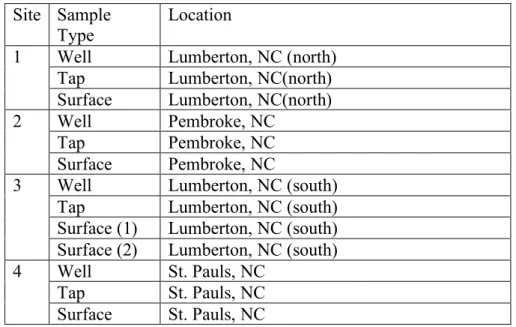
Paired water samples were collected from four sites in Robeson County, NC on ten sampling dates beginning in December 2016 following the landfall of Hurricane Matthew in October 2016 (Table 1). At each site, one surface, one well and one tap water sample were collected using standard sample collection technique, with the exception of site 3, where two surface water samples were collected. Additionally, one field blank was collected on each sampling date. In total, 35 well water samples, 47 surface water samples, 38 tap water samples and 10 field blanks were collected. Samples were transported on ice and stored at 4°C until sample processing.
Table 1. Descriptions of sampling sites.
Sample Preparation
The samples were filtered through 0.4 µm 47 mm EMD Millipore IsoporeTM Polycarbonate Membrane Filters (Fisher Scientific, Hampton, NH) within 24-48 hours of
Site Sample Type
Location
1 Well Lumberton, NC (north) Tap Lumberton, NC(north) Surface Lumberton, NC(north)
2 Well Pembroke, NC
Tap Pembroke, NC
Surface Pembroke, NC
3 Well Lumberton, NC (south) Tap Lumberton, NC (south) Surface (1) Lumberton, NC (south) Surface (2) Lumberton, NC (south) 4 Well St. Pauls, NC
collection. Up to 250 mL was filtered for surface water samples, while up to 500 mL was filtered for well and tap water samples. All filtrations were performed in duplicate.
Microbial DNA was extracted from each filter using PowerSoil® DNA Isolation Kit (MO Bio Laboratories, Carlsbad, CA) following manufacturer’s instructions with one modification: homogenization was performed using a high velocity Mini-Bead-Beater-16 (BioSpec, Burtlesville, OK) for 2 min rather than 10 min on the vortex mixer. One negative extraction control (NEC) was prepared for each of eight extraction dates. In total, 35 well water samples, 47 surface water samples, 38 tap water samples, 8 NECs, and 10 field blanks were prepared for droplet digital PCR.
Droplet digital PCR
Table 2. Primer and probe sequences used in ddPCR. Target ID
Name Forward Primer FP Reference Reverse Primer RP Reference
Probe Probe Reference Human HF183 ATCATG
AGTTCA CATGTC CG Bernhard and Field 2000 CTTCCT CTCAGA ACCCCT ATCC
Green et al
2014 VIC-CTAATG GAACGC ATCCC -MGB
Green et al 2014
Swine
Pig-2-bac GCATGAATTTAG CTTGCT AAATTT GAT
Mieszkin
et al 2009 ACCTCATACGGT ATTAAT CCGC
Mieszkin
et al 2009 6-FAM- TCCACG GGATAG CC -MGB
Mieszkin et al 2009
As in Cao, Raith and Griffith (2016), droplets were generated by mixing the reaction mixture (20 µL) with droplet generation oil (70 µL) in the Droplet Generator (Bio-Rad,
Hercules, CA). The droplet-containing mixture (40 µL) was transferred to the standard 96-well PCR plate, which was heat sealed with PX1 plate sealer (Bio-Rad) at 180°C. The plate was placed on a Bio-Rad T100TM thermal cycler for PCR amplification. Conditions for PCR were as follows: Initial denaturation for 10 min at 95°C followed by 40 cycles of 95°C for 0.25 min and 60°C for 1 min with a 2°C ramp, followed by 10 min at 98°C. At the conclusion of PCR, the temperature was held at 4°C. The plate was then transferred to a QX200 Droplet Reader (Bio-Rad) for measurement of fluorescence in each droplet in each well with the absolute
quantification (ABS) setting.
Data Analysis
All ddPCR data was analyzed using QuantasoftTM software according to the
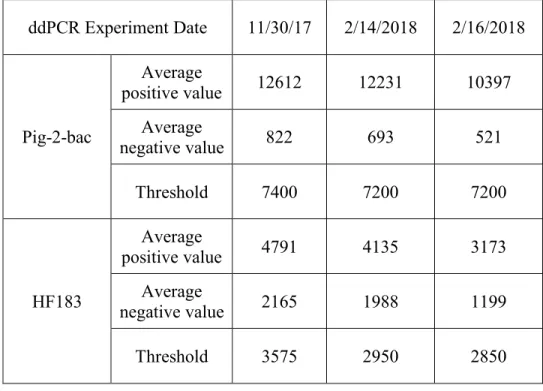
plate by averaging the lowest fluorescence value among the NTCs and the highest fluorescence value among the prepared positive standard. Wells with less than three positive droplets were considered negative.
Table 3. Maximum and minimum droplet fluorescence values and thresholds for each ddPCR experiment.
ddPCR Experiment Date 11/30/17 2/14/2018 2/16/2018
Pig-2-bac
Average
positive value 12612 12231 10397 Average
negative value 822 693 521
Threshold 7400 7200 7200
HF183
Average
positive value 4791 4135 3173
Average
negative value 2165 1988 1199
RESULTS
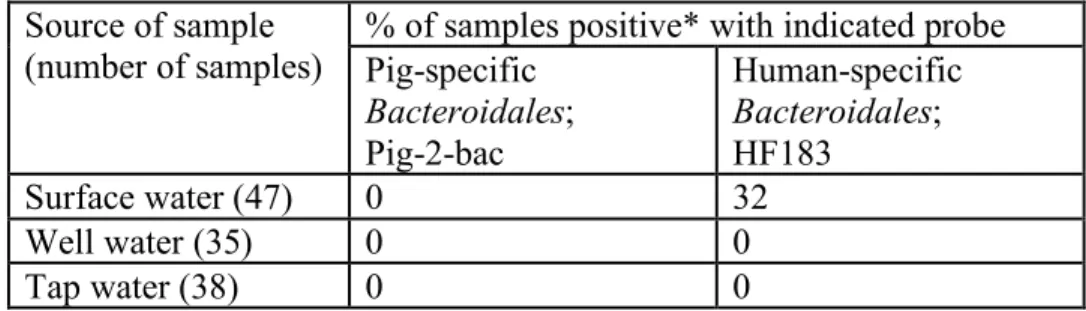
The purpose of this study was to determine the sources and concentration of fecal contamination in surface, well and tap water samples over nine months following flooding from Hurricane Matthew. We found no evidence of swine or human fecal contamination in well or tap water samples, but some evidence of human fecal contamination in surface water samples. Of the surface water samples, none tested positive for the pig-specific Pig-2-bac marker, while 32% tested positive for human-specific HF183 marker (Table 3). HF183 markers were found at least once in surface water samples at each of the four sites.
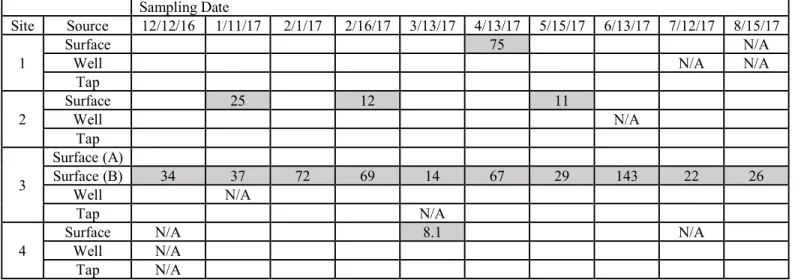
Over the nine-month sampling period, site 2 had three surface water samples total that contained HF183, with 25, 12, and 11 gene copies of the HF183 marker per 100 mL (Table 4). Surface water at site 3B contained the HF183 on 100% (n=10) of sampling dates. In this case, the number of gene copies of the HF183 marker ranged from 22 to 143 gene copies of HF183 per 100 mL, a persistent concentration of markers (Table 4). Sites 1 and 4 had one positive surface water sample each, with concentrations of 75 and 8.1 copies HF183 marker per 100 mL,
respectively. No human fecal contamination was found in well or tap water (Table 4). No swine markers were found in any surface, well or tap water samples. All field blanks and negative extraction controls were negative for both markers.
Table 4. Percentage of samples that tested positive* for Pig-2-bac and HF183 markers. Source of sample
(number of samples)
% of samples positive* with indicated probe Pig-specific
Bacteroidales; Pig-2-bac
Human-specific Bacteroidales; HF183
Surface water (47) 0 32
Well water (35) 0 0
*Positive results were indicated by a positive droplet count greater than 3 droplets above the threshold value as determined from the Standard positive droplet values for each ddPCR experiment.
Table 5. Copies of HF183 marker per 100 mL over ten sampling dates. None of the samples were positive for Pig-2-bac marker.
Sampling Date
Site Source 12/12/16 1/11/17 2/1/17 2/16/17 3/13/17 4/13/17 5/15/17 6/13/17 7/12/17 8/15/17
1
Surface 75 N/A
Well N/A N/A
Tap
2
Surface 25 12 11
Well N/A
Tap
3
Surface (A)
Surface (B) 34 37 72 69 14 67 29 143 22 26
Well N/A
Tap N/A
4
Surface N/A 8.1 N/A
Well N/A
Tap N/A
DISCUSSION
We used a novel duplex ddPCR method to simultaneously examine environmental samples for human-specific HF183 marker and swine-specific Pig-2-bac marker. Our results showed that no swine or human fecal contamination was found in well and tap water samples after flooding from Hurricane Matthew. All human fecal contamination was contained in surface waters, and the concentration of markers did not change within an order of magnitude with time. The lack of HF183 markers in well and tap water samples suggests flooding did not result in cross-contamination from surface water.
This study sought to understand the medium-term impacts of flooding on the quality of surface, well and tap water samples. For this reason, sampling began two months after Hurricane Matthew made landfall in North Carolina, and baseline information before the storm was not collected. It is difficult to ascertain whether the human fecal contamination found in surface waters was a direct result of flooding. The concentrations of human fecal markers remained constant in two sites consistently with no apparent relationship to time since flooding. It is more likely that the source of this contamination, possibly a leaking septic tank, was actively polluting during our sampling period in small amounts.
Matthew could have contaminated sites proximal to swine operations in other parts of Robeson County.
Our study employed a novel method to examine both swine and human fecal markers simultaneously using duplex droplet digital PCR (ddPCR). Cao et al (2016) compared the performance of duplex ddPCR with both simplex ddPCR and qPCR and found consistent results with improved precision compared to qPCR. Multiplexing also decreases labor and material costs, as well as reduces accumulated error from pipetting when compared to running two simplex ddPCR experiments (Whale et al 2013). This study successfully employed a unique ddPCR assay to quantify Pig-2-bac and HF183 markers.
There are some important limitations to duplex ddPCR. The upper quantification limit (UQL) of ddPCR has been found to be several orders of magnitude lower than qPCR. However, in environmental samples of ambient water such as those examined in this study, extremely high concentrations of target markers beyond the UQL were not encountered (Cao et al 2016).
Additionally, there is potential for error in methods of setting the threshold for detection (Dreo et al 2014). For this study, the threshold was set manually using data from the positive standard and no template control results, consistent with the methods of Dreo et al (2014), though other
It is possible that this interpretation of samples at the limit of detection could lead to a high false negative rate (Stewart et al 2013). If this study had set the lower limit of detection at zero, meaning that wells with one or more droplets above the threshold would be considered positive, the results would have been considerably different. With the limit set at three droplets above the threshold, HF183 was found in 32% of surface water samples, and no Pig-2-bac was found in any samples. With the limit set at zero, HF183 was found in 74% of surface water samples, 12% of well water samples and 18% of tap water samples (Table 6). Pig-2-bac was also found in 13% of surface water samples (Table 6). However, preliminary results from the portion of the study measuring fecal indicators total coliforms (TC) and E. coli were consistent with the results presented in this study using a limit of three droplets. All surface water samples contained detectable levels of fecal indicators TC and E. coli, and only one well water sample contained TC above the level of detection (Theo Jass, NCSU, personal communication). The consistency of the results of this study and the fecal indicator tests suggest that the lower limit of detection selected for this study was appropriate.
Table 6. Percentage of total samples (n shown in parentheses) that would have been considered positive if wells with 1-3 droplets above the threshold were included in the number of positive samples.
Sample Type Pig-2-bac (%) HF183 (%)
Surface (47) 13 74
Well (34) 0 12
Tap (38) 0 18
CONCLUSIONS
Our results suggest that human fecal contamination was limited to surface water samples and that the tested samples showed no evidence of swine fecal contamination. The concentration and duration of human fecal contamination appear to be independent of the flooding event. This study was the first to employ a novel application of duplex ddPCR to simultaneously test
environmental samples for human and swine fecal indicators. Researchers should further explore and evaluate the use of duplex ddPCR to determine sources of fecal contamination in
WORKS CITED
Ahmed, W., Hughes, B., & Harwood, V. J. (2016, May 31). Current status of marker genes of Bacteroides and related taxa for identifying sewage pollution in environmental waters. Water (Switzerland). Multidisciplinary Digital Publishing Institute.
https://doi.org/10.3390/w8060231
Bales, J. D., Oblinger, C. J., & Sallenger, A. H. J. (2000). Two months of flooding in eastern North Carolina, September - October 1999: Hydrologic water-quality, and geologic effects of Hurricanes Dennis, Floyd, and Irene. USGS, 51. Retrieved from
http://hdl.handle.net.libproxy.lib.unc.edu/2027/mdp.39015049374344
Beller, M., Ellis, A., SH, L., & al, et. (1997). Outbreak of viral gastroenteritis due to a
contaminated well: International consequences. JAMA, 278(7), 563–568. Retrieved from http://dx.doi.org/10.1001/jama.1997.03550070055038
Bernhard, A. E., & Field, K. G. (2000). A PCR assay to discriminate human and ruminant feces on the basis of host differences in Bacteroides-Prevotella genes encoding 16S rRNA. Applied and Environmental Microbiology, 66(10), 4571–4574.
https://doi.org/10.1128/AEM.66.10.4571-4574.2000
Boehm, A. B., Van De Werfhorst, L. C., Griffith, J. F., Holden, P. A., Jay, J. A., Shanks, O. C., … Weisberg, S. B. (2013). Performance of forty-one microbial source tracking methods: A twenty-seven lab evaluation study. Water Research, 47(18), 6812–6828.
https://doi.org/10.1016/j.watres.2012.12.046
Burkholder, J. M., Mallin, M. A., Glasgow, H. B., Larsen, L. M., McIver, M. R., Shank, G. C., Hannon, E. K. (1997). Impacts to a coastal river and estuary from rupture of a large swine waste holding lagoon. Journal of Environment Quality, 26(6), 1451.
https://doi.org/10.2134/jeq1997.00472425002600060003x
Burton, C. (2016, October 16). Hurricane Matthew floods in N.C. causing more than a billion in estimated damage. Retrieved from https://www.cbsnews.com/news/hurricane-matthew-floods-in-north-carolina-cause-more-than-a-billion-in-estimated-damage/
Cao, Y., Raith, M. R., & Griffith, J. F. (2015). Droplet digital PCR for simultaneous quantification of general and human-associated fecal indicators for water quality
assessment. Water Research, 70, 337–349. https://doi.org/10.1016/j.watres.2014.12.008 Chastain, J. P., Camberato, J. J., Albrecht, J. E., & Adams, J. (2003). Swine Manure Production
and Nutrient Content. CAMM Swine, 3.1-3.18. Retrieved from
https://www.clemson.edu/extension/camm/manuals/swine/sch3a_03.pdf
Dreo, T., Pirc, M., Ramšak, Ž., Pavšič, J., Milavec, M., Žel, J., & Gruden, K. (2014). Optimising droplet digital PCR analysis approaches for detection and quantification of bacteria: A case study of fire blight and potato brown rot. Analytical and Bioanalytical Chemistry, 406(26), 6513–6528. https://doi.org/10.1007/s00216-014-8084-1
Dura, G., Pándics, T., Kádár, M., Krisztalovics, K., Kiss, Z., Bodnár, J., Papp, E. (2010).
Environmental health aspects of drinking water-borne outbreak due to karst flooding: Case study. Journal of Water and Health, 8(3), 513–520. https://doi.org/10.2166/wh.2010.099 Field, K. G., & Samadpour, M. (2007). Fecal source tracking, the indicator paradigm, and
managing water quality. Water Research, 41(16), 3517–3538. https://doi.org/10.1016/J.WATRES.2007.06.056
Goodess, C. M. (2013). How is the frequency, location and severity of extreme events likely to change up to 2060? Environmental Science and Policy, 27, S4–S14.
https://doi.org/10.1016/j.envsci.2012.04.001
Green, H. C., Haugland, R. A., Varma, M., Millen, H. T., Borchardt, M. A., Field, K. G., Shanks, O. C. (2014). Improved HF183 quantitative real-time PCR assay for characterization of human fecal pollution in ambient surface water samples. Applied and Environmental Microbiology, 80(10), 3086–3094. https://doi.org/10.1128/AEM.04137-13
He, X., Liu, P., Zheng, G., Chen, H., Shi, W., Cui, Y., Zhang, X. X. (2016). Evaluation of five microbial and four mitochondrial DNA markers for tracking human and pig fecal pollution in freshwater. Scientific Reports, 6. https://doi.org/10.1038/srep35311
Heaney, C. D., Myers, K., Wing, S., Hall, D., Baron, D., & Stewart, J. R. (2015). Source tracking swine fecal waste in surface water proximal to swine concentrated animal feeding
operations. Science of the Total Environment, 511, 676–683. https://doi.org/10.1016/j.scitotenv.2014.12.062
Jass, Theo. (2018, February 14). NCSU. Personal communication.
Kildare, B. J., Leutenegger, C. M., McSwain, B. S., Bambic, D. G., Rajal, V. B., & Wuertz, S. (2007). 16S rRNA-based assays for quantitative detection of universal, human-, cow-, and dog-specific fecal Bacteroidales: A Bayesian approach. Water Research, 41(16), 3701– 3715. https://doi.org/10.1016/j.watres.2007.06.037
Lee, H.-G., Kim, H. M., Min, J., Kim, K., Park, M. G., Jeong, H. J., & Kim, K. Y. (2017). An advanced tool, droplet digital PCR (ddPCR), for absolute quantification of the red-tide dinoflagellate, Cochlodinium polykrikoides Margalef (Dinophyceae). ALGAE, 32(3), 189– 197. https://doi.org/10.4490/algae.2017.32.9.10
Lin, J., & Ganesh, A. (2013, December). Water quality indicators: Bacteria, coliphages, enteric viruses. International Journal of Environmental Health Research.
Mallin, M. A., Posey, M. H., McIver, M. R., Parsons, D. C., Ensign, S. H., & Alphin, T. D. (2002). Impacts and recovery from multiple hurricanes in a Piedmont-Coastal Plain river system. BioScience, 52(11), 999–1010.
https://doi.org/10.1641/0006-3568(2002)052[0999:IARFMH]2.0.CO;2
Mallin, M. A., Posey, M. H., Shank, G. C., McIver, M. R., Ensign, S. H., & Alphin, T. D.
(1999). Hurricane effects on water quality and benthos in the Cape Fear Watershed: Natural and anthropogenic impacts. Ecological Applications, 9(1), 350–362. Retrieved from
http://www.jstor.org/stable/2641190
Mieszkin, S., Furet, J. P., Corthier, G., & Gourmelon, M. (2009). Estimation of pig fecal contamination in a river catchment by real-time PCR using two pig-specific Bacteroidales 16S rRNA genetic markers. Applied and Environmental Microbiology, 75(10), 3045–3054. https://doi.org/10.1128/AEM.02343-08
Musser, J. W., Watson, K. M., & Gotvald, A. J. (2017). Characterization of peak streamflows and flood inundation at selected areas in North Carolina following Hurricane Matthew, October 2016. Open-File Report. https://doi.org/10.3133/ofr20171047
North Carolina Emergency Management (NCEM) (2017). Hurricane Matthew Resilient
Redevelopment Plan: Robeson County. 3.4-3.7. https://files.nc.gov/rebuildnc/documents /matthew/ rebuildnc_robeson_plan_combined.pdf
Okabe, S., Okayama, N., Savichtcheva, O., & Ito, T. (2007). Quantification of host-specific Bacteroides-Prevotella 16S rRNA genetic markers for assessment of fecal pollution in freshwater. Applied Microbiology and Biotechnology, 74(4), 890–901.
https://doi.org/10.1007/s00253-006-0714-x
Paerl, H. W., Bales, J. D., Ausley, L. W., Buzzelli, C. P., Crowder, L. B., Eby, L. A., Ramus, J. S. (2001). Ecosystem impacts of three sequential hurricanes (Dennis, Floyd, and Irene) on the United States’ largest lagoonal estuary, Pamlico Sound, NC. Proceedings of the
National Academy of Sciences, 98(10), 5655–5660. https://doi.org/10.1073/pnas.101097398
Phanuwan, C., Takizawa, S., Oguma, K., Katayama, H., Yunika, A., & Ohgaki, S. (2006). Monitoring of human enteric viruses and coliform bacteria in waters after urban flood in Jakarta, Indonesia. Water Science & Technology, 54(3), 203.
https://doi.org/10.2166/wst.2006.470
Rothrock, M. J., Hiett, K. L., Kiepper, B. H., Ingram, K., & Hinton, A. (2013). Quantification of zoonotic bacterial pathogens within commercial poultry processing water samples using droplet digital PCR. Advances in Microbiology, 3(5), 403–411.
https://doi.org/10.4236/aim.2013.35055
bacteria survival in freshwater and seawater microcosms. Water Research, 45(15), 4623– 4633. https://doi.org/10.1016/j.watres.2011.06.012
Stewart, J. R., Boehm, A. B., Dubinsky, E. A., Fong, T. T., Goodwin, K. D., Griffith, J. F., Weisberg, S. B. (2013). Recommendations following a multi-laboratory comparison of microbial source tracking methods. Water Research, 47(18), 6829–6838.
https://doi.org/10.1016/j.watres.2013.04.063
U.S. Census Bureau (1990). Historical Census of Housing: Sewage Disposal. Washington, D.C. https://www.census.gov/hhes/www/housing/census/historic/sewage.html
U.S. Department of Agriculture NASS. 2012 Census of Agriculture. 2014. Washington, DC. https://www.agcensus.usda.gov/Publications/2012/Full_Report/Volume_1,_Chapter_1_US/ usv1.pdf
Weerakoon, K. G., Gordon, C. A., Cai, P., Gobert, G. N., Duke, M., Williams, G. M., & Mcmanus, D. P. (2017). A novel duplex ddPCR assay for the diagnosis of schistosomiasis japonica: Proof of concept in an experimental mouse model. Parasitology, 144(8), 1005– 1015. https://doi.org/10.1017/S003118201700021X
Weidhaas, J. L., Macbeth, T. W., Olsen, R. L., Sadowsky, M. J., Norat, D., & Harwood, V. J. (2010). Identification of a Brevibacterium marker gene specific to poultry litter and development of a quantitative PCR assay. Journal of Applied Microbiology, 109(1), 334– 347. https://doi.org/10.1111/j.1365-2672.2010.04666.x
Whale, A. S., Cowen, S., Foy, C. A., Huggett, J. F., & Maga, G. (2013). Methods for applying accurate digital PCR analysis on low copy DNA samples.
https://doi.org/10.1371/journal.pone.0058177
Young, I., Smith, B. A., & Fazil, A. (2015, March). A systematic review and meta-analysis of the effects of extreme weather events and other weather-related variables on