FIRM SIZE’S IMPACT ON ORGANIZATIONAL LEARNING: A CASE STUDY OF WASTE AND PRODUCTION EFFICIENCY IN PENNSYLVANIA’S OIL
AND GAS INDUSTRY
Tara Christine Nath
An honors thesis submitted to the faculty of the Kenan-Flagler Business School at the University of North Carolina at Chapel Hill
Chapel Hill 2019
Approved by:
ABSTRACT
Tara Christine Nath
Firm Size’s Impact on Organizational Learning: A Case Study of Waste and Production Efficiency in Pennsylvania’s Oil and Gas Industry
(Under the direction of Dr. Kristin Wilson)
An understanding of organizational learning provides insights into how
ACKNOWLEDGEMENTS
Several individuals effort and dedication made this thesis possible. From your expertise and breadth of knowledge to your emotional support when I needed it most, thank you for supporting me every step of the way.
Dr. Kristin Wilson - thank you for having faith in me throughout this year. Your input and flexibility allowed this paper to take its ultimate form and I could not have done it without you.
Dr. Jeremy Moulton - thank you for your patience and willingness to help me learn beyond the scope of the classroom. This data analysis would not have been possible without your guidance.
Dr. Olga Hawn - thank you for serving on my committee, providing enriching pieces of prior research, and for making sure I did not go astray with assumptions.
Dr. Patricia Harms - thank you for making me realize what I’m capable of and helping me get there. Your genuine thoughtfulness did not go unnoticed.
TABLE OF CONTENTS
ABSTRACT ... ii
ACKNOWLEDGEMENTS ... iii
TABLE OF CONTENTS ... iv
LIST OF FIGURES ... vi
LITERATURE REVIEW ... 1
What is Organizational Learning ... 1
Organizational Learning in the Oil and Gas Industry ... 2
How Organizational Learning Can Help ... 5
Conclusion ... 7
METHODOLOGY ... 10
Selection of the Fracking Industry ... 10
Data Selection ... 14
Data Operationalization ... 15
RESEARCH FINDINGS ... 22
Industry Level Trends Over Time………..22
Industry Level Learning by Quartile... 25
Organizational Level Learning by Firm Size... 28
DISCUSSION ... 34
Limitations ... 34
APPENDIX ... 37
Appendix A: Final Data Set Variables... 37
Appendix B: Operator Selection Methodology ... 38
Appendix C: Industry Level Summary Statistics (with outliers) ... 39
Appendix D: Industry Level Summary Statistics (without outliers) ... 40
Appendix E: Bottom Quartile Graphs... 41
Appendix F: Upper Quartile Graphs ... 42
LIST OF FIGURES
LITERATURE REVIEW
What is Organizational Learning
Understanding the determinants of organizational learning and learning curves is valuable for internal decision makers, policymakers, and investors associated with almost any industry. Argot points out that internal decision makers can use learning curves and planning and forecasting tools to make strategic decisions in relation to other firms (2013, p. 23). She adds that internal uses include creating production schedules, budgeting, making delivery commitments, and monitoring performance. Externally, uses include predicting competitor’s costs, how to price products, and whether or not to enter a new market. Understanding learning curves is also valuable for policymakers as the learning rate and the ability of firms to transfer knowledge are important considerations for antitrust and trade policies. Investors can also find value in learning curves as these graphical representations can give insights into market structure and performance (Argote, 2013, p, 23).
Organizational Learning in the Oil and Gas Industry
Companies in the Oil Field Services & Equipment (OFSE) sector have to operate under constantly squeezing profit margins while handling environmental concerns from local communities where they operate. If any of these companies are able to realize the benefits of organizational learning, such as improved efficiency, budgeting, and
Financial Pressures of the Oil and Gas Industry
OFSE companies must be able to withstand fluctuating oil prices and the
complexities associated with international competition and trade. For example, in 2018, a year in which Wall Street predicted oil would surpass $100, the market was plagued with ongoing U.S.-China trade disputes, Iranian sanctions, and disagreements within OPEC (Organization of Petroleum Exporting Countries). U.S. crude dropped 25% from the beginning of the year with Brent crude (the international oil benchmark) down 19.5% (DiChristopher, 2018). Concurrently, an increased fuel economy was leading to lower gasoline consumption, thus forcing the industry to operate under extremely tight margins (Ati, Brinkman, Peacock, & Wood, 2016). Given the constant potential for oil price volatility, it is absolutely vital that OFSE companies cut costs whenever and wherever possible.
Environmental Pressures of the Oil and Gas Industry and Fracking
underground well…” (para. 1). This unconventional process has transformed the natural gas industry in terms of increased production quantity. However, the actual fracking process has caused environmental uproar in geographic areas with active wells throughout the United States.
One of the main environmental complaints about fracking is the impact it has on local water sources. Depending on the rock formation, well operator, and well
configuration, among other factors, each fractured well requires between 1.5 and 16 million gallons of water (American Geosciences Institute, 2014). This water is often extracted from the surrounding area, effectively reducing the amount of clean water available to local residents. A 2014 article published in the Energy Policy Journal conducted a public opinion poll and identified a series of externalities that a majority of Americans had associated with fracking, including strains on water and sewage
infrastructure (Boudet et al., 2014). However, more threatening is the potential for this waste water to contaminate local water sources. Historically, between 20% and 40% of frack water returned to the ground is toxically contaminated with waste from the fracking process. This water, often injected into wastewater injection wells or drained into open air impoundment pits (frack ponds), has a tendency to leak into local water supplies (Horton, 2018). While operators have the technology to recycle frack water, disposal methods currently have lower direct costs.
Growth of the Natural Gas Industry
in the United States along with the discovery of new oil and gas resources are shifting supply dynamics of the energy sector. They claim that this shift can be seen particularly in shale production where suppliers are looking to increase liquefied gas exports and decrease imports. Their research determined that between December 2007 and June 2015, domestic natural gas production increased 186% and domestic oil production increased 342%; both of these increases have been primarily attributed to the fracking boom. While the share of natural gas growth is expected to decrease from 29% to 27%, given the extraordinary scale of this energy output measurement, I assume there is still ample opportunity for growth of US natural gas production and the industry will continue to prosper.
How Organizational Learning Can Help
Across the industry, well operators are aware of the tremendous business opportunities and widespread economic benefits associated with fracking and are financially incentivized, both internally and by investors, to be efficient, cut costs, and maximize the potential benefits. As BP’s former CEO John Browne stated,
Learning is at the heart of a company’s ability to adapt to a rapidly changing environment. It is the key to being able both to identify opportunities that others might not see and to exploit those opportunities rapidly and fully. This means that in order to generate extraordinary value for shareholders, a company has to learn better than its competitors and apply that knowledge throughout its businesses faster and more widely than they do (Prokesch, 1997).
Browne’s message underlines the essentiality of organizational learning for financial success in the oil and gas industry. Mr. Browne elaborated that important and effective types of learning include tracking employee expertise, promoting a learning culture, collecting and sharing explicit knowledge, and utilizing technological systems to share captured knowledge (Prokesch, 1997).
Unfortunately, as discussed previously, these financial benefits are currently accompanied by wasteful processes and potentially negative impacts on local communities. Across Pennsylvania, well operators face external pressures from
as communities historically have been shown to push back against the industry by
implementing fracking bans, well limits, traffic and road use restrictions, and high impact fees (Squillace, 2016, p. 554). Each of these pushbacks from local communities would negatively impact a well’s operation and consequently the company’s bottom line, thus demonstrating the financial incentive to be efficient and environmentally responsible. By harnessing the knowledge gained from organizational learning through investment in methods such as energy efficient technology, benchmarking indices for well
performance, and eliminating unnecessary waste, it is possible to develop greater community relationships and decrease the risk of negative community pushback (IPIECA, 2013).
Conclusion
It has been found that learning does not automatically improve with experience alone, but instead is a function of a wide variety of factors that work together to impact a firm’s organizational learning rates. Researchers speculate that some of these variables include individual learning, organizational structure improvements, and more effective new employees, leadership, and equipment. As Argote states in her book, “for
One factor that is under-researched in the organizational learning space is the relationship between firm size and learning. It is widely understood that differences between small and large firms can be seen in organizational structure and management, growth and productivity, and innovation (Schiersch, 2013). Firm size can also be understood as a proxy for operational scope; as a firm’s size increases, their scope also increases since they have more resources to conduct more business in a more efficient manner. Schiersch explained that previous empirical research on size-efficiency relationships yielded ambiguous results with both positive and negative relationships. Further, a majority of size-efficiency studies are set in developing countries, with a minority analyzing successful industries in developed countries (2013). At this point, no known study analyzes size-efficiency or size-learning relationships in the oil and gas industry.
Given the lack of previous research and knowledge on the impact of increased operational scope on learning in the oil and gas industry, especially in terms of
environmental responsibility, research is needed to understand whether operational scope is a driver of organizational learning. This study will analyze whether the size of the operator, measured by the firm’s average number of wells in operation over the firm’s total operating period, is a driver of organizational learning (quantified by a waste efficiency ratio) in the oil and gas industry.
investors to understand which companies have lean, efficient processes. Moreover, this information would be valuable for policymakers in the energy sector. An understanding of organizational learning abilities of operators of different sizes would shed light onto different firm’s abilities to meet target objectives as well as the potential differential impacts of regulations.
One hypothesis tested in this study is that larger operators are less agile and slower learners because it is more challenging for larger companies to have “timely responses that span organizational, product and geographic boundaries (Harraf,
Wanasika, Tate, & Talbott, 2015, p. 676). Similarly, as size increases, the costs of errors increases resulting in more risk-averse decision making. As Harraf et al. explain, these growth factors make agility more challenging and therefore less likely to be incorporated into organizational processes (2015, p. 676).
On the other hand, another hypothesis to be tested is that smaller operators are less agile and slower learners because they do not have benefits of economies of scale (“The keys to organizational agility,” 2015). Similarly, it is possible that they have lesser capacity for knowledge sharing, given that they have fewer active wells from which to learn.
METHODOLOGY
Selection of the Fracking Industry
In the 1980s, George Mitchell pioneered fracking for the extraction of shale gas (Gertner, 2013). Since then, the industry has boomed and continues to have positive growth prospects. Given the highly politicized rhetoric around the environment, fracking has also proven to be a frequently debated industry as of late. According to ABI inform, limited to the search of frack as a root (thus encompassing fracking, fracker, frackers, etc.), the Wall Street Journal alone published 295 articles in the past two years (December 6, 2016 to December 6, 2018) that mention fracking. Considering the
relatively new nature of the industry paired with the excitement of contemporary debates, it is both an interesting time to research this industry and valuable to provide insights into how it can function more efficiently.
Fracking in Pennsylvania
Pennsylvania is consistently identified as one of the top natural gas producers in the country and, as a Pennsylvania native, these conversations and debates are
particularly interesting and hit close to home. Fracking in Pennsylvania is made possible because of the Marcellus Shale Formation. The Marcellus Shale is a stretch of
sedimentary rock reaching from Upstate New York down through Pennsylvania, West Virginia, and Ohio. Buried thousands of feet below the surface, this formation created a large volume of natural gas over millions of years. Now, this shale formation gives life to the Pennsylvania fracking industry. As of August 2018, Pennsylvania is home to almost 9,000 active wells (“The Marcellus Shale, Explained,” n.d.). The Pennsylvania
Department of Community and Economic Development also listed natural gas as one of the top industries in the state (n.d). In 2016 alone, gross natural gas production in Pennsylvania exceeded 5 trillion cubic feet and consequently, as the nation’s second largest natural gas producer, has been ranked among the top three energy exporters in the country. Further, the Global Energy Institute, an arm of the U.S. Chamber of Commerce, issued a report on the economic impact of fracking regulation across the country.
Frack Wastewater
Large amounts of fracking wastewater provide a financial burden to well operators and serve as the basis for many environmental concerns. In fact, one of the largest frack waste components is water, with each well requiring approximately 350,000 barrels or more of water input (one barrel is equal to 42 gallons). For a typical Marcellus well in Washington County, Pennsylvania (one of the largest producing counties in the state), per well water costs are estimated to be $1.4 million (Haines, 2018). Well operators are financially motivated to increase production efficiency and decrease the total amount of water used on each well.
Additionally, in 2011, the U.S. Environmental Protection Agency formally banned the disposal of frack waste water at public sewage plants. This regulation was preceded by former Pennsylvania Governor Tom Corbett’s directive to oil and gas companies to end the practice. While disposal at public treatment facilities was never the most popular method of disposal, it has indefinitely ruled out the option for operators and forces them to come up with independent disposal processes (Hurdle, 2016). Some of these other processes include “spreading” (releasing waste water on unpaved roads to control dust), impoundment pits, and injection wells. Each of these methods involves the risk of toxic water contaminating local water sources. This contamination, or even the idea of contamination, has resulted in many lawsuits being filed against well operators.
Range Resources is one of thousands of operators in the state, meaning that industry-wide across Pennsylvania, lawsuits hinder financial performance.
Well Selection
Both conventional and unconventional wells from 1990 to 2018 were selected for this study. This time frame was selected because the process of fracking Shale gas was first pioneered in the late 1980s by George Mitchell (Gertner, 2013). Given that the Marcellus Shale Formation underlies approximately 60% of Pennsylvania’s total landmass (see Figure 1) and is the principal source of oil and gas in the state, it follows that 1990 is when fracking could first be considered viable in Pennsylvania.
already flowing beneath the ground. Unconventional wells are typically horizontal wells used to extract oil from rock with low permeability (e.g. coal, shale, sandstone).
Unconventional wells are typically recognized as extracting oil through the fracking process. However, conventional and unconventional wells can be at work
contemporaneously to maximize oil extraction from a single geographic location. In addition, a single well could switch from extracting oil by conventional methods to later, once most free flowing oil has been extracted, extracting oil through unconventional methods. Considering many well operators own both conventional and unconventional wells, operate them within the same geographic regions, and utilize much of the same labor and technology for operation, it follows that they should both be included in this efficiency study.
Data Selection
Act of 2012 which required that operators instead report data on a monthly basis. However, since data prior to 2012 could not be identified on monthly levels, annual data was used throughout this study.
Data Explanation
After cleaning and merging Production and Waste Reports, the final data set consisted of sixteen variables, eleven of which were descriptive. These data provided insights into well operators, well operating years, and well types (conventional or
unconventional) along with production and waste quantities. See Appendix A for a list of variables included in the final data set. The raw data was reported by well for each year it was in operation and will be henceforth referred to as “well/year measurements.”
Data Operationalization
Learning Model
Learning was measured as a function of waste output per unit of production output and is subsequently referred to as “waste ratio.” The waste ratio was generated using the following formula:
𝑊𝑎𝑠𝑡𝑒 𝑅𝑎𝑡𝑖𝑜 = (𝑇𝑜𝑡𝑎𝑙 𝑊𝑎𝑠𝑡𝑒 ÷ 𝑇𝑜𝑡𝑎𝑙 𝑃𝑟𝑜𝑑𝑢𝑐𝑡𝑖𝑜𝑛)
This ratio for a certain group (industry, quartile, individual operators) was tracked and plotted on graphs. These graphs used cumulative output as the independent variable and the waste ratio as the dependent variable. I first gathered summary statistics and ran simple regressions on those data. An indication of the potential for organizational
learning would be if the waste ratio had a negative correlation with cumulative quantity at a significant level (𝛼 = 0.05). I then graphed linear and quadratic functions on the data to visualize the learning curve for the group and to compare it with other groups.
Organizational learning was exhibited in learning curves that had a significant, negative geometric relationship. This model was replicated at the industry level (by quartiles identified by firm size), and by individual operators. Measuring the waste ratio over cumulative output to ultimately generate graphical representations of industry level efficiency trends required the construction of several key variables.
Dependent Variable: Waste Ratio
and concentrate. For the purpose of this research, there is little value in viewing them as individual outputs, so I combined them into one “total production” value for each
well/year measurement. Similarly, many different types of fracking wastes were reported in the waste reports, so I combined them into a single “total waste” well/year
measurement. Using these two total measurements, I created the waste ratio. By creating this waste ratio, rather than looking at total waste output, I controlled for increased waste levels due to increased production levels, and vice versa.
Preliminary Analysis: Time
Given the nature of learning curves, the first independent variable in this analysis is time. In this case, time serves as a proxy for experience as a well operator. Per the directive of the Oil and Gas Act of 1984, annual data from wells was collected and starting in 2012, monthly data was collected. However, all monthly data was transformed to yearly quantities to maintain consistency throughout the analysis.
The graphs created by this preliminary analysis represent an eyeball test of the diffusion of practices across industry. While this analysis is confounded by external influences such as international conflict or gas prices, it is still important to understand what is happening over time.
Primary Analysis: Cumulative Quantity
production timeline, rather than at a certain year. By running the analysis in this manner, it controlled for the fact that not all firms begin and end operation during the same years, i.e. an operator who began operation in 2002 and an operator who began in 2009 will have their waste ratios compared at a certain production level (Q) rather than in a certain year when the older operator had more experience than the newer one.
Measuring Learning
Industry Level Learning by Quartile
To determine the upper and lower quartiles of operators (by size), I generated a measurement (well per year) averaging the number of wells an operator had in operation over the time they were active across the state using the formula below:
𝑤𝑒𝑙𝑙 𝑝𝑒𝑟 𝑦𝑒𝑎𝑟 = 𝑤𝑒𝑙𝑙 𝑛𝑢𝑚𝑏𝑒𝑟 ÷ 𝑦𝑒𝑎𝑟 𝑐𝑜𝑢𝑛𝑡𝑒𝑟
given:
𝑤𝑒𝑙𝑙 𝑛𝑢𝑚𝑏𝑒𝑟 = 𝐻𝑜𝑤 𝑚𝑎𝑛𝑦 𝑤𝑒𝑙𝑙𝑠 𝑒𝑎𝑐ℎ 𝑜𝑝𝑒𝑟𝑎𝑡𝑜𝑟 𝑜𝑝𝑒𝑟𝑎𝑡𝑒𝑑 𝑜𝑣𝑒𝑟 𝑡ℎ𝑒𝑖𝑟 𝑡𝑖𝑚𝑒 𝑖𝑛 𝑃𝐴
𝑦𝑒𝑎𝑟 𝑐𝑜𝑢𝑛𝑡𝑒𝑟 = 𝐻𝑜𝑤 𝑚𝑎𝑛𝑦 𝑦𝑒𝑎𝑟𝑠 𝑒𝑎𝑐ℎ 𝑜𝑝𝑒𝑟𝑎𝑡𝑜𝑟 𝑤𝑎𝑠 𝑜𝑝𝑒𝑟𝑎𝑡𝑖𝑛𝑔 𝑖𝑛 𝑃𝐴
By determining upper and lower quartiles based on this well-per-year
measurement, rather than the total number of wells an operator had in total, I was able to limit survivorship bias in the quartile selection process. Additionally, the middle 50 percent of measurements were separated and used as the control and as the metric of comparison between the upper and lower quartiles. The middle 50% is subsequently referred to as the “interquartile range” or “IQR.”
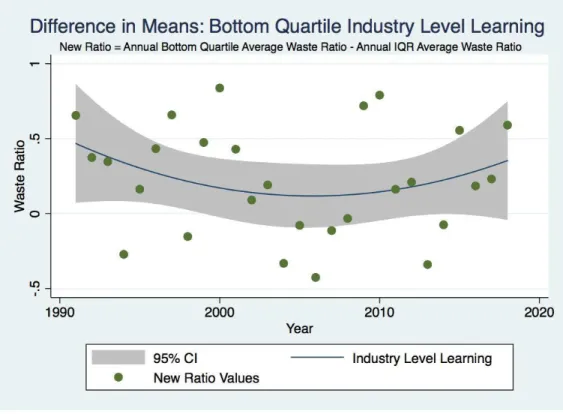
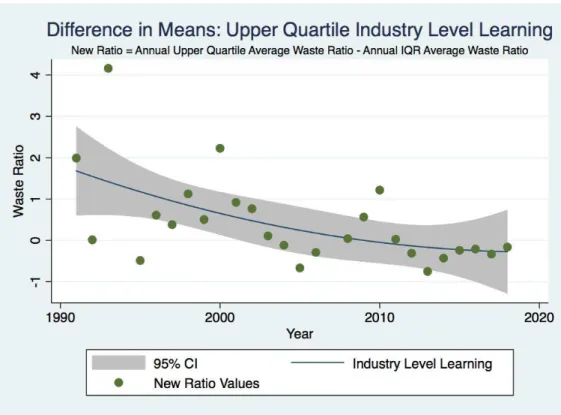
difference in means graph. The following two new ratios were generated and graphed for each year between 1990 and 2018:
𝑁𝑒𝑤 𝐵𝑜𝑡𝑡𝑜𝑚 𝑅𝑎𝑡𝑖𝑜 = 𝐴𝑛𝑛𝑢𝑎𝑙 𝐵𝑜𝑡𝑡𝑜𝑚 𝑄𝑢𝑎𝑟𝑡𝑖𝑙𝑒 𝐴𝑣𝑒𝑟𝑎𝑔𝑒 𝑊𝑎𝑠𝑡𝑒 𝑅𝑎𝑡𝑖𝑜 − 𝐴𝑛𝑛𝑢𝑎𝑙 𝐼𝑄𝑅 𝐴𝑣𝑒𝑟𝑎𝑔𝑒 𝑊𝑎𝑠𝑡𝑒 𝑅𝑎𝑡𝑖𝑜 𝑁𝑒𝑤 𝑈𝑝𝑝𝑒𝑟 𝑅𝑎𝑡𝑖𝑜 = 𝐴𝑛𝑛𝑢𝑎𝑙 𝑈𝑝𝑝𝑒𝑟 𝑄𝑢𝑎𝑟𝑡𝑖𝑙𝑒 𝐴𝑣𝑒𝑟𝑎𝑔𝑒 𝑊𝑎𝑠𝑡𝑒 𝑅𝑎𝑡𝑖𝑜 − 𝐴𝑛𝑛𝑢𝑎𝑙 𝐼𝑄𝑅 𝐴𝑣𝑒𝑟𝑎𝑔𝑒 𝑊𝑎𝑠𝑡𝑒 𝑅𝑎𝑡𝑖𝑜
If either the original or new waste ratio was seen decreasing as cumulative output was increasing in either facet of the study, it was interpreted to mean that that knowledge sharing and learning were occurring within the specified quartiles across the industry.
Organizational Level Learning by Operational Scope
In order to determine if operational scope is a driver of organizational learning in the oil and gas industry, I totaled the waste ratio values of every well for each year an operator was in service, effectively ignoring individual wells and looking at the yearly waste ratios at an operator level. By analyzing data at the operator level rather than the industry or individual well level, it was possible to track the variation in the firm’s waste ratio over time. To conduct this analysis, the cumulative production quantity was used as the independent variable and waste ratio as the dependent. If learning was occurring, the waste ratio would be seen decreasing as cumulative quantity was increasing. By
RESEARCH FINDINGS
Throughout this section, my analysis focuses on the incidence of organizational learning in the Pennsylvania oil and gas industry. Operationalized by running regressions on and graphing the waste ratio for 1,199 well operators between 1990 and 2018, this study determined that decreases in the waste ratio over time were not significantly determined by operational scope. My study first looked at trends within Pennsylvania’s oil and gas industry over time. I then controlled for learning at the industry level and determined that there is no evidence of organizational learning across small operators or large operators, compared to learning of the IQR. Further multivariate analysis
controlling for the fixed effects of individual firms was conducted to determine if organizational learning was occurring within operators. It was found that on average all firms, regardless of operational scope, decreased their waste ratio as their cumulative output increased. I later went into detail regarding how these findings aligned with prior research and my original hypotheses.
Industry Level Trends Over Time
quartile and IQR were the same. This piece of the analysis provided basis for proving a difference between the bottom quartile’s and IQR’s efficiency trends over time. The graphical representation of this relationship is seen in Figure 2.
Figure 2. Industry level bottom quartile difference in means.
See Appendix E for summary statistics and the graphical comparison between the difference in mean waste ratios at the industry level.
Figure 3. Industry level upper quartile difference in means
This analysis reveals evidence declining difference in waste ratios between the upper quartile of Pennsylvania’s oil and gas industry and the IQR. Upon further
Figure 4: Number of wells per year in Pennsylvania from 1990 to 2018.
In conclusion, the effects of time on waste ratio are inconclusive, likely due to confounding effects such as technological advancement, pricing and market conditions, and regulatory shocks. Therefore, the next stage of the analysis will look into the effects of organizational learning in Pennsylvania’s oil and gas industry by analyzing the effect of increasing cumulative output on firms’ waste ratios.
Industry Level Learning by Quartile
this analysis can be found in Appendices C and D (Appendix C details all data and Appendix D details data without outliers in the 99th percentile). Through simple regressions and data charting by quartile, I examined the effect of firm size on organizational learning at the industry level.
Bottom Quartile
Upper Quartile
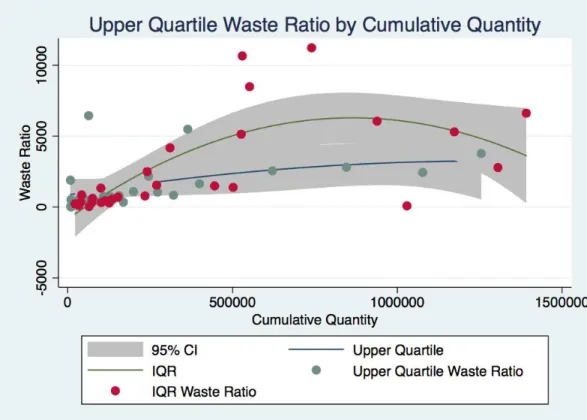
For the upper quartile, there is a .0005858 positive linear correlation between the waste ratio and cumulative quantity. However, this relationship is not significant. Based on the insignificance of this relationship, it is unknown whether learning is occurring on the industry level within the upper quartile, so further analysis is required. A graphical representation of the waste ratio by cumulative quantity, as seen in Figure 6.
Figure 6: Upper quartile waste ratio by cumulative quantity.
analysis. The drivers of internal differences seen in the graphs will be further investigated in the next analysis when controlling for fixed effects of individual firms.
Organizational Level Learning by Firm Size
The second part of this analysis sought to identify organizational learning by small and large individual operators within the oil and gas industry. Through multivariate regressions and data charting, I examined the effect of operational scope and firm size on learning at the organization level.
The Impact of Increased Operational Scope
Figure 7: Relationship between cumulative output and waste ratio for firms of all sizes.
The Impact of Being a Large or Small Operator
The primary goal of this analysis was to determine if a large firm’s waste ratios were decreasing at a different rate over time than those of not-large firms. Similarly, a second analysis was run to determine if a small firm’s waste ratios was decreasing at a different rate over time than those of not-small firms. If the waste ratio was seen decreasing as the operator’s cumulative output was increasing, it was interpreted that knowledge sharing and learning were occurring within the firm.
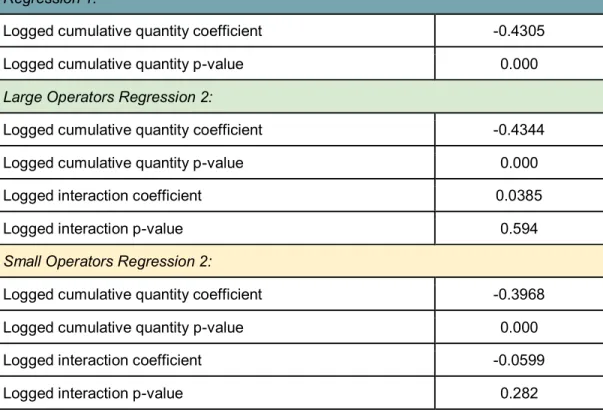
Further, the interaction term’s coefficient of 0.0385 had a p-value greater than 0.05 and therefore could not be considered significant. Similarly, the same regression for small firms again showed no significant change in the coefficient for the logged cumulative quantity and had an insignificant p-value for the interaction coefficient. Please see Figure 5 below for a breakdown of these numbers.
Impact of Being a Large or Small Operator
Regression 1: Cumulative quantity (logged) on waste ratio (logged)
Regression 2: Cumulative quantity (logged) and interaction (logged cumulative quantity
and firm size) on waste ratio (logged)
*all regressions were run with the xtreg command in Stata. All regressions also controlled for fixed effects and robustness.
Regression 1:
Logged cumulative quantity coefficient -0.4305
Logged cumulative quantity p-value 0.000
Large Operators Regression 2:
Logged cumulative quantity coefficient -0.4344
Logged cumulative quantity p-value 0.000
Logged interaction coefficient 0.0385
Logged interaction p-value 0.594
Small Operators Regression 2:
Logged cumulative quantity coefficient -0.3968
Logged cumulative quantity p-value 0.000
Logged interaction coefficient -0.0599
Logged interaction p-value 0.282
In conclusion, this analysis found that neither being a large or small firm impacts learning more than the other. There was no significant difference between firms of any size and their ability to be more efficient and learn over time. Therefore, this analysis shows that firm size is not a driver of organizational learning in Pennsylvania’s oil and gas industry.
Stakeholder Takeaways
The findings of this research can provide value for key stakeholders including investors, policy makers, and internal decision makers.
Investors
Policy Makers
While there is evidence across firms of all sizes within Pennsylvania’s oil and gas industry of declining waste ratios with increases in cumulative quantity, it would be valuable to understand what enables some firms to be more efficient than others. With future research, policy makers could understand which firms need extra incentives to be efficient and create policy as such. Further, even though firms in general are becoming more efficient, it would be beneficial to communities if firms generated less waste. In 2018, Ross Craft, chairman and CEO of Approach Resources Inc, explained that
environmentally friendly, efficient technologies exists that are capable of cleaning water to a point where it can be put into local water sources, used for farming, or even
consumption (Haines, 2018). Unfortunately, he admits that the technology is expensive, an obvious deterrent for oil and gas operators already operating in tight margins. Accordingly, well developed policies and regulation enforcement could incentivize oil and gas companies to take the next step to invest in technology that help protect the environment.
Internal Decision Makers
DISCUSSION
A number of limitations from this study are noteworthy and the resulting opportunities for future research warrant additional discussion.
Limitations
Future Research Opportunities
Future research on organizational learning’s impact on energy efficiency,
specifically within the setting of Pennsylvania’s oil and gas industry, would shed light on some of the questions left behind from this study. One of the largest questions I had at the completion of my research was: “How have energy operators managed, both financially and legally, to not decrease their waste ratios over time?” I believe an avenue of future research that could shed light on this question would be to measure and track the rate of waste being recycled. A possible hypothesis is that while overall waste ratios might not be decreasing, the amount of waste being recycled is increasing, effectively decreasing the environmental impact of waste being created and disposed of.
An additional element that could be valuable to incorporate in future research would be to control for well geography. While it was beyond the scope of this project, I hypothesize that regardless of the identity of the well operator, certain geographies have varying access to resources and disposal methods based on proximity to bodies of water, the necessity to navigate mountainous terrain, and even varying levels of precipitation. Additionally, the existence of local regulations or restrictions could impact a well operator’s ability to operate at optimal efficiency levels.
room for improvement. Likewise, having a comparison to other states or a national basis would provide valuable insights and basis of comparison for this research question and subsequent findings.
Lastly, supplementary research into well-level, individual learning rates would provide valuable insights for internal decision makers. By analyzing individual wells’ waste ratios, underperforming wells could be identified and remedying steps could be taken to improve the well as needed. This research would also provide insight into whether or not firm leadership needs to invest in and facilitate more knowledge sharing within the company. By understanding which wells are performing exceptionally, explanatory metrics (technological innovation, organizational structure, leadership, etc.) can be identified and shared across the company.
APPENDIX
Appendix A
Final Data Set Variables
FINAL DATA
Production Variables Waste Variables
Operator Operator Number Period ID Reporting Period Unconventional Well County Well Latitude Well Longitude Well Permit Number Well Status Well Type Condensate Quantity Gas Quantity Oil Quantity Operator Operator Number Period ID Reporting Period Unconventional Well County Well Latitude Well Longitude Well Permit Number Well Status
Well Type Units
Waste Quantity
Appendix B
Bottom and Top Quartile Operator Selection Methodology
OPERATOR SELECTION METHODOLOGY
Bottom Quartile Top Quartile
1. Sort firms by average number of wells per year
2. Determine firms in 25th percentile of average number of wells per year and label them as BOTTOM
3. Determine 75th percentile of wells per year of BOTTOM operators (operators with 16+ wells per year)
4. Determine 75th percentile of years in operation of BOTTOM operators (operators in service for over 17+ years) 5. Identify BOTTOM operators with 16+
wells per year and 17+ years of service) a. 7 operators were identified
6. Identify BOTTOM operators with 15+ wells per year and 17+ years of service)
a. 0 additional operators were identified
7. Identify BOTTOM operators with 14+ wells per year and 17+ years of service)
a. 3 additional operators were identified
8. Select remaining 10 operators for further analysis
1. Sort firms by total number of years in operation
2. Determine firms in 75th percentile of average number of wells per year and label them as TOP
3. Determine 75th percentile of wells per year of TOP operators (operators with 270+ wells per year)
4. Determine 75th percentile of years in operation of TOP operators (operators in service for over 18+ years)
5. Identify TOP operators with 270+ wells per year and 18+ years of service)
a. 1 operator was identified
6. Identify TOP operators with 18+ years of service)
a. 4 additional operators were identified
7. Identify TOP operators with 14+ years of service)
a. 5 additional operators were identified
8. Select remaining 10 operators for further analysis
Notes:
● Selection of firms operating in the upper percentiles of operating years in their respective quartiles was necessitated by the overarching research methodology. Without sufficient years to track the waste ratio, conclusions could not be determined. ● While there could be inherent differences in firms selected because of falling in the
upper percentile of operating years, prior research has determined that there is no direct correlation between experience and learning rates (Argote, 2013).
Appendix C
Summary Statistics for Industry Level Learning - With Outliers
Industry Level Summary Statistics - With Outliers
Well per Year: Mean 95.78
25th Percentile 22.62 50th Percentile 41.60 75th Percentile 99.53 Standard Deviation 124.60
Waste Quantity: Mean 165.81
50th Percentile 23.62 Standard Deviation 14966.99
Production Quantity: Mean 348.27
50th Percentile 252.90 Standard Deviation 322.4296
Waste Ratio Mean 1.53
50th Percentile 0.09 Standard Deviation 93.54091 Notes:
● Statistics based on 207,520 well/year measurements ○ Originally had 448,302 well/year measurements
Appendix D
Summary Statistics for Industry Level Learning - Without Outliers
Industry Level Summary Statistics - Without Outliers
Well per Year: Mean 92.02
25th Percentile 22.48 50th Percentile 41.28 75th Percentile 99.53 Standard Deviation 116.27
Waste Quantity: Mean 61.25
50th Percentile 21.97 Standard Deviation 102.88
Production Quantity: Mean 346.05
50th Percentile 250 Standard Deviation 321.47
Waste Ratio Mean 0.86
50th Percentile 0.09 Standard Deviation 5.00 Notes:
● Statistics based on 200,717 well/year measurements
Appendix E
Summary Statistics and Graphical Representation of Bottom Quartile and IQR Industry Level Waste Ratios
Summary Statistics of Industry Level Waste Ratios: Bottom Quartile vs IQR
Ho: mean = 0 Ha: mean = 0
*mean = bottom quartile average annual waste ratio - IQR average annual waste ratio
Statistic Value
t-statistic 3.259
df 27
Appendix F
Summary Statistics and Graphical Representation of Upper Quartile and IQR Industry Level Waste Ratios
Summary Statistics of Industry Level Waste Ratios: Upper Quartile vs IQR Ho: mean = 0 Ha: mean = 0
*mean = upper quartile average annual waste ratio - IQR average annual waste ratio
Statistic Value
t-statistic 1.4017
df 26
obs 27
95% confidence interval -0.6320 to 3.342 Notes:
REFERENCES CITED
American Geosciences Institute. (2014, June 17). How much water does the typical hydraulically fractured well require? Retrieved March 24, 2019, from
https://www.americangeosciences.org/critical-issues/faq/how-much-water-does-typical-hydraulically-fractured-well-require
Argote, L. (2013). Organizational Learning: Creating, Retaining and Transferring Knowledge (2nd ed.). New York, NY: Springer Science+Business Media. Ati, N., Brinkman, M., Peacock, R., & Wood, C. (2016, March). Margins under pressure
as market falls further | McKinsey. Retrieved March 17, 2019, from
https://www.mckinsey.com/industries/oil-and-gas/our-insights/margins-under-pressure-as-market-falls-further
Boudet, H., Clarke, C., Bugden, D., Maibach, E., Roser-Renouf, C., & Leiserowitz, A. (2014). “Fracking” controversy and communication: Using national survey data to understand public perceptions of hydraulic fracturing. Energy Policy, 65, 57–67. https://doi.org/10.1016/j.enpol.2013.10.017
DiChristopher, T. (2018, December 31). Oil prices had their worst year since 2015 — here’s what went wrong. Retrieved March 24, 2019, from
https://www.cnbc.com/2018/12/31/oil-prices-are-set-for-their-worst-year-since-2015.html
Frazier, R. (2018, April 3). Poll: Public concern grows over natural gas industry’s
environmental impact. Retrieved March 31, 2019, from StateImpact Pennsylvania website: https://stateimpact.npr.org/pennsylvania/2018/04/03/poll-public-concern-grows-over-natural-gas-industrys-environmental-impact/
Gertner, J. (2013, December 21). George Mitchell, father of fracking. The New York Times. Retrieved from
Retrieved December 6, 2018, from https://www.globalenergyinstitute.org/energy-accountability-fracking-press-release
Haines, L. (2018). Shaving Water Costs. Oil and Gas Investor. Retrieved from https://www.approachresources.com/approach/files/d6/d6f702b6-07e5-4b26-b297-6b744dc8cb3b.PDF
Harraf, A., Wanasika, I., Tate, K., & Talbott, K. (2015). Organizational Agility. Journal of Applied Business Research; Laramie, 31(2), 675.
Hirji, Z., Song, L. (2015, January 20). Map: The Fracking Boom, State by State. Retrieved September 17, 2018, from
http://insideclimatenews.org/news/20150120/map-fracking-boom-state-state Hirschmann, W. (1964). Profit from the learning curve. Harvard Business Review, 42(1),
125–139.
Horton, M. (2018, July 16). What are the effects of fracking on the environment? Retrieved March 24, 2019, from
https://www.investopedia.com/ask/answers/011915/what-are-effects-fracking-environment.asp
Hurdle, J. (2016, June 14). EPA bans disposal of fracking waste water at public treatment plants. Retrieved March 26, 2019, from
https://stateimpact.npr.org/pennsylvania/2016/06/14/epa-bans-disposal-of-fracking-waste-water-at-public-treatment-plants/
Independent Petroleum Association of America. (n.d.). Retrieved December 5, 2018, from https://www.ipaa.org/fracking/
IPIECA. (2013). Saving energy in the oil and gas industry. London, United Kingdom. Marcellus Shale Coalition. (n.d.). Marcellus and Utica Shale Formation Map. Retrieved
March 26, 2019, from http://marcelluscoalition.org/pa-map/
Oil and Gas Act, Penn. Assemb. 223 (1983-2984), Chapter 11 (Penn. Stat. 1984) PA DEP Oil & Gas Reporting Website - Production / Waste Reports. (n.d.). Retrieved
https://www.paoilandgasreporting.state.pa.us/publicreports/Modules/Welcome/Pr odWasteReports.aspx
Pennsylvania Department of Community and Economic Development. (n.d.). Retrieved December 6, 2018, from https://dced.pa.gov/key-industries/naturalgas/
Prokesch, S. (1997, September 1). Unleashing the Power of Learning: An Interview with British Petroleum’s John Browne. Harvard Business Review, (September– October 1997). Retrieved from https://hbr.org/1997/09/unleasing-the-power-of-learning-an-interview-with-british-petroleums-john-browne
Schiersch, A. (2013). Firm size and efficiency in the German mechanical engineering industry. Small Business Economics, 40(2), 335–350.
https://doi.org/10.1007/s11187-012-9438-8
Squillace, M. (2016). Managing unconventional oil and gas development as if communities mattered. Vermont Law Review 40(3), 525-560.
The keys to organizational agility. (2015). Retrieved March 31, 2019, from
https://www.mckinsey.com/business-functions/organization/our-insights/the-keys-to-organizational-agility
The Marcellus Shale, Explained. (n.d.). Retrieved December 6, 2018, from https://stateimpact.npr.org/pennsylvania/tag/marcellus-shale/