CURRENT SENSE HIGH SIDE SWITCH
Features
Suitable for 24V systems
www.irf.com
1
Over current shutdown
Over temperature shutdown
Current
sensing
Active
clamp
Low
current
Reverse battery
ESD
protection
Optimized Turn On/Off for EMI
Applications
24V loads for trucks
Description
The AUIPS7111S is a fully protected four terminal high
side switch. It features current sensing, current,
over-temperature, ESD protection and drain to source active
clamp. When the input voltage Vcc - Vin is higher than the
specified threshold, the output power Mosfet is turned on.
When the Vcc - Vin is lower than the specified Vil
threshold, the output Mosfet is turned off. The Ifb pin is
used for current sensing.
Product Summary
Rds(on) 7.5 m
max.
Vclamp 65V
Current shutdown 30A min.
Package
D²Pak-5 leadsTypical Connection
OutIPS
IN Rifb Vcc Load Battery Input Power Ground Ifb Logic Ground Current feeback 10k On OffQualification Information
†Automotive (per AEC-Q100††)
Qualification Level Comments: This family of ICs has passed an Automotive qualification.
IR’s Industrial and Consumer qualification level is granted by extension of the higher Automotive level.
Moisture Sensitivity Level D2PAK-5L MSL1, 260°C
(per IPC/JEDEC J-STD-020)
Machine Model Class M3 (300V) (per AEC-Q100-003) Human Body Model Class H2 (2,500 V)
(per AEC-Q100-002)
ESD
Charged Device Model Class C4 (1000 V) (per AEC-Q100-011)
IC Latch-Up Test Class II, Level A
(per AEC-Q100-004)
RoHS Compliant Yes
† Qualification standards can be found at International Rectifier’s web site http://www.irf.com/
†† Exceptions to AEC-Q100 requirements are noted in the qualification report.
Absolute Maximum Ratings
Absolute maximum ratings indicate sustained limits beyond which damage to the device may occur. (Tj= -40°C..150°C, Vcc=8..50V unless otherwise specified).
Symbol Parameter
Min.
Max.
Units
Vout Maximum output voltage Vcc-60 Vcc+0.3 V
Vcc-Vin max. Maximum Vcc voltage -32 60 V
Ifb, max. Maximum feedback current -50 10 mA Maximum power dissipation (internally limited by thermal protection)
Pd
Tambient=25°C, Tj=150°C Rth=50°C/W D²Pack 6cm² footprint 2.5 W Tj max. Max. storage & operating junction temperature -40 150 °C
Thermal Characteristics
Symbol Parameter
Typ.
Max.
Units
Rth1 Thermal resistance junction to ambient D²Pak Std footprint 60
Rth2 Thermal resistance junction to ambient D²pak 6cm² footprint 40
Rth3 Thermal resistance junction to case D²pak 0.8
°C/W
Recommended Operating Conditions
These values are given for a quick design.
Symbol Parameter
Min.
Max.
Units
Continuous output current, Tambient=85°C, Tj=125°C Iout
Rth=40°C/W, D²pak 6cm² footprint 10 A
Rifb 1.5 k
Static Electrical Characteristics
Tj=-40..150°C, Vcc=8..50V (unless otherwise specified)
Symbol Parameter
Min.
Typ.
Max.
Units
Test
Conditions
Vcc op. Operating voltage range 8 50 V ON state resistance Tj=25°C 6 7.5 Rds(on)
ON state resistance Tj=150°C 12 15 m Ids=10A Icc off Supply leakage current 2 6
Iout off Output leakage current 2 6 µA
Vin=Vcc=28V,Vifb=Vgnd Vout=Vgnd, Tj=25°C V clamp1 Vcc to Vout clamp voltage 1 60 65 Id=10mA
V clamp2 Vcc to Vout clamp voltage 2 66 Id=10A see fig. 2 Vih(2) High level Input threshold voltage 5.5 6.8 Id=10mA Vil(2) Low level Input threshold voltage 3.5 5
V
Reverse On state resistance Tj=25°C 7 10 m Rds(on) rev
Reverse On state resistance Tj=150°C 13 18
Isd=10A, Vcc-Vin=7..32V Forward body diode voltage Tj=25°C 0.75 0.8
Vf
Forward body diode voltage Tj=125°C 0.6 0.65 V
If=10A
Rin Internal input resistor 180 250 350 Tj=-40°C..125°C (2) Input thresholds are measured directly between the input pin and the tab. See also page 6
Switching Electrical Characteristics
Vcc=28V, Resistive load=3, Tj=25°C
Symbol Parameter
Min.
Typ.
Max.
Units
Test
Conditions
tdon Turn on delay time to 20% 25 35 50 tr Rise time from 20% to 80% of Vcc 8 17 25 µs tdoff Turn off delay time 50 80 120 tf Fall time from 80% to 20% of Vcc 5 13 35 µs
See fig. 1
Protection Characteristics
Tj=-40..150°C, Vcc=8..50V (unless otherwise specified)
Symbol Parameter
Min.
Typ.
Max.
Units
Test
Conditions
Tsd Over temperature threshold 150(3) 165 °C See fig. 3 and fig. 10 Isd Over-current shutdown 30 45 60 A See fig. 3 and page 7 I fault Ifb after an current or an
over-temperature (latched)
2.4 4 6
mA See fig. 3
Current Sensing Characteristics
Tj=-40..150°C, Vcc=8..50V (unless otherwise specified)
Symbol Parameter
Min.
Typ.
Max.
Units
Test
Conditions
Ratio I load / Ifb current ratio 11000 13000 14500 Ratio_TC I load / Ifb variation over temperature -5% 0 +5 %
Iout=10A
I offset Load current offset -0.25 0 0.25 A Iout<10A Ifb leakage Ifb leakage current on 0 6 15 µA Iout=0A, Tj=25°C (3) Guaranteed by design
Lead Assignments
1- In 2- Ifb 3- Vcc 4- Out 5- Out 1 2 4 5 D²Pak - 5 leads 3- VccFunctional Block Diagram
All values are typical
Diag Charge Pump Driver Reverse Battery Protection
IFB OUT
VCC
75V 250 Tj > 165°C Iout > 45A 58V 75V - + 75V 3mAIN
Set Reset LatchQ + -www.irf.com
5Truth Table
Op. Conditions Input Output Ifb pin voltage
Normal mode H L 0V
Normal mode L H I load x Rfb / Ratio
Open load H L 0V
Open load L H Ifb leakage x Rifb Short circuit to GND H L 0V Short circuit to GND L L I fault x Rifb (latched) Over temperature H L 0V Over temperature L L I fault x Rifb (latched)
Operating voltage
Maximum Vcc voltage : this is the maximum voltage before the breakdown of the IC process.
Operating voltage : This is the Vcc range in which the functionality of the part is guaranteed. The AEC-Q100 qualification is run at the maximum operating voltage specified in the datasheet.
Reverse battery
During the reverse battery the Mosfet is turned on if the input pin is powered with a diode in parallel of the input transistor. Power dissipation in the IPS : P = Rdson rev * I load² + Vcc² / 250 ( internal input resistor ).
If the power dissipation I too hight in Rifb, a diode in serial can be added to block the current.
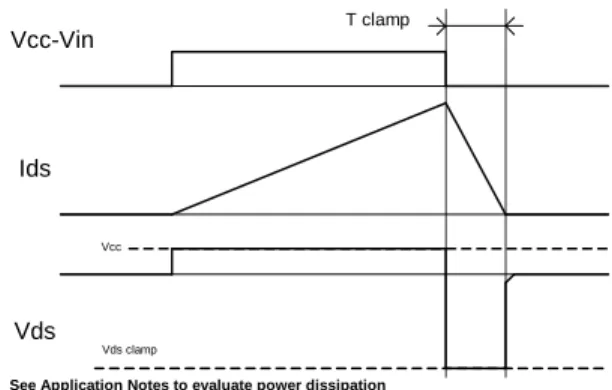
Active clamp
The purpose of the active clamp is to limit the voltage across the MOSFET to a value below the body diode break down voltage to reduce the amount of stress on the device during switching.
The temperature increase during active clamp can be estimated as follows:
)
t
(
Z
P
CL TH CLAMP Tj
Where: is the thermal impedance at tCLAMP and can be read from the thermal impedance curves given in the
data sheets.
)
t
(
Z
TH CLAMP CLavg CL CLV
I
P
: Power dissipation during active clampV
39
V
CL
: Typical VCLAMP value2
I
I
CLCLavg
: Average current during active clampdt
di
I
t
CLCL
: Active clamp duration
L
V
V
dt
di
Battery
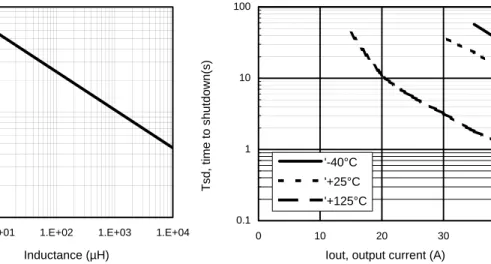
CL: Demagnetization currentFigure 9 gives the maximum inductance versus the load current in the worst case : the part switch off after an over temperature detection. If the load inductance exceed the curve, a free wheeling diode is required.
Input level VIH/VIL
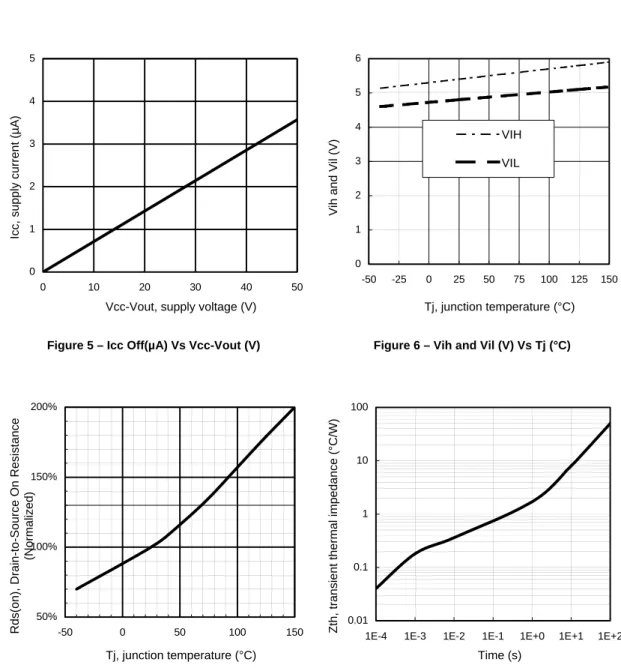
The input level are referenced to Vcc. When Vcc-Vin exceed VIH the part turns on and when Vcc-Vin goes below VIL the part turns off
Current sensing accuracy
Iout Ifb Ifb leakage Ifb2 Ifb1 Iout2 Iout1 I offset
The current sensing is specified by measuring 3 points : - Ifb1 for Iout1
- Ifb2 for Iout2 - Ifb leakage for Iout=0
The parameters in the datasheet are computed with the following formula : Ratio = ( Iout2 – Iout1 )/( Ifb2 – Ifb1)
I offset = Ifb1 x Ratio – Iout1
This allows the designer to evaluate the Ifb for any Iout value using : Ifb = ( Iout + I offset ) / Ratio if Ifb > Ifb leakage
For some applications, a calibration is required. In that case, the accuracy of the system will depends on the variation of the I offset and the ratio over the temperature range. The ratio variation is given by Ratio_TC specified in page 4. The Ioffset variation depends directly of the Rdson :
I offset@-40°C= I offset@25°C / 0.7 I offset@150°C= I offset@25°C / 1.9
Over-current protection
The threshold of the over-current protection is set in order to guaranteed that the device is able to turn on a load with an inrush current lower than the minimum of Isd. Nevertheless for high current and high temperature the device may switch off for a lower current due to the over-temperature protection (see Figure 10).
www.irf.com
8 Vds Ids Vcc-Vin Vcc Vds clamp T clampSee Application Notes to evaluate power dissipation
Vout Vcc-Vin 80% 20% 80% 20% Td on Tr Td off Tf
Figure 2 – Active clamp waveforms Figure 1 – IN rise time & switching definitions
0 5 10 15 20 25 30 -50 0 50 100 150 Tj Tsd 165°C
Icc off, supply le
akage current (µ A) Ids Vin I shutdown Tshutdown Vifb V fault Tj, junction temperature (°C)
www.irf.com
9 0 1 2 3 4 5 6 -50 -25 0 25 50 75 100 125 150 VIH VIL 0.01 0.1 1 10 1001E-4 1E-3 1E-2 1E-1 1E+0 1E+1 1E+2
Figure 8 – Transient thermal impedance (°C/W) Vs time (s) Zth, transient the rmal impedance (°C/W) Time (s) 50% 10 Rds(on), Drain-to -Source On Resi stance (Normalized) 0% 150% 200% -50 0 50 100 150
Figure 7 - Normalized Rds(on) (%) Vs Tj (°C)
Tj, junction temperature (°C)
Tj, junction temperature (°C)
Vih and Vil (V)
0 1 2 3 4 5 0 10 20 30 40
Icc, supply current (µA)
50 Vcc-Vout, supply voltage (V)
www.irf.com
10 110 100
1.E+00 1.E+01 1.E+02 1.E+03 1.E+04
0.1 1 10 100 0 10 20 30 Tsd, time to shut down(s)
Max. output curr
ent (A)
40
'-40°C '+25°C '+125°C
Inductance (µH) Iout, output current (A)
Figure 10 – Tsd (s) Vs I out (A) SMD with 6cm² Figure 9 – Max. Iout (A) Vs inductance (µH)
Case Outline D2PAK - 5 Leads
Tape & Reel D2PAK - 5 Leads
Part Marking Information
Ordering Information
Standard Pack Base Part Number Package Type
Form Quantity
Complete Part Number
Tube 50 AUIPS7111S
Tape and reel left 800 AUIPS7111STRL AUIPS7111R D2-Pak-5-Leads
Tape and reel right 800 AUIPS7111STRR
IMPORTANT NOTICE
Unless specifically designated for the automotive market, International Rectifier Corporation and
its subsidiaries (IR) reserve the right to make corrections, modifications, enhancements,
improvements, and other changes to its products and services at any time and to discontinue any
product or services without notice. Part numbers designated with the “AU” prefix follow
automotive industry and / or customer specific requirements with regards to product
discontinuance and process change notification.
All products are sold subject to IR’s terms and
conditions of sale supplied at the time of order acknowledgment.
IR warrants performance of its hardware products to the specifications applicable at the time of
sale in accordance with IR’s standard warranty. Testing and other quality control techniques are
used to the extent IR deems necessary to support this warranty. Except where mandated by
government requirements, testing of all parameters of each product is not necessarily performed.
IR assumes no liability for applications assistance or customer product design. Customers are
responsible for their products and applications using IR components. To minimize the risks with
customer products and applications, customers should provide adequate design and operating
safeguards.
Reproduction of IR information in IR data books or data sheets is permissible only if reproduction
is without alteration and is accompanied by all associated warranties, conditions, limitations, and
notices. Reproduction of this information with alterations is an unfair and deceptive business
practice. IR is not responsible or liable for such altered documentation. Information of third
parties may be subject to additional restrictions.
Resale of IR products or serviced with statements different from or beyond the parameters stated
by IR for that product or service voids all express and any implied warranties for the associated
IR product or service and is an unfair and deceptive business practice. IR is not responsible or
liable for any such statements.
IR products are not designed, intended, or authorized for use as components in systems intended
for surgical implant into the body, or in other applications intended to support or sustain life, or in
any other application in which the failure of the IR product could create a situation where personal
injury or death may occur. Should Buyer purchase or use IR products for any such unintended or
unauthorized application, Buyer shall indemnify and hold International Rectifier and its officers,
employees, subsidiaries, affiliates, and distributors harmless against all claims, costs, damages,
and expenses, and reasonable attorney fees arising out of, directly or indirectly, any claim of
personal injury or death associated with such unintended or unauthorized use, even if such claim
alleges that IR was negligent regarding the design or manufacture of the product.
IR products are neither designed nor intended for use in military/aerospace applications or
environments unless the IR products are specifically designated by IR as military-grade or
“enhanced plastic.” Only products designated by IR as military-grade meet military specifications.
Buyers acknowledge and agree that any such use of IR products which IR has not designated as
military-grade is solely at the Buyer’s risk, and that they are solely responsible for compliance
with all legal and regulatory requirements in connection with such use.
IR products are neither designed nor intended for use in automotive applications or environments
unless the specific IR products are designated by IR as compliant with ISO/TS 16949
requirements and bear a part number including the designation “AU”. Buyers acknowledge and
agree that, if they use any non-designated products in automotive applications, IR will not be
responsible for any failure to meet such requirements.
For technical support, please contact IR’s Technical Assistance Center
http://www.irf.com/technical-info/ WORLD HEADQUARTERS:
233 Kansas St., El Segundo, California 90245 Tel: (310) 252-7105