Case Study on Scheduling Software for
Prime Contractors’ Efficient Management of Projects
Mike Bell, Tulio Sulbaran, PhD., Kimberly Williams, Michael BlainThe University of Southern Mississippi Hattiesburg, MS
The most important aspect of the prime contractor’s duties on any project is the effective management of materials, labor, time, and safety. The management of project time is depending more and more on scheduling software. The lack of good scheduling software, when managing the completion of hundreds of activities before and during the construction phase, can limit the ability of a prime contractor to effectively manage a project. Thus, the objective of this case study was to identify the construction scheduling software and practices most widely used by prime contractors. This objective was achieved by following an exploratory research methodology. More specifically, the methodology included the development and implementation of a simple survey online followed by descriptive statistical analysis. The results from this project from a small sample size indicate that most prime contractors in the targeted population use Primavera and Microsft scheduling software, most of the schedules are prepared in house and the primary users of scheduling software include schedulers, project managers, superintendents and assistant project managers. It is expected that the results from this study will help prime contractors, educators, and students to obtain the most benefit from the currently available scheduling software by establishing the proper training and implementation priorities.
Keywords: Scheduling Software, Scheduling Practices, Project Management, Software Usage
Introduction
"The use of project management software as a tool for managing and organizing work has grown and continues to grow at a rapid pace in all industries. As heavy users of PM software, professionals in the construction industry have a strong interest in improving the tools and techniques available for better project planning and control" (Liberatore, Pollack-Johnson & Smith, 2001). With so many scheduling software options available the learning curve associated with understanding each and every program would be impossible as well as extremely inefficient. The creation of new technology continues to make things more efficient while at the same time challenging users with a fairly steep learning curve. The time and resources required to learn new software can actually deter some companies from actively using scheduling software to plan and manage projects. The issue of discovering the scheduling software programs and practices most used has been of some interest in the past amongst industry professionals and researchers alike. This problem is supported by a similar study performed in 1996 titled “Project Management in Construction: Software Use and Research Directions” (Liberatore, Pollack-Johnson, & Smith, 2001). This particular team of individuals tried to help with the clarification of scheduling software usage and the direction of future research on this software. With the increase in usage and interest in scheduling software, it is beneficial for industry professionals, educators, and students to all understand who uses scheduling software, what software is actually used, and how often is it used.
This case study will help with the identification of construction scheduling software programs and practices most used. It will also be used to further identify what needs to be learned academically to better prepare students for careers in the construction management industry. Simplifying the wide array of scheduling software options or perhaps identifying the most important programs to be learned will help reduce the amount of time required for practitioners. Perhaps we might need “a common ground from which terms, definitions, and applications can be universally understood. In determining what recommendations might be reasonable in the area of scheduling standards, one area to be examined is how CPM scheduling is being taught in universities, how CPM scheduling is
being described and discussed in the professional arena, and how CPM scheduling is being applied in reality in the field” (Galloway Ph.D., 2006).
The focus of this case project is to identify what scheduling software programs are most used by prime contractors and how software is implemented. Extensive research surveying the top firms in the industry will shed light on these issues and benefit all parties involved in the usage of scheduling software.
Project
ApproachIn order to identify the scheduling software programs and practices most used in the construction industry our team conducted a survey of construction industry professionals. The individuals chosen for this study were to be selected using the Engineering News Record’s list of the top 100 contractors selected by new contracts for 2008. This list provided a wide variety of construction firms that lead the industry and generate millions in revenues every year. The top75 of the 100 firms listed were selected to answer questions from a survey created using a free online survey delivery platform. The program used, Constant Contact, allowed for the efficient management of survey results. The 10 question survey was developed with the industry professionals’ busy schedules in mind. Several of the questions used in the survey were demographically based to help better identify the size and make-up of the firm represented by each respondent. Furthermore, questions were prepared to gather information regarding the number of projects managed by each firm as well as the percentage of those projects scheduled in-house versus subcontracted to a third party. Also included was a list of 8 scheduling software programs identified from a graduate level construction planning and scheduling course. The respondents were also provided the ability to select proprietary software and the option to insert a software program not mentioned on the list. Finally, the respondents were asked to identify the primary users of the scheduling software.
The survey was conducted by three team members over a one week period in October with an additional week for final follow-up. Industry professionals were initially contacted by phone. Each respondent was given the opportunity to complete the survey in person over the phone or online. The overwhelming majority of respondents chose to receive the online survey link via email which afforded them the opportunity to take the survey when their schedule permitted. Both methods allowed for complete management of all results, and provided those being surveyed with alternative methods.
The collection process of surveyed results was simplified thanks to the online survey program. This program managed the results which were exported into a Microsoft Excel worksheet after completion of all surveys. The information was then analyzed by using descriptive statistics.”Descriptive statistics are used to describe the basic features of the data in a study. They provide simple summaries about the sample and the measures. Together with simple graphics analysis, they form the basis of virtually every quantitative analysis of data” (Trochim, 2006). A flow chart for the survey performance can be seen below:
Results & Results Approach
The deliverance of said survey was difficult for the industry professionals’ busy schedules. After receipt of all responses, the final respondent rate was 29.3% (22 of the contacted 75). While the response rate was acceptable, it is important to highlight that the sample size was very small and the results presented here should not be extrapolated to the complete population without further data collection and analysis. The final results have been broken down according to survey question and graphical representation of responses.
How many individuals are employed by your firm or organization? The figure below shows the breakdown of the number of individuals employed by each firm. Approximately 4.5% of the firms had 100-249 employees, 9% employed 250-499, 22.7% had 500-999 employees, and 59% of the firms employed 1000 or more individuals.
0 2 4 6 8 10 12 14 Less than 50 50-99 100-249 250-499 500-999 1000 or more Number of Respondents
Figure 1.1 Number of employees
Please indicate annual revenue totals for your firm. The revenue breakdown involves the annual revenues stated by each respondent. 18.1% of the firms generated $10 billion or more, 31.7% generated revenues between $2.5 billion and $9.9 billion, 36.3% had stated revenues between $500 million and $2.4 billion. The remaining 9% stated less than $500 million in revenues.
Figure 1.2 Annual Company Revenues
How many projects does your firm or organization manage in a given year? Below you can see the number of projects managed in a given year by each firm. 36.3% of the firms reported managing more than 100 projects per year. 27% managed 60 to 100 projects per year, 22.6% managed 15 to 44 projects a year, and 9% managed less than 15 projects a year.
Figure 1.3 Number of Projects Managed Annually
0 1 2 3 4 5 6 7 8
Less than $500 Million $500 Million to $1.4 Billion $1.5 Billion to $2.4 Billion $2.5 Billion to $4.9 Billion $5 Billion to $9.9 Billion $10 Billion or more Number of Respondents 0 2 4 6 8 10 Less than 15 15-29 30-44 45-59 60-74 75-89 89-100 More than 100 Number of Respondents
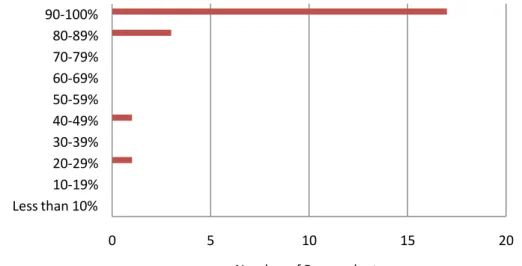
What percentage of those projects mentioned are scheduled using a scheduling software? 17 of the firms used a scheduling software program for more than 90% of the projects managed. 3 of the firms used a software program for 80 to 89% of the projects and the remaining 2 firms used a scheduling software program for less than 50% of their projects managed in a given year.
Figure 1.4 Projects scheduled using a software program
Based on the percentage of projects scheduled using a software program, what percentage is performed by you or a member of your firm or organization and what percentage is subcontracted to a third party scheduling firm. 5 of the firms scheduled all of their projects without the use of a third party. 8 firms prepared 90% of the schedules and 10% were subcontracted, 5 self performed 80% of the schedules with 20% handled by a third party, 1firm performed 70% of the projects while subcontracting the other 30%, 1 firm worked on half while a third party worked on the other half, and 1 firm self performed 20% of the scheduling while subcontracting the remaining 80% to a third party.
Figure 1.5 Projects self performed vs. subcontracted
0 5 10 15 20 Less than 10% 10-19% 20-29% 30-39% 40-49% 50-59% 60-69% 70-79% 80-89% 90-100% Number of Respondents 0 1 2 3 4 5 6 7 8 9 0% In House; 100% Subcontracted 10% In House; 90% Subcontracted 20% In House; 80% Subcontracted 30% In House; 70% Subcontracted 40% In House; 60% Subcontracted 50% In House; 50% Subcontracted 60% In House; 40% Subcontracted 70% In House; 30% Subcontracted 80% In House; 20% Subcontracted 90% In House; 10% Subcontracted 100% In House; 0% Subcontracted Number of Respondents
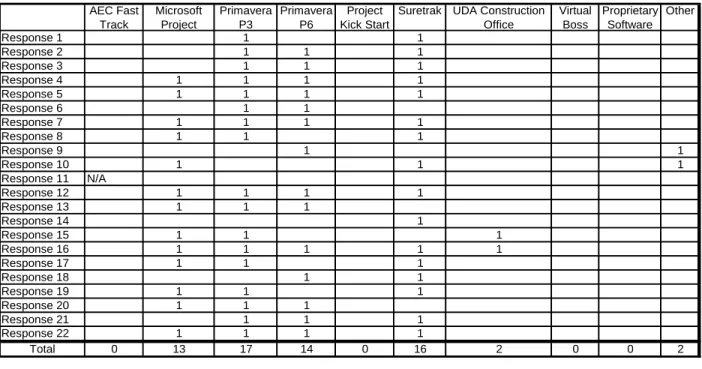
Please select any of the following project management/scheduling software programs your firm or organization has used in the past 5 years. Please mark all that apply. If you use software not mentioned in the list, please include in the “other” box. The list below is a representation of all software program used for scheduling by each firm over the past 5 years. As can be seen, the majority of respondents primarily used the Primavera programs Suretrak, P3 and P6 as well as Microsoft Project. 2 of the firms used UDA Construction Office and 2 firms used software not mentioned in the survey. None of the firms had any plans for acquiring a new scheduling software program in the upcoming year.
Figure 1.6 Scheduling software programs most used
Please indicate which functions are used most? Scheduling software programs include many different features that allow for the efficient management of a construction project. We identified 4 functions we believe are most used and asked the respondents to select them in order of importance. The 4 functions used most are the Gantt/Bar chart, Pert diagram, resource management, and scheduling updates. The results were too close to differentiate the overall importance of one feature to another, but the responses placed the Gantt/bar chart and scheduling updates at the top of the list with the pert diagram following closely behind and resource management designated at the bottom of the 4 choices.
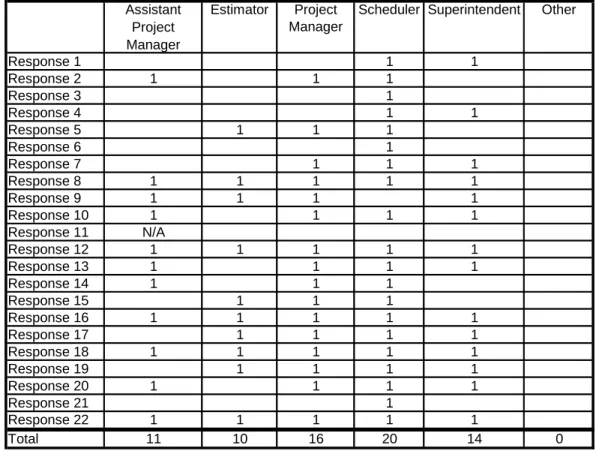
Who primarily uses the scheduling software? Choose all that apply. The firms were given the opportunity to choose the different job positions that are primarily involved in using the software. A scheduler leads the list as the primary user of the scheduling software followed by the project manager and superintendent. The assistant project manager and the estimator are the least likely to use the scheduling software but are still actively involved on some level according the results below.
AEC Fast Track Microsoft Project Primavera P3 Primavera P6 Project Kick Start
Suretrak UDA Construction
Office Virtual Boss Proprietary Software Other Response 1 1 1 Response 2 1 1 1 Response 3 1 1 1 Response 4 1 1 1 1 Response 5 1 1 1 1 Response 6 1 1 Response 7 1 1 1 1 Response 8 1 1 1 Response 9 1 1 Response 10 1 1 1 Response 11 N/A Response 12 1 1 1 1 Response 13 1 1 1 Response 14 1 Response 15 1 1 1 Response 16 1 1 1 1 1 Response 17 1 1 1 Response 18 1 1 Response 19 1 1 1 Response 20 1 1 1 Response 21 1 1 1 Response 22 1 1 1 1 Total 0 13 17 14 0 16 2 0 0 2
Figure 1. 7 Who primarily uses scheduling software
The results gathered above are instrumental in helping students, educators, and professionals identify what
scheduling software programs are being used by some of the top construction firms in the industry. The majority of respondents employ over 1000 individuals, have annual revenues of over $2.5 billion, and manage over 100 projects a year. These firms are perfect indicators as to what software is being used, how often it is used, and who is
primarily using it. Over 80% of the firms do most of the scheduling in house with the responsibility of using the software fairly balanced amongst schedulers, superintendents, project managers, assistant project managers, and estimators. The results indicating that P3, Suretrak, P6 and Microsoft project as the most used programs are important to the construction industry because industry professionals, students, and professors now know what is being used and what needs to be learned.
Summary
Until now students, professors, and construction professionals have been in the dark when considering the
construction scheduling software most important to the industry. This case study has helped identify the scheduling software used most by the top firms in the industry. The scheduling software programs chosen allow industry professionals the ability to effectively manage hundreds of activities on more than 60 projects every year. It is essential for all involved in construction management to understand what is being used and educate themselves accordingly.
These results are similar to those collected by the study, “Project Management Software Usage Patterns and Suggested Research Directives for Future Developments” performed by Bruce Pollack-Johnson and Matthew J. Liberatore in 1996. For their respective survey, they received a 35% response rate of which over 50% of the
Assistant Project Manager
Estimator Project
Manager
Scheduler Superintendent Other
Response 1 1 1 Response 2 1 1 1 Response 3 1 Response 4 1 1 Response 5 1 1 1 Response 6 1 Response 7 1 1 1 Response 8 1 1 1 1 1 Response 9 1 1 1 1 Response 10 1 1 1 1 Response 11 N/A Response 12 1 1 1 1 1 Response 13 1 1 1 1 Response 14 1 1 1 Response 15 1 1 1 Response 16 1 1 1 1 1 Response 17 1 1 1 1 Response 18 1 1 1 1 1 Response 19 1 1 1 1 Response 20 1 1 1 1 Response 21 1 Response 22 1 1 1 1 1 Total 11 10 16 20 14 0
respondents worked for firms that employed 1000 or more. Their research results indicated that 50% of their respondents used Microsoft Project and 21% used P3 (p.4 of 14). P6 was not available in 1996.
This is an updated view of what software is used, how it is used and who is actually performing the work. Over 60% of the responding firms schedule their projects in-house using scheduling software. The scheduling programs are utilized by the estimator, project manager, superintendent, assistant project manager and last but not least, the scheduler. The identification of scheduling software most used in the construction industry is overwhelmingly identified by the following list in order of importance: P3, Suretrak, P6, and Microsoft Project. The results of this study will prove beneficial in the education and implementation of scheduling software. Some additional work that could be done to help support this study might involve the evaluation of the effectiveness of using a scheduling software by comparing the return on investment.
References
“CPM” (2007). CPM Scheduling can help in Resolution of Disputes. Copyright, Hill International,Inc. Retrieved, October 5, 2008 from, <http://www.constructionrisk.com/articles /hillint/cpmscheduling.htm>
Galloway Ph.D, P. F. (2006). Comparative Study of University Courses on Critical-Path Method Scheduling.
Journal of Construction Engineering and Managment , 712-722.
Liberatore, M. J., Pollack-Johnson, B., & Smith, C. A. (2001). Project Management in Construction: Software Use and Research Directions. Journal of Construction Engineering and Management , 101-107.
- Pohrte, K.A. and W.W. Edgerton. (1996) A Scheduling Tool for Tunnel Construction-Critical Path Method Advantages and Disadvantages. Retrieved on October 5, 2008, from,
<www.jacobssf.com/articles/1996%20Edgerton%20Sched%20tool.pdf>
Trochim, W. M. (2006, October 10). Research Methods Knowledge Base. Retrieved October 16, 2008, from Web Center for Social Research Methods: http://www.socialresearchmethods.net/kb/statdesc.htm