@.. ,-,q,
,,, Nb Silver • .
Centimeter
1 2 3 4 5 6 7 8 9 10 11 12 13 14 15 mm
_'''i.'''_''_'''i'_''_''''i.'''_''''_'_''i_'_'_'''l''''_'''_'_''_'''_'_''_'i'_'_'_''i_'_'''_i_'''_''.'i_'.'_'_'_I_'_''''i_'_'_
I''"l''"l'"'l''"l''"l''"l'"'l''"l''"i''"l'"'i""l
1 2 3 4 5
Inches
IIIIll 0
_,_,_
2___.8
....2_.5
IIIII
_;,:_'_IIIIl_ 112.2_,
....
,,oiiii1_.o
Itill
'_
•
Three-Dimensional
Gyrokinetic Particle-In-Cell
Simulation of
Plasmas on a Massively Parallel Computer:
Fina/Report
on LDRD
Core Competency
Project
FY91_
FY93
Jack A. Byers, Principal Investigator?
Timothy J. Williams, Co--Investigator
Bruce I. Cohen, Co-Investigator
Andris M. Dimits, Co--Investigator
MFE Theory and Computations
Lawrence Livermore National I,abomtory
April 27, 1994
1
Overview
1.1 Purpose of Project
One of the programs of the Magnetic Fusion Energy (MFE) Theory and Computations Program is
studying the anomalous transport of thermal energy across the field lines in the core of a tokamak.
We use the method of gyroldnetic particle-in-cell simulation in this study. For this LDRD project
we employed massively parallel processing, new algorithms, and new formal techniques to improve
this research. Specifically, we sought to take steps toward: reaching experimentally-relevant
pa-rameters in our simulations, learning parallel computing to have as a resource for our group, and
achieving a 100× speedup over our starting-point Cray2 simulation code's performance.
1.2 Accomplishments
We have learned much about the art of parallel processing. We ported our three-dimensional
simulation code to various parallel processors using three different parallel programming paradigms. We have made significant advances in using new algorithms and formal techniques to enhance our gyrokinetic simulations. We devised and published a semi-implicit orbit-averaging method. We implemented the new partially-linearized _f method to greatly reduce computational noise. We have used quasiballooning coordinates to more efficiently model wave structures with a given
grid size.
Using these more efficient algorithms, we have drawn closer to tokamak experimental parameters in our gyrokinetic core turbulence simulations. This year the four authors on this project will present simulation results at the IAEA fusion meeting.
From our starting-point simulation code, which ran at 120 microseconds per particle per
timestep on the Cray2 in 19_1, we have achieved a performance improvement of 100×. Our generic
parallel Sf code, running on 512 nodes of the CM5, runs at 1 microsecond per particle per timestep
on a problem whose parameters are taken from our current production suite. P
Finally, our work on this project has helped secure a place in the Numerical Tokamak Project,
an HPCC Grand Challenge. This project now brings new funding to our group.
2
Details
2.1 Scientific Motivation
One of our group's core programs is the study of low-frequency microinstabilities in tokamak
plas-mas, which are believed to cause energy loss via turbulent thermal transport across the magnetic
field lines. This "anomalous" transport of energy radially out of the plasma is partly responsible
for overall loss of energy confinement in the devices. Understanding this turbulent transport is a
fundamental outstanding question in MFE theory, and a question of great interest to the
experi-mentalists. [16] This question has inspired, among other efforts, the DOE Transport Task Force
Initiative.
2.2 Computational Challenge
An important tool in this study is gyrokinetic particle-in-ceU (GPIC) simulation. [17] Gyrokinetic,
as opposed to fully kinetic, methods are particularly well suited to the task because they are
optimized to study the frequency and wavelength domain of the microinstabilities. Furthermore,
many researchers now employ low-noise Sf methods [10] [18] to greatly reduce statistical noise by
modeling only the perturbation of the gyrokinetic distribution function from a fixed background,
not the entire distribution function.
In spite of the increased efficiency of these improved algorithms over conventional PIC
algo-rithms, GPIC simulations of tokamak microturbulence are still highly demanding of computer
power---even fuUy-vectorized and multiprocessing codes on vector supercomputers. For this
rea-son, we have worked for several years to redevelop these codes on massively parallel computers.
During the last year of this LDRD project, this computational challenge has been formalized as
part of a funded HPCC Grand Challenge project: the Numerical Tokamak Project.
2.3 Review of Our Efforts
2.3.1 Parallel Computation
As part of this LDRD research, we investigated three distinct parallel programming paradigms as
applied to our starting-point three-dimensional (3D) GPIC code: data-parallel, control-parallel,
and message-passing. This has not only given us exposure to a broad spectrum of parallel processing
techniques, but has led us to develop what we believe is the most portable and efficient parallel code
for today's machines. (The reader is referred to earlier publications for definitions and elaborations
on these paradigms not contained in this report. Specifically, Refs. [11] and [3] describe the
inefficiencies we found with the first two approaches, and how they motivated efforts on the third.)
First, we developed a data-parallel code using CM Fortran on the Thinking Machines CM2.
This paradigm uses Fortran-90 array syntax to express parallel operations over many data-array
elements; the compiler and runtime system handles distribution of global data arrays among the
patterns between grid and particle data arrays became the chief component of execution time in
this code, and performance on the CM2 relative to the Cray was limited by this. [11] [3]
Second, we developed a control-parallel version using the Parallel Fortran Preprocessor. [15]
This paradigm allows both shared and local data structures. Special syntax provides for nested
' parallel loops and processor-team splitting to statically allocate work (like loop iterates) among the
processors. We stored the grid arrays in the PIC algorithm as shared arrays, using the shared
inter-. leaved memory system on the BBN TC2000; all other data structures were local. We experimented
with various approaches to handling grid-particle data communication, all of which ultimately
limited parallel efficiency as more processors were employed on a fixed problem size. [11] [3]
Third, after studying inefficiencies in the first two paradigms, we developed a generic parallel
code based on domain decomposition and message passing. In this paradigm, the computational
domain of the simulation is decomposed among the processors, and each runs the standard
simula-tion algorithm on the data in its own subdomaln (particle and grid). Communicasimula-tion to handle data
at the borders of the subdomains is done explicitly by bundling and sending data as interprocessor
messages. In this last approach, we have found the most satisfying results-a code that is easily
portable to many different machines and which has predictable performance characteristics. We
have demonstrated this code on clusters of workstations, the CM5, the TC2000, and the C90.
Us-ing fundamental ingredients of floating-point operation speeds, data communication bandwidths,
and message-startup latencies, we have derived a comprehensive performance model to describe a
complete timestep of our GPIC simulation. We have found excellent agreement between predicted
and measured behavior. Furthermore, we have predicted scaling with good parallel efficiency to
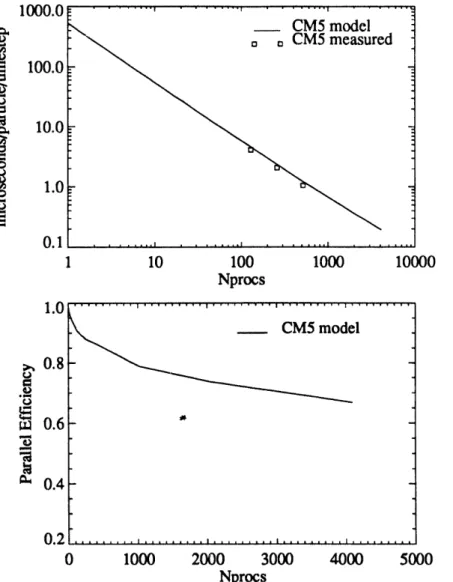
thousands of processors. Figure [1] shows both that excellent agreement between model and
measured performance and scaling with high efficiency up to 4096 processors for a problem size in
our current suite of production runs. For the l_ger runs we anticipate as part of the Numerical
Tokamak Project, we could effectively use O(10000) processors if they were available. It is
inter-esting to note that these measurements were made on the CM5 using only the SPARC chips for
floating-point arithmetic (TMC does not provide vectorizing compilers to access their 10× faster
vector units). We predict much better performance on machines like the Cray T3D, which will
offer both much faster floating-point performance and higher network bandwidth; new machines
like this one should run our simulations ten times faster than a 16-processor C90.
2.3.2 Algorithm and Method Development
We have investigated several new algorithms and formal techniques to improve the intrinsic
effi-ciency in all our GPIC codes. These included semi-implicit orbit-averaging algorithms,
partially-linearized _f algorithms, and quasiballooning coordinates.
We formulated [12] and implemented [9] a semi-implicit orbit-averaged algorithm as a way to
exploit multiple timescales to improve efficiency. Formally, this approach removes some stability
constraints on the timestep by using implicit timestepping. In practice, we found marginal gains,
since for the physics parameters of our microinstability studies the nonlinear velocities overwhelmed
the velocities used in formulating and analyzing the new algorithm. This work has proved
invalu-able, however, in more recent formulations of moment-implicit SJ" algorithms which will allow us
to efficiently include more realistic electron physics in all our work. [4] [2] I
Like many others in our field, we have switched to using the partially-linearized 8f method
to increase efficiency. In this method, the particles sample the perturbation of the phase-space
; distribution function away from a fixed background rather than the entire distribution function.
This, when coupled with a partial linearization of the equations, can result in greatly reduced
1000.",,- ... ' ... ' ... ' ...
CM5 model d
100.0
.-_ ,
'_ 10.0
q
i 1.0
0.1 ... , ...
1 10 100 1000 10000
Npr_s
_, 0.8__1'0... ' CM5... model'... "t
.qm,q
_06. "
1
a. 0.4
,2 I I i I I II I II | II I .I1'.1. I,,1 I.l'lllll..i, .|, , ..I.1..
0 I000 2000 3000 4000 5000
Nprocs
Figure 1: Performance model and measured performance on a production-sized run [256 × 128 x 32
grid, 8M particles (8 per cell)l: (a) Absolute timing in #sec per particle per timestep. (b) Parallel
efficiency, defined as 1-_---T1/TN_ ,.c,; 7"1is the time for an optimal_'proca P serial algorithm on 1 processor,
which our code uses. This problem was much too large for 1 CM5 node, hence no parallel efficiency
measurements; measurements on smaller problems agree well with the model predictions.
our GPIC codes, for all platforms.
In order to more efficiently represent the structures in the simulated instabilities with a given
grid resolution, we have begun to use a modified coordinate system called quasiballooning
coor-dinates. [5] We now have a 3D code with correct toroidal geometry and boundary conditions to
model a flux tube (section of a toroidal annulus that approximately follows the magnetic field lines).
Production simulations underway in the SPP queue on the NERSC C90 represent the first studies
of toroidal ion temperature gradient instabilities in the presence of externally imposed sheared
toroidal flows--a unique capability of our production code. We are currently implementing the
quasiballooning-coordinate algorithm under the parallel GPIC framework developed for the slab
simulation code.
2.3.3 Tool Building
In the process of building the generic message-passing 3D slab GPIC code, we have developed
sev-eral useful tools for parallel programs. For example, we have developed a routine that transposes a
, 3D data array with an arbitrary uniform 3D domain decomposition and number of guard cell layers
to an arbitrary different 3D domain decomposition. This plays a central role in a generic parallel
3D real-to-complex FFT routine which we also developed. We have also pioneered the use of a
- public-domain portable binary I/O library, NetCDF, for doing asychronous parallel I/O on
multi-ple platforms. The output files from our simulations, written using this system, are independent of
the machine architecture and the processor count or domain decomposition. In conjunction with
the DDI software developed at NERSC, which reads this file format, we use graphics workstations
to postprocess our data with commercial visualization software. To make our code portable across
multiple hardware and software systems, we have hidden the system-specific message--passing
de-tails within a library of generic wrapper functions. So far, we have wrapped several message-passing
libraries: PVM (for workstations and the C90), CMMD (for the CMS), and LMPS (for the TC2000).
These tools have already seen some reuse by other computational scientists. Another participant
in the Numerical Tokamak Project has taken the parallel FFT, with its domain-decomposition
transposer, to use in an object-oriented parallel PIC system. The Earth System Modeling group
at LLNL has adopted the NetCDF parallel I/O techniques. Researchers at PPRI at LLNL are
benefiting from the message-passing wrapper library in developing a parallel dynamic alternating
direction implicit (DADI) algorithm.
2.4 Benefits
We have gained a solid position in the world of parallel scientific computing. We are ready with
simulation codes to run oh the proposed NERSC MPP machine. Our new skills are attractive
to other organizations within and outside the lab. We are collaborating with PPRI on a parallel
DADI solver. We are establishing collaboration on seismic-wave propagation simulations on MPP's.
T. Williams is now supported by the NERSC parallel computing group to help other scientific
pro-grammers move applications to MPP's. Finally, and most importantly, this work was instrumental
in our getting a place in the HPCC Numerical Tokamak Project, which is a new source of funding
for our group.
References
and
Publication
List
Our Publications
Following is a partial list of publications that derive, at least in part, from the research described
in this report.
1. A. M. Dimits and B. I. Cohen, "Collision Operators for Partially Linearized Particle
Simula-tion Codes," Phys. Rev. E 49, 709 (1994).
2. B. I. Cohen et. al., "Implementation of a _f Implicit Moment Algorithms," Proc.
Interna-tional Sherwood Fusion Theory Conference, March 14-16, Dallas (1994).
3. Timothy J. Williams, "3D Gyrokinetic Particle-In-Cell Simulation of Fusion Plasma
Mi-croturbulence on Parallel Computers," Proc. 1993 SCS Simulation Multiconference High
4. B. I. Cohen et. al., "Formulation of/_f Implicit Moment Algorithms for Particle Simulation
of Turbulence," Bull. Am. Phys. Soc. 38 2016 (1993).
5. A. M. Dimits, "Fluid Simulations of Tokamak Turbulence in Quasiballooning Coordinates,"
Phys. Rev. E 48, 4070 (1993).
6. B. I. Cohen, Timothy J. Williams, Andris M. Dimits, and Jack A. Byers, "Gyrokinetic
simu-lations of E x B velocity-shear effects on ion-temperature-gradient modes," Phys. Fluids B.
5, 2967 (1993).
7. Nathan Mattor, Timothy J. Williams, and Dennis W. Hewett, "Algorithm for Solving Banded
Diagonal Matrix Problems in Parallel," UCl_L-JC-114756 (1993) (Submitted to Parallel
Computing).
8. A. M. Dimits and B. I. Cohen, "Simulation Models for Tokamak Plasmas," Proc. 14th
IAEA Conference on Advances in Simulation and Modeling of Thermonuclear Plasmas, IAEA
Technical Meeting, Montreal, Canada June 15-17, 1992 (Vienna, 1993).
9. B. I. Cohen and Timothy J. Williams, "Implementation of a Semi-Implicit Orbit-Averaged
Gyrokinetic Particle Code," J. Comput. Phys. 107, 282 (1993).
10. A. M. Dimits and W. W. Lee, "Partially Linearized Algorithm in Gyrokinetic Particle
Sim-ulation," J. Comput. Physics 107, 309 (1993)
11. Timothy J. Williams and Y. Matsuda, "3D Gyrokinetic Particle-In-Cell Codes On The
TC2000 And CM2." In The 1992 MPCI Yearly Report: Harnessing the Killer Micros,
E. R. Brooks et. al. eds., UCRL-ID-107022-92,303-311 (1992).
12. B. I. Cohen and Timothy J. Williams, "Semi-Implicit Particle Simulation of Kinetic Plasma
Phenomena," J. Comput. Phys. 97, 224 (1991).
13. A. M. Dimits, "Efficient Simulation of High-n Turbulence in Ballooning Coordinate," Proc.
International Sherwood Fusion Theory Conference, April 22-24, Seattle (1991).
14. Timothy J. Williams, Y. Matsuda, and E. Boerner, "Parallel Particle Simulation On the
TC2000 and CM-2," In The 1991 MPCI Yearly Report: Attack of the Killer Micros, E. R. Brooks
et. al. eds., UCttL-ID-107022, 133-138.
Other References
Work by other authors cited in this report.
15. B. C. Gorda and K. H. Warren, "PFP: A Scalable Parallel Programming Model," in The
1992 MPCI Yearly Report: Harnessing the Killer Micros, E. R. Brooks et. al. eds. Lawrence
Livermore National Laboratory publication UCRL-ID-107022-92, 17-21 (1992).
16. J. D. Callen, Phys. Fluids B 4, 2142 (1992). ¢
17. W. W. Lee, J. Comput Physics 72,243 (1987).
18. M. Kotschenreuther, "Particle Simulations with Greatly Reduced Noise," Proc. 14th