Figuring out the Farmstead
A critical evaluation of the concept Iron Age farmstead in Dutch archaeological research
Page 2 of 69
“We’ve Got Thousands of These! What Makes an Historic Farmstead Significant?”
Wilson 1990
Leon de Rouw Walstraat 53, 7411GK Deventer Email: [email protected] Telephone number: 0031 6 30 30 16 28
Page 3 of 69
Figuring out the Farmstead
A critical evaluation of the concept Iron Age farmstead in Dutch archaeological research
Leon de Rouw, s1298720 Archaeology, 60805
Page 4 of 69
Content
Preface and acknowledgements ...6
1 Introduction ...7
1.1 Research theme ...7
1.2 Approach ...7
2 Current use of the Iron Age farmstead ...9
2.1 Introduction ...9
2.2 The origin and development of the farmstead concept ...10
2.3 Application of the farmstead concept ...12
2.3.1 Raalte-Jonge Raan ...14
2.3.2 Zutphen-Looërenk ...19
2.4 Conclusion ...21
3. Towards a new perspective ...23
3.1 Introduction ...23
3.2 Theoretical Framework ...24
3.2.1 The use of Analogies in Archaeology ...24
3.2.2 The use of observations from the discipline Rural History as inspiration ...25
3.3 The establishment of processes causally related to the farmstead ...26
3.3.1 The cultivation and processing of surrounding fields in relation to the farmstead ...27
3.3.2 The livestock in relation to the farmstead ...28
3.3.3 The farming family in relation to the farmstead ...29
3.4 The farmstead as an agricultural model ...30
4 Relevant archaeological features ...32
4.1 Introduction ...32
4.2 The house ...33
4.3 Outbuildings ...35
4.4 Pits...37
5 The application of the process-related farmstead model ...39
5.1 Introduction ...39
5.2 Methodology ...39
5.3 Raalte-Jonge Raan in an agricultural perspective ...42
5.3.1 The relevant data ...42
5.3.2 The application of the process-related farmstead model...45
5.4 Zutphen - Looërenk in an agricultural perspective ...48
Page 5 of 69
5.4.2 The application of the process-related farmstead model...51
6 Discussion...54
6.1 Introduction ...54
6.2 The application of the Process Related Farmstead model on the sites Raalte-Jonge Raan and Zutphen-Looërenk ...55
6.3 Shortcomings and recommendations in farmstead research ...58
7 Conclusion ...61
Abstract ...62
Bibliography ...63
Page 6 of 69
Preface and acknowledgements
“How can you write a thesis on such an obvious subject?” is probably the question I heard most often while explaining the subject of my thesis to other people. But I cannot blame the people who asked me this question. Before starting this thesis, I also had no clue what could be written solely about the farmstead. Now, a year after I wrote my first thesis proposal, it turned out that there is so much to be written on this subject that this thesis can only be regarded as a new perspective in farmstead research.
I encountered problems with the interpretation of the farmstead during my bachelor thesis, in which the results of an Iron Age/Early Roman period excavation were elaborated. In this bachelor thesis, I tried to distinguish the farmstead within a site with more archaeological features than I could count. For this purpose, I used archaeological methods, which would help me to distinguish a farmstead within a palimpsest. Nevertheless, I was not satisfied with my conclusion, because I was unable to get significant results from my data. Therefore, my initial master thesis proposal was on the Iron Age farmstead and its role within a wider regional framework. In a short conversation with Maikel Kuijpers and Harry Fokkens subsequently the very simple question was asked: “Can you define the Iron Age farmstead?”. At that time, I realised, I could not, thus was born the thesis topic.
This thesis could not have been written without the people who pushed me in the right directions. Therefore, I wish to thank Maikel Kuijpers, for his supportive feedback during the process of writing this master thesis. I also wish to thank Roy van Beek, for supporting me with feedback when I was still searching in the unknown. Furthermore, I wish to thank Bastiaan Steffens, for our constructive conversations about our thesis subjects. And I also thank Dion Stoop, Eric van der Kuijl, Piet van Cruyningen and Wilko van Zijverden for their valuable contributions during my thinking process.
Page 7 of 69
1 Introduction
1.1 Research theme
The farmstead is the habitat of the farmer through-out the Late Prehistory. It is the place where these people live and act. From an archaeological point of view, the farmstead provides detailed information about the activities of farmers in relation to their environment in the past. The archaeological concept of the farmstead, however, lacks definition. This is because archaeological evidence is not used to determine how a farmstead ‘works’. Instead archaeologists assume that a farmstead is always present, and use this assumption as a model to differentiate and explain archaeological evidence. This is problematic, because the result is a multitude of methodologies to extract a farmstead from archaeological data, whilst information about how the farmstead is influenced by prehistoric farmers remains unclear. Therefore, this study elaborates a new perspective on the farmstead, to gain a more credible understanding of how prehistoric farmers used their habitat.
The lack of definition of the concept “farmstead” is not restricted to a specific period, area or methodology. Therefore, boundaries have been applied in order to cover the subject in a single thesis. The emphasis of this study is on the spatial layout of the farmstead, from an agricultural and economical perspective. The social or cosmological meaning of the farmstead and its processes receive little attention in this study (Cf.
Gerritsen 2003; Beck 2007; Webley 2008). Although these topics are intertwined with the definition of the farmstead, they are beyond the scope of this study. The starting point of this thesis is the Iron Age farmstead in the eastern Netherlands. The reason to tackle the farmstead problem with data from the eastern Netherlands is because in this area several large excavations have been conducted, but there is still relatively little knowledge available about the Iron Age farmstead. In order to gain understanding of the concept “farmstead”, therefore the following research question is proposed:
What is the Iron Age farmstead?
1.2 Approach
Page 9 of 69
2 Current use of the Iron Age farmstead
2.1 Introduction
The farmstead, in the archaeological sense, is usually seen as a series of features that make up multiple structures, all located in relative proximity to each other, which are tied together by contemporaneous activities related to a single household group. The methods to distinguish the farmstead within archaeological excavations vary to a large extent. The main cause for this multitude of interpretation techniques is the palimpsest situation. In this context the palimpsest situation can be described as a situation “… in which the successive episodes of deposition, or layers of activity, remain superimposed
one upon the other without loss of evidence, but are so re-worked and mixed together
that it is difficult or impossible to separate them out into their original constituents.”
(Bailey 2007, 204). Palimpsest situations are always to a certain extent present on archaeological excavations (Bailey 2007, 203). Archaeologists therefore need specific methodologies capable of avoiding or elucidate the palimpsest situation. According to Bailey (2007), this is done with what he calls a ‘microscopic’ and a ‘macroscopic’ view. A microscopic view is the improvement of dating methods and taphonomic analyses, so that a palimpsest situation can be unravelled and post-depositional processes can be determined. This method does not resolve the palimpsest situation, but makes it able to narrow the scale of this situation, so that there is the possibility to interrogate the palimpsest with different research questions (Bailey 2007, 209). A macroscopic view is to gain understanding of a palimpsest situation by using large-scale comparison in order to place phenomena in a wider perspective. In a macroscopic view, the palimpsest is left for what it is and narrowed to a single episode, so that the wider comparative context with other data sets can be studied. The pitfalls of a macroscopic view are the credibility of the comparisons, in terms of representability, interference, geomorphology or chronology (Bailey 2007, 208-210).
Page 10 of 69
2.2 The origin and development of the farmstead concept
The current archaeological definition of the farmstead is closely connected to the study of the spatial distribution of archaeological features. In the Netherlands, this started in the early 20th century, with important contributions made by archaeologists such as Holwerda and van Giffen (Brongers and Mank 1977, 2). Their approach to archaeological research was emphasised by their attention to archaeological features, in addition to finds. This marked the beginning of settlement research, with the interpretation of archaeological features as the key principle. The understanding of archaeological features took flight between 1923 and 1934, when van Giffen encountered excellently preserved foundations near the village Ezinge. The understanding of how foundations evolved to archaeological traces led to a breakthrough in settlement research (Waterbolk 2009, 3). However, it was not until the 1960s that settlement research would rapidly advance in intensity. Before this time, archaeological research focused mostly on cemeteries and material culture. Excavations performed by the ROB and the University of Leiden, primarily in the southern Netherlands, led to interpretations which are currently still being used (Gerritsen 2003, 22-29). However, the farmstead was not yet a specific research aim. At the extensive excavations at Haps, for example, Verwers (1972) describes the presence of many houses, granaries and wells, but does not refer to them as farmsteads (cf. Verwers 1972, 53-99).
The first major work written about the Iron Age farmstead in the Netherlands is the dissertation of Schinkel, based upon large-scale excavations at Oss (Schinkel 1994; 1998). Schinkel (1998) defines the farmstead as “…the land immediately surrounding a farm.” (Schinkel 1998, 26). This broad definition is further argued for by the presence of boundaries and outbuildings situated nearby a farm, such as wells and granaries (Schinkel 1998, 26). In Schinkels dissertation, the farmstead-related features are a significant part of the interpretation of the farmstead. As a result, even in situations where only farmstead-related features were found, a farmstead is identified, even though a house plan was absent. In these situations, it was assumed that the house-plan would be present in an area that was not excavated, indicated by the orientation of other houses and farmsteads on the site (Schinkel 1998, 26).
In his dissertation, Schinkel attempts to portray the farmstead as well as the settlement as a whole. Schinkel defines the settlement, in an analytical sense, “…to refer to a chronologically and spatially related group of features separated from a different group
Page 11 of 69 Schinkel also defines the settlement as “…a territory within which one or more farmyards were moved around.” (Schinkel 1998, 26). Within an archaeological excavation this can lead to fairly large settlements that contain various farmsteads which are diachronically related and can be represented in successive phases in the occupation of one, or at most, two farms (Schinkel 1998, 26). Schinkel uses the term ‘wandering farmyard’ (hereafter wandering farmstead) to describe how farmsteads were periodically relocated (Schinkel 1998, 26).1
The concept of the periodical relocation of farmsteads has been proposed earlier. Schinkel refers to Hingley (1989, 75) and Kossack et al. (1984). In the Netherlands signs of this periodical relocation of farmsteads were also found before Schinkels model was proposed. According to Gerritsen (2003, 26), the periodical relocation of farmsteads is one of the main characteristics of the urnfield period (ca. 1050-400 B.C.). This idea is based on the results of excavations at a site in St-Oedenrode, in the southern Netherlands. Here, an urnfield was found together with the remains of several farmsteads. According to Van der Sanden (1981), the amount of burials present in the urnfield was much smaller than the number of excavated farmsteads would suggest. This would suggest that the farmsteads could not have been contemporary, but were successively inhabited instead (van der Sanden 1981, 326). Also Waterbolk describes the process of periodical relocation of farms in Drenthe, hereby using the German term
Verlegung (Waterbolk 1982, 102-103). In the Eastern Netherlands this concept is known as Einzelhöfe (Verlinde 1999, 85; van der Velde 2011, 71; van Beek 2009, 79). Both terms have the same meaning, which is ‘farmsteads situated in isolation’. Roymans and Fokkens published an overview of the Dutch Bronze Age and Early Iron Age settlements in 1991, stating that most researchers agree that there were no large settlements, like villages, present. In excavations, multiple house plans are often found. However, they represent the periodical relocation of one to three house plans, belonging to a small settlement. Only incidentally, farmsteads were rebuilt on top of a predecessor (Roymans and Fokkens 1991, 11-12).
1 Gerritsen (2003) defines a farmyard as a single house (phase) and its surrounding structures. He
defines a farmstead as a more abstract object which implies successive farmyards in time (Gerritsen 2003, 38). This means that multiple farmyards can belong to the same farmstead (in time). The interpretation made by Gerritsen is useful when determining the farmstead/yard usage in time. However, to use this definition implies an assumption in whether the farmstead exists of one phase or multiple phases. Because this thesis treats the farmstead as an
Page 12 of 69 The influence of the wandering farmstead model is perfectly illustrated by the dissertation of Arnoldussen (2008), written about the nature and dynamics of Bronze Age settlement sites. Arnoldussen (2008) observes how the ‘wandering farmstead model’ is applied to situations that are far beyond the framework proposed by Schinkel (1998) in both time and space (Arnoldussen 2008, 77). He describes how the model of the wandering farmstead as an isolated farmstead that is successively inhabited, is almost naturally applied on Bronze Age settlements, thereby overlooking the possibilities for contemporaneity (i.e. more houses) and a larger life span (i.e. rebuilt houses; Arnoldussen 2008, 78, note 34). As an example, Arnoldussen illustrates how of 25 excavated (and published) Bronze Age sites known in 1991, only eight contained single farmhouses. Eight more contained several house plans. These eight did not intersect and could not be held apart by dating evidence. The remaining nine examples of farmhouses contained at least two overlapping house-plans. This, he argued, proves how the wandering farmstead model is primarily a descriptive model, based on the known settlement dynamics and cannot always be sustained with supporting evidence (Arnoldussen 2008, 77-78).
2.3 Application of the farmstead concept
Although Schinkel provided a major contribution in farmstead research, he was not able to provide a synthesis on the Iron Age farmstead. In his dissertation, Schinkel describes that archaeological evidence from the excavations at Oss-Ussen was far from complete, therefore his synthesis analysed the site on settlement level, instead of on the farmstead level (Schinkel 1998, 59). Arnoldussen (2008) explains this problem in interpreting the farmstead. In order to interpret Bronze Age farmsteads in the Dutch River region Arnoldussen conducted a Visual Analysis of Spatial Overlays (VASO), which is a method that “… relies on computer generated overlays of excavations plan from settlement sites, which are thereafter inspected visually in order to trace and outline
specific patterns. Examples of such patterns are, for example, the spatial locations of
Page 13 of 69 2008, 327; Cf. Arnoldussen 2008, 329). Arnoldussen further states that “… Under the scrutiny of VASO, disappointingly few typical elements of Middle Bronze Age house-sites
in the Dutch river area could be outlined.” (Arnoldussen 2008, 429). Although Arnoldussen provides several perspectives that can influence this variation, he clearly doubts the use of the farmstead as a methodological aide. This becomes most clear when stating that “It is for archaeologists among themselves to debate whether such structuring is enough to legitimize the use of interpretative labels such as ‘farmsteads’.”
(Arnoldussen 2008, 429). According to Arnoldussen, the risk in using the farmstead as a research method is that it is unknown to what extent it is comparable to (sub)modern farmsteads, and that its use requires to use cross-disciplinary cherry picking of a concept in which the research methodology, research aims and connotations so much differs (Arnoldussen 2008, 429). Arnoldussen’s research emphasizes that, despite the many Bronze Age houses that have been researched using the VASO method, no single prehistoric farmstead concept can be identified. It is thus all the more problematic that researchers have continued to do so regardless.
Page 14 of 69
2.3.1 Raalte-Jonge Raan
In 1997 and 1998, the ROB conducted extensive excavations at Raalte-Jonge Raan.2 The aim of these excavations was to gain an insight in the archaeological and historic-geographical function of arable lands covered by sods (Groenewoudt et al. 1998, 9; Groenewoudt et al. 2000, 9). In the publication of Raalte-Jonge Raan it is assumed that if a house plan is present, there must also be a farmstead present, surrounding the house plan. In order to spatially distinguish these farmsteads, the authors used the location of excavated non-house structures to indicate that these structures formed outbuildings on the border of the farmstead (fig 2.1). In case this was not possible, the authors chose to apply ‘middle lines’ or so-called ‘thiessen polygons’, to spatially distinguish the farmstead. Furthermore, if it was not clear to which farmstead the interpreted structures belonged, the method was to assign structures to the farmstead that had relatively fewest structures beforehand (van der Velde 2011, 55).
The authors argue that the farmsteads found at Raalte-Jonge Raan belong to various successive phases, in which the farmsteads were periodically relocated. For this interpretation, the authors estimated the life span of each individual farmstead on 30-40 years. This was based on 14Cdating evidence, the typology of the farmhouses as a whole and the extreme low density of stray finds. Furthermore, the authors estimated the size of the arable lands associated with these farms during the Late Iron Age and Early Roman period as being about three hectares. In addition, they determined that the
2 ROB (Rijksdienst Oudheidkundig Bodemonderzoek) is the predessor of the current RCE
(Rijksdienst voor Cultureel Erfgoed), the Dutch archaeological state service. Figure 2.1: Reconstruction of Late Iron Age and
Early Roman period farmsteads and arable land at Raalte-Jonge Raan (after Groenewoudt et al.
Page 15 of 69 limited dehydration of these arable lands excludes over-extensive use (Groenewoudt et al. 1998, 144).
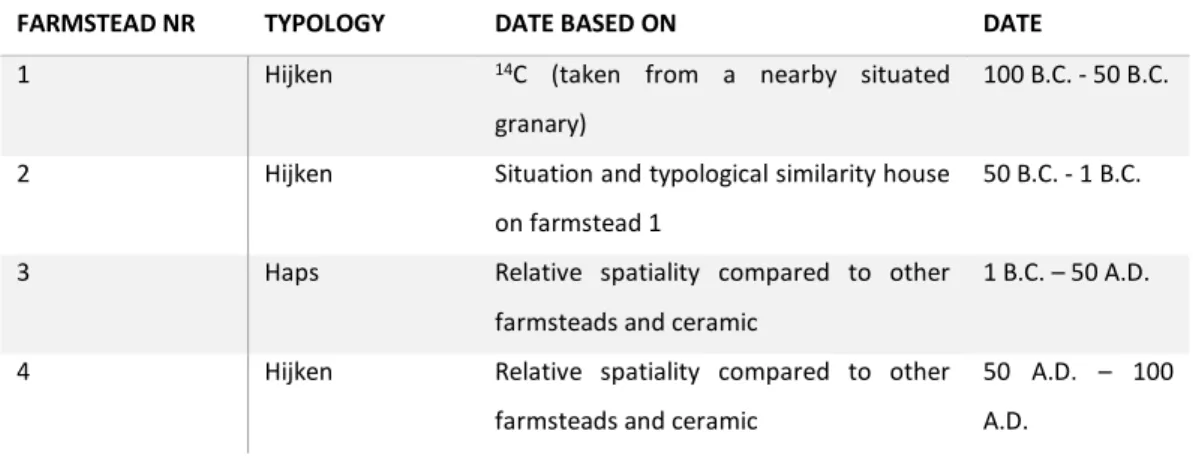
In the dissertation of van der Velde (2011), covering the long-term history of the eastern Netherlands cultural landscape from 500 B.C to 1300 A.D., the site of Raalte-Jonge Raan is an important case study. Van der Velde (2011), who was the project leader during the excavations at Raalte-Jonge Raan, clarifies the arguments made in the interpretation of the site. In his argumentation, Van der Velde (2011) uses the original chronology of the site proposed by Groenewoudt et al. (1998), dating the farmsteads between 100 B.C. and 100 A.D. However, van der Velde (2011) assumes a life span of 50 years, instead of the original 30-40 year, which is derived from the idea that that a single farm covers a single generation. In order to visualize successive phases in the farmstead, van der Velde (2011) uses various dating methods to support his interpretation (Van der Velde 2011, 54-55; table 2.1 and fig. 2.2).
Table 2.1: Dating methods used to separate the various farmsteads in time at the excavations of Raalte-Jonge Raan (After van der Velde 2011a, 55, table 3.10).
FARMSTEAD NR TYPOLOGY DATE BASED ON DATE
1 Hijken 14C (taken from a nearby situated
granary)
100 B.C. - 50 B.C.
2 Hijken Situation and typological similarity house
on farmstead 1
50 B.C. - 1 B.C.
3 Haps Relative spatiality compared to other
farmsteads and ceramic
1 B.C. – 50 A.D.
4 Hijken Relative spatiality compared to other
farmsteads and ceramic
50 A.D. – 100
Page 16 of 69
Figure 2.2: The periodical replacement of farmsteads through time at the site Raalte - Jonge Raan (after Van der Velde 2011, 54, fig. 3.9)
Page 17 of 69 border of the farmstead. However, in the case of Raalte-Jonge Raan, several farmsteads are located adjacent to each other. To distinguish the farmstead in these situations, van der Velde states that thiessen polygons and the relative amount of outbuildings assigned to a farmstead are used to spatially separate the farmsteads. This approach is, however, problematic and does not contribute to any credible knowledge about the farmstead. The use of Thiessen polygons suggest that the farmstead is geometrically assigned. This assumption is already invalidated by van der Velde himself, stating that the situation of outbuildings shows few systematics (van der Velde 2011, 55). Furthermore, the use of thiessen polygons suggest contemporaneity, which is not the case at Raalte-Jonge Raan according to the dating evidence provided by van der Velde. This means that thiessen polygons are not applicable. The assignment of outbuildings to farmsteads that have relatively few outbuildings compared to other farmsteads can even be described as a manipulation of data, and is not based on any sustainable argument whatsoever. In the present example, this contributes to a very subjective view on the farmstead and affects the presence and shape of the farmstead to a large degree.
Page 18 of 69 type better fits the Hijken type (van der Velde 2011, 56, note 219). However, this does not clarify the contradiction to the dates provided by the typochronological evidence.
At Raalte-Jonge Raan multiple dating methods were used to support the dates of the farmstead. The date of the site between 100 B.C. and 100 A.D. is primarily based on the ceramics. Furthermore, two 14C samples are used to plea for the interpretation. The first 14C sample was taken from an as granary interpreted structure, allocated near one of the farmhouses. The sample showed a dating range between 166 B.C. and 42 B.C. The proposed dating of the farmstead, between 100 B.C. and 50 B.C., is a selection of the ranges provided by the 14C sample. Furthermore, it was not taken from the farmhouse itself, but from a structure near the house, which makes it hard to sustain the date provided by the typological reference of the house. In addition, the ceramics found cannot narrow down the palimpsest situation to a period of 50 years.3 As a result, the actual archaeological evidence provided by the authors cannot prove the proposed life span of 50 years.
From the original arguments used to sustain periodical relocation of single-phase farmsteads, only the arguments using the size and dehydration of arable lands and the low density of archaeological finds are more difficult to debunk. However, these arguments alone cannot prove successive phases of a single farmstead. The size and revenue of arable fields cannot be used as an argument alone, because it is not known to which extent other food supplies were used as addition to arable farming. The argumentation that a relatively low density of archaeological finds indicates periodical relocation lacks evidence and is speculative.
In summary, at Raalte-Jonge Raan the argumentation used to separate and interpret the farmsteads in space and time are questionable. Although van der Velde argues for periodical relocation, the actual archaeological evidence presented provides little support for this interpretation. Therefore, models put forward beyond the boundaries in time and space are used to prove the presence of the farmstead within the palimpsest. However, these models are uncritically applied. On the contrary, it seems that the periodical relocation of a single-phase farmstead is taken for granted and archaeological evidence is adjusted to fit this hypothesis.
3 The closest typological framework of Iron Age ceramics is provided by Van den Broeke (2012) at
Page 19 of 69
2.3.2 Zutphen-Looërenk
In Zutphen, several excavations were conducted at the Looërenk between 2000 and 2004 (Bouwmeester et al. 2002; Bouwmeester et al. 2008). Especially the third campaign resulted in an extensive publication covering Iron Age farmsteads (Bouwmeester et al. 2008). At these excavations, little to no boundary-type features, such as fences, ditches or other parcel divisions were found (Bouwmeester et al. 2008, 257). In order to interpret farmsteads, the authors use a model proposed by Fokkens and Jansen (2002) in which the size of the farmstead is estimated as a square of 50x50m on average, with a farmhouse situated in the centre (Cf. Fokkens and Jansen 2002). Bouwmeester et al. state that they are aware that this is only a rough estimation, possibly only regionally applicable. Nevertheless, the authors decide to use the model proposed by Fokkens and Janssen to see what effect it would have on the interpretation of the farmstead. Instead of a square, Bouwmeester et al. (2008) applied a circle with a diameter of 30m around each house-plan, implicating that within this circle farmstead structures should be expected (fig. 2.3).
Page 20 of 69
Page 21 of 69 At Zutphen - Looërenk, Bouwmeester et al. (2008) applied the wandering farmstead model. However, instead of basing their argument on archaeological evidence, it is the amount of arable land available in relation with the consuming population of a single farm that leads to the suggestion that only one generation could have lived on the relatively small amount of arable lands available. Furthermore, the authors state that the exhaustion of the soil could well be a main reason for the former inhabitants of the Looërenk to displace their farmsteads (Bouwmeester et al. 2008, 263-264).
Although at Zutphen - Looërenk an extensive study was applied to gain insight in the food supply of the former inhabitants, none of this data is used in relation to the farmstead. This is probably because of the definition of the farmstead maintained by the authors. Bouwmeester et al. (2008) limit the interpretation of the farmstead to its boundaries and the outbuildings within these boundaries. All the outbuildings are interpreted as granaries, which means that observations performed by the authors only treat the situation of granaries in relation to the house or to each other (Bouwmeester
et al. 2008, 259). Information about the food supply could not be related to the farmstead, because the definition of the farmstead does not include food supply. Therefore, the authors could not provide explanations for their observations on the layout of the farmstead.
The application of boundaries does not work for the interpretation of Zutphen - Looërenk. This is because the processes which influence the boundary of the farmstead are not defined. In situations where structures were interpreted outside the 30-meter circle, there is no explanation about what this observation would mean for the farmstead. This shows how the application of boundaries, whether it is by determining outbuildings as boundaries or using models from other time and space in which boundaries are included, is useless if it is not defined which processes are responsible for the presence of boundaries. The same accounts for the interpretation of outbuildings and therefore the farmstead as a whole. The understanding of causally related processes is necessary to subsequently interpret archaeological data.
2.4 Conclusion
Despite the importance of the farmstead for understanding prehistoric settlements, the Iron Age farmstead is ill defined. The archaeological definition of the farmstead is based on the presence of a house with surrounding outbuildings, wells, fences and ditches (Cf.
Page 22 of 69 site. As a result, the farmstead is regarded by archaeologists as a static spatial entity, and interpreted in an almost typological fashion, which results in syntheses that only highlight the spatial layout, situation and life span of archaeological features. What is lacking in these interpretations is an explanation why the spatial layout of the farmstead or the features in this farmstead differ, other than an increase or decrease in volume. It is therefore justified that Arnoldussen (2008) doubts the applicability of the concept farmstead in archaeological research. However, even though the concept of the farmstead is not unwarranted, the argumentation used to identify the farmstead can certainly be seen as flawed. In this chapter it is shown how the presence of a farmstead is taken for granted, and archaeological evidence is adjusted to fit the models that prove its existence. The definition of a farmstead as a house surrounded by outbuildings is therefore inadequate to use as a research method in archaeological research.
Page 23 of 69
3. Towards a new perspective
3.1 Introduction
In the last chapter, the lack of an explanatory model for the presence of Iron Age farmsteads was problematized. As of yet, use of the farmstead-concept has been characterized by our inability to understand the farmstead as the archaeological remnant of past processes. Rather, in our conception, the farmstead is treated as a singular and unchanging idea that is repeatedly projected onto the past. This contributes to a lack of understanding of how a farmstead ‘works’. Archaeologists assume that a farmstead is always present, defined by a house and its surrounding outbuildings, and study the life-span, lay-out and situation of the farmstead in a typological fashion, as if the farmstead is a static entity rather than a lived in dynamic place. The presence of a farmstead, however, is influenced by various processes. The understanding of these processes is essential to understand why a farmstead should be present in the first place, and subsequently to determine how a farmstead works. Only then, a farmstead can be understood and used as a proper research method.
Page 24 of 69
3.2 Theoretical Framework
3.2.1 The use of Analogies in Archaeology
At their simplest, analogies are used to search for similarities and differences between source and the subject. At the basis of such an approach is the assumption that if the source and subject share some properties, it can be inferred that they share others as well (Wylie 1985, 147). However, a crucial stage is to incorporate relevance to the variables responsible for the source and the subject, in order to determine causal relations between process and product (Binford 1981; Wylie 1985, 148; Pobiner and Braun 2005, 62). The understanding of causal relations between process and product is the actual purpose of analogical reasoning (Cf. Pobiner and Braun, 2005, 62). Binford (1967) even states that no matter how well ethnohistoric contexts are understood, it will never make analogical reasoning more credible. Credibility from analogical reasoning can only be gained by establishing causal relations and to test these through a deductive approach (Binford 1967, 10; Wylie 1985, 144). This is perfectly illustrated by Pobiner and Braun (2005), who state that the importance of Binfords study regarding the butchery practices of the Nuniamut4 in relation to hunter-gatherer populations, is not a full understanding of the Nuniamut themselves, “but the realization that the economic utility of skeletal parts affects the butchery practices of hunter-gatherer
populations and the subsequent material residues of these practices” (Pobiner and Braun 2005, 62). Therefore, analogical reasoning is not fundamentally about the similarities or differences between source and subject. The most essential part is the understanding of causal relations between process and product, which can subsequently be applied to the archaeological record through deductive reasoning (Wylie 1985, 148; Pobiner and Braun 2005, 58).
The main criticism on the use of analogies is that archaeologists are limited in their understanding of the past, hence overlook ‘unique’ processes. In addition, archaeologists run the risk of a direct reading of the past from the present, thereby taking a strictly uniformitarian approach which neglects the context of a framework from another time and space (Pobiner and Braun 2005, 62). As a result, there is a risk is that an ethnocentric image of the past is created. In this case, one ends up in circular reasoning (Wylie 1985, 139). It cannot be expected that analogical reasoning provides complete explanatory closure, because it remains difficult to understand all the variables responsible for process and product (Wylie 1985, 145). Nevertheless, the
Page 25 of 69 correct use of analogies offers an alternative between clear-cut material physics on the one hand, and mere speculation on the other hand (Wylie 1985, 153).
3.2.2 The use of observations from the discipline Rural History as inspiration
In order to understand the processes causally related to the farmstead, inspiration is taken from the rural-historical discipline. Especially farmsteads between the 16th and 18th century A.D. are used as examples in the present study. This timescale was chosen because information of farmsteads from these periods is available from first-hand observations. Furthermore, during the 19th century Dutch agriculture started to modernize quickly, in which many distinctive farms vanished or were thoroughly renovated (Cruyningen 2014, 134). This does not mean that the previous period was static (Bieleman 1992, 11). Several studies show that the agrarian production in the post-medieval period steadily increases. However, farming methods show relatively little change in comparison with the 19th and 20th century (Slicher van Bath, 1957, 587).
Observations and the gathering of information on rural society started in the late 19th century and 20th century. Several researchers, both with and without an academic background, have been engaged in rural research. In this study, the work of Gallée and Uilkema is used (Gallée 1908; van Olst 1991). Both studied the rural society of the eastern Netherlands. Gallée was the first to collect large amounts of information about farmhouses and to synthesize this data from a construction-historic and culture-historic point of view (van Cruyningen 2002, 5). Uilkema provided presumably the largest collection of data, containing hundreds of detailed drawings and thousands of photos, taken between 1914 and 1934. However, His work was not published at the time. Nearly fifty years after his death, van Olst (1991) studied and published his extensive work.
Page 26 of 69 Present studies in agrarian history mostly focus on agrarian society on supra-regional level, not on the level of individual farmsteads. Studies focusing on the individual farmstead in the eastern Netherlands, are primarily performed as popular scientific work, initiated by foundations such as De Rijksdienst voor de Monumentenzorg and the
Stichting Historisch Boerderij-onderzoek. For qualitative methodological and deductive research purposes, these works are not applicable, because they only provide global overviews and lack research questions, methods and synthesis. However, given the fact that several works contain many extensive representations of farmhouses and farmsteads, written by experts in the field of agrarian history, a number of these works are useful if used for representation purposes such as the appearance of typical farmstead objects.
The oldest remaining farm type in the Netherlands is the los hoes5 (van Olst 1991, 378).
The los hoes is a farmhouse in which living-, stable- and storage functions are brought together under the same roof (Gallée 1908, 44; van Olst 1991, 355). The most remarkable aspect of this ‘intertwining of functions’ is that the spaces belonging to these functions are barely demarcated by physical boundaries (van Olst 1991, 378). From an archaeological perspective, this corresponds with the layout of Iron Age farmhouses, in which clear-cut spatial boundaries inside the farmhouse are also often absent or difficult to establish. Furthermore, the activities performed on the farmstead of the los hoes in relation to its long-term use shows little dynamic and therefore provides an indication of characteristic farmstead processes. Therefore, the los hoes is taken as starting point for the understanding of processes relating to the presence of a farmstead.
3.3 The establishment of processes causally related to the farmstead
The farmstead cannot be treated as a static entity, because it is the nerve centre of the total farming business, including the surrounding environment (Cf. Leopold 2001, 56). In order to understand the dynamic of the farmstead, its place within the agrarian business as a whole need to be understood. Each of the variables influencing the farming business as a whole can also be related to the farmstead. Determining this connection is necessary to understand how the farmstead is influenced by its agricultural purpose. The aim of this study is therefore to determine activities which occur in the farming
Page 27 of 69 business and are related to the farmstead. Therefore, the agricultural function of the farmstead, in economical perspective, is taken as a basic principle.
The farmstead strongly depends on the cultivation of the surrounding arable- and wastelands. This entails the necessities to cultivate these lands, as well as the processing of revenue coming from these lands. Within the agrarian practice, the size of the farming business and the relation between farming opportunities and necessities is of essential value. Key features within the farming business are the amount of arable land, hayfields and pastures available, the amount of traction animals, technology, storage function, the amount of fertilizer needed and therewith related the amount of animals needed to provide fertilizer (Slicher van Bath 1960, 25). Especially in older sub modern agrarian communities, where the emphasis is on arable labour rather than cattle breeding, the relationship between these various factors is vital (Slicher van Bath 1960, 26). According to Slicher van Bath, the size of the agrarian company, including the availability of arable lands, pastures and cattle, the extent of traction available, the size of the family and the amount of labour depend on each other in an optimal ratio (Slicher van Bath 1960, 26). In the fringe, agrarian businesses of the pre-18th century there were little opportunities to diverge from this ratio (Slicher van Bath 1960, 26).
3.3.1 The cultivation and processing of surrounding fields in relation to the
farmstead
Cultivation and the processing of surrounding fields is directly related to the farmstead in terms of storage space needed for the yield. Before the 19th century, agrarian production was almost exclusively meant for food purposes (Slicher van Bath 1960, 31-32). Field revenues contained for a large part various grain types and hay, from which a significant part was reserved to sow the fields for next season (Slicher van Bath 1960, 27-28). In addition to grain, root vegetables were also harvested (Slicher van Bath 1960, 32-33).
Page 28 of 69 before they could be used for other purposes. On the threshing yard the cereal grain was removed from the spike. The grains were threshed by hand. This started shortly after the harvest and lasted until spring. Only in the summer, threshing did not take place (Koldeweij et al. 2001, 25). The threshing yard be covered from rain or frost. Therefore, the threshing yard was located inside the central hall of the los hoes. Root vegetables, vulnerable to frost, moist, light and heat, had to be stored underground (Gallée 1908, 46; Koldeweij et al. 2001, 145). In areas where the emphasis was on arable farming, the threshing yard was exclusively used for threshing purposes. At specialized cattle breeding farms, the threshing yard was used to store hay, in order to feed the animals. In addition, the threshing yard was also used for short-term storage purposes. When the grain was processed, it was stored inside a granary, shed or farm (Koldeweij et al. 2001, 145).
3.3.2 The livestock in relation to the farmstead
Even in areas with an emphasis on arable farming, there is a need for cattle. Cattle provides three advantages: Primary and secondary products to consume; animal traction for transporting, ploughing, harrowing and other processing purposes; and fertilizer purposes (Slicher van Bath 1960, 30, 309-310). Specific buildings on the farmstead are equipped to feed and shed the cattle. The revenue provided by cattle, in terms of primary and secondary products, is processed and stored on the farmstead. However, the raising of cattle is restricted by the availability of food and labour. On the farmstead, structures were erected to store animal food. There are additional variables restricting the keeping of cattle not directly related to the farmstead, such as the availability of pastures or heathlands and the amount of labour needed to keep cattle (Koldeweij et al. 2001, 119).
The shedding space of cattle on the farmsteads varies by animal. In places where the emphasis is arable farming, the caring for cows had the highest priority. This is due to the amount manure they provide, in addition to primary and secondary products and traction. The cows were herded on pastures, such as grasslands or more extensively used heathlands and marshlands. In addition, the cow spent considerable time inside the shed, which was located on the farmstead, but also inside the farmhouse, on either sides of the threshing yard (Gallée 1908, 45-46).
Page 29 of 69 and secondary products, but excels in animal traction (Slicher van Bath 1957, 528). According to Slicher van Bath, based on 16th century French sources, a horse provides three to four time as much animal traction then the cow. The horse is more common in areas with the emphasis on cattle breeding then on arable farming, because in arable farming areas there is not always enough food present to feed the horse, in addition to other animals and the farming family themselves. Slicher van Bath therefore states that the transition from cows to horses suggests an increase of prosperity of the farming population (Slicher van Bath 1960, 317-318).
Sheep and goats are an exception when it comes to animals in relation to the farmstead. Most of the time they were herded outside, on the outstretched heathlands or extensively used marshlands. They were shed in so-called sheep pens, which from the medieval period onwards also often functioned to collect manure, to use as fertilizer. These sheep folds were not necessarily located on, or in the neighbourhood of, the farmstead (Koldeweij et al. 2001, 119). The herding of sheep is closely connected to the multifunctional use of the animal. The sheep does not provide traction, but it does provide primary and secondary production and fertilizer (Slicher van Bath 1957, 543-548).
Pigs were kept on the farmstead (Gallée 1908, 45-46). Most of the time they were walking outside, around the manure pile for instance. When a pig was fattened, it was taken inside the shed or farmhouse (Koldeweij et al. 2001, 119). From historical sources, a view is provided in which it seemed that the pig is strictly used for self-sufficiency, because only a handful of pigs were kept on farmsteads (Slicher van Bath 1957, 538). The advantage of pigs is that they can be fed cheaply with garbage, yet, they primarily provide only meat (Koldeweij et al. 2001, 21).
Other possible livestock present on the farmstead are poultry and beehives (Gallée 1908, 45-46). In some situations, poultry was shed in henhouses, although there are also examples in which poultry is shed inside the farmhouse (Koldeweij et al. 2001, 119). Beehives were located on the borders of the farmstead. These bees provided products such as beeswax for candles in addition to honey (Gallée 1908, 46).
3.3.3 The farming family in relation to the farmstead
Page 30 of 69 the processing of secondary products, such as the weaving of wool or the processing of milk to butter. However, in return the farming family needs resources to survive and perform these tasks. These are the basic needs to live, such as food consumption, clothing and housing.
One structure on the farmstead that can be related to the activities performed by the farming family is the place in which they eat and sleep. This is the farmhouse, characterised by the hearth and the bedstead. In the los hoes the hearth is located in the same central hall as the threshing yard. The division between the two spaces is often not demarcated, showing the intertwinement of the ‘living space’ with the ‘labour space’. Chimneys were not present in the los hoes, therefore the smoke had to search for a way out through the upper shelves and the thatched roof, which resulted in a dusky room (Olst 1991, 378). In the summer, the door was open to keep the smoke out. In the winter there was enough ‘draught’ to keep the air breathable (Olst 1991, 377-378). The quarters of the living space contained the bedsteads (Gallée 1908, 45-46; van Olst 1991, 383; Koldeweij et al. 2001, 15).
Outside the farmhouse, structures that were used for the basic necessaries were present as well. The well was, unless fresh surface water was available, located on the farmstead (Koldeweij et al. 2001, 107). Furthermore, the restroom is also a common farmstead object, although it was preferably build above a ditch or channel, so that the dung was quickly drained (Koldeweij et al. 2001, 113).
3.4 The farmstead as an agricultural model
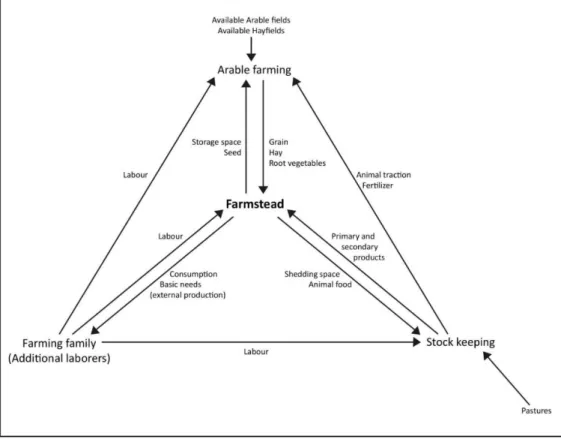
Page 31 of 69 The rural-historical approach performed in this chapter shows that the presence of a farmstead depends on its agricultural purpose. This means that the farmstead is not a static object, and its existence cannot be solely defined based on its spatial characteristics. The farmstead is a dynamic object and its presence changes to fit its agricultural purpose. The understanding of the agricultural purpose of the farmstead is therefore key to determine its characteristics. In this study I put forward a model, capable of gaining understanding in the processes influencing the farmstead (fig 3.1). This process-related farmstead model (hereafter PRF-model) focuses on the agricultural purpose of the farmstead and depicts how these variables are causally related to the farmstead and each to each other. The model is based on the information described in this chapter and can be used to establish quantifiable causal relations. In it, the archaeological product, the features and finds, are linked to the processes responsible for their presence. The purpose of this model is to provide additional argumentation to for the interpretation of a farmstead. As such, the process related farmstead model redefines the concept of the farmstead.
Page 32 of 69
4 Relevant archaeological features
4.1 Introduction
According to the PRF-model, the presence of the farmstead depends on three variables: arable farming, stock breeding and the farmer’s activities. These three variables express themselves through various processes causally related to each other and causally related to the farmstead. With the farmstead considered as viewpoint, these processes are divided in internal or external processes. Internal processes are directly related to the farmstead. In arable farming, this is considered as the storage space to provide sowing seed and to store and process the harvest. In stock breeding, the internal processes are the available shedding space, the food stored at the farmstead and the primary and secondary products provided by cattle. The farming activities directly related to the farmstead are the basic necessities to provide labour. External processes do not present themselves in farmstead features, but are directly related between the three variables, arable farming, stock keeping and farmers’ activities. Therefore, the external processes are indirectly related to the farmstead. In arable farming, these external processes are expressed through the availability of arable fields and hayfields. In stock keeping, these are expressed in the availability of pastures. Other external processes include the technological or economical processes influencing the extent to which arable farming or stock keeping can be conducted. The key process in this is the amount of labour provided by the farming family, both in arable farming and in stock breeding. Another interrelated causal relation is the amount of fertilizer and animal traction provided by the livestock in relation to arable farming. In this chapter the archaeological features relevant for the determination of the internal processes of the farmstead are discussed.
Page 33 of 69 In this study, demarcating features are not treated. The reason for this neglect is because their exact agricultural function is unclear. On some occasions they can be related to arable farming or stock keeping, beside social processes, which would be external processes in view of the farmstead. However, the primarily reason to not include boundary features such as fences as ditches is that they are not present in the case-studies treated in this study.
4.2 The house
The most examined archaeological structure related to the Iron Age farmstead is undoubtedly the house. Research on this subject is extensive, varying from typological studies (e.g. Schinkel 1998; Waterbolk 2009; Lange et al. 2014) to more post-processual approaches on the social context of the house (i.e. Gerritsen 2003; Beck 2007; Webley 2008). However, there is no study specifically emphasising the agrarian function of the house. The function of the farmhouse is typically explained as the living space of the farming family. However, there are also examples in which the layout of the ground plan suggests a division in two or more sections, which are interpreted as separate spaces, defined as a dwelling section and a byre section (Gerritsen 1999, 83; Waterbolk 2009, 54-67).
According to Waterbolk (2009), attics or lofts for storage purposes were probably present inside the house, although they are difficult to distinguish in a house-plan and almost impossible to direct to a specific function (Waterbolk 2009, 54). Another feature interpreted as a storage space are cellars, in the shape of rectangular pits (Waterbolk 2009, 129). Waterbolk primarily points to the Late Medieval Period for the appearance of cellar pits inside the house. However, these are also known from Late Prehistory. Arnoldussen observed various Bronze Age sites in the river region where storage pits inside the house are interpreted as cellar pits on multiple occasions, in which cereals in properly sealed containers were possibly stored (Arnoldussen 2008, 263).
Page 35 of 69
Figure 2.1: Percentage of different domestic animals in prehistoric settlements in the river area. (N=total determined fragments). Translations from left to right: Cow, sheep/goat, pig, horse, dog and wildlife (Van Wijngaarden-Bakker and Brinkkemper 2005, 494, fig. 22.4)
4.3 Outbuildings
Outbuildings are defined as farmstead-related structures that consist of multiple archaeological features and are not interpreted as a house. This definition is very broad and made because outbuildings have been interpreted in all types and sizes. In archaeological research, this broad definition is often divided in two divisions. Granaries6, as storage space for all kinds of commodities, however, and other shed-like structures. This division essentially means that only granaries are defined in archaeological research, while other interpreted shed-like structures are not.
By far the most interpreted outbuilding in archaeological research is the granary. The granary is the earliest known explanation to interpret multipolar non-house structures. Since then, the concept of the granary has become a much-used interpretation method in archaeological research. The problem in the application of the granary concept is not that its interpretation is incorrect, there is plenty of anthropological examples that point out that granaries are common storage structures on farmsteads (Cf. Arnoldussen 2008, 238-237). Furthermore, there are some excavations in which botanical evidence is used to link a multipolar structure to a presumed storage function of different kinds of raw materials (Cf. Arnoldussen 2008, 236-237). However, in archaeological excavations it seems that the granary is the only defined explanation for multipolar structures. This
Page 36 of 69 can perfectly be exemplified by typological overviews covering the ground-plans of interpreted granaries. Figure 4.1 and 4.2 show two typological overviews of interpreted granaries. The first (Fig. 4.1) is based upon Bronze Age research in the Dutch River Area by Arnoldussen (2008) while the second is based upon archaeological excavations at the Late Bronze Age and Iron Age site Hatzum-Boomborg in north-west Germany, near the Dutch border, provided by Waterbolk (2009). These typological overviews show a proliferation of granaries lay-outs, without critically evaluating on the function of such different ground-plans. Because there is no understanding why granary lay-outs differ, the typological methods used to differentiate between granaries are practically meaningless.
Research on other shed-like structures is scarce. In several excavations there have been alternative functions suggested for the interpretation of multipolar structures. According to Arnoldussen (2008), other interpretations of granaries as multipolar structure include storage for fodder, haystacks, livestock pens, religious structures, watch-towers, privies, fighting stages and exposure platforms, but are from an archaeological perspective difficult to prove, highly speculative or rarely applied (Arnoldussen 2008, 236). In the archaeological interpretation of the Iron Age farmstead only the haystack is considered as a viable other explanation. The haystack is defined as a storage structure meant for the storage of hay, in contrast to the granary, which is meant for grains. According to Arnoldussen (2008),
t
he haystacks most important function is to dry hay, in which conservation is less important. This is in contrast with granaries, which need to conserve food, and therefore need to have free-air circulationFigure 4.1: Typology of Bronze Age granaries interpreted in the Dutch River Area (After Arnoldussen 2008, 239, fig. 5.39).
Page 37 of 69 and less vulnerability to animal or insect attacks (Arnoldussen 2008, 137). Waterbolk defines the haystack as a triangular or cylindrical pattern, this in contrast to the granary, which he defines on a square or rectangle pattern. Arnoldussen also includes triangular and cylindrical patterns as granaries, while Waterbolk specifically assigns them to the interpretation of haystack. However, just as is the case of the interpretation of the granaries, the typological approach on the presence of haystacks contains the same problem as the interpretation of the granary. That is to say, the processes influencing the layout of a haystack are unknown. The definition of these structures depends on the way archaeologists argue their interpretation. The typological approach in which granaries and haystacks are interpreted, and unknown spatial layouts are interpreted as a new not yet discovered shape of a granary or haystack, reveals a circular argument in which the concept of granary and haystack is taken for granted, without critically approaching why they would by all means present on archaeological excavations.
The remaining type of outbuilding treated in this paragraph is the shed. Essentially the granary or haystack is also a shed-like structure. However, in archaeological research the shed is defined as the remaining structure that is too large to be interpreted as a granary and too small to be interpreted as a house. This ill definition, is to a large extent, arbitrary, which highly influences its application in archaeological research. For example, Waterbolk (2009) suggests that the Iron Age farmstead is limited to granaries and haystacks and that sheds are not present (Waterbolk 2009, 111). However, there are multiple examples of archaeologists interpreting sheds on the Iron Age farmstead (e.g. Van Beek 2009, 176-177; Van der Velde 2011, 52; Verlinde 2000, 18, 21).
4.4 Pits
In every excavation, pits are interpreted. Schinkel (1998) defines pits as all non-linear features that cannot be interpreted as a posthole or burial (Schinkel 1998, 267). This broad definition results in large numbers of pits interpreted on an Iron Age farmstead. Examples are refuse purposes, storage purposes, animal care purposes, living space purposes, processing purposes or burial purposes (Cf. Huijbers 2007, 195-196 for the Medieval period; Arnoldussen 2008, 262-264 for the Bronze Age).
Page 38 of 69 divided in two categories. Silos dug for the conservation of sowing seed and storage pits used to temporarily store remaining (raw) materials.
Van Wijngaarden-Bakker and Brinkkemper (2005) suggest that in some occasions silos were used to store sowing seed. This argument is based on interpreted silos at Deventer-Colmschate, that were quite large (3m3/4m3) and could not be re-opened. Re-opening a silo contacts the seed with oxygen, which can make the seed mouldy or causes it to germinate. Furthermore, the silo was situated above groundwater-level, which was necessary because contact with water can cause mould (van Wijngaarden-Bakker and Brinkkemper 2005, 509). On some occasions, silos may have been re-used and sanitized by fire (Arnoldussen 2008, 263).
Page 39 of 69
5 The application of the process-related farmstead model
5.1 Introduction
Establishing the variables and related processes directly and indirectly influencing the farmstead results in a dynamic model explaining the presence of the Iron Age farmstead. In the previous chapter, the emphasis was on the discussion of relevant archaeological features for the application of the PRF-model on Iron Age farmsteads. This discussion was put forward on an abstract level, using archaeological syntheses as a starting point. However, to show the relevance of the PRF-model it is necessary to apply the model to an analysis of actual archaeological excavations. The case studies used to exemplify the problems in the interpretation of the Iron Age farmstead in paragraph 2.3 are used for this purpose. These case-studies are chosen because they are firmly criticised in these thesis, but their interdisciplinary and extensive archaeological approach also show potential for the application of the PRF-model on the interpreted Iron Age farmsteads.
The purpose of this chapter is to reinterpret the sites using the PRF-model proposed earlier. This is accomplished by placing the site in a new agricultural perspective, established in in the previous chapters. The starting point in the approach of each case study are the archaeological features that are relevant for the interpretation of the agrarian function of a farmstead, as is determined in the previous chapter. In the case studies, information is also provided about some of the external processes relevant for the application of the process-related farmstead model on the Iron Age farmstead. These ideas are therefore also critically approached in this chapter.
5.2 Methodology
In the previous chapter I stated that the reasoning behind the interpretation of outbuildings is to a large extent questionable. Yet they are the key to define and understand the farmstead. A re-evaluation of the function of outbuildings would therefore be recommended before analysing the full potential of an agricultural perspective, so that more credibility can be gained from this analysis. However, this is not fully achievable in this present study. Therefore, the understanding of outbuildings must be established by establishing the processes related to the presence of outbuildings, which is partly done in the current analysis.
Page 40 of 69 to the farmstead. For this purpose, a ratio to understand the quantitative relationship between farmstead related processes and archaeologically visible traces should be established. For such a ratio the exact volume of archaeological structures related to storage, shedding, processing and living spaces needs to be understood. In the previous chapter it was explained that the methods to interpret archaeological features, especially outbuildings, is questionable. Therefore, this ratio must be established by using data from another time and space, through the use of analogies. The risk in this approach is a direct reading of the present onto the past. The purpose of nevertheless applying such an approach, is to provide a new perspective on current archaeological interpretations that can be questioned if additional information on the functioning of outbuildings would come to light.
The relation between the size of the haystack and its storage function is studied from an archaeologic point of view by Huijbers for a medieval context (Huijbers 2007, 152-159). Based on studies of Bieleman (1996), the volume of piled hay is expressed in the amount of livestock that can be fed in the winter, based on 180 days of winter (Bieleman 1996, 259). According to Kuijsten (1919), based on his own observation of Frisian haystacks, hay can weigh approximately between 75kg and 125kg per m3, depending on how it is stacked (Kuijsten 1919, 4; Huijbers 2007, 157). Huijbers maintains an absolute weight of 125 kg as a starting point (Huijbers 2007, 158). The variable is referred to as ‘koe’sete’, and comprises, according to Kuijsten (1919), 2500 kg of hay (Kuijsten 1919, 5; Huijbers 2007, 158). According to Uilkema (1916), a four-poled haystack could contain 20
‘koe’sete’, a five-poled haystack 28 ‘koe’sete’ and a six-poled haystack 36 ‘koe’sete’
(Uilkema 1916; Huijbers 2007, 157). Therefore, Huijbers (2007) calculates the amount of hay that could be stored inside a haystack on 50.000 kg, 70.000 and 90.000 kg hay in respectively four-poled, five-poled and six-poled haystacks (Huijbers 2007, 158). This would mean that one fully piled up four-pole haystack would provide food for 20 cows during winter. According to Huijbers (2007), the total volume of the haystack barely differs from the average barn. In addition, the use of a haystack as storage structure for hay has advantages to storage inside the house or in barns. They are relatively easy to build structures, the consequences in case of fire are less severe, there is less of a chance of vermin related problems and the structure provides a smooth drying of hay (Kuijsten 1919, 8; Bieleman 1996, 256-257; Huijbers 2007, 156).
Page 41 of 69 archaeologists is not known from post-medieval and modern observations of Dutch farmsteads. Huijbers (2007) assumes for the medieval period in the Maas-Demer-Schelde region that all four- five- and six poled-outbuilding could in principal be used for all kinds of storage space (Huijbers 2007, 161). The question how much can be stored in a granary is, however, difficult to answer. To determine the potential volume of the granary, constructional and anthropological data is needed. Bakels (1989) mentions English experiments that estimate the average size of a granary on a floor surface of 4 m2. Furthermore, the height of the granary is assumed on an average of 2 meter. This results in a capacity of 8 m2, which can bear approximately 5000 kilos of threshed grain (Bakels 1989, 11). Bakels provides various pitfalls in the use of this number as a starting point. The first is the question whether a granary can carry the weight of 5000 kilo’s of threshed grain and the second is the question whether or not only threshed grain was kept inside the granary, or only unprocessed grain. The weight of unprocessed grain is significantly lower than stored threshed grain (Bakels 1989, 11). However, in a more recent publication Bakels clearly states “…that the granary was certainly not, at least not commonly, used for bulk storage of grain. In the few instances where the burnt contents
of granaries, destroyed by fire, could be studied, the conclusion was that they held
several products stored apparat, in separate heaps, sacks, baskets or chests.” (Bakels 2009, 121). In her publication, which emphasised the loess region in the southern Netherlands, Belgium and France, Bakels also state that common sizes of granaries can be 9m2 or even larger (Bakels 2009, 121). This would mean that the amount of stored harvest could even be larger. In this thesis, however, the amount of 5000 kilos is maintained as a starting point to compare with the amount of yield needed to store at the farmstead.