Pairing in hot rotating nuclei
N. Quang Hung1,*and N. Dinh Dang1,2,†
1Heavy-Ion Nuclear Physics Laboratory, RIKEN Nishina Center for Accelerator-Based Science 2-1 Hirosawa, Wako City, 351-0198 Saitama, Japan
2Institute for Nuclear Science and Technique, Hanoi, Vietnam (Received 15 July 2008; published 19 December 2008)
Nuclear pairing properties are studied within an approach that includes the quasiparticle-number fluctuation (QNF) and coupling to the quasiparticle-pair vibrations at finite temperature and angular momentum. The formalism is developed to describe noncollective rotations about the symmetry axis. The numerical calculations are performed within a doubly folded equidistant multilevel model as well as several realistic nuclei. The results obtained for the pairing gap, total energy, and heat capacity show that the QNF smoothes out the sharp SN phase transition and leads to the appearance of a thermally assisted pairing gap in rotating nuclei at finite temperature. The corrections due to the dynamic coupling to SCQRPA vibrations and particle-number projection are analyzed. The effect of backbending of the momentum of inertia as a function of squared angular velocity is also discussed.
DOI:10.1103/PhysRevC.78.064315 PACS number(s): 21.60.Jz, 21.30.Fe, 24.10.Pa, 24.60.−k
I. INTRODUCTION
Thermal effect on pairing correlations has been extensively studied within the Bardeen-Cooper-Schrieffer (BCS) theory [1] at finite temperature T (FTBCS theory). The FTBCS theory predicts a destruction of pairing correlation at a critical temperatureTc0.568(0) [(0) is the pairing gap at zero
temperature], resulting in a sharp transition from the superfluid phase to normal one (the SN phase transition) in good agree-ment with the experiagree-mental findings in macroscopic systems such as metallic superconductors. However, the BCS theory is valid only when the assumption on the quasiparticle mean field is good, i.e., when the difference between the pair correlator Pkσ† ≡a†kσak†−σand its expectation valuePkσ†is small so that the quadratic term (Pkσ† − Pkσ†)2is negligible, whereakσ† is
the operator that creates a particle with angular momentumk and spinσ. For small systems such as underdoped cuprates, where the coherence lengths (the Cooper-pair sizes) are very short, the fluctuations (Pkσ† − Pkσ† )2 are no longer small,
which invalidate the quasiparticle mean-field assumption, and break down the BCS theory. As the result, the gap evolves continuously acrossTc, and persists well aboveTc[2].
Various theoretical studies have been undertaken over the past three decades to study the effects of thermal fluctuations on pairing in atomic nuclei. Pioneer articles by Moretto [3] employed the macroscopic Landau theory of phase transition to treat thermal fluctuations in the pairing field as those occurring around the most probable value of the pairing gap. The results of calculations within the uniform model carried out in Ref. [3] show that the average pairing gap does not collapse as predicted by the FTBCS theory but decreases monotonously with increasingT, smearing out the sharp SN phase transition. This approach was later used by Goodman to include the effects of thermal fluctuations in the
Hartree-*On leave of absence from the Institute of Physics and Electronics,
Hanoi, Vietnam;[email protected] †[email protected]
Fock-Bogoliubov (HFB) theory at finite temperature [4]. The static-path approximation (SPA), which takes into account thermal fluctuations by averaging over all static paths around the mean field, also shows the noncollapsing pairing gap at finite temperature [5,6]. The recent microscopic approach called the modified BCS (MBCS) theory [7–9] is based on the secondary Bogoliubov transformation from quasiparticles to the modified ones to restore the unitary relation for the generalized particle-density matrix at T = 0. The MBCS theory, for the first time, points out the quasiparticle-number fluctuation (QNF) as the microscopic origin that causes the noncollapsing thermal pairing gap in finite small systems. The predictions of these approaches are in qualitative agreements with the experimental findings of pairing gaps and heat capacities measured in underdoped cuprates [2] and extracted from nuclear level densities [10].
Differing from all above-mentioned approaches, where quasiparticles are regarded as independent, the recently pro-posed FTBCS1 theory with corrections coming from the QNF and self-consistent quasiparticle random-phase approx-imation (SCQRPA) at finite temperature [11] calculates the quasiparticle occupation numbers from a set of FTBCS1+ SCQRPA equations. Within this approach, which is called the FTBCS1+SCQRPA and is an extension of the BCS1+SCQRPA developed in Ref. [12] to finite temperature, the QNF and quantal fluctuations caused by coupling to SCQRPA vibrations are included into the equations for the pairing gap and particle number. Under the influence of these SCQRPA corrections, the temperature functional of the quasiparticle occupation number deviates from the Fermi-Dirac distribution of independent quasiparticles. The results obtained within the FTBCS1+SCQRPA for the total energies and heat capacities agree fairly well with the exact solutions of the Richardson model [13,14] at finite temperature and those obtained within the finite-temperature quantum Monte Carlo method for the realistic56Fe nucleus [15].
to study hot rotating nuclei. The rotational phase of the nucleus as a whole, such as that present in spherical nuclei or that about the axis of symmetry in deformed nuclei, is known to affect nuclear level densities. The relationship between this noncollective rotation and pairing correlations has been the subject of many theoretical studies. The effect of thermal pairing on the angular momentum at finite temperature was first examined by Kammuri in Ref. [16], who included in the FTBCS equations the effect caused by the projection M of the total angular momentum operator on the z axis of the laboratory system (or nuclear symmetry axis in the case of deformed nuclei). It has been pointed out in Ref. [16] that, at finite angular momentum, a system can turn into the superconducting phase at some intermediate excitation energy (temperature), whereas it remains in the normal phase at low and high excitation energies. This effect was later confirmed by Moretto in Refs. [17,18] by applying the FTBCS at finite angular momentum to the uniform model. It has been shown in these articles that, apart from the region where the pairing gap decreases with increasing both temperatureT and angular momentumMand vanishes at a given critical valuesTcandMc,
there is a region ofM, whose values are slightly higher than Mc, where the pairing gap reappears atT =T1, increases with
T atT > T1 to reach a maximum, and then decreases again
to vanish at TT2. This effect is called anomalous pairing
or thermally assisted pairing correlation. In the recent study of the projected gaps for even or odd number of particles in ultrasmall metallic grains in Ref. [19] a similar reappearance of pairing correlation at finite temperature was also found, which is referred to as the re-entrance effect. Recently, this phenomenon was further studied in Refs. [20,21] by performing the calculations using the exact pairing eigenvalues embedded in the canonical ensemble at finite temperature and rotational frequency. The results of Refs. [20,21] also show a manifestation of the re-entrance of pairing correlation at finite temperature. However, differing from the results of the FTBCS theory, the re-entrance effect shows up in such a way that the pairing gap reappears at a givenT =T1and remains finite at T > T1due to the strong fluctuations of the order parameters.
The aim of the present study is to extend the FTBCS1 (FTBCS1+SCQRPA) theory of Ref. [11] to finite angular momentum so that both the effects of angular momentum as well as QNF on nuclear pairing correlation can be studied simultaneously in a microscopic way. The formalism is applied to a doubly degenerate equidistant model with a constant pairing interactionGand some realistic nuclei, namely20O, 22Ne, and44Ca.
The article is organized as follows. The FTBCS1+ SCQRPA theory is extended to include a specified projection Mof the total angular momentum on the axis of quantization in Sec.II. The results of numerical calculations are discussed in Sec. III. The last section summarizes the article, where conclusions are drawn.
II. FORMALISM
A. Model Hamiltonian
We consider a system of N particles interacting via a pairing force with the parameter G and rotating about the
symmetry axis (noncollective rotation) at an angular velocity (rotational frequency) γ with a fixed projection M (or K) of the total angular momentum operator along this axis. For a spherically symmetric system, it is always possible to make the laboratory-frame z axis, taken as the axis of quantization, coincide with the body-fixed one, which is aligned within the quantum mechanical uncertainty with the direction of the total angular momentum, so the latter is completely determined by its z-axis projection M alone. As for deformed systems, where the symmetry axis is the principal (body-fixed) axis, this noncollective motion is known as the “single-particle” rotation, which takes place when the angular momenta of individual nucleons are aligned parallel to the symmetry axis, resulting in an axially symmetric oblate shape rotating about this axis. Such noncollective motion is also possible in high-K isomers [22], which have many single-particle orbitals near the Fermi surface with a large and approximately conserved projectionKof individual nucleonic angular momenta along the symmetry axis. Therefore, without losing generality, further derivations are carried out below for the pairing Hamiltonian of a spherical system rotating about thezaxis [16–18], namely
H=HP−λNˆ −γM,ˆ (1)
whereHPis the well-known pairing Hamiltonian
HP =
k
k(Nk+N−k)−G
k,k
Pk†Pk,
(2) N±k=a±†ka±k, Pk†=a
† ka
†
−k,
witha±†k(a±k) denoting the operator that creates (annihilates)
a particle with angular momentum k, spin projection±mk,
and energyk. For simplicity, the subscriptskare used to label
the single-particle states|k, mk in the deformed basis with
the positive single-particle spin projectionsmk, whereas the
subscripts−kdenote the time-reversal states|k,−mk(mk>
0). The particle number operator ˆN and angular momentum ˆ
Mcan be expressed in terms of a summation over the single-particle levels:
ˆ N =
k
(Nk+N−k), Mˆ =
k
mk(Nk−N−k), (3)
whereas the chemical potentialλand angular velocityγ are two Lagrangian multipliers to be determined. For deformed and axially symmetric systems, thez-projectionM and spin projections mk should be identified with the projection K
along the body-fixed symmetry axis and spin projectionsk,
respectively, which are good quantum numbers [18].
By using the Bogoliubov transformation from particle operators,ak†andak, to quasiparticle ones,αk†andαk,
the Hamiltonian (1) is transformed into the quasiparticle Hamiltonian as
H=a+
k
b+kNk++ −k
b−kNk−+
k
ck(A†k+Ak)
+
kk
dkkA†kAk+
kk
gk(k)(A†kNk+NkAk)
+
kk
hkk(A†kA†k+AkAk)+
kk
qkkNkNk, (5)
where Nk+ andNk− are the quasiparticle-number operators,
whereasA†kandAkare the creation and destruction operators of a pair of time-conjugated quasiparticles, respectively:
N+
k =α
†
kαk, Nk−=α †
−kα−k, Nk=Nk++Nk−, (6)
A†k =α†kα−†k, Ak=(A†k)†. (7)
They obey the following commutation relations
[Ak,A†k]=δkkDk, where Dk=1−Nk, (8)
[Nk±,A†k]=δkkA†k, [Nk±,Ak]= −δkkAk. (9)
The coefficientsb±k in Eq. (5) are given as b±k ≡bk∓γ mk
=(k−λ)
u2k−vk2+2Gukvk
k
ukvk+Gvk4∓γ mk,
(10) whereas the expressions for the other coefficients a, bk, ck, dkk, gk(k), hkk, and qkk in Eqs. (5) and (10) can
be found, e.g., in Refs. [12,23,24].
B. Gap and number equations
We use the exact commutation relations (8) and (9) and follow the same procedure introduced in Ref. [11], which is based on the variational method
∂H ∂uk
+∂H
∂vk
∂vk
∂uk
≡ [H,A+k] =0, (11) to minimize the expectation valueHof the pairing Hamilto-nian (5) in the grand canonical ensemble,
Oˆ ≡ Tr[ ˆOe−βH]
Tre−βH , (12)
with Oˆ denoting the ensemble or thermal average of the operator ˆO. The following gap equation is obtained, which formally looks like the one derived in Refs. [11,12], namely
k=
G
Dk
k
DkDkukvk. (13)
Here
u2k = 1 2
1+
k−Gvk2−λ
Ek
,
(14) v2k = 1
2
1−
k−Gvk2−λ
Ek
,
with the quasiparticle energiesEkdefined as
Ek=
k−Gvk2−λ2+2k, (15) wherek are the renormalized single-particle energies: k =k+
G
Dk
k
u2k−v2k
(A†kA†k=k + A†kAk). (16)
Notice that the diagonal elements A†kA†k are excluded from all calculations because of the Pauli principle. The Bogoliubov’s coefficients, uk and vk, in Eq. (14), as well
as the quasiparticle energy Ek in Eq. (15), contain the
self-energy correction −Gv2
k. It describes the change of
the single-particle energy k as a function of the particle
number starting from the constant Hartree-Fock single-particle energy as determined for a doubly closed shell nucleus. This self-energy correction is usually discarded in many nuclear structure calculations, where experimental values or those obtained within a phenomenological potential such as the Woods-Saxon one are used for single-particle energies, on the grounds that such self-energy correction is already taken care of in the experimental or phenomenological single-particle spectra. As all calculations in the present article use the constant single-particle levels, determined atT =0, within the schematic doubly folded multilevel equidistant model and within the Woods-Saxon potentials, we also choose to neglect, for simplicity, the self-energy correction−Gvk2from the right-hand sides of Eqs. (14) and (15) in the numerical calculations.
The expectation valuesA†kA†kandA†kAkin Eq. (16) are
called the screening factors. They are calculated by coupling to the SCQRPA vibrations in the next section. The quasiparticle-number fluctuation (QNF) is included into the gap equation following the exact treatment:
DkDk = DkDk +δNkk, with
δNkk = NkNk − NkNk. (17)
The term δNkk can be evaluated by using the mean-field
contraction as
δNkkδNk2δkk, (18)
with
δNk2=(δNk+)2+(δNk−)2, (δNk±)2≡n±k(1−n±k), (19)
being the QNF for the nonzero angular momentum. The quasiparticle occupation numbersn±k are defined as
n±k = Nk±. (20) From here, one can rewrite the gap equation (13) as a sum of a level-independent part,, and a level-dependent part,δk,
namely
k=+δk, (21)
where
=G
k
ukvkDk, δk =G
δN2
k
with
Dk =1−n+k −n−k. (23) Within the quasiparticle mean field, the quasiparticles are independent, therefore the quasiparticle-occupation numbers (20) can be approximated by the Fermi-Dirac distribution of noninteracting fermions in the following form
n±k = 1
exp[β(Ek∓γ mk)]+1
. (24) The equations for particle number and total angular momentum are found by taking the average of the quasiparticle represen-tation of Eq. (3) in the grand canonical ensemble (12). As the result we obtain
N ≡ Nˆ =2
k
v2kDk + 1
2(1− Dk)
, (25)
M≡ Mˆ =
k
mk(n+k −n−k). (26)
We call the set of equations (21), (25), and (26) as the FTBCS1 equations at finite angular momentum. By neglecting the QNF (19), as well as the screening factorsA†kA†kandA†kAk, i.e.,
settingk =kin Eq. (16), one recovers from Eqs. (21), (25),
and (26) the well-known FTBCS equations at finite angular momentum presented in Refs. [16,18].
C. Coupling to the SCQRPA vibrations
1. SCQRPA equations and screening factors
The derivation of the SCQRPA equations at finite tempera-ture and angular momentum is carried out in the same way as that forT =0 and is formally identical to Eqs. (46), (56), and (57) of Ref. [12]. The only difference is the expressions for the screening factorsA+kA+kandA+kAkat the right-hand
side of Eq. (16), which are now the functions of not only the SCQRPA amplitudes but also of the expectation values
Q+µQµ and Q+µQ+µ of the SCQRPA operators. As the
details of the derivation are given in Ref. [11], only final expressions are quoted below. The screening factors are given as
xkk ≡ A¯†kAk¯
=
µ Yµ
kY µ k+
µµ
UkkµµQ†µQµ +ZkkµµQ†µQ†µ
,
(27) ykk ≡ A¯†kA¯
† k = µ Yµ kX µ k +
µµ
UkkµµQ†µQ†µ +Z µµ
kk Q†µQµ
,
(28) where
¯
A†k= A†k √
Dk, Ak¯ =[ ¯A†k]†,
Ukkµµ =XkµX µ
k +YkµYµ
k , (29)
Zkkµµ =XkµY µ
k +Y
µ
k X
µ k,
with Xkµ and Y µ
k being the amplitudes of the SCQRPA
operators1 Q† µ= k Xµ kA¯†k−Y
µ kAk¯
, Qµ=[Q†µ]†. (30)
The expectation values ofQ†µQµandQ†µQ†µare found as Q†µQµ =
k Yµ kY µ k + kk
Ukkµµxkk−W µµ kk ykk
, (31)
Q†µQ†
µ = −
k Yµ kX µ k + kk
Ukkµµykk−W µµ kk xkk
,
(32) where
Wkkµµ =XkµY µ
k +Y
µ kX
µ
k . (33)
From Eqs. (27), (28), (31), and (32), the set of exact equations for the screening factors is obtained in the form
k1k1
δkk1δkk1 −
µµ
UkkµµUµµ
k1k1 −
ZkkµµWµµ
k1k1
xk1k1
+
k1k1µµ
UkkµµWµµ
k1k1−
ZkkµµUµµ
k1k1
yk1k1
=
µ Yµ
kY µ k+
kµµ Yµ
k
UkkµµYµ
k −Zµµ
kk Xµ
k
, (34)
k1k1µµ
UkkµµWµµ
k1k1 −Z
µµ kk Uµµ
k1k1
xk1k1
+
k1k1
δkk1δkk1−
µµ
UkkµµUµµ
k1k1−Z
µµ
kk W
µµ k1k1
yk1k1
= µ Yµ kX µ k +
kµµ Yµ
k
ZkkµµYµ
k −U
µµ
kk X
µ k
. (35)
2. Quasiparticle occupation numbers
The quasiparticle occupation numbers (20) are calculated by coupling to the SCQRPA phonons making use of the method of double-time Green’s functions [25,26]. By representing the Hamiltonian (5) in the effective form as
Heff =
k
b+kNk++ −k
b−kNk−+
k
qkkNkNk
+
µ
ωµQ†µQµ+
kµ
VkµNk(Q†µ+Qµ). (36)
with ωµ denoting the phonon energies (eigenvalues of the
SCQRPA equations) and the vertexVkµgiven as Vkµ=
k
gk(k)
DkXkµ +Ykµ
, (37)
1Although at finite angular momentum, the expectation value
we introduce the following double-time Green’s functions for the quasiparticle propagations
G±k(t−t)= α±k(t);᱆k(t), (38)
as well as those corresponding to quasiparticle⊗phonon couplings
±−−kµ(t−t)= α±k(t)Qµ(t);᱆k(t),
(39) ±−+kµ(t−t)= α±k(t)Q†µ(t);᱆k(t).
Following the same procedure in Ref. [11], we obtain the final equations for the quasiparticle Green’s functionsG±k(E) in
the following form G±k(E)=
1 2π
1
E−Ek±−Mk±(E), (40) where
E±k =bk±+qkk, (41)
Mk±(E=ω±iε)=Mk±(ω)∓iγk±(ω), (42) Mk±(ω)=
µ
Vkµ2
(1−n±k +νµ)(ω−E±k −ωµ)
(ω−Ek±−ωµ)2+ε2 +(n±k +νµ)(ω−Ek±+ωµ)
(ω−Ek±+ωµ)2+ε2
, (43)
γk±(ω)=ε
µ
Vkµ2
1−n±k +νµ
(ω−E±k −ωµ)2+ε2 + n±k +νµ
(ω−E±k +ωµ)2+ε2
. (44)
In Eqs. (42)–(44), the imaginary parts γk±(ω) (ω real) of the analytic continuation ofMk±(E) into the complex energy describe the damping of quasiparticle excitations due to coupling to SCQRPA vibrations,νµ = Q+µQµis the phonon
occupation number, andεis a sufficient small parameter. These results allow to find the spectral intensitiesJk±(ω) from the re-lationsJk±(ω)=i[G±k(ω+iε)−G±k(ω−iε)]/[exp(βω)+
1] in the form Jk±(ω)= 1
π
γk±(ω)(eβω+1)−1
[ω−Ek±−Mk±(ω)]2+[γ±
k (ω)]2
, (45) and, finally, the quasiparticle occupation numbers (20) as
n±k =
∞
−∞
Jk±(ω)dω. (46)
In the limit of quasiparticle dampingγk±(ω)→0, n±k can be
approximated with the Fermi-Dirac distribution n±k 1
exp(βEk±)+1, (47) whereEk±are the solutions of the equations for the poles of the quasiparticle Green’s functionsG±k(ω) (40), namely
E±k −Ek±−Mk±(E±k)=0. (48) The particle-number violation inherent in the BCS-based theories still causes some quantal fluctuation of particle number starting from T =0. This defect can be removed
by carrying out a proper particle-number projection (PNP). Among different methods of PNP, the Lipkin-Nogami (LN) prescription (LN-PNP) [27] is widely used because of its simplicity. This method has been implemented into the FTBCS1 and FTBCS1+SCQRPA in Ref. [11], and the ensuing approaches are called the FTLN1 and FTLN1+SCQRPA, respectively. Their extension toM=0 is straightforward. It is easy to see that, in the nonrotating limit (γ =0), one has b+k =b−k =bkfrom Eq. (10),n+k =n−k from Eqs. (46), and all
above-derived formalism reduces to that presented in Ref. [11].
III. NUMERICAL RESULTS
A. Ingredients of numerical calculations
The numerical calculations are carried out within a schematic model as well as several nuclei with realistic single-particle spectra. For the schematic model, we use the one with N particles distributed over=N doubly folded equidistant levels. These levels interact via an attractive pairing force with the constant parameterG. When the interaction is switched off, all the lowest /2 levels are filled up withN particles so that each of them is occupied by two particles with the spin projections equal to ±mk (k=1, . . . , , and
mk=1/2,3/2, . . . , −1/2). The single-particle energies
k are measured from the middle of the spectrum as k=
[k−(+1)/2] so that the energies of the lower 5 levels are negative, whereas those of the upper 5 levels are positive. The results obtained forN =10, =1 MeV, andG=0.5 MeV are analyzed in the present article.
As for the realistic nuclei, we carry out the calculations for neutrons in20O and44Ca, whereas the contribution of proton
and neutron components to nuclear pairing is studied for the well-deformed22Ne nucleus, where a backbending of moment
of inertia as a function of the square of angular velocity was detected [28]. The calculations use the single-particle energies generated atT =0 within deformed Woods-Saxon potentials. For the slightly axially deformed20O, the multipole deformation parameters β2, β3, β4, β5, andβ6 are chosen to
be equal to 0.03, 0.0,−0.108, 0.0, and−0.003, respectively. For 22Ne, the axial deformation is rather strong with these
parameters taking the values equal to 0.326, 0.0, 0.225, 0.0, and 0.011, respectively. For the spherical44Ca, all the deformation
parametersβi are set to be equal to zero. Other parameters of
Woods-Saxon potentials are taken from Table 1 of Ref. [29]. The neutron single-particle spectrum for20O includes all levels
up to the shell closure withN =20 (between around−25.84 and 0.49 MeV), from which two orbitals, 1d3/2and 1d1/2, are
unbound. These unbound states have been shown to have a large contribution to pairing correlations in 20−22O isotopes [30]. The neutron single-particle spectrum for 44Ca include
all bound states between around −35.6 and −1.05 MeV, up to the 2p1/2 orbital of the closed shell withN =50. The
single-particle spectra for22Ne consist of all 11 proton bound states between−30.23p −0.156 MeV, and 12 neutron
ones between −29.834 n −0.742 MeV. The values of
from the odd-even mass differences for these nuclei, namely (0,0)4 MeV for protons in22Ne and 3, 2, and 3 MeV for neutrons in20O,44Ca,22Ne, respectively.
The numerical calculations are carried out within the FTBCS and FTBCS1 for the level-weighted pairing gap ¯=
kk/ as functions of temperatureT, angular momentum
M, and angular velocity γ. The effect caused by coupling to SCQRPA vibrations is analyzed by studying the total energyE = Hand heat capacityC =∂E/∂T, whereas the backbending is studied by considering the momentum of inertia as a function ofγ2asT varies.
B. Results within the doubly-folded multilevel equidistant model
Shown in Fig.1(a)and1(d)are the level-weighted pairing gaps ¯as functions ofTat variousM, whereas the dependence of ¯ on M at several T is displayed in Fig. 1(b) and1(e). Finally, Fig.1(c)and1(f)show the gaps ¯as functions of the angular velocityγat variousT. All the results are obtained for the system withN =10 and G=0.5 MeV, from which the left panels are the predictions by the FTBCS theory, whereas
0 0.2 0.4 0.6 0.8 1.0 0 0.5 1.0 1.5 2.0 2.5 3.0
0 1 2 3 4 5
0 0.1 0.2 0.3 0.2
0.4 0.6 0.8 1.0 1.2
1.4 M/M = 0.0c
0.2 0.4 0.6
0.8
0.9 1.0
1.05
T/TC
FTBCS N=10 G=0.5 MeV
M/M = 0.0c
0.2 0.4
0.6 0.8 1.0
1.2 3.0
FTBCS1 N=10 G=0.5 MeV
T/TC
T/T = 0.0 0.2c
0.6
0.8
0.9
0.95
0.98
M/MC
0 0.2 0.4 0.6 0.8 1.0
0.2 0.4 0.6 0.8 1.0 1.2 1.4
T/T = 0.0 0.2c 0.4
0.6 0.8
1.0
1.2
1.6 2.0
M/MC
T/T = 0.0c 0.2 0.4 0.6 0.8 0.9 0.95 0.98
0.2 0.4 0.6 0.8 1.0 1.2 1.4
T/T = 0.0c 0.2 0.4 0.6 0.8 1.0
1.2 1.6 2.0
0 0.1 0.2 0.3 0.4
(a)
(b)
(d)
(e)
(c) (f)
(MeV)
(MeV)
(MeV)
( MeV/ h )_ ( MeV/ h )_
FIG. 1. (Color online) Level-weighted pairing gaps ¯as func-tions of T at variousM [(a) and (d)], and as functions ofM [(b) and (e)] andγ [(c) and (f)] at severalT forN=10,G=0.5 MeV obtained within the FTBCS (left) and FTBCS1 (right).
the right panels are those by the FTBCS1 one. It is clearly seen from Fig.1(a)and1(b)that the FTBCS gap decreases with increasing T (M) at M=0 (T =0) up to a certain critical valueTc=0.77 MeV (Mc=8¯h), where the FTBCS
gap collapses. The collapse of the pairing gap atM=Mc(at
T =0) was proposed by Mottelson and Valatin as being caused by the Coriolis force, which breaks the Cooper pairs [31]. This feature remains with the FTBCS gap as a function ofM, whenT =0, but with decreasingMc(T)< McasT increases
beyond 0.6Tc. As for the behavior of the FTBCS gap as a
function ofT, one notices that, atMslightly larger thanMc, the
so-called thermally assisted pairing correlation takes place, in which the pairing gap is zero atTT1, increases atT > T1to
reach a maximum, and then decreases again to vanish atTT2
[see Fig. 1(a)for M/Mc1]. This interesting phenomenon
was predicted and explained, for the first time, by Moretto in Refs. [17,18] by applying the FTBCS to the uniform model. AtM/Mc>1.1, no FTBCS pairing gap remains.
Different from the FTBCS predictions, the results obtained within the FTBCS1 include the effect caused by the QNF. As one can see in Fig. 1(d), although in the region of low temperature T < Tc the FTBCS1 and FTBCS gaps for
differentMare rather similar, they are qualitatively different atT > Tc. Here, the QNF, which is rather strong at highT,
causes a monotonous decrease of the FTBCS1 gap ¯as T increases. This FTBCS1 gap never collapses even at very highT. Instead all the values of the FTBCS1 gap obtained at variousMseem to saturate at a value of around 2.25 MeV atT >5 MeV. This feature shows that the effect of angular momentum on reducing the pairing correlation is significant only at lowT. In the high temperature region, the QNF leads to a persistence of the pairing correlation in a rotating system. Compared to the FTBCS theory, when the QNF is neglected, the effect of thermally assisted pairing correlation also takes place at M/Mc>1.1. However, the FTBCS1 gap is now
zero at TT1, reappears at T =T1, and remains finite at
T > T1. This result is found in qualitative agreement with those obtained in the calculations of the canonical gap of in Refs. [20,32], where the reappearance of the pairing gap at finiteT andγ is related to the strong fluctuations of order parameter in the canonical ensemble of small systems such as metal clusters and nuclei. In the present article, we point out the QNF as the microscopic origin of this effect. Comparisons between the FTBCS1 gaps and the canonical ones obtained at (T =0,M=0) and (T =0,Mand/orγ =0) are discussed later, in Sec.III E.
The QNF has a similar effect on the behavior of the pairing gap ¯as a function of angular momentum. As lowT, when the QNF is still negligible, the FTBCS and FTBCS1 gaps as functions of M are similar. They both decreases as M increases and collapse at M=Mc or at M slightly higher
thanMcfor 0< T /Tc0.2. But, contrary to the trend within
the FTBCS theory, whereMc(T) decreases asT /Tcincreases
above 0.6, the value Mc(T) for the FTBCS1 gap increases
with T [compare Fig. 1(b) and 1(e)]. At T /Tc=0.8, e.g.,
the collapsing points of the FTBCS and FTBCS1 gaps are M/Mc0.85 and 2.9, respectively.
0 0.4 0.8 1.2 1.6
0 1 2 0 1 2 3 4 5 6
M/M = 0.0c 0.2
0.4 0.6
0.8 0.9
0.95
FTBCS
O
G=1.04 MeV 20
(a)
M/M = 0.0c 0.2 0.4 0.6
0.8
0.9
1.0
FTBCS1
O
G=1.04 MeV
(d)
T/T = 0.0C
0.4 0.6 0.8
0.9
0.95
0.98
(b)
T/T = 0.0 C
0.6
0.8
0.9 1.0
2.0
(e)
T/T = 0.0 C
0.4 0.6
0.8
0.9
0.95
0.98
T/T = 0.0 C
0.4
0.6 0.8
0.9
1.0 2.0
(c) (f)
0.5 1.0 1.5 2.0 2.5 3.0
0.5 1.0 1.5 2.0 2.5 3.0
0.5 1.0 1.5 2.0 2.5 3.0
T/TC
0 0.2 0.4 0.6 0.8 1.0 0 1 2 3 T/TC
M/MC
0 0.2 0.4 0.6 0.8 1.0
M/MC
(MeV)
(MeV)
(MeV)
( MeV/ h ) ( MeV/ h )
20
0.4
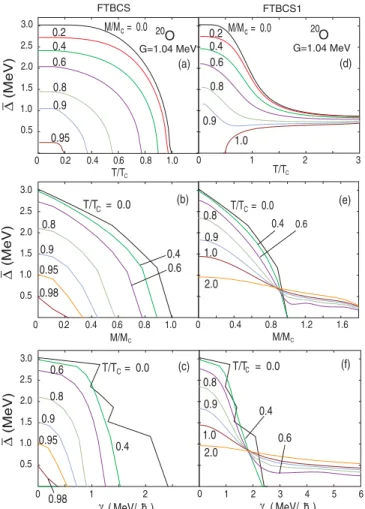
FIG. 2. (Color online) Same as Fig.1but for neutrons in 20O usingG=1.04 MeV.
variousT. ForT /Tc0.2, the pairing gap undergoes a
back-bending, which will be discussed under Sec.III D. AtT /Tc>
0.2 no backbending is seen for the pairing gaps. This result agrees with those obtained in calculations within the finite-temperature Hartree-Fock-Bogoliubov cranking (FTHFBC) theory, which is applied to the two-level model in Ref. [33]. Within the FTBCS1, the pairing gaps at large M become enhanced withT, in agreement with the results obtained within an exactly solvable model for a singlef7/2shell in Ref. [21].
C. Results for realistic nuclei
Shown in Fig. 2 are the level-weighted pairing gaps as functions of T , M, and γ obtained within the FTBCS and FTBCS1 theories for neutrons in 20O. The values of Tc (at M=0) and Mc (at T =0) are found equal to
1.57 MeV and 4¯h, respectively. Compared to the case with schematic model discussed in the previous section, the difference is that no thermally assisted pairing correlation appears within the FTBCS for 20O. All the FTBCS gaps behave similarly as functions ofT with increasing M. At a given value ofM, they decrease with increasing bothT and collapse at some values Tc(M)< Tc. A similar behavior is
seen for the gaps as functions of M at a given value of T. Here the critical valueMc(T) for the angular momentum, at
which the gap collapses is found decreasing with increasing T so thatMc(T)< Mc [see Fig.2(a)and2(b)]. Meanwhile,
the temperature dependence of the FTBCS1 gap in Fig.2(d) shows a clear manifestation of the thermally assisted pairing gap. As M increases up to M/Mc0.8, the gap decreases
monotonously with increasingT up toT 1.5Tc, higher than
which the gap seems to be rather stable against the variation of T. AtM/Mc0.9, the re-entrance of thermal pairing starts to
show up as the enhancement of the tail atT > Tc. WhenM/Mc
becomes equal to or larger than 1, the gap completely vanishes at lowTbut reappears starting from a certain value ofT, above which the gap increases withT and reach a saturation at high T. AtT 3 MeV, all the gaps obtained at different values ofM seem to coalesce to limiting value around 0.7–0.8 MeV. At a given value ofTin the regionT /Tc0.7, as shown in Fig.2(e),
the pairing gaps decrease steeply with increasing T and all collapse at the same value Mc. This difference compared to
the FTBCS theory comes from the presence of the QNF. At T /Tc0.8, the QNF becomes stronger, which pushes up the
collapsing point to Mc(T)=2Mc. One can also sees some
oscillation occurring in the region between 0.8M/Mc1.4
because of the shell structure. The collapsing point might be shifted even further to higherMwith increasingT, but at too highT the temperature dependence of single-particle energies becomes significant so that the use of the spectrum obtained atT =0 is no longer valid [34].
The pairing gaps as functions of angular velocityγobtained at various T within the FTBCS and FTBCS1 theories are plotted in Fig. 2(c)and2(f), respectively. AsEk, γ, andmk
are positive, atT =0, the quasiparticle occupation numbern−k is always zero, whereas n+k is a step function ofEk−γ mk,
which is zero ifEk> γ mkand 1 ifEkγ mk. As the result,
the FTBCS and FTBCS1 gaps decrease with increasingγin a stepwise manner up to a critical valueγc, where they vanish. At
T =0, the Fermi-Dirac distribution replaces the step function, which washes out the stepwise manner in the behavior of the gaps as functions of the γ. Here again, once can see that, atT /Tc>0.8, the QNF is so strong that the collapse of the
FTBCS1 gap is completely smoothed out [Fig.2(f)].
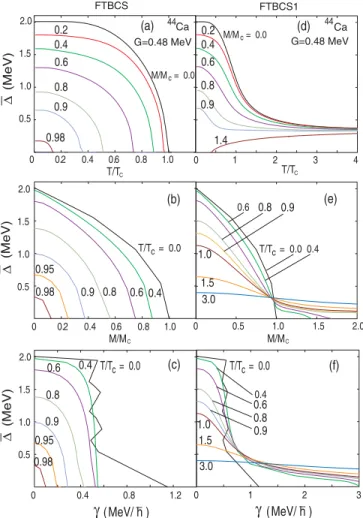
The level-weighted pairing gaps ¯ for neutrons in44Ca shown in Fig. 3 have a similar behavior as as functions of T , M, andγwith the values ofTcandMcare found to be 1.07
MeV and 8¯h, respectively. The thermally assisted pairing gap appears atM/Mc>1.0 but the high-T tail is much depleted
due to a weaker QNF in a heavier system compared to that in
20O.
The well-deformed nucleus22Ne has both neutron and
pro-ton open shells, therefore two gap and two number equations for protons (p) and neutrons (n) are simultaneously solved together with one equation for the total angular momentum M=Mp+Mn to obtain the pairing gapsp and chemical
potential λp for protons, the corresponding quantities, n
and λn, for neutrons, as well as the angular velocity γ of
0 0.4 0.8 1.2 0 1 2 3 0.5
1.0 1.5 2.0
M/M = 0.0c
0.2 0.4 0.6 0.8 0.9 0.98 FTBCS Ca 44 (a)
M/M = 0.0c
0.2 0.4 0.6 0.8 0.9 1.4 FTBCS1 Ca 44 (d)
T/T = 0.0c
0.4 0.6 0.8 0.9 0.95 0.98 (b)
T/T = 0.0 0.4c 0.6 0.8 0.9
1.0
1.5 3.0
(e)
T/T = 0.0c
0.4 0.6 0.8 0.9 0.95 0.98
(c) T/T = 0.0c
0.4 0.6 0.8 0.9 1.0 1.5 3.0 (f) T/TC
0 0.2 0.4 0.6 0.8 1.0 0 1 2 3 4 T/TC
M/MC
0 0.2 0.4 0.6 0.8 1.0 0 0.5 1.0 1.5 2.0 M/MC (MeV) 0.5 1.0 1.5 2.0 (MeV) 0.5 1.0 1.5 2.0 (MeV)
( MeV/ h )_ ( MeV/ h )_
G=0.48 MeV G=0.48 MeV
FIG. 3. (Color online) Same as Fig.1but for neutrons in44Ca usingG=0.48 MeV.
0 1 2 3 4
1 2 3 4
0 0.5 1.0 1.5 2.0 0 0.5 1.0 1.5
T (MeV) 0.5 1.0 1.5 2.0 2.5 3.0 (MeV)n
M = 0
1 2 3 h 1 2 3 4 2 4 5 6 7 8 (MeV)p
T (MeV)
5 6 8 9 10 2 4
0 1 2 3 4
T (MeV)
T (MeV)
Ne G = 1.0 MeV
22
n
Ne G = 1.0 MeV
22 n (a) (b) (c) (d)
FTBCS FTBCS1
Ne G = 1.32 MeV
22
p
Ne G = 1.32 MeV
22
p
M = 0 h M = 0 h
M = 0 h
FIG. 4. (Color online) Level-weighted pairing gaps as functions ofT at variousM obtained within the FTBCS (left) and FTBCS1 (right) for neutrons [(a) and (c)] and protons [(b) and (d)] in22Ne usingGn=1.0 MeV andGp=1.32 MeV.
from Tc(M=0)1.7 MeV to Tc(M=3¯h)1.1 MeV.
The FTBCS1 gaps obtained at M <3¯h never collapse but gradually decrease with increasing T > Tc(M=0) and
re-main a finite value of around 0.4 MeV atT as high as 4 MeV. AtM=4¯h, whereas there is no FTBCS gap, the thermally assisted pairing gap appears within the FTBCS1 theory at T >0, increases withT to reach a maximum atT ∼1.5 MeV, and then decreases slowly to reach the same high-T limit of around 0.4 MeV atT 4 MeV. The situation is the similar for the proton pairing gaps, where the effect of thermally assisted pairing correlation takes place atM >8¯hwith the rather stable values of the gap againstT >3 MeV.
20 40 60 80
0 0.02 0.04 0.06 0.08
T/T = 0.0c
0.2 0.4 0.6 0.8 1.0 FTBCS N=10 G=0.5 MeV (a)
0 0.02 0.04 0.06 0.08 0.1
FTBCS1
N=10 G=0.5 MeV
T/T = 0.0c
0.2 0.4 0.6 0.8 1.0 2.0 (e) 0.5 1.0 1.5 2.0 2.5 3.0
0 2 4 6 8
0.5 1.0 1.5 2.0
T/T = 0.0c
0.4 0.6 0.8
1.0
T/T = 0.0c 0.4
0.6 0.8
1.0
2.0
0 2 4 6 8 10
T/T = 0.0c
0.4 0.6 0.8
1.0
T/T = 0.0c
0.4 0.6 0.8
1.0 2.0 4.0 (d) 1 2 3 4 5
0 1 2 3
T = 0.0 MeV
0.2 0.4 0.6 0.8 1.0 2.0 Ne G = 1.0 MeV G = 1.32 MeV 22
p n
T = 0.0 MeV
0.4 0.6 0.8 1.0 1.5 2.0 4.0 Ne G = 1.0 MeV G = 1.32 MeV 22
p n
0 1 2 3 4
(h)
(MeV / h )2 2 2
O G=1.04 MeV 20 (b) O G=1.04 MeV 20 (f) (c) Ca G=0.48 MeV 44 Ca G=0.48 MeV 44 (g) 2
(MeV / h )2 2
( / MeV)
h
2
( / MeV)
h
2
( / MeV)
h
2
( / MeV)
h
2
FIG. 5. (Color online) Moment of inertia as a function of the squareγ2of angular velocityγobtained within the FTBCS (left) and FTBCS1 (right) at variousT forN=10 [(a) and (e)], neutrons in 20O [(b) and (f)] and44Ca [(c) and (g)], and the whole22Ne nucleus
0.4 0.8 1.2 1.6
0 1 2 3 T/TC
0 1 2 3 T/TC
0
M/M = 0.0C
(a1)
M/M = 0.4C
(b1)
0 0.5 1 1.5 2 2.5 M/MC 0.4
0.8 1.2 1.6
0 0.5 1 1.5 2 2.5 3 M/MC
0 0.5 1 1.5 2 2.5 M/MC
0 0.2 0.4 0.6 0.8 0 0.2 0.4 0.6 0 0.2 0.4 0.6
0.4 0.8 1.2 1.6
T/T = 0.0C
(a2)
T/T = 0.8C T/T = 1.6C
(b2) (c2)
T/T = 0.0C T/T = 0.8C T/T = 1.6C
(a3) (b3) (c3)
(MeV)
(MeV)
(MeV)
(MeV / h )2 2 2 2
(MeV / h )2 2 2 (MeV / h )2 2
( MeV/ h )_ ( MeV/ h )_
1 2 3 4 T/TC
(c1)
M/M = 3.0C
T/T = 0.8C T/T = 1.6C
(b4) (c4)
0 0.02 0.04 0.06 0.08 0 0.02 0.04 0.06 0.08 0.1 20
40 60 80
0 0.02 0.04 0.06 0.08
T/T = 0.0C
(a4)
( / MeV)
h
2
( MeV/ h )_
FIG. 6. (Color online) Level-weighted pairing gap ¯and moment of inertiaJ forN=10 withG=0.5 MeV [ε=0.1 MeV in Eqs. (43) and (44)]. (a1)–(c1) ¯vs. temperatureTat different angular momenta M. (a2)–(c4) Results obtained at different values ofT, namely (a2)–(c2): ¯ vs. M; (a3)–(c3): ¯ vs. angular velocity γ; (a4)–(c4): J vs. γ2. The dotted, thin solid, thick solid, thin dash-dotted, and thick dash-dotted lines are results obtained within the FTBCS, FTBCS1, FTBCS1+SCQRPA, FTLN1, FTLN1+SCQRPA, respectively. The solid lines with circles and boxes in (a1) and (a3) correspond to two definitions
(1)C and (2)
C of the canonical gaps at T =0, respectively (see Appendix). In (a2) the dashed lines connecting the discrete values of the corresponding canonical gaps at T =0 are drawn to guide the eye.
D. Backbending
For an object that rotates about a fixed symmetry axis, its moment of inertiaJ is found as the total angular momentum M divided by the angular velocity γ, i.e., J =M/γ. The backbending phenomenon is most easily demonstrated by the behavior of J as a function of the square γ2. This curve first increases with γ2 up to a certain region of γ2, where the increase suddenly becomes very steep, and the curve even bends backward. This phenomenon is understood as the consequence of the no-crossing rule in the region of band crossing [36]. The SN phase transition has been suggested as one of microscopic interpretations of backbending [31].
The values of the moment of inertiaJ, obtained at various T within the schematic model as well as realistic nuclei, are plotted in Fig. 5. In the schematic model, one can see in Fig.5(a)and5(e)a sharp backbending, which takes place at very low temperatures,T /Tc0.2. As the QNF is negligible
in this temperature region, the predictions by the FTBCS and FTBCS1 theories are almost identical. AsT increases, the moment of inertia obtained within the FTBCS changes
abruptly to reach the rigid-body value, generating a cusp, whereas, under the effect of QNF, the value obtained within the FTBCS1 theory gradually approaches the rigid-body value in such a way that the cusp is smoothed out. Although no signature of backbending is seen in the results obtained in 20O [Fig. 5(c) and 5(f)] and 44Ca [Fig. 5(d) and 5(g)], backbending can be seen in22Ne [Fig.5(d)and5(h)] atT
0.4 MeV, in agreement with the experimental data reported in Ref. [28].
E. Corrections due to SCQRPA and particle-number projection
-170 -165 -160 -155
2 4 6 8 10 12 14 0.5 1.0 1.5 2.0 2.5 3.0
0 1 2
T/TC
0 1 2
T/TC
0 1 2 3
T/TC
M/M = 0.0
cO; G=1.04 MeV
20
(a1)
M/M = 0.4
cO; G=1.04 MeV
20
(a2)
M/M = 0.8
cO; G=1.04 MeV
20
(a3)
(b1)
(c1)
(b2)
(c2)
(b3)
(c3)
(MeV)
C
(MeV)
FIG. 7. (Color online) Level-weighted pairing gaps ¯, total energies E, and heat capacities
C as functions of temperature T for three val-ues of angular momentum M obtained within the FTBCS (dotted lines), FTBCS1 (thin solid lines), and FTBCS1+SCQRPA (thick solid lines) for neutrons in 20O with G=1.04 MeV (ε= 0.1 MeV).
[Fig.6(a1)], (T =0, M =0) [Fig.6(a2)], and (T =0, γ =0) [Fig. 6(a3)] are also shown (see Appendix for the detailed discussion of the canonical results).
As seen from Fig.6, the effect due to the SCQRPA cor-rections on the pairing gap increases withM. AtM/Mc0.8
it is rather weak, causing only a slight enhancement of the gap at 1.2< T2 MeV as compared with the FTBCS1 results [Fig.6(a1) and6(b1)]. However, it becomes important atM >1.2Mc [Fig.6(c1), 6(a2)–6(c2)] orγ >0.2 MeV/¯h
(at T 0.8Tc) [Fig. 6(b3) and 6(c3)]. In particular, the
reappearance of the thermal gap atM1.1Mcis significantly
enhanced by the SCQRPA corrections [Fig.6(c1) and6(c2)]. For the moment of inertia [Fig. 6(a4)–6(c4)], the SCQRPA corrections are important only at lowT andγ <0.25 MeV/¯h. AtT >1 MeV, the predictions by all the approximations for
J saturate to the rigid-body value.
As compared to the predictions by the FTBCS1 and FTBCS1+SCQRPA, the corrections due to LN-PNP are important only at low T and M. As the result, the gap is pushed up to be closer to the canonical results at TTc andM=0 [Fig.6(a1)]. This feature is well known
and has been discussed within the present approach at
-485 -475 -465 -455
5 10 15 0.5 1.0 1.5 2.0
(MeV)
C
0 1 2 3
T/TC
0 1 2 3
T/TC
0 1 2 3 4
T/TC
M/M = 0.0c
Ca G=0.48 MeV 44
(a1)
(b1)
(c1)
M/M = 0.4c
(a2)
(b2)
(c2)
M/M = 0.8c
(a3)
(b3)
(c3)
(MeV)
Ca G=0.48 MeV 44
Ca G=0.48 MeV 44
M=0 in Ref. [11]. At M=0 (γ =0), the effect due to LN-PNP is noticeable in the gaps as functions of M (or γ) only at [M1.2Mc (γ <0.2 MeV/¯h), T <1 MeV],
otherwise the FTLN1 (FTLN1+SCQRPA) results are hardly distinguishable from the FTBCS1 (FTBCS1+SCQRPA) ones [Fig. 6(b2), 6(c2), 6(b3), and 6(c3)]. Consequently, for the moment of inertia, the LN-PNP corrections to the FTBCS1 (FTBCS1+SCQRPA) results are important only at (T < Tc, γ < γc) [Fig. 6(a4)–6(c4)]. In particular, the results at
T =0 [Fig.6(a4)], where the BCS1 coincides with the BCS, show that backbending becomes less pronounced within the SCQRPA and LN-SCQRPA. For this reason, the corrections due to LN-PNP are omitted in the results obtained for realistic nuclei below.
Shown in Figs. 7 and 8 are the pairing gaps, total energies and heat capacities as functions of T obtained at M/Mc=0,0.4, and 0.8 within the FTBCS, FTBCS1, and
FTBCS1+SCQRPA for realistic nuclei, 20O and 44Ca. The SCQRPA corrections are significant for the total energy in the light nucleus, 20O, due to the important contributions
of the screening factors (27) and (28) [11,12]. In medium
44Ca nucleus, the effect of SCQRPA corrections on the total
energy is weaker. The corrections due to LN particle-number projection have a similar effect as that discussed above for the schematic model, but with much reduced magnitudes, so they are not shown in these figures. With increasingMthe pairing gap decreases. As the result, the total energy becomes larger but the relative effect of the SCQRPA correction does not change. For the heat capacity, as has been reported in Ref. [11], the spike atTcobtained within the FTBCS theory, which serves as
the signature of the sharp SN phase transition, is smeared out within the FTBCS1 theory into a bump in the temperature region around Tc. With increasing M, this bump becomes
depleted further. Finally, the SQRPA corrections erase all the traces of the sharp SN phase transition in the model case as well as realistic nuclei.
IV. CONCLUSIONS
The present work extends the FTBCS1 (FTBCS1+ SC-QRPA) theory to finite angular momentum to study the pairing properties of hot nuclei, which rotate noncollectively about the symmetry axis. The FTBCS1 theory includes the quasiparticle number fluctuation whereas the FTBCS1+SCQRPA also takes into account the correction due to dynamic coupling to SC-QRPA vibrations. The proposed extension is tested within the doubly degenerate equidistant model with N =10 particles as well as some realistic (spherical and deformed) nuclei,
20O,22Ne, and44Ca. The numerical calculations were carried
out within the FTBCS, FTBCS1, and FTBCS1+SCQRPA for the pairing gap, total energy, and heat capacity as functions of temperature T, total angular momentumM, and angular velocityγ. The corrections due to the Lipkin-Nogami particle-number projection are also discussed. The analysis of the numerical results allows us to draw the following conclusions: (i) The proposed approach is able to reproduce the effect of a thermally assisted pairing correlation that takes place in the schematic model within the FTBCS theory, according to which a finite pairing gap can reappear
within a given temperature interval,T1< T < T2(T1>
0), while it is zero beyond this interval. However, this phenomenon does not show up in realistic nuclei under consideration.
(ii) Under the effect of QNF, the paring gaps obtained within the FTBCS1 at different values M of angular momentum decrease monotonously asT increases and do not collapse even at hightT in the schematic model as well as realistic nuclei. The effect of thermally assisted pairing correlation is seen in all the cases but in such a way that the pairing gap reappears at a givenT1>0 and remains finite atT > T1, in qualitative
agreement with the canonical results of Ref. [20]. (iii) The backbending of the moment of inertia is found in
the schematic model and in22Ne in the low-temperature
region, whereas it is washed out with increasing temperature. This effect does not occur in20O and44Ca, consistent with existing experimental data and results of other theoretical approaches.
(iv) The effect caused by the corrections due to the dynamic coupling to SCQRPA vibrations on the pairing gaps, total energies, and heat capacities is found to be significant in the region around the critical temperature Tc of the SN phase transition and/or at large angular
momentum M (or angular velocityγ). It is larger in lighter systems. As the result, all the signatures of the sharp SN phase transition are smoothed out in both schematic model and realistic nuclei. The SCQRPA corrections also significantly enhance the reappear-ance of the thermal gap at finite angular momentum. However, the effect caused by the corrections due to PNP is important only at temperatures belowTcand at
quite low angular momentum. In particular, it makes backbending less pronoucned atT =0.
Still the fluctuations due to violation of angular-momentum conservation are not implemented in the present extension. We hope that further studies in this direction will shed light on this issue.
ACKNOWLEDGMENTS
The authors thank L. G. Moretto (Berkeley) for suggestions, which led to the present study. Fruitful discussions with S. Frauendorf (Notre Dame) and P. Schuck (Orsay) are acknowledged. N.Q.H. is a RIKEN Asian Program Associate. The numerical calculations were carried out using theFORTRAN
IMSL Library by Visual Numerics on the RIKEN Super Combined Cluster (RSCC) system.
APPENDIX: ON THE COMPARISON WITH CANONICAL RESULTS
2 4 6 8
-2 -1 0 1 2
0 0.2 0.4 0.6 0.8
(a) (b)
(MeV/ h )_
(MeV) 2
2
C
(1)
[ ]
3
0 0.2 0.4 0.6 0.8 (MeV/ h )_
T/T = 0.0C
( / MeV)
(MeV / h )2 2 2
(c)
40 80 120
0 0.1 0.2 0.3 0.4 0
h
2
FIG. 9. (Color online) (a) Canonical moment of inertia vs. γ2; (b) absolute values
|EC−Em.f.| (solid line) and
|Eunc.| (dotted line) vs. γ; (c) [(1)C]2 vs. γ for the schematic model with N=10 and G=
0.5 MeV atT =0.
predictions by BCS-based approaches and the canonical results. As a matter of fact, thez projectionM of the total angular momentum within the FTBCS (FTBCS1) approach is temperature independent. AtT varies, by solving the FTBCS (FTBCS1) equations, the angular velocity γ is defined as a Lagrangian multiplier soM, the thermal average of the total angular momentum within the grand canonical ensemble (12), remains unchanged. In this way, within the FTBCS (FTBCS1), the angular velocity γ varies withT, whereas M does not. Similar to that for choosing the chemical potentialλto preserve the (grand-canonical ensemble) average particle-number N, this contraint is physically reasonable when the total angular momentum is conserved as in the noncollective rotation of spherical systems or rotation of axially symmetric systems about the symmetry axis, as has been discussed in Sec.II A.
On the contrary, the canonical results in Ref. [20] are ob-tained by embedding the eigenvalues Eν,i(γ)=Eν−γ Mν,i
in the canonical ensemble with the partition function Z(β, γ)=
ν,i
e−βEν,i(γ). (A1)
HereEνdenote the eigenvalues of theνth state with seniority
ν at γ = 0, whereas Mν,i are the z projections of angular
momenta of ν nucleons. Although the eigenvalues Eν are
obtained by separately diagonalizing the pairing Hamiltonian HPin Eq. (2), the rotational partν=
iexp(βγ Mν,i) of the
partition functionZ(β, γ) is calculated following Ref. [32]. The resulting canonical average value M(β, γ)C =
βZ(β, γ)−1∂Z(β, γ)/∂γ of angular momentum, therefore,
varies with T. However, the angular velocity γ just plays the role of an independent parameter and therefore does not depend on T. For the same reason, each canonical average valueM(β, γ)C corresponds to a single value ofγ, i.e., the
canonical moment of inertia JC undergoes no backbending, as shown in Fig.9(a).
Because of this principal difference, a quantitative compar-ison between the FTBCS (FTBCS1) results and the canonical ones as functions ofM(orγ) atT =0 unfortunately turns out to be impossible. To establish a meaningful correspondence, one needs to know the exact eigenvalues of the ground state as well as all excited states of the pairing problem described by Hamiltonian (1) so by embedding the eigenvalues in the grand canonical ensemble,γbecomes a function ofT in such a way to keepM(β, γ)Calways equal toM. To our knowledge, this
problem still remains unsolved. One may also try to estimate the results within the microcanonical ensemble. However, here one faces a problem of extracting the nuclear temperature,
which is rather ambiguous at low level density (smallN) within the schematic model under consideration [37,38], whereas the extension of exact solution of the pairing problem toT =0 is unpracticable atN16.
Therefore, in the present article, we can compare the predictions of our approach with only the canonical results as functions of temperatureT atM=0 or as functions ofM (or angular velocityγ) atT =0. For this purpose, and given several definitions of the “effective” gaps existing in literature, we choose to employ in the present article two definitions of the canonical gaps,(1)C and(2)C . They should be understood as effective ones because a gap per se, which is a mean-field concept, does not exist in the exact solutions of the pairing problem.
The canonical gap(1)C is defined from the pairing energy
Epairof the system as
(1)C 2= −GEpair, Epair≡ EC−Em.f.−Eunc.,
(A2)
Em.f.≡2
k
kfk, Eunc.≡ −G
k
fk2.
HereEC is the total energy within the canonical ensemble
with the partition function Z(β, γ) given by Eq. (A1) of a system rotating at angular velocity γ or with the partition functionZ(β,0) atM=0. The termEm.f.denotes the energy
of the single-particle motion described by the first term at the right-hand side of the pairing Hamiltonian HP in
Eq. (2). Functionsfk are occupation numbers ofkth orbitals
within the canonical ensemble. The energy Em.f. becomes
that of the mean-field once the single-particle occupation numbersfkare replaced with those describing the Fermi-Dirac
distributions of independent particles. The energyEunc.comes
from the uncorrelated single-particle configurations caused by the pairing interaction in Hamiltonian (2). Therefore, by subtracting the termEm.f.+Eunc.from the total energyEC,
one obtains the result that corresponds to the energy due to pure pairing correlations. The definition (A2) is very similar to that given in Ref. [39]. It is, however, different from the canonical gap(2)C , which is used in Ref. [20]. The latter is defined as
(2)C 2= −G[EC− E(G=0)C], (A3)
where E(G=0)C is the total canonical energy EC
atG=0.
velocityγ(atT =0), respectively. It is seen from these figures that the difference between the two canonical gaps(1)C and (2)C is rather significant at large T for M=0 and at large M(orγ) forT =0. The reason is rather simple because the definition (A2) of(1)C is rather similar to that for the BCS gap. As a matter of fact, by replacing the canonical single-particle occupation numbersfkwith the Bogoliubov’s coefficientsvk2,
and the total energyEC with that obtained within the BCS
theory, the gap(1)C reduces to the usual BCS gap. Meanwhile, by doing so with(2)C, the energyE(G=0)Cjust reduces to
the Hartree-Fock energy, leaving the uncorrelated energyEunc.
out of the definition. Consequently, as functions ofT, the gaps predicted by the BCS-based approaches under consideration agree better with the canonical gap (1)C than with (2)C [Fig.6(a1)].
As functions of angular velocity γ, both the squared values (A2) and (A3) of the canonical gaps undergo a
stepwise decrease with increasingγ. The step occurs whenever the state of the lowest energy changes from ν−2 to ν, causing a stepwise increase of M(β, γ)C [20]. Therefore,
forN =10, the pairs are gradually broken in five steps with a corresponding stepwise increase of seniorityνfrom 0 to 10 by two units in each step. However, Fig.9(b)shows that the absolute value of the uncorrelated energyEunc., which enters
in the definition (A2) of the gap(1)C , becomes larger than that of the differenceEC−Em.f.as early as the second step, leading
to [(1)C]2 <0 [Fig.9(c)], i.e., an imaginary value for(1)
C . As
the result, instead of collapsing as(2)C in five steps at a rather large value ofM (orγ), the canonical gap(1)C collapses in two steps at a value ofM(orγ) much closer toMc(orγc) for
the BCS gap [Fig.6(a2) and6(a3)]. Once again, this makes the gaps predicted by the BCS-based approaches as functions of M (orγ) agree better with the canonical gap(1)C , rather than with(2)C [Fig.6(a2) and6(a3)].
[1] J. Bardeen, L. Cooper, and Schrieffer, Phys. Rev. C108, 1175 (1957).
[2] H. Dinget al., Nature382, 51 (1996). [3] L. G. Moretto, Phys. Lett.B40, 1 (1972). [4] A. L. Goodman, Phys. Rev. C29, 1887 (1984).
[5] R. Rossignoli, P. Ring, and N. D. Dang, Phys. Lett.B297, 9 (1992).
[6] N. D. Dang, P. Ring, and R. Rossignoli, Phys. Rev. C47, 606 (1993).
[7] N. Dinh Dang and V. Zelevinsky, Phys. Rev. C64, 064319 (2001).
[8] N. Dinh Dang and A. Arima, Phys. Rev. C67, 014304 (2003). [9] N. D. Dang, Nucl. Phys.A784, 147 (2007).
[10] A. Schilleret al., Phys. Rev. C63, 021306(R) (2001).
[11] N. Dinh Dang and N. Quang Hung, Phys. Rev. C77, 064315 (2008).
[12] N. Q. Hung and N. D. Dang, Phys. Rev. C76, 054302 (2007); 77, 029905(E) (2008).
[13] R. W. Richardson, Phys. Lett.3, 277 (1963);5, 82 (1963); R. W. Richardson and N. Sherman, Nucl. Phys.52, 221 (1964). [14] A. Volya, B. A. Brown, and V. Zelevinsky, Phys. Lett.B509, 37
(2001).
[15] S. Rombouts, K. Heyde, and N. Jachowicz, Phys. Rev. C58, 3295 (1998).
[16] T. Kammuri, Prog. Theor. Phys.31, 595 (1964). [17] L. G. Moretto, Phys. Lett.B35, 397 (1971). [18] L. G. Moretto, Nucl. Phys.A185, 145 (1971).
[19] R. Balian, H. Flocard, and M. V´en´eroni, Phys. Rep.317, 251 (1999).
[20] S. Frauendorf, N. K. Kuzmenko, V. M. Mikhajlov, and J. A. Sheikh, Phys. Rev. B68, 024518 (2003).
[21] J. A. Sheikh, R. Palit, and S. Frauendorf, Phys. Rev. C 72, 041301(R) (2005).
[22] A. Bohr and B. R. Mottelson, Phys. Scripta A10, 13 (1974). [23] J. H¨ogaasen-Feldman, Nucl. Phys.28, 258 (1961).
[24] N. D. Dang, Z. Phys. A335, 253 (1990).
[25] N. N. Bogolyubov and S. V. Tyablikov, Sov. Phys. Dokl.4, 60 (1959) [Dokl. Akad. Nauk SSSR126, 53 (1959)].
[26] D. N. Zubarev, Sov. Phys. Usp.3, 320 (1960) [Usp. Fiz. Nauk 71, 71 (1960)].
[27] H. J. Lipkin, Ann. Phys. (NY)9, 272 (1960); Y. Nogami, Phys. Rev.134, B313 (1964); H. C. Pradhan, Y. Nogami, and J. Law, Nucl. Phys.A201, 357 (1973).
[28] E. M. Szanto, A. Szantode Toledo, H. V. Klapdor, M. Diebel, J. Fleckner, and U. Mosel, Phys. Rev. Lett.42, 622 (1979). [29] S. Cwiok, J. Dudek, W. Nazarewicz, J. Skalski, and T. Werner,
Comput. Phys. Commun.46, 379 (1987).
[30] R. Id Betan, N. Sandulescu, and T. Vertse, Nucl. Phys.A771, 93 (2006).
[31] B. R. Mottelson and J. G. Valatin, Phys. Rev. Lett. 5, 511 (1960).
[32] N. K. Kuzmenko and V. M. Mikhajlov, Phys. Lett.A296, 49 (2002).
[33] A. L. Goodman, Nucl. Phys.A352, 45 (1981).
[34] M. Brack and P. Quentin, Phys. Lett.B52, 159 (1974); P. Bonche, S. Levit, and D. Vautherin, Nucl. Phys.A427, 278 (1984). [35] L. G. Moretto, Nucl. Phys.A216, 1 (1973).
[36] L. D. Landau and E. M. Lifshitz,Course of Theoretical Physics (Pergamon, Oxford, 1959).
[37] T. Sumaryada and A. Volya, Phys. Rev. C76, 024319 (2007). [38] N. Q. Hung and N. Dinh Dang (submitted).