MICROSCOPIC DESCRIPTION
OF NUCLEAR THERMODYNAMIC PROPERTIES
NGUYEN QUANG HUNG1
School of Engineering, Tan Tao University, Tan Tao University Avenue, Tan Duc Ecity, Duc Hoa, Long An Province
Abstract. Thermodynamic properties of atomic nuclei at high excitation energy (hot nuclei) are studied within two microscopic approaches. The latter are derived based on the solutions of the Bardeen-Cooper-Schrieffer (BCS) and self-consistent quasiparticle random-phase approximation (SCQRPA) at zero temperature embedded into the canonical and microcanonical ensembles. The results obtained for 94Mo, 98Mo, 162Dy, and172Yb nuclei are in good agreement with the recent experimental data measured by the Oslo (Norway) group.
I. INTRODUCTION
The study of thermodynamic properties of hot nuclei has been an important topic in nuclear physics. Thermodynamic properties of any system can be studied by using three principal statistical ensembles, namely the grand canonical ensemble (GCE), canonical ensemble (CE) and microcanonical ensemble (MCE). The GCE is an ensemble of iden-tical systems in thermal equilibrium each of which exchanges their energies and particle with the external heat bath. The CE describes the same systems as the GCE but they exchange only their energies, whereas their particle numbers are fixed. The MCE consists of thermally isolated systems with fixed energies and particle numbers. The GCE is of-ten used in most theoretical approaches, for example, the conventional finite-temperature BCS (FTBCS) theory [1] and/or finite-temperature Hartree-Fock-Bogoliubov theory [2]. While this theory describes very well thermodynamic properties of infinite systems such as metal superconductors, it fails to describe the properties of finite systems such as atomic nuclei, where the quantal and thermal fluctuations are significant. Most of theoretical approaches to thermal pairing have been derived so far within the GCE in finite systems, where no particle-number fluctuations are allowed. Therefore, the CE and MCE should be used instead of the GCE to describe the thermodynamic properties of atomic nuclei. Moreover, although the pairing problem can be solved exactly [3] and the exact eigenvalues are usually embedded into the CE and MCE [4, 5]. This task is impracticable for particle numbersN > 14 in the case of half-filled doubly-folded multilevel model withN = Ω (Ω is number of single-particle levels). The purpose of this work is to construct an approach based on the CE and MCE, which can offers results in good agreement with the exact solutions for any value of the particle number, as well as the experimental data of realistic nuclei.
II. FORMALISM
The present paper considers the pairing HamiltonianH =P
kk(a†k+ak+a†k−ak−)−
GP
kk0a
†
k+a
†
k−ak0−ak0+, where a†
k and ak are respectively the creation and annihilation
operators of a particle (neutron or proton) on thekth orbitals andGis the pairing inter-action parameter. The subscript k are labeled the single-particle states in the deformed basis, whereas the subscripts −k denote the time-reversal ones. This Hamiltonian can be diagonalized exactly by using the SU(2) algebra of angular momentum [3]. At finite temperature T 6= 0 the exact diagonalization is done for all total seniority or number of unpaired particles S, whose values are S = 0,2, ..., N for systems with even particle number N, and S = 0,1,3, ..., N for odd-N systems. The number nExact of exact eigen-states for a system of N particles moving in Ω degenerate single-particle levels is given as nExact = PSCSΩ ×CNΩ−S
pair−S/2, where C
m
n = m!/[n!(m−n)!] and Npair = N/2 [6].
This number increases combinatorially with N. Therefore, the exact solution at T 6= 0 is impossible for systems with large particle number, for example, N > 14 for the half-filled case (N = Ω), because the size of the matrix to be diagonalized is huge. Knowing all the exact eigenvalues EExact
S and occupation numbers fkS, one can construct the CE
partition function ZExact(β) = PSdSexp(−βESExact), where dS = 2S is the degeneracy
and β = 1/T is the invert of temperature. Based on this CE partition function, one can calculate all the thermodynamic quantities such as total energyE, free energyF, entropy
S, and heat capacity C as F = −TlnZ(T), S = −∂F∂T, E = F +T S, C = ∂T∂E. The exact pairing gap is calculated as ∆Exact = [−G(E −2Pkkfk+GPkfk2)]1/2, where fk=PSfkSdSexp(−βESExact)/ZExact [5].
II.1. Canonical ensemble of the BCS with Lipkin-Nogami particle-number pro-jection (CE-LNBCS)
The CE-LNBCS is derived based on the solutions of the BCS + Lipkin-Nogami particle-number projection (PNP) at T = 0 [7] for each total seniority S. The LNBCS equations atT = 0 for each total seniorityS are given as
∆LNBCS(kS) =G
X
k6=kS
ukvk, N = 2
X
k6=kS
v2k+S , (1)
where
u2k6=k
S =
1 2
1 +k−Gv 2
k−λ(kS)
Ek
, v2k6=k
S =
1 2
1−k−Gv
2
k−λ(kS)
Ek
, (2)
Ek6=kS =
q
[k−Gvk2−λ(kS)]2+ [∆LNBCS(kS)]2, λ(kS) =λ1(kS) + 2λ2(kS)(N + 1),
λ2(kS) =
G
4
P
k6=kSu
3
kvkPk06=k0
Suk
0v3
k0 −
P
k6=kSu
4
kvk4
(P
k6=kSu
2
kvk2)2−
P
k6=kSu
4
kvk4
,
with kS denoting the quantum number of unpaired particles appeared when the pairs
are broken (S 6= 0). The single-particle levels with k = kS (blocked levels) always
have the occupation numbers of 1/2. Solving the systems of Eqs. (1)-(2), one ob-tains the pairing gaps ∆LNBCS
uk and vk corresponding to each position of unpaired particles on the blocked levels kS
at each total seniority S. The LNBCS energies (eigenvalues) are then given asELNBCS
iS =
2P
k6=kSkv
2
k+
P
kSkS−
[∆LNBCS(k
S)]2
G −G
P
k6=kSv
4
k−4λ2(kS)Pk6=kSu
2
kvk2. As the result,
one can construct the partition function of the so-called CE-LNBCS having the form as
ZLNBCS(β) =
P
SdS
PnLNBCS
iS=1 e
−βELNBCS
iS . Based on this partition function, all the
ther-modynamic quantities are then calculated in the same way as the exact case mentioned above. The CE-LNBCS pairing gap is obtained by averaging the seniority-dependent gaps ∆LNBCSi
S atT = 0 in the CE as ∆CE−LNBCS=
1
ZLNBCS
P
SdS
PnLNBCS
iS ∆
LNBCS
iS e
−βELNBCS
iS .
II.2. Canonical ensemble of the Lipkin-Nogami selfconsistent quasiparticle random-phase approximation (CE-LNSCQRPA)
Within the LNBCS at T = 0, only the lowest eigenstates can be obtained, e.g., the ground-state energy at S = 0. The number of LNBCS eigenstates obtained in this case is equal to nLNBCS = PSCSΩ, which is much smaller than nExact. The CE of these lowest eigenstates is therefore comparable with the exact one only in the region of low T. At higher T , one needs to include not only the ground state but also excited states into the CE. This can be resolved by means of the self-consistent quasiparticle random-phase approximation with Lipkin-Nogami PNP (LNSCQRPA) [8]. The LNSC-QRPA includes the ground-state and screening correlations, which are neglected within the conventional BCS and quasiparticle RPA. These correlations improve the agreement between the energies of ground state and low-lying excited states obtained within the LNSCQRPA and the corresponding exact results for the doubly-folded multilevel pair-ing model. The formalism of the LNSCQRPA was presented in details in [8], so we do not repeat it here. The total number of eigenstates obtained within the LNSCQRPA is
nLNSCQRPA=PSCSΩ×(Ω−S)> nLNBCSbecause of the presence of QRPA excited states but it is still much smaller thannExact. This is the most important feature of the present method, which tremendously reduces the computing time in numerical calculations for heavy nuclei. The thermodynamic quantities are obtained within the CE-LNSCQRPA in the same way as that for the CE-LNBCS, namely from the CE-LNSCQRPA partition func-tion ZLNSCQRPA(β) = PiSdSexp[−βE
LNSCQRPA
iS ], where E
LNSCQRPA
iS are the eigenvalues
obtained by solving the LNSCQRPA equations for each total seniority S.
II.3. MCE-LNBCS and MCE-LNSCQRPA
Within the MCE, we use the eigenvalues ELNBCS
iS and E
LNSCQRPA
iS to calculate the
MCE entropy directly from the Boltzmanns definition S(E) = lnW(E), where W(E) =
ρ(E)δE is the number of accessible states within the energy interval (E,E +δE) with
1 2 3 4 5
6
(MeV)
= N = 10
1
(a)
E
(MeV)
(b)
GCE-BCS CE-LNBCS CE-LNSCQRPA Exact CE
5 10 15 20
C
0 1 2 3 4 5 T (MeV)
(c)
0 1 2 3 4 5 T (MeV) 0 1 2 3 4 5
T (MeV) -35 -30 -25 -20 -15
-10 25
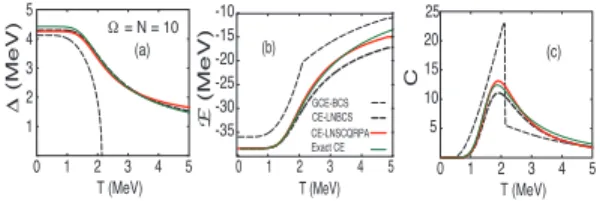
Fig. 1. Pairing gaps ∆, total energy E, and heat capacity E as functions of T
obtained within the multilevel model for N = Ω = 10 with G = 1 MeV. The
thick dashed, thick solid, and thin solid lines respectively denote the CE-LNBCS, CE-LNSCQRPA and exact CE results, whereas the thin dashed lines stand for the conventional FTBCS or the so-called GCE-BCS.
II.4. Level density
Within the CE, the level density is calculated by using the invert of Laplace trans-formation of the partition function with the saddle point approximation [9]. It is ap-proximated as ρ(E) ≈eS(E)[−2π∂E/∂β]−1/2, where S(E) and E are the CE entropy and excitation energy of the systems, respectively. Within the MCE, the level density is de-fined based on the inverse relation of Boltzmann definition for MCE entropy, namely
ρ(E) =eS(E)/∂E.
III. NUMERICAL RESULTS AND DISCUSSIONS
The numerical calculations are carried out within a multilevel pairing model, which consists of Ω doubly-folded equidistant levels with the single-particle energies chosen as
k = k−(Ω + 1)/2 MeV, as well as several realistic nuclei such as 94,98Mo, 162Dy, and
172Yb. For the latter, we employ the axially deformed Woods-Saxon single-particle spectra
including spin-orbit and Coulomb interaction, whose parameters are chosen to be the same as in Refs. [6, 10]. The pairing interaction parameter G for the model case is chosen to beG= 1 MeV, whereas for realistic nuclei it is adjusted so that the pairing gap obtained within the LNBCS at T = 0 and S = 0 fits the experimental odd-even mass difference.
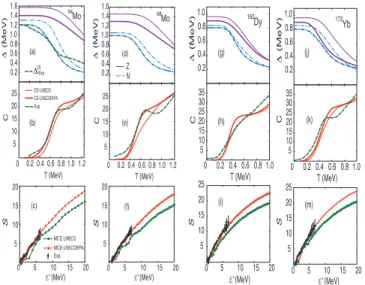
Shown in Fig. 1 are the pairing gaps ∆, total energies E, and heat capacities C ob-tained within the GCE-BCS, CE-LNBCS, CE-LNSCQRPA versus the exact CE of the multilevel model with N = Ω = 10 and G = 1 MeV. The figure clearly shows that the CE-LNSCQRPA results (thick solid lines) nearly coincide with the exact ones (thin solid lines) for all thermodynamic quantities under consideration. The results obtained within the CE-LNBCS (thick dashed lines) are a bit off from the exact ones but, as compared to the predictions by the GCE-BCS (thin dashed lines), they still offer a much better agreement with the exact solutions. Figure 2 depicts the CE pairing gaps ∆, CE heat ca-pacitiesC, and MCE entropiesS obtained within the LNBCS and CE(MCE)-LNSCQRPA versus the experimental data for94,98Mo,162Dy, and172Yb nuclei. This Fig. 2 shows that the heat capacities obtained within the CE-LNSCQRPA (thick solid lines) as well as the MCE-LNSCQRPA entropies (triangles) fit well the experimental data for all nuclei under consideration, wheres those obtained within the CE (MCE)-LNBCS are a bit far from the experimental ones, especially at high T and high excitation energy
5 10 15 20 25
0 0.2 0.4 0.6 0.8 1.0 1.2
C T (MeV) 5 10 15 20
0 5 10 15 20
Mo 98 Z N 5 10 15 20 25 C
0 0.2 0.4 0.6 0.8 1.0 1.2 T (MeV)
5 10 15 20
0 5 10 15 20
Mo 94 Exp 0.2 0.4 0.6 0.8 1.0 1.2 1.4 1.6 Δ (MeV) 0.2 0.4 0.6 0.8 1.0 1.2 1.4 1.6 Δ (MeV) Δ(3) MCE-LNBCS MCE-LNSCQRPA Exp (a) (b) (c) (d) (e) (f)
E (MeV)* E (MeV)*
0.2 0.4 0.6 0.8 1.0
Δ (MeV) Yb 172 5 10 15 20 25 30 35 C
0 0.2 0.4 0.6 0.8 1.0 T (MeV) 5 10 15 20 25
0 5 10 15 20 0.2
0.4 0.6 0.8 1.0
0 0.2 0.4 0.6 0.8 1.0 T (MeV) 5 10 15 20 25 30 35 C Δ (MeV) 5 10 15 20 25
0 5 10 15 20
Dy 162 (g) (h) (i) (j) (k) (m)
E * (MeV) E (MeV)*
CE-LNBCS CE-LNSCQRPA Exp S S S S
Fig. 2. The CE pairing gaps ∆ and heat capacity Cas functions ofT and MCE
entropyS as function ofE∗for94,98Mo,162Dy, and172Yb nuclei. In (a), (d), (g),
and (j), the solid and dash-dotted lines denote the pairing gaps for protons and neutrons, respectively, whereas the thin and thick lines respectively correspond to the CE-LNBCS and CE-LNSCQRPA results. In (b), (e), (h), and (k), the thin and thick solid lines stand for the CE-LNBCS and CE-LNSCQRPA results, whereas the thick dashed lines depict the experimental results taken from Refs.
[10, 11], respectively. Shown in (c), (f), (i), and (m) are the MCE entropies
obtained within the MCE-LNBCS (squares) and MCE-LNSCQRPA (triangles), and extracted from experimental data (circles with error bars).
CE-LNBCS nor those obtained within the CE-LNSCQRPA for both model and realistic cases collapse at the critical temperature TC as predicted by the GCE-BCS, but they
Mo
94
1 10 10 10 10 10
106
5 4 3 2
CE-LNSCQRPA
(a)
Exp
ρ
(MeV )
-1
MCE-LNSCQRPA
Mo
98
(b) 1
10 10 10 10
105
4 3 2
ρ
(MeV )
-1
1 10 10 10 108
6
4
2
ρ
(MeV )
-1 162Dy
(c)
Yb
172
(d) 1
10 10 106
4
2
ρ
(MeV )
-1
0 2 4 6 8 10
0 2 4 6 8 10
E * (MeV) E * (MeV)
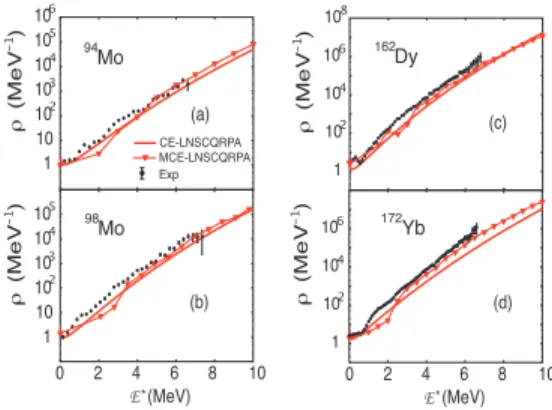
Fig. 3. Level densities as functions of E∗ obtained within the CE-LNSCQRPA
(solid line) and MCE-LNSCQRPA (triangles) versus the experimental data (circles
with error bars) for94Mo (a), 98Mo (b), 162Dy (c), and172Yb (d).
IV. CONCLUSION
The present paper proposes two approximations based on the solutions of the LNBCS and LNSCQRPA at T = 0 embedded into the CE and MCE. The proposed approaches are tested within the multilevel pairing model as well as several realistic nuclei such as 94,98Mo,162Dy, and172Yb. The results obtained for the pairing gap, total energy, heat capacity, entropy, and level density show that the CE(MCE)-LNSCQRPA describe quite well the recent experimental data by the Oslo group [10, 11].
ACKNOWLEDGMENT
Financial support of National Foundation for Science and Technology Development (NAFOSTED) under project No 103.04-2010.02 is gratefully acknowledged.
REFERENCES
[1] J. Bardeen, L. Cooper, Schrieffer,Phys. Rev.108(1975) 1175.
[2] K. Tanabe, K. Sugaware-Tanabe, Phys. Lett. B97(1980) 337; A. L. Goodman,Nucl. Phys. A352 (1981) 30.
[3] R. W. Richardson,Phys. Lett. 3(1963) 277; 14(1965) 325; A. Volya, B. A. Brown, V. Zelevinsky, Phys. Lett. B509(2001) 37.
[4] T. Sumaryada, A. Volya,Phys. Rev. C76(2007) 024319. [5] N. Quang Hung, N. Dinh Dang,Phys. Rev. C79(2009) 054328. [6] N. Quang Hung, N. Dinh Dang,Phys. Rev. C81(2010) 057302.
[7] H. J. Lipkin,Ann. Phys. (NY)9(1960) 272; Y. Nogami,Phys. Lett.15(1965) 4. [8] N. Quang Hung, N. Dinh Dang,Phys. Rev. C76(2007) 054302;77(2008) 029905 (E). [9] T. Ericson,Adv. Phys.9(1960) 425; L. G. Moretto,Nucl. Phys. A185(1971) 145. [10] K. Kanekoet al.,Phys. Rev. C74(2006) 024325.
[11] M. Guttormsenet al.,Phys. Rev. C 62(2000) 024306; R. Chankovaet al.,Phys. Rev. C73 (2006) 034311.