BIA EDUCATION RESEARCH BULLETIN, YEAR1979
Vol. 7, No. 1, January 1979
Survey of Off-Reservation Residential Schools in the Bureau of Indian 1 Affairs – A Committee Report
Dan Sahmaunt
A Step Toward Fairness in Evaluating Handicapped Indian Children 14 A Formula for Weighing Culture Items on the WISC-R & WAIS
Bruce S. Pray, Sr.
Locus of Control and Self-Esteem in Indian and White Students 22 James C. Martin
Developing an Orientation Manual for Non-Indian Teachers of Indian 29 Students: A Case Study on the Papago Reservation
Jan McFarlane
Vol. 7, No. 2, May 1979
When is Disadvantagement of an Indian Student a Handicap? 35 Janet C. Smith
Indian Career Education, The Mississippi Choctaw Experience 41 Ernest Boudreaux
Ute Indian Tribe Teacher Training Program, Uintah and Ouray Reservation 45 Forrest S. Cuch
Indian Students’ Problems in Boarding Schools 50
Ruth V. Klinekole
A Dissertation Abstract: Analysis of Post-Secondary Education of the 59 Jicarilla Apaches of New Mexico
SURVEY OF OFF-RESERVATION RESIDENTIAL SCHOOLS IN THE BUREAU OF INDIAN AFFAIRS
A COMMITTEE REPORT by
Dan Sahmaunt∗
New Direction
Over the years of boarding school existence, they have externally and internally gone through various stages that kept in step with social and economic changes with the mainstream America. Our boarding school program opened its doors in the mid 1880's truly reflecting the agrarian lifestyle of American with few trade skills offered for variation, which, was followed by the concept of building schools closer to the Indian population to address the schools more to the liking of the communities and to keep youngsters closer to the home environment. Off-reservation schools continued to attract high school and post-high age students during the 50's and 60's. We cannot deny that some of the schools are experiencing a decline in enrollment. More and more Indian youngsters are attending public schools. However, for many, the boarding school remains the only option. For many high school age Indian youth, they express preference to boarding rather than to public school. A major problem facing them in public schools, as expressed by many, is eventual failure and having to contend with discrimination from both the majority anglo students as well as teachers. Scholastic failure stemming from these problems leaves no alternative except to be where a person is accepted, and less embarrassment and ridicule and be able to experience success. One might say that we all must learn to live with social pressure and learn to adjust but on the other hand, we are all humans and we need desperately to succeed in whatever small quantities it may come. Those small successes lead to larger ones, if we feel good about ourselves and feel accepted. These are things that our boarding schools offer. Much more important than that, they provide an environment that is conducive to self acceptance and not self-rejection.
The Realities of Off-Reservation Residential Schools
The Committee felt strongly that the data gathered on the schools was comprehensive and accurate and that it is a sound beginning in telling the story as it has been needed to be told for several years. This story is that off-reservation residential schools are meeting a very difficult educational challenge and are not getting credit for the good work they are doing. They are taking students who do not adjust to public schools, the reservation society, the small town society or the urban society and are providing them with a home-away-from-home and an education. It is a matter of record that the public schools have failed at least 70% of the students enrolled in our residential schools. It is conservatively estimated that the dropout rate of Indian children from schools is 40% and it is more than likely that the
∗ The text of this article developed from a survey conducted by the Division of Evaluation. Research, and
national dropout rate is 50% or greater. Even so, the dropout rate from all off-reservation residential schools was 35% and for grades 9-12 it is slightly over 37%, both of which are below the estimated national dropout rate for all Indian children. Off-reservation residential schools feel that they have contributed to the life of an Indian youngster if they can retain him/her long enough for the student to gain some stability and personal strength so they may return to the school of their choice in their home community. It is apparent from the survey data that this does indeed occur very frequently. The general negative stereotypical concept of the off-reservation residential schools begins to fade when the total and real facts of the situation are viewed. We believe that BIA officials responsible for developing the survey data are to be commended as for the first time at least a partial true picture of the situation is beginning to emerge. Contrary to popular opinion, off-reservation residential schools are more effective than public schools when it comes to serving the types of students who enroll in them. Recognition of the positive contributions of the off-reservation residential schools was important to the work of the Committee.
One aspect of the reality of off-reservation residential schools pertains to the number of children eligible to attend them. The committee reviewed this issue using the best
information available, which we feel is minimal but usable. It is obvious that when the
Student Characteristics
It is apparent a different kind of student is now entering the residential school. Characteristically, the residential school has served in the past, students from remote and isolated areas who had no other choice but to attend a BIA boarding school. That type of student is giving way to the student who has tried public school and for some reason or another preferred to attend a boarding school.
—70% of the children in Off-Reservation Residential Schools are dropouts from public schools. Public schools cannot meet the extraordinary educational and social needs of the children.
—It is conservatively estimated that 40% of all Indian children drop out of school before completion of the 12th grade. Dropout increases dramatically at about grade 8 and peaks in the latter part of grade 9 but maintains a high rate during the entire high school time. Dropout rate of Off-Reservation Residential Schools is 35%, grades 112, 37%, grades 9-12.
—63% of the enrollment comes from the reservation and 68% are full bloods. 53% of the children come from disrupted homes. The range of children from disrupted homes is 72% at Intermountain School to a low of 34% at Wingate Elementary. The characteristics of disrupted homes is extremely important to the success of the child at the Off-Reservation Residential Schools.
—75% of the children come from unstable homes.
—75% of the children come from homes that are below the poverty level regarding family income. 50% of the children come from a family with an annual income of less than one-half of the poverty level.
—The average family size of a one parent household is 7 and for a two parent household is 8.
—17% of the parents have no formal education and 33% have an 8th grade or less formal education.
—10-15% of the children have special behavioral problems that are not being met in the public schools or in the homes.
—75% of all children are mobile, having changed high schools at least once. Only 10% will spend their entire high school time in the Off-Reservation Residential Schools. 62% will have spent more than one but less than 2 years in the schools. There is a high incidence of moving from one city to another.
—Student consumption of alcohol is the largest single problem in the schools and it occurs most frequently out of class, on and off campus, and away from teacher supervision. 38% of the children are considered to have no major strengths. (17% are considered to have no involvement in school activities of any type.)
New Policies
In his statement before the House Subcommittee on Interior and Related Agency appropriations, on February 7, 1978, Assistant Secretary Forrest Gerard announced new policies which would apply to all schools operated by the Bureau of Indian Affairs. Two of these policies have special importance to off-reservation residential schools. Secretary Gerard stated:
Revised Policies
"As a result of our analysis, and in order to improve the support effectiveness of our priority system, we have established the following Bureau policies:
1) Indian children may be educated in facilities as close to home as possible and
on a day basis.
choice in the selection of schools for their children. The BIA school construction list will now reflect Indian Self-Determination."
The next part of the report will take the information provided in the introduction and apply it to the issues of:
1. The contemporary role and function of the schools. 2. Who should attend them.
3. Revised and updated policies.
An Updated Residential School Program
The Committee reviewed a proposed Bureau of Indian Affairs manual release concerning "Types of Schools" and used the parts of it pertaining to off-reservation boarding schools as a general outline for this part of our report. The updated residential school program is based on an assumption that all the children enrolled in off-reservation residential schools are legitimately placed in them. The survey data developed for committee use provides validity of this assumption.
Suggested Manual Language:
Policy. It is the general policy of the Bureau of Indian Affairs to emphasize the attendance of elementary school-age children on a day-school basis in order to preserve for them, as long as possible, the shelter of a normal home, either with their own parents, or, where the child is separated from his own family, with selected foster parents.
It is desirable for the family to recognize and assume financial and guidance responsibility for its children. Bureau officials should not encourage the enrollment of Indian children in residential schools in instances where day schools are available and the child possesses a home, or can remain a member of a normal home through application of aid to dependent children or other forms of assistance. When all opportunities for a normal home life seem impossible, residential schools may be selected. Indian tribes and families may designate certain schools in which to enroll their children and Indian families may determine the school which their children attend.
Attendance Boundary. It is the general policy to educate all students as close to their homes as possible. The policy shall apply to residential schools as well as to day schools. Each Area Office is responsible for the development of suitable educational opportunities for students within its geographical jurisdiction and for the establishment of attendance boundaries which will implement this policy.
As a rule, no students shall be enrolled in schools outside of their attendance boundary unless no school exists within the attendance boundary having a program and space to meet the student's need. Tribal determination, confirmed by an official action of the governing body of a tribe, prevails regarding attendance boundaries and schools.
Indian blood who reside within the exterior boundaries of Indian reservations under the jurisdiction of the BIA, on trust or restricted lands under the jurisdiction of the BIA, Federal boarding schools (or boarding dormitories) are used to educate (a) those who have no means of attending school, (b) those whose educational needs cannot be met by the schools available to them, and (c) those who require care away from their homes even though other schools may be available to them. Enrollment may also be available to children of one-fourth or more degree of Indian blood who reside near the reservation when a denial of such enrollment would have a direct effect upon Bureau programs within the reservation (25 CFR 31.1 (b)).
1. Policy. It is the general policy to avoid enrollment of small children where any other suitable plans can be made for them; to review and re-evaluate annually all elementary school enrollments; to retain in school for the full year a child enrolled during the year unless his or other children's welfare is affected adversely by his remaining; and ordinarily to retain for the full high school four-year course a student enrolled in high school.
2. Eligibility for Admission. Applicants otherwise eligible, who meet one or more of the criteria listed below, may be admitted to Federal boarding (residential) schools having suitable programs.
a. Education Criteria
1 Those for whom a public or Federal day school is not available. A school is considered available if it is not severely overcrowded, offers instruction at an appropriate grade level and is located, or served by a bus route, within walking distance of the student's home. Since environmental conditions vary greatly from reservation to reservation, walking distance shall be determined by the Area Office in consultation with tribes and Central Office Education. The guiding principle in determining walking distance shall be the "safe walking distance for children."
2 Those who need special education/special vocational or preparatory training, not available to them locally.
3 Those for whom the available school makes no adequate provision to meet the educational requirements of students with academic retardation, linguistic or cultural differences, or other specialized needs of individual students.
4 History of grades should reflect or be shown on student's records. b. Social Criteria
(1) Those who are rejected or neglected and for whom no suitable plans can be made other than the boarding school.
(2) Those who may have siblings or other close relatives enrolled in the boarding
school and who would be adversely affected by separation.
(3) Those whose behavioral problems are too difficult for solution by their families, or through existing community resources, and who can benefit from the more structured environment of a boarding school without harming other children.
(4) Those whose health or proper care is jeopardized by the illness of other members of the household and for whom no more suitable arrangements can be made.
Admission Procedures. Form 5-6221 (Revised ASAP), Application for Admission to Boarding School, will be used throughout the Bureau for boarding school admissions, except where a locally developed alternative form has been approved by the Central Office. Application to include a form of parental consent and signature for Assessment and Placement, this should comply with P.L. 94-142. It will be necessary to give assistance as well as the liaison assistance necessary to obtain the medical examination when Federal facilities are within reach for this service. A separate form should be given parents for approval and signature for surgery done during the school year. (There will be instances when the medical certificate cannot be obtained at the time the application is prepared. If there is no evidence of disease or other disability which would cause rejection of the application, admission will be approved and arrangements made to furnish the physical examination immediately when the child reports to the school.) Otherwise, forms shall be fully completed prior to admission.
Off-Reservation Boarding Schools. Formal application signed by the person having responsibility of the child will be prepared in duplicate and submitted to the agency
superintendent or his representative.
Referral of the application for review as to completeness and initial evaluation will be made to agency education personnel. If the need for attendance is solely educational (Criteria (1), (2) and (3) education will recommend approval or disapproval. If the need for attendance is for social reasons, the application will then be forwarded to Social Services for evaluating and recommendation. (Agencies which do not have appropriate local staff will refer these applications to the Area.) This will include the determination and certification of the approp-riate social criterion and the development of a social summary.
Applications recommended for approval are signed by the agency superintendent and forwarded to the Area Office. Applications rejected at the Agency level are retained at the Agency and the superintendent is responsible for notifying the parent or guardian. Appeal process be formulated for parents for those applications that were disapproved.
Review and approval of the application will be made at the area level by education personnel with Social Services review when appropriate. The approved application form, together with the applicant's school record, health record/and, in social cases where indicated, the case summary, is forwarded to the school. One copy of the application will be retained at the area or agency level.
The school will notify the parent and the agency of the acceptance of the child and indicate the reporting date. When space is available, the school will promptly notify the parent and the agency and will return the application and other forms through the area office so that other plans can be made. When two areas are involved, correspondence and approval are channeled through both area offices.
School Capacities and Utilization
it remains that the determination of the relationship between facilities and the education programs taught in them is an arbitrary process. Since it is an arbitrary process it is best that the facilities capacities and utilization be determined by reasonable relationships between curriculum and the facilities. It is thought that when one starts with the program and goes from it to an analysis of facilities that the arbitrary nature of the exercise is mitigated with professionalism.
It is proposed by the Committee that facilities capabilities and utilization of off-reservation residential schools be determined by the tribe, school, agency, Area, and Central Office education. Also, that the determination of the capacity of a school facility be formalized and reviewed every three years. The recommended procedure leading to formalization of the school program is as follows:
1. Carefully identify the educational-social needs of the children attending the school.
2. Describe the school program or curriculum needed to meet the needs of the children.
3. Relate the school program (curriculum) to the types of facilities needed at a school.
4. Establish a reasonable student capacity for the school.
5. Review this procedure every three years.
The survey conducted in behalf of the Off-Reservation Residential Committee should serve as a foundation for the education needs assessment in Step 1 of Figure 3. This means that the Off-Reservation Residential Schools are in an excellent position to carry forth the procedure outlined above. More details in the procedures are needed and it is recommended that these be developed by a small committee composed of the following:
1 Assistant Area Director for Education, Chairperson 2 School Superintendents, Elementary & High School
2 Principals for the Instructional Program High School/Elementary
2 Supervisors of out-of-class activities High School/Elementary 1 School Board member 1 Central Office Education staff member with special qualification or experience in research and evaluation
The committee should meet in October of 1978, and complete their work before November 1, 1978. Then, Area Offices will take the Committee work and provide a formalized school program complete with a capacity figure by the end of the 78-79 school year.
Ways and Means of Improving Management
1. Improve School Holding Power: This is another way of saying reduce the dropout rate. It is still a fact that the more formal schooling an individual has, including Indians, the higher their chances are of leading a successful life be it on or off a reservation. The holding power of off-reservation residential schools is already better than the public schools, but it is still too low and needs to be improved. Other suggestions regarding ways and means of improving management will provide directions regarding how to improve school holding power.
2. Focus Program and Staff Efforts Where They Will Do the Most Good: The data from the survey indicated that students leave school in increasing numbers starting in the seventh grade and continuing through high school. The survey also revealed that students who were entering off-reservation residential schools for the first time had the most difficulty adjusting. Schools could do much by providing special programs to ease the student's adjustments to the residential school. If all schools focused on providing special assistance to the adjustment of students to the residential school it is probable that the overall school holding power could be improved as much as 5% in one school year. Generally, the dropout of ninth graders is highest with tenth grade second highest. This tells us that focusing on these two grades alone would be helpful. But in general, special assistance to all students making an initial adjustment to the school would be helpful and would do much to improve management and school effectiveness.
3. Personnel Management: Special efforts are needed which makes it easier to move employees from one assignment to another. It is realized that this is complicated by Indian Preference, but even so, some improvement can be made. Hiring procedures remain a great hindrance to school management. This has been pointed out time and again over the past five years and the schools as yet have received virtually no relief. More efficient hiring and firing practices would be helpful to improved management and effectiveness of the schools.
4. Staffing Patterns: Staffing patterns at the schools need to be reviewed and standards set. The staffing pattern should relate to the educational-social needs of the students. In a sense, a standard staffing pattern should be set and modification of it should be on the basis of valid information regarding student needs and programs to meet these needs.
5. Training: There is great need to have a bureauwide, coordinated training program for the staff of all off-reservation residential schools. Some Areas have already started such training programs and there should be coordination so that personnel from one Area jurisdiction may attend training offered by another Area. This is already occuring on a limited basis and expanding it would be very helpful. Basically, however, some overall training needs should be identified and a strong, concerned staff training program should be developed and immediately implemented. The need is there and personnel at all levels are eager to participate.
of the training program. Recognition of the administrators of the schools as a major strength and source of information on the off-reservation residential program is needed. Including responsible officials from the schools is a first step in improving management and school effectiveness. Recommendations may be made and administratively
implemented, but all will go better and more efficiently if the school administrators are invited in on initial planning regarding the improved management of their schools.
7 Funding Mechanism: A foundation funding program for off-reservation residential schools is needed, but it too should relate to identified student need. The program developed should include school "Membership" as of October 1 as contrasted to another suggestion that it be "Average Daily Membership."
8 Improved Information: The survey conducted in support of the Committee provided for the first time a beginning of data collection regarding the educational-social needs of the students enrolled in off-reservation residential schools. The content of the survey was comprehensive and should, with modification, be conducted every three years. This should be augmented with the annual use of the computerized information already available to the BIA, namely subsystems on student enrollment and curriculum. The curriculum subsystem is very detailed and keeping it current would provide additional helpful information. Now that a start has been made on information regarding the off-reservation residential schools, it should be maintained and expanded.
9 Evaluation: It is possible for the BIA to conduct a limited annual evaluation of off-reservation residential schools by monitoring at least three variables. The three variables are: (1) cost of operating the school, (2) school holding power, and (3) learning as measured by an achievement test. Of the three variables, only the third one will require any developmental work and this will be minimal. Simply stated, the BIA should select one test that is given nationally in all off-reservation residential schools. Data from this test can indicate learning in the cognitive area of the school program. Essentially, most students leave the schools because of personal and social problems that are seldom related to cognitive learning, hence, checking the school holding power in effect provides a check on the out-of-class side of the school program. The cost of operating in relationship to the other two variables would provide a basic evaluation model for the schools that could be implemented with a minimum of trouble and not too much cost. The Student Enrollment System and the existing financial system can be used to provide information for the evaluation model. We must emphasize, however, that the success of the evaluation will depend on computer services, which for several years now have not been available from Administration for school evaluation purposes. Recent changes should correct this problem.
also would like to point out that keeping the Manual up-to-date is a task for Central Office Education. Areas stand ready to assist the Central Office in up-dating the Manual, but in the end the responsibility remains with Central Office.
Along this same line of management, student application procedure needs to be up-dated and the basic "Application to Boarding School" needs to be formally revised. Efforts at revision were started a few years back and were never carried through to fruition. The revision of the application form is a very serious and immediate need, which is of almost crisis proportions. The Committee has provided language for up-dating application procedures, and it is included in this report under "An Updated Residential School Program."
During the data gathering phase of the survey student records were reviewed in great detail. All aspects of student records should receive immediate review and standards need to be set which each school should consider minimal. The content of the records as well as their location on the campus needs to be reviewed and improved. Record keeping at the schools ranged all the way from outstanding to inadequate. All schools expressed a willingness and readiness to cooperate with improving record keeping.
11 Students With Special Behavior Problems: The Bureau has long been concerned with the special behavior student and the committee believes that it has a responsibility in providing assistance to them. The survey revealed the following:
—319 students were attending off-reservation residential schools because of special behavior problems of one type or another.
---745 were reported to have the major problem of truancy.
--- 53 were enrolled because of student alcoholism.
---91 committed acts of physical violence toward school staff. —167 committed acts of physical violence toward students.
--—73 were reported as court cases.
—735 have had formal trouble with law enforcement officials.
—226 had a formal relationship with law officials (the courts) while enrolled in the schools. —46 students were sent to off-reservation schools rather than to correctional institution.
—23 students went directly from the off-reservation residential schools to correctional institutions.
—234 students had been arrested at least once.
—136 students were arrested between 1977 and 1973, indicating a history of involvement with law authorities prior to enrolling in the schools.
First, the Bureau needs to accept responsibility for assisting students who have critical personal problems. Second, the Bureau should establish (designate) two schools that are specifically designed to care for these special students. Then, the Bureau should provide an effective program to meet their needs. The staffs of the schools should reflect the comprehensive type of support services such troubled youngsters need in order to assist them in their adjustment. The school should focus on providing intensive services aimed at the students' reentry into a normal school situation as soon as practical. As perceived, the schools would keep the youngsters as long as necessary, be it a week or two years, in order to assist them in achieving some type of personal stability. The schools would also be flexible in their approach. Perhaps most important would be the school attitude, which would reflect a warm welcome to the students, would have a strong tolerance toward misbehavior, yet a disciplined approach toward working with students toward achieving normal behavior.
12. Update Advisory School Board Policy and Procedures: Policies and procedures pertaining to advisory school boards should be updated as soon as possible. Advisory school boards have matured to where they serve a vital role in the off-reservation residential school program. Since off-reservation residential school boards have a vital role, it is suggested that training be given to them.
13. Improvement of Supervision: The BIA has the authority and power to initiate an improved supervision program in all off-reservation residential schools. Improved supervision refers to overseeing employees in all aspects of school work be it classroom instruction or monitoring student behavior outside of the classroom. It also includes supervision of the school administrators charged with responsibility for the schools. This is a basic need and there is no reason for not undertaking it.
14. Improved Communication: One can always say that communications should be improved but this is of particular importance to the geographically far-flung off-reservation residential schools. Some regular and on-going form of communication specifically addressing off-reservation residential schools is needed.
15. Special Travel Ceiling: Off-reservation residential schools should have travel ceilings for student and staff transportation that are separate for the operations of Area Offices. Including their travel within Area Office travel ceiling is simply unrealistic.
16. Special Status as Off-Reservation Residential Schools - Budget: Off-reservation residential schools should be removed from the budget process which is also part of Area Offices. This type of management in essence says that the administration of an Area Office is analogous to operating an off-reservation residential school. Such a management technique would be challenged by almost anyone, but this is how off-reservation residential schools are placed administratively. They deserve and need special status for what they are, off-reservation residential schools.
to locate students who are not in any school who could benefit from programs offered at off-reservation residential schools. Enrolling children in school and keeping them in school is a shared responsibility of the BIA, Indian tribes, and families. The BIA cannot in these times of Indian Self-Determination assume total responsibility for the education of Indian children. Areas, Agencies, and schools should strengthen established communications with tribes and seek ways and means to increase communications with tribes regarding all children but with special emphasis on those youngsters who are not enrolled in any school or who are having serious problems educationally and/or socially.
18. Consultation With Tribes: Basic decisions have always been made on off-reservation residential schools without tribal consultation or with it coming after the decision has been made. Decision makers are strongly encouraged to keep in constant touch with tribal officials on decisions affecting off-reservation residential schools, and others, too.
19. Recognition of Education Information: All too frequently in the BIA decisions
have been made which have either ignored or discredited education information regarding off-reservation residential schools. Much of the responsibility for this type of attitude can be placed on educators who have not bothered to systematically gather the information or who have themselves ignored it. However, the situation is changing regarding off-reservation residential schools and there is now a beginning of a collection of valid information describing the educational-social needs of Indian students in off-reservation residential schools. What is needed now is for people to change their attitudes toward the past, inaccurate and incomplete information and review the current information with an open, unprejudiced mind. This one change would be very important to the assessment of the management of the schools. In recent times good information has been ignored and discredited for no apparent reason other than it didn't correlate with and agree with some strongly held views, most of which were rooted in conventional wisdom about off-reservation residential schools.
20. FacilitiesMaintenance: The facilities maintenance manager at each school should be supervised by the Education Program Administrator rather than an Agency or Area Office official. Facilities maintenance is an important high cost factor at each school and including it as a responsibility of the school official is necessary if good management is to be realized. Facilities maintenance of schools should also be an assigned responsibility to the Office of Indian Education Programs at the Central Office level of operation. It makes little sense to place school supervision of facilities maintenance under a school official and then assign it at the Central Office level to Administration.
The Committee on Off-Reservation Residential Schools
Mr. Daniel Sahmaunt, Chairman (Anadarko Area Office), Anadarko, Oklahoma Ms. Rebecca Martgan (Navajo Area Office), Gallup, New Mexico
A STEP TOWARD FAIRNESS IN EVALUATING HANDICAPPED INDIAN CHILDREN A FORMULA FOR WEIGHING CULTURE ITEMS
ON THE WISC-R & WAIS by
Bruce S. Pray, Sr.∗
Public Law 94-142 has been acted and its implementation has caused anxiety in many circles. To say that departments of education were not prepared for the implementation of such a comprehensive plan is probably the understatement of the year. Yet, efforts have been made in the past year to provide a "free appropriate education" to handicapped Indian children.
Crucial to the implementation of P.L. 94-142 is the concept of assessment by professionals. This point of the law is crucial for at least two reasons:
1) Unless the assessment is done first and the IEP is based on the professional assessment, properly trained teachers cannot be found and employed. It is a truism but yet it needs to be affirmed that teachers are employed to meet students' needs, not students identified to employ teachers. Properly done, professional identification will help this to take place.
2) The medical model of diagnosis and prescription stands out most sharply in the law. The prescription or plan of remediation can only be as good as the diagnosis or assessment. Again these concepts are self evident, yet, because of pressure to "get evaluations done" there is a tendency to give way to that pressure. This must be resisted.
The Law (94-142) defines certain kinds of handicapping conditions. Some of these are clear cut. For example, persons who are blind, crippled or deaf are generally easy to identify. This does not mean that an IEP is easy to develop, but only that the handicapping condition is observable to all who come in contact with those persons. Not so with mentally retarded or learning disabled, yet MR-LD are the conditions that most evaluators are identifying at the present time. According to the report sent to Congress in April, 1978, by the Washington Office of the Bureau of Indian Affairs, these two handicapping conditions account for 42% of all children evaluated and with an IEP.
In both of these conditions the law states that intelligence is one of the key elements to be considered in the identification of these problems. A mentally retarded person is one who has sub-average intelligence, deficits in adaptive behavior, and a history of develop-mental delay. A learning disabled student is one who has normal or above normal intelligence but who has a severe discrepancy between his/her achievement and intelligence. The question for educators of Indian children then arises, how are Indian children to be assessed fairly, and, more particularly, how is an accurate measure of intelligence to be found?
∗
Three elements need to be considered in any professional evaluation. They are the evaluator, the student and the instrument. First, let us consider the evaluator. The evaluators must be people who are properly trained. They must be people with high ethnical standards who will stand by their work and make every effort to address themselves to the educational needs of the Indian children they are asked to assess. Evaluators must understand that technical terminology is useless to many educators and parents. The name of the law is The Education of Handicapped Children. Terminology and jargon that address themselves to anything that does not bear on the education of the handicapped Indian child must be avoided.
The student or potential student also bears some responsibility for an accurate evaluation. If a student is hostile, rebellious or non-communicative, the evaluation will often be a reflection of these conditions and not a true reflection of the student's potential or intelligence. When students are incapable of cooperating, parents, teachers and friends should be used to arrive at a reasonable assessment. The best assessment is not one in which one person does something to the other person, the adult tests the child, but rather something two people do together.
The history of intelligence testing in this country is of a relatively short duration. It is only since the Alfa-Beta testing during World War I that such tests have been used with a large number of people. The Stanford-Binet was used with some popularity in the 1920's but because of its format of leaving clients at a failure level it lost some of its popularity. It is of course still used by many people today.
Wechsler participated in the Alfa-Beta testing for the army and after World War I created the Wechsler Adult Intelligence Scale. This test sampled more than "school knowledge" and was used mainly as a test of adaptability. The specific items of the WAIS were different for the WISC and WISC-R, as were the items of WIPPS, yet the format stayed the same. They are primarily tests of adaptability and only incidentally a test of learning potential in a school setting. This particular test has been used and abused more by over-zealous evaluators, that is, those who attempt to make the scores say more than they were ever created to say, on the one hand, and on the other hand treated with contempt by untrained and in some cases unscrupulous evaluators. All those who use these tests need to come some place between these two extremes.
When we use the Stanford-Binet or Wechsler tests with an Indian population the problem of culture differences compounds the problem of the tests themselves. After all, they were normed on a different population than is found on most reservations. With the implementation of P.L. 94-142, along with its definition of retardation and learning disabled children, those who want to be competent in evaluations are caught on the horns of a dilemma. Several solutions have been tried.
reservation. The technical know-how could be developed but there is no assurance that with that kind of fragmentation the evaluations would be of any use except in a very parochial sense.
There has been another solution offered by some. This is a rejection of all testing and use of recommendations and observations only. The subjective nature of this solution is frightening. Many people who have been involved in education know the problem of typing a family and making judgments on a student's ability on the basis of what a brother or sister has or has not done. In most cases, teachers' observations are useful and important but never should be exclusive because, like all other human beings, teachers are fallible.
Still another way of dealing with the problem of being fair to handicapped Indian students in evaluations is what I call the "pick and choose method" of testing or evaluating. We have seen some evaluators pick certain sub-tests and administer them. Upon the basis of an incomplete test battery, it has been decided what the intelligence level of a child is. Besides, the statement of the law "121a553a. 'Tests and other evaluations: Item 2, have been validated for the specific purpose for which they were used; Item 3, are administered by trained personnel with the instructions provided by their producer'." I know of no competent college or university which teaches its students to use tests in such a fragmented way. When it is decided that Indian students should not be given the full battery, this is a decision based for the most part on a prejudgment and is a subtle form of prejudice. The evaluation must contain much more than a score to be useful. It must allow every student a chance to succeed or fail on all items. The inter-relationship of sub-tests is crucial to the understanding of the student.
Guilford has developed a concept of process and product kinds of items in testing instruments. Product items are those items which reflect knowledge of the dominant culture. The more advanced the test, the more product items are found. Therefore, the less one knows of the dominant culture, the less intelligent he/she appears.
With this concept in mind, we have examined the WISC-R and WAIS tests. It appears to this author that the following sub-tests of the WISC-R are the most heavily laden with product items or those items that reflect the dominant culture. They are: information, comprehension, vocabulary and picture arrangement. The following formula was developed to try and compensate for these product items by giving a weight to these sub-tests.
A = Standard Scores, Information, Comprehension, Vocabulary and Picture Arrangement. B = Standard Scored: Similarities, Diget Span, Arithmetic, Picture Completion, Block Design, Object Assembly, Codeing.
| ∑A/4 - ∑ B/7 I = weight
∑(3w+v+I+c) + S+A+Ds = WVIQ
∑(1w+pa) + PC+BD+OA+DSY = WPIQ WVIQ + WPIQ = WIQ
a representation of the mean scores of these sub-tests. The formula has been applied in the following way:
A/4 5.62+6.24+1.54+19.1 = 15.31
A/7 5.72 + 7.13 + 7.40 + 7.38 + 8.25 + 7.13 = 43.01 15.31/4 = 3.8 - 43.01/7 = 6.1
Weight = 2.355 pt.
(3w+v+I+C)+S+A= WVIQ
(6.9 + 1.5 + 5.6 + 6.2) + 7.1 + 5.7 = 33.55 (1W+ PA) + PC + BD + OA +D sy=WVIQ (2.3 + 1.9) + 7.4 + 7.3 + 8.2 + 7.1 = 34.2 WVIQ + WPIQ = Full WIQ 33.0 + 34.2 = 67.2 79 WVIQ
Mean77 WPIQ 77 Full WIQ
Without weight 27 = 70 VIQ 31 = 74 PIQ
Mean56 = 70 Full IQ
The above statistical data is not intended to be used as a level of intelligence. It is after all an average and the average child does not exist. The formula is worked out to illustrate how it might work.
It should be noted that the Verbal IQ is raised nine (9) points by use of the formula. The performance is raised three (3) points. The full IQ score is raised seven (7) points. This could have a significant difference in the evaluation of a handicapped Indian child.
Every Indian child has the right to try every item on a test that is going to be used to make a plan that will affect his/her life. Number scores are not infallible but they do have some bearing on the development of an IEP especially for the handicapping conditions of MR and LD. When we use the students' own scores to weigh those sub-tests that are heavily culture-laden, we do less violence to the test and to the student than if we completely reject sub-tests and/or reject the test completely. This has been an attempt to deal with a vital problem. Reactions are welcomed.
BIBLIOGRAPHY
Guilford, J.P.; The Nature of Human Intelligence, New York: McGraw-Hill, 1967. Kaufman, Alan S.; Kaufman, Nadeen L.; Clinical Evaluation of Young Children with the McCarthy Scale. Grune and Stratton, New York, 1977.
Reynolds, Maynard; Birch, Jack; Teaching Exceptional Children in All America's Schools. The Council for Exceptional Children. Reston, Virginia, 1977.
Golden, Charles J. Diagnosis and Rehabilitation in Clinical Neuropsychology. Charles C. Thomas, Springfield, Ill, 1978.
Meeker, Mary; The Structure of Intellect. Charles E. Merrill Pub. Co.; Columbus, Ohio, 1969.
Glasser, Alan and Simmerman I.; Clinical Intepretation of the Wechsler Intelligence Scale for Children. Grune and Stratton, New York, 1967.
Koppitz, Elizabeth; The Bender Gestalt Test for Young Children. Grune and Stratton, New York, 1975.
Cattell, A.M. Cattell Culture Fair Intelligence Test. Bobbs Merrill Co., Indianapolis, Ind., 1959.
CORRECTION INSERT
The correction formula that follows is with reference to the article, "A Step Toward Fairness In Evaluating Handicapped Indian Children; A Formula For Weighing Culture Items on the WISC-R and WAIS," by Bruce S. Pray, BIA Education Research Bulletin, Vol. 7, January 1979, No. 1, pp. 16-21. The author's submission of this corrected formula is appreciated by the editors of the Bulletin.
In developing this formula the author was concerned that it is only a possible solution and may not prove to be the best solution to this problem of how to fairly evaluate handicapped Indian children who are suspected of being LD. and MR. It is only an attempt. In the Aberdeen Area 190 WISC-R tests have been given by various evaluators. The number of WAIS tests which have been given are 349. The following chart is a representation of the mean scores of these sub tests.
LOCUS OF CONTROL AND SELF—ESTEEM IN INDIAN AND WHITE STUDENTS∗∗∗∗
6y
James C. Martin
Rotter (1966) identified the construct of internal-external control of reinforcement (I-E) as being the degree to which an individual believes his reinforcements are dependent upon his own behaviors (internality) or are controlled by forces beyond his control, such as luck or chance (externality). Researchers have subsequently attempted to relate locus of control to various personality variables. Externality has been correlated with low-ego strength (Erikson and Roberts, 1971) and poor personal adjustment (Warehime and Foulds, 1971). Lombardo, Fantasia, and Solheim (1975) found that externals exhibited less self-acceptance than internals while Baldo, Harris, and Crandall (1975) found that externals performed lower than internals on psychsocial developmental tasks. Overall, it appears that an external locus of control orientation is associated with negative personality characteristics while an internal orientation is related to positive personality characteristics.
A review of I-E research reflected an absence of studies which utilized children from different ethnic or cultural groups as subjects. Obviously, there is a need for research which examines the relationship between locus of control and personality adjustment in children from different ethnic groups. The purpose of the present study was to examine the relationship between locus of control and self-esteem in American Indian and white children. Ethnic differences in self-esteem and locus of control were also examined.
Historically, American Indian children have been found to be more rejected, depressed, and withdrawn than white children (Bryde, 1965). Splindler and Splindler (1957) found that Indians have serious doubts about their personal adequacy while Berry (1969) concluded that the Indian is plagued with feelings of alienation, anxiety, and inadequacy. Similarly, Coleman (1966) reported that Indians tend to view themselves as being inferior to whites on measures of self-concept. From these findings, it seems probable that Indian children would score lower than whites on measures of self-concept or self-esteem.
In terms of locus control, a review of the literature indicated that little is known about the development of this dimension of personality in Indian children. In comparing black and white children, Battle and Rotter (1963) found that lower-class blacks were more external than lower-class whites. In another study, Graves (1961) found that blacks were more external than whites and that Indians were more external than blacks. In general, previous researchers (Nowicki and Strickland, 1973) have found that locus of control becomes increasingly internal with age and that internality relates positively to self-concept.
In the present experiment, it was predicted that white children would evidence higher self-esteem scores than Indian children. A second prediction was that the locus of control
∗
dimension would gradually become internal with age for both Indian and white children and that Indians would be more externally oriented than whites. Finally, it was predicted that internality would be positively related to self-esteem for both Indian and white children.
Methodology
The Sample. Subjects for the present study were selected from 22 public school systems in Oklahoma. Each of the schools had a high enrollment of American Indian children. An Indian student was defined as being one-quarter or more degree of Indian blood. In each school system, an equal proportion of Indian and white children were randomly selected from the fourth, eighth, and twelfth grades. The total sample consisted of 254 (135 Indians, 119 whites) fourth-grade students, 290 (149 Indians, 141 whites) eighth-grade students, and 219 (111 Indians, 108 whites) twelfth-grade students.
The Instruments. Self-esteem was measured by the short form of the Coopersmith Esteem Inventory (Coopersmith, 1967). The short version of the Coopersmith Self-Esteem Inventory (CSEI) contains seven high esteem items ("I'm a lot of fun to be with") and eighteen low-esteem items ("I often wish I were someone else"). An individual's score is the sum of the number of high esteem items marked in the positive "Like Me" direction and the number of low-esteem items marked in the negative "Unlike Me" direction. The higher an individual's total score on the CSEI, the higher his subjective evaluation of himself.
Locus of control was measured by the Nowicky-Strickland Locus of Control Scale (Nowicki and Strickland, 1973). The NowickiStrickland Locus of Control Scale (NSLCS) consists of 40 questions which are answered either yes or no by placing a mark by each question. The construction of items for the NSLCS was based on Rotter's definition of the internal-external control of reinforcement. An individual's total score is the total number of items marked in the external direction. Thus, the higher an individual's total score, the more external is his locus of control orientation.
Collection of Data. In each school the randomly selected samples of Indian and white children were administered the CSEI and the NSLCS. The instruments were administered in group settings with no time limits. When necessary, the questions were read out loud to the fourth-grade students. All students were tested during the fall term of the 1975-76 school year.
Results and Discussion
grade four. In terms of developmental trends, it seems that the present sample of elementary Indian and white students did not differ in their subjective evaluations of themselves. However, in the junior and senior high school grade levels Indian students evidenced lower subjective evaluations or self-esteem than did white students.
A second hypothesis of the present study was that the locus of control dimension would become more internal with age for both Indian and white children and that Indian children would be more externally oriented than white children. Table I presents the means and standard deviations for the Indian and white students' NCLCS scores by sex. From Table I it can be seen that Indian and white students' mean NSCLS scores decreased as the grade level increased. The lower the score on the NSCLS, the more internal the individual's locus of control orientation.
For Indian males, fourth-grade students were significantly more external than eighth-grade students (t = 3.38, p< .01 on a one-tailed test) and eighth-eighth-grade students were significantly more external than twelfth-grade students (t = 6.23, p<.01 on a one-tailed test). For white males, fourth-grade students were more external than eighth-grade students (t = 5.07, p < .01 on a one-tailed test) and eighth-grade students were more external than twelfth-grade students (t = 3.55, p < .01 on a one-tailed test). Similar results were found for Indian and white females. Fourth-grade Indian females were more external than eighth-grade Indian females (t = 4.72, p < .01 on a one-tailed test) and eighth-grade Indian females were more external than twelfth-grade Indian females (t = 3.93, p < .01 on a one-tailed test). Finally, fourth-grade white females were more external than eighth-grade white females (t = 4.22, p < .01 on a one-tailed test) and eighth-grade white females were more external than twelfth-grade white females (t = 3.85, p < .01 on a one-tailed test). In view of these findings, it appears that the locus of control dimension gradually becomes more internal with increments in age. This developmental trend of becoming more internal with age seems to be present in both Indian and white children.
Hypothesis two also predicted that Indian children would be more externally oriented than white children. This prediction was tested for males and females at grades four, eight, and twelve. The results of the comparisons are presented in Table I. It can been seen from Table I that Indian males scored significantly higher than white males on the NDLCS at grades four and eight. No difference was found at grade twelve. The results imply that Indian males were more externally oriented than white males at grades four and eight. Table I also shows that Indian girls were more externally oriented than white girls at grades four, eight, and twelve.
NSLCS was scored in an external direction. Thus, a significant negative correlation coefficient between NSLCS and CSEI scores meant that a decrease in external control was associated with an increase in self-esteem. The results imply that internality was positively related to self-esteem for both Indian and white children.
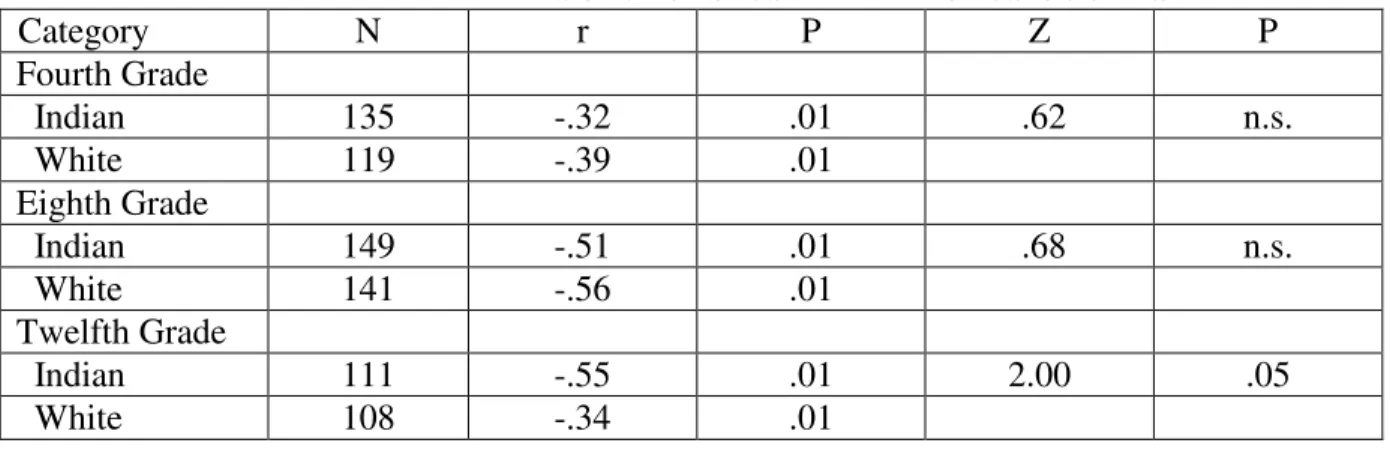
After establishing that locus of control was related to self-esteem in both Indian and white children, a question arose regarding the strength of the relationship. More specifically, did the relationship between locus of control and self-esteem vary according to the ethnicity of the students? To answer this question, the correlation coefficients obtained from the Indian and white students' NSLCS and CSEI scores were tested for significant differences. Fisher's Z scores were computed from Indian and white students' correlation coefficients at grades .four, eight, and twelve. The results of the comparisons are presented in Table II. It can be seen from Table II that the Fisher's Z value was not significant for grades four and eight. However, at grade twelve the relationship between locus of control and self-esteem was significantly stronger for Indians than whites. Thus, for twelfth-grade students, the relationship between locus of control and self-esteem varied according to ethnicity.
Conclusions
Previous research (Splinder and Splinder, 1957; Berry, 1969; and Coleman, 1966) has indicated that Indian children do not develop as well as white children, in terms of personal or psychological development. The present study examined the development of two dimensions of personality, self-esteem and locus of control, in Indian and white children. The study also attempted to identify how self-esteem was related to locus of control in children from both ethnic groups. From an analysis of the results from the present study, it was concluded that Indian and white children do not significantly differ in their developmental level of self-esteem until the junior high school grades. At the junior high school level, the Indian children are significantly lower than white children in terms of self-esteem and this difference in level of self-esteem persists throughout the high school grade levels. Perhaps a focus for future research should be the period of transition from elementary to junior high school. It should be noted that this transitional period correlates with the onset of adolescence and it could be that Indian and white children may differ in their reactions to adolescence.
Concerning the development of locus of control in Indian and white children, the following conclusions were formulated. First, both Indian and white children tend to become more internal with age. As a child becomes older, he apparently feels that his behavior is controlled more by himself than by others. This finding is consistent with previous research (Nowicki and Strickland, 1973). Second, white children perceive themselves as having more control over their actions than do Indian children. This difference was found at all three grade levels. The only exception to this was found at the twelfth grade and only for males. It seems that Indian and white children do differ in their locus of control orientation and this difference is evident by the time the students reach the fourth grade. Perhaps future research should specifically identify what factors influence the development of locus of control and determine if the contribution made by these factors is affected by ethnicity.
related to self-esteem for both Indians and whites. This finding indicates that an internal locus of control orientation is associated with good mental health. It was further concluded that the strength of this relationship between locus of control and self-esteem is different for whites than Indians at the high school level. Future research should examine the possibility of developing an individual's internal locus of control orientation. It could be that by increasing one's internal locus of control orientation his subjective evaluation (self-esteem) of himself may show a corresponding improvement.
In summary, the present study has studied the development of two dimensions of personality in Indian and white children. It should be noted that the Indian children utilized in the present study were attending Oklahoma public schools and may not be representative of Indian children from other states. Ethnic differences in self-esteem and locus of control orientation were found at three grade levels. The causes of these differences was not a concern of the present study, but was left for future researchers to identify. It was also found that internality was positively related to social or personal adjustment for both Indian and white children and, more importantly, that at the high school level this relationship was stronger for Indians than whites. This finding suggests that the strength of the relationship between certain personality variables may be a function of ethnicity or cultural background.
TABLE I
TEST FOR DIFFERENCE BETWEEN INDIAN AND WHITE SUBJECTS' NSLCS SCORES BY SEX
Male Female
Category N X SD t P N X SD t P
Fourth Grade
Indian 72 19.43 3.96 1.78 .05 63 19.56 3.69 2.29 .05
White 55 18.11 4.31 64 17.83 4.69
Eighth Grade
Indian 64 17.03 4.41 3.84 .01 85 16.16 4.78 2.29 .05
White 62 13.90 4.68 79 14.41 5.03
Twelfth Grade
Indian 56 11,79 4.88 1.24 n.s. 55 12.82 5.18 1.85 .05
TABLE II
PEARSON PRODUCT-MOMENT CORRELATION COEFFICIENTS BETWEEN INDIAN AND WHITE SUBJECTS' CSEI AND NSLCS SCORES
Category N r P Z P
Fourth Grade
Indian 135 -.32 .01 .62 n.s.
White 119 -.39 .01
Eighth Grade
Indian 149 -.51 .01 .68 n.s.
White 141 -.56 .01
Twelfth Grade
Indian 111 -.55 .01 2.00 .05
White 108 -.34 .01
REFERENCES
Baldo, R., Harris, M. & Crandall, J. Relations among psychosocial development, locus of control, and time orientation. Journal of Genetic Psychology, 1975, 126, 297-303.
Battle, E. & Rotter, J.B. Children's feelings of personal control as related to social class and ethnic group. Journal of Personality, 1963, 31, 482-490.
Berry, B. The Education of American Indians. Washington, D.C.; U.S. Government Printing Office, 1969.
Bryde, J.F. The Sioux Indian Student: A Study of Scholastic Failure and Personality Conflict. Vermillion, S. Dakota: Dakota Press, 1970.
Coleman, J.S., et al. Equality of Educational Opportunity. Washington, D.C.: U.S. Government Printing Office, 1966.
Coopersmith. S. The Antecedents of Self-Esteem. San Francisco, Calif.: Freeman, 1967. Erikson, R.V. & Roberts, A.H. Some ego functions associated with delay of gratification in male delinquents. Journal of Consulting and Clinical Psychology, 1971, 36, 378-382.
Graves, T.D. Time perspective and the deferred gratification pattern in a tri-ethnic community. Research. Report No. 5, Tri-Ethnic Research Project. Boulder, Colorado: University of Colorado, Institute of Behavioral Science, 1961.
Spindler, G.D. & Spindler, L.S. American Indian personality types and their sociocultural roots. The Annals of the American Academy of Political and Social Science, 1957, 147. Rotter, J.B. Generalized expectancies for internal versus external control of reinforcement. Psychological Monographs, 1966, 80 (1, whole No. 609).
Warehime, R.G. & Foulds, M.F. Perceived locus of control and personal adjustment. Journal of Consulting and Clinical Psychology, 1971, 37, 250-252.
DEVELOPING AN ORIENTATION MANUAL FOR NON-INDIAN TEACHERS OF INDIAN STUDENTS:
A CASE STUDY ON THE PAPAGO RESERVATION by
Jan McFarlane
INTRODUCTION
Each fall many new teachers from different parts of the country are recruited for employment in public and federal schools on American Indian Reservations. Perhaps the majority of these teachers have had little previous experience instructing Indian students and possess only limited knowledge about American Indian history and culture. Perhaps even fewer will have received any training from colleges of education in course work which could be of direct benefit to them - for example, courses focusing on cultural factors affecting student behaviors and attitudes and the particular educational needs of second language learners. But it is perhaps even more unfortunate that very few school districts in the nation which enroll primarily Indian students have recognized the magnitude of this problem and have attempted to devise any thorough, on-going program of in-service training for their teachers. Even if a district does wish to organize a comprehensive orientation program, few relevant materials exist. Therefore, any training materials directly related to a particular Indian culture must be developed locally.
Assessing Needs and Resources on the Papago Reservation
Teachers entering the public school system on the Papago Indian Reservation in southern Arizona have encountered similar problems in becoming acclimated to their new positions. In past years existing district orientation programs have been of limited assistance, consisting primarily of brief procedural lectures delivered in the few hectic days preceding the opening of school. When school begins, the new teacher is then often left to flounder with the many questions and problems which arise concerning curriculum and classroom administration. Many teachers manage to survive and learn to devise appropriate educational methods by sheer trial and error; a few succeed very well. Quite a few, however, find it extremely difficult to cope and could benefit greatly by increased assistance from the district such as could be obtained during in-service training programs.
At faculty meetings and at many informal gatherings throughout recent years many teachers have expressed their awareness of the need for the development of a more thorough orientation program. One idea which frequently surfaced was the need for the construction of some sort of written resource materials which could be consulted by the beginning teacher, particularly during the first few months of the academic year. However, because of chronic shortages of time, money and staff, prospects for developing teacher training materials appeared rather bleak. As of Spring 1972, no commercial or university materials were available and no federally funded programs existed in the district which could undertake the project. Furthermore, there was little official recognition of the problem and little encouragement for any teachers aspiring to assume the responsibility on their own. The remaining possibility was for someone to begin the process alone.
Selecting Topics. Since there were few models which could serve as a guide, the first decision was obviously to decide which topics the manual should cover. It was decided to limit the manual to` cover basic issues: traditional and contemporary Papago culture and also significant educational topics, such as student behaviors, culturally appropriate teaching styles, and bilingualism. Therefore, the first part of the manual copy contained two chapters on present-day reservation life and family structure and two chapters on traditional Papago culture and family life. The middle section consisted of one chapter which related Papago child-rearing practices to their implications for the classroom teacher, while the next two chapters dealt with the important issue of Papago and Anglo value systems, and the cultural conflicts which often arise because of differences between these contrasting values. A concluding group of three chapters focused on topics of language: development of the Papago orthography; difficulties of Papago speakers in learning English; and instructional techniques for use with second language learners, particularly the goals and methods of bilingual bicultural education.
Gathering Information. Information for the manual was gathered in several ways: written sources, contact with individuals and organizations, and personal observations. For example, cultural material about traditional Papago life came from library research of anthropological ethnographies. Present-day cultural data came from accounts by both Indian and non-Indian authors, as well as from interviews, both formal and informal, with Papago agency workers and community members.
Questionnaires, interviews, and formal and informal meetings provided attitudinal information from all facets of the educational community: administrators, school board members, teachers, parents, aides, and students. Technical and sociolinguistic information for the Papago language chapters was provided by both a Papago and non-Papago linguist and the contents were checked for accuracy.
The last method used for gathering insights into the cross-cultural inter-actions in the community was the anthropological technique of "observation-participation." This refers to the personal and professional experiences of the author as an employee and resident of the school district for six years.
Developing Mutual Trust. First, an attitude of credibility and trust had to be developed between the community and the writer before much work could progress. Receiving official permission by the school board to begin the project was somewhat helpful in gaining initial community acceptance. But in the long run it was left to the author to develop trust among the people and the awareness that the manual could be of real value to their children by helping their teachers become more knowledgeable about the Papago way of life.