Combinatorics Through Guided Discovery
1Kenneth P. Bogart
November 6, 2004
c
Contents
Preface vii
1 What is Combinatorics? 1
1.1 About These Notes . . . 2
1.2 Basic Counting Principles . . . 2
1.2.1 The sum and product principles . . . 5
1.2.2 Functions and directed graphs . . . 9
1.2.3 The bijection principle . . . 12
1.2.4 Counting subsets of a set . . . 12
1.2.5 Pascal’s Triangle . . . 13
1.2.6 The quotient principle . . . 16
1.3 Some Applications of Basic Counting Principles . . . 22
1.3.1 Lattice paths and Catalan Numbers . . . 22
1.3.2 The Binomial Theorem . . . 25
1.3.3 The pigeonhole principle . . . 27
1.3.4 Ramsey Numbers . . . 29
1.4 Supplementary Chapter Problems . . . 30
2 Applications of Induction and Recursion in Combinatorics and Graph Theory 33 2.1 Some Examples of Mathematical Induction . . . 33
2.1.1 Mathematical induction . . . 33
2.1.2 Binomial Coefficients and the Binomial Theorem . . . 35
2.1.3 Inductive definition . . . 36
2.1.4 Proving the general product principle (Optional) . . . 37
2.1.5 Double Induction and Ramsey Numbers . . . 38
2.1.6 A bit of asymptotic combinatorics . . . 39
2.2 Recurrence Relations . . . 41
2.2.1 Examples of recurrence relations . . . 41
2.2.2 Arithmetic Series (optional) . . . 43
2.2.3 First order linear recurrences . . . 43
2.2.4 Geometric Series . . . 44
2.3 Graphs and Trees . . . 45
2.3.1 Undirected graphs . . . 45
2.3.2 Walks and paths in graphs . . . 46
2.3.3 Counting vertices, edges, and paths in trees . . . 47
2.3.4 Spanning trees . . . 49
2.3.5 Minimum cost spanning trees . . . 49
2.3.6 The deletion/contraction recurrence for spanning trees 50 2.3.7 Shortest paths in graphs . . . 52
2.4 Supplementary Problems . . . 54
3 Distribution Problems 57 3.1 The Idea of a Distribution . . . 57
3.1.1 The twenty-fold way . . . 57
3.1.2 Ordered functions . . . 61
3.1.3 Multisets . . . 63
3.1.4 Compositions of integers . . . 63
3.1.5 Broken permutations and Lah numbers . . . 64
3.2 Partitions and Stirling Numbers . . . 65
3.2.1 Stirling Numbers of the second kind . . . 65
3.2.2 Stirling Numbers and onto functions . . . 66
3.2.3 Stirling Numbers and bases for polynomials . . . 68
3.3 Partitions of Integers . . . 69
3.3.1 The number of partitions ofk intonparts . . . 70
3.3.2 Representations of partitions . . . 70
3.3.3 Ferrers and Young Diagrams and the conjugate of a partition . . . 71
3.3.4 Partitions into distinct parts . . . 76
3.3.5 Supplementary Problems . . . 77
4 Generating Functions 81 4.1 The Idea of Generating Functions . . . 81
4.1.1 Visualizing Counting with Pictures . . . 81
4.1.2 Picture functions . . . 82
4.1.3 Generating functions . . . 84
4.1.4 Power series . . . 85
4.1.5 Product principle for generating functions . . . 87
CONTENTS v
4.2 Generating Functions for Integer Partitions . . . 90
4.3 Generating Functions and Recurrence Relations . . . 94
4.3.1 How generating functions are relevant . . . 94
4.3.2 Fibonacci Numbers . . . 95
4.3.3 Second order linear recurrence relations . . . 95
4.3.4 Partial fractions . . . 96
4.3.5 Catalan Numbers . . . 99
4.4 Supplementary Problems . . . 100
5 The Principle of Inclusion and Exclusion 103 5.1 The Size of a Union of Sets . . . 103
5.1.1 Unions of two or three sets . . . 103
5.1.2 Unions of an arbitrary number of sets . . . 104
5.1.3 The Principle of Inclusion and Exclusion . . . 106
5.2 Applications of Inclusion and Exclusion . . . 107
5.2.1 Multisets with restricted numbers of elements . . . 107
5.2.2 The M´enage Problem . . . 107
5.2.3 Counting onto functions . . . 108
5.2.4 The chromatic polynomial of a graph . . . 108
5.3 Deletion-Contraction and the Chromatic Polynomial . . . 110
5.4 Supplementary Problems . . . 111
6 Groups Acting on Sets 113 6.1 Permutation Groups . . . 113
6.1.1 The rotations of a square . . . 113
6.1.2 Groups of permutations . . . 115
6.1.3 The symmetric group . . . 117
6.1.4 The dihedral group . . . 118
6.1.5 Group tables (Optional) . . . 121
6.1.6 Subgroups . . . 122
6.1.7 The cycle decomposition of a permutation . . . 123
6.2 Groups Acting on Sets . . . 125
6.2.1 Groups acting on colorings of sets . . . 128
6.2.2 Orbits . . . 131
6.2.3 The Cauchy-Frobenius-Burnside Theorem . . . 134
6.3 P´olya-Redfield Enumeration Theory . . . 136
6.3.1 The Orbit-Fixed Point Theorem . . . 139
6.3.2 The P´olya-Redfield Theorem . . . 140
A Relations 147
A.1 Relations as Sets of Ordered Pairs . . . 147
A.1.1 The relation of a function . . . 147
A.1.2 Directed graphs . . . 149
A.1.3 Digraphs of Functions . . . 150
A.2 Equivalence Relations . . . 153
B Mathematical Induction 159 B.1 The Principle of Mathematical Induction . . . 159
B.1.1 The ideas behind mathematical induction . . . 159
B.1.2 Mathematical induction . . . 161
B.1.3 Proving algebraic statements by induction . . . 163
B.2 Strong Induction . . . 164
C Exponential Generating Functions 167 C.1 Indicator Functions . . . 167
C.2 Exponential Generating Functions . . . 168
C.3 Applications to Recurrences. . . 170
C.3.1 Using calculus with exponential generating functions . 171 C.4 The Product Principle for EGFs . . . 172
C.5 The Exponential Formula . . . 178
Preface
This book is an introduction to combinatorial mathematics, also known as combinatorics. The book focuses especially but not exclusively on the part of combinatorics that mathematicians refer to as “counting.” The book consists almost entirely of problems. Some of the problems are designed to lead you to think about a concept, others are designed to help you figure out a concept and state a theorem about it, while still others ask you to prove the theorem. Other problems give you a chance to use a theorem you have proved. From time to time there is a discussion that pulls together some of the things you have learned or introduces a new idea for you to work with. Many of the problems are designed to build up your intuition for how combinatorial mathematics works. There are problems that some people will solve quickly, and there are problems that will take days of thought for everyone. Probably the best way to use this book is to work on a problem until you feel you are not making progress and then go on to the next one. Think about the problem you couldn’t get as you do other things. The next chance you get, discuss the problem you are stymied on with other members of the class. Often you will all feel you’ve hit dead ends, but when you begin comparing notes and listening carefully to each other, you will see more than one approach to the problem and be able to make some progress. In fact, after comparing notes you may realize that there is more than one way to interpret the problem. In this case your first step should be to think together about what the problem is actually asking you to do. You may have learned in school that for every problem you are given, there is a method that has already been taught to you, and you are supposed to figure out which method applies and apply it. That is not the case here. Based on some simplified examples, you will discover the method for yourself. Later on, you may recognize a pattern that suggests you should try to use this method again.
The point of learning from this book is that you are learning how to discover ideas and methods for yourself, not that you are learning to apply
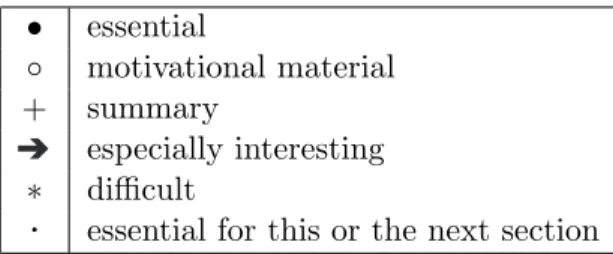
Table 1: The meaning of the symbols to the left of problem numbers.
• essential
◦ motivational material + summary
especially interesting ∗ difficult
·
essential for this or the next sectionmethods that someone else has told you about. The problems in this book are designed to lead you to discover for yourself and prove for yourself the main ideas of combinatorial mathematics. There is considerable evidence that this leads to deeper learning and more understanding.
You will see that some of the problems are marked with bullets. Those are the problems that I feel are essential to having an understanding of what comes later, whether or not it is marked by a bullet. The problems with bullets are the problems in which the main ideas of the book are developed. Your instructor may leave out some of these problems because he or she plans not to cover future problems that rely on them. Many problems, in fact entire sections, are not marked in this way, because they use an important idea rather than developing one. Some other special symbols are described in what follows; a summary appears in Table 1.
ix
If you are taking a course, your instructor will choose problems for you to work on based on the prerequisites for and goals of the course. If you are reading the book on your own, I recommend that you try all the problems in a section you want to cover. Try to do the problems with bullets, but by all means don’t restrict yourself to them. Often a bulleted problem makes more sense if you have done some of the easier motivational problems that come before it. If, after you’ve tried it, you want to skip over a problem without a bullet or circle, you should not miss out on much by not doing that problem. Also, if you don’t find the problems in a section with no bullets interesting, you can skip them, understanding that you may be skipping an entire branch of combinatorial mathematics! And no matter what, read the textual material that comes before, between, and immediately after problems you are working on!
One of the downsides of how we learn math in high school is that many of us come to believe that if we can’t solve a problem in ten or twenty minutes, then we can’t solve it at all. There will be problems in this book that take hours of hard thought. Many of these problems were first conceived and solved by professional mathematicians, and they spent days or weeks on them. How can you be expected to solve them at all then? You have a context in which to work, and even though some of the problems are so open ended that you go into them without any idea of the answer, the context and the leading examples that precede them give you a structure to work with. That doesn’t mean you’ll get them right away, but you will find a real sense of satisfaction when you see what you can figure out with concentrated thought. Besides, you can get hints!
You should try to write up answers to all the problems that you work on. If you claim something is true, you should explain why it is true; that is you should prove it. In some cases an idea is introduced before you have the tools to prove it, or the proof of something will add nothing to your understanding. In such problems there is a remark telling you not to bother with a proof. When you write up a problem, remember that the instructor has to be able to “get” your ideas and understand exactly what you are saying. Your instructor is going to choose some of your solutions to read carefully and give you detailed feedback on. When you get this feedback, you should think it over carefully and then write the solution again! You may be asked not to have someone else read your solutions to some of these problems until your instructor has. This is so that the instructor can offer help which is aimed at your needs. On other problems it is a good idea to seek feedback from other students. One of the best ways of learning to write clearly is to have someone point out to you where it is hard to figure out what you mean. The crucial thing is to make it clear to your reader that you really want to know where you may have left something out, made an unclear statement, or failed to support a statement with a proof. It is often very helpful to choose people who have not yet become an expert with the problems, as long as they realize it will help you most for them to tell you about places in your solutions they do not understand, even if they think it is their problem and not yours!
xi
There are quite a few concepts that are developed in this book. Since most of the intellectual content is in the problems, it is natural that defini-tions of concepts will often be within problems. When you come across an unfamiliar term in a problem, it is likely it was defined earlier. Look it up in the index, and with luck (hopefully no luck will really be needed!) you will be able to find the definition.
Above all, this book is dedicated to the principle that doing mathematics is fun. As long as you know that some of the problems are going to require more than one attempt before you hit on the main idea, you can relax and enjoy your successes, knowing that as you work more and more problems and share more and more ideas, problems that seemed intractable at first become a source of satisfaction later on.
Chapter 1
What is Combinatorics?
Combinatorial mathematics arises from studying how we can combine ob-jects into arrangements. For example, we might be combining sports teams into a tournament, samples of tires into plans to mount them on cars for testing, students into classes to compare approaches to teaching a subject, or members of a tennis club into pairs to play tennis. There are many ques-tions one can ask about such arrangements of objects. Here we will focus on questions about how many ways we may combine the objects into arrange-ments of the desired type. These are called counting problems. Sometimes, though, combinatorial mathematicians ask if an arrangement is possible (if we have ten baseball teams, and each team has to play each other team once, can we schedule all the games if we only have the fields available at enough times for forty games?). Sometimes they ask if all the arrangements we might be able to make have a certain desirable property (Do all ways of testing 5 brands of tires on 5 different cars [with certain additional prop-erties] compare each brand with each other brand on at least one common car?). Counting problems (and problems of the other sorts described) come up throughout physics, biology, computer science, statistics, and many other subjects. However, to demonstrate all these relationships, we would have to take detours into all these subjects. While we will give some important applications, we will usually phrase our discussions around everyday expe-rience and mathematical expeexpe-rience so that the student does not have to learn a new context before learning mathematics in context!
1.1
About These Notes
These notes are based on the philosophy that you learn the most about a subject when you are figuring it out directly for yourself, and learn the least when you are trying to figure out what someone else is saying about it. On the other hand, there is a subject called combinatorial mathematics, and that is what we are going to be studying, so we will have to tell you some basic facts. What we are going to try to do is to give you a chance to discover many of the interesting examples that usually appear as textbook examples and discover the principles that appear as textbook theorems. Your main activity will be solving problems designed to lead you to discover the basic principles of combinatorial mathematics. Some of the problems lead you through a new idea, some give you a chance to describe what you have learned in a sequence of problems, and some are quite challenging. When you find a problem challenging, don’t give up on it, but don’t let it stop you from going on with other problems. Frequently you will find an idea in a later problem that you can take back to the one you skipped over or only partly finished in order to finish it off. With that in mind, let’s get started. In the problems that follow, you will see some problems marked on the left with various symbols. The preface gives a full explanation of these symbols and discusses in greater detail why the book is organized as it is! Table 1.1, which is repeated from the preface, summarizes the meaning of the symbols.
Table 1.1: The meaning of the symbols to the left of problem numbers.
• essential
◦ motivational material + summary
especially interesting ∗ difficult
·
essential for this or the next section1.2
Basic Counting Principles
1.2. BASIC COUNTING PRINCIPLES 3
•2. Now some numbern of schools are going to send their baseball teams to a tournament, and each team must play each other team exactly once. Let us think of the teams as numbered 1 through n.
(a) How many games does team 1 have to play in?
(b) How many games, other than the one with team 1, does team two have to play in?
(c) How many games, other than those with the first i−1 teams, does team ihave to play in?
(d) In terms of your answers to the previous parts of this problem, what is the total number of games that must be played?
•3. One of the schools sending its team to the tournament has to send its players from some distance, and so it is making sandwiches for team members to eat along the way. There are three choices for the kind of bread and five choices for the kind of filling. How many different kinds of sandwiches are available? Online hint.
+4. An ordered pair(a, b) consists of two things we call a and b. We say
a is the first member of the pair and b is the second member of the pair. If M is an m-element set and N is an n-element set, how many ordered pairs are there whose first member is inM and whose second member is in N? Does this problem have anything to do with any of the previous problems?
◦5. Since a sandwich by itself is pretty boring, students from the school in Problem 3 are offered a choice of a drink (from among five different kinds), a sandwich, and a fruit (from among four different kinds). In how many ways may a student make a choice of the three items now?
•6. The coach of the team in Problem 3 knows of an ice cream parlor along the way where she plans to stop to buy each team member a triple decker cone. There are 12 different flavors of ice cream, and triple decker cones are made in homemade waffle cones. Having chocolate ice cream as the bottom scoop is different from having chocolate ice cream as the top scoop. How many possible ice cream cones are going to be available to the team members? How many cones with three different kinds of ice cream will be available? Online hint.
exactly one memberf(x) ofT with each elementxinS. We will come back to the ideas of functions and relationships in more detail and from different points of view from time to time. However, the quick review above should probably let you answer these questions. If you have difficulty with them, it would be a good idea to go now to Appendix A and work through Section A.1.1 which covers this definition in more detail. You might also want to study Section A.1.3 to learn to visualize the properties of functions. We will take up the topic of this section later in this chapter as well, but in less detail than is in the appendix.
(a) Using f, g, . . . , to stand for the various functions, write down all the different functions you can from the set {1,2} to the set {a, b}. For example, you might start with the function f given by f(1) = a, f(2) = b. How many functions are there from the set {1,2}to the set {a, b}? Online hint.
(b) How many functions are there from the three element set{1,2,3} to the two element set {a, b}? Online hint.
(c) How many functions are there from the two element set {a, b}to the three element set {1,2,3}? Online hint.
(d) How many functions are there from a three element set to a 12 element set?
(e) A function f is called one-to-one or aninjection if wheneverx is different from y,f(x) is different fromf(y). How many one-to-one functions are there from a three element set to a 12 element set?
(f) Explain the relationship between this problem and Problem 6.
•8. A group of hungry team members in Problem 6 notices it would be cheaper to buy three pints of ice cream for them to split than to buy a triple decker cone for each of them, and that way they would get more ice cream. They ask their coach if they can buy three pints of ice cream.
(a) In how many ways can they choose three pints of different flavors out of the 12 flavors? Online hint.
(b) In how many ways may they choose three pints if the flavors don’t have to be different? Online hint.
1.2. BASIC COUNTING PRINCIPLES 5
{3,5,7} are not. Three or more sets are said to be mutually disjoint
if no two of them have any elements in common. What can you say about the size of the union of a finite number of finite (mutually) disjoint sets? Does this have anything to do with any of the previous problems?
•10. Disjoint subsets are defined in Problem 9. What can you say about the size of the union ofm(mutually) disjoint sets, each of sizen? Does this have anything to do with any of the previous problems?
1.2.1 The sum and product principles
These problems contain among them the kernels of many of the fundamental ideas of combinatorics. For example, with luck, you just stated the sum principle (illustrated in Figure 1.1), and product principle (illustrated in Figure 1.2) in Problems 9 and 10. These are two of the most basic principles of combinatorics. These two counting principles are the basis on which we will develop many other counting principles.
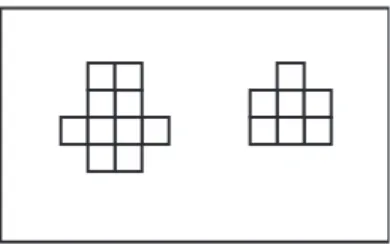
Figure 1.1: The union of these two disjoint sets has size 17.
You may have noticed some standard mathematical words and phrases such as set, ordered pair, function and so on creeping into the problems. One of our goals in these notes is to show how most counting problems can be recognized as counting all or some of the elements of a set of standard mathematical objects. For example, Problem 4 is meant to suggest that the question we asked in Problem 3 was really a problem of counting all the ordered pairs consisting of a bread choice and a filling choice. We useA×B to stand for the set of all ordered pairs whose first element is inAand whose second element is inB and we callA×B theCartesian product ofAandB. Thus you can think of Problem 4 as asking you for the size of the Cartesian product of M and N, that is, asking you to count the number of elements of this Cartesian product.
When a setS is a union of disjoint setsB1, B2, . . . , Bm we say that the
setsB1, B2, . . . , Bm are apartition of the setS. Thus a partition ofS is a
(special kind of) set of sets. So that we don’t find ourselves getting confused between the setS and the sets Bi into which we have divided it, we often
call the setsB1, B2, . . . , Bm theblocksof the partition. In this language, the
sum principlesays that
if we have a partition of a finite set S, then the size of S is the sum of the sizes of the blocks of the partition.
Theproduct principlesays that
if we have a partition of a finite set S intom blocks, each of size n, then S has sizemn.
You’ll notice that in our formal statement of the sum and product principle we talked about a partition of a finite set. We could modify our language a bit to cover infinite sizes, but whenever we talk about sizes of sets in what follows, we will be working with finite sets. So as to avoid possible complications in the future, let us agree that when we refer to the size of a set, we are implicitly assuming the set is finite. There is another version of the product principle that applies directly in problems like Problem 5 and Problem 6, where we were not just taking a union ofm disjoint sets of size n, but rather m disjoint sets of size n, each of which was a union of m0 disjoint sets of sizen0. This is an inconvenient way to have to think about a counting problem, so we may rephrase the product principle in terms of a sequence of decisions:
1.2. BASIC COUNTING PRINCIPLES 7
• there arek1 possible first choices, and
• for each way of making the first i−1 choices, there are ki ways
to make the ith choice,
then in how many ways may we make our sequence of choices? (You need not prove your answer correct at this time.)
The counting principle you gave in Problem 11 is called the general product principle. We will outline a proof of the general product principle from the original product principle in Problem 80. Until then, let us simply accept it as another counting principle. For now, notice how much easier it makes it to explain why we multiplied the things we did in Problem 5 and Problem 6.
12. A tennis club has 2n members. We want to pair up the members by twos for singles matches.
(a) In how many ways may we pair up all the members of the club? (Hint: consider the cases of 2, 4, and 6 members.) Online hint.
(b) Suppose that in addition to specifying who plays whom, for each pairing we say who serves first. Now in how many ways may we specify our pairs? Online hint.
+13. Let us now return to Problem 7 and justify—or perhaps finish—our
answer to the question about the number of functions from a three-element set to a 12-three-element set.
(a) How can you justify your answer in Problem 7 to the question “How many functions are there from a three element set (say [3] = {1,2,3}) to a twelve element set (say [12])? ” Online hint.
(b) Based on the examples you’ve seen so far, make a conjecture about how many functions there are from the set
[m] ={1,2,3, . . . , m}
to [n] ={1,2,3, . . . , n} and prove it.
+14. Now suppose we are thinking about a set S of functionsf from [m] to
some set X. (For example, in Problem 6 we were thinking of the set of functions from the three possible places for scoops in an ice-cream cone to 12 flavors of ice cream.) Suppose there arek1 choices forf(1). (In Problem 6, k1 was 12, because there were 12 ways to choose the first scoop.) Suppose that for each choice of f(1) there are k2 choices for f(2). (For example, in Problem 6 k2 was 12 if the second flavor could be the same as the first, but k2 was 11 if the flavors had to be different.) In general, suppose that for each choice of f(1), f(2), . . .f(i−1), there are ki choices for f(i). (For example, in Problem
6, if the flavors have to be different, then for each choice of f(1) and f(2), there are 10 choices forf(3).)
What we have assumed so far about the functions in S may be sum-marized as
• There are k1 choices forf(1).
• For each choice of f(1), f(2), . . . , f(i−1), there are ki choices
for f(i).
How many functions are in the set S? Is there any practical difference between the result of this problem and the general product principle?
The point of Problem 14 is that the general product principle can be stated informally, as we did originally, or as a statement about counting sets of standard concrete mathematical objects, namely functions.
15. A roller coaster car has n rows of seats, each of which has room for two people. If nmen andnwomen get into the car with a man and a woman in each row, in how many ways may they choose their seats? Online hint.
+16. How does the general product principle apply to Problem 6?
17. In how many ways can we pass out k distinct pieces of fruit to n children (with no restriction on how many pieces of fruit a child may get)?
•18. How many subsets does a set S with n elements have? Online hint.
1.2. BASIC COUNTING PRINCIPLES 9
number if k > n? Assume for both questions that we pass out all the fruit. Online hint. A second online hint.
•20. Another name for a list, in a specific order, ofkdistinct things chosen from a set S is a k-element permutation of S. We can also think of a k-element permutation ofS as a one-to-one function (or, in other words, injection) from [k] = {1,2, . . . , k} to S. How many k-element permutations does an n-element set have? (For this problem it is natural to assume k ≤ n. However, the question makes sense even if k > n.) What is the number of k-element permutations of an n-element set ifk > n? Online hint.
There are a variety of different notations for the number of k-element permutations of an n-element set. The one we shall use was introduced by Don Knuth; namely nk, read “n to the kfalling” or “n to thek down.” In Problem 20 you may have shown that
nk =n(n−1)· · ·(n−k+ 1) =
k Y
i=1
(n−i+ 1). (1.1)
It is standard to call nk the k-th falling factorial power of n, which explains why we use exponential notation. We call it a factorialpower since nn = n(n−1)· · ·1, which we call n-factorial and denote by n!. If you are unfamiliar with the Pi notation, or product notation we introduced for products in Equation 1.1, it works just like the Sigma notation works for summations.
•21. Expressnk as a quotient of factorials.
22. How should we define n0?
1.2.2 Functions and directed graphs
whether each horizontal straight line crosses the graph at most one time. The functions we deal with will often involve objects which are not numbers, and will often be functions from one finite set to another. Thus graphs in the cartesian plane will often not be available to us for visualizing functions. However, there is another kind of graph called adirected graphordigraph
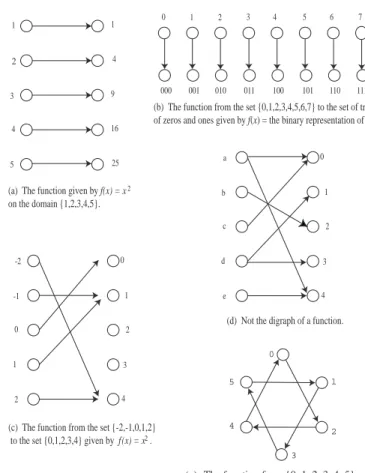
that is especially useful when dealing with functions between finite sets. We take up this topic in more detail in Appendix A, particularly Section A.1.2 and Section A.1.3. In Figure 1.3 we show several examples of digraphs of functions. If we have a function f from a set S to a set T, we draw a
Figure 1.3: What is a digraph of a function?
1 3 4 5 1 -2 0 4 -1 1 9 0 2 16 1 3 25 2 4 2
(a) The function given by f(x) = x on the domain {1,2,3,4,5}.
2
(c) The function from the set {-2,-1,0,1,2} to the set {0,1,2,3,4} given by f(x) = x .2
0 000 1 001 2 010 3 011 4 100 5 101 6 110 7 111
(b) The function from the set {0,1,2,3,4,5,6,7} to the set of triples of zeros and ones given by f(x) = the binary representation of x.
a 0
b 1
c 2
d 3
e 4
(d) Not the digraph of a function.
(e) The function from {0, 1, 2, 3, 4, 5} to {0, 1, 2, 3, 4, 5} given by f(x) = x + 2 mod 6
0 1 2 3 4 5
1.2. BASIC COUNTING PRINCIPLES 11
then draw an arrow from the vertex for x to the vertex for y if f(x) = y. Sometimes, as in part (e) of the figure, if we have a function from a set S to itself, we draw only one set of vertices representing the elements of S, in which case we can have arrows both entering and leaving a given vertex. As you see, the digraph can be more enlightening in this case if we experiment with the function to find a nice placement of the vertices rather than putting them in a row.
Notice that there is a simple test for whether a digraph whose vertices represent the elements of the setsS and T is the digraph of a function from S to T. There must be one and only one arrow leaving each vertex of the digraph representing an element ofS. The fact that there is one arrow means that f(x) is defined for eachx inS. The fact that there is only one arrow means that each x inS is related to exactly one element of T. (Note that these remarks hold as well if we have a function fromS toS and draw only one set of vertices representing the elements ofS.) For further discussion of functions and digraphs see Sections A.1.1 and A.1.2 of Appendix A.
◦23. Draw the digraph of the function from the set {Alice, Bob, Dawn, Bill} to the set {A, B, C, D, E} given by
f(X) = the first letter of the name X.
•24. A function f :S → T is called an onto function or surjectionif each element of T is f(x) for some x ∈ S. Choose a set S and a set T so that you can draw the digraph of a function from S to T that is one-to-one but not onto, and draw the digraph of such a function.
◦25. Choose a set S and a set T so that you can draw the digraph of a function from S to T that is onto but not one-to-one, and draw the digraph of such a function.
•26. Digraphs of functions help us visualize the ideas of one-to-one functions and onto functions. Online hint.
(a) What does the digraph of a one-to-one function (injection) from a finite setX to a finite setY look like? (Look for a test somewhat similar to the one we described for when a digraph is the digraph of a function.)
(c) What does the digraph of a one-to-one and onto function from a finite set S to a setT look like?
•27. The wordpermutation is actually used in two different ways in math-ematics. A permutation of a set S is a one-to-one function from S onto S. How many permutations does an n-element set have?
Notice that there is a great deal of consistency between the use of the word permutation in Problem 27 and the use in the Problem 20. If we have some waya1, a2, . . . , an of listing our setS, then any other listb1, b2, . . . , bn
gives us the permutation ofS whose rule isf(ai) =bi, and any permutation
ofS, say the one given by g(ai) =ci gives us a listc1, c2, . . . , cn of S. Thus
there is really very little difference between the idea of a permutation of S and ann-element permutation ofS whenn is the size ofS.
1.2.3 The bijection principle
Another name for a one-to-one and onto function is bijection. The di-graphs marked (a), (b), and (e) in Figure 1.3 are didi-graphs of bijections. The description in Problem 26c of the digraph of a bijection from X toY illustrates one of the fundamental principles of combinatorial mathematics, thebijection principle:
Two sets have the same size if and only if there is a bijection between them.
It is surprising how this innocent sounding principle guides us into finding insight into some otherwise very complicated proofs.
1.2.4 Counting subsets of a set
28. Thebinaryrepresentation of a numbermis a list, or string,a1a2. . . ak
of zeros and ones such thatm=a12k−1+a22k−2+· · ·+ak20.Describe
a bijection between the binary representations of the integers between 0 and 2n−1 and the subsets of an n-element set. What does this tell you about the number of subsets of the n-element set [n]? Online hint.
Notice that the first question in Problem 8 asked you for the number of ways to choose a three element subset from a 12 element subset. You may have seen a notation like nk
,C(n, k), or nCk which stands for the number
1.2. BASIC COUNTING PRINCIPLES 13
n k
is read as “nchoosek” and is called abinomial coefficientfor reasons we will see later on. Another frequently used way to read the binomial coefficient notation is “the number of combinations of nthings takenk at a time.” We won’t use this way of reading the notation. You are going to be asked to construct two bijections that relate to these numbers and figure out what famous formula they prove. We are going to think about subsets of the n-element set [n] = {1,2,3, . . . , n}. As an example, the set of two-element subsets of [4] is
{{1,2},{1,3},{1,4},{2,3},{2,4},{3,4}}.
This example tells us that 42 = 6.
•29. Let C be the set of k-element subsets of [n] that contain the number n, and let D be the set ofk-element subsets of [n] that don’t contain n.
(a) Let C0 be the set of (k−1)-element subsets of [n−1]. Describe a bijection fromC toC0. (A verbal description is fine.)
(b) LetD0be the set ofk-element subsets of [n−1] ={1,2, . . . n−1}. Describe a bijection from DtoD0. (A verbal description is fine.)
(c) Based on the two previous parts, express the sizes ofC and Din terms of binomial coefficients involving n−1 instead of n.
(d) Apply the sum principle to C and D and obtain a formula that expresses nk
in terms of two binomial coefficients involvingn−1. You have just derived the Pascal Equation that is the basis for the famous Pascal’s Triangle.
1.2.5 Pascal’s Triangle
The Pascal Equation that you derived in Problem 29 gives us the triangle in Figure 1.4. This figure has the number ofk-element subsets of ann-element set as the kth number over in the nth row (we call the top row the zeroth row and the beginning entry of a row the zeroth number over). You’ll see that your formula doesn’t say anything about nk
if k = 0 or k = n, but otherwise it says that each entry is the sum of the two that are above it and just to the left or right.
Figure 1.4: Pascal’s Triangle
1
1 1
1 2 1
1 3 3 1
1 4 6 4 1
1 5 10 10 5 1
1 6 15 20 15 6 1
1 7 21 35 35 21 7 1
31. Without writing out the rows completely, write out enough of Pascal’s triangle to get a numerical answer for the first question in Problem 8. Online hint.
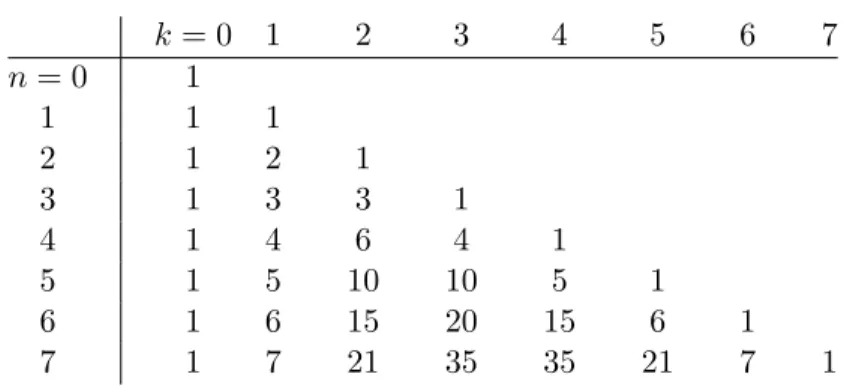
It is less common to see Pascal’s triangle as a right triangle, but it actually makes your formula easier to interpret. In Pascal’s Right Triangle, the element in row nand column k(with the convention that the first row is row zero and the first column is column zero) is nk
. In this case your formula says each entry in a row is the sum of the one above and the one above and to the left, except for the leftmost and right most entries of a row, for which that doesn’t make sense. Since the leftmost entry is n0
and the rightmost entry is nn
, these entries are both one (to see why, ask yourself how many 0-element subsets and how manyn-element subsets ann-element set has), and your formula then tells how to fill in the rest of the table.
Figure 1.5: Pascal’s Right Triangle
k= 0 1 2 3 4 5 6 7
n= 0 1
1 1 1
2 1 2 1
3 1 3 3 1
4 1 4 6 4 1
5 1 5 10 10 5 1
6 1 6 15 20 15 6 1
1.2. BASIC COUNTING PRINCIPLES 15
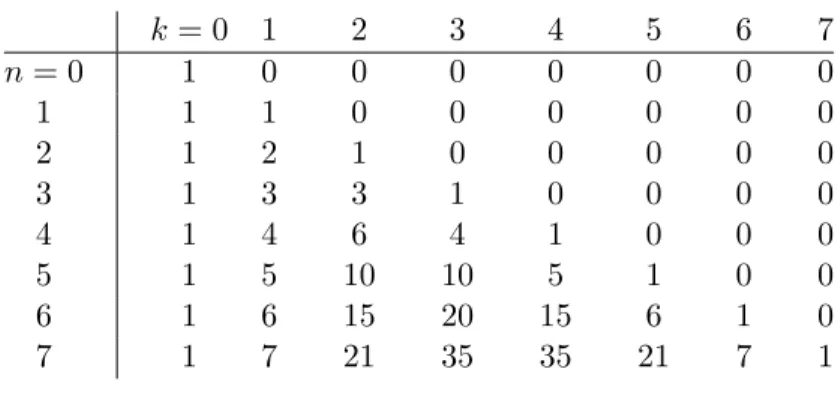
Seeing this right triangle leads us to ask whether there is some natural way to extend the right triangle to a rectangle. If we did have a rectangular table of binomial coefficients, counting the first row as row zero (i.e.,n= 0) and the first column as column zero (i.e., k = 0), the entries we don’t yet have are values of nk
fork > n. But how manyk-element subsets does an n-element set have if k > n? The answer, of course, is zero, so all the other entries we would fill in would be zero, giving us the rectangular array in Figure 1.6. It is straightforward to check that Pascal’s Equation now works for all the entries in the rectangle that have an entry above them and an entry above and to the left.
Figure 1.6: Pascal’s Rectangle
k= 0 1 2 3 4 5 6 7
n= 0 1 0 0 0 0 0 0 0
1 1 1 0 0 0 0 0 0
2 1 2 1 0 0 0 0 0
3 1 3 3 1 0 0 0 0
4 1 4 6 4 1 0 0 0
5 1 5 10 10 5 1 0 0
6 1 6 15 20 15 6 1 0
7 1 7 21 35 35 21 7 1
32. Because our definition told us that nk
is 0 when k > n, we got a rectangular table of numbers that satisfies the Pascal Equation.
(a) Is there any other way to define nk
when k > n in order to get a rectangular table that agrees with Pascal’s Right Triangle for k≤nand satisfies the Pascal Equation? Online hint.
(b) Suppose we want to extend Pascal’s Rectangle to the left and define −nk
forn≥0 andk >0 so that−k <0. What should we put into rownand column −kof Pascal’s Rectangle in order for the Pascal Equation to hold true? Online hint.
33. There is yet another bijection that lets us prove that a set of size n has 2nsubsets. Namely, for each subsetSof [n] ={1,2, . . . , n}, define a function (traditionally denoted by χS) as follows.1
χS(i) =1 if i∈S 0 if i6∈S
The functionχS is called thecharacteristic functionofS. Notice that
the characteristic function is a function from [n] to{0,1}.
(a) For practice, consider the function χ{1,3} for the subset {1,3}of
the set {1,2,3,4}. What are
i. χ{1,3}(1)?
ii. χ{1,3}(2)?
iii. χ{1,3}(3)?
iv. χ{1,3}(4)?
(b) We define a functionf from the set of subsets of [n] ={1,2, . . . , n} to the set of functions from [n] to {0,1} by f(S) =χS. Explain
why f is a bijection.
(c) Why does the fact that f is a bijection prove that [n] has 2n
subsets?
In Problems 18, 28, and 33 you gave three proofs of the following theo-rem.
Theorem 1 The number of subsets of an n-element set is2n.
The proofs in Problem 28 and 33 use essentially the same bijection, but they interpret sequences of zeros and ones differently, and so end up being different proofs. We will give yet another proof, using bijections similar to those we used in proving the Pascal Equation, at the beginning of Chapter 2.
1.2.6 The quotient principle
•34. As we noted in Problem 29, the first question in Problem 8 asked us for the number of three-element subsets of a twelve-element set. We were able to use the Pascal Equation to get a numerical answer to that question. Had we had twenty or thirty flavors of ice cream to
1
1.2. BASIC COUNTING PRINCIPLES 17
choose from, using the Pascal Equation to get our answer would have entailed a good bit more work. We have seen how the general product principle gives us an answer to Problem 6. Thus we might think that the number of ways to choose a three element set from 12 elements is the number of ways to choose the first element times the number of ways to choose the second element times the number of ways to choose the third element, which is 12·11·10 = 1320. However, our result in Problem 29 shows that this is wrong.
(a) What is it that is different between the number of ways to stack ice cream in a triple decker cone with three different flavors of ice cream and the number of ways to simply choose three different flavors of ice cream?
(b) In particular, how many different triple decker cones use vanilla, chocolate, and strawberry? (Of course any three distinct flavors could substitute for vanilla, chocolate and strawberry without changing the answer.)
(c) Using your answer from part 34b, compute the number of ways to choose three different flavors of ice cream (out of twelve flavors) from the number of ways to choose a triple decker cone with three different flavors (out of twelve flavors).
•35. Based on what you observed in Problem 34c, how many k-element subsets does an n-element set have?
36. The formula you proved in Problem 35 is symmetric inkandn−k; that is, it gives the same number for nk
as it gives for n−nk
. Whenever two quantities are counted by the same formula it is good for our insight to find a bijection that demonstrates the two sets being counted have the same size. In fact this is a guiding principle of research in combinatorial mathematics. Find a bijection that proves that nk equals n−nk
. Online hint.
•37. In how many ways can we pass out k(identical) ping-pong balls ton children if each child may get at most one? Online hint.
everyone get up and move to the right one place and sit back down, then we get an equivalent arrangement of people. Notice that you can get a list from a seating arrangement by marking a place at the table, and then listing the people at the table, starting at that place and moving around to the right.) There are at least two different ways of doing this problem. Try to find them both. Online hint. A second online hint.
We are now going to analyze the result of Problem 35 in more detail in order to tease out another counting principle that we can use in a wide variety of situations.
Table 1.2: The 3-element permutations of {a, b, c, d, e} organized by which 3-element set they permute.
abc acb bac bca cab cba abd adb bad bda dab dba abe aeb bae bea eab eba acd adc cad cda dac dca ace aec cae cea eac eca ade aed dae dea ead eda bcd bdc cbd cdb dbc dcb bce bec cbe ceb ebc ecb bde bed dbe deb ebd edb cde ced dce dec ecd edc
In Table 1.2 we list all three-element permutations of the 5-element set {a, b, c, d, e}. Each row consists of all 3-element permutations of some subset of{a, b, c, d, e}. Because a givenk-element subset can be listed as ak-element permutation ink! ways, there are 3! = 6 permutations in each row. Because each 3-element permutation appears exactly once in the table, each row is a block of a partition of the set of 3-element permutations of {a, b, c, d, e}. Each block has size six. Each block consists of all 3-element permutations of some three element subset of{a, b, c, d, e}. Since there are ten rows, we see that there are ten 3-element subsets of {a, b, c, d, e}. An alternate way to see this is to observe that we partitioned the set of all 60 three-element permutations of{a, b, c, d, e} into some numberq of blocks, each of size six. Thus by the product principle,q·6 = 60, soq = 10.
1.2. BASIC COUNTING PRINCIPLES 19
the set of all k-element permutations of an n-element set S up into blocks. We do so by letting BK be the set (block) of all k-element
permutations of K for each k-element subset K of S. Thus as in our preceding example, each block consists of all permutations of some subset K of our n-element set. For example, the permutations of {a, b, c}are listed in the first row of Table 1.2. In fact each row of that table is a block. The questions that follow are about the corresponding partition of the set ofk-element permutations ofS, whereS andkare arbitrary.
(a) How many permutations are there in a block? Online hint.
(b) SinceS hasnelements, what does Problem 20 tell you about the total number of k-element permutations ofS?
(c) Describe a bijection between the set of blocks of the partition and the set of k-element subsets ofS. Online hint.
(d) What formula does this give you for the number nk
ofk-element subsets of ann-element set? Online hint.
40. A basketball team has 12 players. However, only five players play at any given time during a game.
(a) In how may ways may the coach choose the five players?
(b) To be more realistic, the five players playing a game normally consist of two guards, two forwards, and one center. If there are five guards, four forwards, and three centers on the team, in how many ways can the coach choose two guards, two forwards, and one center? Online hint.
(c) What if one of the centers is equally skilled at playing forward? Online hint.
•41. In Problem 38, describe a way to partition then-element permutations of thenpeople into blocks so that there is a bijection between the set of blocks of the partition and the set of arrangements of the npeople around a round table. What method of solution for Problem 38 does this correspond to?
the set has size m·n.” In problems 39d and 41 we knew the size p of a set P of permutations of a set, and we knew we had partitioned P into some unknown number of blocks, each of a certain known size r. If we let q stand for the number of blocks, what does the product principle tell us about p, q, and r? What do we get when we solve for q?
The formula you found in Problem 42 is so useful that we are going to single it out as another principle. Thequotient principle says:
If we partition a set P of size pintoq blocks, each of size r, then q =p/r.
The quotient principle is really just a restatement of the product principle, but thinking about it as a principle in its own right often leads us to find solutions to problems. Notice that it does not always give us a formula for the number of blocks of a partition; it only works when all the blocks have the same size. In Chapter 6, we develop a way to solve problems with different block sizes in cases where there is a good deal of symmetry in the problem. (The roundness of the table was a symmetry in the problem of people at a table; the fact that we can order the sets in any order is the symmetry in the problem of countingk-element subsets.)
In Section A.2 of Appendix A we introduce the idea of an equivalence re-lation, see what equivalence relations have to do with partitions, and discuss the quotient principle from that point of view. While that appendix is not required for what we are doing here, if you want a more thorough discussion of the quotient principle, this would be a good time to work through that appendix.
•43. In how many ways may we string ndistinct beads on a necklace with-out a clasp? (Perhaps we make the necklace by stringing the beads on a string, and then carefully gluing the two ends of the string to-gether so that the joint can’t be seen. Assume someone can pick up the necklace, move it around in space and put it back down, giving an apparently different way of stringing the beads that is equivalent to the first.) Online hint. A second online hint.
1.2. BASIC COUNTING PRINCIPLES 21
(a) In how many ways may we pair up all the members of the club? Give at least two solutions different from the one you gave in Problem 12a. (You may not have done Problem 12a. In that case, see if you can find three solutions.) Online hint.
(b) Suppose that in addition to specifying who plays whom, for each pairing we say who serves first. Now in how many ways may we specify our pairs? Try to find as many solutions as you can. Online hint.
·
45. (This becomes especially relevant in Chapter 6, though it makes an important point here.) In how many ways may we attach two identical red beads and two identical blue beads to the corners of a square (with one bead per corner) free to move around in (three-dimensional) space? Online hint.46. While the formula you proved in Problem 35 and Problem 39d is very useful, it doesn’t give us a sense of how big the binomial coefficients are. We can get a very rough idea, for example, of the size of 2nn
by recognizing that we can write (2n)n/n! as 2nn ·2n−1
n−1 · · ·
n+1
1 , and each quotient is at least 2, so the product is at least 2n. If this were an accurate estimate, it would mean the fraction of n-element subsets of a 2n-element set would be about 2n/22n= 1/2n, which becomes very small asnbecomes large. However, it is pretty clear the approximation will not be a very good one, because some of the terms in that product are much larger than 2. In fact, if 2kn
were the same for every k, then each would be the fraction 2n1+1 of 22n. This is much larger than the fraction 21n. But our intuition suggests that 2nn
is much larger than 21n
and is likely larger than n2−n1
so we can be sure our approximation is a bad one. For estimates like this, James Stirling developed a formula to approximate n! when n is large, namely n! is about √2πnnn/en. In fact the ratio of n! to this expression approaches 1 as nbecomes infinite.2 We write this as
n!∼√2πnn
n
en.
We read this notation as n! is asymptotic to √2πnnenn. Use Stirling’s
2Proving this takes more of a detour than is advisable here; however there is an
formula to show that the fraction of subsets of sizenin an 2n-element set is approximately 1/√πn. This is a much bigger fraction than 21n!
1.3
Some Applications of Basic Counting
Princi-ples
1.3.1 Lattice paths and Catalan Numbers
◦47. In a part of a city, all streets run either north-south or east-west, and there are no dead ends. Suppose we are standing on a street corner. In how many ways may we walk to a corner that is four blocks north and six blocks east, using as few blocks as possible? Online hint.
·
48. Problem 47 has a geometric interpretation in a coordinate plane. Alattice path in the plane is a “curve” made up of line segments that either go from a point (i, j) to the point (i+ 1, j) or from a point (i, j) to the point (i, j+ 1), whereiand j are integers. (Thus lattice paths always move either up or to the right.) The length of the path is the number of such line segments.
(a) What is the length of a lattice path from (0,0) to (m, n)?
(b) How many such lattice paths of that length are there? Online hint.
(c) How many lattice paths are there from (i, j) to (m, n), assuming i,j,m, and nare integers? Online hint.
·
49. Another kind of geometric path in the plane is adiagonal lattice path. Such a path is a path made up of line segments that go from a point (i, j) to (i+ 1, j+ 1) (this is often called anupstep) or (i+ 1, j−1) (this is often called a downstep), again where i and j are integers. (Thus diagonal lattice paths always move towards the right but may move up or down.)(a) Describe which points are connected to (0,0) by diagonal lattice paths. Online hint.
(b) What is the length of a diagonal lattice path from (0,0) to (m, n)?
1.3. SOME APPLICATIONS OF BASIC COUNTING PRINCIPLES 23
◦50. A school play requires a ten dollar donation per person; the donation goes into the student activity fund. Assume that each person who comes to the play pays with a ten dollar bill or a twenty dollar bill. The teacher who is collecting the money forgot to get change before the event. If there are always at least as many people who have paid with a ten as a twenty as they arrive the teacher won’t have to give anyone an IOU for change. Suppose 2n people come to the play, and exactly half of them pay with ten dollar bills.
(a) Describe a bijection between the set of sequences of tens and twenties people give the teacher and the set of lattice paths from (0,0) to (n, n).
(b) Describe a bijection between the set of sequences of tens and twenties that people give the teacher and the set of diagonal lat-tice paths between (0,0) and (2n,0).
(c) In each of the previous parts, what is the geometric interpretation of a sequence that does not require the teacher to give any IOUs? Online hint.
·
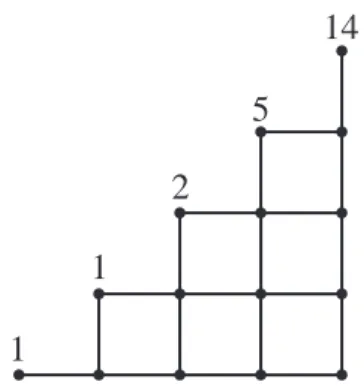
51. Notice that a lattice path from (0,0) to (n, n) stays inside (or on the edges of) the square whose sides are the x-axis, the y-axis, the line x = n and the line y = n. In this problem we will compute the number of lattice paths from (0,0) to (n, n) that stay inside (or on the edges of) the triangle whose sides are thex-axis, the linex=nand the line y =x. Such lattice paths are called Catalan paths. For example, in Figure 1.7 we show the grid of points with integer coordinates for the triangle whose sides are the x-axis, the line x = 4 and the line y=x.(a) Explain why the number of lattice paths from (0,0) to (n, n) that go outside the triangle described previously is the number of lattice paths from (0,0) to (n, n) that either touch or cross the line y=x+ 1.
(b) Find a bijection between lattice paths from (0,0) to (n, n) that touch (or cross) the liney=x+ 1 and lattice paths from (−1,1) to (n, n). Online hint.
(c) Find a formula for the number of lattice paths from (0,0) to (n, n) that do not go above the line y=x. The number of such paths is called aCatalan Numberand is usually denoted byCn. Online
Figure 1.7: The Catalan paths from (0,0) to (i, i) for i = 0,1,2,3,4. The number of paths to the point (i, i) is shown just above that point.
1
1
2
5
14
52. Your formula for the Catalan Number can be expressed as a binomial coefficient divided by an integer. Whenever we have a formula that calls for division by an integer, an ideal combinatorial explanation of the formula is one that uses the quotient principle. The purpose of this problem is to find such an explanation using diagonal lattice paths.3 A diagonal lattice path that never goes below the y-coordinate of its first point is called a Dyck Path. We will call a Dyck Path from (0,0) to (2n,0) a (diagonal)Catalan Pathof length 2n. Thus the number of (diagonal) Catalan Paths of length 2nis the Catalan NumberCn. We
normally can decide from context whether the phrase Catalan Path refers to a diagonal path, so we normally leave out the word diagonal.
(a) If a Dyck Path hasnsteps (each an upstep or downstep), why do the firstk steps form a Dyck Path for each nonnegativek≤n?
(b) Thought of as a curve in the plane, a diagonal lattice path can have many local maxima and minima, and can have several ab-solute maxima and minima, that is, several highest points and several lowest points. What is the y-coordinate of an absolute minimum point of a Dyck Path starting at (0,0)? Explain why a Dyck Path whose rightmost absolute minimum point is its last point is a Catalan Path. Online hint.
3The result we will derive is called the Chung-Feller Theorem; this approach is based
1.3. SOME APPLICATIONS OF BASIC COUNTING PRINCIPLES 25
(c) LetDbe the set of all diagonal lattice paths from (0,0) to (2n,0). (Thus these paths can go below thex-axis.) Suppose we partition Dby lettingBibe the set of lattice paths inDthat haveiupsteps
(perhaps mixed with some downsteps) following the last absolute minimum. How many blocks does this partition have? Give a succinct description of the block B0. Online hint.
(d) How many upsteps are in a Catalan Path?
∗(e) We are going to give a bijection between the set of Catalan Paths and the block Bi for each i between 1 and n. For now, suppose
the value of i, while unknown, is fixed. We take a Catalan path and break it into three pieces. The piece F (for “front”) consists of all steps before the ith upstep in the Catalan path. The piece U (for “up”) consists of theith upstep. The pieceB (for “back”) is the portion of the path that follows the ith upstep. Thus we can think of the path asF U B. Show that the function that takes F U B toBU F is a bijection from the set of Catalan Paths onto the block Bi of the partition. (Notice that BU F can go below
thex axis.) Online hint.
(f) Explain how you have just given another proof of the formula for the Catalan Numbers.
1.3.2 The Binomial Theorem
◦53. We know that (x+y)2 =x2+ 2xy+y2. Multiply both sides by (x+y) to get a formula for (x+y)3 and repeat to get a formula for (x+y)4. Do you see a pattern? If so, what is it? If not, repeat the process to get a formula for (x+y)5 and look back at Figure 1.4 to see the pattern. Conjecture a formula for (x+y)n.
•54. When we apply the distributive law ntimes to (x+y)n, we get a sum of terms of the form xiyn−i for various values of the integer i.
i. Expand the product (x1+y1)(x2+y2)(x3+y3).
ii. What do you get when you substitutex for eachxiand yfor
each yi?
iii. Now imagine expanding
(x1+y1)(x2+y2)· · ·(xn+yn).
Once you apply the commutative law to the individual terms you get, you will have a sum of terms of the form
xk1xk2· · ·xki·yj1yj2· · ·yjn−i.
What is the set{k1, k2, . . . , ki} ∪ {j1, j2, . . . , jn−i}?
iv. In how many ways can you choose the set{k1, k2, . . . , ki}?
v. Once you have chosen this set, how many choices do you have for{j1, j2, . . . , jn−i}?
vi. If you substitute x for eachxi and y for each yi, how many
terms of the formxiyn−i will you have in the expanded prod-uct
(x1+y1)(x2+y2)· · ·(xn+yn) = (x+y)n?
vii. How many terms of the formxn−iyi will you have?
(b) Explain how you have just proved your conjecture from Prob-lem 53. The theorem you have proved is called the Binomial Theorem.
55. What is P10 i=1
10
i
3i? Online hint.
56. What is n0− n
1
+ n2− · · · ± n n
ifnis an integer bigger than zero? Online hint.
•57. Explain why
k X
i=0 m
i !
n k−i
!
= m+n k
! .
Find two different explanations. Online hint. A second online hint.
1.3. SOME APPLICATIONS OF BASIC COUNTING PRINCIPLES 27
59. What is Pn i=0i
n i
? (Hint: think about how you might use calculus.) Online hint.
Notice how the proof you gave of the binomial theorem was a counting argument. It is interesting that an apparently algebraic theorem that tells us how to expand a power of a binomial is proved by an argument that amounts to counting the individual terms of the expansion. Part of the reason that combinatorial mathematics turns out to be so useful is that counting arguments often underlie important results of algebra. As the algebra becomes more sophisticated, so do the families of objects we have to count, but nonetheless we can develop a great deal of algebra on the basis of counting.
1.3.3 The pigeonhole principle
◦60. American coins are all marked with the year in which they were made. How many coins do you need to have in your hand to guarantee that on two (at least) of them, the date has the same last digit? (When we say “to guarantee that on two (at least) of them,...” we mean that you can find two with the same last digit. You might be able to find three with that last digit, or you might be able to find one pair with the last digit 1 and one pair with the last digit 9, or any combination of equal last digits, as long as there is at least one pair with the same last digit.)
If we partition a set with more thann elements inton parts, then at least one part has more than one element.
The pigeonhole principle gets its name from the idea of a grid of little boxes that might be used, for example, to sort mail, or as mailboxes for a group of people in an office. The boxes in such grids are sometimes called pigeon-holes in analogy with stacks of boxes used to house homing pigeons when homing pigeons were used to carry messages. People will sometimes state the principle in a more colorful way as “if we put more thann pigeons into npigeonholes, then some pigeonhole has more than one pigeon.”
61. Show that if we have a function from a set of sizento a set of size less than n, then f is not one-to-one. Online hint.
•62. Show that if S and T are finite sets of the same size, then a function f fromS toT is one-to-one if and only if it is onto. Online hint. A second online hint.
·
63. There is ageneralized pigeonhole principlewhich says that if we parti-tion a set with more thanknelements intonblocks, then at least one block has at least k+ 1 elements. Prove the generalized pigeonhole principle. Online hint.64. All the powers of five end in a five, and all the powers of two are even. Show that for some integer n, if you take the first n powers of a prime other than two or five, one must have “01” as the last two digits. Online hint.
·
65. Show that in a set of six people, there is a set of at least three people who all know each other, or a set of at least three people none of whom know each other. (We assume that if person 1 knows person 2, then person 2 knows person 1.) Online hint.1.3. SOME APPLICATIONS OF BASIC COUNTING PRINCIPLES 29
1.3.4 Ramsey Numbers
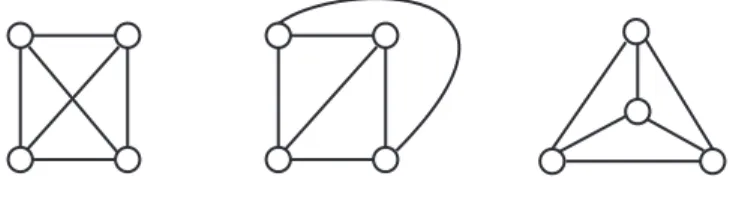
Problems 65 and 66 together show that six is the smallest number R with the property that if we have R people in a room, then there is either a set of (at least) three mutual acquaintances or a set of (at least) three mutual strangers. Another way to say the same thing is to say that six is the smallest number so that no matter how we connect six points in the plane (no three on a line) with red and green lines, we can find either a red triangle or a green triangle. There is a name for this property. The Ramsey Number R(m, n) is the smallest number R so that if we have R people in a room, then there is a set of at least m mutual acquaintances or at leastn mutual strangers. There is also a geometric description of Ramsey Numbers; it uses the idea of acomplete graphonRvertices. Acomplete graphonRvertices consists of R points in the plane, together with line segments (or curves) connecting each two of the R vertices.4 The points are called vertices and the line segments are called edges. In Figure 1.8 we show three different ways to draw a complete graph on four vertices. We use Kn to stand for a
complete graph on nvertices.
Figure 1.8: Three ways to draw a complete graph on four vertices
Our geometric description ofR(3,3) may be translated into the language of graph theory (which is the subject that includes complete graphs) by saying R(3,3) is the smallest number R so that if we color the edges of a KR with two colors, then we can find in our picture a K3 all of whose edges have the same color. The graph theory description of R(m, n) is that R(m, n) is the smallest numberRso that if we color the edges of aKR with
red and green, then we can find in our picture either aKm all of whose edges
are red or aKnall of whose edges are green. Because we could have said our
colors in the opposite order, we may conclude that R(m, n) =R(n, m). In particular R(n, n) is the smallest numberR such that if we color the edges
4
of aKR with two colors, then our picture contains aKn all of whose edges
have the same color.
◦67. Since R(3,3) = 6, an uneducated guess might be that R(4,4) = 8. Show that this is not the case. Online hint.
·
68. Show that among ten people, there are either four mutual acquain-tances or three mutual strangers. What does this say about R(4,3)? Online hint.·
69. Show that among an odd number of people there is at least one person who is an acquaintance of an even number of people and therefore also a stranger to an even number of people. Online hint.·
70. Find a way to color the edges of aK8 with red and green so that there is no red K4 and no green K3. Online hint.·
71. FindR(4,3). Online hint.As of this writing, relatively few Ramsey Numbers are known. R(3, n) is known forn <10,R(4,4) = 18, and R(5,4) =R(4,5) = 25.
1.4
Supplementary Chapter Problems
1. Remember that we can write n as a sum of n ones. How many plus signs do we use? In how many ways may we write nas a sum of a list of k positive numbers? Such a list is called a compositionof n intok parts.
2. In Problem 1 we defined a composition ofn intok parts. What is the total number of compositions of n (into any number of parts)?
·
3. Write down a list of all 16 zero-one sequences of length four starting with 0000 in such a way that each entry differs from the previous one by changing just one digit. This is called a Gray Code. That is, a1.4. SUPPLEMENTARY CHAPTER PROBLEMS 31
4. Use the idea of a Gray Code from Problem 3 to prove bijectively that the number of even-sized subsets of ann-element set equals the number of odd-sized subsets of ann-element set.
5. A list of parentheses is said to be balanced if there are the same number of left parentheses as right, and as we count from left to right we always find at least as many left parentheses as right parentheses. For example, (((()()))()) is balanced and ((()) and (()()))(() are not. How many balanced lists ofn left andnright parentheses are there?
∗6. Suppose we plan to put six distinct computers in a network as shown in Figure 1.9. The lines show which computers can communicate directly with which others. Consider two ways of assigning computers to the nodes of the network different if there are two computers that commu-nicate directly in one assignment and that don’t commucommu-nicate directly in the other. In how many different ways can we assign computers to the network?
Figure 1.9: A computer network.
7. In a circular ice cream dish we are going to put four scoops of ice cream of four distinct flavors chosen from among twelve flavors. Assuming we place four scoops of the same size as if they were at the corners of a square, and recognizing that moving the dish doesn’t change the way in which we have put the ice cream into the dish, in how many ways may we choose the ice cream and put it into the dish?
8. In as many ways as you can, show that nk n−k m
= mn n−m k
.
members into doubles matches so that each player is in one doubles match? In how many ways may we do it if we specify in addition who serves first on each team?
10. A town hasnstreetlights running along the north side of Main Street. The poles on which they are mounted need to be painted so that they do not rust. In how many ways may they be painted with red, white, blue, and green if an even number of them are to be painted green?
∗11. We havenidentical ping-pong balls. In how many ways may we paint them red, white, blue, and green?
Chapter 2
Applications of Induction
and Recursion in
Combinatorics and Graph
Theory
2.1
Some Examples of Mathematical Induction
If you are unfamiliar with the Principle of Mathematical Induction, you should read Appendix B (a portion of which is repeated here).
2.1.1 Mathematical induction
The principle of mathematical induction states that
In order to prove a statement about an integer n, if we can
1. Prove the statement when n=b, for some fixed integer b, and
2. Show that the truth of the statement for n=k−1 implies the truth of the statement for n=kwhenever k > b,
then we can conclude the statement is true for all integersn≥b.
As an example, let us give yet another proof that a set with n elements has 2n subsets. This proof uses essentially the the same bijections we used in proving the Pascal Equation. The statement we wish to prove is the statement that “A set of size nhas 2nsubsets.”
Our statement is true when n= 0, because a set of size 0 is the empty set and the empty set has 1 = 20 subsets. (This step of our proof is called a base step.)
Now suppose that k >0 and every set with k−1 elements has 2k−1 subsets. Suppose S = {a1, a2, . . . ak} is a set with k
ele-ments. We partition the subsets of S into two blocks. Block B1 consists of the subsets that do not contain an and blockB2 con-sists of the subsets that do containan. Each set inB1 is a subset of{a1, a2, . . . ak−1}, and each subset of{a1, a2, . . . ak−1}is inB1. Thus B1 is the set of all subsets of {a1, a2, . . . ak−1}. Therefore by our assumption in the first sentence of this paragraph, the size of B1 is 2k−1. Consider the function from B2 to B1 which takes a subset of S including ak and removes ak from it. This
function is defined on B2, because every set in B2 contains ak.
This function is onto, because if T is a set inB1, thenT∪ {ak}
is a set in B2 which the function sends to T. This function is one-to-one because ifV andW are two different sets inB2, then removing ak from them gives two different sets in B1. Thus we have a bijection between B1 and B2, so B1 and B2 have the same size. Therefore by the sum principle the size of B1∪B2 is 2k−1+ 2k−1 = 2k. Therefore S has 2k subsets. This shows that if a set of sizek−1 has 2k−1 subsets, then a set of sizek has 2k
subsets. Therefore by the principle of mathematical induction, a set of size n has 2n subsets for every nonnegative integer n.
The first sentence of the last paragraph is called theinductive hypothesis. In an inductive proof we always make an inductive hypothesis as part of proving that the truth of our statement whenn=k−1 implies the truth of our statement whenn=k. The last paragraph itself is called theinductive step of our proof. In an inductive step we derive the statement for n = k from the statement for n = k−1, thus proving that the truth of our statement whenn=k−1 implies the truth of our statement when n=k. The last sentence in the last paragraph is called the inductive conclusion. All inductive proofs should have a base step, an inductive hypothesis, an inductive step, and an inductive conclusion.