Executive functions and autism traits in Sex
Chromosome Trisomies compared to typically
developing children
Author: Jarla Pijper
Supervisor: Sophie van Rijn, Hanna Swaab
2 Abstract
Individuals with a SCT characterized with an additional X chromosome encounter difficulties in social functioning, which is most prominent in there higher susceptibility for developing autism. The current study aimed to systematically address underlying mechanisms related to these difficulties by examining differences in executive functions of children with a SCT karyotype and typically developing children. Furthermore, we examined to what extent executive function deficits were related to higher autism traits. 135 boys and girls (M = 11.4,
SD = .2) participated in this study, 85 typically developing children and 50 children with a
3 Executive functions and autism traits in Sex Chromosome Trisomies compared to
typically developing children
Sex chromosome trisomies (SCT) occur as a consequence of deficiencies during the maternal or paternal meiosis process. Klinefelter syndrome (KS), characterized by the karyotype 47 XXY, is the most common sex chromosomal disorder among males. Its prevalence is estimated on one in 650 men (Bojesen, Juul, & Gravholt, 2003). Individuals with KS are infertile and encounter androgen deficiencies which can lead to the development of small testis or breast development (Boada, Janusz, Hutaff-Lee, & Tartaglia, 2009). Although KS is not rare, recognizing individuals with KS is difficult due to the fact that the physical impairments are not always clearly apparent, in particular during early development. The androgen deficiencies can become clearer during puberty when the secretion of testosterone appears to be insufficient. Further medical examinations can lead to an identification of Klinefelter syndrome. However, some individuals with KS even remain unidentified.
Women can also be born with an additional X chromosome, resulting in the karyotype 47 XXX. This syndrome is often referred to as Triple X syndrome and its prevalence is estimated on one in 1000 females (Jacobs, 1979). The majority of these females tend to have a tall stature, others can encounter epicanthal folds, hypotonia during infancy, and genitourinary malformations ranging from unilateral kidney and renal dysplasia to ovarian malformations (see for an overview Tartaglia, Howell, Sutherland, Wilson, & Wilson, 2010). However, there is a need for more medical and psychological research with regard to the Triple X population (Tartaglia et al, 2010).
4 McClean, & Reveley, 1992; Kusumi & Prange, 1973). The challenges that individuals with KS and Triple X encounter with regard to their susceptibility for difficulties in social interaction and their higher vulnerability for developing psychopathology including autism spectrum disorders stresses the importance to search for underlying mechanisms.
From a neuropsychological perspective we are able to examine which cognitive mechanisms are possibly associated to this vulnerability. Previous studies among individuals with KS and Triple X provides us the ability to speculate about different mechanisms. For instance, we know that one of the core deficits among individuals with KS and Triple X are language deficiencies (e.g. Rattcliffe, 1982; Geschwind & Dykens, 2004; for an overview see Boada et al., 2009; Legget, Jacobs, Nation, Scerif, & Bishop, 2010). Encountering difficulties in language obviously affect social interaction and communication. Additionally, difficulties in the recognition of facial expressions such as anger have also been found among males with KS (Van Rijn, Swaab, Aleman, & Kahn, 2006b). Being less efficient in recognizing facial affect can result in difficulties in social functioning. However, higher order cognitive functions, referred to as executive functions, may also be involved and of specific interest to examine. Executive functions are essential during daily life, they are associated with the regulation of behavior and emotion (Beauchamp & Anderson, 2010), which is suggested to be impaired among individuals with KS and Triple X (Visootsak & Graham, 2009; Boada et al., 2009; Tartaglia et al., 2010; Legget et al., 2010). An important component of executive skills is cognitive flexibility. It is ‘the ability to shift to a different thought or action according to a changing situation’ (Hill, 2004, p. 197). Other important components are attention skills, inhibition and the ability to shortly hold information online in order to plan a response; working memory (Baddeley, 2000). Earlier studies have suggested impairments in inhibition and verbal working memory among individuals with KS (Temple & Sanfilippo, 2003; Kopmus et al., 2011; Fales et al., 2003). However, due to methodological limitations across these studies, such as small samples, no standardized measurements, and no control groups (Boada et al., 2009), firm conclusions concerning this matter are unable to be drawn. Especially with regard to Triple X syndrome, since no studies to date have investigated the executive functions among females with Triple X (Tartaglia et al., 2010).
5 and adults with an extra X chromosome. From this literature it is frequently suggested that individuals with autism tend to encounter difficulties on several executive skills, including working memory, attention skills (Hill, 2004; Verté, Geurts, Roeyers, Oosterlaan, & Sergeant, 2006; Williams, Goldstein, Carpenter, & Minshew, 2005; Steele, Minshew, Luna, & Sweeney, 2007; Burack, 1994; Goldstein, Johnson, & Minshew, 2001) and cognitive flexibility (Geurts, Roeyers, Oosterlan, & Sergeant, 2004; Hill, 2004). However, earlier studies are repeatedly unclear whether there is a deficit in inhibition among individuals with autism, or that this skill is partly affected (e.g. Tsai, Pan, Wang, Tseng, & Hsieh, 2011; Christ, Kester, Bodner, & Miles, 2011; Russell, Mauthner, Sharpe & Tidswell, 1991; Hughes & Russell, 1993; Lemon, Gargaro, Enticott, & Rinehart, 2010; Mosconi et al., 2009). More specifically, it seems to be unclear whether individuals with an autism spectrum disorder have difficulties in inhibition to prepotent responses or that the broader skill is affected (for an overview see Hill, 2004).
In the current study executive skills are of specific interest due to their importance in daily life and their association with regulating behavior and emotions (Beauchamp & Anderson, 2010), which is important in social interactions. More specifically, this study aims to examine to what extend children with KS and Triple X syndrome between 9 and 18 years of age encounter executive function deficits compared to typically developing children and whether this is related to a higher susceptibility for social difficulties and autism traits. This study will contribute to retrieving more insight into possible underlying cognitive mechanisms possibly related to difficulties in social interaction among KS and Triple X syndrome. This knowledge can be used to enhance treatments, diagnosis, and prevention. Having knowledge about the cognitive profiles of both syndromes, creates the opportunity to rely on their strengths and stimulate their weaknesses during treatments. Moreover, it provides guidelines for diagnostics, and helps in identifying those functions that require monitoring during development.
Methods
Sample
6 through the Triple X association. Both groups were also recruited via clinical genetics departments for follow-up after prenatal diagnosis. Controls were recruited through local schools in the south-west part of the Netherlands. Five boys with KS used testosterone supplements. Diagnosis with karyotype 47 XXY and XXX was examined and confirmed using standard procedures. One-way ANOVA revealed differences in cognitive abilities between the SCT’s and the controls based on the subtests block design and vocabulary of the Dutch version of the Wechsler’s Intelligence Scale (Kort et al., 2005), F(1, 126) = 68.28, p < .001. Children with a SCT (M = 79.83, SD = 16.68) had a lower estimate full scale IQ compared to controls (M = 103.24, SD = 14.30). However, their cognitive abilities were still within the normal range. Exclusion criteria for all participants were neurological conditions and intellectual disability. Written informed consents were obtained after full clarification was given with regard to the study.
Table 1
Sample size and mean ages in SCT and typically developing participants
Group N M SD Min Max
47 XXY 27 13.6 .6 8.1 19
47 XXX 22 12.1 .6 7.4 18.2
Total SCT 49 13 .4 7.4 19
Control 85 10.6 .1 9 14.2
Total 134 11.4 .2 7.4 19
Procedure
7 Measurement instruments
Autism traits
The degree of autism traits were measured using the Autism-spectrum Quotient (AQ) (Baron-Cohen, Wheelwright, Skinner, Martin, & Clubley, 2001). This questionnaire aims to measure the degree of autism traits among individuals who have intelligence within the normal range (Baron-Cohen et al., 2001). Different questionnaires are developed, one self-administered questionnaire for adults and adolescents, whereas a parental version has been developed for children. Test-retest reliability and discriminative validity is sufficient for individuals with Asperger syndrome within a clinical population using a cut off score of 26 (Woodbury-Smith, Robinson, Wheelwright, Baron-Cohen, 2005) and within the general population using a cut off score of 32 (Baron-Cohen et al., 2001). The AQ-questionnaire consists out of 50 questions equally divided in the following subscales: social skills, communication, imagination, attention to detail, and attention switching (Baron-Cohen et al., 2001). A higher the score on the AQ-questionnaire indicates a higher degree of autism traits (Baron-Cohen et al., 2011).
Executive functions
Amsterdam Neuropsychological Tasks (ANT)
Speed and stability of information processing, visual working memory, inhibition, cognitive flexibility, sustained attention, and divided attention were all measured using the ANT (De Sonneville, 1999). The ANT test battery has been proven to be helpful in assessing neurocognitive deficit profiles in clinical and typically developing populations (Rommelse et al., 2008; Serra et al., 2003). Moreover, several studies found satisfactory psychometric properties of the test battery (for an overview see De Sonneville, 2005).
Speed and stability of information processing
8 twice, first with the not preferred hand and secondly with the preferred hand of the child. Dependent measure of the task was reaction time.
Visual Working memory
Visual working memory was measured using the Spatial Temporal Span (STS) of the ANT (De Sonneville, 1999). The STS task consisted out of a forward and backward condition each consisting out of three sessions: an instruction session, a practice session, and a test session. Children were asked to watch the computer screen in which a three by three square grid appeared. They were instructed to press space on the keyboard after which a computer hand appointed several squares in a particular order. After the computer hand pointed to the last square, children had to point to the same squares in the same sequence and confirm their answer by pressing space. This was repeated until children were unable to complete five sequences in a row. Difficulty level was increased by increasing the number of squares in the sequence. During the backward trial, children were asked to appoint to the square in reversed order. Main outcome parameters are amount of correct completed series forward and correct completed series backward separately. The correct completed series forwards indicates imprinting abilities, whereas the amount of correct completed series backward indicate actual working memory since the children had to hold the particular sequence ‘online’ to manipulate that information in order to appoint the reversed sequence.
Cognitive flexibility and inhibition
9 trials in which the green and red squares appeared in random fashion on the horizontal bar which forced the children to shift between response set, which requires cognitive flexibility. Latter condition was measured separately for the green and red squares; a variable copy condition and a variable ‘mirror’ condition. Preceding all test conditions there was an instruction and practice session. Accuracy and reaction times were the dependent measures, with percentage errors and reaction time of the mirror trial indicating inhibition and percentage errors and reaction times of the mixed trial indicating cognitive flexibility.
Sustained attention
Sustained attention was measured using the Sustained attention dots task (SAD) of the ANT. This task consisted out of an instruction, practice, and test session. During this task a square appeared at the middle of the computer screen in which three, four, or five dots were equally presented over 600 trials in random order. Children were asked to press ‘yes’ when four dots appeared at the screen, when more or less than four dots appeared children were instructed to press ‘no’. Auditory feedback was given to the children when they made an error. Sustained attention capability was measured in terms of accuracy and reaction time as well as stability of reaction times (attention fluctuation). Accuracy was measured using mean percentage errors, false alarms (pressing a button while no target stimulus was apparent), and missed responses (no response was given to a target stimulus) over all 600 trials. The 600 trials were divided over five separate blocks which create the opportunity to measure sustained attention capabilities during the task; measuring time on task effects. Dependent measures during the time on task effects were also percentage errors, in terms of percentage false alarms, missed responses, and rate of attention fluctuation over the five different time blocks.
Focused attention
10 difference in amount of errors when the cherries were on the correct place and the amount of errors when the cherries were in the wrong place. Reaction time was measured using the difference between reaction time when the cherries were on the correct line and the reaction time when the cherries were on the incorrect line.
Verbal working memory
Verbal working memory was measured using the subtest digit span of the Clinical Evaluation of Language Fundamentals (CELF) – 4 NL (Kort, Compaan, Schittekatte, & Dekker, 2008). This task consisted out of two conditions; a forward and a backward condition. During the forwards condition the children were asked to repeat verbally a particular sequence of digits. During the backward condition, children were asked to manipulate the digit spans in working memory by verbally repeating the digit sequence in reversed order. In both conditions difficulty level was increased, by increasing the amount of digits to repeat. Each condition was aborted when the participant was unable to complete two trials of similar difficulty level. Children were able to obtain a maximum score of sixteen on the first condition and fourteen on the second condition. Amount of correct repeated sequences during the forward condition indicated imprinting abilities whereas the amount of correct completed backward sequences indicated working memory abilities.
Executive functions in daily life
11 Statistics
12 Results
Autism traits
A significant difference was found between typically developing children (controls) and the SCT karyotype on the total score of the AQ questionnaire, F (1, 121) = 37.5, p < .001. The SCT group had a higher total score (M= 21.6, SD= 8) on the AQ questionnaire than the control group (M= 12.8, SD= 5.6). Furthermore, differences were also found between the controls and SCT karyotype on subscale level with regard to: social skills, dividing attention, communication, and imaginary skills (Table 2). Children with SCT karyotype had a higher score on all those subscales compared to the control group (Table 2). However, on the attention to detail scale no differences were found between the groups. The SCT group did not have a higher or lower score compared to the control group on this scale.
Table 2
Autism traits among SCT karyotype and controls
Controls SCT
Scale M (SD) M (SD) p
Social skills 1.6 (1.6) 3.77 (2.73) < .001* Dividing attention 2.93 (1.86) 5.47 (1.91) < .001* Communication 1.94 (1.72) 4.20 (2.14) < .001* Attention to detail 4.28 (2.00) 4.23 (2.25) .79 Imaginary skills 2.04 (1.54) 3.73 (2.42) .001* Total score 12.80 (6.03) 21.40 (8.52) < .001* Note. SCT’s N = 39, controls N = 84, df = 1, 121, * = p < .01 Speed and stability of information processing
13 Visual working memory
For the correct recalled series forward, no significant difference was found between the SCT karyotype and the control group, F(1, 103)= 1.37, p = .24. Findings indicate that the performance of SCT karyotype (M= 10.44, SD= 2.22) on the visual working memory task is comparable to the control group performance (M= 10.48, SD= 2.04), indicating no difficulties in memory encoding in the SCT karyotype.
With regard to the backward condition, again no significant difference was found between the SCT karyotype and the control group, F(1, 103) = .28, p = .60. This indicates that the performance of the SCT karyotype (M= 10.48, SD= 3.43) on the visual working memory task is comparable to the control group performance (M= 9.57, SD= 2.11). In other words, no evidence for impairments in visual working memory.
Verbal working memory
A significant difference was found between the SCT karyotype and control group in the percentage correct recalled digit sequences forwards F(1, 105) = .02, p < .05, partial
ƞ= .05. The SCT group (M= 46.31, SD= 10.29) obtained a lower percentage correct recalled digit sequences than the control group (M= 49.33, SD= 8.84). In other words, the SCT karyotype showed impairments in verbal memory encoding independent of age en SES.
For the backward condition no significant difference was found between the SCT karyotype (M= 38.78, SD= 13.60) and the control group (M= 34.17, SD= 9.87) in the percentage correct recalled digit sequences, F(1, 105) = .52, p = .47. These findings indicate no impairments in visual working memory among SCT karyotype.
Inhibition
No significant difference was found in amount of errors between the SCT karyotype (M= 7.54, SD= 7.37) and the control group (M= 5.99, SD= 6.65), F(1, 106) = 1.83, p = .18. Furthermore, no significant difference was found between the SCT karyotype (M= 682.32, SD= 192.05) and the control group (M= 848.90, SD= 261.43)in reaction time,
F(1, 106) = 3.21, p = .08. These findings indicate no impairments in inhibition among the
14 Cognitive flexibility
A significant difference was found in accuracy during the cognitive flexibility task between the SCT karyotype and the control group, F(1, 104) = 3.83, p = .05, partial ƞ2 = .04. The SCT karyotype (M = 9.96, SD= 7.06) made more errors during the task compared to the control group (M= 7.06, SD= 6.55). Additionally, a significant difference was found in reaction time between the SCT karyotype and the control group, F(1, 104) = 4.67, p < .05,
partial ƞ2 = .04. The control group (M= 1156.57, SD= 276.16) obtained a higher reaction time compared to SCT karyotype (M= 937.11, SD= 357.85). The SCT karyotype was less accurate and had a lower reaction time (i.e. a higher speed) during the cognitive flexibility task than the control group, indicating difficulties in cognitive flexibility in the SCT karyotype group.
Focused attention
No significant difference was found in accuracy between the SCT karyotype (M= -.85, SD= .99) and the control group (M= -1.10, SD= 1.82), F(1, 103) = .15, p = .70. Moreover, no significant difference was found in reaction time when comparing to the SCT karyotype (M= 142.63, SD= 106.60) and the control group (M= 178.44, SD= 148.44),
F(1, 103) = .52, p = .47. In other words the SCT karyotype did not have a higher or lower
reaction time, nor were they more or less accurate during the focused attention task compared to the control group, indicating no impairment in focused attention.
Sustained attention
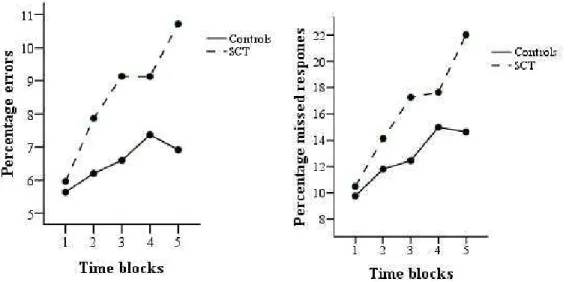
Significant difference was found in accuracy between the SCT karyotype and the control group for the sustained attention task. The SCT karyotype made more errors compared to the controls including more false alarms and missed responses. Results, means, and standard deviations are presented in Table 4. No significant difference was found in reaction time after an error between both groups, F(1, 103) = .18, p = .67.
15 errors compared to the control group from the first to the fifth time period,
V = .11,F(4, 101), p < .05. More specifically, the SCT karyotype had more missed responses
than the control group V = .10, F(4, 101), p < .05. Figure 1 and Figure 2 illustrate this effect. No significant interaction was found between both groups and percentage false alarms,
V = .06, F(4, 101) = 1.72, p = .15. Again multivariate statistics were reported since Mauchly’s
test indicated that the assumptions of sphericity had been violated, χ2(9) = 17.38, p < .05.
With regard to mean rate of fluctuation during the task, findings indicated a main effect meaning in that all participants obtained a higher mean rate of attention fluctuation from the first to the fifth time period of the task (Figure 3), V = .09, F(4, 101) = 2.46, p = .05. Again Mauchly’s test was significant, χ²(9) = 20.52, p < .05, therefore multivariate tests are reported using Pillai’s Trace. No significant interaction was found between the two groups on mean rate of fluctuation during the task V = .04, F(4, 101) = .95, p = .44, indicating that the SCT and control group did not differ in the attention fluctuation during the task.
In sum, the SCT karyotype showed impairments in sustained attention in that they became less accurate during the task than the controls; they made increasingly more errors during the task. They showed an increase in their attention fluctuation but did not differ in that from controls.
Table 4
Sustained attention among controls and SCT karyotype
Controls SCT
16 Executive functions in daily life
A significant effect was found of group on total score on the DEX questionnaire,
F(1,106) = 20.10, p < .001, partial ƞ² = .16. The SCT karyotype (M= 27.83, SD= 13.29) obtained a higher score on the DEX questionnaire compared to the control group (M= 16.43, SD= 10.81) in this sample.
Higher autism traits association with executive functions
Spearman’s correlation was computed between the executive functions that were found to be significant in the SCT karyotype and autism traits using the AQ total score. More specifically, Spearman’s correlation was computed for the variables cognitive flexibility, digit
Figure 1. Percentage errors for controls and SCT Figure 2. Percentage missing for controls and SCT
17 span forward, total score of the DEX questionnaire, and the overall accuracy indices of the sustained attention task mean percentage errors, percentage false alarms, and percentage missed responses with autism traits. Results showed a significant association between amount of errors during the cognitive flexibility task and total score on the AQ questionnaire, rs = .19,
p < .01. Higher autism traits were related to the percentage errors of the cognitive flexibility
task. Digit span forward was negatively related to the AQ total score indicating that higher autism traits were related with lower performances on imprinting abilities, rs = -.20, p < .05.
Furthermore, a significant association was found between the total score of the DEX questionnaire and the total AQ score, rs = .63, p < .01. Higher autism traits were related to
more difficulties in executive functions in daily life. Percentage errors, rs = .04, p = .65 false
alarms, rs = .05, p = .59 and missed responses, rs = .04, p = .66 of the sustained attention task
were not significantly related to the AQ total score. This indicates that autism traits were not related to accuracy in sustained attention.
Discussion
The current study addressed to what extend children with a SCT characterized with an additional X chromosome have executive function deficits compared to typically developing children. A second aim of the study was to examine whether the executive function deficiencies among the children with a SCT karyotype were related to impaired social functioning, including autism traits. A wide range of executive functions were examined including speed and stability of information processing, working memory, cognitive flexibility, inhibition, focused attention, sustained attention, and functioning of executive skills in daily life.
18 in turn making them increasingly less accurate during the sustained attention task than controls. Children with a SCT karyotype also showed an increase in their attention fluctuation during the task. However the typically developing children did as well, meaning that there were no differences in increased attention fluctuation between both groups. The findings suggests that children with a SCT can encounter difficulties in activities that require sustained attention skills, which becomes apparent in inaccurateness and an increase in attention fluctuations. However, studies among individuals with a SCT reported mixed results with regard to executive functioning including sustained attention and cognitive flexibility (e.g. Ross et al., 2008; Van Rijn & Swaab, 2011; Bender et al., 2001; Leggette et al., 2010; Temple & Sanfilippo, 2003; Boone et al., 2001), which could be the consequence of small samples and methodological limitations. The present study failed to provide evidence for deficiencies in speed and stability of information processing, inhibitory skills, and working memory. Other studies conducted on individuals with a SCT were also unable to find unambiguous evidence for deficiencies in these particular skills (for an overview see Boada et al., 2009).
19 compared to the children with KS (Van Rijn & Swaab, 2011). The differences in contrasting cognitive profiles with regard to schizotypical traits and autism traits suggest for subgroups among individuals with KS. The current study suggests that individuals with a SCT with higher autism traits additionally have impairments in executive functions. Future studies should explore whether there are also differences in specific impaired executive functions between autism traits and schizotypical traits.
The higher vulnerability for developing autism and schizophrenia, but also higher rates of ADHD (Bruining et al., 2009), shows that the phenotype of a SCT is variable. This could be the consequence of differences in social cognition. Difficulties in social cognition have also been suggested in other studies (e.g. Van Rijn et al., 2006). Males with KS tend to encounter deficits in the perception of social cues, they show increased levels of emotional arousal when being exposed to emotional inducing events, but tend to be less proficient in verbalizing their emotions (Van Rijn et al., 2006). This could in turn be the consequence of underlying biological mechanisms in which the additional X chromosome plays a crucial role. There are suggestions for an association between the additional X chromosome and the development of psychopathology including autism and schizophrenia (Gauthier et al., 2006; Van Rijn et al., 2005). Furthermore, the parental origin of the genes on the X chromosome are hypothesized be related to the variability in phenotype among individuals with a SCT karyotype (Isles et al., 2006; Bruining et al., 2010).
20 amygdala abnormalities and difficulties in social cognition which in turn is suggested to lead to an increased risk for psychopathology. This supports the hypothesis that X chromosomal abnormalities is related to the development of psychopathology.
The reason why this X chromosomal abnormality found in SCT could lead to the variability in phenotype could be related to what is known as genomic imprinting. Genomic imprinting refers to the different expression of genes dependent on the parental origin of the genes. There are assumptions for an association between the parental origins of the genes and social functioning (Davies et al., 2006; Badcock & Crespy, 2006). Studies among individuals with Tuner syndrome support this. For example, Skuse and colleagues (1997) have found that females with a single X chromosome of maternal origin showed higher autism traits when comparing them with females with a single X chromosome of paternal origin. Genomic imprinting has also been investigated among males with KS. Bruining et al. (2010) have found that imprinted X chromosomal genes may have differential effects on autistic as well as schizotypical traits. Furthermore, Stemkes et al. (2006) have found that the additional X chromosome among males with KS of parental origin lead to increased difficulties in motor and speech development. The scarce studies of genomic imprinting effects stress the importance to investigate to what extend this matter effects variability in phenotype among SCT.
Another underlying biological mechanism which should be taken into account while hypothesizing about possible underlying mechanisms related to differences in phenotype among SCT, is the role of testosterone. Androgen deficiencies are present in males with KS becoming apparent during puberty by lower levels of testosterone (Salbenblatt, Bender, & Puck, 1985). To date it remains unclear to what extend testosterone levels affect behavioral impairments (Craig, Harper, & Loat, 2004). There are speculations that the behavioral impairments in KS are the consequence of the additional X chromosome instead of hormone deficiencies. This speculation is supported by the fact that females with Triple X syndrome have typical androgen levels but do show impairments in language and cognitive deficits similar to KS (Bender et al., 1999).
21 traits of both groups separately. Second, in the current study we only addressed autism traits while we know from previous studies that individuals with KS also tend to have a higher susceptibility for developing schizotypical and ADHD traits. Third, age differences were apparent together with differences in intellectual functioning. However, during analyses we accounted for age together with SES aiming to control for confounding effects. Although the children with a SCT had lower overall intellectual functioning than the controls, their intellectual functioning still fell within the average range. Furthermore, children with IQ < 70 were removed from the analyses. Another factor which requires consideration is that the cognitive abilities of the children are still subject to the dynamics of development. Based on current findings it remains unclear to what extend the executive function deficits develop among individuals with a SCT. Moreover, it remains unclear whether androgen deficiencies in boys with KS influenced the results since only 7 participants used testosterone supplements. Fatigue should therefore be taken into account while interpreting the results.
22 References
Astington, J. W. & Jenkins, J. M. (1999). A longitudinal study of the relation between language and theory of mind development. Developmental psychology, 35, 1311-20.
Badcock, C., & Crespi, B. (2006). Imbalanced genomic imprinting in brain development: An evolutionary basis for the aetiology of autism. Journal of Evolutionary Biology, 19, 1007–1032.
Baddeley, A. (2000). The episodic buffer: a new component of working memory? Trends in
cognitive sciences, 4, 417 – 423.
Baron-Cohen, S., Wheelwright, S., Skinner, R., Martin, J., & Clubley, E. (2001). The autism-spectrum quotient (AQ): evidence from Asperger syndrome/high-functioning autism, males and females, scientists and mathematicians. Journal of autism and
developmental disorders, 31, 5 – 17.
Baumgardner, T. L., Green, K. E., & Reiss, A.L. (1994). A behavioral neurogenetics approach to developmental disabilities: gene-brain-behavior associations. Current
opinion in neurology, 7, 172 – 178.
Beauchamp, M. H., & Anderson, V. (2010). SOCIAL: An integrative framework for the development of social skills. Psychological bulletin, 136, 39 - 64.
Bender, B., Harmon, R. J., Linden, M. G., Robinson, A. (1995). Psychosocial adaptation in 39 adolescents with Sex Chromosome Abnormalities. Pediatrics, 96, 302 - 308.
Bender, B. G., Harmon, R. J., Linden, M. G., Bucher-Bartelson, B., & Robinson, A. (1999). Psychosocial competence of unselected young adults with sex chromosome abnormalities. American Journal of Medical Genetics-Neuropsychiatric Genetics, 88, 200–206.
Bender, B. G., Linden, M. G., Harmon, R. J. (2001). Neuropsychological and functional cognitive skills of 35 unrelated adults with sex chromosome abnormalities.
American journal of medical genetics, 102, 309 – 313.
Bennet, P. C., Ong, B. E. N., & Ponsford, J. (2005). Measuring executive dysfunction in an acute rehabilitation setting: using the dysexecutive questionnaire (DEX). Journal of
23 Bishop, D. V. M., Jacobs, P. A., Lachlan, K., Wellesley, D., Barnicoat, A., Boyd, P. A., et al.
(2011). Autism, language and communication in children with sex chromosome trisomies. Archive of disease in childhood, 96, 954 – 959.
Boada, R., Janusz, J., Hutaff-Lee, C., & Tartaglia, N. (2009). The cognitive phenotype in Klinefelter syndrome: a review of the literature including genetic and hormonal factors. Developmental disabilities,15,284 – 294.
Bojesen, A., Juul, S, & Gravholt, C. H. (2003). Prenatal and postnatal prevalence of Klinefelter syndrome: a national registry study. The journal of clinical
endocrinology & metabolism, 88 (2), 622 - 626.
Bojesen, A., Juul, S., Birkebaek, N.H., & Gravolt, C.H. Morbidity in Klienfelter syndrome: a Danish register study based on hospital discharge diagnoses. Journal of clinical
endocrinol metabolism, 91, 1254 – 1260.
Boone, K. B., Swerdloff, R. S., Miller, B. L., Geschwind, D. H., Razani, J., Lee, A., et al. (2001). Neuropsychological profiles of adults with Klinefelter syndrome.
Journal of the international neuropsychological society, 7, 446 – 456.
Bruining, H., Swaab, H., Kas, M., & Van Engeland, H. (2009). Psychiatric characteristics in a self-selected sample of boys with Klinefelter syndrome. Pediatrics, 123, e865 – e870.
Bruining, H., Van Rijn, S., Swaab, H., Giltay, J., Kates, W., Kas, M. J. H.,… De Sonneville, L. (2010). The parent-of-origin of the extra X chromosome may differentially affect psychopathology in Klinefelter syndrome. Biological Psychiatry, 68, 1156-1162.
Burack, J. A. (1994). Selective attention deficits in persons with autism: Preliminary evidence of an insufficient lens. Journal of abnormal psychology, 103, 535-543.
Chan, R. C. K. (2001). Dysexecutive symptoms among a non-clinical sample: a study with the use of the dysexecutive questionnaire. British journal of psychology, 92, 551 – 565.
Christ, S. E., Kester, L. E., Bodner, K. E., _ Miles, J. H. (2011). Evidence for selective inhibitory impairment in individuals with autism spectrum disorder.
24
Craig, I.W., Harper, E., & Loat, C.S. (2004). The genetic basis for sex differences in human
behaviour: role of the sex chromosomes. Annals of human genetics, 68, 269– 284.
Davies, W., Isles, A. R., Burgoyne, P. S., & Wilkinson, L. S. (2006). X-linked imprinting: effects on brain and behaviour. Bioessays: News and Reviews in Molecular, Cellular
and Developmental Biology, 28, 35–44.
De Sonneville, L. M. J. (2005). Amsterdamse Neuropsychologische Taken: Wetenschappelijke en klinische toepassingen. Tijdschrift voor neuropsychologie, 0, 27 – 41.
Fales, C. M., Knowlton, B. J., & Holyoak, K. J., et al (2003). Working memory and relational reasoning in Klinefelter syndrome. Journal of international neuropsychological
society, 9, 839 – 846.
Gauthier, J., Joober, R., Dubé, M-P., St-Onge, J., Bonnel, A., Gariépy, D. et al. (2006). Autism spectrum disorders associated with X chromosome markers in French-Canadian males. Molecular psychiatry, 11, 206-213.
Geschwind, D. H., Boone, K. B., Miller, B. L., Swerdloff, R. S. (2000). Neurobehavioral phenotype of Klinefelter syndrome. Mental retardation and developmental
disabilities research reviews, 6, 107 – 116.
Geschwind, D. H., & Dykens, E. (2004). Neurobehavioral and psychosocial issues in Klinefelter syndrome. Learning disabilities research & practice, 19 (3), 166 – 173.
Geurts, H. M., Verté, S., Oosterlaan, J., Roeyers, H., & Sergeant, J. A. (2004). How specific are executive function deficits in attention deficit hyperactivity disorder and autism?
Journal of child psychology and psychiatry, 45, 836 – 854.
Goldstein, G., Johnson, C. R., & Minshew, N. J. (2001). Attentional processes in autism.
Journal of autism and developmental disorders, 31, 433-440.
Hill, E. L. (2004). Evaluating the theory of executive dysfunction in autism. Developmental
review, 24, 189 – 233.
25 Kompus, K. et al. (2011). Deficits in inhibitory executive functions in Klinefelter (47, XXY) syndrome. Psychiatry research, 189, 135 – 140.
Kort, W., Schittekatte, M., & Compaan, E. (2008) CELF-4-NL: Clinical Evaluation of
Language Fundamentals-vierde-editie. Amsterdam: Pearson Assessment and
Information B.V.
Kort., W., Schittekatte, M., Dekker, P. H., Verhaeghe, P., Compaan, Elb, M. et al. (2005).
Wechsler intelligence for children (David Wechsler). 2nd edition. Dutch version. Manual. Amsterdam: Harcourt Test Publishers, 2005.
Linden, M. G., Bender, B. G., Harmon, R. J., Mrazek, D. A., Robinson, A. (1988). 47 XXX: what is the prognosis? Pediatrics, 84, 619 – 630.
Lemon, J. M., Gargaro, B., Enticott, P. G., & Rinehart, N. J. (2010). Brief report: executive functioning in autism spectrum disorders: a gender comparison of response inhibition. Journal of autismand developmental disorders, 41, 352 – 356.
Lord, C., Rutter, M., & Le Couteur, A. (1994). Autism Diagnostic Interview-Revised: a revised version of a diagnostic interview for caregivers of individuals with possible pervasive developmental disorders. Journal of Autism and Developmental Disorders,
24, 659-685
Mosconi, H. W., Kay, M., D’Cruz, A. –M., Sweidenfeld, A., Guter, S., Stanford, L. D., & Sweeneym J. A. (2009). Impaired inhibitory control is associated with higher-order repetitive behaviors in autism spectrum disorders. Psychological medicine, 39, 1559 – 1566.
Myake, A., Friedman, N.P., Emerson, M.J., Witzki, A.H., Howerter, A., & Wager, T.D. (2000). The unity and diversity of executive functions and their contributions to complex “frontal lobe” tasks: a latent variable analysis. Cognitive psychology, 41, 49 – 100.
Isles, A. R., Davies, W., & Wilkinson, L. S. (2006). Genomic imprinting and the social brain.
Philosophical transactions of the royal society of London series B biological sciences, 361, 2229–2237.
26 Russell, J., Mauthner, N., Sharpe, S., & Tidswell, T. (1991). The ‘ Windows task’ as a measure of strategic deception in preschoolers and autistic subjects. British journal of
developmental psychology, 9, 101 – 119.
Rommelse, N. N. J., Altink, M. E., Oosterlaan, J., Buschgens, C. J. M., Buitelaar, J., Sergeant, J. A. (2008). Support fora n independent familial segregation of executive and intelligence endophenotypes in adhd families. Psychological medicin, 38, 1595.
Salbenblatt, J. A., Bender, B. G., & Puck, M. H. (1985). Pituitarygonadal function in klinefelter syndrome before and during puberty. Pediatric Research, 19, 82–86. Sarsour, K., Sheridan, M., Jutte, D., Nuru-Jeter, A., Hinshaw, S., & Boyce, W. T. (2011).
Family socioeconomic status and child executive functions: the roles of language, home environment, and single parenthood. Journal of the international
neuropsychological society, 17, 120 – 132.
Serra, M., Althaus, M., De Sonneville, L. M. J., Stant, A. D., Jackson, A. E., Minderaa, R. B. (2003). Face recognition in children with a percasive developmental disorder not otherwise specified. Journal of autism and developmental disorders, 33, 303.
Siegel, D. J., Minshew, N. J., & Goldstein, G. Wechsler IQ profiles in diagnosis of high-functioning autism. Journal of autism and developmental disorders, 26, 398-406.
Skuse, D. H., James, R. S., Bishop, D. V., Coppin, B., Dalton, P., Aamodt Leeper, G., et al. (1997). Evidence from turner’s syndrome of an imprinted x-linked locus affecting cognitive function. Nature, 387, 705–708.
Skuse, D., Morris, J.S., & Dolan, R.J., (2005). Functional dissociation of
amygdala-modulated arousal and cognitive appraisal, in Turner syndrome. Brain 128, 2084–
2096.
Steele, S. D., Minshew, N. J., Luna, B., & Sweeney, J. A. (2007). Spatial working memory deficits in autism. Journal ofautism and developmental disorders, 37, 605 – 612.
27 klinefelter syndrome? A clinical and molecular genetic study of 61 cases. Clinical
Genetics, 70, 43–48.
Temple, C. M., & Sanfilippo, P. M. (2003). Executive skills in Klinefelter’s syndrome.
Neuropsychologia, 41,1547 – 1559.
Tsai, C-L., Pan, C-Y., Wang, C-H., Tseng, Y-T., Hsieh, K-W. (2011). An event-related potential and behavior study of impaired inhibitory control in children with autism spectrum disorder. Research in autism spectrum disorder, 5, 1092 – 1102.
Van Rijn, S., Aleman, A., Swaab, H., & Kahn, R.S., (2005). Neurobiology of emotion and
high risk for schizophrenia: role of the amygdala and the X-chromosome.
Neuroscience and biobehavioral research, 29, 385– 397.
Van Rijn, S., Swaab, H., Aleman, A., & Kahn, R. S. (2006b). X chromosomal effects on social cognitive processing and emotion regulation: a study with Klinefelter men (47, XXY). Schizophrenia research, 84, 194 – 203.
Van Rijn, S., Swaab, H., Aleman, A., & Kahn, R.S. (2008). Social behavior and autism traits in a sex chromosomal disorder: Klinefelter (47XXY) syndrome. Journal of autism and developmental disorders.
Van Rijn, S., Aleman, A., De Sonneville, L., & Swaab, H. (2009). Cognitive mechanisms underlying disorganization of thought in a genetic syndrome (47, XXY).
Schizophrenia research, 112, 91 - 98.
Van Rijn, S., & Swaab, H. (2011). Vulnerability for psychopathology in Klinefelter syndrome: age specific and cognitive specific risk profile. Acta paediatrica, 100, 908 – 916.
Visootsak, J., & Graham, J. M. Jr. (2009). Social function in multiple X and Y chromosome disorders: XXY, XYY, XXYY, XXXY. Developmental disabilities, 15, 328-332.
Verté, S., Geurts, H. M., Roeyers, H., Oosterlaan, J., & Sergeant, J. A. (2006). The relationship of working memory, inhibition, and response variability in child psychothology. Journal of neuroscience methods, 151, 5 – 14.
Williams, D. L., Goldstein, G., Carpenter, P. A., & Minshew, N. J. (2005). Verbal and spatial working memory in autism. Journal of autism and developmental disorders,
28 Wilson, B. A., Alderman, N., Burgess, P. W., Emslie, H., & Evans, J. J. (2003). Behavioral assessment of the dysexecutive syndrome (BADS). Journal of occupational
psychology, employment and disability, 5, 33 - 37.