1
DataCite as a novel bibliometric
source: Coverage, strengths and
limitations
Nicolas Robinson-Garcia1*, Philippe Mongeon2, Wei Jeng3 and Rodrigo Costas4,5
1INGENIO (CSIC-UPV), Universitat Politècnica de València (Spain) [email protected]
* Corresponding author
2École de bibliothéconomie et des sciences de l'information, Université de Montréal (Canada) [email protected]
3Department of Library and Information Science, National Taiwan University, (Taiwan) [email protected]
4CWTS, Leiden University (The Netherlands) [email protected]
5Centre for Research on Evaluation, Science and Technology (CREST), Stellenbosch University, Private Bag X1, Matieland 7602 (South Africa)
Abstract
This paper explores the characteristics of DataCite to determine its possibilities and potential as a new bibliometric data source to analyze the scholarly production of open data. Open science and the increasing data sharing requirements from governments, funding bodies, institutions and scientific journals has led to a pressing demand for the development of data metrics. As a very first step towards reliable data metrics, we need to better comprehend the limitations and caveats of the information provided by sources of open data. In this paper, we critically examine records downloaded from the DataCite’s OAI API and elaborate a series of recommendations regarding the use of this source for bibliometric analyses of open data. We highlight issues related to metadata incompleteness, lack of standardization, and ambiguous definitions of several fields. Despite these limitations, we emphasize DataCite’s value and potential to become one of the main sources for data metrics development.
Keywords
Data sharing, data citations, bibliometric sources, open data, data infrastructure, data metrics, DataCite
1. Introduction
2
sharing and reuse within the scientific community by promoting data citations (Robinson-García, Jiménez-Contreras, & Torres-Salinas, 2015).
Data sharing and reuse practices have been adopted at a different pace by the different scientific communities. For instance, data infrastructure is widely developed within the crystallography community, dating back to the early 1970s (Torres-Salinas, Robinson-García, & Cabezas-Clavijo, 2012). A similar expansion can be observed in Genomics or Astronomy (Borgman, 2012). On the other hand, social sciences and the humanities have thus adopted these new practices at a slower pace than STEM fields (Doorn, Dillo, & van Horik, 2013; Kim & Adler, 2015).
Infrastructure design is a key factor towards fostering data sharing and reuse. Piwowar, Becich, Bilofsky and Crowley (2008) analyzed how certain elements of data sharing frameworks may influence the usability, discoverability, and data reuse for different stakeholders.
Although measuring the impact of data is a highly relevant element in the research policy agenda, a direct measure of data reuse is very difficult to achieve (Missier, 2016). Attempts of metrics such as downloads of datasets or data citations have been proposed to track data reuse (Konkiel, 2013). While the former seem to be problematic on capturing different dimensions of usage (Mayernik, Hart, Maull, & Weber, 2016), -- e.g., data might be downloaded for research validating purposes, -- more effort has been put into the call of movement of “data citations” (Costas, Meijer, Zahedi, & Wouters, 2013; Piwowar, Day, & Fridsma, 2007).
For data citations to become a valid indicator on data reuse, a shift is needed on the communication behavior of researchers when citing sources, as well as on the meaning they attach to their references (Mayernik, 2012; Parsons & Fox, 2013). Initiatives such as the launch of the Data Citation Index and the DataCite consortium are examples of efforts directed at promoting data citations. However, little is known about the production of data, field-specific practices, and other basic requirements such as the format a data record should have to facilitate information retrieval and bibliometric analyses. Previous studies focusing on Thomson Reuters’ Data Citation Index (now Clarivate Analytics) have explored disciplinary biases and data types included (Torres-Salinas, Martín-Martín, & Fuente-Gutiérrez, 2014), data citation practices between fields (Robinson-García et al., 2015), and the relation between data citations and data mentions in social media (Peters, Kraker, Lex, Gumpenberger, & Gorraiz, 2016).
In a recent report, Costas et al. (2013) highlighted the need for developing data publication standards, reducing the dispersion of data repositories, and facilitating the traceability, citation and measurement of data records. The most comprehensive source for open data currently available is DataCite, which contains more than 7 million freely accessible records, almost doubling the figures last reported for the Data Citation Index (Peters et al., 2016).
3
2. Objectives
This paper aims to explore the characteristics of the data collected by DataCite to determine its potential as a new source of bibliometric data for the study of open data production. Specifically, we examine the database structure and the level of standardization of the information provided in each field, to assess the usability of the data for bibliometric purposes. The paper is structured as follows. Firstly, we present the metadata scheme of DataCite records (2015). Then we assess the completeness of the data in each specific field and give an overview of the database coverage. Finally, we discuss the potential of DataCite as a source for tracking open data production, and we provide some recommendations for its use as tool for studying data production and citation patterns.
3. Data and methods
This section is structured in three parts. The first describes the different points of access available by DataCite and advantages and limitations of using one or the other. Second, we recollect and describe the information provided by DataCite as to its structure, definition of data record fields, and information requested to each repository. The aim is to give the reader a full account as to what DataCite expects to receive from each data repository and how this information is expected to be presented to the final user. The last part describes the dataset downloaded from DataCite’s public OAI API. The information retrieved and its structure is compared with the information provided in the first subsection.
3.1 Points of access to DataCite
DataCite provides to APIs to the public for downloading records indexed in its database. These two points of access contain the same number of records but differ in the structure in which they are presented as well as in the detail of information provided.
DataCite Metadata Store (https://oai.datacite.org/). The DataCite Metadata Store is a service to manage activities related to Digital Object Identifier (DOI) registration at DataCite. The MDS is used to create, register, store and manage DOIs and associated dataset metadata created by DataCite's users and members. Here we are presented to raw data as provided by DataCite’s members and has not yet been processed by DataCite.
DataCite REST API (https://api.datacite.org/). The DataCite REST API includes the same contents as the DataCite Metadata Store but with added layers of information by record. The DataCite team adds new information to each record regarding funding, ORCIDs, citations not provided by the data centers themselves are added.
As well as these two points of access, DataCite allows bulk queries via two additional URLs: search SOLR (https://search.datacite.org/ui) and search (https://search.datacite.org/). In this paper, we have used the DataCite Metadata Store to retrieve all records from DataCite. Throughout the rest of the paper all references made to DataCite’s metadata structure are based on such information.
3.2 DataCite Metadata Scheme v. 3.1
4
mandatory, recommended and optional fields. In the following sections, we briefly describe the main fields retrieved from the DataCite Metadata Store.
3.2.1 Mandatory fields
Identifier. While in principle DataCite encourages and promotes the use of DOI numbers, it also allows the inclusion of other unique identifiers (e.g. URN, CCDC, INCHI key, URL).
Creator. This field includes the name, surname or affiliation name of the creators of the data records. It would be equivalent to the author field of bibliographic records.
Title. The name by which the resource is known. Sometimes it also includes subtitle as a sub-field.
Publisher. DataCite defines publisher as “[t]he name of the entity that holds, archives, publishes prints, distributes, releases, issues, or produces the resource” (DataCite, 2015). For the current practice, there can be different interpretations on this definition thus could be performed by different actors. Hence, it can result in ambiguity on the type of entities assigned as publisher, namely individual authors, institutions, or individual data repositories. We discuss this limitation in subsection 4.2.
Publication Year. The year in which the data record was made publicly available, which may differ from the year of its creation. DataCite’s documentation acknowledges that this can be problematic in certain cases leaving up to the user depositing the data to choose their preferred date for citation purposes.
3.2.2 Recommended fields
Subject. This is a free text field that can include keywords, classification codes, subjects, or key phrases. It includes as subfield the subject scheme used, if any, with a link to the subject scheme.
Contributor. This field includes the institutions and individuals involved on the collection, management, distribution or other types of contributions to the production of the data. It includes as subfield the type of contribution (i.e., contact person, data collector, etc.).
Date. Due to the potential ambiguity of the publication year, this field allows to specify more than one date which may be relevant for the user, such as data availability, collection, publication, etc.
ResourceType. Here, a two-level classification of data types is introduced. While the top level is a closed list of 15 data types, the second level classification is a free text field.
RelatedIdentifier. This field contains identifiers different from the DOI.
Description. This is a structured field. If used, free text can be entered but the type of content (abstract, methods, series information, table of contents, and other) must be specified.
GeoLocation. Includes the geographical location in which the data presented was collected.
3.3 General description of the retrieved database
5
are combined in two fields (Identifier and Date). Additionally, it indicates the Data Center providing the records to DataCite. 762 organizations were included as data centers at the time of the download. These organizations have contracted with an individual DataCite member to assign DOIs. Appendix A includes a detailed description of each field retrieved and the information they contain.
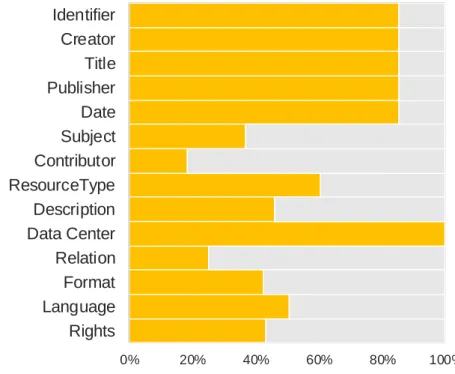
Figure 1 shows the share of records in DataCite with information in each of the fields described in Appendix A. We see that many records contain empty fields (even mandatory ones). A total of 1,092,131 records (14.7% of all records collected) include no data at all. This appears to be caused by modifications made by DataCite in the data structure. More specifically, DataCite employs the Open Archives Initiative Protocol for Metadata Harvesting (OAI-PMH) and assigns an OAI id to each record. It appears that when a record needs to be modified, a new record is created with the updated information. The information in the old record is deleted (except for the OAI and the data center information), but not the record itself. Figure 2 shows an example of an empty record. This is an important element to consider when working with DataCite’s API as these records should be removed from the sample.
Figure 1. Distribution of metadata information by fields
When focusing on the records that do include information (6,348,284 records), we still find that 1,306 records (0.02%) do not include a title or publisher information. Resource type and language are reported in 60% and 51% of the records, respectively. The contributor (18%) and relation (25%) fields have the lowest presence in DataCite records.
0% 20% 40% 60% 80% 100%
6
Figure 2. Example of an empty record retrieved from DataCite’s API
4. Results
In this section, we report our findings regarding the content of each field and the level of standardization of the data. First, we present descriptive statistics on different types of data records. Then we analyze the geographical distribution of data centers and the number of records by country. We also analyze the publisher field to disentangle the different types of entities it contains. We also present an overview of the different types of dates included in the database. Finally, we focus on the description of the relation field, which contains DOIs of related records, trying to understand the type(s) of linkages captured by DataCite.
4.1 Resource types
The ResourceType field presents a controlled list of 15 values, complemented by a free-text subtype. Table 1 reports the total number of records by resource type and the three most common subtypes. We observe that 42% of the records are categorized as datasets, following by text (18%), image (14%), and collection (7%). As observed in table 1, most of records with a ResourceType‘text’ are manuscripts, conference papers or journal articles. Records tagged as images are heterogeneous, ranging from academic posters to historical manuscripts, or data figures. The subtype is not mandatory and is thus empty in many records. For instance, only 4.3%, 6% and 6% of records with the resource type “Model”, “Sound” and “Film”, respectively, have a subtype. Overall, we find 158,781 different variations of resource subtypes, a natural off-shoot of it being a free-text field, but which reflects different understandings of what is data and what is included by each of the 15 data types.
Table 1. Records by resource type and share of top 3 most common subtypes in DataCite. In bold-cursive subtypes appearing in more than one data type category
Resource type Number of records Most frequent subtypes
N %
Dataset 1,867,627 41.69 Dataset (63.5%), Metadata (5.8%), Data package (4.1%)
Text 786,882 17.56 Conference papers (15.5%), Journal articles (15.4%), Report(10.1%)
Image 641,404 14.32 Image (11.9%), Figure (11.2%), Plate (8.1%)
Collection 303,638 6.78 Collection (20.7%), Gaussian job archive (9.1%), Report(4.7%)
7
Resource type Number of records Most frequent subtypes
N %
Audiovisual 4,470 0.10 Audiovisual (43.8%), Media (23.9%), Teaching material (8.5%)
Film 960 0.02 Experiment (5.4%), Video (0.4%), Animation (0.1%)
Physical Object 587 0.01
Archival object (63.9%), HIAPER-HAIS airborne sensor (2.4%), Physical object (0.9%)
Event 508 0.01 Conference presentation (73.4%), Presentation (9.6%), Event (1.6%)
Model 470 0.01 Model (2.8%), Ontology (0.9%), Shapefiles (0.2%)
Interactive Resources 287 0.01 Interactive resources (12.2%), Learning object (2.1%), Sites Web (0.3%)
Sound 234 0.01 Recording, oral (4.3%), Sound (0.4%), Conference (0.4%)
Workflow 209 < 0.01 Taverna 2 workflow (7.2%), Workflow (1.0%), RapidMiner workflow (0.5%)
Service 18 < 0.01 Service (88.9%), S-map (5.6%), Data provider (5.6%)
Other 871,549 19.45 Data sheet (98.2%), Oceanographic cruise (0.7%), Field expedition (0.7%)
Total 4,480,077 100
We also observe classification redundancies between the two levels. For example, the resource type “dataset” has a subtype also called “dataset”. There are also redundant subtypes between different resource types. For example, the subtype “report” appears as a subtype of both the resource types “collection” and “text”. A specifically problematic case is the Resource Type “other”, for which 98.2% of the records have a subtype labeled as “Data sheet”. This suggests that these records could perhaps be considered as datasets. Taking a closer look at these records, we found that they were all derived from the same repository, Data-Planet. Actually, all records from Data-Planet are classified as “Data sheet”. This variability in the distribution of records may reflect some inconsistencies in the way data centers classify records according to the scheme proposed by DataCite.
From now on, we will refer as “data records” to all those records in DataCite that have a resource type different than “text” (i.e. we consider as data-related records all records that are not articles such as manuscripts or pre-prints).
4.2 The geographic distribution of data infrastructures
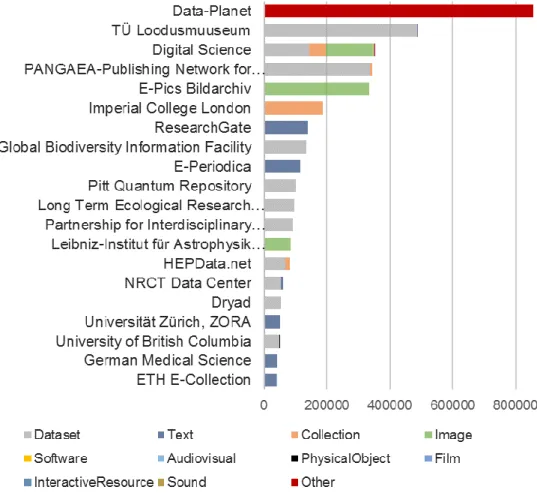
In this section, we focus on the data providers and the countries in which they are based, to provide insights on how data infrastructures are being developed in different countries. DataCite provides a closed list of 762 institutions from which records are retrieved. The distribution of records across these data centers is uneven: 15 (2%) data centers account for more than 80% of all records. Figure 3 shows the distribution of records by resource type (excluding the records where this field is empty) for the 20 data centers who provided the most records.
8
universities (Imperial College London, ETh Zürich). Data-Planet is the largest data center in DataCite, providing 20% of all the records. As mentioned before, all records provided by Data-Planet are “data sheets”. Also, some data centers (ResearchGate, E-Periodica, Universität Zürich, Zora, and ETH E-Collection) provide only “text” records.
Figure 3. Top 20 data centers by data types
9
Table 2. The number of data centers, number of records and share of records after excluding records labeled as data type “text” by country. Countries are ordered by total number of records
Countries Data centers # records % data records* Countries Data centers # records % data records*
USA 217 2952086 58.6% Hungary 37 1809 0.8%
Germany 185 1795638 26.5% Poland 4 1713 1.3%
UK 66 1382661 49.9% Russia 3 1388 0.0%
Switzerland 48 1120868 32.1% Iran 2 1292 0.0%
Estonia 6 489896 99.5% Romania 3 1032 47.2%
Denmark 5 138640 98.0% China 2 703 31.2%
Canada 24 85984 93.5% Czech Republic 1 470 100.0%
Thailand 1 61529 87.9% South Korea 1 188 0.0%
Italy 35 50350 4.2% Belgium 1 106 79.2%
Netherlands 16 49900 80.8% South Africa 1 105 93.3%
Austria 7 36450 0.0% Liechtenstein 1 56 0.0%
Australia 41 24122 19.6% Ghana 1 53 98.1%
Ireland 3 23181 16.1% Spain 2 37 100.0%
France 32 13093 48.7% Slovenia 1 18 0.0%
New Zealand 2 3081 39.4% Japan 1 15 0.0%
Sweden 6 2835 97.9% Tanzania 1 10 90.0%
Unknown 8 2722 1.8% Uruguay 1 1 100.0%
* Data records are defined as all data types excluding text
The second source of information relating to open data providers is obtained from the publisher field. It is a non-standardized free-text field in which we found 118,136 different names. The distribution of records is highly skewed, hence by manually disambiguating the most common 1,148 publishers we managed to cover about 90% of all the records that include publisher information.
10
Figure 4. Total number of data records (excluding data type “text”) by country using data center and publisher affiliation data. Y-axis are logarithmic. Countries are ordered according to the total number of records using the data center affiliation.
We also divided the publishers in 11 types of entity to better comprehend what users understand as “data publisher”, but also to identify different types of institutions publish data products. We distinguish four types of repositories (i.e., national, institutional, disciplinary, and multidisciplinary repositories), and the other entities are diverse groups (research body, professional body, and educational body), publishers, firms, conferences and individuals. Appendix B provides more details on this classification.
11
Figure 5. Number of records and share of data records (after excluding text) by type of publisher. Only records with publisher information and data type are shown.
4.3 Publication year and related dates
Publication year is a key field in any bibliometric analysis intending to provide a longitudinal perspective or to frame the study period(s). DataCite requires the publication year to be presented in a four-digit format. However, an important point to consider for the development of data metrics is that data records can be subjected to different actions occurring on different dates of actions, that may all be included in the metadata. Thus, DataCite (2015) has two date-related fields: publication year and date. The publication year field is a mandatory field that DataCite Metadata Working Group (2015) defines as “the year when the data was or will be made publicly available”. Still, DataCite acknowledges that this information may be unclear or unavailable, providing alternatives such as, “[if] that date cannot be determined, use the date of registration”or “[i]f an embargo period has been in effect, use the date when the embargo period ends”. Concluding that “[i]f there is no standard publication year value, use the date that would be preferred from a citation perspective”.
The date field is an optional free-text field that can refer to different dates relevant to the record. These can be related to the date when the dataset was created, uploaded to a repository, made publicly available, updated, etc. Thus, when information if provided in the date field, one of the following 9 subtypes is required: accepted, available, copyrighted, collected, created, issued, submitted, updated and valid.
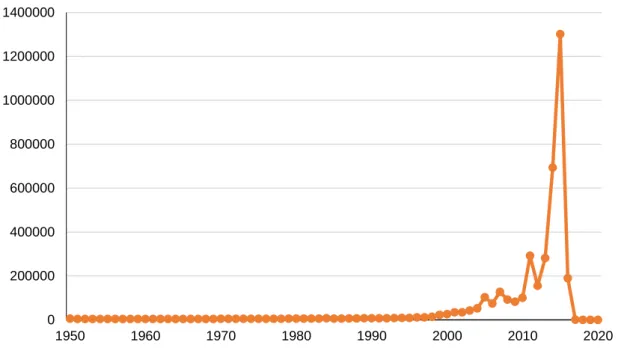
As mentioned before and presented in Appendix 1, the field “date” retrieved DataCite Metadata Store OAI API combines both the publication year and date in a single field. Hence the distinctions discussed above are not available. This means that multiple dates may be assigned to a single record and that the publication year field can only be distinguished from the date field when the latter is not in a four-digit format. Therefore, the date information retrieved with the API must be somehow processed before used. In this study, we define “publication year” as a date presented with a four-digit format. We identified 4,242,804 data records with this format. This cleaning process is not completely accurate as a total of 50,679 records reported publication years above 2099 or from early 1000s and were thus not considered1. Figure 6 shows the
1 Although there are cases of data records dating from the early 1000s, e.g., digitalized archival objects.
Type of publishers # publishers
Thematic repository 2205204 67,78% 18
Institutional repository 852954 83,26% 35
Research body 764962 43,18% 33
Multidisciplinary repository 408355 88,45% 2
Scientific publisher 149305 9,85% 24
National repository 40634 42,33% 5
Firm 20704 9,67% 6
Professional body 19215 0,00% 5
Conference 18571 0,00% 1
Individual 8025 0,00% 2
Educational body 2326 93,59% 1
Not found 621544 78,74% 24
Total 5111799 72,47% 156
12
number of records for the 1950-2020 period. We observe many records dating from 2016 onwards due to the embargo they are restricted by.
Figure 6. Number of records per year using the publication year in DataCite. 1950-2020 period
Figure 7. Example of record with an older date to the development of data repositories. 6A. Contents of a photograph taken in 1929. 6B Data record in DataCite. The date of publication of the record is 1929.
The fact that there is no clear definition for the publication year field, may lead to some discrepancies in the data. This is especially meaningful in the case of historical data where the user could choose to indicate the date of the historic record or the date of its retrieval. Figure 7
0 200000 400000 600000 800000 1000000 1200000 1400000
13
provides the example of a digitized photograph which had already been published in its physical form. Here, the publication year field contains the value 1929, which is in fact the date when the photograph was taken.
Regarding records including additional dates, we identified 2,095,183 records of which 43% reported the availability date, 25% reported the date of creation 14% declared the collection date and 12% an update and 3% and issue date. Less than 0.2% of the records reported the date of copyright, submission, validity or acceptance.
4.4 Related DOI numbers
14
Figure 8. Analysis of the relation field in DataCite. A Share of records in DataCite with related DOI numbers within DataCite records. B. Distribution of the number of related DOI numbers by data record. C. Share of related DOI numbers included in DataCite by their data type. D. Share of related DOI numbers indexed in DataCite, indexed in DataCite and with data type information, and indexed in Web of Science.
15
with a related DOI number, and 44 (5%) of them reported related DOI numbers in all their records (see Figure 9).
Figure 9. Share of records with related DOI numbers assigned to them. Blue represents records with related DOI numbers. Grey represents records with no related DOI numbers reported.
5. Concluding remarks and recommendations
The research on data sharing and open data is growing, while at the same time funding bodies are encouraging greater research transparency. Terms like data-driven science, data-intensive science, and open science are becoming more and more common in policy documents and statements such as the European Unions’ Horizon2020 (European Commission, 2016). In this context, DataCite is called to play an important role as source for the analysis and study of data publication and reuse. While the demand of data metrics has been a constant since the beginning of the 2010s (Costas et al., 2013), there is still a long way to go until the movement expands to broader fields of Science and to more countries.
16
Index, the size and richness of DataCite data offer greater possibilities as a bibliometric source for developing open data metrics. Still, this richness of data comes at a price. Conceptual problems such as what is data or to which scientific field or discipline different datasets belong to, along with technical problems such as the lack of standardization of many of its fields, may still represent an advantage towards the Data Citation Index, in which the structure of fields in the Data Citation Index adapts to some extent the structure of bibliographic records. This is presents a positive advantage for the Data Citation Index because it allows bibliometric analyses without prior processing (e.g., Robinson-Garcia, Jiménez-Contreras & Torres-Salinas, 2016). However, this analytical simplicity of the Data Citation Index overlooks some of the key issues found when exploring the nature and heterogeneity of open data. As shown in this paper, the metadata of DataCite records is very rich and heterogeneous, here we describe some of the important issues that need to be considered when using DataCite as a source of data for open data analytics.
5.1 Central issues regarding the metadata provided by DataCite
5.1.1 Data types
and the definition of “data”
An important critical element that needs to be considered when working with DataCite is that as such, all records included in the database are not strictly data-related. For example, more than 12% of the valid records in DataCite are text or articles. Therefore, in order to properly identify and analyze the production of data, diverse filters need to be applied by types of data. However, we have highlighted the important diversity of data types included in DataCite. In a way, the many types of data covered in DataCite suggest that a broader understanding of what constitutes research data is very necessary. In fact, the presence of multiple data related types such as “Images”, “collection” or “software” reinforces the idea that we need to stop considering “data” as a homogeneous publication type.
5.1.2 DataCite Metadata fields
The DataCite schema closely aligned with Dublin Core, which allows interoperability between different platforms and record types as well as ensuring minimum levels of quality of author-generated metadata (Greenberg et al., 2002). However, the simplicity of the model (Lagoze, 2001) leaves room to ambiguity in many of the fields required in order to develop any type of bibliometric analysis. We found that a major issue existing on DataCite is that a lot of records are missing information in many of the fields (even mandatory ones). In addition, making some of the recommended fields mandatory (e.g., the subject, the institutional affiliation of the creator) would enhance DataCite’s potential for bibliometric analyses. It would also be useful to make mandatory a “type of relation” subfield for the “Relation” field which is one of the most promising fields for the development of data metrics. It is worth noting that this information is now available in the new metadata scheme and through the DataCite search webpage.
17
for each data record, it could make more sense to use it for citation purposes rather than the publisher, which isa free text field2.
6. Recommendations
Based on the results of this paper it is possible to suggest a series of recommendations that might be useful for users who wish to employ DataCite for developing data metrics, and for DataCite as a provider of data records on data sharing activities. These recommendations are intended to maximize their efforts to provide a service that efficiently promotes data publishing and data citation. The size of DataCite and the fact that it is accessible for free highlight its potential to become a valuable source of information for quantitative analyses of data production, sharing and (re)use. However, there are critical issues regarding the structure and cleanliness of DataCite records that would need to be addressed to improve its usability. In any case, the conclusions drawn here are based on the DataCite Metadata Store and do not consider any improved functionalities available through the DataCite REST API. In this sense, the advantages and limitations of using different points of access should be made clearer so that users can choose one or the other depending on the analysis they wish to conduct.
In this sense, potential users of DataCite should consider the following issues: First, empty records should be removed before attempting to make any statement regarding the actual data contained by DataCite. As noted in subsection ‘General description of the retrieved database’, over 1 million records were found empty at the time of the retrieval of the data. The non-removal of these records may mislead the counts of the actual size of the database.
Second, issues related to data completeness reduce the analyzable dataset as more filters are used to retrieve records. For example, to focus on only data-related records (e.g. datasets) it is necessary to filter by ResourceType. However, this field is empty for a substantial amount (40%) of records. In addition, the DataCite Metadata Store contains a wide variety of “resource types”. Thus, users must decide before hand which data types are relevant for the analysis and understand the potential losses of information that the filters will impose.
Third, a considerable amount of data processing and cleaning will most likely be needed, as most fields are not standardized. Furthermore, the fact that some fields are merged (e.g. publication date and date) makes it compulsory to process and clean the data before analyzing it.
Finally, an important issue critical for the potential usability of the database for metric purposes is the lack of standardization of many metadata fields. Having many free text fields (e.g. Publication year, publisher, creator) makes data retrieval more arduous and makes it necessary to disambiguate the data. By simply imposing a standard format for certain fields such as the creator field, or by including a closed list for the ResourceType field and subfield or for the subject field would greatly improve the quality of the data and facilitate its analysis.
6.1 Further research
DataCite is currently one of the main data sources available for the development of data metrics, and a great promoter of data sharing and reuse. Indeed, despite its recent creation, DataCite is probably the largest database, with a vast and heterogeneous set of data records, bringing us a step closer to an ideal of open science characterized by its transparency and its capacity to optimize the use of resources. By providing an overview of the structure and content of the DataCite records, this paper has hopefully served as a first step towards a better understanding
18
of data production, publication and reuse by the scientific community. Further research will focus on comparisons with different of access to DataCite records, the study of the relationships between authors of scientific publications and creators of datasets, the development of suitable classifications of data records and the presence of mentions to DOIs in the references of scientific publications to data.
Acknowledgements
Preliminary results of this paper were reported at the 3:AM Conference held in Bucharest (Romania), 27-29 September, 2016. The authors would like to thank Henri de Winter from CWTS for helping in the retrieval of the data and Kristian Garza from DataCite for fruitful and helpful discussions on points of access to DataCite and structure of records. The two anonymous reviewers are also thanked for their constructive comments and recommendations. This study has been partially supported by the European Commission project RTD-B6-00964-2013 Monitoring the evolution and benefits of Responsible Research and Innovation (MoRRI). Nicolas Robinson-Garcia is currently supported by a Juan de la Cierva-Formación grant from the Spanish Ministry of Economy and Competitiveness.
References
Borgman, C. L. (2012). The conundrum of sharing research data. Journal of the American Society for Information Science and Technology, 63(6), 1059–1078.
Costas, R., Meijer, I., Zahedi, Z., & Wouters, P. F. (2013). The Value of Research Data Metrics for datasets from a cultural and technical point of view.A Knowledge Exchange Report [External research report]. Available at https://openaccess.leidenuniv.nl/handle/1887/23586
DataCite Metadata Working Group. (2015). DataCite Metadata Schema for the Publication and Citation of Research Data. Version 3.1 DataCite e.V. http://dx.doi.org/10.5438/0010
Doorn, P., Dillo, I., & van Horik, R. (2013). Lies, Damned Lies and Research Data: Can Data Sharing Prevent Data Fraud? International Journal of Digital Curation, 8(1), 229–243.
European Commission (2016). H2020 Programme. Guidelines on FAIR Data Management in Horizon 2020. Version 2.1 Available at:
http://ec.europa.eu/research/participants/data/ref/h2020/grants_manual/hi/oa_pilot/h2020-hi-oa-data-mgt_en.pdf
Greenberg, J., Pattuelli, M.C., Parsia, B., & Robertson, W.D. (2002). Author-generated Dublin Core Metadata for web resources: A baseline study in an organization. Journal of Digital Information, 2(2). Available at https://journals.tdl.org/jodi/index.php/jodi/article/view/42
Kim, Y., & Adler, M. (2015). Social scientists’ data sharing behaviors: Investigating the roles of individual motivations, institutional pressures, and data repositories. International Journal of Information Management, 35(4), 408–418.
Konkiel, S. (2013). Tracking citations and altmetrics for research data: Challenges and
opportunities. Bulletin of the American Society for Information Science and Technology, 39, 27– 32.
19
Mayernik, M. S. (2012). Bridging data lifecycles: Tracking data use via data citations workshop report. NCAR Technical Note NCAR/TN-494+ PROC, Boulder, CO: National Center for
Atmospheric Research (NCAR), 2013, http://dx. doi. org/10.5065/D6PZ56TX.
Mayernik, M. S., Hart, D. L., Maull, K. E., & Weber, N. M. (2016). Assessing and tracing the outcomes and impact of research infrastructures. Journal of the Association for Information Science and Technology. https://doi.org/10.1002/asi.23721
Missier, P. (2016). Data trajectories: tracking reuse of published data for transitive credit attribution. International Journal of Digital Curation, 11(1), 1-16.
Parsons, M. A., & Fox, P. A. (2013). Is Data Publication the Right Metaphor? Data Science Journal, 12, WDS32-WDS46.
Peng, R. D. (2011). Reproducible research in computational science. Science, 334(6060), 1226.
Perneger, T. V. (2011). Sharing raw data: another of Francis Galton’s ideas. British Medical Journal, 342, d3035.
Peters, I., Kraker, P., Lex, E., Gumpenberger, C., & Gorraiz, J. (2016). Research data explored: an extended analysis of citations and altmetrics. Scientometrics, 107(2), 723-744.
Piwowar, H. A., Becich, M. J., Bilofsky, H., & Crowley, R. S. (2008). Towards a data sharing culture: recommendations for leadership from academic health centers. PLoS Medicine, 5(9), e183.
Piwowar, H. A., Day, R. S., & Fridsma, D. B. (2007). Sharing Detailed Research Data Is Associated with Increased Citation Rate. PLoS ONE, 2(3), e308.
Robinson-García, N., Jiménez-Contreras, E., & Torres-Salinas, D. (2016). Analyzing data citation practices using the Data Citation Index. Journal of the Association for Information Science and Technology, 67(12), 2964-2975.
Torres-Salinas, D., Martín-Martín, A., & Fuente-Gutiérrez, E. (2014). Análisis de la cobertura del Data Citation Index–Thomson Reuters: disciplinas, tipologías documentales y repositorios. Revista Española de Documentación Científica, 37(1), e036.
20
Appendix A. Retrieved fields and description of their contents
Field Description
Identifier Unique number identifier. DataCite assigns DOIs to all data records, although many include additional identifiers such as CCDC (Cambridge Crystallographic Data Centre) or InChI (International Chemical Identifier). Creator Author of the data record. This field is not presented in a standardized
format (i.e. Surname, Initials).
Title Name of the data set or file stored in the repository.
Publisher Non-standardized format which includes a great variety of different entities raging from repositories, journals, institutions, etc.
Date This field includes the mandatory field ‘Publication Year’ as well as the ‘Date’ field, which means that each record can have more than one publication year. The format is standardized but heterogeneous. Hence ‘Publication Year’ information appears as a four-digit number while Date appears stating the type of date and the actual year (i.e., Available:01/2/2005).
Subject Keywords assigned to each data record. While we observe that for some repositories a fixed classification system is employed, this is not systematized for all data records.
Contributor Individuals and institutions collaborating on the creation of the data but not considered as creators. As with the ‘Creator’ field, this field is not presented in a standardized format.
ResourceType This field includes both, the first-level data type classification as well as the second-level data type classification.
Description This field includes in its content the five distinct subsections described by DataCite. However not all records include all subsections.
Data Center Institution in charge of feeding DataCite with records. Data centers have a unique identifier each constructed in two parts. First the intermediary institution and secondly, the sending institution. For instance, BL.IMPERIAL is the identifier for Imperial College London. BL stands for British Library, the intermediary institution and IMPERIAL for the sending institution.
Relation This field related each data record with additional DOI numbers. How such relation is established is not formally declared in the record. Despite DataCite offers a controlled list of values indicating the type of relation established between records, we did not find this information in the data retrieved. More on this in subsection 3.4
Format Non-standardized field which includes a formal description of the contents of the record. Here we find information which ranges from a catalographic description of the contents (i.e., Zwei Teile in 1 Band ; 17 cm) to actual format of the submitted file (i.e., SPSS file).
Language Non-standardized field indicating the language of the record. Language is indicated by using a two-digit format, a three-digit format or the full name. In some cases, more than one language is reported (i.e., fr-en) Rights Non-standardized format including the holder of the copyrights if any or
21
Appendix B. Classification of publisher types
Publishers were classified into eleven mutually exclusive categories to analyze different national data infrastructures. Following we include the twelve types of publishers identified along with examples for each of them.
Publisher type Examples # records
Thematic repository Data-Planet™ Statistical Ready Reference by Conquest Systems, Inc.; Cambridge Crystallographic Data Centre
2,205,204
Institutional repository Imperial College London, ETH-Bibliothek Zürich, Bildarchiv, University of Pittsburgh
852,954
Research body Partnership for Interdisciplinary Studies of Coastal Oceans (PISCO), Leibniz Institut für Astrophysik Potsdam (AIP)
764,962
Multidisciplinary repository
Figshare, ZENODO 408,355
Scientific publisher German Medical Science GMS Publishing House, Zofinger Tagblatt, PeerJ
149,305
National repository Digital Repository of Ireland, Colchester, Essex: UK Data Archive
40,634
Firm Huber & Co. AG, Verlegergemeinschaft Werk, Bauen + Wohnen Bauen + Wohnen GmbH
20,704
Professional body Bund Schweizer Architekten, Freidenker-Vereinigung der Schweiz, Union syndicale Suisse
19,215
Conference European Congress of Radiology 18,571
Individual W. Jegher & A. Ostertag, J.F. Boscovits 8,025