1
Chapter 1: Economic Basics
What Is a Business?
Businesses come in many shapes and sizes, such as local,
regional, national, and/or global. They are classified by their size, structure, and the role they play in the community.
Profit or Non-profit?
For-Profit Business
A for-profit business produces or sell goods and services to satisfy the needs, wants, and demands of consumers for the purpose of a making profit.
Non-profit and Not-for-profit Organizations
2
Chapter 1: Economic Basics
What Is a Business?
For-profit Business
By supplying goods and services, a business can make a profit.
• Profit is the income left after all costs and expenses are paid.
• Expenses are the payments involved in running a business and the
assets that get “used up” operating it.
• Cost is the money required to produce or provide the goods and
services.
Revenue – Expenses = Profit (or Loss)
When a business makes a profit, it can • reinvest money for expansion
• provide improved goods and services
• give the owner(s) funds to spend on personal needs or wants
3
Chapter 1: Economic Basics
What Is a Business?
Non-profit Organizations
The primary motive of a non-profit organization is to raise funds for a specific goal. Only charities and charitable organizations are called non-profit and are allowed to raise such funds. These
organizations operate to serve people and their communities.
Not-for-profit Organizations
A not-for-profit organization uses any surplus funds to improve the services offered to its members. However, they do not
4
Chapter 1: Economic Basics
What Is a Business?
Large or Small
A small or medium-sized business (SMB) can be classified by the following characteristics: • employs fewer than 500 people
• estimated to be over one million in Canada • provides jobs for more than 60 percent of the Canadian workforce
Forms of Business Ownership
Informal descriptions of business ownership include: • sole proprietorship
• partnership • corporation
Portfolio Activity 1
• What is the connection between profit, costs,
and expenses?
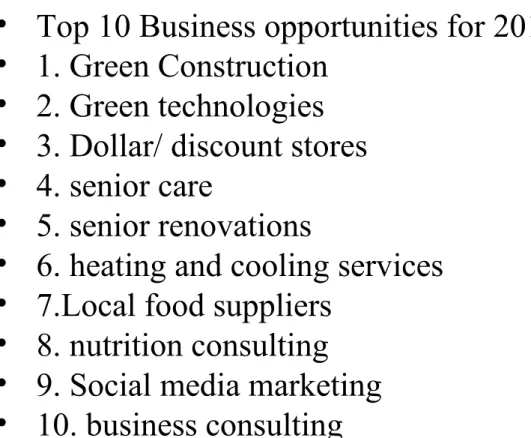
• Look at table 1.1 on page 9, identify 1 job for
each type of business.
Table 1.1 page 9
• Top 10 Business opportunities for 2010
• 1. Green Construction
• 2. Green technologies
• 3. Dollar/ discount stores
• 4. senior care
• 5. senior renovations
• 6. heating and cooling services
• 7.Local food suppliers
• 8. nutrition consulting
7
Chapter 1: Economic Basics
What Is a Business?
Channels of Distribution
A business can be classified according to how it delivers goods or services to the customer. Some of these categories are
•retail (“bricks and mortar”) •the telephone
•catalogues •e-commerce
Role in the Community
A business performs different functions in its community.
Jobs
8
Chapter 1: Economic Basics
The Role of the Consumer
Producers are the businesses that make goods or provide services that consumers need or want.
Consumers are the people who purchase goods and services from producers.
A marketplace or location is where producers and consumers come together to buy and sell their goods and services.
Businesses use consumer habits plus their own research to decide what quantities of goods and services they will provide to consumers. Some key questions that businesses might ask about themselves are
•When do they want these goods and services? •Where do they want them?
•How much goods or services do they want?
•What price will they pay for these goods and services?
9
Chapter 1: Economic Basics
The Role of the Consumer
Consumer Influence on Products
In the past, businesses controlled what, when, and the amount
of products and services available to consumers. With
increased
competition
and the appearance of more
producers, consumers ultimately buy from businesses that
meet their personal needs and wants.
When Products Become Obsolete
Over time, products or services can become
obsolete
10
Chapter 1: Economic Basics
The Role of the Consumer
Consumer Influence on Price
Businesses are in control when they have pricing power. They can
increase prices in response to increased costs or to increase their profits.
Consumers have control when they have power. They demonstrate this
by “voting with their feet” to look elsewhere for products and services.
Consumer Influence on Service
Consumer purchasing power gives individuals the control to buy
11
Chapter 1: Economic Basics
Starting a Business
Characteristics of Entrepreneurs
Entrepreneurs are individuals who are risk-takers and
problem-solvers. They are acutely aware of opportunities in the marketplace and take advantage of these in their businesses. Important entrepreneurial characteristics include the following:
Consumer Needs and Wants
Entrepreneurs often start businesses to satisfy consumer needs. Basic survival needs for individuals are food, clothing, and shelter. However, entrepreneurs can also provide consumers with new products or
services that are not considered a need but a want—something that adds comfort or pleasure to their lives.
• self-confidence • a flair for
innovation
• the ability to work alone
12
Chapter 1: Economic Basics
Starting a Business
Attracting Consumer Interest
Entrepreneurs need to identify their competition. They must determine how to attract their customers and keep them.
Businesses also plan what goods and services to offer and how to distribute and market them by knowing how consumers will answer the following questions:
• Do I really need it?
• Where should I buy it?
• How much variety is there to choose from? • How much can I afford to spent?
13
Chapter 1: Economic Basics
Starting a Business
Attracting Consumer Interest
Businesses compete for consumers. Here are a few strategies that businesses use to help attract buyers to try a product or service.
• Create something new and/or improve it. • Promote the latest trends.
• Compete with similar businesses.
Making Good Business Decisions
Entrepreneurs face many decisions on a daily basis. Even deciding how much inventory or stock (i.e., the quantity of goods and
14
Chapter 1: Economic Basics
Starting a Business
15
Chapter 1: Economic Basics
Economic Resources
Economic resources, also known as factors of
production, are the means through which goods and services are made available to consumers.
Most products require a combination of • natural resources
• human resources • capital resources
Businesses are interdependent, which means they rely on the goods and services from a variety of
16
Chapter 1: Economic Basics
Economic Resources
Economic Systems
Economic systems are a way of dealing with the selection, production, distribution, and consumption of goods and services. Government and business work together to foster activity and growth in the marketplace.
Economic systems have to answer three key questions:
1. What goods and services should be produced within the system? 2. For whom should these goods and services be produced?
17
Chapter 1: Economic Basics
Demand, Supply, and Price
Law of Demand
Demand is the quantity of a good or service that consumers are willing and able to buy at a
particular price.
Law of demand and its relationship to prices and consumers is defined as the following:
• When prices decrease consumers buy more and demand goes up .
• When prices increase consumers buy less; demand goes down .
Several conditions that create demand are • consumer awareness
• price
• supply
18
Chapter 1: Economic Basics
Demand, Supply, and Price
Law of Supply
Supply is the quantity of a good or service that businesses are willing and able to provide within a range of prices that people would be willing to pay. Increasing the quantity
supplied as prices increase is called the law of supply.
Several conditions that affect supply are
• the cost of producing or providing a good or service • the price consumers are willing to pay for it
Relating Price to Supply and Demand