Economics
Stage 2
Contents
202
Chapter 1 : Microeconomics 2
Chapter 2: Macroeconomics 34
Chapter 3, Theory, Data and Forecasting 46
Part 2, National Income and Demography
Chapter 1:Concepts of National Income 58
Part 3: Inflation 82
Part 4: Unemployment 99 Part 5, Trade Balance and Exchange Rate
Chapter 1 : Trade Balance 113
Chapter 2, Exchange Rate 127
Part 6: Money
Chapter 1 : Evolution of Money 140
Part 7: Demand and Supply of Money 145 Part 8: Monetary Policy
Chapter 1 : Objectives of Monetary Policy 158 Part 9, Fiscal Policy
Chapter 1 : Objectives of Fiscal policy 165
Part 10: Transmission mechanism of Monetary Policy and the Impact of Banking Sector Credit
Chapter 1 : Monetary Policy Transmission Channels ' 74
Part 11 : Central Banks and Monetary Policy Regimes 181 Part 12: Impact of Fiscal and Monetary Policies on Equilibrium 192 Part 13: The World Economy:
Economics I Reference Book 15 Chapter 1
Learning Outcome
Introduction The meaning and nature of economics
By the end
___ Introduction to Economics
ofchapter
Microeconomics you should be
able to: « Recall the importance of studying economics _ Differentiate between microeconomics and macroeconomics j- Identify and explain the basic concepts of microeconomics, i.e. supply^ demand, elasticity and inelasticity, consumer preferences, supply demand curve and equilibrium ■ Discuss the production function 0 Discuss the terms opportunity cost, sunk cost, marginal cost, average cost, production cost
Economics is the study of the way in which societies use and develop the scarce resources at their disposal. Scarcity is the key to the entire study of economics, the concept which underlies all economic thought and activity, due to mankind’s constant search for ways of overcoming scarcity. What economists mean by scarcity, however, is quite different to the normal interpretation of the word.
An accepted definition of economics is perhaps a useful way to begin. Lord Robbins provided the following widely quoted definition of what he called the “basic economic problem" :
y
“Economics is the science which studies human behavior as a relationship between ends and scarce means which have alternative uses.”Economics is as old as civilization itself, derived from two Greek words
oikos
- a house - andnemo-1
manage. The first practical economists were probably stewards or estate managers concerned with managing the business affairs of a private individual or nobleman. Gradually over time, economics expanded into managing the business and finances of the state as a whole. One of the earliest treatises on the subject ^Economicd
9 (300 BC) ^ was concerned with raising revenue from taxation.In Britain, the foundations of modern economics were laid by a Scottish economist Adam Smith, when he published
“The Wealth of Nations”
in 1776. Other early economists were David Ricardo who published“Principles
of Political Economy and Taxation”
in 1817 and John Stuart Mill with“Principles of Political Economy, ,
n 1847. TheIn the definition stated above, the “economic problem” has been identified — that of ends, means and alternative resources. We all have our own “basic economic problem” — that of trying to live within our income. In everyday speech the word “means” is used instead of income, so if we partially rewrite the definition and substitute “inadequate income” for “scarce means” and, instead of using the word “ e n d s , , , think instead of all the consumer goods which are always temptingly on offer but which we are unable to afford because our incomes are limited, then we can identify more closely with the formal definition.
We can say then, that economics is about living within our income. So far we have assumed that resources were scarce in relation to the needs and wants of individuals or households, but this problem afflicts the whole of society at every level.
Scarcity at an individual level is only ourselves experiencing the dilemma that all people, firms, organizations and governments experience. A chancellor or a company director trying to balance the national or company accounts is acting in the same way as a household trying to satisfy all its wants from its limited income. They are both allocating limited resources as best they can, deciding which “ends” have to be met first as priorities and relegating those which must, as a consequence, remain unsatisfied. Disputes about the relative levels of wages and profits are essentially disputes about the distribution of a limited national income.
Our incomes are limited in relation to all those products which we wish to own and enjoy. One must choose between them, deciding which wants to satisfy and which to reluctantly ignore. Those choices, however, are only possible because our incomes have alternative uses and can be spent as we wish. The general term “ends” in the definition should be broken down into two separate and distinct component parts — needs and wants.
Needs
These are the primary essentials necessary for survival such as food, shelter, and clothing and heating. With these basic requirements met, life can be sustained and, for most people in our society, these needs are adequately satisfied. For the majority, only one house can be lived in at a time and only three meals eaten per day. Improvements in quality are constantly sought, but the quantity demanded is limited once adequacy has been achieved. In economics it is said that the demand for human needs is limited or finite, i.e. they have a definite quantitative limit.
Wants
survival-4
Economics I Reference Book 2 Microeconomics and
macroeconomics
Opportunity cost
The production possibility curve
they do not sustain life. They are the motor force which drives us to a more complete and satisfactory enjoyment of it.
The key to our understanding of economic man is that wants must be limitless. If they were not, then with a given level of income, we could satiate all our consumer desires. We would no longer have to practice choice because our incomes could afford us to demand all that we wanted. Income is only limited because it is not and never is, enough, to allow us to demand all that we want.
This problem of scarcity, choice and limited income seems to remain constant, irrespective of which society we study, of its relative level of economic development or its place in time. Our desire for wants is relative _ we never have
enough, our income is therefore limited and everything we want is scarce.
Microeconomics is concerned with the individual parts of the economy, for example how prices of individual goods are determined.
Macroeconomics is concerned with the economy as a whole, for example what determines the general level of prices.
A man living alone living on a desert island has little use for money, but he still has to deal with the problems of scarcity and choice. His scarce means are the physical resources he finds on and around his island, including his own skills and knowledge. Even time is a scarce resource since there are only twenty-four hours in a day - an hour spent building a shelter is an hour not spent gathering food.
Each opportunity taken implies some alternative foregone. Every choice involves a cost. The real cost is not the price we pay. In the simple one- man economy, money serves no purpose. The real cost of taking one option is the alternatives foregone, or, to be more accurate, the most attractive alternative foregone. Economists call this ^opportunity cost. So it could be, for example, that if the government decides that it wants to hire 1000 extra police it will have to reduce spending on education and 900 fewer teachers can be afforded. So the opportunity cost of 1000 police would be 900 teachers.
Companies choose between one expansion programme and another because investment funds are limited, as are the necessary resources available. For the same reason, governments cannot cut taxes, employ more nurses and re-equip the army all at the same time - ministers must choose. All economic problems are really just the same problem set in a different context.
Opportunity cost can be illustrated by means of a table called a pi^duction possibility schedule where we assume a country with given resources and a given level of technology. Let us also assume that the country can produce two products
1hich tdi
/\/\COme
We could
' U S to I
£ ms to remain relative levej of
isreJative !and ev^mhin„
0
A but
Hs scarce
fs island. P
to o o
£
iM—pffwoiiiks
of guns. Once all resources are being used, the only way the output of one good can be increased is by reducing the output of the other. There is a trade off between the production of food and the production of guns which can be seen in the following table.
Table 1-1: Production Possibility Schedule
10
m
toy
Production Possibility Schedule showing possible combinations of food and guns production per month
Food(Thousands of tons) Guns(Thousands) 30
5
Figure 1-1: Production Possibility Curve resource u
Gildig
t choice one - h one 'most w cost”.
Food {'000 tons)
The horizontal axis measures the quantity of food while the vertical axis measures the quantity of guns. The curve on the figure shows all those combinations that can be produced if all the nation’s resources are fully employed. It is called a production-possibility curve. Points outside the curve are those that cannot be obtained because there are not enough resources to produce them.
28 _ B 1 — 2 C economy det^mined. for example 24 .
D 3
E __
18
6
Economics I Reference Book 2 Economic Systems
custom and habit.
The market economy ■%
lapit' or I _ : XXriceh4cS/xS.
A
rttTo
A
..
Smith called this the invisib^ hand .
What is produced depends on
they are willmg ' 'Afferent methods. Who is going to
their willingness to exercise it. =====f==' closest to the market economy.
.private property - the resources needed for production belong to private iXST are
Fe
atures of a free to use and dispose of them as they see fit. market system
•Freedom of choice - consumers are'ree== hire'hTresources wealth as they choose. Producers are to buy or hxr the re
Public goods
Public goods are goods and services which cannot be provided through the market and, if we are to enjoy them, they must be j'ovided by government. These include such servicers public health, law and order, public service broadcasting and national defense.
Features of public goods are:
•Non-rivalry — the fact that one individual is enjoying a public good does not mean there is any less for anyone else
•Non-excludability — it is not possible to exclude non-payers from enjoying the benefits of public goods. Merit goods
Merit goods can be provided through the market, but the likelihood is that people could not afford or would not be willing to spend on'hem as much money as is judged appropriate. goods include education, personaMfiealth care and cultural and recreational facilities such as parks, sports grounds and theatres.
Externalities
Market prices reflect costs and benefits accruing to individual buyers and sellers. They do not reflect social costs and benefits which accrue to society as a whole. A producer whose factory is heated by a coal fired furnace will include the cost of the coal in the price of the product. This will not include the eost of the pollution caused by burning the coal.
The command
Command, centrally planned or socialist economies are the opp6site pf market economies. In a command economy, the questions what, how and for whom, are decided by a central planning authority appointed by the government. Examples of command economies are China and the former Soviet J'nion. Most command economies contain some element of private enterprise such as private food production and small-scale trading.
Features of command
•Public ownership - the means of production are owned and controlled by the community as a whol'and decisions about their use are made through the central planning authority.
•Limited freedom of choice — individuals are free to choose the goods and services they wish, but this freedom is limited not just by their funds but also by the range of goods and services available. This range is decided by the planning authority. Prices are used, but they are set by the planning authority and so do not reflect the underlying forces of supply and aemand.
•Motivation - the underlying motivation is the common good rather than personal self interest.
•Co-operation — command economies tend to stress the attractions of co-operation rather than competition.
'Planning mechanism - at the core of the command economy is the /central planning authority.
The mixed economy
The mixed economy lies between the market and the command economies and contains elements of both to get the best of both systems. Britain is an example of a mixed economy. Most goods and services are produced by private enterprise in response to
market forces. In recent years this has been extended by the govemmenfs privatization programme -the sale of state-owned industries such as telecommunications, gas and electricity companies. Despite this, there remains a substantial public sector.
Production
Production is the creation of goods and services which people want and for which they are willing to pay. Production can also apply to unpaid work as carried out in the home, such as cooking, cleaning, gardening and general maintenance, which are important for the well-being of any family, but are usually not marketable. Productive workers are not only those who make things but also those who provide services such as shop assistants, teachers, bankers and doctors. Production produces output which can be classified as goods and services or according to the type of industry involved, such as:
•Consumer goods — wanted for their own sakes and satisfy wants directly. Nondurable goods, such as food and heating, are used up immediately, but durable goods provide a flow of utility over a period or time.
•Services — as a society becomes more mature and specialized, the demand for services increases. Similarly as living standards rise, so an increasing proportion of income is spent on services such as entertainment, education, health care and education.
•Prunary or extractive industries - include agriculture, forestry, fishing, mining and the production of oil.
•Secondary industries — include construction, manufacturing and the production and processing of electricity, gas and water.
•Tertiary industries — transport, distribution and services in general. The factors of production
The factors of production are the scarce resources that firms use to produce the goods and services we demand. We, ll look at these factors under four headings:
• Land
• Capital
• Labor
• Enterprise
Land
Land refers to all natural resources and not just the land itself and includes rivers, lakes and seas, mineral deposits, fisheries, the climate; in fact any free gift of nature. The total supply of land is fixed, if we ignore land reclamation and the effects of erosion. The amount of land available for one particular purpose is not fixed since it is possible to switch land from one use to another.
The land used for farming could be used instead for housing, but at any given location, such as a busy city centre, there is a fixed amount of land available and while it is possible to switch the land from one use to another, it is not possible to increase the actual amount of land. In a country such as Britain where the land has been worked for thousands of
Economics I Reference Book 9 years, there can be very little land which has not been modified in some way by human effort. The income earned from the ownership of land is called rent.
Capital
Capital consists of those man-made assets such as buildings, tools, machines and equipment which are used in the production of other goods and services. Capital items are not wanted for their own sake but for the part they play in production. Notice that there is no reference here to money. Capital, as a factor of production, means the physical resources needed to make other products; it does not mean the money required to purchase them. In this sense, the capital of a firm is its buildings and equipment and not the money subscribed by its shareholders.
Working capital consists of completed goods, partly finished goods and stocks of raw materials held by producers. Fixed capital consists of the actual buildings and machines used in the productive process. Production covers services as well as goods, so the nation' fixed capital would include hospitals, schools, bank buildings, insurance offices, railways, airports and so on, including the furnishings and equipment they use. A feature of capital is that it wears out and has to be replaced. Allowance has to be made for maintenance and declining value. This is called depreciation. The income earned from the ownership of capital is interest.
Labor
Labor is the human effort that goes into producing goods and services, including mental effort as well as physical effort. A bank manager is working and supplying labor when interviewing a customer or deciding whether or not to make a loan; so too is a teller when answering a customer’s query. Because labor is provided by people and cannot be bought and sold in the same way as land and capital, it must be treated separately.
The supply of labor depends on a number of factors:
•Composition of the population — the make-up of the population will affect the number of people available for work. Children and senior citizens are much less likely to seek employment than people between the ages of 18 and 65.
•Migration - emigration and immigration can affect both the size of the ponulation and its composition.
•Employment legislation — can affect the number of people available for work and how long they may work. A rise in the legal school leaving age would reduce the supply of workers. A rise in the age of retirement would increase it. Laws governing the length of the working day and holiday entitlement would also affect the supply of labor.
•Pay - apart from voluntary workers, most people work to earn their living. Their willingness to work is therefore influenced by the rate of Dav offered. If pay rates are generally low, a rise in the rate of pay is likely to encourage more people to work or existing workers to work longer. As incomes rise and people become better off, there comes a point where they might prefer leisure to extra income. At this point, a rise in pay rates could lead to less work being offered.
The efficiency of labor
improved, the same level of output can be produced by fewer workers, or alternatively, the same, number of workers can produce a higher level of output.
Efficiency depends on a number of factors:
•Education and training- modern business requires a well-educated and well-trained labor force. Many employers run their own training schemes and encourage their staff to improve their qualifications.
•Working conditions — a well-organized workplace can increase the efficiency of workers and a pleasant working environment can improve workers5 motivation. This applies to social as well as physical environment and is one of the reasons why some employers encourage social and sporting activities for their staff.
•Health and welfare — nobody gives of their best when they are ill. The National Health Service in Britain was set up for social reasons, but one of its consequences is a healthier workforce.
•Motivation- people work better if they are properly motivated which may be done by financial incentives such as bonuses, commission and work-related pay. It can also be helped by providing a pleasant working atmosphere, recognition of effort and good career prospects. The income earned from labor is called wages.
Enterprise
Land, capital and labor must be combined together if production is to be undertaken.
Somebody has to decide what to produce and how to produce it. This somebody is the entrepreneur, the person who organizes the other factors of production. The entrepreneur is the risk taker. Nobody can know for sure whether a business will succeed. Future demand and potential costs can be estimated, but there is always an element of uncertainty. The entrepreneur must hire or buy the factors of production needed before the goods can be made and sold. Only when all payments have been made or received can it be known for certain if his or her judgment has been correct.
Some argue that enterprise is merely a specialized form of labor. Professional managers can be hired to direct a business. The people who run major banks would come into this category. They manage the businesses on behalf of the owners, the shareholders. It is the owners of the business who carry the ultimate risk. They have a claim over the profits and it is their money which is at risk should the business fail.
The reward for enterprise is profits. One difference between enterprise and the other factors of production is that the rewards for land, capital and labor are contractual; rent, interest and wages can all be fixed by agreement or legal contract.
The reward for enterprise is residual; profits cannot be fixed by contract, they are simply what is left from income or revenue after all costs have been met.
Production and time
The factors of production may be combined together in a variety of different ways to produce the same end product. One method may require more capital and less labor, another more labor and less capital. For example, a Dank can decide to operate with more equipment, computers and automated tellers, or it can decide to do the same work with less equipment, but more staff.
The options open to a producer depend on the time available:
•The very short term — the period in which supply is fixed and nothing can be done to vary it.
• The short term — the period during which some factors can be varied but there
14
is at least one which is fixed and cannot be changed. For example, a bank branch which suddenly increases its volume of business can take on more staff to deal with the extra work, but in the short run it cannot increase the size of its premises. The short term in this instance would be the time it would take to extend or enlarge the branch.
•The long term — in the long temi, all factors can be changed. All that is fixed is the technology and methods of operating. For example, a bank which finds its business has grown can move to larger premises or redevelop the existing building.
•The very long term — not only can all factors be varied, but so also can the technology used. The banks have already introduced many examples of new technology in recent years, including automated teller machines, debit cards and telephone/internet banking. This process is likely to continue and could lead to major changes in the way those banks operate.
In the long run everything can change, and in the very long run, even technology. In the short term, however, one factor (usually land or capital) remains fixed, so output can only be increased by using more of the variable factors. This changes the proportions in which the fixed and variable factors are used.
Production Function The production function links input to the output. It explains the
technological relationship between the inputs firms use and the output produced. Mathematically, the production function can be expressed as follows:
q=0 (£■ ■ ■fm)
Where,
q is the quantity of goods or services produced,
are the quantities of
m
different inputs used, and 0 tells us that q is a function of/i.e./determines qCosts in the Short Run
The length of short run is influenced by technological considerations such as how quickly equipment can be manufactured and installed.
Short Run Variations in Input
In the short run we are primarily concerned with the effect of variable input on output and costs with a given auantity of the fixed input. The underlying assumption for a simplified production function is tnat the capital is fixed, whereas the labor is variable. Therefore, the scenario here is that the firm starts with a fixed amount of capital equipment and then contemplates using various amounts of labor to work with it.
Table 1-2 in the case study shows how output can vary if input is changed. The change in output can be interpreted in three different ways.
Total Product =the total amount produced during some period of time by all the inputs the firm uses. If all but one of the inputs is held constant, the product will change as input of the variable factor is changed.
Marginal Product = the addition to total product resulting from the use of one more (marginal) unit of the variable factor Change in Total product Change in Number of units of variable factor.
Average Product = total product per unit of the variable input Total product Number of units of variable factor
As shown in the case study, as more of the variable input is used, average product first rises and then falls. The point where average product reaches a maximum is called the point of diminishing average returns. For example, in Figure 1-2, average product reaches a maximum when 7 units of labor are employed.
Ahmed & Sons is a specialist manufacturer of office furniture. It produces one standard product, the “Executive desk”. The firm has a well equipped factory and is able to vary its output by varying the number of workers it employs. Each worker is of equal skill and makes the same effort as the rest of the team.
14 From the table and the diagram we can see that production falls into three phases:
1.Increasing returns — up to and including the employment of the third worker, total output is growing at an increasing rate. Marginal product is increasing and so too is average product.
2. Diminishing returns — with the employment of the fourth worker, total output continues to increase but at a reducing rate. Marginal product is positive but getting smaller. Average product is also declining.
3.Total output starts to decline - with the addition of the eighth worker, marginal product becomes negative and total product falls. There would be no point in employing the eighth worker.
The law of diminishing returns assumes that at least one factor of production is fixed and applies to the short run. Underlying the law of diminishing returns are other assumptions:
•All units of factors employed are of equal efficiency
•Diminishing returns cannot be explained by using the best workers first and poorer workers later
• Technology remains unchanged Short Run Variations in Cost
We have now seen how output varies with changes in just one of the inputs in the short run. By costing these inputs, we can discover how the cost of production changes as output varies. For the time being we consider firms that are not in a position to influence the prices of their inputs, so they take the prices of these inputs as given.
We now define cost concepts that are closely related to the product concepts introduced earlier.
Total Cost (TC) is the entire cost of producing any given rate of output. Total cost is divided into two parts: Total fixed costs (TFC) and total variable costs (TVC). Fixed costs are those costs that do not vary with output; they will be the same if output is 1 unit or 1 million units. These costs are also often referred to as overhead costs or unavoidable costs. All of those costs that vary positively with output, rising as more are produced and falling as less is produced, are called variable costs.
In previous examples, we kept changing the number of labor as labor is variable input. Therefore the cost o|>labor would be a variable cost. Variable costs are also called direct costs or avoidable costs.
These costs can be cut down or avoided, for example using machinery instead of labor; therefore this can also be referred to as avoidable cost.
Average Total Cost (ATC) is the total cost of production per the number of units produced. ATC may be divided into average fixed costs and average variable costs.
Marginal Cost (MC) is defined as the increase in total cost resulting from raising the rate of production by one unit. The marginal cost of the tenth unit, for example, is the change in total cost when the rate of production is increased from nine to ten units per period.
Sunk Cost (also called retrospective cost) is defined as a cost that, once incurred, cannot be reversed. For example, a worn-out piece of equipment bought several years ago is a sunk cost because the cost of buying it Table 1-2: Total, average and marginal products in the short run
Quantity of Labor(L)
Total Output (TP) Average Product (AP) Marginal Product (MP)
2 v- 3 4
43 43 43'
2 160 80 11.7
3 351 117 191
4 600
150
249
r
875
175
275
6
1152
192277
7'
1372
196
220
8
1536
192
164
9 1656
184
12010
1750
175
94
11
1815
165
65
18 cannot be reversed.
Sunk costs are sometimes contrasted with prospective costs, which are future costs that may be incurred or changed if an action is taken. Both retrospective and prospective costs may be either fixed (i.e. they are not dependent on the volume of economic activity, however measured) or variable (dependent on volume).
Short Run Cost Curves
The three different types of cost defined above are mathematically interrelated. Considering the output numbers used in Table 1-1 in case study 1, we assume that the price of labor is PKR 20 per unit and the price of capital is PKR 10 per unit. Figure 1-3 shows the computed values.
Since total fixed cost does not vary with output, average fixed cost is negatively related to output, while marginal fixed cost is zero. In contrast, variable cost Table 1-4: Variation of costs with fixed capital and variable labor
Pl—.. Output Total Cost (PKR) Average Cost (PKR) Marginal Cost (PKR)
1ST
(TFC)FixedVariabl e (TVC)
Tota l (TC)
Fixed (AFC)
Variable (AVC)
Total (ATC)
3 4 5 6 7 8 9 10
ft 100 20 120 2.326 0.465 2.791 0.465
160 100 40 140 0.625 0.250 0.875 0.171
351 100 60 160 0.285 0.171 0.456 0.105
600 100 80 180 0.167 0.133 0.300 0.080
875 100 100 200 0.114 0.114 0.229 0,073
1152 100 120 220 0.087 0.104 0.191 0.072
1372 100 140 240 0.073 0.102 0.175 0.091
1536 100 160 260 0.065 0.104 0.169 0.122
1556 100 180 280 0.060 0.109 0.169 0.167
1750 100 200 300 0.057 0.114 0.171 0.213
1815 100 220 320 0.055 0.121 0.176 0.308
1860
Wc
100 240 340 0.054 0.129 0.183 0.444
Economics | Reference I
is positively related to output, since to produce more requires more of the variable input. Average variable cost may, however, be negatively related to output at some levels of output and positively related at others. Marginal variable cost is always positive, indicating that it always costs something to increase output; but, as we will soon see, marginal cost may rise or fall as output rises.
If we look closely at the graph, we will see that the marginal cost curve cuts the ATC and AVC curves at their lowest points. This is another example of the relation between a marginal and an average value. The ATC curve, for example, slopes downwards as long as the marginal cost curve is below it; it makes no difference whether the marginal cost curve is itself sloping upwards or downwards.
Going back to Figure 1-3 we can see that the average variable cost curve reaches a minimum and then rises. With fixed input prices, when average product per worker is at a maximum, average variable cost is at a minimunL The common sense is that each new worker adds the same amount to cost but a different amount to output, and when output per worker is rising, the cost per unit of output must be falling, and vice versa.
The short-run curves for AVC are often U-shaped. This is primarily dur to the following assumptions:
The average productivity is increasing when output is low, but the ave productivity eventually begins to fall fast enough to cause average ti cost to increase.
The least cost combination of factors of production
20 Economics | Refere
Profit is the difference between total revenue and total costs, but the law of diminishing returns deals in physical inputs and gives no indication of cost; nor does it show at what price output will be sold.
Using the data in the case study, if we assume that the fixed factor is free, then the lowest per unit of output will be where average product per worker is highest. This would be when three workers are employed. On the other hand, if the workers are unpaid volunteers, perhaps working for a charity, then the optimum level of output will be the maximum that can be achieved.(lhis is where marginal output is zero and corresponds with seven workers being employed.)
In practice, firms have to pay for both their fixed factors and their variable factors. The mix they choose of these will depend on relative costs.
The cost structure of firms in the long run
In the short run, with only one input variable, there is only one way to produce a given output: by adjusting the input of the variable factor until the optimal rate of output is achieved. Thus, once the firm has decided on a rate of output, there is only one technically possible way of achieving it.
By contrast, in the long run all inputs can be varied. The firm must decide both on a level of output and on the best input mix to produce that output. Specifically, in our two input example this means that firms must choose the nature and amount of plant and equipment, as well as the size of their labor force. So long run in this context means that the capital stock can be changed, while very long run means that the technology can change too.
Cost curves in the long run
When all inputs can be varied, there is a least cost method of producing each possible level of output. Thus with given input prices, there is a minimum achievable cost for each level of output; if this cost is expressed as a quantity per unit of output, we obtain the long-run average cost of producing each level of output. When this least cost method of producing each output is plotted on a graph, the result is called a long run average cost curve (LRAC). Figure 1-4 shows one such curve.
This cost curve is determined by the industry’s current technology and by the prices of the inputs. It is a boundary in a sense that points below i are unattainable;points on the curve, however, are attainable in sufficient time elapses for all inputs to be adjusted. To move from one point on the LRAC curve to another requires an adjustment in all inputs, which may, for example, require building a larger, more elaborate factory. The — RAC curve is the boundary between cost levels that are attainable, with Smown technology and given input prices, and those that are unattainable.
r
as variable. Because all input costs are variable in the long run, we do not need to distinguish between AVC, AFC, and AT/as we did in the short run. In the long run there is only one long-run average cost (LRAC) for any given set of inputs.
q o 1 (
|m
Output per period Figure 1-6 : The shape of the long-run average cost curve
The long-run average cost (LRAC) curve is the boundary between attainable and unattainable levels of cost. Since the lowest of producing qo is co per unit, the point Eo is on the LRAC curve. Suppose a firm producing at Eo desires to increase output ql.In the short run it will not be able to vary all inputs, and thus unit costs above cl, say c2, must be accepted. In the long run a plant that is the optimal size for producing output qi can be built and costs of cl can be attained. At output qm the firm attains its lowest possible per-unit cost of production for the given technology and input prices.
As the firm varies its output in the long run, average cost may vary for two distinct reasons. First, the prices of its inputs may change. Second, the physical relation between inputs and outputs may change. To separate these two effects, we assume for the moment that all the input prices remain constant.
This LRAC curve is often described as U-shaped, although empirical studies suggest it is often “saucer-shaped”.
Demand, Supply In this section we will be examining the forces of demand and supply, the relationships and the between them, and how the price mechanism operates in the market economy.
Price Mechanism
Demand
20 Economics | Refere Figure 1-7, Market demand curve
What we are concerned with is effective demand, that is, the willingness and the ability to purchase the product. This should not be confused with desire, want or need. Typically, the higher the price, the lower the quantity of a product people will purchase and the lower the price, the higher the quantity. If we look at the purchases of a particular product we might make as individuals during a month, we can draw up what is called an Individual Demand Schedule. By combining the individual demand schedules of all the people in an economy, we obtain the Market Demand Schedule.
1-5: ®*" jemand Schedule •M QuantityDemanded »i )per month
10,000 8,000 5.000
2.000
1 , 0 0 0
Demand curve
A demand curve shows the relationship between price and quantity demanded, assuming all other market conditions remain constant. A demand curve normally slopes downward to the right. As price falls, there is a movement down the
curve to the right. As price rises, there is a movement up the curve to the left. Other things being equal,a change in price leads to movement along the demand curve. The demand curve slopes downward to the right because as price falls, people tend to bov more.
This is due to the operation of two factors: • The substitution effect • The income effect
Sabstitution effect
Economics I Reference I Income effect
A fall in the price of a product increases the purchaser's real income. He or she is able to buy the same quantity as before and have some money left over which can be used to finance additional purchases, althoug it may not all be spent on the same product. The lower price may now place the product within the reach of people who could not previously afford it. This could further increase the quantity demanded.
Exceptions to the general law of demand
There are three exceptions to the general rule that, as the price of a good falls, more of it is demanded and as the price rises, less is demanded:
• Inferior goods
• Expected price rises
•Goods of conspicuous consumption Inferior goods
Usually the substitution and income effects work m the same direction.
As price falls, both the substitution and income effects lead to an increase in the quantity demanded. This is true for normal goods, but there are some products known as inferior goods where this is not the case. Inferior goods are low quality products bought by people who can afford nothing j better. As incomes rise, people switch from inferior goods to more expensive, but more attractive, alternatives. The substitution effect j continues to operate as for a normal good.
A fall in price encourages the substitution of an inferior good for a mor= j expensive alternative. The income effect is the opposite of that normal1 good The fall in price increases the purchasers’ real income and allows I them to switch part of their expenditure away from the inferior good to alternatives. This partially offsets the increase in quantity demanded due to the substitution effect.
An extreme form of inferior good is a giffen good where the incomcj effect is so great that it completely wipes out the substitution so that a fall in price results in a decrease in quantity demandedLi
Expected Price rises
23 Goods of cdAs|>icu|)us consumption
The appeal of some goods is the very fact that they are expensive and beyond the reach of most people. Their high price adds to their exclusiveness and their attraction. Jewelry, expensive cars and up market branded goods may all come under this heading.
Determinants of demand
The demand for a good or service, that is, the quantity bought over a period of time, is determined by a number of factors:
•Price factors, the price of the product - as we have seen from the demand schedule and demand curve, the quantity purchased of a product depends on the price. Economists often say it is a function of price.
•Non-price factors, The prices of other products ^ buyers have a choice of competing products on wmch to spend their limited income. Buyers will take account of the prices or alternative products when deciding which to purchase. A customer considering whether or not to apply to a bank for a credit card is likely to compare that bank’s fee and interest rates with those charged by other banks.
•Buyers7 incomes ^ the more people earn, the more they are able to spend and the greater is likely to be the general level of demand.
•Buyers7 tastes and preferences - each person has his or her own set of tastes and preferences.
•Market size ^ the number of potential customers will influence the demand for a product. A bank branch located at the centre of a busy city is likely to face a greater demand for its services than one located in a rural area.
Demand and utility
Goods and services are desired for utility- in this context meaning 'satisfaction “rather than “usefulness”. As we get more of a good or service, we increase our satisfaction or add to the total utility we derive from it. However, the extra or marginal utility we gain from each extra unit of the product becomes progressively less, the more units we have. This is not as complicated as it sounds. Imagine how you would feel after a long
■ilk on a hot summer’s day if you were offered a cool, refreshing drink. The tirst glass would be very welcoming indeed. So too might a second s'ss. but not quite as much as the first. In other words, the utility from tbe second glass is not as great as that from the first. That from a third be even less. This is sometimes referred to as the Law of Diminishing Mirsinal Utility which states that:
Economics | Reference 1 Put another way, the more we have of a good, the less satisfaction we gain from consuming one more unit of it. It would be helpful if we could measure utility or satisfaction. Unfortunately, nobody has yet invented a device which can actually measure satisfaction. An alternative approach might be to ask how much a person would be willing to pay for each extra unit of a good. As more of a product is consumed, each extra unit becomes less attractive and worth less to the consumer. The amount a person is willing to pay for each extra unit indicates how much he or she values that unit and reflects the utility or satisfaction derived from it.
Measuring satisfaction or utility is fraught with problems. Using money as a measure of satisfaction is not a perfect alternative since the satisfaction derived from holding money may change. The satisfaction you would derive from receiving an extra 100 rupees per week would be much greater than that derived by a millionaire receiving the same increase. In other words, money is also subject to diminishing marginal utility. A way around this problem is to accept that we cannot measure utility and instead place our choices in order of preference. Demand, however, is only half the story and we must now turn to supply.
Supply
Supply is the quantity of a good or service which would be offered for | sale at a particular price over a period of time. As in the case of demand, j supply is always related to price. Supply is measured over a period of time such as a week, a month, or a year. Each supplier will have in mind the I quantity he or she would be willing to supply at each price. Typically, as price rises, the supplier will increase the quantity on offer. As with demand, j this information can be set out in a table known as a supply schedule. By I combining the supply schedules for each individual supplier, it is possiW™ to produce a market supply schedule.
Table 1-6:
Market Supply Schedule Price per
Product (PKR)
Quantity Supplied per month
5 1,000
10 2,000
15 5,000
20 8,000
25 A supply curve slopes upwards from left to right which implies felt producers will increase their output if they are offered higher prices, kirfier price gives producers an incentive to produce more and also
~7
es them the means to produce more since the higher price gives them the income they need to bid for extra resources and can offsetany nsng costs.
Demand and supply relationships Interrelated
demand • Joint or complementary
demand
Sometimes demand for one product is closely linked to demand for another, such as strawberries and cream, cars and petrol, or possibly bricks and mortar. In each case, the two joint products are used or consumed together. A change in the demand for one of these products is likely to lead to a change in demand for the other.
Two financial services which have joint demand are mortgages and insurance. A person taking out mortgage to buy a house will probably think it wise to insure their own life and the lender will no doubt insist that the house which serves as security for the loan is also insured. Home contents and personal possessions may also be included. Given that mortgages are long-term loans, often for 25 years, it can be seen that home loans can generate considerably more business than just the original loan. Hence there is a competition between banks for this type of business.
•Derived demand
In some cases a product is demanded because it is used in the production of some other product. This is known as derived depa: and. The demand for bank staff is derived from the demand for financial services. As the demand for financial services increases, other things being equal, the demand for bank staff is likely to increase.
•Composite demand
Some products have a number of different uses; for example, steel can be used in the manufacture of ships, cars, domestic appliances and many other products. Composite demand is the total demand for a product in all its different uses.
Competitive demand
Economics | Reference I
For most people, the most important form of wealth they hold is their own home. In a sense, all products are in competitive demand since consumers have limited incomes and must therefore make choices.
Inter-related supply • Joint supply
In soixTcases, tw^' products are produced together; an example would be wdol and mutton. An increase in the supply of one leads to a similar increase in the supply of the other.
Competitive supply
Where two products are produced together, it may be that output of one can only be increased at the expense of the other. A farmer who wishes to keep more livestock on his farm may only be able to do so by cutting back on arable farming.
The price mechanism
At the heart of the market economy is the price mechanism. Price carries out three important functions:
• Rations
• S
ignals •Allocates Rations
Price rations out the existing supply of a product among those who wish i to buy it. If at a given price, the demand for a product exceeds the supply, j the price will rise. As the price rises, some would-be purchasers decide it is now too expensive and drop out of the market. Eventually a price is j reached where the quantity purchasers are willing to buy just matches 1 the quantity suppliers wish to sell.
Signals
Prices provide important information for buyers and sellers in a market which allows them to make informed decisions and to co-ordinate their activities.
Allocates
Price allocates scarce resources towards the production of goods services that people are willing to buy and away from the production < those that people reject. If the demand for a product increases then, ('things being equal, its price will rise. This higher price is an incentive 1 the producer to expand output of the product. It also provides the ] for expanding output. The producer can use the extra money gained i the price rise to bid for the extra resources needed to increase produc If demand for a product decreases, the opposite happens. Price falls
i
the producer’s income is reduced. With less money, the producer is j to command fewer resources.Determining price
30 25
20
15
10
5
0
0 2,000 4,000 6,000 8,000 10,000 12,000 Figure 1-9, Equilibrium price
IA h a diagf
>
! can see that there is only one price at which TOZTL
rSh i ° lS £qUal to the 9^f[Producers wish
ab0V£ the
equilibrium price, producers would wish to sell more "Uk °™ ers Wlsh t0
buy. Supply would exceed demand and producers
:
===tlh rf St,°Ck-Ther£ W°ud be no p°“ m maintaining r jduction at this level and so production
would be cut back. To clear Mstlng s,uiplus> producers would need to reduce their price This
?r°cess w°uid conn^ ^ | i the equilibrium price was reached
'producers underestimated the strength of demand and produced less ^ ^ n .he equilibrium level of output, at below the equilibrium price they
X
uld soon find themselves sold out. Some customers would be willingLZricclT AP?e AtWs WOuld Producers to rais* “ ^ °UtpUt * * the Pra'ss would continue TSreated', adjU5tments — * to to work, “ % P ce emg charged and paid, the market price, may not be -'equilibrium price. However, provided the market forces of demand
t0
E , ' ' PiC£ —tend — the
n0t almyS all
°Wed t0 feely. Sometimes for
y
of motives, governments decide29 Price ceilings
In the case of price ceilings, government fixes the maximum price which can be charged for a particular product. Producers can charge less than this if they wish; they cannot charge more. The aim is to keep prices low so that poorer people can afford to buy the product. If the maximum permitted price is set above or at the equilibrium price, it will have no effect, as market forces will move the market price to the equilibrium price.
If the maximum permitted price is set below the equilibrium price, the quantity people wish to buy at the official price is greater than the quantity producers wish to supply. The result is that, at the official controlled price, demand exceeds supply and there is a shortage.
2. Price floors
In the case of price floors, the government fixes a minimum price whichJ can be paid for a particular good. Consumers can pay more than this minimum, if they wish, but not less. If the minimum price is set at or below the equilibrium price, it will have no effect, as once again market forces will move the market price to the equilibrium. If the minimuil® price is set above equilibrium, suppliers will offer more than customeia wish to buy. The result will be a surplus.
In a free market, if supply exceeds demand at any given price, price fall until the quantity supplied just equals the quantity demanded. Tlfl would also happen with a controlled price unless there is some mechaniJ to enforce the government’s minimum price.
Elasticity
When a firm considers changing the price of one of its products, it muJ see what effect this will have on sales. In the case of a normal good, a in price will lead to a fall in quantity sold; a fall in price will lead toaiM in sales. So far so good, but the firm would probably like somethin|H little more precise than this. For example, if a bank raised the anmfl charge on its credit card by 20%, it could expect to lose some cardhoIdaH The important question is, how many? Will it lose just 1% or 2% offll customers, or will it lose a much more substantial number sucftH 30% or 40%? In other words, just how sensitive will customers change in price? I
In economics this is known as price elasticity of demand. I Price elasticity of demand is defined as the responsiveness of demanded to a change in price. Price elasticity of demand is saiduAA
•Elastic if a small percentage change in price leads to a larger perce'H change in quantity demanded ■
•Inelastic if H large percentage change in price leads to a smaller
—J
•Unitary or unit elasticity if a given percentage change in price is matched by the same percentage change in quantity demanded. Price elasticity of demand can be calculated using the equation:% change in quantity demanded % change in price
Let's use this equation in the example of the bank raising its credit card annual charge.
EXAMPLE
A bank raises the annual charge on its credit card from PKR 1000 to PKR 1200 and finds the number of cardholders drops from one million to '«00,000. To calculate the price elasticity of demand, we calculate first that the increase from PKR 1000 to PKR 1200 is a 20% rise in price, while the decrease in the number of cardholders from one million to 900,000 is a Call of 10%.
Inserting these figures into the equation, we get:
-10% =-0.5
Notice that the answer is negative. This is because price and quantity iemanded normally change in opposite directions. Usually people find it convenient to ignore the minus sign, but in an examination it is a £: .3od idea to say that this is what you have done. In other forms of : isticity which we will meet shortly, the sign is important, so we cannot A ways ignore it.
Interpreting the result is straightforward. If we ignore the sign, ibe value can be anything between zero and infinity.
_ If the value is greater than 1, price elasticity of demand is elastic _ If the value is less than 1, price elasticity of demand is inelastic •.f ine value is 1, price elasticity of demand is unitary
Bllastkity in practice
Jin rr'ctice, when suppliers consider changing price, they are unlikely to iisaass whether demand is elastic or inelastic, or whether it is greater titoi1 or less than l.What they are interested in is how the price change _ i:! £rect their sales and whether it will increase or decrease their total However, the effect of a price change on total revenue depends
tht
price elasticity of demand:_ Siaestk demand ^ price and total revenue change in opposite directions.
A
-sc in price leads to a fall in total revenue. A fall in price leads to a rise mictil revenue.•Imrilastk demand - price and total revenue change in the same direction. A in price leads to a rise in total revenue. A fall in price leads to a fall
•Unit elasticity of demand — total revenue remains the same when price is changed. Any revenue lost by a fall in price is just matched by the revenue gained from extra units sold. Similarly, any revenue gained by raising price is matched by revenue lost because fewer units are sold.
Factors influencing price elasticity of demand Availability of close substitutes
Price elasticity of demand is much more elastic for products for which close substitutes are readily available at a similar price. In Britain there is considerable competition between banks for mortgage business and house buyers are well aware of the going market rate. Any bank which tried to raise its rate significantly above that of its competitors would find the demand for mortgages very elastic as would-be borrowers turned to other, lower priced lenders.
Proportion of income spent on a product
If people spend only a very small proportion of their income on a product, they are not very sensitive to changes in its price. Most people spend very little on items such as pins or nails and would not notice even a 100% increase in their price.
For these, price elasticity of demand is fairly inelastic. Mortgages are a different matter. For most house buyers, mortgage interest and repayments represent a significant part of their income and they are very sensitive j to changes in interest rates. This would make the interest elasticity ofl demand for mortgages fairly elastic.
People seem less sensitive to interest charges when borrowing money 1 for fairly small purchases. Here the interest elasticity of demand can bd said to be inelastic. Where this is the case, it would take relatively higfcj interest rates to discourage people from borrowing and spendiiid | This weakens interest rate policy as a weapon for managing the econoiJ
_
J
Some goods such as tobacco, alcohol and drugs are strongly habit formiB and have no close substitutes. Users of these substances are not e'W discouraged by price rises and so demand for them is inelastic government may take advantage of this to raise revenue knowing if high taxes are put on tobacco and alcohol, although there a small fall in consumption, the total tax revenue will incie'''
Even non-addictve goods may become habit forming. People the habit of reading a particular newspaper, shopping at a particula''J or even using a particular bank. This is why banks are so keen to enooi'H students and young people to open accounts. The hope is to
new customers for life. Once the habit is established and beconid"!
of the daily routine, people are less sensitive to price increases and becomes more inelastic. Durable and non-durable goods
Demand for durable goods such as cars, televisions and domestic electrical goods tend to be sensitive to price changes and therefore elastic. These are goods which should last for years and so it is easy if prices rise to postpone purchases of new models and extend the working life of existing units. Demand for non-durables such as fuel, food and clothing is more inelastic since, even if prices rise, purchases cannot easily be delayed.
Time
Time can have a major effect on price elasticity of demand. The longer -u) ers have to adjust to a price change, the more elastic demand becomes.
Width Of Definition
Necessities And Luxuries
— ^ ' needs to be treated with caution. It is often assumed that the demand i'r necessities will be inelastic and the demand for luxuries will be elastic.
>1 is a necessity, yet the demand for individual types of food may be .2 < .:y elastic. If potatoes become dearer, consumers can switch to bread, rxx and pasta. The key factor is the availability of acceptable substitutes ace not whether the product is a necessity or a luxury good. Many luxury fece inelastic demand as purchasers are not very sensitive to price. .taicoroe elasticity of demand iii«ai*me elasticity of demand is the responsiveness of demand for a pni to a change in incomes.
pe e already seen that changes in income can lead to changes in H&2 for a product. Income elasticity of demand can be calculated g me equation:
% change in quantity demanded % change in income
elasticity of demand is said to be:
3 :.he value is greater than 1 v Ae value is less than 1
This is an occasion when the sign is important. For a normal good, the
'sign
is positive, indicating that income and demand move in the same direction. As incoijief increases, so more of the good is bought. For an inferior good, th'sign is negative. Income and demand move in opposite directions. As incomes increase, consumers can afford to buy dearer, better quality goods and so buy less of the inferior product.Price elasticity of supply
Price elasticity of supply is the responsiveness of supply to a change in I price. An awareness of price elasticity of supply helps people to under the consequences for price of a change in the conditions of demanA |
Price elasticity of supply can be calculated as:
% change in quantity supplied — % change in price
Price elasticity of supply is:
•Elastic if the value of the equation is greater than 1 which implies 1 supply is flexible and changes at a greater rate than pi
33 Economics | Reference Factors influencing price elasticity of supply
Elasticity of supply depends on the ease with which output can adji changes in price. This is influenced by a number of fac
Time
The longer the time period involved, the greater the opportunity to s output and so the greater the elasticity of supply.
Time required for production
If the production process takes only a short time, it is relatively < adjust output to take account of price changes. A fast food oi change its output relatively quickly and so its supply is fairly ( farmer may have to wait a whole year before he can make sig changes in output, so his supply will be much more ii
Number of producers
THe more producers of a good, the more elastic is supply like Available capacity If firms are already working to full capacity, it will be harder to i output and supply will be inelastic. If firms have spare capacity, iti easier to increase output
and supply is more elastic. SlQCdge potential
:
a : ™dUCt T1 bf
m fr
stored, surPius output can be put into stock r; J mand and pnces arelow offered for sale when demand is Substitutability of factors of production
Chapter 2
Learning Outcome
Introduction to Economics
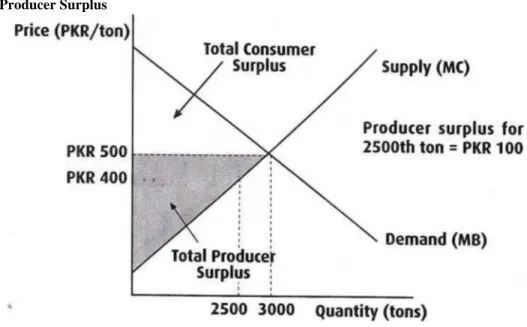
MacroeconomicsBy the end of this chapter you should be able to: n Discuss the basic framework of macroeconomics, i.e. National Income, Inflation, Unemployment, Exchange Rate and Trade Imbalances B Discuss the macroeconomic goals of achieving full employment, economic growth and stability H Discuss marginal benefit and marginal cost and the relationship between the two n Discuss consumer and producer surplus a Explain deadweight loss, overproduction, underproduction a Explain the concept of
trade offs a Describe the characteristics of perfect competition, oligopoly, monopoly, monopolistic competition * Recall the principles of macroeconomic policies for a sustainable economy
33 Economics | Reference
-- ■ i! llimi 41+ III IIIWI
Introduction Framework of Macroeconomics
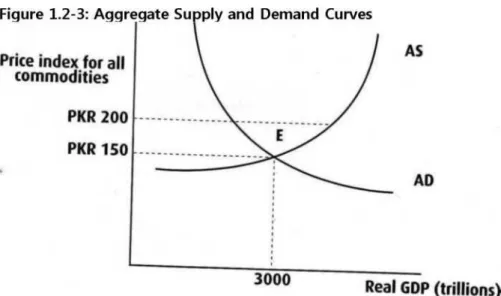
We need macroeconomics due to the fact that there are forces that affect the economy as a whole that cannot be fully or simply understood by analyzing individual markets and individual products. Macroeconomics is study of dealing with economic activities as a whole with respect to the national output, national income, price levels, international trade, balance of payments, unemployment, and inflation, among other aggregate economic variables.
1. Economic Growth
Per capita output has been facing ups and downs for many decades in most industrial countries, alon'jAdth total output. These long-term trends also impact on average living standards. For instance, in Pakistan the per capita income has increased to USD 1250 in 2010 from USD 920 in 2008.
mus a clear objective of macroeconomic policy. 2. Business Cycles
:he economy is not 'Ways stable and goes through a series of um and jowns, called business cycles. When the business cycle is in an upward
. __ d __ 0m; WhCreaS Wh£n is a d th.6
1= jery important for economists, entrepreneurs and managers of firms velop an understanding of business cycles. During recessions most businesses incur heavy
losses, while the survivors face falling profits. On * oth
] r hand, dumg a period of boom, businesses do well due to high '£mand f°rp r o d u c t s, r e s u l t s in higher profits. It is easier for usmesses to expand during boom times while during recession acquisitions, and hostile take-over and even worse, shutting down of busmesses, are likely to happen. Understanding the business cycle is thus important for successful businesses. Decisions on whether to expand ra prices, lay ofFsome of the labor force, introduce new products need
n 0,1 the
'asis of economic situations; therefore it is important or companies to closely observe the business cycle and try to foresee
right bUSineSS dedSi nS
Inflation
Econ'imc growth and inflation go hand in hand. Swings in economic =ty are us.ufy accompanied by fluctuating inflation. Therefore it thp
C
°meSjfiy data* fa- ta government to maintain a balance between rt U°' att£mptS of government ^ control high inflation generally suit m recessions. Therefore an important policy problem that arises
1 m
governments is how to stimulate economic activity without T usi'g inflation. The policy makers, during a time of boom, are often
H ffi ' thdr ro^s t0brl n
g Mata 'der control. When flat on falls after a recession, policy makers often feel that they have so: leeway to stimulate the economy again. Controlling inflation alone =keepmg the economy stable, is not a
simple matter and polio
4. Unemployment
Slowdown in the economy results in unemployment. Unemployment is ery critical matter for the government. Indeed, it was the high unemployment of the 1930s that led to the establishment of the subject
anLo'al5 maCr
f°eC°n°mlcs --- ngly, analysis of the causes of, d potential cures for,
unemployment is still very high on the agenda
of macroeconomics. A new bout of high unemployment can never be ruled out, even for those countries where it has been low for some time.
r Governmentscan reduce unemployment by increasing their spending
ta"xe"e' irnflTeS' th era e £ o g _____________ ent spending and axes to influence the economy is
conomics
35 The price
together to coordinate their macroeconomic goals and policies.
Income policies are government attempts to moderate inflation by direct steps, whether by verbal persuasion or official wage and price controls.
Characteristics of market competition Perfect Competition
The following assumptions should be taken into account relating to perfect competition: ■Identical goods are produced by all the firms in the market
• There is a large number of independent firms
•Each seller is small relative to the size of the total market
■ Entry or exit is barred from any barriers to entry or exit
When it comes to perfect competition, all firms are price takers. Thr demand curve in this situation is horizontal to the x-axis due to th** perfectly elastic demand of the products. The firms can sell all of the* output at the prevailing market price, but if they set their output piioc higher than the market price, they would sell nothing. Due to the
thaf _ .^ey '■ , i w n - - - ^ . i ^ n . ,
k n n n e e r tn--tdrrr°te * * * resources to discovering the best price at wl QPII *r Proc^uct- A “price-taker” market is equivalent to a perfe
competiti
There is ] !i>^ h i e e . . , e‘,„ I : i , . - : n . i r |A i . | v , ! > , _ n : , , hu, . , -
is based on market supply and demand. The individual fir chedule is perfectly elastic.
Monopol istk Competitjon
Monopol o > mp e U i a . > n I i a > ( h o f o l l o w i n ; ; m a r k e t e h aI\Kt c - > : .
A large number of independent sellers:
The market share for every fiirelatvely ;‘ -l !
i i i i i1! ) n r : i i M i I : > - h r , I h l i h m a i l , n \ ■ i - - -
power ove
! pi X n , - , I I , , ! V, jv ; i ( | v,
price rathi
er t h a n t h e price of i n d i v i d u a l competitors. Collusion ([
fixing) is ■ ' i 'l' - ' 1 ■ 1 h . ' l v- .1 i h I I I I I h , I . .
Different pP
ducts\
Pr°ducts produced by each producer are slightly
^Se
fr o m i t s c c '
1 " 1 : 1 ‘ ’ i ' i ' ’ > 11 - - ! ' ■ a i e a - a ! i i ! u ; ! 1 I ! I i h " . n n , , a a . i I I u , competir
1 • ' 1 1 1' ' 1 1
. H e h ' ■ ■ ■ . ' ■ ! } ' ■ . . ! I ! ] I i ^ - 1 , > | m i , ' : - • -
Frms conm^te on price, quality and marketing
as a resultofyffro
different' a t i o n . Q u a l i t y acts as ani n t e g r a l product-differentia
characters - a. I > i ! e I - a ». , ■ , , 1 A , , j . l , , p p , m : J e m m a ! , m ■, i h e . . output can he -e' h\
i i a - , . i . ) u a i i i \ a n a [ M i , : ; h a i L . . n i ! e .. h a e a r n .
usually have a strong correlation between them. To inform or coituthl the product’s characteristics to the m a r k e t , m a r k e t i n g is of ut
importanc -.
U
JWtamers to entry
so that firms are free to enter and exit the i New firms can enter the industry if theexisting firms in the indus
earning ec( a mn i a m m m - . demand s