Anne van der Veen
The development of
Egyptology and its connection
with the National Museum of
Antiquities in Leiden in the
beginning of the 19
thcentury
Egyptology within the museum
The development of Egyptology and its connection with the
National Museum of Antiquities in Leiden in the beginning of
the 19
thcentury
Student information: Supervisor:
Anne van der Veen Mariana De Campos - Françozo
Student number: S1315994 Supervisors Internship:
Course: Master Thesis Maarten Raven
Course code: 1040X3053Y Christiaan Greco
Ma Archaeology: Museum Studies – Archaeology of Egypt
University of Leiden,
Faculty of Archaeology
Content
Introduction ... 6
1. The history of Egyptology ... 11
1.1. From the Classical Ages until the expedition of Napoleon to Egypt ... 12
1.1.1. The Classical Ages ... 12
1.1.2. The Middle Ages... 18
1.1.3. The Renaissance ... 21
1.2. The expedition of Napoleon to Egypt (1798-1801) ... 26
2. The consequences of the expedition ... 36
2.1. Establishment of the National Museum of Antiquities ... 36
2.2. The decipherment of the hieroglyphs ... 43
3. The Egyptian collection of the National Museum of Antiquities ... 52
4. Caspar Reuvens: the first Dutch Egyptologist?... 57
Conclusion ... 63
Abstract ... 66
Bibliography ... 67
Internet ... 72
6
Introduction
“We are a vibrant platform for antiquities and archaeology in the Netherlands”
This sentence briefly summarizes the mission of the National Museum of Antiquities in Leiden. This has rather been unchanged since its establishment in 1818. From that moment onwards, the museum tries to engage a broad public to the cultures of the ancient world and their relevance to our own times, in an inspiring, high-quality, participatory, active way (http://www.rmo.nl/english/organization/mission). This can be complied to all departments within the museum, including the Egyptian collection.
The Egyptian objects in the museum are telling a story which goes back to the Ancient Egyptian period itself. They had a moment of revival during the 19th century
when they were acquired by the National Museum of Antiquities. However, for this thesis it is not necessary to focus entirely on the history of the museum and to give a synopsis on its acquisitions of Egyptian objects, because there are already many good publications available1. Nevertheless, there aren’t a lot of records yet which try
to explain the history of the National Museum of Antiquities through the eyes of the discipline which studies the Egyptian objects: Egyptology.
This thesis examines how the development of Egyptology can be connected with the history of the National Museum of Antiquities in the beginning of the 19th century.
The time and spatial setting of this research question have been chosen as such in order to give the reader an interesting idea about crucial points happened both within the history of Egyptology and the history of the National Museum of Antiquities. The museum was founded in 1818 and Caspar Jacob Christiaan Reuvens was appointed to be its first director. Subsequently, he witnessed the many cultural changes that occurred during the beginning of the 19th century. And not many
7
publications have questioned the connection between him and Egyptology. However, the publication which stands the closest to this topic is written by Hans D. SCHNEIDER who was the curator of the Egyptian department of the National Museum of Antiquities since 1968 and became even the director of the museum in 1979. The publication in dispute is called C.J.C. Reuvens: wegbereider van de Nederlandse egyptologie2. But it lacks a good explanation how Egyptology has ultimately reached
its position in 1818. Therefore it doesn’t reveal much in what kind of setting Reuvens was present.
The development of Egyptology is strongly related on how other cultures saw the past of Ancient Egypt. The thesis will briefly discuss how civilizations, which came in contact with Egypt, approached its past and how these perspectives have changed throughout history. However, the explanation will not be comprehensive and in order to do so I’ll just focus on three periods: The Classical Ages, The Middle Ages and the Renaissance. Each of those periods shows a different kind of perspective toward Ancient Egypt. But is it possible that all three periods share a common approach which will continue throughout history? The literature that I’ve used reveal that the expedition of Napoleon has caused a major impact on the Egyptology. That’s why I’ll describe the expedition apart from the others in order to answer the question if it is true that a new approach in Egyptology occurred at that moment.
When a good impression is formed how Egyptology has developed until the expedition of Napoleon, it’s necessary for this thesis to investigate how it further advanced in the 19th century. This time by connecting it with the history of the
National Museum of Antiquities.
Two consequences of Napoleon’s expedition can be indicated by both the history of the museum and the discipline: (1) the establishment of the National Museum of
2An English translation: C.J.C. Reuvens: pioneer of the Dutch Egyptology. (the complete reference is
8
Antiquities in 1818, and (2) the decipherment of the hieroglyphs in 1822 by Jean-François Champollion.
Both have one aspect in common: Caspar Jacob Christiaan Reuvens. He’ll play a huge role in the interaction as the director of the museum. According to SCHNEIDER, Reuvens has to be seen as the pioneer in Dutch Egyptology, because he made new
discoveries for Egyptology (SCHNEIDER 2007, 67-68). But I would like to find out if that statement is based on relevant facts. His involvement will be questioned with the decipherment (chapter 2.2.) and the acquisition of Egyptian artefacts (chapter 3). Eventually in chapter 4, a definite answer will be formulated if Reuvens was whether or not an Egyptologist.
In order to get to the final conclusion, a strict methodology has been followed. Mostly, the thesis is built upon an extensive literature discussion. I read articles, books and even exhibition catalogues which were relevant for the subject. I discussed them critically in order to see if the main sources I’ve used are correct or did they need to be adapted by statements of other scholars. With main sources I mean the publications which I consulted as a starting source. Each chapter has one or two of them:
There are many publications written about the history of Egyptology and the various perspectives toward Ancient Egypt. So, for chapter 1 it is important to have a good starting publication that differs from others. That’s why I decided to use the works of James S. CURL (1982 and 1994) and The Rediscovery of Ancient Egypt: artists and
travelers in the 19th century by Peter CLAYTON (2005). They both wrote extensively
9
The expedition of Napoleon is of major concern to the thesis. It needs to be described briefly on the one hand, but on the other hand it has to be clear enough to understand how it could have affected the development of Egyptology and the National Museum of Antiquities. In order to investigate the expedition I’ve chosen the article written by PADILLA in Mit Napoleon in Ägypten (2009) for the political discussion of the campaign. The publications of CLAYTON and CURL will still be consulted as the main source for the cultural aspect of the expedition.
Hans D. SCHNEIDER, Ruurd B. HALBERTSMA and Maarten J. RAVEN, three employees of the National Museum of Antiquities were a great benefit for examining the role of Reuvens within the field of Egyptology and the history of the museum in general. But to criticize their work, it’s scientifically justified to look at their information from an outsider’s perspective. When discussing this subject, a visit to the archives of the museum was inevitable to this thesis. Many letters, notes and contracts between Reuvens and other parties are kept in boxes and they are still in good condition. Some of the documents are used for the thesis in order to add important information.
The main sources that examine the effects of the decipherment are written by Hans D. SCHNEIDER. Two of his publications Notes Diverses d'un Futur Grand Antiquaire (2006) and Je tiens l’affaire (1990) are very relevant when dealing with the achievements of Champollion. An old account of Champollion is conserved in the archives and this will indicate that a possible connection between him and the National Museum of Antiquities can be made.
10
First, its uniqueness. Many publications are available discussing the main subjects: the history of Egyptology, the National Museum of Antiquities and the career of the director Reuvens. But the relation between Egyptology and the National Museum of Antiquities is rarely discussed, especially how the approaches toward Ancient Egypt has changed through time and if these could affected the history of the National Museum of Antiquities. There are important records concerning the association of Egyptology and museums, but they don’t focus on the first years of the National Museum of Antiquities in particularly.
Second, some of the important literature are written in Dutch. An English version of the subject will be helpful for the non-Dutch scholar.
11
1.
The history of Egyptology
Today, Egyptology has become a well-known branch within archaeology. At first it seems it has followed the same evolving progress like any other historical discipline, but instead it expresses a very unique identity. It cannot easily be compared with historical sciences nor with its nearest neighbor of classical archaeology. Egyptology deserves a comprehensive explanation how it reached its present position within educational and cultural institutions, such as universities and museums.
When examining the development of Egyptology it’s essential to have a starting point: a moment in time when Egyptology came to its existence. From that particular moment it would have been possible to observe how the discipline develops throughout time in order to understand its position today. Explaining a development is not an easy task, because many different perceptions must be incorporate in order to see how the progress changes through various perspectives from sections as cultural, political, economic, socially and so on. It is always a struggle to explain scientific progresses, but unfortunately for Egyptology an extra problem has emerged. Since there is no clear indication when it came into its existence, scholars still debate when Egyptology exactly appeared. That brings us to different ideas about its starting point.
12
1.1.
From the Classical Ages until the expedition of Napoleon to
Egypt
1.1.1. The Classical Ages
The latest dynasties of the Ancient Egyptian history are marked by internal chaos, war and invasions. The Egyptians had been attacked by several foreign rulers: the Kushites (Nubians), Assyrians and the Persians. Especially under the reign of the latter, Egypt suffered from plunder and destruction. Without a leader the rich culture of Egypt was doomed to collapse. The Persians could not keep on with their ruthless policy in Egypt, because the coming of the Macedonian general Alexander the Great caused them too many problems. Consequently, in 332 BC, Egypt was conquered by Alexander the Great who took over the control. Instead of overthrowing the population and subverting the culture, like the Persians did, he allowed the Egyptian people to continue with their traditions. In this way, the Egyptians were pleased by his arrival. Alexander was seen as their savior (THOMPSON 2008, 96-97).
Based on the fact that the Greek didn’t subdue the Egyptian culture but rather consumed it into their own, they could be assigned to be the first ones who were historically interested about the Ancient Egyptian past and were willing to understand their traditions. This can be proved by the written sources of the classical historians which are still available and the material culture.
13
Ancient Egypt in the Classical Ages. A pot or statue that looks Egyptian doesn’t reveal much further information than that it looks Egyptian. However, I do not immediately agree with this last statement.
The impact of classical historians to the study of Ancient Egypt will be examined first, followed by one example of a Greek object that is based on Ancient Egyptian characteristics. This is to inform that the meaning of objects need to be included as well to explain the perspectives of the Greek on the Ancient Egypt culture.
Written Sources
In the 5th century BC a Greek intellectual went to Egypt to describe its people and
their history: Herodotus (ca. 485-420 BC). He, and later Diodorus and the Roman scholar Strato, were three important historians who wrote volumes which are still used by modern historians today. These books were read throughout history and where for a long time the only available source in Europe explaining the Ancient Egyptian past (CURL 1982, 7; REID 2000, 31;THOMPSON 2008, 94).
This is mainly because of the fact that the meaning of the hieroglyphs had already been forgotten by the common people during the time when Herodotus visit Egypt. The earliest scholars throughout the history could only rely on the works of the classical historians.
Herodotus’s work is the most consulted one. He wrote in his second book of his volume, called Historia, about the Egyptians. He described how they lived and he tried to interpret the history of the country.
14
mode of enquiry, which was based on his exceptional interest in the historical evidence, is a bit exaggerated. Although, he set off a new concept which would continue throughout history and had a true culmination in the Renaissance, this concept was not a scientific correct approach. It embraces the idea that Egypt was the oldest nation of civilized humanity and was a land of marvels (CURL 1994, 2; CURRON 2007, 17).
However, CURRON himself notices a contradiction here. Herodotus, and the classical authors in general, looked at Egypt with two different viewpoints. One, already said, considered that Egypt was the source of wisdom, which can be defined as a positive approach. The second is a more negative one (CURRON 2007,16). The historians were in the first place interested in how the Egyptians lived in opposite of the Greek (as for Herodotus and Diodorus) or the Romans (as for Strato). Like a mirror (HARTOG 1988) wherein the classical historians observed the Egyptians through their own eyes (FROIDEFOND 1971). This explains that Herodotus was not only praising the Egyptians, but he was also very skeptic about their lifestyles. He saw the Ancient Egyptians as “the other” (VASUNIA 2001, 185-215; CURRON 2007, 18).
The Roman empire took control over Egypt after Cleopatra VII had committed suicide and subsequently when emperor Augustus had won the battle of Actium in 31 BC. Egypt now belonged to the Roman Empire. The big difference between Greek and Roman authority in Egypt was that Roman emperors saw Egypt as a private property. Only through its excellence’s permission, a visit to Egypt was possible (CLAYTON 2005, 8). Nevertheless, Egypt was being regarded as an area belonging to the Mediterranean World, just like the Ancient Greek did (CHAMPION and UCKO 2003, 2-3).
15
started this kind of expansion policy, but consistent prove is still lacking. Obelisks were popular features for emperors. These monuments, because of their pure Egyptian architectural style, served as a mark to demonstrate the Roman victory on mighty Egypt. In 10 BC Augustus brought the first obelisk to Rome which he erected in the Circus Maximus. Nowadays, it can be seen on the Piazza del Popolo, Rome (thanks to pope Sixtus V as we’ll see later in chapter 1.1.3.). The transport was very risky and special ships were made to carry the heavy stone monuments as Plinius (or Pliny the Elder, 23 – 79 AD) wrote in his publication Natural History (CLAYTON 2005, 11).
After the first obelisk, emperors erected more than thirteen of them in Rome. Not all of them carry hieroglyphs, because some are blank or have Latin inscriptions. This indicates that obelisks were also produced in Rome (or in the area nearby) and that a lack of knowledge about the hieroglyphs existed (BURCKHARDT 1990).
16
Material Sources (one example)
The Greek Diodorus (80-20 BC) was inspired after reading Herodotus’ Historia. He wanted to see Egypt by himself and he traveled to this “land of marvels”. When observing the architecture and art, he could not disagree with Herodotus to conclude that the Egyptians were the ones who invented the art of sculpture and architecture. He was convinced that the famous Greek sculptor Daedalus probably was inspired by the techniques of
Egyptian artists (CURRON 2007, 20). That’s why the early Greek Archaic kourai (fig 13) have the
same static features as the Egyptian ones (fig 2 4).
To refer back on the statement of MATTHEWS and ROEMER who argue that written sources are inevitable in explaining the psychological meaning behind objects, I would like to add a sentence stated by CURL: “The Greek revived the traditional art and religion of Egypt. And the reason may lay to emphasize the cultural continuity and national identity” (CURL 1994, 6).
3National Archaeological Museum of Athens. Inv.no. 2720
4LANGE and HIRMER 1955, fig 61
17
The cultural continuity and national identity are seen as two individual terms by CURL, but I think it is necessary to combine the two. To gain this national identity, the nation used traditions in art and architecture from other countries which they had conquered, annexed or controlled. Both the Greek and Romans did that.
To show how this could be realized, is by looking at the importance of cities during the Classical Ages. In our case: Alexandria.
With the invasion of Alexander the Great, this city was constructed at the coast line of Egypt to became one of the most vital settlements in the Mediterranean World that influenced the cultural world (THOMPSON 2008, 101-103; TYDESLEY 2009, 199). Slowly the Greek and Macedonian culture intermixed with the Egyptian. This intermediation was possible thanks to a harbor which was constructed during the creation of Alexandria. Even the name of the harbor itself carried a Egyptian-Greek aspect: Isis Pharia. Isis as the Egyptian goddess, and Pharia is the Greek patron of Pharus. Like any other harbor, it was primarily a place indispensable for the economy, but it also worked as a trading post for exchanging objects from other cultures. These objects were not only masterpieces of art, but just ordinary utilized objects as well. Both contributed to the interference of cultures. To use the words of CURL which explain it very clearly: “the capital was to became a fountain-head from which an Egyptian-Hellenistic civilization would flow” (CURL 1994, 3).
Notice the use of the combined term Egyptian-Hellenistic. It is not sure in his publication if he wants to point out that the period was an intermediate time between Egyptian and Greek civilization, or that he focuses on the objects that were exchanged. Because, it isn’t true that only Egyptian and Greek pots were traded in the harbor. All kinds of objects from all parts of the empire arrived in Alexandria and were from there brought else were.
Alexandria was also known as the city with the famous musaeum (Latin) or museion
18
Paula YOUNG LEE wants to know how this musaeum could have influenced the formation of museums in the 19th century when they became symbols of the nation.
She described the musaeum as a Hellenstic feature, because it was founded during the Hellenistic period thanks to a group of scholars. This is another statement than what CURL gives. He thinks that Ptolemy I was the one who came up with the idea to build a central place where culture can be shared.YOUNG LEE suggested that Ptolemy I only supported the project and financed it, but he didn’t conceptualize the idea. We might never know the identities of the scholars, because we don’t know the names of these founders of the musaeum. Nevertheless, to conclude that the musaeum was just Hellenistic is a risk. Besides, it is possible that Egyptian intellectuals were part of the group as well. Then we might consider whether the musaeum was a Hellenistic, Egyptian or a mixture of the two.
The view of the Classical Ages on Ancient Egypt can be summarized in a positive and a relatively negative approach: Egypt as a source of wisdom and mystery and Egypt seen as “the other” based on the perspectives by the cultures with whom Egypt came into contact.
From now on, I will look at if these approaches toward Ancient Egypt will change during the Middle Ages and the Renaissance.
1.1.2. The Middle Ages
CLAYTON tells us that in the medieval times interest in Ancient Egypt revived, especially at scholarly level (CLAYTON 2005, 9). But, other literature describe the Middle Ages as dark times for the development of Egyptology (BURCKHARDT 1990, DONADONI 1990, CURL 1994, REID 2000, CHAMPION and UCKO 2003). And I agree with the latest group.
19
dedicated their lives to Christianity or Islam. The pagan traditions of the Ancient Egyptians (for example, their polytheistic belief) were rejected by the paradigms of the Christians and the Muslims and this makes it seem logical why people avoided Egypt (CURL 1984, 31). But on the contrary, there are records dated from the Middle Ages that indicate that there were indeed people who had a desire to know Egypt better.
CLAYTON builds upon this concept and referred to the work of the German Friar Felix Fabri. This man planned his journey to go to Israel by ship, but he would travel back via Egypt. He was one of the first we know who traveled this way. He wanted to travel through this country to see for himself the route the Hebrews had taken through the Sinai Desert, according to the Bible (CLAYTON 2005, 10).
Friar Felix Fabri was however not the only one. Other fortunate pilgrims were destined to reach the Holy Land and Egypt was just a temporary station for them. From now on, Jerusalem and Constantinople were considered as the celestial city of the Ancient Near Eastern World (CURL 1984, 31). Before that, during the Classical Period, Alexandria was the main center of culture and religion.
20
Like the other periods, Middle
Ages interpreted Egyptian
monuments according to their own mind set. For example, the pyramids. The only explanation they could give to them, when they heard a description from the pilgrims, was to recognize them as the granaries of Joseph (fig 3) (DAVIDS 2000, 61). This in order to stay within the acceptance of their Christian belief.
As it is aware, not all people, with a wish of pilgrimage, could make the trip, because of the simple fact that they didn’t had enough money. There is, however, another reason why Egypt was not a popular travel resort back in the Middle Ages.
The successful invasions of Arab tribes in the region, caused a situation in Egypt that didn’t permit foreign travelers easily. Those Arab tribes were compelled followers of the Prophet Mohammed and within no time Islam was the dominant religion which created a strong union. It’s still a mystery how this religion could influenced the population at that enormous speed and effectiveness (OCHSENWALD and NETTLETON FISCHER 2011, 19).
The traditions of Christian belief may look unique, but there are indications of some ceremonies that could be originated from other religions, and concerning this thesis some of these indicate a possible derivation from Ancient Egypt.
In the art of the Church are some features hidden that can be inspired from Ancient Egyptian religion: humans with heads or other parts of the body from an animal.
Figure 3: A section of the Third Cupola of Joseph, Basilica of San Marco, Venice (mosaic:, 13th century)
21
Unlike the Egyptian belief, these strange creatures were depicted as demons and monstrous figures coming from hell (CURL 1982, 31). They might thought this illustration came from the Roman paintings and fresco’s, but without realizing it that the Romans already copied them from Egyptian wall paintings and reliefs (BURCKHARDT 1990).
Thanks to Christianity in medieval Europe, Egypt had not be totally forgotten. CURL explains it very clear: “due to the inaccessibility of Egypt, it increases its fascination” (CURL 1982, 33).
1.1.3. The Renaissance
Beside the continuation of this fascination during the 16th century, there is a turning
point to be detected within the approaches toward the study of Ancient Egypt. The Renaissance is a period when a new philosophy entered the minds of the people after the restless Middle Ages. The announcement of the 16th century is however
artificial, because the Renaissance is dispersed over a larger time period. I think that this implies why CLAYTON thought the increased scholarly of the study of Ancient Egypt had started to develop in the Middle Ages. The time frames of historical period is artificial: for some the 16th century was still a part of the Middle Ages, for some the
Renaissance occurred in the 17th century. I encounter this problem when reading the
literature concerning the views in the 15-16th century, because they were similar.
However, most authors comprise the 16th century to the Renaissance (WORTHAM
22
Can we decide that these “new” publications were scientifically correct? Simply put, no. There was still a long way ahead before scholars could use other ones publications as a source for academic dissertations.
However, the door to a different approach toward Ancient Egypt was opened and a distinction between the Middle Ages and the Renaissance is definitely justified. Because, what DAVIDS says: “these new publications from the Renaissance provide a first-hand contemporary narrative which augment the earlier classical authors” (DAVIDS 2000, 60). So no longer they were additionally essays to the Bible.
Another interesting perception of what DAVIDS has encountered, is that throughout the Renaissance two kinds of people can be observed who both had a different motive to travel to Egypt.
The first group are those who wished to study Ancient Egyptian past. The other one shows us how the inspiration of objects from Ancient Egypt can resulted into another desire than just a study. The second group is thus interested in the collecting of objects: treasure hunting (DAVIDS 200, 60-61).
This is different than the motive from the Middle Ages, because Egypt was a halt during their pilgrimage to Jerusalem. Besides, Egypt was then a country best to be avoid because of the danger of being captured by Arab troops.
The first group who wanted to study Ancient Egyptian history followed the more positive approach.
The second motive relatively a negative one. These people saw a precious value of the Egyptian artefacts and went to Egypt to collect these artefacts to sell them to the elite in Europe. A big collection mania was soon to be started, but it was mainly the beginning of the establishments of museums. And this had a culmination during the 19th century (DAVIDS 2000, 60-61). The impact of this group is best to be observed
23
artefacts, for collections in museums and personal cabinets, became a big business (see chapter 3).
Now, we discuss the achievements of the first group in more detail, because it suits more to our search to the answer when the study of Ancient Egypt actually begin to emerge in a correct scientific way.
George Sandys was a traveler from England (DAVIS 1955) who was inspired about Ancient Egypt by one of the conceptions of the Renaissance movement which sought enlightenment about the ancient civilizations. Figure 4 shows that the pyramids where now depicted in a correct way –more or less–, and where not based on stories of few persons who made the trip and returned to Europe alive. Based on this plate from his journal A Relation of a Journey Begun (1621) (DAVIDS 2000, 64), there is now prove that writers had really been to Egypt.
Sandys traveled to Rome which became the city to study (DAVIDS 2000, 64). Rome was the capital that attracted scholars from whole of Europe, including the ones who had a desire to study the history of Egypt. This is quite a
reformation from the Middle Ages who saw Ancient Egypt as a pagan culture not worthy
to be studied. However, it did became possible in the reformations of the Renaissance thanks to the reorganizations done by pope Sixtus V. His efforts were the restoration and transportation of obelisks.
Figure 4
24
The obelisks, which were confiscated by the Romans, were still standing in Italian cities. During the Middle Ages they were neglected by the people who had no idea where these monuments were originated from. But thanks to pope Sixtus V (1521-1590), they were giving new life, restored and transported to other locations (CLAYTON 2005,19).
But I wonder why these obelisks weren’t destroyed by radical Christians who saw those obelisks as a pagan symbol? To just confirm on the explanation that people leave them alone because they didn’t knew what to do with it else, is unjustified to me. So, another reason should explain why obelisks still remained in Rome. The most famous obelisk in Italy is the one standing on the Saint Peter’s Square at the Vatican. To clarify why even this obelisk -right in the heart of Catholicism- wasn’t destroyed, is worth an explanation.
BURCKHARDT comes with a Christian legend called the myth of Saint Peter (BURCKHARDT 1990). Saint Peter was martyred in Rome and the obelisk was therefore regarded as a silent witness/a trophy that indicated the square of the Vatican as an area associated with a monument erected in the area of Peter’s victory, according to O’CONNOR, (O’CONNOR 2013). Domenico Fontana, an architect from Milan, transported this obelisk and three other by the order of pope Sixtus V who saw these monuments not as a symbol of paganism, but as a mark of education and religion, suitable for the Church (BURCKHARDT 1990) .
Anthanasius Kircher (1601-1680) too was an earlier scholar who belonged to the first group of during the 16th century. He was not an adventurer such as Sandys, but was
25
The second group, who saw more potential selling artefacts than to study them, is larger than the first group. A treasure hunt appeared in Egypt during the Renaissance when people in Europe saw the beauty and value of an Ancient Egyptian object, and this collection desire continues until this day. The situation began to escalate and out of control, so wealthy people hired diplomats to collect artefacts for them (DAVIDS 2000, 61). Diplomats knew the country, understood the market and most importantly, they could collect the artefacts legally.
The importance of this collection desire has a reflection on the development of Egyptology and a more direct one upon the establishment of museums. This will be discussed in the third chapter of this thesis.
So, during the Renaissance a more open approach toward Ancient Egyptian culture began to grow. And during the 17 and 18th century onwards, this openness became
more and more related to scientific research.
But to stay rational, the publications were still based on phantasy and the travels were written like adventure stories. For example, the work of Savary (Lettres sur ‘Egypte, 1785-6) contains information about the Ancient Egyptian culture, although it was mainly a dissertation of phantasy (DONADONI 1990, 108).
The days of exaggerated travelers’ tales were coming to an end, but still Egypt was a country of fascination.
Short conclusion
26
mystery of Egypt” was due to its inaccessibility, quoted by CURL. Unlike CLAYTON has said, the publications about Egypt were scare and the few accounts that existed stated Ancient Egypt as a land from known from the Bible. In the 16th century more
publications were written. Still, Egypt remained an mysterious inspiration for the travelers, because their accounts are based on inaccuracy and phantasy, except for few who tried to look at Egypt in a more scientific way: George Sandys, for example. Most of the knowledge of Ancient Egypt ended up primarily in art and architecture. But it has more than just an esthetic meaning for the people who adapted or re-used the Egyptian culture. It had also a social, political and even an economical influence upon the society (CHAMPION and UCKO 2003, 1). And this is applicable for every society from every period in history who had contact with Egypt.
1.2.
The expedition of Napoleon to Egypt (1798-1801)
This chapter shows us how the view and interpretation on the study of Ancient Egypt can radically change thanks to one historical event: the expedition of Napoleon to Egypt. Beside its impact on the development of Egyptology, it had a reflection on the history of the establishments of museums as well, in our case: the National Museum of Antiquity. However, it is the question how much it really influenced the museum in Leiden.
27
motives, it’s important to know briefly the political purposes for Napoleon to travel to that faraway land of Egypt. Because without this information, and without knowing the broad context, the cultural motives will eventually have no value and no meaning.
There are two political motives that led Napoleon to Egypt: foreign matters and due internal problems with the French Parliament called the Directoire (ENG: Directory).
Together with Great Britain, France was a superpower in Europe during the 18th and
19th century. Great Britain had absolute authority over the Sea Ways and controlled
the passage to India and, subsequently, to the other regions of Asia. The British ships had directly access to sail overseas and dominated the trade to the exotic species coming from those Asian countries (OCHSENWALD and NETTLETON FISCHER 2011 , 261-262).
The decision to defeat the powerful British in order to stop their ambitious expansion for becoming more powerful did not originated from Napoleon alone. It was the
28
therefore controlled the trade route of exotic goods, but Egypt itself was also famous for its fertile lands and its production of cotton and grain (THOMPSON 2008, 228).
Wherever the emphasize had been laid, the invasion was political and economic embedded. In France the internal political situation was another reason why Napoleon went to Egypt. This sentence must be altered a bit, because Napoleon was send to Egypt after the decision of the Directoire.
This committee had been established in 1795 when king Louis XVII was executed. After the execution the chaos maintained in France between the loyalists of the monarchy and the revolutionists in which Napoleon played an active role. The aim of the Directoire was to create order, but instead, the Directoire had difficulties to maintain the balance between its own members. When they tried to create a new administrative system and to integrated it within the old ministerial framework, a division appeared between senior staff and their inferiors in the hierarchy. The inferiors argued about the inequality of the status and salary between them and the senior members (CHURCH 1967, 60 + 72; SOBOUL 1962, 478-80). This caused a huge tension which was felt by the common people in France. They were desperate for peace, especially after the French Revolution, and with the failure of the Directoire,
they wished for a coup from a person who finally understood their needs.
29
Directoire appointed Napoleon as the general of the French military expedition to Egypt (PADILLA 2009, 159)5.
Based on the statements above, the political aspects of the expedition have to be attributed by the Directoire. When questioning the cultural motives we need to take a look at why Napoleon himself wanted to travel to Egypt.
Many of the literature, which concerns about the cultural aspects of the expedition, mention the fact that Napoleon had a special interest for the history of Ancient Egypt which wasn’t comparable to any other leader who wanted to conquer Egypt before. According DONADONI, Napoleon wanted to verify the old approach toward Ancient Egypt of being a land of wonder and mystery (DONADONI 1990, 106).
But, did Napoleon had such a special interest in history? Or was it because he wanted to understand Egypt better, so he could control the nation with more stability (CONNER 1983, 29)? I tried to be skeptic about the reason why Napoleon eventually set off to Egypt. Although, it seems clear to me that Napoleon indeed had intentions to change the old approach toward Ancient Egypt.
A good statement which approve that Napoleon did had an interest in ancient history is the fact that many scholars accomplished him on his expedition.
Before Napoleon set sail to Egypt on May 1798, he ordered two head scholars of de
École Polytechnique in Paris, named Gaspard Monge and Jean-Baptiste Joseph Fourier, to gather other scholars to form a special committee that would travel with him to Egypt. This committee was called La Commission des Sciences et des Arts en Egypt. Monge and Fourier grouped as much as 167 experts or savants (DONADONI 1990, 106; PADILLA 2009, 159). The average age was approximately 25 years. Why did
5 Note: In 1799, when Napoleon returned to France, he overthrew the Directoire and appointed
30
Monge and Fourier choose such young and inexperienced men for such a huge expedition to an unknown country?
Back then, the youth of the savants didn’t instantly mean that they were all naïf, because it was normal for men to start their career when they were just teenagers. It was to believe that people tended to gain experience at an early age and during their training they passed on to a ministry (CHURCH 1967, 64).
In spring 1798, Napoleon arranged a meeting of the new Institute of France at Paris. He addressed to the savants on the importance of the expedition and how the consequences would give benefit to the increasing professionalization of disciplines (archaeology, Egyptology,…) and he urged them for a strong intellectual support. According to FAGAN, minister Tallyrand-Périgord, had espoused this idea years before (FAGAN 2004, 47; CHAMPION 2003, 78). Nevertheless, Napoleon was not the first
authority who sent scholars to Egypt. King Christian VI of Denmark ordered Frederic Louis Norden (1708-1742) to visit Egypt in order to make a publication that would eventually be applicable for the public. Christian VI saw the potential of the need of good scientific publication concerning Ancient Egypt. In 1755, Norden’s work Voyage d’Égypt et de Nubie was finished and it contained drawings of monuments. Although, it didn’t add information about the history of Ancient Egypt (FAGAN 2004, 43-44; CLAYTON 2005, 13).
On July 1799 Napoleon arrived in Cairo (THOMPSON 2008, 220; OCHSENWALD and NETTLETON FISCHER 2011 , 262). There he founded a subsidiary institution of the Institut
de France at Paris and called it: Institut de l’Égypte (FAGAN 2004, 48). It was here, that the savants could perform their studies, including their research on Ancient Egyptian culture. The building contained a library and even a small museum (CONNER 1983, 29).
31
legal business which can be summarized in what COLLA has pointed out: Ancient Egypt and its treasures were the rightful patrimony. That was basically the central colonial assumption of early European antiquity collectors (COLLA 2007, 11).
It is undeniable that the French didn’t collect artefacts without the intension to transport them to France and to be placed in the museums (CONNER 1983, 28-29). When the British defeated the French, they pointed out in a degree that every single artefact which had been discovered by the French needed to be confiscated. They were allowed to keep their notes (degree: Article XVI of Capitulation of Alexandria). This has caused the surrender the famous Rosetta Stone. (ANDREWS 1982, 11). The impact of this “stone” to the development of Egyptology will be discussed in the chapter 3.2.
But when the British defeated the French and Napoleon left the country (also due internal problems back in France which eventually resulted the coup by Napoleon in 1799), the French influence in Egypt still remain. The savants were “trapped”, as Reid stated. This is depicted on a print made by cartoonist James Gillray (fig 5). For the British the French campaign was regarded as a total failure, because they confiscated the artefacts for the British Museum, instead of the Louvre. The print shows how the French savants are trapped on top of the Pompey’s Pillar and are threatened by soldiers of the Mamluks (who fought among the British to defeat
Figure 5
32
the French) (BRIER 1990, 12; REID 2000, 34-35; CLAYTON 2005, 18).
But must we conclude that the expedition was a total failure? Apparently not for the development for Egyptology.
When Napoleon realized that his campaign was a military disaster, he tried to be triumphal on cultural achievements (REID 2000, 32) which are (1) the establishment of the Institut de l’Égypte and (2) the publication of the Description de l’Égypte.
This last one he urged as a true state project in 1802 and in 1804 the first edition came on the market (CLAYTON 2005, 27). This work contained 24 volumes, 930 engravings, published by various editors between 1809-1828 (CONNER 1983, 29).
The completion of the Description was therefore commemorated by a bronze medallion (fig 6). Here a general in Roman outfit symbolizes France who unveiled a queen (Egypt). On the other side are Egyptian motives such as a scarab (symbol of the sun god), the ankh-sign and Egyptian deities (CURL 1984, pl.81; CLAYTON 2005, 27).
Figure 6
33
A total different approach to the expedition than what James Gillray wanted to express.
From all the 167 savants, there is one person of special interest to this thesis: Dominique-Vivant Denon (1747-1825). Unlike the other savants, Denon had much more experience in the field. He was the supervisor of a collection of antique gems under King Louis XV and he was employed at the French Embassy in Russia (FAGAN 2004, 47-48). Denon travelled with the escort of General Louis Chales Antoine Desaix de Veygoux and his efforts were published in a folio called Voyage dans la Basse et la Haute Égypte in 1802 in London (HALBERTSMA 1995, 86; CLAYTON 2005, 18).
It’s remarkable that London was the location of the publication, because the British were not only enemy to France based on political problems, but also on cultural reasons. I couldn’t find a good justification which could explain why Denon’s work was welcomed in England. Perhaps it was because the British knew that they lacked important publication about Ancient Egypt.
Denon also worked on the Description by adding drawings and notes. but his Voyage
contains more details.
Denon didn’t only contributed to Egyptology, but also on the development of museums. He became the first director of the Musée Napoléon and obtained a policy of collecting which was revolutionary. He examined, documented and conserved the objects (SCHNEIDER 1981, 13). This principle will be followed by Caspar Reuvens as this will be pointed out in chapter 4.
34
Shouldn’t we be more careful about making conclusions on Egyptology based on the work of the savant now we know that they apparently didn’t had any Egyptological experience?
I’ve found the answer in the article of FAGAN and REID: yes, we must be careful. For example, the savants didn’t discover new sites (FAGAN 2004, 56) and very few made the trip to discover Egypt by joining a military escort, like how Denon did.
The increasing of publications about Ancient Egypt which is seen since the Renaissance (chapter 2.1.3) has its
culmination during the expedition of Napoleon. Still, the results must not be overestimated based on their scientific use. Besides, since the discipline of Egyptology didn’t exist, the hieroglyphs were a mysterious feature too. I would like to illustrate this by a print (fig 8) made by Benoît de Mascrier (REID 2000, 29, figure 10). Left we see the obelisk “Cleopatra’s Needle” and on the right “Pompey’s Pillar” (the same which has been used on the print by James Gillray: fig 7) De Mascrier drew the hieroglyphs on the obelisk with quick hand without any precision and this assumes that (1) the hieroglyphs were still illegible, and (2) the publications remain inaccurate.
The work of savants had a practical end in view and was intended to serve as a basis for improving the agriculture, medicine and general administration of Egypt, as soon as the nation had been annexed by Napoleon (CONNER 1983, 29).
Figure 7
35
Although, we have concluded that the journals from earliest visitors, who came to Egypt before the arrival of Napoleon, were not based on academic principles, it seems that the work done by savants was brilliant but it must not be overrated.
After Napoleon’s campaign in 1789-1801 a huge interest in Ancient Egypt rose up in Europe.
The Description written by the savants became model for long-range archaeological explorations and thanks to its the popularity and profit, the French government was able to re-establish the Institute de l’Égypte in 1886 which started to publish a bulletin (IFAO = Institut Français d’Archéologie Orientale).
The other consequence was the uncontrolled desire to collect Egyptian artefacts to fill up the new museums that came into existence during the 19th century. This was
thanks to the transport of the Egyptian artefacts from Egypt to the West (mostly to England after they defeated the French in Egypt) (DONADONI 1990, 111).
36
2.
The consequences of the expedition
Among the many consequences of the Napoleon campaign in Egypt, two events are important for this thesis, because they are linked to the National Museum of Antiquities. One more directly than the other.
2.1.
Establishment of the National Museum of Antiquities
The French Revolution, which started around 1789, was a crucial point of change and radical modification within culture and museum world. I believe that the expedition of Napoleon, triggered the collecting of objects at a new level which shaped the establishment of museums in general and the National Museum of Antiquities in Leiden (1818) particularly.
During the 19th century disciplines underwent a big transformation which explains
the increased professionalization and institutionalization (MOST 2002, VIII; CHAMPION 2003, 78), such as Egyptology. This transformation was, to borrow the words of HOIJTINK “the implementation of archaeology (Egyptology) within the study programs at universities” (HOIJTINK 2012, 48). But I would like to add that this enclosure also occurred in museums as well. I want to point out here that Egyptology didn’t immediately find a place in the museum as an academic discipline, but as “a result” from acquisitions of Egyptian artefacts. The history of the acquisitions of the National Museum of Antiquities will be further discussed in chapter 3.
37
The king of the Netherlands Willem the First saw how important museums were to the society and for the status of his nation abroad.
Because from the moment museums were created, the main aim for them was to attract international visitors (HOIJTINK 2012, 69-70). With France and England as the big nations concerning museums, the Dutch king realized that it was impossible to compete with them.
Luckily the Netherlands didn’t lack from artefacts at all. In Leiden itself were interesting ancient objects conserved, even some remains of Egyptian mummies. These were used as study material during classes at the Theatrum Anatomicum. But since this academic institution was abandoned in the 18th century, those neglected
objects needed a new location (SCHNEIDER 1981, 12; RAVEN 1994, 149). The University of Leiden had also another collection which consisted some classical statues and vases. These were given by Gerard van Papenbroack in 1742. It was subsequently put into the orangery of the Hortus Botanicus which seems to be a building with a very bad climate condition for statues (SCHNEIDER 1981, 16; HALBERTSMA 2003, 16-20).
So, it was during the increasing creation of museums abroad that Willem I wanted to establish a museum in his own country. He shared his plans with the Ministry of Education whereby Anton Reinhard Falck (1777-1843) was the Head of the department.
38
They both agreed with a plan that can be summarize into two major projects. First, they had to select someone to be the first professor in Archaeology in Europe. The second project was to establish a national museum of antiquities. And, as already pointed out, this became a true struggle, especially finding a suitable location.
First, focusing on the appointment of the first professor of Archaeology and how this could be a benefit to the Egyptology.
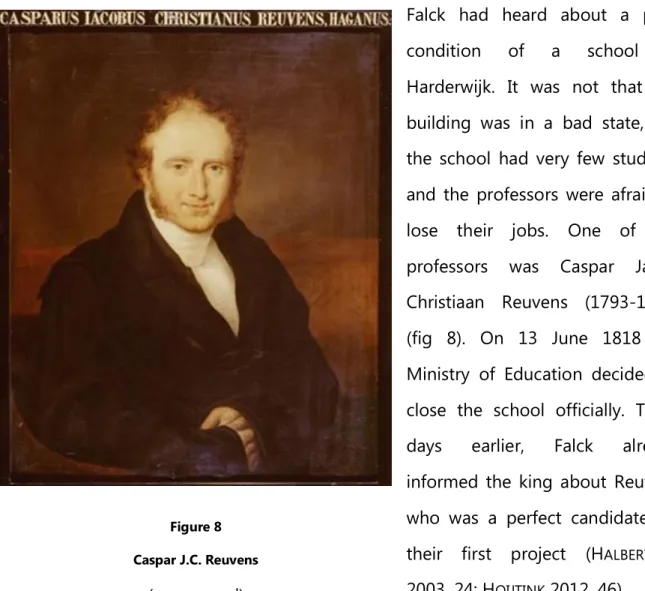
Falck had heard about a poor condition of a school in Harderwijk. It was not that the building was in a bad state, but the school had very few students and the professors were afraid to lose their jobs. One of the professors was Caspar Jacob Christiaan Reuvens (1793-1835) (fig 8). On 13 June 1818 the Ministry of Education decided to close the school officially. Three
days earlier, Falck already
informed the king about Reuvens who was a perfect candidate for their first project (HALBERTSMA 2003, 24; HOIJTINK 2012, 46).
But why did Falck choose Reuvens in particularly? In order to answer this question without creating some confusion, we need to take a closer look on the life and personality of Reuvens. This is necessary to fully understand how Reuvens became in contact with the new disciplines of archaeology and eventually Egyptology as well.
Figure 8
Caspar J.C. Reuvens
39
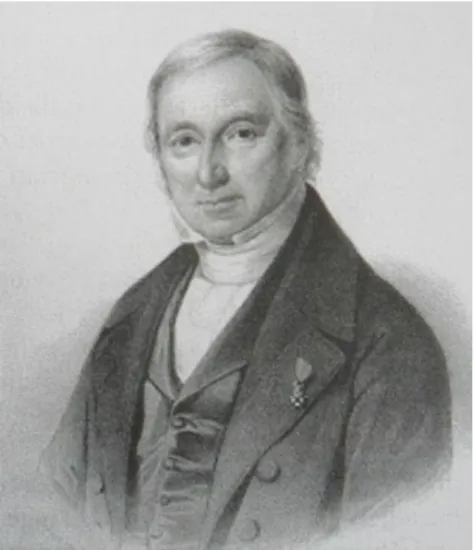
Caspar Reuvens started his high school career in 1808 at the Athenaeum in Amsterdam (the former of the University of Amsterdam today). There he was educated by a professor of Classical Studies named David Jacob Van Lennep (1774 – 1853) (fig 9). This man was a classicist, but he was very interested in other historical disciplines, including in the earliest state of archaeology (SCHNEIDER 2007, 56). Van Lennep and Reuvens shared the same interest and this could explain why they kept in touch when Reuvens went to Leiden to study Classical Studies (see for more information in: BRONGERS 2002, 55) and even when he moved to Paris for his Law Studies.
Paris underwent lots of reformations during this time of the French Revolution. After the coup of Napoleon, the city became the new capital of art: a switch from Rome to Paris (HASKELL and PENNY 1981, 108). It’s obvious that Reuvens witnessed these radical changes when he went to Paris in 1811. He, however, moved there not for archaeological and artistic reasons, but to complete his Law Studies. His father Jan Everard Reuvens, the Dutch Minister of Justice, was asked by Napoleon to work at the Imperial Court of Cassation in Paris. Caspar Reuvens followed him in order to assure his future
as a jurist (BRONGERS 2002, 56; HALBERTSMA 2003, 21). However, it cannot be denied that Reuvens didn’t visit the Musée Napoléon at all, which became the central place where all changes within the world of museums was visible. The reason why recent scholars (the curators of the National Museum of Antiquities and BRONGERS believe that Reuvens’s interest in museums and archaeology must be search by his friendly relationship with professor Van Lennep (BRONGERS 2002, 55).
Figure 9
David J. Van Lennep
40
During Reuvens’s study in Paris, Van Lennep arranged a meeting between his pupil and his fellow colleague Jean François Boisonnade de Fontarabie (1774 – 1857) who lived there and occasionally informed Van Lennep about the developments of historical sciences in France, including the newest updates about Egyptology. Reuvens too stayed in contact with this man. For example, a publication about
Collectanea Litturia written by Reuvens dated from 1815, was owed to Boisonnade (BRONGERS 2002, 56; SCHNEIDER 2007, 56-58).
The relation between Reuvens and Van Lennep didn’t diluted when Reuvens graduated in laws and returned to Leiden in 1814. He started his career as a jurist – which was usually the first job for young man in those times- (HALBERTSMA 2003, 21). It seems that Reuvens didn’t really like this kind of job and probably contacted Van Lennep about his frustration. His old professor helped him and arranged a job for him as a teacher at the Athenaeum at Harderwijk, but he couldn’t have done that without the interaction of the Education Department of the Dutch government. This time Minister Anton Reinhard Falck comes into the picture. Van Lennep and Falck worked in the same branch of the society, but they were also good friends during their studies (SCHNEIDER 2007, 59). But maybe Falck already knew Reuvens before Van Lennep contacted him and met Reuvens since he probably knew Jan Everard Reuvens as a Minister of Justice. However, I cannot verify this speculation, because I didn’t find any letters confirming this statement.
41
Falck wrote to the king himself (HALBERTSMA 2003, 24; HOIJTINK 2012, 46):
“The profession of ancient languages, that of Mr. Reuvens, is well taken care of at all universities, and there is no special vacancy at the moment. But Mr. Reuvens has acquired a special taste for Archaeology, the knowledge of antiquity, elucidated by remaining monuments, about which until now at our universities no teaching has taken place. This profession could be offered to him, and this profession are available” 6
When this letter reached the king in 1818, he accepted the offer and on 13 June 1818 he appointed Reuvens not only to became the first professor of Archaeology, but to be the first director of a national museum of antiquities as well. Remarkably, this museum didn’t existed yet, concerning a building (SCHNEIDER 1981, 14; HALBERTSMA 1995, 30; HALBERTSMA 2003, 21+25). It was called first the Archaeological Cabinet and contained only the collection of Gerard Van Papenbroek which belonged to the University of Leiden.
For some this appointment of both a professor and a director was an unique occasion. Tough Reuvens was the first one who gained these two titles.
The French Louis-Aubin Millen (1759 – 1818) organized educational sessions to make archaeology popular. He was a professor of Classical and Medieval Studies in Paris. With his appointment as professor he too was selected to be the keeper of a cabinet situated in the Bibliothèque de Roi in 1794 (HOIJTINK 2012, 47). This model was thus
6ARA-II Staatsecretarie 632 (Algemeen RijksArchief The Hague).The original text of the letter in Dutch:
42
followed by the Netherlands. However, Reuvens was indeed appointed as the first professor in Archaeology in the world.
As we already had pointed out, during the 19th century the big countries of Europe
were very active in creating national museums and king Willem I of the Kingdom of the Netherlands tried to compete with them (SCHNEIDER 1981, 12; HALBERTSMA 1995, 30). So the king accepted the offer of his minister and Reuvens became professor of archaeology and subsequently –by following the French– he came in charge of the Archaeological Cabinet. Reuvens added his own collection of numismatics to it. When he was asked by the University to explicate what the cabinet was still lacking in order to become a real museum, Reuvens pointed out two things: the transportation of the objects to a better location and the need of purchasing more objects (SCHNEIDER 1981, 16). In order to request the support of the king, was not the problem, because the king even gave the new director a budget to buy those missing
objects to include these with the small collection (HALBERTSMA 1995, 11). But the co-operation with the other party, the University of Leiden, was a constant struggle. I will not go into further details about this matter since this subject has rather no value to this thesis. The work by SCHNEIDER (1981), HALBERSTMA (1981 and 2003) and HOIJTINK (2012) are excellent accounts which discusses this problem in greater depth.
43
2.2.
The decipherment of the hieroglyphs
When in Europe the Egyptian objects became popular and when the Rosetta Stone was displayed to the public in 1802 (ANDREWS 1982, 12; SCHNEIDER 1990.16), the desire to understand the hieroglyphs was again revived.
The Rosetta Stone is inevitable to the history of the decipherment of the Ancient Egyptian language. It mentions three different scripts: hieroglyphs, Greek and Demotic.
The circumstances of the discovery of the stone are controversial. Some sources argues that it was found by a lonely soldier, others proclaimed it to a general. And even than there are some different points of view. For example ANDREWS believes that a lieutenant Pierre François Xavier Bouchard ordered soldiers to clear the way in order to construct a fort near Rosetta. And by the demolish of some walls, they founded the stone (ANDREWS 1982, 9). However, DONADONI and CLAYTON agree with the fact that how the stone was found, but assigns that a general called Louis-Joseph Victor Julien ordered the demolishing and that Bouchard was the lucky discoverer of the stone (DONADONI 1990, 111; CLAYTON 2005, 25).
44
It was Jean-François Champollion (1790-1832) who cracked the code in 1822. The connection of this event within Egyptology can be consulted in the archives of the National Museum of Antiquities. For example, a pre-study of Champollion has been conserved when the progress is to be seen how he eventually deciphered the code of the hieroglyphs, but it shows his museological interest as well. Another
These archive documents will be used in this chapter in order to investigate how the museum in Leiden reacted on the decipherment which started a new approach toward the study of Egyptology.
Jean-François Champollion is assigned by every author I’ve read to be the decipherer of the hieroglyphs (for example CLAYTON 2005, 26). But was he indeed the first? Apparently, a whole history of the decipherment can be explored even before Champollion comes into the picture. A brief description about the history will be given. But to avoid lots of names of people who did some previous attempts to crack the code, I divide two groups which both approached the hieroglyphs in a different way: the first group believes that the hieroglyphs are just ideograms, symbols without any phonetic meaning. The second one assumes that the hieroglyphs are a mixture of ideograms and phonetic signs.
As modern Egyptologist, like James P. ALLEN, the second group follows the correct approach (ALLEN 2009). It is supposed that Champollion discovered the approach of the second group. But is this true?
According to ANDREWS and CONNOR, Thomas Young was the first one who confirmed that he hieroglyphs were depicting both ideograms and phonetic signs (ANDREWS 1982, 13-15;CONNOR1983, 31.). He discovered that in 1814 when he obtained a copy
45
that Champollion always knew that Young had detected the correct code of the hieroglyphs, but he had never admitted that in print (ANDREWS 1982, 13-15). The reason behind the fact that Champollion has assigned to be the decipherer of the hieroglyphs is because of is relatively extensive grammar. His list of translations of names and other terms was longer than the one which Young had given to Champollion himself and Champollion published a readable grammar in 1824 called
Précis du système hiéroglyphique des anciens Égyptiens (DONADONI 1990, 136).
The theory about the hieroglyphs of the first group had been sustained until 1822. However, as we will see, some of the contemporary scholars of Champollion were not immediately convinced by the new theory (ADKINS 2000, 5; REID 2000, 41-42) and were needed some extra support to be convinced about the correct approach ultimately (SCHNEIDER 2007, 61-64). And this support was added by Van Lennep who had close relations with Reuvens.
The name of Athanasius Kircher (1601-1680) has to be mentioned when discussing the first group. Kircher didn’t write a grammar in order to how to read hieroglyphs, and even if he did, he would not successful. However, he had some points that helped Champollion with his discovery. Kircher was the first who pointed out that if people want to read the Ancient Egyptian script they should understand Coptic. Because Coptic was a later variant of the hieroglyphs (SCHNIEDER 1990, 9; BURNETT 2003, 1-15).
It was not the fault of Kircher that he was at the wrong track. The Ancient Greek were the ones who said that hieroglyphs were just pictorial signs. And this continued in the Middle Ages and the Renaissance, because they were relied to the publication only known back than which was the Hieroglyphica by Horapollo. It was discovered in the 15th century and assumed to be a primary source from Egypt, but it was written
46
The hieroglyphs were illegible until 1822. And as has been pointed out in chapter 1.2. the savants during the expedition couldn’t recognized the different shapes of the signs and draw them without much precision (see figure 7 on page 35).
His mission to decipher hieroglyphs of Jean-François Champollion probably started when he Champollion met Jean-Baptiste Fourier scholar who accomplished the expedition of Napoleon (DAVIDS 2000, 79; chapter 1.2 of this thesis). DAVIDS doesn’t mention where this meeting occurred but according to Adkins this happened when Champollion went to Paris in 1807 after he graduated from Classical Studies in Grenoble (France). Fourier as an administrator of the Institut de France showed Champollion the small collection of the Musée Napoléon and the young scholar was inspired (ADKINS 2000, 51+71).
Based on the fact that he, at the age of 16, presented a lecture about his assumption that the hieroglyphs were –like Kircher had pointed out– an old variant of Coptic, it is clear that Champollion had developed a special interest in the Ancient Egyptian writing.
Champollion’s discovery caused a division between the scholars. Most of them were praising him, including Reuvens and Van Lennep.
It was Champollion’s own professor Antoine Isaac Silvestre de Sacy (1758-1838) who was not convinced about the new theory and even tried to Thomas Young that Champollion was wrong (ADKINS 2000, 5; CLAYTON 2005, 47). It’s not clear why Silvestre was such a hostile against Champollion. Perhaps, he was jealous about his fame or he didn’t like the fact that Champollion was a supporter of Napoleon’s policy and Silvestre might have been a royalist.
47
In 1825 Champollion presented a lecture about the decipherment of the hieroglyphs and the Dutch media became interested. Subsequently, Reuvens and Van Lennep were enthusiastic about the new discovery within the field of Egyptology. They decided to invite Champollion to be a member of the Royal Dutch Institute7 where
they too both belonged to. Champollion however never, although he write to his brother that he was very honoured about the of the Dutch scholars (SCHNEIDER 2007, 62):
Mes compliments à Quercetanas, le greffier de dure tête, que je soupçonne être l’ agent de mon apothéose à Amsterdam (note 32) .
Van Lennep perhaps was more frustrated about the fact that there were still scholars who were not convinced by the new theory of the hieroglyphs and published an article in the Bulletin Férussac (april 1826) were he states that those who did not accept the new grammar of hieroglyphs should first read the Précis du système hiéroglyphique des anciens Égyptiens before complaining. It was mainly addressed to a German scholar Gustave Seyfarth who too was very skeptical about the new philological discovery within Egyptology (SCHNEIDER 2007, 64 note 34), but I believe that even Silvestre would have thought twice before he criticized Champollion’s work. Reuvens too wrote very positively about the decipherment of the hieroglyphs. For example, he wrote a review on Champllion’s “Précis du Système“ in the Leidse bulletin called Antiquiteiten. His article was published in 1825. Here he explains that he was very positive about the theories of Champollion (and he mentioned Young as well!) and compared the data of both the French man and Thomas Young (Reuvens, C.J.C., 1825. Nieuwste ontdekkingen omtrent den ouderdom der Aegyptische gedenkstukken. Antiquiteiten 3, 1; referred by SCHNEIDER 2007, 60) And in 1835, two years after the death of Champollion, he referred into an apologia how pioneering
48
Champollion’s work actually was for Egyptology (SCHNEIDER 1990, 23: the content of the letter in Dutch).
What about other connections between Champollion and the National Museum of Antiquities? Reuvens shared lots of characteristics with Champollion.
They both were working in a museum: Reuvens as a director since 1818, Champollion as a curator of the Louvre since 1826.
They both visited museum abroad: The intention of Reuvens was to investigate the design of the layout of museum (SCHNEIDER 1981, 17; HALBERTSMA 2003, 28-29). Champollion traveled to other museums to study the Egyptian collections (CLAYTON 2005, 47).
They even did excavations: Reuvens in his own country since 1833 (SCHNEIDER 1981, 26). Champollion organized a co-operational excavation with his Italian colleague Ippolito Rosellini in Egypt in 1828-1829. This was the first time a systematic survey had been on Egyptian sites and monuments (CLAYTON 2005, 47), because now they know –although still roughly– what the hieroglyphs on the walls and on the objects were telling.