ASSET DEFINITION/ASSET CLASS PROCEDURE
Parent Policy Title
Asset Management Policy
Associated Documents
Asset Purchase – Asset Under Construction Procedure Asset Management Policy
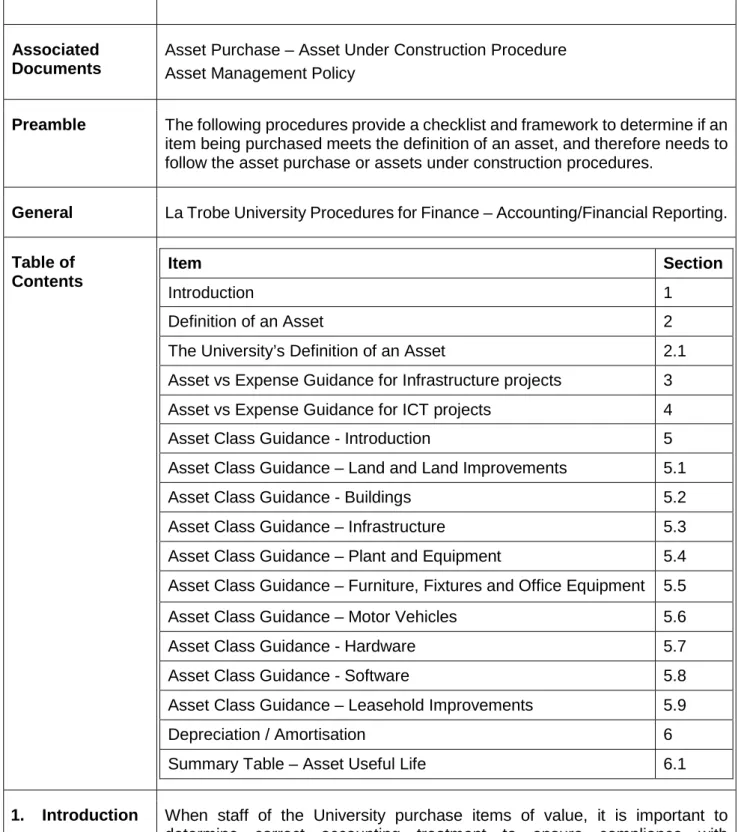
Preamble The following procedures provide a checklist and framework to determine if an item being purchased meets the definition of an asset, and therefore needs to follow the asset purchase or assets under construction procedures.
General La Trobe University Procedures for Finance – Accounting/Financial Reporting. Table of
Contents
Item Section
Introduction 1
Definition of an Asset 2
The University’s Definition of an Asset 2.1 Asset vs Expense Guidance for Infrastructure projects 3 Asset vs Expense Guidance for ICT projects 4 Asset Class Guidance - Introduction 5 Asset Class Guidance – Land and Land Improvements 5.1 Asset Class Guidance - Buildings 5.2 Asset Class Guidance – Infrastructure 5.3 Asset Class Guidance – Plant and Equipment 5.4 Asset Class Guidance – Furniture, Fixtures and Office Equipment 5.5 Asset Class Guidance – Motor Vehicles 5.6 Asset Class Guidance - Hardware 5.7 Asset Class Guidance - Software 5.8 Asset Class Guidance – Leasehold Improvements 5.9
Depreciation / Amortisation 6
Summary Table – Asset Useful Life 6.1
1. Introduction When staff of the University purchase items of value, it is important to determine correct accounting treatment to ensure compliance with
International and Australian Accounting standards, as per the Asset Management Policy. When an item/group of items is determined as an asset, the University will manage, secure, verify and report on that asset over its useful life (and in accordance with the Financial Management Act).
2. Definition of an Asset
The Australian Accounting Standard 138.8 defines an asset as a resource that is:
(a) controlled by an entity as a result of past events; and
(b) from which future economic benefits are expected to flow to the entity.
Note that ownership is not important in the definition of an asset (that is, we can hold an asset in the University’s balance sheet that is not held on University land, providing we have control over that asset)
In order to have control without ownership, there must be some form of access agreement or lease in place over the land or property to guarantee our access and on-going benefit of the asset.
‘Future Economic Benefits’ refers to the University’s income earning activities. In order for something to be considered an asset, it must directly or indirectly be linked to the University’s ability to earn income.
Note that in the case of software, and software development, Intangible Asset definitions and Standards apply (refer AASB 138) in addition to the above. Please refer to section 5 for further information and guidance on classifying software.
2.1 The
University’s definition of an Asset
The University defines an asset as follows:
A transaction/group of transactions that comply with the above accounting definition; and
• that do not meet the definition of an expense (refer below for capital vs expense guidance) ;and
• that as an individual unit is valued over $5,000 GST exclusive; and/or • that as individual units, may cost less than $5,000 GST exclusive, but may
combine to form an operating unit or network or have the same or similar nature with a combined cost of more than $10,000 GST exclusive.
For further guidance on how to determine if an item or group of items constitute an asset (including intangible asset guidance with regard to software/website development), please refer to the frameworks/guidance in Section 4 and 5, or contact the Senior Manager External Reporting Tax and Compliance.
3. Asset vs expense for infrastructure purchases /building works and projects
The table below provides a decision framework to guide users to determine accounting treatment for common infrastructure purchases. If after referring to this table (and the project guidance table below), staff are still unable to determine accounting treatment, please refer to the Senior Manager External Reporting Tax and Compliance or another Finance person for assistance.
ASSET VS EXPENSE FOR INFRASTRUCTURE
Please answer the following questions: (Note for something to be classified as capital, it must first meet the University’s definition of an asset)
IF YES:
Was the work normal upkeep required during the productive life of the item?
(E.g. Preventative contracts, cleaning, lubricating,
Expense
Did the work return the item to its normal operating condition?
Expense
Did the work improve the original operating condition or performance of the equipment or significantly extend the equipment’s’ useful life?
Asset
Did the work involve the complete replacement of the equipment with new equipment (e.g. Air conditioning unit, generator etc.); or the replacement of a major
component/major components of the equipment, resulting inbetter performance or reduced running costs?
Asset
The table below provides guidance on accounting treatment for common infrastructure works/projects. This table is not intended as a comprehensive list, but a framework to assist in classification. If after referring to this table (along with guidance from section 6 and the table above), staff are still unable to determine accounting treatment, please refer to the Senior Manager External Reporting Tax and Compliance for assistance.
EXAMPLES OF COMMON
INFRASTRUCTURE/OPERATIONS WORKS WITH CLASSIFICATION (Note for something to be classified as an asset, it must first meet the University’s definition of an asset, and meet the guidance criteria for an asset above)
GUIDANCE
Repairs to fixtures and fittings which have been damaged.
Expense
Repainting a wall around a delivery entry etc. where it has been damaged.
Repairing broken floor tiles, or replacing small areas of carpet where cost < $5,000.
Expense
Refurbishment/uplifting an area with new paint, carpet, floor tiles, furniture to improve the overall effectiveness or output of the area > $10,000. Note any of these
improvements on their own may not constitute an asset, but combined together may constitute an asset.
Asset
Replacing large amounts of carpet, vinyl, tiling, or other permanent fixtures, where it is reasonable to assume the old fixtures are fully depreciated, and the total cost is >$10,000.
Asset
Restoring a major piece of equipment to its original operating condition, or expected operating condition given its age. E.g. Works to a chiller which does not increase its capacity or efficiency beyond that which would be expected.
Expense
A major overhaul of a piece of equipment that results in greater efficiency and increased output beyond that which would normally be expected for its age, and/or an extension to its useful life.
Asset
New landscaping works in a previously un-landscaped area that improves the functional use of the space.
Asset
Consultant’s costs where the output is required to design, plan, build, install or implement an asset, and is therefore necessary in getting an asset ready for its intended use.
4. Asset vs expense for ICT
purchases and projects
The table below provides a decision framework to guide users to determine accounting treatment for common information and communication technology purchases. If after referring to this table (and the project guidance table below), staff are still unable to determine accounting treatment, please refer to the Senior Manager External Reporting Tax and Compliance for assistance.
ASSET VS EXPENSE FOR ICT
Please answer the following questions: (Note for something to be classified as an asset, it must first meet the University’s definition of an asset above)
IF YES:
Was the work normal upkeep required during the productive life of the item?
(E.g. Replacement of minor parts or consumable items)
Expense
Did the work return the item to its normal operating condition? (e.g. Debugging a program, resolving a virus, repairing technical equipment, replacing small
components of an AV room installation,
maintenance/service agreements that last less than 3 years, licensing that must be paid annually)
Expense
With regard to applications not directly related to hardware, was the work related to the ‘research phase’ of a project? That is, proof of concept work, pilots, feasibility studies, investigations etc.
Expense
With regard to applications not directly related to hardware, was the work related to the ‘development phase’ of a project? That is, the design, construction and testing of a chosen alternative for new or improved materials, devices, products, processes, systems or services.
Asset
Did the work improve any one of the following: the original operating condition/ capacity/ performance of the equipment/ program/ application; significantly extend the useful life; significantly change the functionality; or significantly increase the productivity?
Asset
Did the work involve the complete replacement of the equipment/ program/ application, and result in better performance, greater capacity, more functionality or reduced running costs?
Asset
Training of staff from a technical nature or users of any new or upgraded application or to use new equipment.
Expense
Employees’ salaries and benefits of staff not directly involved in the creation of an asset, for example Administrative staff, Finance staff, Management
The table below provides guidance on accounting treatment for common information and communication technology works/projects. This table is not intended as a comprehensive list, but a framework to assist in classification. If after referring to this table (and guidance provided in Section 6), staff are still unable to determine accounting treatment, please refer to Senior Manager External Reporting Tax and Compliance for assistance.
EXAMPLES OF ICT WORKS WITH CLASSIFICATION
(Note for something to be classified as an asset, it must first meet the University’s definition of an asset (section 2), and meet the guidance criteria for an asset above)).
GUIDANCE
Replacement of components of an AV room installation, which is not a major upgrade or refurbishment that increases capability.
Expense
AV room major upgrade, renewal or a new installation.
Asset
Internal and external labour and on-costs of staff that are working on programming or configuration of new software, or implementing program enhances to new and existing systems that increase their efficiency, effectiveness or productivity, including project
management, subject to Intangible Asset definitions & guidance found in section 6.8 (e.g. excludes work on research phase and training).
Asset
All Training, including technical training required for support.
Expense
Travel costs associated with rolling out a new
program, providing it can be assumed part of the cost of purchasing/building the asset and getting it ready for its intended use, subject to Intangible Asset definitions & guidance found in section 6.8 (e.g. excludes work on research phase).
Asset
Travel cost associated with trouble shooting a roll out of a new program, or user support/training.
Expense
Purchasing licences where the fee is a one off permanent access to software/hardware or will last a minimum of 3 years. This can be on initial purchase of software, or for additional licences.
Asset
Maintenance agreements where the fee provides maintenance/warranty for a minimum of 3 years – only where this forms part of the initial purchase of software/programming.
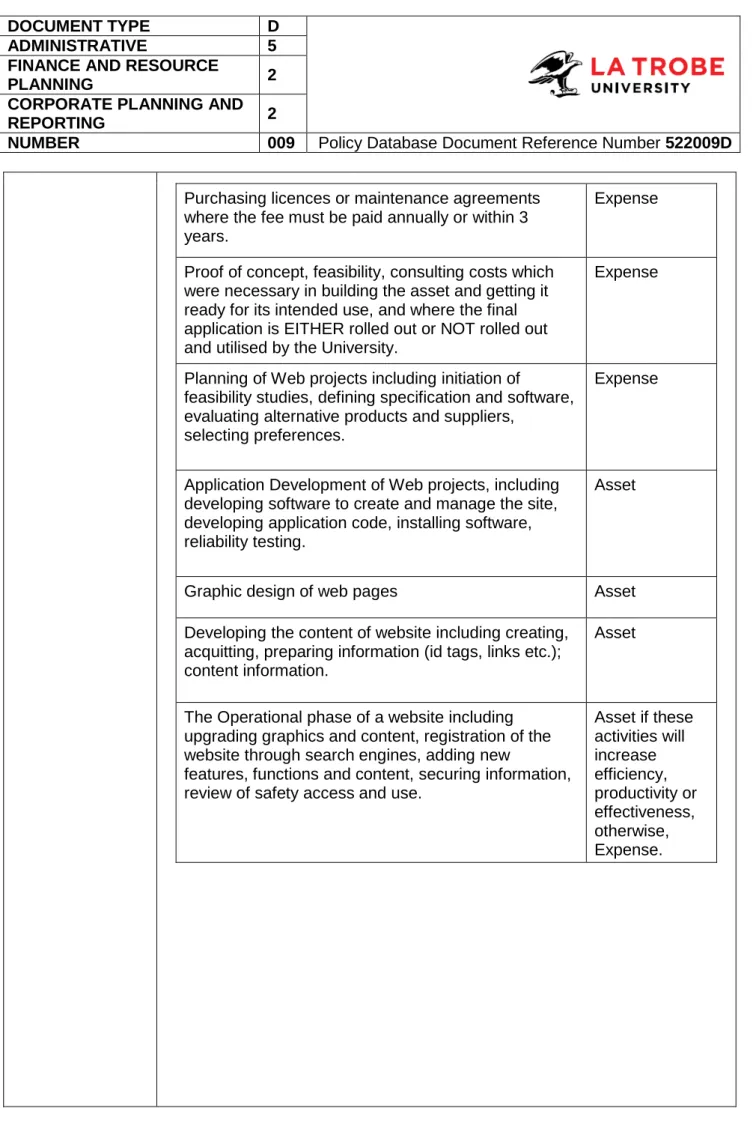
Purchasing licences or maintenance agreements where the fee must be paid annually or within 3 years.
Expense
Proof of concept, feasibility, consulting costs which were necessary in building the asset and getting it ready for its intended use, and where the final application is EITHER rolled out or NOT rolled out and utilised by the University.
Expense
Planning of Web projects including initiation of
feasibility studies, defining specification and software, evaluating alternative products and suppliers,
selecting preferences.
Expense
Application Development of Web projects, including developing software to create and manage the site, developing application code, installing software, reliability testing.
Asset
Graphic design of web pages Asset
Developing the content of website including creating, acquitting, preparing information (id tags, links etc.); content information.
Asset
The Operational phase of a website including upgrading graphics and content, registration of the website through search engines, adding new
features, functions and content, securing information, review of safety access and use.
Asset if these activities will increase efficiency, productivity or effectiveness, otherwise, Expense.
5. Asset Class Guidance - Introduction
All University Assets are required to be recorded in an Asset Class. The Asset Class groups assets on the asset register for financial reporting purposes, and will also determine the ‘useful life’ applied to the asset for accounting purposes (this will determine the rate of depreciation).
The following section will provide guidance on what kinds of assets are included in each of the asset classes. The guidance is a framework only. If staff are unsure of which asset class to use after referring to the guidance below they should contact Senior Manager External Reporting Tax and Compliance for assistance.
5.1 Land and Land Improve-ments
Land refers to any freehold land, or any leasehold agreement greater than 21 years.
Land is held as a fixed asset and does not require depreciation.
Land improvements will be coded to the land asset most closely related and will form part of the land asset value.
Ground works can be considered land improvements if they satisfy the following:
• The works are required in order to use the land for its intended purpose; and
• The works would be required by any other party should the land be sold; and therefore
• They add to the recoverable value of the land
The acquisition or disposal of land (for value >$5 million) requires approval from the Minister, unless that land (in the opinion of Council) is held for investment purposes (in accordance with the La Trobe University Act 2009). Ministerial approval is not required if the value of the land is <$5 million, unless the land was acquired via a Crown grant.
5.2 Buildings A building asset would normally either be a result of the purchase of a new property (subject to the La Trobe Act and Council approval), or at the completion of an ‘Asset Under Construction’ (refer to Asset Under Construction Procedures). If the University purchases a new building, the components (land, building, plant and equipment, infrastructure) must be valued and recorded separately. In order to achieve this, the new building should be valued by a Quantity Surveyor or a comparative consultant to enable correct capitalisation on the Balance Sheet.
The value of a building includes all structural works (internal and external) including lift shafts, trenches, tunnels, demolition and all consultant fees required in the building (including but not limited to, any fees associated with site surveys, permits, specialist advice, project management, quantity surveyors and architecture).
A list of components that would normally be included in a building asset are below (note this list is not exhaustive and should be considered a guide):
• Utilities/Headwork’s • Demolition
• All Consultants Fees including Legal & Security • Structural works • Tunnels/Excavation • Slab/Pilings/Footings • Frame • Roof/Ceilings/Floors/Walls • Windows • Exterior Fabric
Buildings are subject to revaluation to fair value periodically (refer to Valuation/Re-valuation Policy).
5.3 Infrastructure Infrastructure assets are those which are primarily stationary in nature, associated with a network or a system, and cost more than $5,000 individually, or more than $10,000 for a ‘total unit’ or ‘network’. Infrastructure assets include building systems and external works on roads, supply of services to site, public transport infrastructure, water supply/services, drainage, sewerage, bridges etc.
The cost of Infrastructure assets includes the purchase cost plus any costs incidental to the purchase, delivery and installation.
Infrastructure assets would most commonly be capitalised at the completion of an ‘Asset under Construction’ (refer Asset Purchase – Asset Under Construction Procedure), or valued as a component of a new building purchased by the University (refer Section 5.2 Buildings).
A list of components that would normally be included in an infrastructure asset are below (note this list is not exhaustive and should be considered a guide): • Internal fixtures and fittings that do not meet the definition of Plant and Equipment (Section 5.4) or Furniture, Fixtures and Office Equipment (Section 5.5)
• Water supply and systems • Lighting systems
• Dams and other water storage facilities • Public transport Infrastructure
• Bridges, Road Networks, Car Parks, footpaths, paved areas • Electricity Supply systems
• Gas supply systems/networks • Pipelines
• Sewerage Systems
• Cabling and Communication systems • Ductwork
• Stormwater and Drainage • Retaining Walls
• Parking Barriers • Fountains • Covered Ways • Street Furniture
• Only Hard & Soft Landscaping (when building on a new site in a previously un-landscaped area)
• Irrigation systems • Fencing
Note: Artworks (external/internal are to be classified under Art Collection)
5.4 Plant and Equipment
Plant and Equipment is defined as any item of a mechanical, electrical or technical nature, that has an individual cost greater than $5,000 or a ‘total unit’ or ‘network’ cost greater than $10,000; and does not meet the definition of Furniture, Fittings and Equipment, Infrastructure or Motor Vehicles.
The cost of Plant and Equipment includes the purchase cost plus any costs incidental to the purchase, delivery and installation. Plant Equipment is categorised as either 10 or 20 year life (refer section 6.0).
Items of Plant and Equipment would most commonly be capitalised at the completion of an ‘Asset under Construction’ (refer Asset Purchase - Asset Under Construction Procedure), or purchased individually by staff.
A list of items that would normally be included in Plant and Equipment (10 year life) are below (note this list is not exhaustive and should be considered a guide);
• Microscopes
• Specialist teaching, research or laboratory equipment e.g. Spectrometers, autoclaves, fume cupboards etc.
• Building management systems
• Air Conditioning systems (including split systems etc.) • Security Cameras
• UPS systems • AV large lecterns
• Communication room components (e.g. racks) • Grounds Equipment (e.g. spray unit)
• Boats, motorised or other
A list of items that would normally be included in Plant and Equipment (20 year life) are below (note this list is not exhaustive and should be considered a guide);
• Switch boards/power boards • Chillers
• Air handling units • Generators • Boilers
• Fire protection systems. 5.5 Furniture,
Fixtures and Office
Equipment
Furniture, Fixtures and Office Equipment assets have an individual cost greater than $5,000 or a ‘total unit’ or ‘network’ cost greater than $10,000; and include items of furniture and fixtures used in the daily running of the University’s administrative requirements, furniture and fixtures in public and teaching spaces, and electronic equipment (other than that which meets the definition of computer hardware (section 5.7) or plant and equipment (section 5.4)).
The cost of Furniture, Fixtures and Office Equipment includes the purchase cost plus any costs incidental to the purchase, delivery and installation. A list of items normally included in Furniture, Fixtures and Office Equipment are below (note this list is not exhaustive and should be considered a guide);
• Desks
• Chairs (replacement or new for large areas) • Partitioning • Meeting Tables • Shelving • Bookcases/Filing systems/Drawers • Compactus • Photocopier • Scanner • Fax Machines • Printers • White boards
• Floor and Window coverings • Electronic Whiteboards 5.6 Motor
Vehicles
Motor Vehicles include automobile, truck, wagon, motorcycle or any other self-propelled vehicle designed for running on land but not on rails or water. Motor vehicles must individually cost greater than $5,000 to be classed as an asset.
Motor vehicles are categorised as either Commercial motor vehicles or Passenger motor vehicles.
The cost of Motor Vehicles includes the purchase cost plus any costs incidental to the purchase, delivery and getting the vehicle ready for its intended use. Registration and Insurance costs are operating expenses and do not form part of the cost of purchasing the vehicle.
Commercial Motor Vehicles: Any motor vehicle whose primary use is not to transport passengers.
• Grounds equipment used by Infrastructure and Operations e.g. Elevated Work Platforms, ride on lawn mowers, tractors, utility vehicles, forklifts, motorcycles (where used for University security) etc. • Trucks used to transport goods.
Passenger motor vehicles: All motor vehicles that are not commercial motor vehicles.
Common examples of Passenger Motor Vehicles are: • Executive Vehicles • Fleet Cars • Security Vehicles 5.7 Hardware (Computer/ Technical Equipment)
Hardware refers to computer and technical equipment that is greater than $5,000 individually, or has a ‘total unit’ or ‘network’ cost greater than $10,000, and does not meet the definition of Furniture, Fixture and Office Equipment (5.5), Software (5.8) or Plant and Equipment (5.4).
Items of Hardware would most commonly be capitalised at the completion of an ‘Asset under Construction’ (refer Asset Purchase - Asset Under Construction Procedure), or purchased individually by staff.
The cost of Hardware includes the purchase cost plus any costs incidental to the purchase, delivery and installation.
A list of items normally included in Hardware are below (note this list is not exhaustive and should be considered a guide);
• Servers
• Operating systems (Software integral to the related Hardware) • Network appliances
• Desktop Computers • Laptop Computers
• Phones, Phone networks, Phone Systems • Mobile Phones, iPhones, Blackberrys
• IPads or other transportable technical devices • Monitors/Screens
• Audio Visual Equipment, including screens, projectors, controllers, microphones
• Video Conferencing Equipment including screens, projectors, controllers, microphones, cameras
• Polycom or other sound devices • Lectopia equipment
• Stand alone Projectors • Interactive Whiteboards
5.8 Software Software is any program used to enhance business processes that is greater than $5,000 individually or has a ‘total unit’ or ‘network’ cost greater than
$10,000. In accordance with the Asset Management Policy, the University will comply with International and Australian Accounting standards when accounting for asset purchases, which requires different considerations with regard to software.
Software is categorised as either 5 or 10 Year Life (refer section 6.0).
Software should be categorised to the useful life most closely aligned with the expected length of economic benefit (for example the core financial system of the University would be a 10 year life, whereas the graphic design of a website would be 5 years). The project manager, in conjunction with Finance will decide on the useful life.
Accounting Standard Guidance for the recognition of Software
In accordance with Australian Accounting Standard AASB138, software that is not integral to the related hardware is considered an intangible asset. This results in software being subject to a different recognition criteria than other asset classes.
In accordance with AASB 138, software that is integral to the related hardware (for example operating systems) is considered part of Property, Plant and Equipment, and is included in the ‘Hardware’ category (5.7).
Under AASB138, an intangible asset is recognised when it is probable that the expected future economic benefits that are attributable to the asset will flow to the University and the cost of the asset can be measured reliably.
When the University purchases software externally, this recognition criteria is generally met. However if software is internally generated AASB 138 outlines additional requirements that must be fulfilled in order for internally generated software to be recognised (this also relates to web design and development). When assessing whether internally generated software meets the criteria the University is required to classify work performed internally into two phases: • the research phase; and
• the development phase
Costs associated with the research phase cannot be treated as an asset, and must be expensed in the period they are incurred.
Examples of activities classified in the research phase are: • feasibility studies, and investigation of alternatives; and
• the formulation, design, evaluation and final selection of possible alternatives for new or improved materials, devices, products, processes, systems or services, including proof of concept.
Examples of activities classified in the development phase are: • the design, construction and testing of software; and
• the design, construction and testing of a chosen alternative for new or improved materials, devices, products, processes, systems or services. If activities or costs of internally generated software are classified in the development phase above, they must still meet all criteria below in order to meet the definition of an intangible asset. If any of the below cannot be
demonstrated, the costs associated must be expensed in the period they are incurred:
• the technical feasibility of completing the software so that it will be available for use;
• its intention to complete and use the software; • its ability to use the software;
• how the software will generate probable future economic benefits. Among other things, the University can demonstrate the usefulness of the software;
• the availability of adequate technical, financial and other resources to complete the development and to use the software; and
• its ability to measure reliably the expenditure attributable to the software during its development.
The cost of Software includes the purchase cost plus any directly attributable costs (excluding costs related to the research phase). Directly attributable costs include delivery, installation, professional fees and employee costs of bringing software into working order and also costs of testing the software.
There are some costs that cannot be treated as an asset in the purchase or generation of software under any circumstances. These include staff training costs (for use or technical support) and administrative and other overhead costs. These costs must always be expensed in the period they were incurred.
5.9 Leasehold Improve-ments
Where the following conditions/considerations are met, an asset should be purchased/settled under the ‘Leasehold Improvement’ asset class:
• The item being built/purchased meets the definition of an asset from section 1.0; and
• The asset is not easily transportable/is fixed (mainly sections 5.1-5.5 above);and
• The land or building the asset will be installed/positioned on is not owned by La Trobe University; and
• La Trobe University have a lease, or a written access agreement to the land and/or building the asset will be installed/positioned on.
Where an asset is considered a ‘Leasehold Improvement’ it will be depreciated over the shorter of the useful life (refer section 6.0) or the life of the lease/agreement, whichever is shorter.
6.0 Depreciation/ Amortisation
All fixed assets other than land, land improvements, special collections and assets under construction are depreciated (or in the case of software amortised) over their estimated economic useful lives using the straight line method. Leasehold improvements are depreciation over their useful lives, or the unexpired period of the lease, whichever is shorter.
Depreciation of all fixed assets and amortisation of intangible assets will be calculated from the month after acquisition (or when the asset is put into use), until the item is fully depreciated/amortised or until the month of retirement, whichever is shorter.
Depreciation/Amortisation will be charged to the cost centre responsible for the management and safekeeping of the asset (this will also be the cost centre responsible for stock-take and impairment testing annually).
For further details of depreciation and amortisation, including current depreciation/amortisation rates, refer to the Financial Accounting Procedures.
6.1 Summary Table -Asset Useful Life
Asset Class Useful Life
(Yrs.)
Buildings 50
Infrastructure 20
Leasehold Improvements Yrs./LOL
Library Books and E- resources 10
Plant & Equipment 10YR 10
Plant & Equipment 20YR (New) 20 Furniture, Fixtures & Office Equipment 10
Motor Vehicles (Commercial) 10
Motor Vehicles (Passenger) 15
Hardware (Computer/Technical) 3
Software (10YR) 10
Software (5YR) (New) 5
Status Reviewed with a minor amendments July 2015. New. Approved by the Vice-Chancellor as Chair, Planning & Resources Committee, 2 December 2011, Minute 43.9.The implementation of the latest version of this procedure supersedes all previous versions.
Approval Body Vice-Chancellor on the recommendation of the Planning and Resources Committee.
Initiating Body Finance Division
Definitions None
Next Review
Date 30 September 2018
Keywords Asset Definition, Asset Class, Expense. Owner/Sponsor Director, Budgets and Financial Performance. Author Senior Management Accountant(Corporate) Contact person
or area