WHY NOT THE BEST SCHOOLS?
Brian J. Caldwell1The purpose of this presentation is to describe and illustrate a new framework for understanding the transformation of schools.
The framework is based on research in six countries (Australia, China, England, Finland, United States and Wales) in the International Project to Frame the Transformation of Schools. Transformation is defined as significant, systematic and sustained change that secures success for all students in all settings. The findings of the project as a whole are reported by Caldwell & Harris (2008) with separate reports containing the findings for each country (Douglas & Harris, 2008 for Australia; Egan, 2008 for Wales; Goodfellow & Walton, 2008 for England; Saarivirta, 2008 for Finland; Zhao et al 2008a for China; and Zhao et al 2008b for the United States).
The centre piece of the project was a study of secondary schools that had been transformed or were progressing well in their pursuit of transformation. It was found that each school was adept at creating and strengthening four kinds of capital – intellectual, social, spiritual and financial – and aligning and sustaining them to achieve its mission. Creating, strengthening, aligning and sustaining the four forms of capital do not occur by themselves, outstanding governance is required. Outstanding governance calls for outstanding leadership.
The starting point is a description of the International Project to Frame the Transformation of Schools. Indicators of intellectual capital are provided. The concept of ‘capital formation’ is explained and illustrated in the context of efforts to achieve an education revolution in Australia.
International Project to Frame the Transformation of Schools
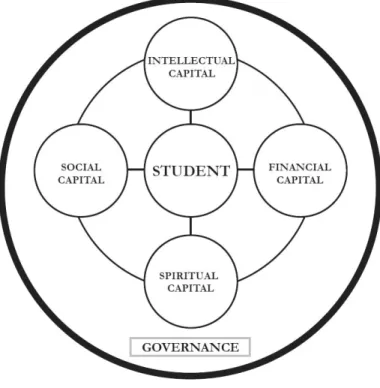
The purpose of the International Project to Frame the Transformation of Schools was to explore how schools that had been transformed or had sustained high performance had built strength in each of four kinds of capital and aligned them through effective governance to secure success for their students. The project was framed by a model (Figure 1) developed earlier from 2004 to 2006 (Caldwell & Spinks, 2008). Particular attention was given to secondary schools in systems where there was a relatively high level of school autonomy.
Intellectual capital refers to the level of knowledge and skill of those who work in or for the school. Social capital refers to the strength of formal and informal partnerships and networks involving the school and all individuals, agencies, organisations and institutions that have the potential to support and be supported by the school. Spiritual capital refers to the strength of moral purpose and the degree of coherence among values, beliefs and attitudes about life and learning (for some schools, spiritual capital has a foundation in religion; in other schools, spiritual capital may
1
This paper summarises the major themes in an invited presentation to the Senior Schooling Conference of the Queensland Studies Authority on the theme ‘Productive pathways – successful futures’ conducted at the Brisbane Convention and Exhibition Centre, 19-20 March 2009. Brian Caldwell is managing director of Educational Transformations Pty Ltd and professorial fellow at the University of Melbourne where he served as dean of education from 1998 to 2004. He is co-author with Jessica Harris of Why not the Best Schools (ACER Press, 2008) which reports in more detail the insights presented in paper.
refer to ethics and values shared by members of the school and its community). Financial capital refers to the money available to support the school. Governance is the process through which the school builds its intellectual, social, financial and spiritual capital and aligns them to achieve its goals.
Figure 1: A model to frame the transformation of schools (adapted from Caldwell & Spinks, 2008; Caldwell & Harris, 2008).
The model in Figure 1 was the starting point for the project that was conducted in 2007. There were two stages. The first called for a review of literature on the four kinds of capital and how they are aligned through effective governance. An outcome of this review was the identification of 10 indicators for each form of capital and for governance. The second called for case studies in five secondary schools in each of six countries: Australia, China, England, Finland, United States and Wales (the Australian component also included a primary school and a network of primary and secondary schools). The project was carried out by Melbourne-based Educational Transformations with different components conducted by international partners with funding from the Australian Government and the Welsh Assembly Government. Capital formation
The concept of ‘capital formation’ is proposed as a helpful way of describing the work of the leader in achieving transformation. It is a concise way of describing the framework for leadership that emerged in the international project. According to the Merriam-Webster online dictionary, capital refers to ‘accumulated goods devoted to the production of other goods’ or ‘a store of useful assets or advantages’. Intellectual capital, for example, may be viewed as ‘accumulated goods’ (‘the level of knowledge and skill of those who work in or for the school’) devoted to the ‘production of other
goods’ (state-of-the-art curriculum and pedagogy leading to ‘success for all students in all settings’). High levels of capital in each of the four domains constitute ‘a store of useful assets or advantages’.
Indicators
Indicators were devised for each kind of capital and of governance. They served as a guide to researchers in each of the six countries in the selection of schools and to help build a common understanding of what was meant by each concept (intellectual capital, social capital, spiritual capital, financial capital and governance). The majority of the 50 indicators – 10 for each kind of capital and for governance – were evident in most schools in the six countries. The following are the indicators of intellectual capital.
Intellectual Capital
1. The staff allocated to or selected by the school are at the forefront of knowledge and skill in required disciplines and pedagogies
2. The school identifies and implements outstanding practice observed in or reported by other schools
3. The school has built a substantial, systematic and sustained capacity for acquiring and sharing professional knowledge
4. Outstanding professional practice is recognised and rewarded
5. The school supports a comprehensive and coherent plan for the professional development of all staff that reflects its needs and priorities
6. When necessary, the school outsources to augment the professional talents of its staff
7. The school participates in networks with other schools and individuals, organisations, institutions and agencies, in education and other fields, to share knowledge, solve problems or pool resources
8. The school ensures that adequate funds are set aside in the budget to support the acquisition and dissemination of professional knowledge
9. The school provides opportunities for staff to innovate in their professional practice
10. The school supports a ‘no-blame’ culture which accepts that innovations often fail
A pre-eminent capacity to create and sustain intellectual capital is a requirement for educational leadership in the 21st century. Symbolically, that is why intellectual capital is positioned at the top of the model in Figure 1. The key issue in the context of this conference is what counts as intellectual capital for those who work in or for the school, and this includes students as well as teachers and other professionals. As we shall see in the final section of the paper, we are in serious danger of limiting our view.
Conducting a school audit
One outcome of the International Project to Frame the Transformation of Schools was the development of an instrument to guide a school audit (the instrument is contained in Caldwell & Harris, 2008). For each indicator, respondents are invited to provide ratings of (1) importance in the context of your school, (2) how well your school is performing, and (3) the priority you attach to further development.
The instrument may be used in a range of situations. Its main use is to frame an audit of a school’s capacity to achieve change on the scale of transformation or to sustain high levels of performance. It may be completed in the school setting by a leadership team or a group of staff working in the same area.
The instrument travels well across international borders. To date it has been used in workshops in Australia, England, Malaysia, Mauritius, Netherlands, Philippines, Singapore and Wales. Participants have not baulked at the inclusion of any indicator and have been able to work through the entire set in the context of their own schools or school systems.
The futures focused school
The findings in the International Project to Frame the Transformation of Schools yielded a breakthrough in understanding governance which, in turn, provided a breakthrough in understanding leadership. Good governance no matter how it is configured does not occur by itself. Good leadership is required. Conceptualising governance and leadership as capital formation complements and extends other approaches.
A critical aspect of capital formation in any setting is sustaining the level of capital that is required for success. This was explicitly included in the description of a capacity to create, strengthen, align and sustain the four forms of capital through outstanding governance and outstanding leadership. It is explicitly included in the description of transformation: significant, systematic and sustained change that secures success for all students in all settings.
These attributes are central to the Futures Focused School Project undertaken in Australia by Educational Transformations in partnership with Teaching Australia (Australian Institute for Quality Teaching and School Leadership), the centrepiece of which is a series of workshops in every state and territory to build capacity for futures thinking and strategic planning in Australia’s schools.
A description of a futures focused school was adopted in the project (drawing in part on insights in Beare, 2001; Caldwell & Harris, 2008; Davies, 2006; Loader, 2007 and Mintzberg, 1995). It included the following:
A futures- focused school ‘sees ahead’, but it also ‘sees behind’, honouring and extending its accomplishments in the past. It ‘sees above’ in the sense of understanding the policy context. It ‘sees below’, demonstrating a deep understanding of the needs, interests, motivations and aspirations of students and staff. It ‘sees beside’ by networking professional knowledge to take account of best practice in other schools in similar settings. It ‘sees beyond’ by seeking out best practice in other nations and in fields other than education. It is consistent and persistent; it ‘sees it through’. The metaphor of ‘sensing’ is also helpful given that ‘seeing’ refers to what is already in place or is projected. A futures focused school is alert to signals in its internal and external environment that may influence what may occur in the future and that may subsequently be ‘seen’. These signals may be strong or weak and a high level of sensitivity is required to distinguish among them (Caldwell & Loader, 2009).
Creating capacity of the kind described here is part and parcel of creating intellectual capital in our schools.
Strategies for an education revolution
In January 2007 Prime Minister Kevin Rudd, then leader of the opposition, invoked the idea of an ‘education revolution’ to describe what he believed was necessary for Australia. The term continues to be used, to some extent by government but also by commentators who take every opportunity to compare each step forward with expectations that were raised. We concluded Why not the Best Schools by proposing a ten-point ten-year strategy that will ensure that, when all is said and done, people will look back and say a revolution in schools has occurred and all schools can be fairly described as ‘best schools’.
The ten-year strategy
The ten-point ten-year plan for the transformation of Australia’s schools may be summarised as follows:
1. A national curriculum is designed that is broad enough and sufficiently adaptable to ensure the professional judgement of a highly-skilled profession will prevail at the school level
2. Initial teacher education is transformed to ensure all teachers have a master’s degree and remain at the forefront of knowledge and skill through continuous professional development
3. New structural arrangements are designed ensure diversity of programs in the post-compulsory years in an effective constantly-changing alignment of education, economy and society
4. National testing of all students is minimised as the highest levels of knowledge and skill are developed by teachers and those who support them 5. The wider community including business is seriously engaged in design and
delivery with public and private funds deployed through networks of foundations and trusts
6. Transparent needs-based mechanisms are designed to ensure the efficient deployment of public and private funds
7. Innovative approaches to governance are introduced along the lines of publicly-funded no-fee charter schools to ensure that public schools maintain their appeal to parents
8. School ownership ceases to be a factor in determining the amount of public funds that are disbursed to schools
9. Higher levels of school autonomy in the public sector are achieved within a framework of accountability and choice
10. Most schools in the public sector are rebuilt or redesigned to make them suitable for learning and teaching in the 21st century
We are off to a good start with regard to the first (the national curriculum) and the last (the $14.7 billion for school facilities in the economic stimulus package). However, expectations for an education revolution in the short term are unrealistic. It took Finland more than ten years to create what is generally regarded at the close of the first decade of the 21st century as the best in public education. It will take at least that time in Australia.
Critical concerns
Of particular concern in the context of this conference is the narrowness of efforts to create a national curriculum, the headlong rush to ‘league tables’, and the failure to commit to a long-term strategy for rebuilding schools.
The criticism of efforts to date is not aimed at the work of the National Curriculum Board. I can imagine no more suitable person to lead the effort than Professor Barry McGaw. After all, the board takes its brief from the Council of Australian Governments (COAG) through MCEETYA. It is the narrowness of its brief that is of deepest concern. Despite clear-cut recommendations at the Australia 2020 Summit, the place of creativity in the Melbourne Declaration on Educational Goals for Young Australians (MCEETYA, 2008) (‘successful learners . . . are creative, innovative and resourceful’), and a powerful body of evidence on the nature of intelligence, the brief does not address the place of the arts in education. To use the imagery of Sir Ken Robinson in what must surely be the most frequently down-loaded YouTube film on education, it seems that the arts have been ‘strip mined’ from the curriculum of schools, here and elsewhere around the world (Robinson, 2006). Indeed, in his just-published book The Element, Robinson mounts a powerful critique of current directions in education policy:
• Education doesn’t need to be reformed – it needs to be transformed. The key to this transformation is not to standardise education but to personalise it, to build achievement on discovering the individual talents of each child, to put students in an environment where they want to learn and where they can naturally discover their true passions (p. 238).
• The curriculum of education for the twenty-first century must be transformed radically. . . The arts, sciences, humanities, physical education, languages, and math all have equal and central contributions to make to a student’s education (p. 247).
• Education is being strangled persistently by the culture of standardised testing. The irony is that these tests are not raising standards except in some very particular areas, and at the expense of most of what really matters in education (p. 249).
The Rudd Government’s initiative in providing $14.7 billion for school facilities in the economic stimulus package is outstanding. The chief concerns, however, are whether it will result in facilities that are conducive to curriculum and approaches to learning and teaching that are needed in the 21st century, and whether the effort will be sustained over the next decade. After all, the UK government is committing AUD $110 billion over 10 years which, on a pro rata population basis in Australia, is equivalent to at least AUD $40 billion over the same period of time. The key issue in this and all other matters addressed in the paper is to ensure alignment in policy. Conclusion
A review of developments in recent years reveals that particular strategies have taken their turn in moving to centre stage and then retreating as others are spotlighted. One might be a curriculum for the 21st century which enables every student to find a pathway to success at the same time that the needs of society are addressed. Another might be pedagogy, taking up the extraordinary advances in scholarship about how the brain functions and young people learn. It might be a matter of money, because quality and equity cannot be addressed without appropriate allocation of funds to schools and within schools. It might be to attract, reward and sustain the best teachers and other professionals. It might be to replace the run-down and obsolete stock of school buildings that are no longer fit for learning and teaching if there is to be success for all. It might be to build the support of the community for public education. It is all of these strategies and more, and the key to success is to bring them together and make them effective. Leadership is required at all levels – for a system of schools as well as within schools. New concepts of
distributed leadership, but not constrained to a simple sharing of tasks to make lighter the work of the principal. Outstanding governance is also required, but there must be a breakthrough in how we understand the concept. It is time to draw together what has been learnt from schools that have been transformed. The outcomes of the International Project to Frame the Transformation of Schools, as reflected in the 50 indicators of the four forms of capital and of governance, show how this can be done. Outstanding leadership drives the enterprise and this is why a framework for understanding leadership as capital formation is helpful and timely. Enough is now known about what makes a successful school that no nation or system of education should settle for less than the best. This conclusion can be drawn when the findings of the International Project to Frame the Transformation of Schools are combined with those in contemporary research and the recent landmark report by McKinsey & Company on How the World’s Best-Performing School Systems come out on Top (Barber & Mourshed, 2007). A key finding was that ‘The quality of an education system cannot exceed the quality of its teachers’ (Barber & Mourshead, 2007, p. 16). This finding highlights the pre-eminence of intellectual capital in those who work in or for the school who must in turn create, strengthen, align and sustain the capacities for transformation, conceived in this paper as the four forms of capital that underpin the effort to secure success for all students in all settings.
References
Barber, M. & Mourshed, M. (2007). How the World’s Best-Performing School Systems Come Out on Top. London: McKinsey & Company.
Beare, H. (2001). Creating the Future School. London: Routledge.
Caldwell, B. J. & Harris, J. (2008). Why Not the Best Schools? Camberwell: ACER Press.
Caldwell, B. & Loader, D. (2009). ‘What is a Futures Focused School?’ Special materials in the workshop program on The Futures Focused School, a project of Teaching Australia and Educational Transformations. Brighton VIC: Educational Transformations.
Caldwell, B.J. & Spinks, J.M. (2008). Raising the Stakes. London: Routledge.
Davies, B. (2006). Leading the Strategically Focused School. London: Paul Chapman Publishing.
Douglas, E. & Harris, J. (2008). Why Not the Best Schools? The Australia Report. Camberwell: ACER Press.
Egan, D. (2008). Why Not the Best Schools? The Wales Report. Camberwell: ACER Press.
Goodfellow, M. & Walton, M. (2008). Why Not the Best Schools? The England Report. Camberwell: ACER Press.
Loader, D. (2007). Jousting for the New Generation. Camberwell: ACER Press.
MCEETYA (2008). Melbourne Declaration on Educational Goals for Young Australians. South Carlton: MCEETYA.
Mintzberg, H. (1995). ‘Strategic thinking as “seeing”’. In Garratt, B. (Ed.) Developing Strategic Thought: Rediscovering the Art of Direction-Giving. London: McGraw-Hill. Chapter 5.
Robinson, K. (2006) Summation of a Technology, Education and Design (TED) Conference in Monterey, California, February. Available at www.TED.com
Robinson, K. (2009). The Element. New York: Viking.
Saarivirta, T. (2008). Why Not the Best Schools? The Finland Report. Camberwell: ACER Press.
Zhao, Y., Ni, R., Qiu, W., Yang, W. & Zhang, G. (2008a). Why Not the Best Schools? The China Report. Camberwell: ACER Press.
Zhao, Y., Ni, R., Qiu, W., Yang, W. & Zhang, G. (2008b). Why Not the Best Schools? The US Report. Camberwell: ACER Press.
Acknowledgements
The contributions of Dr Jessica Harris to the research underpinning this chapter are acknowledged. She managed the International Project to Frame the Transformation of Schools and was co-author of Why Not the Best Schools? (Caldwell and Harris, 2008) that reported the findings.
Author
Brian J. Caldwell is Managing Director of Educational Transformations Pty Ltd and Associate Director of the Specialist Schools and Academies Trust in England, providing support for its international arm – International Networking for Educational Transformation (iNet). From 1998 to 2004 he served as Dean of Education at the University of Melbourne where he is currently Professorial Fellow. International work over the last 25 years includes more than 500 presentations, projects and other professional assignments in or for 39 countries. He is author or co-author of books that helped guide educational reform in several countries, most notably the trilogy on self-managing schools: The Managing School (1988), Leading the Self-Managing School (1992) and Beyond the Self-Self-Managing School (1998), each with Jim Spinks. Re-imagining Educational Leadership was published in 2006. Raising the Stakes (2008) is his fourth collaboration with Jim Spinks. Why not the Best Schools with Jessica Harris was published in 2008. He is deputy chair of the board of the Australian Council for Educational Research and co-director of the Futures Focused School Project, a national initiative of Educational Transformations in partnership with Teaching Australia (Australian Institute for Teaching and School Leadership) to build capacity for futures thinking and strategic planning in Australia’s schools.