Headquarters
ExECUTIvE SUMMARy
Forrester applied an adjusted version of its Search Marketing Review methodology to 300 paid search ads from the retail, travel, consumer packaged goods (CPG), media and entertainment, financial services, and business services industries. Despite some bright spots — primarily in retail and travel — the majority of ads failed. Retail, travel, and CPG companies must improve their calls to action; media and entertainment companies should screen out irrelevant clickers; financial services firms should mention keywords searched in their ads and landing pages; and business services marketers should learn paid search basics. All marketers can improve their paid search return by applying search for short- and long-term goals and across a customer’s entire purchase process.
Paid Search Campaigns Still Need Improvement
In order to help interactive marketers move beyond the basics of search marketing, we introduced Forrester’s Search Marketing Review in January of 2008 as a tool to help diagnose search program strengths, defects, and ways to improve effectiveness.1 Although our original review is a comprehensive methodology that encompasses both user experience and internal business processes, this study focuses just on the best and worst of paid search ads. To complete our reviews, we:
·
Adjusted the review methodology. Forrester’s published Search Marketing Review evaluates if and where a keyword ad shows up in search results as well as its value to users. For this report, we didn’t judge search engine optimization (SEO) results, an ad’s rank, or marketers’ keyword selection or bid strategies. We focused instead on evaluating paid search ads exactly as a consumer would experience them.·
Reviewed 300 keyword ads. Since we don’t have visibility into marketers’ specific keywordselections, we chose five common search terms across six different industries and evaluated the first 10 Google AdWords ads that appeared. This gave us a total of 300 ads to consider.2
·
Played consumers. We put on our user hats to see how well keyword ads attracted our attention, related to our keyword search, convinced us to click, and fulfilled our goal once we clicked through.PAID ADS ARE EXECUTED INCONSISTENTLY ACROSS INDUSTRIES
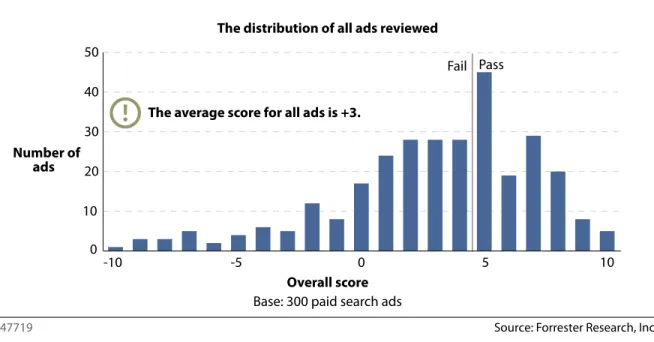
We evaluated each keyword ad on five criteria relating to its ad copy, calls to action, and landing pages (see Figure 1). Possible scores for each criteria ranged from a -2 (severe fail) to +2 (best practice). The lowest possible ad score was a -10, the highest a +10, and a passing grade equates to a +5 or greater.
The Best And Worst Of Paid Search In 2009
Forrester Applies Its Search Marketing Review To 300 Keyword Ads
by Shar VanBoskirk
Figure 1 Adjusted Paid Search Marketing Review Scorecard
Source: Forrester Research, Inc.
47719
Your score 1. Does the keyword appear in the paid search ad title and description?
Does not appear in either the ad title or copy, and the ad copy is not relevant to the keyword Does not appear in either the ad title or copy, but the ad copy is relevant to the keyword
Appears in both the ad title and copy Appears in either the ad title or copy -2
-1 +1 +2
4. Is the landing page content relevant to the keyword?
Does not relate to the keyword
Is relevant to the keyword but does not contain the keyword Contains the keyword in the site content
-2 -1 +1
+2 Prominently features the keyword in site bullets and/or headlines
2. Does the ad copy “pre-qualify” clickers?
So difficult to understand that it dissuades clicks
Contains an aggressive offer that applies to almost anyone Weeds out searchers who obviously do not fit the ad or offer
Provides a unique message/offer intended to generate clicks from a specific group of users -2
-1 +1 +2
3. Does the ad contain a compelling call to action?
Does not provide any call to action
Includes a call to action that is confusing or not related to the users’ search Contains a general call to action that is relevant to the keyword
Contains a specific call to action or offer, such as “download a white paper,” “see new products,” or “get free shipping”
-2 -1 +1
Each review question is scored on a scale of -2 to 2:
Strong pass: Exemplary; establishes or embodies an industry best practice +1
-1 -2 +2
Pass: Competent performance; business process is effective and users can accomplish their goals
Fail: A hindrance; may interfere with business processes and prevent users from accomplishing their goals
Strong fail: A major flaw; necessary process, functionality, or content is missing
+2
5. Does the landing page employ Scenario Design practices to aid user experiences?
The landing page is not functional.
The landing page is live but is difficult to read or takes considerable effort to view and understand.
The landing page is designed to help searchers complete their primary tasks easily. The landing page is designed to help searchers complete their primary tasks easily, plus the site employs design best practices like bread crumb navigation, informative hyperlinks, and clear and exclusive category names.
Scoring:
The top score possible is a 10, the worst possible is a -10, and a score of 5 or higher would be considered an overall passing grade.
-2 -1 +1 +2
More Than Half Of Ads Fail
With an average score of only +3, the ads we reviewed fell short of the best practices articulated in our search marketing review. Fifty-eight percent of the ads we reviewed — 174 out of 300 — failed to achieve a passing score (see Figure 2). Only 2% — like Expedia’s ad for the search term “cruise” — scored a +2 on all of our evaluation criteria. Here is where keyword ads need the most improvement:
·
Keyword mentions. More than one-quarter of the ads we reviewed failed to include the keywordsearched in either the ad title or copy — a practice that helps users know the ad is relevant to their search. Business services are the biggest offenders here: Half of them fail. In contrast, 90% of retailers pass this test. Forty-six percent — including Victoria’s Secret and Sears — mention the keyword searched in both ad title and copy.
·
Conversions. Search ad copy should screen out irrelevant clickers and compel relevant ones to take action in order to keep marketers from burning their budgets on clicks from customers who don’t buy. Few ads do both of these well. For instance, 82% of the CPG ads we reviewed targeted specific consumer groups: For example, Procter & Gamble’s Secret deodorant offered “All-Day Odor Control for Women.” But 66% of ads failed to entice people to click through.Financial services had the strongest results here: 80% of ads screened out irrelevant clicks, and 68% included a call to action. For instance, American Express’ credit card keyword ad invites searchers with good credit to “apply now and receive a decision in less than a minute.”
·
Landing pages. Many ads — especially from business services companies — had landing pages that included either not enough content or too much detail about the keyword searched. For example, several “lead management” ads landed on pages that solicited contact information but offered no context about the lead management product promoted in the ad. Furthermore, “database marketing” ads took us to pages with an overwhelming amount of content too dense to scan. Better to take Zappos.com’s approach to landing page design that features easy-to-find ways to research or buy the item searched.How To Make Your Keyword Ads More Effective
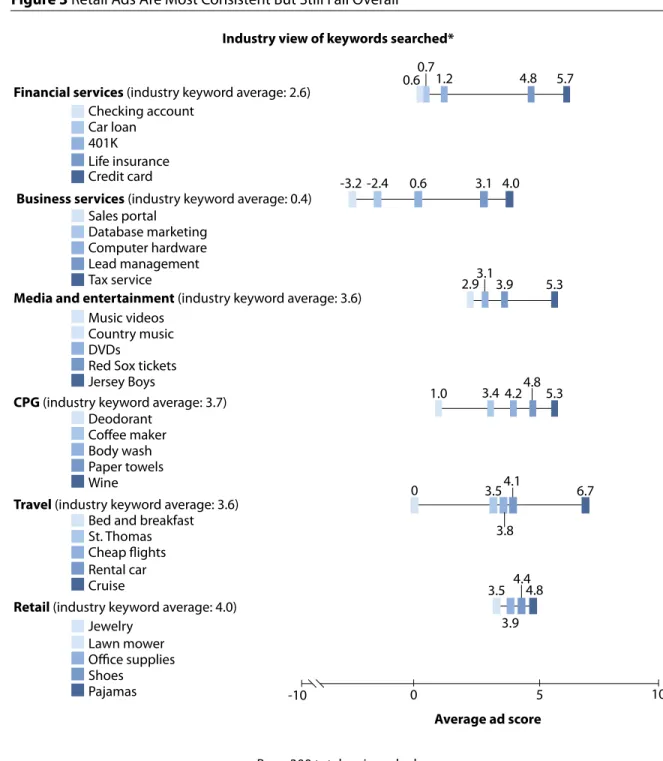
Not surprisingly, retail and travel ads — likely designed by direct marketers with long search tenure — scored the best (see Figure 3). But even these did not consistently pass our review. All industries have room for improvement (see Figure 4). Here are our recommendations by industry group:
·
Retail, travel, and CPG: Improve calls to action. Ads in these industries received passing marks in several areas, including strong keywords, ad copy, and relevant landing pages. But poor calls to action are their Achilles’ heel. Firms in these industries should follow the lead of OfficeMax, which advertised free shipping on orders of $50 or more for searchers who “click to buy now.” And National Car Rental creates urgency with its call to action: “Reserve now for last minute travel specials & Internet only deals!”·
Media and entertainment: Screen out irrelevant clickers. Very few media and entertainment ads targeted a specific type of consumer, meaning all ads welcomed clicks from anyone, even unqualified customers. For example, almost all sellers of “Red Sox tickets” highlighted competitive prices. But FrontRowTickets.com offered premium seats to appeal to affluent or avid fans willing to pay top dollar.·
Financial services: Improve ad and landing page relevance. While most financial services ads we reviewed did include calls to action, one-third failed to include the keyword searched in the ad copy or title. And financial services landing pages also missed the mark. The Teachers Insurance and Annuity Association — College Retirement Equities Fund’s ad for “401K” brought us to a site promoting IRAs but didn’t mention “401K” or explain its relationship to an IRA. For inspiration, financial services search marketers should look to other industries. Orbitz, whose ad mentions St. Thomas in response to that keyword, has navigable landing pages that include island information and the ability to customize several vacation packages.·
Business services: Master the basics. According to our searches for terms like “database marketing,” business services ads fail most criteria. Ad copy and landing pages commonly did not reference the keyword searched — “gain search top search engine placement” — or used language that left the ad’s intent unclear: For example, “buyers receive 10% closing credit” was an ad for a real estate company. Tax service providers stand out as best in class here because of their consistently strong landing pages. For example Intuit’s TurboTax brand brings searchers to a page that allows them to choose from five clearly described tax preparation packages that they can trial for free.Figure 2 Most Ads We Reviewed Fell Short
Source: Forrester Research, Inc.
47719
0 10 20 30 40 50
Source: Forrester Research, Inc.
47719
Figure 4 How Industries Scored Across All Review Criteria
Source: Forrester Research, Inc.
47719
*Each criteria was graded on a -2 (strong failure) to +2 (strong pass). 1. Does the keyword appear in the
paid search ad title and description? 2. Does the ad copy ”pre-qualify” clickers? 3. Does the ad contain a compelling call to action? 4. Is the landing page content relevant to the keyword? 5. Does the landing page employ Scenario Design practices to aid user experience?
Financial
services Businessservices Media and
entertainmen t CPG
Travel All
0.8 1.1 1.0 1.1 0.4 0.1
Passes Fails
The average score*
Retail
1.3
0.9 1.1 1.4 1.4 0.8 0.4 0.5
0.6 1.2 0.5 0.9 1.1 0.3 -0.1
0.0 -0.6 -0.2 -0.3 0.7 0.5 0.0
0.6 1.0 0.9 0.9 -0.1 1.0 0.0
R E C O M M E n d A T I O n S
THINK OUTSIDE THE CLICK
To avoid a piecemeal approach that results in an uncoordinated or inconsistent search strategy, marketers should make sure to:
·
Plan for short- and long-term business goals. Interactive marketers love the instant gratification of paid search ads. But immediate returns should not be prioritized over long-term customer relationships and Return On Marketing Investment (ROMI). With its search synergy methodology, search analytics, and optimization, Covario can help find the optimal balance between SEO and paid search — even if that means sacrificing short-term click volumes from paid ads.·
Use search across users’ purchase processes. Consumers use search to research and buy, but many paid search strategies focus exclusively on driving sales. As new tools — like Yahoo! Web Analytics’ Path Analysis — develop to help measure the contribution of one keyword ad on a conversion that ultimately happens through another keyword ad, marketers will be better equipped to buy keyword ads that influence as well as convert customers.Forrester Research, Inc. (Nasdaq: FORR) is an independent research company that provides pragmatic and forward-thinking advice to global leaders in business and technology. Forrester works with professionals in 19 key roles at major companies providing proprietary research, consumer insight, consulting, events, and peer-to-peer executive programs. For more than 25 years, Forrester has been making IT, marketing, and technology industry leaders successful every day. For more information, visit www.forrester.com.
© 2009, Forrester Research, Inc. All rights reserved. Unauthorized reproduction is strictly prohibited. Information is based on best available resources. Opinions
ENDNOTES
1 Our original Search Marketing Review encompasses not only the user experience — paid and organic search — but also the internal business processes like governance, process, team, and measurement. For more information, see the January 2, 2008, “The Search Marketing Review” report.
2 Since the majority of consumers use Google for search — and we weren’t judging an ad’s placement in a search engine — we conducted our searches only in Google. A company’s keywords, ad copy, and calls to action should be consistent on each search engine.