Development
V Tomonori Yamashita V Takeo Nakamura V Hiroshi Noguchi
(Manuscript received August 23, 2004)
Recently, there have been demands for greater functional diversity and higher perfor-mance in the information technology (IT) infrastructure and mobile communication products. As a result, the complexity and scale of product design in the product development phase have increased. In addition, development periods need to be re-duced so products can be marketed sooner. These requirements have rapidly increased the need to efficiently simulate and analyze in order to achieve optimum designs and verification. Also, Grid computing technology is coming into practical use as a new way of using geographically distributed computer resources connected to a network. This technology is based on advances achieved in high-performance computing and broadband networking. The authors have constructed the “CAD-Grid” Grid comput-ing system to quickly perform computationally intense simulations in the product development phase. This system has been used to simulate a mobile communication system and confirm its effects. This paper describes the Grid computing environment of CAD-Grid, its structure, the system simulation to which CAD-Grid was applied, and the application results. This paper also describes the future development plan for the CAD-Grid system.
1. Introduction
In recent years, technologies that support servers, storages, networks, mobile communica-tions, and other platforms that support the IT society have been making rapid advances almost on a daily basis. Accompanying the demands for greater functional diversity and higher perfor-mance in these products, the factors that must be investigated have become wider in scope and more complex compared with several years ago. In ad-dition to technological requirements such as low power consumption, compactness, and environ-mental friendliness, shorter development periods and faster marketing of products are required.
When carrying out development in such a strict environment, it is essential to optimize and verify designs through simulation, starting from the high-level design stages such as system
specification design, hardware and software partitioning, and LSI/FPGA (Field Programma-ble Gate Array) specifications design. In addition, even in the low-level implementation design phase, analyses regarding noise countermeasures and improvements in the production rate are ac-tively being pursued. Also, the requirements for product development have increased. Moreover, Grid computing technology is being researched and developed for use as a new way of using geo-graphically distributed computer resources connected to a network. This technology is based on advances achieved in high-performance com-puting and broadband networking and is currently in transition from the research stage to being put to practical use.
We have constructed a Grid computing sys-tem called CAD-Grid1) for design verification to
quickly and efficiently perform computationally intense simulations in the product development phase. This system has been used to simulate a wireless interface evaluation for the base station and terminal equipment of the UMTS mobile com-munication system.2)
This paper describes the Grid computing environment of CAD-Grid, its structure, the mo-bile communication system simulation to which CAD-Grid was applied, and the application re-sults. It also describes our future development plan for CAD-Grid.
2. CAD-Grid structure
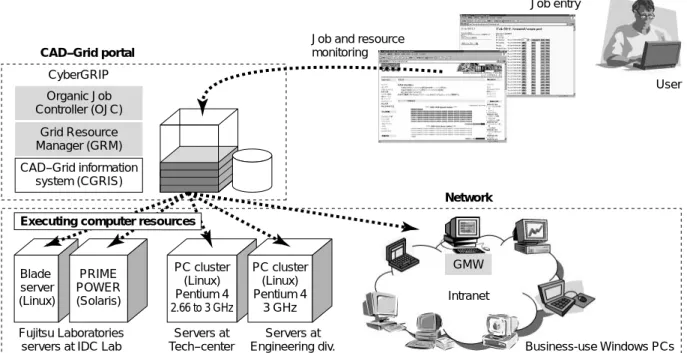
Figure 1 shows the structure of CAD-Grid. The hardware consists of a job entry and resource management server called CAD-Grid Portal and a network that connects the various computer re-sources used to perform the computations. The group of computers for job execution consists of UNIX servers and Windows PCs connected
through an intranet.
CyberGRIP3),4) developed by Fujitsu Labora-tories Ltd. and Condor5) developed in part by the University of Wisconsin are used as the core middleware for managing the jobs and computer resources. The middleware is essential for exe-cuting large numbers of jobs efficiently and operating and managing large numbers of com-puter resources. The organic job controller (OJC) function of CyberGRIP has been designed to group related jobs together, execute and manage them, and construct simulation environments.
To design a product, the user need only use the CAD-Grid portal to submit jobs and check the results; the user need not be aware of the back-end computer resources. In addition, a Web-interface is provided so that jobs can be easily submitted and the results checked, files can be sent and received, and the status of the computer resources can be checked using a Web browser.
CAD-Grid portal
CyberGRIP Organic Job Controller (OJC)
Grid Resource Manager (GRM) CAD-Grid information
system (CGRIS)
Network Executing computer resources
Blade server (Linux)
PRIME POWER (Solaris)
PC cluster (Linux) Pentium 4 2.66 to 3 GHz
PC cluster (Linux) Pentium 4
3 GHz Fujitsu Laboratories
servers at IDC Lab
Servers at Tech-center
Servers at Engineering div.
GMW Intranet
User Job entry
Job and resource monitoring
Business-use Windows PCs
Figure 1
3. Grid middleware: CyberGRIP
This section describes the OJC function and Grid Resource Manager (GRM)/Grid Mediator for Windows (GMW) of CyberGRIP, which are the core technologies of CAD-Grid.3.1 Organic job controller (OJC)
System simulation and analysis often con-sists of creating scenarios for verification in advance, grouping a series of jobs whose condi-tions change based on the scenario, and then executing the system simulation and analysis. During simulation of a mobile communication system, for example, the conditions of the trans-mission path can be used to measure the communication quality. Usually, in this case, a set of between 10 to 250 simulation jobs are exe-cuted in series.
Generally, a scripting language is used to code the job creation and submit scripts to execute the job sets. In a Grid computing envi-ronment, however, the jobs in a set are rarely completed at the same time, even if they are sub-mitted simultaneously. As a result, it becomes difficult to control jobs that are interdependent. In addition, if the execution of a job set needs to be canceled and/or restarted, the completion sta-tus of each job must be confirmed manually, which involves a lot of work.
To solve these problems, an OJC has been developed to facilitate the coding and control of job sets. The OJC script consists of simple se-mantic rules for specifying parameters and coding the workflow for asynchronous job-wait control. The OJC also supports a batch-execution function that can execute just the required jobs in a job set whose execution has been interrupted.
3.2 GRM/GMW
When the increase in design complexity and scale are taken into consideration, it is clear that simulation requirements will increase even more in the future. However, if development costs are to be reduced, equipment investment must be kept
under control. As a step to increase the computer resources that can be used for simulations, we in-vestigated the use of Windows PCs that are normally used for applications processing on the desktop. In recent years, PCs used for jobs such as applications processing have shown a remark-able increase in performance and have become fully capable of handling computational tasks such as simulations. Furthermore, most CPU resourc-es are not fully utilized in interactive work performed by the PC’s owner such as document processing and e-mail tasks.
GRM/GMW is middleware that provides functions for managing PCs and other computer resources and executing jobs when CPUs become available. GRM is installed on the CAD-Grid por-tal server, and GMW is inspor-talled on each PC. GRM and the GMWs then cooperate with each other to send and receive jobs to and from the PCs and monitor the execution of jobs. When a job is exe-cuted, the execution priority of the job on the PC is set to the lowest level so that tasks such as doc-ument or spreadsheet creation that are being performed by the PC’s owner are not affected. As a result, a job on the Grid is executed at the same level as that of an idle Windows system process and the CPU’s surplus work capacity can be utilized.
Condor is used as middleware for managing the UNIX computer resources and controlling job execution on the UNIX systems. Jobs, however, can be submitted using the OJC for both process-es (managing and controlling). The job execution OS type (i.e., Solaris, Linux, or Windows) is spec-ified within the OJC script. GRM determines the OS type and requests Condor or a GMW to exe-cute the jobs.
In addition, for Windows PCs, the perfor-mance greatly depends on the purpose and time of introduction. Therefore, GRM has functions that reduce the job turnaround time (TAT) and allocate jobs that require a long computational time based on a processing weight specification called the execution rank.
4. CAD-Grid information system:
CGRIS
For CAD-Grid, the CAD-Grid information system (CGRIS) shown in Figure 2 has been developed as an environment for providing a Web-based user interface and unifying information management to improve user operability and re-duce the workload.
4.1 Job queue status and machine status
monitoring
The CAD-Grid middleware for UNIX is Con-dor. For Windows, an independently developed middleware called GRM/GMW is used (described above).
The commands for accessing the job process-ing history and analyzprocess-ing the job execution status differ between these two middlewares. Therefore, to improve user operability, we developed a sys-tem that uses a database and a scripting language to dynamically display the job queue status and machine status on the Web.
As a result, the user can easily obtain the job status, job processing statistical information, and operating status of each computer without being aware of the differences in the Grid
mid-dlewares.
In addition, the Simple Network Manage-ment Protocol (SNMP) is used to collect information to monitor the basic system status such as the disk usage status and CPU load and the memory usage status of the servers that con-figure the Grid.
4.2 Job result collection and visualization
Because a large number of jobs are executed simultaneously in a Grid computing environment, efficient collection and confirmation of completed jobs are important. Otherwise, even if jobs are quickly completed, there will be no improvement in the overall TAT. We therefore developed a mechanism that automatically stores the job results and execution status in a database when a job is completed and enables the data to be accessed.
By using a simple library for registering data in the OJC script, the user can automatically store the job results and execution conditions in the database without having to use a database access language such as SQL. As a result, even when there are a large number of jobs, they can be checked and the processing results quickly
collect-CAD-Grid portal
CGRIS
Web interface •Serch/browse/edit •Grapher
Database DBAPI
Information collection module
Job script
GRM
Execution results Job
Status monitoring Execution results
Executing computer
Executing computer
Executing computer
Executing computer
Executing computer
Executing computer SNMP
GMW GMW GMW
User
Execution results Condor
Figure 2
ed and managed.
A grapher module is also provided for creat-ing graphs from the collected data and accesscreat-ing them on the Web. Using this module, the user can view the results of a job as a graph immedi-ately after it is completed and analyze and investigate them. In addition, because the data can be downloaded, it can be merged into spread-sheet software from a Web browser for more detailed analysis and graph creation.
5. Mobile communication system
This section describes the background and development issues of the mobile communication system to which the CAD-Grid was applied.The mobile communication system currently provides third-generation (IMT-2000: International Mobile Telecommunications-2000) services that feature multimedia communication, high-speed data communication, and global roaming. Tech-nologically, these third-generation services are characterized by the use of broadband Code Division Multiple Access (CDMA) with direct diffusion as the multiplexing method and the use of the same radio frequency at all base stations. As a result, the system design and verification are complex.
CDMA technology uses the same frequency for multiple communication operations by execut-ing a diffusion process that applies signals called diffusion codes to the original signals. Because diffusion increases the signal bandwidth and re-duces the signal level of each communication operation, communication privacy can be im-proved and the number of paths and the communication speed can be increased.
However, because the same frequency is used for multiple communication operations, advanced technologies such as power control, rake recep-tion, and multiple error correction are required to prevent interference and phasing between sig-nals and extract the desired sigsig-nals. Moreover, the quality of propagating radio waves greatly depends on geographical factors and natural
phenomenon. Therefore, to ensure sufficient communication quality under various conditions, a large number of paths and algorithms must be verified.
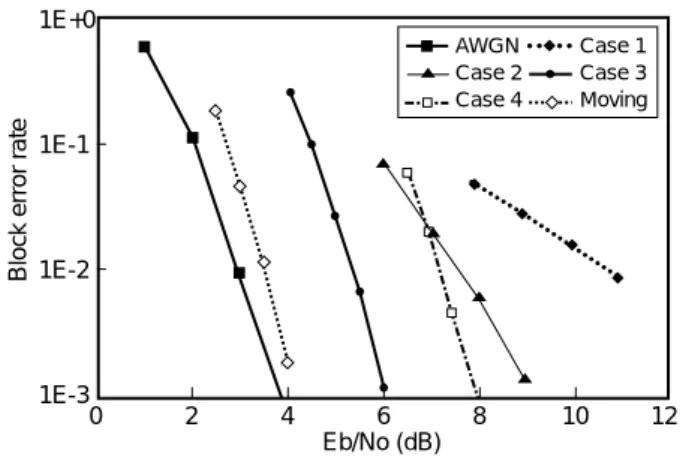
When measuring the communication quali-ty, several indexes such as the bit error rate (BER), block error rate (BLER), and signal interference rate (SIR) are often used to determine the signal error occurrence rate. In a simulation, the paths and algorithms are also verified based on these indexes. Figure 3 shows example relationships between the Eb/No (energy per bit/noise power density) and BLER using the BLER characteris-tics obtained in a simulation.
6. Simulation model
Figure 4 shows a simulation model6) that was created by the mobile communication system design department using CAD-Grid. The model was created to develop base station equipment for overseas use. Specifically, it was created to obtain the characteristics of the base-band processing block of the base station equipment. The model was coded using C++ to simulate communications between the base station and multiple terminals through transmission paths using the same conditions as those of the equip-ment. The base station equipment was developed using this simulation model as the reference model
AWGN Case 2 Case 4
Case 1 Case 3 Moving
1E+0
1E-1
1E-2
1E-3
Eb/No (dB)
Bloc
k error r
ate
0 2 4 6 8 10 12
Figure 3
and was completed using hardware devices (e.g., FPGAs, LSIs, and DSPs [Digital Signal Proces-sors]), firmware, and software.
The base station model consisted of a hard-ware block that performed the CDMA modulation and a wireless processing block that sent and re-ceived radio waves using an antenna. For the transmission paths, we modeled the noise, phas-ing, reflected waves, and terminal/base-station spatial relationships (i.e., speed, distance, and di-rection of travel of terminals with respect to the base station). For the terminals, we modeled CDMA-modulated radio waves that were sent and received in the same way as at the base station.
The simulations verified the parameter com-binations shown in Figure 4. As the number of transmission path conditions increase, the system becomes larger and more complex. Also, because the individual parameters affect other items, it becomes necessary to perform computationally intense simulations in order to find the optimum combination of algorithms and paths.
For simulations required to develop mobile equipment, a dedicated model different from that used for the base station equipment was created
to verify the algorithms and paths.
7. Application results
We tested and verified CAD-Grid environ-ment by using it to simulate the performance of the base station and mobile equipment of a mo-bile communication system. The simulation ran for about six months on the Linux PC cluster and Windows PCs. Table 1 shows some details of the simulation.
In addition to the computer resources of CAD-Grid, the base station development department and mobile equipment development department have their own resources. Compared to the total simulation TAT when just these resources were used, the verification TAT was about 75% less for the base station development and about 50% less for the mobile equipment development. Although the increase in the number of computer resources was a major factor in reducing the TAT, this was not the only factor.
To execute the simulation, additional work such as making preliminary preparations, moni-toring during execution, and verifying and analyzing the results was necessary. However, Base station
SParameter count = 19 – Algorithm: 7
– Circuit parameters: 12 84 patterns total
Modulation Demodulation
Modulation Demodulation Transmission path
Mobile phone 1 Parameter count = 20
Modulation Demodulation Mobile phone n Parameter count = 20 SParameter count = 27
– Rate: 5 – Service: 2 – Fading: 10 – Noise: 5 – Offset: 5 2500 patterns total
Figure 4
script coding and execution control using the OJC to facilitate the work as well as status verifica-tion and compilaverifica-tion using the CGRIS reduced the number of additional processes for simulation. This was another major factor in reducing the TAT.
In a conventional environment, manual op-erations such as copying the programs and scripts for each computer, scheduling the jobs, and collecting the results are required. In CAD-Grid, however, these operations can be done simply by using the CAD-Grid portal. As a result, the num-ber of additional processes for simulation was reduced by about 75% for the base station devel-opment and about 67% for the mobile equipment development. The difference between these two developments was due to the difference in work contents, for example, the parameter settings due to the different simulators, and differences in the number of jobs that were entered for each scenario.
Regarding the effective use of computer re-sources, the operating ratio of the Linux machine was from 70 to 80%. If we look at the job schedul-ing by computer type, which is usually done manually in a conventional environment, there were cases in which some computer resources were idle. However, by using CyberGRIP, im-provements in the operating ratio of 1.5 to 2 times were achieved. In particular, for the Windows PCs, the average CPU operating ratio in regular
office work was less than 10%. We verified that the operating ratio could be improved by more than 10 times by effectively using the idle time.
8. Conclusion
We constructed a Grid computing system called CAD-Grid with CyberGRIP as the core and verified that it significantly improved the overall execution speed and effectiveness of a large num-ber of simulation jobs for a mobile communication system. In particular, for the development of the base station of this mobile communication system, CAD-Grid enabled us to fully optimize the param-eters of the devices by short-term simulations, which reduced the adjustment period of the de-vices.
By using CAD-Grid, we have shown that Grid technology is effective for advancing de-velopment environments, which do not use test models, for the virtualization of production for manufacturers.
Currently, several computer resources inside Fujitsu are connected to CAD-Grid. In addition to simulations using models written in C++, system-level simulations using SystemC7) that are capable of highly abstract hardware coding and logical simulations using Hardware Description Language (HDL) are being implemented. More-over, we plan to extend the range of CAD-Grid to analysis applications using the SIGAL noise analysis tool8) and ACCUFIELD 2000 electromag-netic wave analysis tool9) developed by Fujitsu. Also, we are using the technology of Fujitsu Lab-oratories Ltd. to research and develop automatic parameter-tuning functions using statistical anal-ysis methods. We plan to imbed this structure within the OJC script to automatically create and execute parameter searching jobs.
Base station development About 9000
2900 days 7.3 h/job
45 to 80 CPUs 80 to 100 GHz
About 75% About 75% Total job count
Total processing time Average processing time Number of CPUs used Overall CPU clock frequency Verification TAT reduction Person-hours reduction
Mobile equipment development About 10 000 2200 days
5.3 h/job
About 50% About 67%
Table 1
References
1) T. Yamashita et al.: Grid environment “CAD-Grid” for mobile communication system simulation. PSE Workshop in Sapporo, July 2003, p.31-36. 2) Universal Mobile Telecommunication System.
http://www.umtsworld.com/
3) H. Ueda et al.: Organic Job Controller — A script language to describe submission, synchronization and dependency of jobs —. SWOPP, August 2003, p.99-106.
4) A. Asato et al.: Grid Middleware for Effective Using Computing Resources: CyberGRIP. (in Jap-anese), FUJITSU, 55, 2, p.146-151 (2004).
Tomonori Yamashita received the B.S. degree in Precision Engineering from Yamanashi University, Kofu, Japan in 1984. He joined Fujitsu Ltd., Kawasa-ki, Japan in 1984, where he has been engaged in research and development of system-level design and verification methodology at the CAD system department.
E-mail: [email protected]
Takeo Nakamura received the B.S. degree in Information-Communication Engineering from Tamagawa Universi-ty, Tokyo, Japan in 1982. He joined Fujitsu Ltd., Kawasaki, Japan in 1982, where he has been engaged in research and development of system-level design and verification methodology at the CAD system department.
E-mail: [email protected]
Hiroshi Noguchi received the B.S. and M.S. degrees in Electronic Engineering from Saitama University, Saitama, Ja-pan in 1993 and 1995, respectively. He joined Fujitsu Ltd., Kawasaki, Japan in 1995, where he has been engaged in research and development of system-level design and verification methodol-ogy at the CAD system department. E-mail: [email protected] 5) Condor.
http://www.cs.wisc.edu/condor/
6) N. Saito et al.: The method of system simulation for hardware development with DSP. IEICE, 2002.
7) Open SystemC Initiative.
http://www.systemc.org/
8) T. Sato et al.: Noise Analisys System Design syn-thesis SIGAL. EMC 2000. 7. 5, NO.147.
9) ACCUFIELD 2000. (in Japanese).
http://salesgroup.fujitsu.com/plm/eda/html/ ACCUFIELD.html