TT-RFID platform - Introduction
Version 0.7 – 01/06/2011
INDEX
1. RFID PROTOCOL - MAIN FEATURES ...1
2. COMMAND DISPLAY FOR THE RFID PROTOCOL...2
3. GUIDELINES FOR USING THE RFID PROTOCOL ... 4
3.1. CONFIGURATION OF THE RFID READER/WRITER DEVICE... 5
3.2. CONFIGURATION OF THE ACTIVE TAG DEVICES ... 6
3.3. AUTOMATIC MANAGEMENT OF UNIVOCAL ID (AND SENSING) DATA READ BY THE TAGS 7 3.4. MEMORY DATA MANAGEMENT READ AND WRITTEN ON TAGS ... 7
3.5. MANAGEMENT OF SENSING DATA READ FROM ACTIVE TAGS ... 8
1. RFID Protocol - main features
All of the reading/writing devices based on RFID technology produced by TERTIUM Technology are managed by a single protocol, which has been studied so as to standardize the variegated technological platform which forms the basic ecosystem of the RFID systems.
This protocol is the nucleus of the TT-RFID platform, it allows the simultaneous and homogeneous management of:
• HF, UHF and 2.4 GHz tags
• passive, semi-passive and active tags
• standard tags and sensor tags (also with data logging capacity)
• univocous ID, memory and sensing data
• activation or synchronization inputs such as: keys, detection sensors, external inputs
• signalisation output such as: beeper, LED, external outputs
Moreover, the TT-RFID platform allows you to optimise the full usage of all the capacities of the local “intelligent” of the RFID reader/writer devices.
A considerable series of advanced functionalities is provided which can be autonomously actuated by the device without involving the host system to which it is connected, including:
• repetition of the unsuccessful low level commands
• management of scanning times and cycles
• management of scanning activation events
• management of sound and light signals
• validation (or limitation) of tag inventories
• reduction of consumptions (increase in the operating life of battery-powered devices) The TT-RFID platform shall facilitate and optimise the management of RFID, RFID&Sensing and WSN infrastructures, the abstraction levels of the hardware resources has been chosen as a optimal “trade-off” in respect to the software typologies of which it interfaces (e.g.: middleware, application software for SmartPhone, drivers for laptop terminals).
2. Command display for the RFID Protocol
The RFID Protocol defines a set of commands (and corresponding responses) through which a hosting device can check one or more RFID writing/reading devices and all of the tags which can reachable via radio.
Commands are divided into four groups:
• generic management commands of RFID reader/writer devices
• generic configuration commands of RFID reader/writer devices
• tag management commands
• specific configuration commands of selected standard RFID
Generic management and configuration commands are the same for all of the RFID reader/writer devices of TERTIUM Technology. These commands, which are operated locally, allow the user to configure the function of the device and to check (in real time) the inputs and the outputs provided.
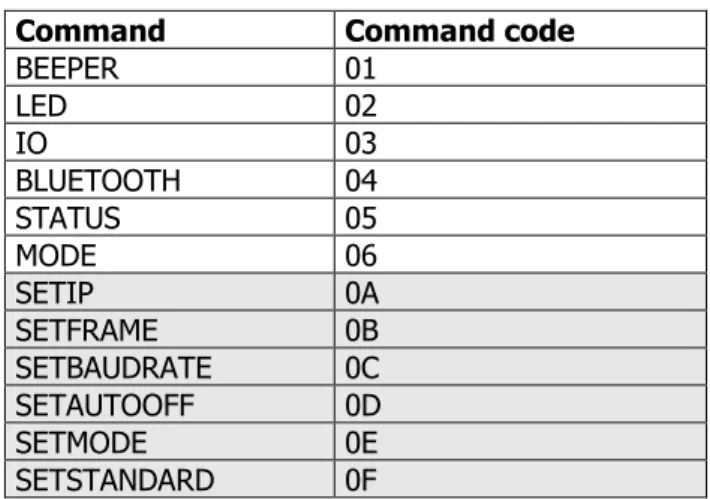
Command Command code
BEEPER 01
LED 02
IO 03
BLUETOOTH 04
STATUS 05
MODE 06
SETIP 0A
SETFRAME 0B
SETBAUDRATE 0C
SETAUTOOFF 0D
SETMODE 0E
SETSTANDARD 0F
Table 1: management command and generic configuration codes
NOTE: some devices may not support all of the commands listed above. For more details refer to the manual of the specific product.
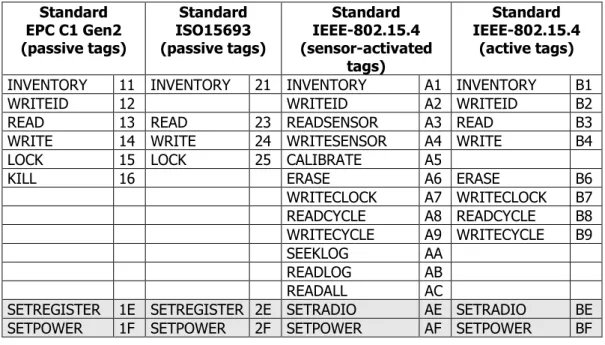
The tag management and specific configuration commands are as similar and consistent as possible with one another, also in the variation of the standard RFID. Via these commands, it is possible to access tags by radio, as well as adjust locally the radio peripheral.
Standard EPC C1 Gen2 (passive tags)
Standard ISO15693 (passive tags)
Standard IEEE-802.15.4 (sensor-activated
tags)
Standard IEEE-802.15.4
(active tags)
INVENTORY 11 INVENTORY 21 INVENTORY A1 INVENTORY B1
WRITEID 12 WRITEID A2 WRITEID B2
READ 13 READ 23 READSENSOR A3 READ B3
WRITE 14 WRITE 24 WRITESENSOR A4 WRITE B4
LOCK 15 LOCK 25 CALIBRATE A5
KILL 16 ERASE A6 ERASE B6
WRITECLOCK A7 WRITECLOCK B7
READCYCLE A8 READCYCLE B8
WRITECYCLE A9 WRITECYCLE B9
SEEKLOG AA
READLOG AB
READALL AC
SETREGISTER 1E SETREGISTER 2E SETRADIO AE SETRADIO BE
SETPOWER 1F SETPOWER 2F SETPOWER AF SETPOWER BF
3. Guidelines for using the RFID Protocol
The versatility of the use of the platform TT-RFID commands depends on the tag typology and on the operational contexts in which RFID reader/writer devices are used.
However the following contexts are ensured:
• configuration of RFID reader/writer devices
• configuration of the active tag devices
• automatic management of univocal ID (and sensing) data read by the tags
• memory management of data read and written on the tags
• management of sensing data read by the active tags
in each of the above mentioned the development of special programs dedicated to the operations which are to be performed in this specific context are to be taken into consideration.
At basic level - for internal use - specific utility programs can be developed which configure the function of the RFID reader/writer devices as required by the application [the EVK valuation kit of
TERTIUM products provides an example].
At application level - for the final user - simple programs can be immediately developed which, via the basic automatic management, only use univocal ID (and sensing) data read by the tags; for example, a keyboard emulation software which processes tagged objects like a bar code reader
[the EVK provides an example]. Or alternatively, more complex programs can be developed which,
via the detailed management of memory data, read and written on the tags, perform higher-evolved identification functions, typical of RFID technology.
Regarding sensor active tags with data logging capacity, still at application level - for levels of use suitably diversified - programs can be developed to configure their operation, to obtain real-time readings of sensors, to download – partially or entirely - the acquisition log.
3.1. Configuration of the RFID reader/writer device
The configuration program is uses “una tantum” to set the operation mode of the RFID reader/writer device in accordance with application needs and with the host system to which it will be connected.
The program shall use the subset of the SET commands of the TT-RFID platform consistent with the hardware features of the device.
All these commands save the parameters in the permanent memory contained in the devices, therefore, on every startup, they will act as pre-configured.
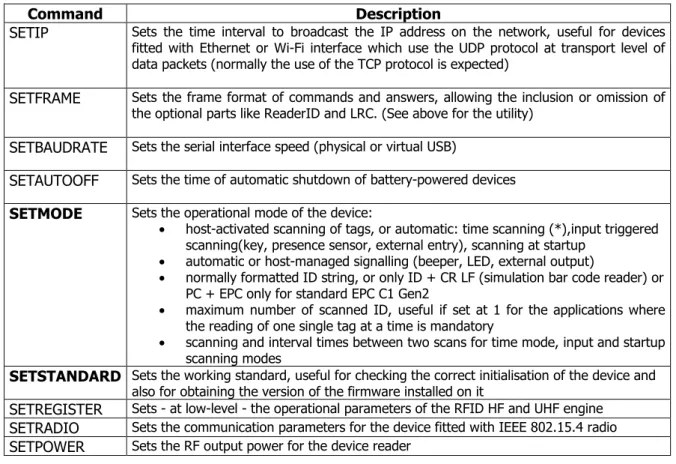
Command Description
SETIP Sets the time interval to broadcast the IP address on the network, useful for devices fitted with Ethernet or Wi-Fi interface which use the UDP protocol at transport level of data packets (normally the use of the TCP protocol is expected)
SETFRAME Sets the frame format of commands and answers, allowing the inclusion or omission of the optional parts like ReaderID and LRC. (See above for the utility)
SETBAUDRATE Sets the serial interface speed (physical or virtual USB)
SETAUTOOFF Sets the time of automatic shutdown of battery-powered devices SETMODE Sets the operational mode of the device:
• host-activated scanning of tags, or automatic: time scanning (*),input triggered scanning(key, presence sensor, external entry), scanning at startup
• automatic or host-managed signalling (beeper, LED, external output)
• normally formatted ID string, or only ID + CR LF (simulation bar code reader) or PC + EPC only for standard EPC C1 Gen2
• maximum number of scanned ID, useful if set at 1 for the applications where the reading of one single tag at a time is mandatory
• scanning and interval times between two scans for time mode, input and startup scanning modes
SETSTANDARD Sets the working standard, useful for checking the correct initialisation of the device and also for obtaining the version of the firmware installed on it
SETREGISTER Sets - at low-level - the operational parameters of the RFID HF and UHF engine
SETRADIO Sets the communication parameters for the device fitted with IEEE 802.15.4 radio
SETPOWER Sets the RF output power for the device reader
Table 3: description of configuration commands of RFID reader/writer devices
Regarding the (hybrid) BLUETOOTH command, through which it is possible to send instant commands and set a series of operational parameters of the Bluetooth interface. (Refer to the special appendix of the RFID Protocol document.)
3.2. Configuration of the active tag devices
The configuration program of the active tags is used to set various working parameters which let tags, being active (with onboard battery), work autonomously regardless of being illuminated by the RFID reader.
The program uses the following RFID Protocol commands:
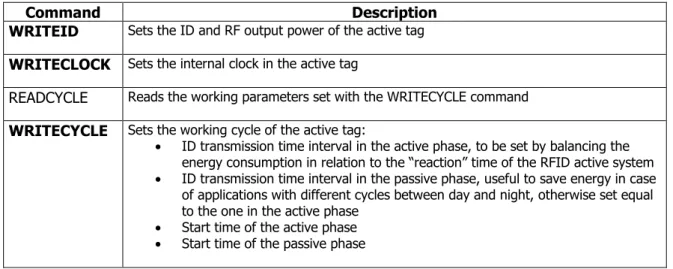
Command Description
WRITEID Sets the ID and RF output power of the active tag WRITECLOCK Sets the internal clock in the active tag
READCYCLE Reads the working parameters set with the WRITECYCLE command WRITECYCLE Sets the working cycle of the active tag:
• ID transmission time interval in the active phase, to be set by balancing the energy consumption in relation to the “reaction” time of the RFID active system • ID transmission time interval in the passive phase, useful to save energy in case of applications with different cycles between day and night, otherwise set equal to the one in the active phase
• Start time of the active phase • Start time of the passive phase
Table 4: description of configuration commands of active tags
Regarding sensor active tags, the configuration program shall also use the following commands of the TT-RFID platform:
READSENSOR Reads the working parameters set with the WRITESENSOR and CALIBRATE commands WRITESENSOR Sets the data acquisition cycles from the various sensors on the active tag:
• index of the configured sensor
• data acquisition and transmission time interval together with the ID • alarm activation threshold (surpassed upwards or downwards) • alarm and data logging activation of the active tag
CALIBRATE Sets the calibration parameters of the various sensors present in the active tags
3.3. Automatic management of univocal ID (and sensing) data read by the tags
The programs which use the automatic management do not normally use any command of the TT-RFID platform but simply process the univocal ID (and sensing) data autonomously read by the tags from the RFID reader, which automatically perform INVENTORY commands according to the preconfigured scanning mode: time mode, from the input, until initialization.
Also the signals are normally, automatically preconfigured.
For passive RFID, in case of a barcode reader simulation or keyboard emulator data entry, usually the reader is configured so as the string sent to the host system contains only the ID + CR LF.
3.4. Memory data management read and written on tags
More articulated programs which, as well as univocal ID data, perform more advanced identification functions reading and writing the data in the memory of the RFID tags, normally use the RFID reading/writing devices configured to be completely controlled by the host system.
In particular the scanning of tags and signalling are under the direct control of the program. However, it is possible to use the automatic management for just one or for both of the above mentioned functions, so that the program controls the remaining application functions which therefore cannot be automatized.
These programs use the following commands of the TT-RFID platform:
Command Description
INVENTORY Scanning of the ID of tags within the reader via radio
WRITEID Writing ID on the tag - only for standard EPC C1 Gen2 and IEEE 802.15.4 READ Memory reading
WRITE Memory writing
LOCK Protection from the writing in some memory areas
Command Description
BEEPER Immediate activation of the acoustic signal LED Immediate activation of the LED signal
IO Immediate activation of the external outputs and reading of the status of external inputs
STATUS Reading the status of the operational device
MODE Sets the device functioning mode
Table 7: description of signal management commands
3.5. Management of sensing data read from active tags
Regarding the programs which process sensing data, the same information previously stated for those which generically access the memory of the tags, is applied.
However, there are some accessory functionalities which require further amendments. Especially the active sensor tags which, as well as sending the data acquired by sensors together with the ID, can also store data (capable of data logging) making the data available later.
Several sensing data management modes can be used, one of them - or more than one - can be applied to meet with the application demands, which are, specifically:
• real time data recording, acquired by sensors and immediately sent together with the ID (reader in automatic scanning mode)
• immediate and real time reading of sensor-acquired data
• partial download, almost in real time, of the latest “logged” data
• total download of “logged” data on a deferred time
In particular, logging and automatic scanning use calibrated data while immediate reading can use both raw or calibrated data.
For these programs the following commands of the TT-RFID platform are available:
Command Description
READSENSOR Immediate reading of the raw data acquired from a sensor
READALL Immediate reading of the calibrated data acquired from one or more sensors
ERASE Total cancellation of the memory contained in all logged data SEEKLOG Optional positioning at a logged data record
READLOG Reading of a logged data record and shift to the next record (calibrated data)
4. Guidelines for the implementation of API
Some guidelines for the implementation of a library of dedicated API are provided in this section, in order to make the management code of the TT-RFID platform clear in the host system, as well as homogenizing the management of the peripherals inside the host system in accordance to those which are external (made available by RFID reading/writing device).
The technological TT-RFID platform, able to facilitate and optimise the management of the RFID, RFID&Sensing and WSN infrastructures, finds its final classification in the operational environment where the application programs which use the RFID Protocol shall be developed and executed.
Given that the TT-RFID platform involves the use of a serial communication channel between the RFID reading/writing device and the host system, and given that the functionalities from the TT-RFID platform are embedded in the firmware of the device, the API can be classified in:
• API Device – host-side remap of functionalities provided by the device
• API Channel - implement the communication channel management with the device
• API Function - implement high-level functionalities using the API Device
The API Device contains the management code of the TT-RFID platform and do not implement any accessory function. Every command in the management of the TT-RFID platform substantially consists of the following procedure:
a) formatting the string to be sent, by copying the function parameters in the correct spaces b) send the string on the communication channel with the device, activation of a timer with
maximum time expected for the execution of a command
c) waiting for the answering string from the communication channel with the device d) extrapolation from the answer string of the parameters and the function return code e) in the case of a timeout (no answer string), generation of a special function return code
The API Function is not usually implemented, the TT-RFID platform is already sufficiently powerful to supply application programs with what they need for the management of the RFID, RFID&Sensing and WSN infrastructures. The API Functions are provided to gather any host-side encoded functions, which are at a central level between the infrastructure and the application (e.g. file transfer functions or the implementation of a file system on the tags).