PIOUS POLITICS: POLITICAL THEOLOGY IN THE ARAB WORLD AND BEYOND
Brandon Chase Gorman
A dissertation submitted to the faculty at the University of North Carolina at Chapel Hill in partial fulfillment of the requirements for the degree of Doctor of Philosophy in the Department of Sociology.
Chapel Hill 2016
Approved by: Charles Kurzman Christopher A. Bail Neal Caren
© 2016
ABSTRACT
Brandon Chase Gorman: Pious Politics: Political Theology in the Arab World and Beyond (Under the direction of Charles Kurzman)
In this dissertation, I investigate the correlates and contents of Islam-centered political ideas among individual Muslims using a combination of survey data, cognitive interview data, and text data gathered from Arabic-language online messageboards. In the Chapters 2 and 3, I find that Muslims tend to support shari'a law and other Islamist political values do not systematically object to liberal global norms like democracy and human rights. The fourth chapter builds on these findings by exploring how Muslims discuss these issues online using a combination of dictionary-based and unsupervised text classification techniques on a sample of 214,861 posts made on the Arabic-language messageboard majalisna.com. I find that posters on this messageboard take issue with global norms not because of the content of the norms themselves, but because of their relationship with the West and powerful global actors. These results 1) provide evidence that the divide between Islamists and non-Islamists in the Muslim world is not as stark as the scholarly literature would otherwise suggest and 2) show that the expansion of international institutions and global culture can lead to both isomorphism and
ACKNOWLEDGEMENTS
TABLE OF CONTENTS
LIST OF TABLES viii
LIST OF FIGURES ix
CHAPTER 1: INTRODUCTION 1
CHAPTER 2: GLOBAL BOUNDARY INVERSION: INTERNATIONAL ORGANIZATIONS,
MUSLIM IDENTITY, AND SHARI’A LAW 5
Introduction 5
Boundaries and the World Polity 7
Shari’a and Global Culture 11
Why Do Some Muslims Support Shari’a? 13
Religiosity 13
Orthodoxy 13
Demographics 14
Cultural Content 15
Boundaries 15
Methods and Data 16
Who Supports Shari’a? – Quantitative Data and Method 18
Dependent Variable 18
Religiosity 19
Orthodoxy 20
Demographics 20
Cultural Content 21
Boundaries 22
Models 23
Who Supports Shari’a? – Quantitative Results 24
Religiosity 24
Orthodoxy 24
Demographics 25
Cultural Content 25
Boundaries 28
Why Do Some Muslims Support Shari’a? – Qualitative Data, Method, and Results 30
Discussion and Conclusion 35
CHAPTER 3: THE MYTH OF THE SECULAR-ISLAMIST DIVIDE IN MUSLIM POLITICS 38
Introduction 38
The Secular-Islamist Divide 39
Polarization, Political Identity, and Islamism 42
Case Selection: Islamism in Tunisia 43
Methods and Data 45
Variables – Arab Barometer Survey 46
Dependent Variables – Measuring Islamism 46
Independent Variables – Demographics 48
Independent Variables – Belief and Ideology 48
Measuring the Secular-Islamist Divide – Definitional Results 50 Evaluating the Secular-Islamist Divide – Attitudinal Results 54
Models 54
Missing Data 54
Model Results – Demographics 55
Model Results – Belief and Ideology 55
Liberal and Secular Elements in Islamist Discourses 57 Illiberal and Islamist Elements in Secularist Discourses 60
Discussion and Conclusion 63
CHAPTER 4: ISLAMISM AND DEMOCRACY IN THE ARAB ONLINE PUBLIC SPHERE 66
Introduction 66
Data and the Online Public Sphere 67
The Arab Online Public Sphere 68
Data 69
Text Classification Models 71
Unsupervised Topic Modeling: Latent Dirichlet Allocation 71 Dictionary-Based Classification: Islamism and Democracy 74
Topic and Subtopic Comparisons: Methods and Results 75
Variables 75
Models 79
Regression Results 79
Discussion and Conclusion 81
APPENDIX 1: GLOBAL BOUNDARY INVERSION 85
APPENDIX 2: ISLAMISM AND DEMOCRACY IN THE ARAB ONLINE PUBLIC SPHERE 94
LIST OF TABLES
Table 1: Fixed Effects Regressions on Support for Shari’a (Arab Barometer) 26 Table 2: Ordered Logistic Regressions with Country-Level Fixed Effects on Support
for Shari’a (World Values Survey) 27
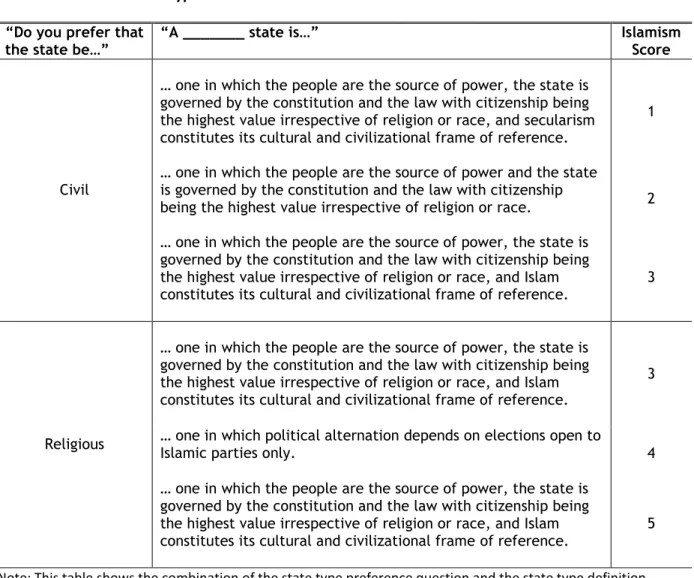
Table 3: Details on State Type Preference Variable Construction 47 Table 4: Correlation Matrix for Variables Measuring Islamist Attitudes 53 Table 5: Results of Regression Models with Islamism Measures as Dependent Variables 56
Table 6: Internet Use Statistics in the Arab World 70
Table 7: Ten Countries with the Highest Number of Majalisna Members 70
Table 8: LDA Topics with Top Ten Most Informative Features 76
Table 9: Islamism and Democracy English-Equivalent Dictionary Lists 78 Table 10: Fixed-Effects Logistic Regression Models Predicting Islamism and
LIST OF FIGURES
Figure 1: Percentage of Muslims Responding “Agree” or “Strongly Agree” with
Survey Item on Implementing Shari’a in Eight Majority-Muslim Countries 6
Figure 2: Histograms Describing Dependent Variables 19
Figure 3: Cumulative Effects of Independent Variables on Support for
Shari’a Index (Arab Barometer) 29
Figure 4: Cumulative Effects of Independent Variables on Predicted Probabilities
of Ordinal Support for Shari’a Variable (World Values Survey) 30
Figure 5: Cumulative Effects of Independent Variables on Predicted Probabilities of “Agree” or “Strongly Agree” Responses to Ordinal Support for Shari’a Variable
(World Values Survey) 31
Figure 6: Distribution of Interview Responses for Support for Shari’a Item 32 Figure 7: Histogram Describing Distribution of State Type Preferences 51 Figure 8: Choice of Islamic or Civil State and Definition of Respondent Choice 52 Figure 9: Bar Chart Showing Number of Respondents Giving “Islamist”
Responses to Survey Items 53
Figure 10: Monthly Time Series of Posting Activity 72
Figure 11: Histogram of Post Activity by Individual Posters 72
Figure 12: Monthly Time Series of LDA Topics 77
CHAPTER 1: INTRODUCTION
On the afternoon of September 9th 2013, I hailed a taxi to take me home from an interview I was
conducting in Sidi Bou Said, Tunisia. My conversation with the taxi driver took a predictable route – compliments on my Arabic, my knowledge of Islam, questions about my ethnoreligious heritage and my reason for being in Tunisia. The discussion of my dissertation topic – the relationship between shari’a and democracy – inevitably turned to an animated analysis of the situation in Tunisia since the revolution. Hands waving, the taxi driver enumerated a lengthy list of problems in the country: corruption, violence, infighting, rising prices, and a shortage of tourists. Intrigued, I probed – how will Tunisia solve all of these problems? My companion replied, “Of course you must know that God is the solution, faith is the solution, the answers are always in Islam.” I probed further, asking him to clarify. He responded, “First, we must have term limits so that politicians don’t become lazy and they work for the common good, and the laws must apply to politicians like everyone else. There should also be
transparency in campaign financing, we have to know who is paying for these politicians,” and so on, without mentioning Islam, God, or faith again for the remainder of his half-hour monologue.
I found this pattern repeated in other conversations. In early November, a man I met in a café told me that he supported the creation of a caliphate whose leader would be “elected, but not through democratic elections, through Islamic elections.” Other self-described Salafists told me similar things: elections should be replaced with shura (a Qur’anic term meaning “consultation”) and bei’a (allegiance), taxes should be replaced with analogous Islamic concepts, khums and jizya, and the civil state should be replaced with an Islamic one. Yet, despite these differences in terminology, respondents largely
tourists, and have peaceful relations with its neighbors (in fact, these people argued, Tunisia would improve on all of these fronts). This phenomenon also permeated more mundane elements of life during my time in Tunisia. Tunisia’s first “Islamic restaurant” opened in Sousse in December 2013; it differs from “secular” restaurants in only two ways: the waitresses are all veiled and the dining area is divided into family-sized units by movable partitions that allow conservative women to feel comfortable removing their head coverings.
This was not at all what I expected to find when I started my fieldwork, given the acrimonious and polarized public debate surrounding Islamism in the Arab world and around the world. Activists, politicians, and media outlets on both sides of the secular-Islamist divide depict the two sides as fundamentally incompatible, and this pessimism is echoed by scholars who depict Islamists as
“ideological actors” that are committed, first and foremost, to realizing their vision of an Islamic moral and political order. The incongruence with my experience as a foreign researcher in Tunisia is what spurred the broad topic of this dissertation: what is Islamism and how and why do people invoke it? I explore these questions by adopting a broad and complementary set of data and methods.
In Chapter 2, entitled “Global Boundary Inversion: International Organizations, Muslim Identity, and Shari’a Law,” I investigate Islamism as a form of boundary work targeted at international
their political concepts in global culture. This suggests that the diffusion of global culture produces both isomorphism and differentiation, weakening some symbolic boundaries while strengthening and creating others.
In Chapter 3, entitled “The Myth of the Secular-Islamist Divide in Muslim Politics,” I evaluate the notion that secularists and Islamists in the Muslim world are engaged in “culture wars” that pit
fundamentally divergent ideological blocs against one another in a zero-sum contest for power. Using a mixed-method design combining analyses of data from the second wave of the Arab Barometer surveys and in-depth interviews with Tunisians, I find little evidence that Islamists are different from non-Islamists in regards to attitudes about declaring others non-Muslims (takfir), popular sovereignty, women’s rights, or minority rights, though they are more likely to believe that democracy undermines Tunisian values and less likely to be tolerant of followers of other religions. Further, many of the “Islamic” political procedures advocated by Islamists bear striking resemblances to the secular
procedures they seek to replace, and secularist respondents revealed in their interviews that they would potentially agree with many Islamist positions – such as applying shari’a – so long as their
interpretations were implemented. By exploring the correlates and contents of Islamist and secularist ideologies at the individual level, this chapter shows that the so-called secular-Islamist divide in Muslim politics is not as deep or fundamental as it seems.
Chapter 4, entitled “Islamism and Democracy in the Arab Online Public Sphere,” follows on the previous chapters using computational techniques to analyze discussion topics in 214,861 posts made on the Arabic-language messageboard majalisna.com. In this chapter, I employ two computer-assisted text classification techniques – unsupervised topic models using Latent Dirichlet Allocation (LDA) and dictionary-based classification – to investigate when and how individuals discuss Islamism and
democracy-related concepts like elections tend to be clustered in explicitly political topics, and the people who discuss democracy are more likely to discuss international crises, conflicts, and conspiracy theories than those who do not. These results provide evidence in support of the previous two chapters by showing that the divide between Islamists and non-Islamists is not as stark as the scholarly literature would otherwise suggest and that democracy is a contentious topic among Arabic speakers because of its relationship with the West and powerful global actors. It is also among the first sociological studies to explore the content of the Arab Online Public Sphere (AOPS) by employing “big data” analysis
techniques to Arabic-language text.
CHAPTER 2: GLOBAL BOUNDARY INVERSION: INTERNATIONAL ORGANIZATIONS, MUSLIM IDENTITY, AND SHARI’A LAW
Introduction
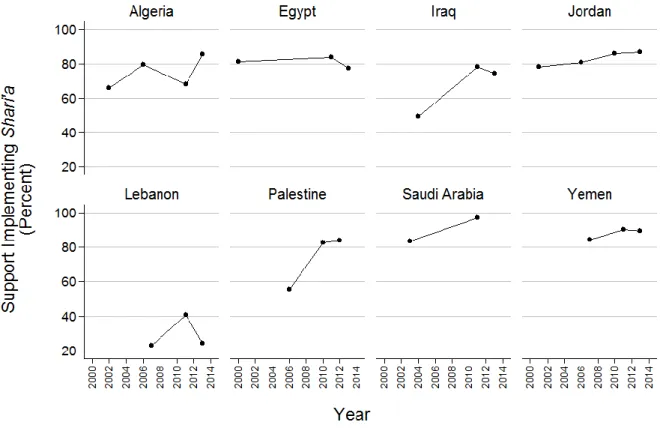
Shari’a, or Islamic law, was largely replaced by Western-style legal codes in the early twentieth century. Over the past few decades, however, it has been steadily reintroduced in majority-Muslim countries due in part to “the powerful… discourse surrounding it, which holds promises for the ‘ordinary people’” (Peters 2005:146). Today, support for shari’a is regarded by many Muslims as a litmus test for judging the cultural authenticity of social and political actors. After the 2011 uprising in Tunisia, for example, the Islamist Ennahda Movement’s decision to abandon their goal of implementing shari’a was met with backlash from pro-shari’a groups who denounced Ennahda for failing to be authentically Islamic (Torelli et al. 2012). Globally, however, the rise in the popularity of shari’a has become a point of contention, with Western countries, international organizations, and human rights activists often associating shari’a with stonings, floggings, forced marriages, and worse (Abiad 2008; Korteweg 2008). Nearly 79 percent of Muslim respondents to values surveys in majority-Muslim countries “agree” or “strongly agree” with implementing shari’a, and, as Figure 1 illustrates, support has increased since the early 2000s when researchers began collecting systematic data on the topic. This increasing support for shari’a alongside increasing criticism by international organizations and Western countries presents a puzzle for sociological theories of global cultural diffusion that predict coalescence around globally-legitimated norms.
Figure 1: Percentage of Muslims Responding “Agree” or “Strongly Agree” with Survey Item on Implementing Shari’a in Eight Majority-Muslim Countries
Sources: World Values Survey Wave 4 (1999-2004), Arab Barometer I (2006-2007), Arab Barometer II (2010-2011), Arab Barometer III (2012-2013).
Note: Countries included are those with data for more than one time point; non-Muslims are dropped from the sample in all countries. This figure indicates that overall support for shari’a has risen across all countries in this time period with the exception of Egypt, where support has remained relatively flat.
superiority to globally-legitimated sociopolitical configurations. Thus, Muslims may not choose to support shari’a because of its ideological content, but rather because they feel purposefully excluded from global norm-making.
In what follows, I generate testable hypotheses about the determinants of support for shari’a drawn from previous research and boundary work theory. I test these hypotheses using a mixed-method design combining quantitative analyses of data from values surveys in twelve majority-Muslim countries with a qualitative analysis of data drawn from cognitive interviews I performed with fifty Tunisians between 2013 and 2014. Findings indicate: 1) a robust relationship between support for shari’a and reservations about international organizations and global actors and, 2) shari’a supporters explicitly frame their support in opposition to international organizations and actors irrespective of their attitudes toward the content of global norms and their personal understanding of shari’a. This suggests that support for alternatives to global norms is a reaction to, rather than a holdout from, global cultural diffusion. Further, results provide evidence that international institutionalization can lead not only to isomorphism but also to cultural differentiation.
Boundaries and the World Polity
World polity scholars argue that the spread of international organizations and their cultural norms – which include democracy, secularism, rationality, environmentalism, science promotion, women’s rights, and human rights – contribute to the decreasing relevance of cultural boundaries and increasing global homogenization of cultural practices (Beck, Drori, and Meyer 2012; Boli 2005; Bush 2007; Frank, Hironaka, and Schofer 2000; Hafner-Burton and Tsutsui 2005; Longhofer and Schofer 2010; Meyer et al. 1997; Meyer and Jepperson 2000; Schofer 2004; Torfason and Ingram 2010). Meyer
often exclusionary (Anderson 1991; Edgell, Gerteis, and Hartmann 2006; Telles 2004). It is possible that the global-cultural appeal to universality contributes to cultural differentiation (Appadurai 1996; Hannerz 1996) and that, by legitimating certain practices as “global”, international institutions and their discourses implicitly delegitimate others (Halliday and Carruthers 2007:1140).
It is also unclear to what extent the isomorphic tendencies described by world polity scholarship are the result of individuals’ assessments of global culture as universal. Recent studies have emphasized the boundaries in global institutional networks wrought by inequalities and global power dynamics (Beckfield 2003, 2010; Hagan et al. 2006; Hughes et al. 2009; Paxton et al. 2015). As a result of this stratification, the most powerful countries are the dominant producers and promoters of global norms (Cole 2006) which are either local cultural features presented as universal (Carruthers and Halliday 2006:534) or are intended to alter policies and practices in weaker countries (Barrett, Kurzman, and Shanahan 2010). While some local actors attempt redefine global norms to match already-existing cultural features (Rinaldo 2013; Vasi 2007), they do so at their own peril – international institutions often subject relatively weak countries to exclusion from global norm-making (Halliday 2009) or public shaming (Halliday et al. 2010:90–93) for nonconformity. As a result, many countries adopt global norms not due to their intrinsic appeal but because they lack the resources to “opt out” (Boyle and Preves 2000; Boyle et al. 2001).
Thus, as international organizations become external identifiers of a given population, the imposition of their cultural norms changes that population’s identification process. Anthropologists have found, for example, that Amazonian Indians in Brazil (Conklin and Graham 1995) and Mayans in Guatemala
(Warren 1998) both overcame internal divisions to form pan-indigenous identities in the wake of United Nations rainforest protection programs in the 1980s and 1990s. The authors argue that these groups produced novel self-identifications as a result of external identifications that lumped them together as “indigenous populations.”
However, external identifications rooted in legitimacy-granting institutions are not automatically adopted by target populations and sometimes produces opposition to external identifiers (Scott 1990; Tilly 1998). This is particularly true in the contemporary era, where the prevalence of mass media ensures that disparaging representations “are quickly moved into local repertoires of irony, anger, humor, and resistance” (Appadurai 1996:7). Indeed, group identities often thrive on embattlement and cultural boundaries become more salient when repeatedly challenged by outsiders (Gurrentz 2013; Smith et al. 1998; Stein 2001). For instance, Boyle and Carbone-López (2006:441) found that the international push to eliminate female genital cutting was deemed offensive by local opponents of the practice because of its perceived hostility toward African culture. Likewise, historical studies have shown that local nationalisms take on anti-global overtones when groups are targeted or excluded by
international organizations. Gelvin (1998) and Milton-Edwards and Farrell (2010) show how nationalist sentiments in Syria and Palestine identify international organizations as enemies as a result of these countries’ being defined as less-than-full members of the global community. Similarly, Ivković and Hagan (2006) found that Sarajevans became increasingly skeptical of the International Criminal Tribunal for the former Yugoslavia as a result of perceived marginalization in the tribunal process.
that individuals belonging to these groups can seek to change the meanings of boundaries by
challenging the hierarchical ordering of the categories they create. Wimmer (2008:986) calls this process boundary inversion, wherein subordinate groups self-identify as a “chosen people” who are morally and culturally superior to dominant groups. Examples include “black power” (Morris 1999; Telles 2004), “red power” (Nagel 1995; Warren 1998), and other ethnicity-based minority movements in the Americas (Takezawa 1994) as well as the more subtle use of conspicuous consumption to cast black American culture as uniquely “hip” (Lamont and Molnár 2001). Scholars of Chinese foreign policy have noted a tendency for Chinese intellectuals and authorities to disparage the international system by calling for global “Sinicization” (Barmie 1996) epitomized by the slogan “only Chinese culture can save the world” (Zhao 1997:738); they have also noted that this discourse diminished as China became increasingly embedded in global institutional networks (Kent 2007).
shari’a results in boundary inversion, wherein Muslims increasingly support shari’a and elevate it as superior to the global culture from which it is excluded.
Shari’a and Global Culture
The word shari’a, which means “the path” in Arabic, is a non-codified legal system based in the Qur’an and the example of the life of the Prophet Muhammad (Esposito 2011) that has historically been
open to many interpretations, leading to a wide variation in what constitutes shari’a (Coulson 1964; Halliday 2003). More contemporary Muslims have continued this trajectory of diverse interpretations: for Islamic fundamentalists such as Ḥasan al-Bannāʼ and Sayyid Quṭb, shari’a is a total institution that governs all realms of life and is defined in opposition to Western forms of governance (Al-Bannāʼ 1978; Quṭb 1990). Islamic modernists, by contrast, believe that shari’a should be kept out of public life but still consider it crucially important in the private sphere (Kepel 1994:13–23; Kurzman 2002). Still others interpret shari’a as intrinsically liberal, arguing that it demands human rights, women’s rights, and democracy (Kurzman 1998; Sadowski 2006). This suggests that support for shari’a does not inherently entail opposition to global norms.
While shari’a was replaced by secular legal codes in most countries1 by the early 20th century
(Hefner 2011), many studies indicate a resurgence in its popularity beginning in the 1970s and
accelerating through the 1990s (Juergensmeyer 1993; Lawrence 1995; Roy 2006; Salvatore 1997). This era, which world polity scholars identify as the period of exponential expansion of global networks (Beckfield 2010; Koo and Ramirez 2009; Pubantz 2005), also saw the rise of Islam-based global
institutions, such as the Organization of Islamic Cooperation, and the promotion of Islamic alternatives to global norms (Arjomand 2004). While historical contention over shari’a was largely restricted to struggles between religious and political elites (Feldman 2008:106), the late 20th century resurgence in
1 It is important to note that this shift was not complete – scholars have shown that shari’a remained in place in
its popularity was fueled, in part, by ordinary Muslims. Intensifying calls for implementing shari’a prompted Anwar Sadat to issue the 1980 amendment to the Egyptian constitution identifying it as a source of legislation (Ayubi 1980:486–490); Muhammad Zia-ul-Haq’s implementation of shari’a provisions in Pakistan during the 1970s and 1980s were met with substantial popular support (Kepel 2002:100–101). This “return to Islam” was so pronounced that Palestinian historian Hisham Sharabi, who in 1966 wrote that Islam had “simply been bypassed” as a mobilizing ideology (1966:26), called Islamism “the dominant ideological force in Arab Society” thirteen years later (1979:97; see also: Lewis 1979; Tessler 1980).
Historical and qualitative studies suggest that the delegitimization of shari’a among world polity organizations has led some Muslims to seek to create an alternative global culture based on Islamic principles as they understand them. Since the adoption of the Universal Declaration of Human Rights in 1948, for example, there have been various attempts, beginning with the Universal Islamic Declaration of Human Rights in 1981, to outline a specifically “Islamic” declaration of human rights, all of which emphasize the centrality of shari’a (Mayer 2007; Moosa 2000). A number of case studies similarly suggest that, in majority-Muslim countries, some individuals and organizations that work towards the implementation of global norms like women’s and human rights couch their interests in the framework of shari’a rather than (or in addition to) the language of international organizations (e.g., Kendhammer 2013a:482; Salime 2011:37–39). This shows that shari’a supporters may adhere to the content of global norms while simultaneously avoiding identification with global norm-makers.
Why Do Some Muslims Support Shari’a?
Previous scholarship suggests a number of factors that may lead Muslims to support shari’a: religiosity, orthodoxy, demographics, opposition to the content of global culture, and boundary work resulting from domestic oppression. The current study theorizes an additional explanation – boundary inversion targeted at international institutions and other global actors.
Religiosity
One body of literature suggests that support for shari’a is an intrinsic feature of Islam and, thus, all Muslims should support shari’a, particularly more religious Muslims (e.g., Potrafke 2012). More recent studies, on the other hand, have found that religiosity is only loosely related to support for shari’a (Hoffman and Jamal 2012).
Orthodoxy
Starks and Robinson 2005). This approach distinguishes between two fundamentally different conceptions of the role of God in the universe. Religious modernists, on the one hand, believe that individuals are the ultimate judges of morality and that God is largely a passive force in human existence (Starks and Robinson 2009:651). The religiously orthodox, by contrast, believe that God is the ultimate moral arbiter, that the revealed word of God is inerrant, and that God takes an active hand in shaping people’s daily lives (ibid.).
This scholarship argues that orthodoxy, due to its God-centered orientation, is associated with conservative social attitudes, egalitarian economic attitudes, and skepticism about popular sovereignty (Blouin et al. 2013; Davis and Robinson 1999, 2006). According to this line of reasoning, individuals that display a high level of orthodoxy in their belief system (e.g., helping the poor as a religious requirement, strict adherence to scriptural rules, application of religious solutions to social problems) should be more likely to support shari’a, while individuals who have a strong commitment to popular sovereignty should be less likely to support shari’a. Indeed, much of the work in this area in majority-Muslim countries uses support for shari’a as a straightforward proxy for orthodoxy (e.g., Acevedo 2008; Davis and Robinson 2006; Junisbai 2010; Moaddel and Karabenick 2008).
Demographics
If shari’a is a constitutive feature of a pre- or anti-modern Islamic ideology, support for it should be most prevalent among older and less educated individuals who are less likely to be exposed to global cultural trends (Boyle et al. 2002). On the other hand, demographic pressures might also lead Muslims to embrace shari’a as a solution to economic and political problems at the behest of political
Cultural Content
Some scholarship conceptualizes religious political concepts like shari’a as components of a totalizing meaning system that inspires its adherents to axiomatically reject cultural innovation. For scholars in this area, religion “bolsters individuals’ acceptance of ‘traditional’ norms over the norms promoted by the international community, and Islam has served as a base of resistance to a number of global norms” (Boyle et al. 2002:16; see also: Boyle and Meyer 1998:218–219). The specific aspects of global culture that ostensibly run counter to shari’a range from abstract ideological principles such as individualism (Juergensmeyer 1993:191, 2008; Lawrence 1995), capitalism (Barber 1995; Mandaville 2007:99), democracy (Ciftci 2012; Potrafke 2012), human rights (Kendhammer 2013a; Moosa 2000), and women’s empowerment (Charrad 2001:5; Fish 2011), to cultural objects including “fine arts, novels, [and] music” (Roy 2007:74). This suggests that individuals with ideological objections to the content of global norms are more likely to support shari’a.
Boundaries
Among the theoretical approaches that conceptualize the integration of religion and politics as a form of symbolic boundary work, subcultural identity theory suggests that individuals may endorse shari’a not out of religious obligation, but as a form of resistance against perceived marginalization in
domestic culture and politics. Smith et al. (1998) argue that evangelicals, fundamentalists, and other religious subcultures in the United States thrive by drawing symbolic boundaries between their adherents and mainstream American culture. Thus, individuals may adopt Islamist discourses in
Others posit that support for shari’a is a form of resistance against political, economic, and military domination at the hands of powerful external actors, such as the United States, that marginalize and subordinate Muslims in the international system (Ayoob 2005; Jamal 2012; Kepel 1994). Thus, support for shari’a is, in part, an outcome of powerful actors’ historical mistreatment of Muslims and backing of oppressive secular-autocratic domestic regimes, and supporting it “makes a clearly anti-Western statement” (Peters 2005:145). This suggests that individuals who think that external forces are obstacles to reform and development in the Muslim world are more likely to support shari’a than those that do not. While this approach explicitly ties support for shari’a with global power dynamics, it focuses on state politics rather than international institutions and global norm-making processes. The current study additionally proposes that Muslims support shari’a as a form of boundary inversion targeted at international institutions whose discourses place Islamic political concepts outside the bounds of the global legitimacy framework. I hypothesize that many Muslims who support shari’a frame their support specifically in reference to international institutions.
Methods and Data
I use a mixed-method design to explore the relationship between support for shari’a and attitudes toward international institutions. First, I test for a statistical relationship between support for shari’a and key independent variables using ordinary least squares and ordered logistic regression models with country-level fixed effects. I analyze two sources of data: 1) the second wave2 of the Arab
Barometer (AB) survey, which includes data on over 10,000 respondents across ten Arab countries – Algeria, Egypt, Iraq, Jordan, Lebanon, Saudi Arabia, Sudan, Tunisia, and Yemen – in 2010 and 2011 and, 2) the fourth wave3 of the World Values Survey (WVS) with responses from approximately 8,000
2 Only the second AB wave contains survey items about a number of relevant independent variables, including
orthodoxy, global norms (e.g., tolerance and women’s rights), and attitudes about the international community.
individuals across six majority-Muslim countries – Bangladesh, Egypt, Indonesia, Jordan, Nigeria, and Saudi Arabia – between 1999 and 2004.4
I use qualitative results from fifty semi-structured interviews that I performed in Tunisia between August 2013 and March 2014 to validate findings from the quantitative analyses and examine the content of pro-shari’a attitudes. Most interviews were conducted in Tunisian Arabic, with a handful in English at the request of the respondent. I conducted the interviews using cognitive interviewing techniques, which involve asking respondents to answer a standard set of survey items along with open-ended follow-up questions in order to provide insight into respondents’ perceptions of the survey items and the justifications for their answers (Miller 2014). I chose respondents using a combination of
convenience and purposive sampling (Teddlie and Yu 2007) designed to capture the full range of support for shari’a among respondents, with self-identified Salafists5 oversampled. Respondents ranged in age
from 22 to 64 years (mean=33.32), were 60% men (N=30) and 40% women (N=20), and the vast majority had or expected to acquire a college degree6 (80%, N=40).
Cognitive interviewing is an ideal data collection method for this kind of analysis. Because interview questions were chosen from AB and WVS survey questionnaires, the resulting data provide insight into the content of pro- and anti-shari’a attitudes by allowing shari’a supporters and opponents to justify their answers in their own words (Gorman 2015). This allows me to: 1) ensure that the results of the quantitative analyses accurately reflect respondents’ cognitive schemas – a strategy that Small (2011) calls triangulation – and, 2) test the hypothesis that support for shari’a is tantamount to global
4 Non-Muslims are dropped from both samples.
5 Salafism is an interpretation of Sunni Islam that forbids theological innovation and advocates adherence to the
social structures that existed at the beginning of Islamic history.
6 My sample is younger and more educated than the Tunisian population as a whole. According to the AB data, the
boundary inversion by evaluating whether shari’a supporters discursively elevate it as superior to global norms. The former is particularly important given the possibility that being interviewed by a foreign researcher may have influenced interviewees’ responses.
Who Supports Shari’a? – Quantitative Data and Method
Dependent Variable
The dependent variable for the quantitative models is support for shari’a. For the AB data, I construct an index using four survey items presenting respondents with the statement that the government and parliament7 should enact: 1) laws in accordance with shari’a; 2) penal laws in
accordance with shari’a; 3) personal status laws in accordance with shari’a and; 4) inheritance laws in accordance with shari’a, with responses ranging from “strongly disagree” to “strongly agree”
(Cronbach’s alpha = 0.8731). (See Appendix 1A for a list of indices drawn from both datasets and their related indicators). The resulting index is the sum of all individual indicators scaled to a theoretical range of 1-100, and any missing indicator results in a missing index score (N=1,036; roughly 9% of
respondents).
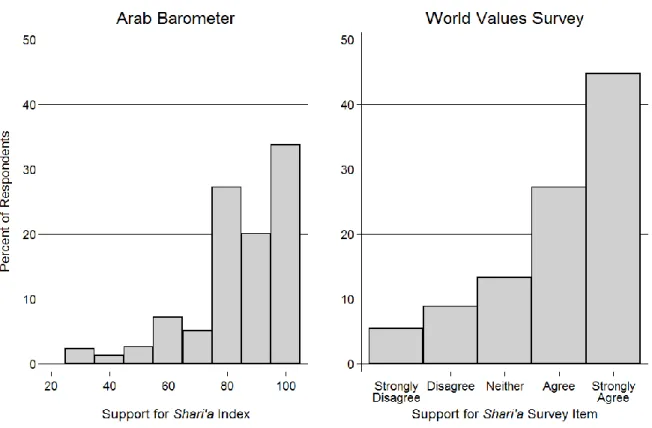
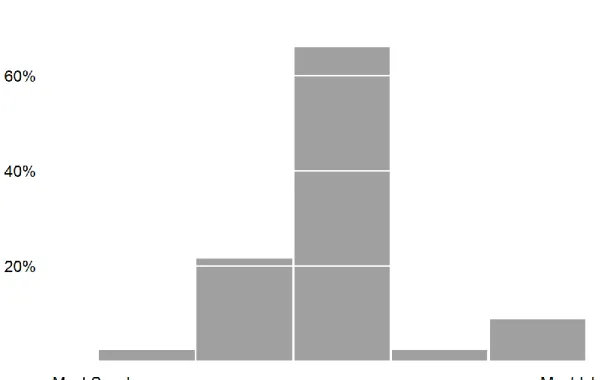
In the WVS data, there is only one survey item that deals with shari’a. It presents respondents with the statement “The government and parliament should implement only the laws of the shari’a,” with a five-item Likert response scale ranging from “strongly disagree” to “strongly agree.” Figure 2 presents the distribution of the dependent variables in both datasets and shows that, while shari’a is popular among Muslims, there is considerable variation in the responses: nearly 30% of respondents are ambivalent or opposed to its implementation.
7 In Saudi Arabia, all questions with the stem “The government and parliament…” are worded “The government
Figure 2: Histograms Describing Dependent Variables
Note: The theoretical range for the support for shari’a index used in the AB data is 0-100; its empirical range is 25-100.
Religiosity
For the AB data, I use two measures of religiosity. The first is self-reported religiosity8 with
responses ranging from “religious” to “not religious.” The second is an additive religiosity index constructed from three survey items that assess how often the respondent watches or listens to religious programs on the radio or television, reads religious books, and listens to or reads the Qur’an with responses ranging from rarely9 to daily (Cronbach’s alpha = 0.7687); this index is z-standardized to
8 I include self-reported religiosity as a separate variable in models using both datasets for two reasons. First, the
correlation between this variable and other measures of religiosity is relatively weak (range: 0.1062 to 0.3478). Second, scholarship on attitudes in majority-Muslim countries indicates that self-reports are not reliable indicators of religiosity in these contexts (e.g., Hoffman and Jamal 2012; Jamal and Tessler 2008).
9 Because respondents were given the option to choose “never” in the Tunisian sample, I combined this option
enhance comparability across independent variables. For the WVS data, I use responses to two survey items to measure religiosity: a binary variable that captures self-reported religiosity and an ordinal variable describing religious service attendance, with responses ranging from “never” to “more than once a week.”
Orthodoxy
To measure the doctrine component religious orthodoxy in the AB sample, I construct a z-standardized additive index using responses to three survey items asking respondents to what extent helping the poor, public prayer, and not listening to music are criteria for individual piety, with
responses ranging from to “absolutely irrelevant” to “to a great extent” (Cronbach’s alpha = 0.7047). In the WVS sample, I construct a z-standardized additive index using three binary variables that measure whether respondents believe that religious institutions have solutions to moral, social, and family problems (Cronbach’s alpha = 0.7539). According to previous research, religiously orthodox individuals should be also skeptical of popular sovereignty. I measure this aspect of orthodoxy10 through a survey
item that asks respondents if they think laws should be made according to the people’s wishes, with responses ranging from “strongly disagree” to “strongly agree.” These variables are identical in both the AB and WVS data, although in the WVS there is a neutral category on the response scale.
Demographics
In both datasets, I include three demographic variables. The first is age in decades. The second indicates if the respondent is female. The third measures level of education, coded 1 if the respondent
10 I include support for popular sovereignty as a separate variable in models because the correlation between this
has at least some college. This variable was recoded due to differences in response categories between the datasets and across countries.11
Cultural Content
I measure individual attitudes about six global norms. In the AB data, I construct a
z-standardized index that measures support for women’s empowerment using five survey items that ask respondents whether they believe that women should be able to work outside the home, have the same employment opportunities as men, travel abroad, and assume judicial and ministerial positions
(Cronbach’s alpha = 0.7996). I assess attitudes about democracy using a survey item12 that asks
respondents whether they think that, despite its faults, democracy is better than any other political system, with responses ranging from “strongly disagree” to “strongly agree.” I measure racial and religious tolerance using two binary variables that ask respondents if they would be comfortable having “people of a different race or color” or “followers of other religions” as neighbors.13 Finally, I construct a
binary measure that captures whether the respondent is an association member, coded 1 if the respondent belongs to a union, charity, or non-governmental organization.
In the WVS data, I construct a z-standardized index that measures attitudes toward women’s empowerment using two survey items that ask to what extent being a good mother and good wife are
important traits for women (Cronbach’s alpha = 0.7947). As in the AB data, I assess attitudes about
11 In the AB dataset, for example, Tunisian respondents were presented a 6-item response scale while respondents
in other countries were presented with a 7-item response scale.
12 I use this question because it measures diffuse support for democracy in general rather than specific support for
particular aspects of democracy, thus more accurately measuring support for democracy as an element of global culture. There is a similar question which asks respondents to what extent they think democracy is a “good” political system. Results of models using this alternative question are substantively very similar (not reported).
13 While similar questions exist in the WVS data, I do not include them in models for two reasons. First, they were
democracy via a survey item that asks respondents whether they think that, despite its faults,
democracy is better than any other political system. I measure trust in science using a survey item that asks respondents whether they think scientific advances will harm or help mankind, with higher values associated with more pro-science responses. Finally, I measure individual support for environmentalism using a binary survey item that asks respondents whether they prioritize protecting the environment over economic growth.
Boundaries
To evaluate individual perceptions of domestic oppression, I use a survey item that asks respondents to what extent they feel they are treated equally to other citizens in their country, with responses ranging from “not at all” to “to a great extent.”
To measure reservations about the international community in the AB data, I use five survey items. The first asks whether external calls for reform are illegitimate, recoded as a dummy variable with all “unacceptable” responses coded as 1. I employ this coding strategy because many of the responses categories do not discriminate between different intensities of attitudes but instead are justifications for choices (e.g., “unacceptable on principle” vs. “unacceptable because they are harmful to national interests”). The second item is a three-category variable that captures the respondent’s ideal level of openness to the outside world, with higher values indicating a preference for being more closed. The third variable is a binary measuring whether the respondent thinks that the Arab14 world is globally
embattled, coded as 1 if the respondent answered the question “what is the most important challenge
the Arab world currently faces?” with the response “curbing foreign interference.” The fourth measures feelings of global dependency, asking respondents whether or not foreign interference is an obstacle to reform in their countries.
Because the WVS data contains survey items that ask for respondents’ opinions on the United Nations, I use these to measure reservations about international institutions directly. First, I use a question asking for the respondent’s confidence in the United Nations, with responses ranging from “none at all” to “a great deal”. Second, I construct a z-standardized index using questions that probe respondents’ feelings towards the UN in five policy areas: aid to developing countries, environmental protection, international peacekeeping, refugees, and human rights (Cronbach’s alpha = 0.6737). Higher scores indicate that the respondent believes the UN is justified in promoting policies in that area. Finally, in order to measure and control for feelings of Muslim identity, I constructed a dummy variable from a survey item that asks respondents “which of the following best describes you?” with the response “above all, I am a Muslim” coded as 1.
Missing Data
Missing data were imputed using iterative chained equations. I created five imputations per dataset and transformed all variables before imputing (Von Hippel 2009). To avoid perfect prediction problems when imputing categorical variables, I implemented an augmented-regression approach which adds observations with small weights to the data during estimation (White et al. 2010). Finally, before running models on the imputed data, I dropped any cases that had missing values on the dependent variable (Von Hippel 2007).
Models
For the AB data, I estimate linear regression models with country-level fixed effects to control for unobserved country-level effects. For individual i in country j, the model is:
𝑌𝑖𝑗= 𝑈𝑗+ 𝑋𝑖𝑗𝛽 + 𝜀𝑖𝑗
because the dependent variable is ordinal, I estimate an ordered logistic regression model with country-level fixed effects. For individual i in country j, the model is:
𝐿𝑜𝑔 (Pr (𝑌𝑖𝑗≤ 𝑚|𝑋) Pr (𝑌𝑖𝑗> 𝑚|𝑋)
) = 𝜏𝑚− 𝑋𝑖𝑗𝛽 + 𝑈𝑗
Where m is a category for the ordinal support for shari’a variable, τ is a cut point, 𝑋𝑖𝑗 is a matrix of individual-level covariates, β is a vector of coefficients, and 𝑈𝑗 is a country-specific constant term. While statistical literature indicates that the use of fixed effects in nonlinear regression models can produce inconsistent coefficients, this is only an issue when the number of observations per group is small. In the case of the WVS data, which has hundreds or thousands of observations per country, including country-level fixed effects is appropriate (Hsiao 2014:196–205). As a robustness check, I also ran a series of linear regression models with country-level fixed effects, treating the categorical variable as continuous, with substantively similar results (see Appendix 1B). For both datasets, I include sampling weights to replicate nationally-representative samples.
Who Supports Shari’a? – Quantitative Results
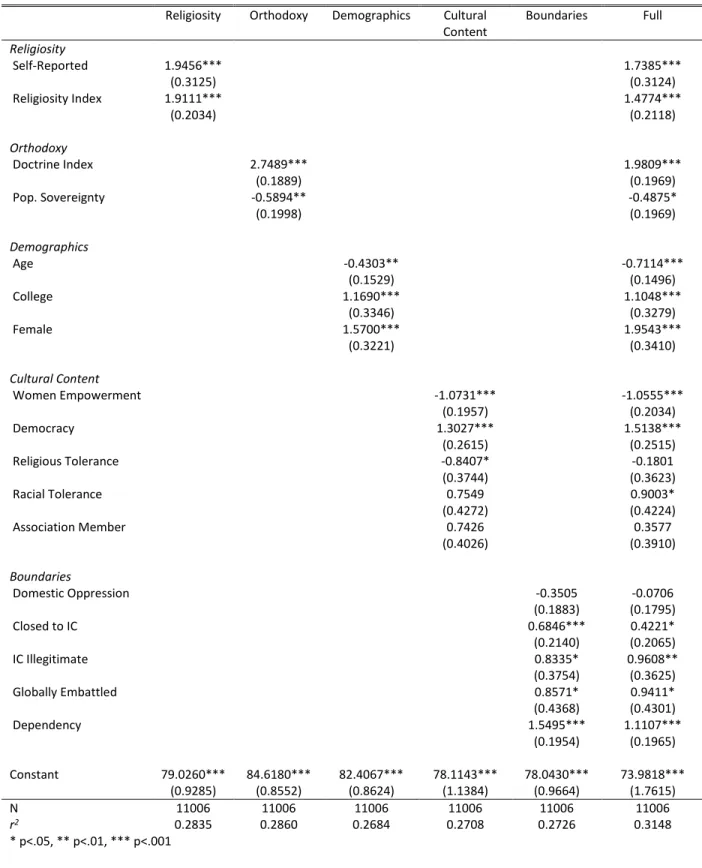
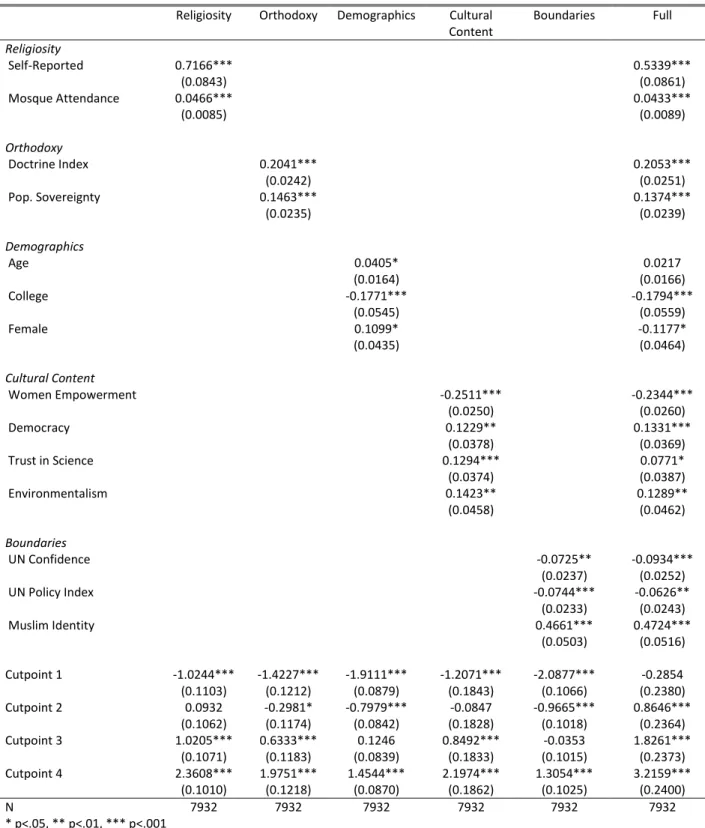
Table 1 presents the results of the linear regression models using the AB data. Table 2 presents the results of the ordered logistic regression models using the WVS data.
Religiosity
All of the variables measuring religiosity are significantly and positively related to support for shari’a in all models across both datasets.
Orthodoxy
All of the variables measuring doctrinal orthodoxy are significantly associated with support for shari’a in the expected direction in all models across both datasets. The analysis shows inconsistent
significantly and negatively associated with support for shari’a in the AB data but positively associated with support for shari’a in the WVS data.
Demographics
The results for the demographic variables are inconsistent. Age has a negative association with support for shari’a in the AB model but fails to achieve statistical significance in the full WVS model. For sex and education, the results of the different datasets point in opposite directions – the AB models suggest that women and people with college educations are more likely to support shari’a while the WVS models suggest the opposite. These results cast doubt on the argument that support for shari’a is a pre-modern ideological holdover adopted by traditionalists and individuals with relatively little exposure to global culture.
Cultural Content
The results for the variables measuring attitudes toward global norms are also mixed. Consistent with previous literature, positive attitudes about women's empowerment are significantly and
Table 1: Fixed Effects Regressions on Support for Shari’a (Arab Barometer)
Religiosity Orthodoxy Demographics Cultural Content
Boundaries Full
Religiosity
Self-Reported 1.9456*** (0.3125)
1.7385*** (0.3124) Religiosity Index 1.9111***
(0.2034)
1.4774*** (0.2118)
Orthodoxy
Doctrine Index 2.7489***
(0.1889)
1.9809*** (0.1969)
Pop. Sovereignty -0.5894**
(0.1998)
-0.4875* (0.1969)
Demographics
Age -0.4303**
(0.1529)
-0.7114*** (0.1496)
College 1.1690***
(0.3346)
1.1048*** (0.3279)
Female 1.5700***
(0.3221)
1.9543*** (0.3410)
Cultural Content
Women Empowerment -1.0731***
(0.1957)
-1.0555*** (0.2034)
Democracy 1.3027***
(0.2615)
1.5138*** (0.2515)
Religious Tolerance -0.8407*
(0.3744)
-0.1801 (0.3623)
Racial Tolerance 0.7549
(0.4272)
0.9003* (0.4224)
Association Member 0.7426
(0.4026)
0.3577 (0.3910)
Boundaries
Domestic Oppression -0.3505
(0.1883)
-0.0706 (0.1795)
Closed to IC 0.6846***
(0.2140)
0.4221* (0.2065)
IC Illegitimate 0.8335*
(0.3754)
0.9608** (0.3625)
Globally Embattled 0.8571*
(0.4368)
0.9411* (0.4301)
Dependency 1.5495***
(0.1954)
1.1107*** (0.1965)
Constant 79.0260***
(0.9285) 84.6180*** (0.8552) 82.4067*** (0.8624) 78.1143*** (1.1384) 78.0430*** (0.9664) 73.9818*** (1.7615)
N 11006 11006 11006 11006 11006 11006
r2 0.2835 0.2860 0.2684 0.2708 0.2726 0.3148
* p<.05, ** p<.01, *** p<.001
Table 2: Ordered Logistic Regressions with Country-Level Fixed Effects on Support for Shari’a (World Values Survey)
Religiosity Orthodoxy Demographics Cultural Content
Boundaries Full
Religiosity
Self-Reported 0.7166***
(0.0843)
0.5339*** (0.0861) Mosque Attendance 0.0466***
(0.0085)
0.0433*** (0.0089)
Orthodoxy
Doctrine Index 0.2041***
(0.0242)
0.2053*** (0.0251)
Pop. Sovereignty 0.1463***
(0.0235)
0.1374*** (0.0239)
Demographics
Age 0.0405*
(0.0164)
0.0217 (0.0166)
College -0.1771***
(0.0545)
-0.1794*** (0.0559)
Female 0.1099*
(0.0435)
-0.1177* (0.0464)
Cultural Content
Women Empowerment -0.2511***
(0.0250)
-0.2344*** (0.0260)
Democracy 0.1229**
(0.0378)
0.1331*** (0.0369)
Trust in Science 0.1294***
(0.0374)
0.0771* (0.0387)
Environmentalism 0.1423**
(0.0458)
0.1289** (0.0462)
Boundaries
UN Confidence -0.0725**
(0.0237)
-0.0934*** (0.0252)
UN Policy Index -0.0744***
(0.0233)
-0.0626** (0.0243)
Muslim Identity 0.4661***
(0.0503)
0.4724*** (0.0516)
Cutpoint 1 -1.0244***
(0.1103) -1.4227*** (0.1212) -1.9111*** (0.0879) -1.2071*** (0.1843) -2.0877*** (0.1066) -0.2854 (0.2380)
Cutpoint 2 0.0932
(0.1062) -0.2981* (0.1174) -0.7979*** (0.0842) -0.0847 (0.1828) -0.9665*** (0.1018) 0.8646*** (0.2364)
Cutpoint 3 1.0205***
(0.1071) 0.6333*** (0.1183) 0.1246 (0.0839) 0.8492*** (0.1833) -0.0353 (0.1015) 1.8261*** (0.2373)
Cutpoint 4 2.3608***
(0.1010) 1.9751*** (0.1218) 1.4544*** (0.0870) 2.1974*** (0.1862) 1.3054*** (0.1025) 3.2159*** (0.2400)
N 7932 7932 7932 7932 7932 7932
Boundaries
The variable measuring feelings of domestic oppression was not statistically significant in any AB model. This suggests that shari’a supporters do not feel more embattled by domestic actors than individuals who do not support shari’a.
In contrast with the inconsistent effects of attitudes toward specific global norms, all of the models suggest that support for shari’a is associated with skepticism about the role of the international community. The AB models indicate that individuals who believe external calls for reform are
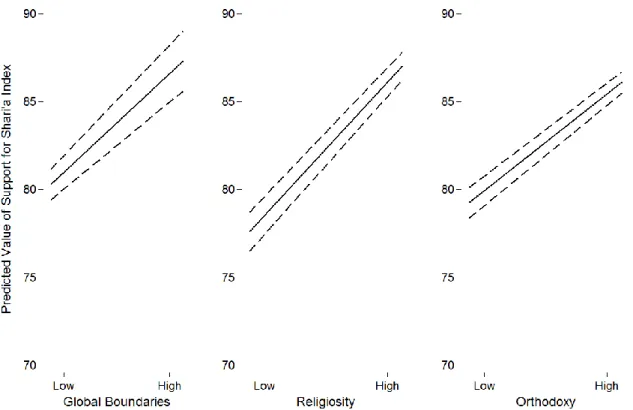
illegitimate, would like to be more closed to the outside world, feel as though foreign influence is the biggest problem in the Arab world, and believe that foreign interference is an obstacle to reform are more likely to support shari’a. The coefficients show that, holding the other variables constant at their means, a respondent with the least supportive attitudes towards the international community scores approximately 7% higher on the dependent variable than one with the most supportive attitudes. Figure 3 illustrates this association, falling between the effect of orthodoxy and religiosity.
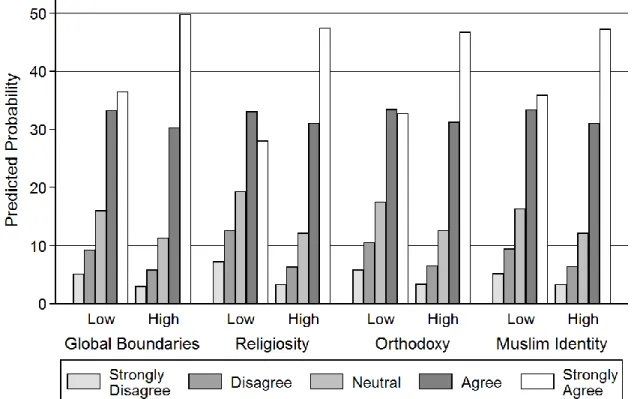
Results of the WVS models indicate that individuals who express confidence in the UN in general as well as in specific policy areas are less likely to support shari’a. The variable measuring Muslim identity is significant in the anticipated direction: respondents who see themselves as Muslims above all are more likely support implementing shari’a. Figure 4 illustrates the results of the ordinal logistic regression model (Table 2) by showing the predicted probabilities of belonging to each category of the dependent variable given high and low values of independent variables measuring religiosity, orthodoxy, and boundaries with other variables held constant at their means. The figure shows that respondents who have reservations about the UN are over 13% more likely to “strongly agree” with implementing shari’a than respondents who are not: higher than the effect of Muslim identity (approximately 11%),
“agree” or “strongly agree” with implementing shari’a given high and low values of the key groups of independent variables.
Figure 3: Cumulative Effects of Independent Variables on Support for Shari’a Index (Arab Barometer)
Note: This figure compares the cumulative effect of moving from the lowest to highest values for each set of statistically significant independent variables on the 1-100 support for shari’a index with 95% confidence intervals. For global boundaries, this figure illustrates the cumulative effect of moving from the most supportive attitudes toward the international community to the least supportive attitudes. The popular sovereignty component of orthodoxy is excluded because it has inconsistent effects.
These results provide evidence that support for shari’a is associated with reservations about international institutions and the international community broadly construed. With the exception of attitudes toward women’s empowerment, results of models from both datasets demonstrate that shari’a supporters do not systematically object to the content of global norms. Similarly, the models
Figure 4: Cumulative Effects of Independent Variables on Predicted Probabilities of Ordinal Support for Shari’a Variable (World Values Survey)
Note: This figure compares the cumulative effect of moving from the lowest to highest values for each set of statistically significant independent variables on the probability of belonging to each category of the support for
shari’a variable. The global boundaries group is reverse coded: “low” indicates a positive attitude toward the UN
and “high” indicates a negative attitude. The popular sovereignty component of orthodoxy is excluded because it has inconsistent effects.
Why Do Some Muslims Support Shari’a? – Qualitative Data, Method, and Results
The cognitive interviews, in which respondents were asked to justify their responses to closed-ended survey questions about implementing shari’a, did not contain any questions about international organizations because they were designed to gather data on how respondents understand the
Figure 5: Cumulative Effects of Independent Variables on Predicted Probabilities of “Agree” or “Strongly Agree” Responses to Ordinal Support for Shari’a Variable (World Values Survey)
Note: This figure compares the cumulative effect of moving from the lowest to highest values for each set of statistically significant independent variables on the probability of belonging to the “agree” or “strongly agree” categories of the support for shari’a variable with 95% confidence intervals. The global boundaries group is reverse coded: “low” indicates a positive attitude toward the UN and “high” indicates a negative attitude. The popular sovereignty component of orthodoxy is excluded because it has inconsistent effects.
one or more of the four following substantive categories: religiosity, orthodoxy, domestic boundary work, and global boundary work; approximately 54% of my respondents who supported implementing shari’a invoked global boundary work (see Appendix 1D for example excerpts and more information about category prevalence).
While respondents who supported shari’a defined it in myriad ways, a common thread ran through all of their justifications: Muslim identity. Ali, who “agreed” with implementing shari’a, said:
Even some respondents that disagreed with the survey item about implementing shari’a, when asked to justify their answers, responded that they actually did support shari’a. Rym, a 29 year old college student living in Tunis who disagreed with the closed-ended question about implementing shari’a, justified her response by saying she was afraid of an Iranian-style political system but insisted: “I can’t be against shari’a, because I’m Muslim.” Rym and others like her saw shari’a as a central, but contested, aspect of Muslim identity.
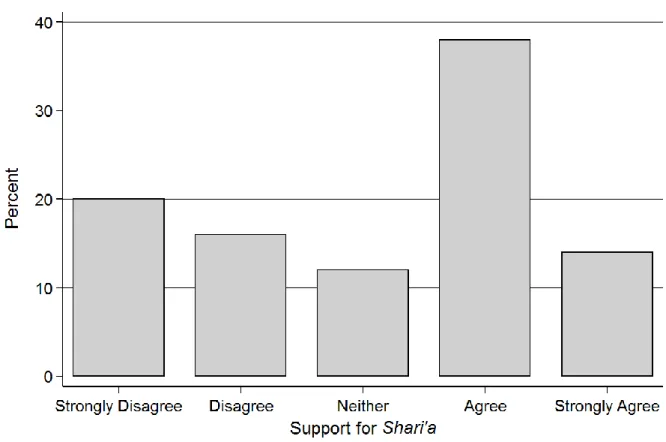
Figure 6: Distribution of Interview Responses for Support for Shari’a Item
Note: This figure describes responses to the support for shari’a item included in the qualitative interview questionnaire (“The government and parliament should enact laws in accordance with the shari’a”), taken verbatim from the Arab Barometer Survey.
Concerning associations that look after human rights, that look after the rights of Christians and secular minorities, those associations urgently apply pressure to protect these people’s rights, but when it comes to the rights of Muslim people who are killed by the millions in Myanmar-Burma, Iraq, and other countries, we don’t see any action. (28, electrician, Bizerte)
Faisal, a 29-year-old auto mechanic from Bizerte, performs global boundary work when he rejects democracy, arguing that it “is used for the geostrategic interests of the American empire and its proxies like… NGOs and the UN.” Chokri saw the world similarly:
The American empire is struggling against China, but both consider Islam the greatest threat, a sleeping giant. They want to be careful not to awaken the theory of shari’a. They want to isolate Islam until it becomes nothing more than a failed political project. (29, college student, Tunis) He was suspicious of the United States and China, and thought that Islam and “the theory of shari’a” were under attack from both.
Interview results also provide evidence that Muslims who express support for shari’a are engaging in global boundary inversion, elevating shari’a above international actors and global culture. Omar, a well-known shari’a advocate who “strongly agreed” with its implementation, lamented:
What is happening in England [after the financial collapse] is that their banks use Islamic finance now. You are using shari’a only for economics. Why don’t you use it in social relations and politics? Because you think with your pockets, and you only want to gain money! (64, retired, Bizerte)
Later in our conversation, Omar described the interaction between Muslims and the outside world in terms of the eternal struggle between God and Satan:
Satan told God that he would lead people astray from the truth and destroy them, and this is what is happening. Tunisian students go to Russia or the US or some other country and learn things, then they come back to apply the Russian or American life here in Tunisia. This is why we have so many ideologies, secularists, communists, rightists, leftists. But the Muslim culture is better than all of those cultures and ideologies, and this is what the shari’a embodies. (64, retired, Bizerte)
A lot of international organizations come to Tunisia and they are surprised about the degree of altruism and hospitality of the Tunisian people. In Arab countries you can find people who are starving, but they will still give you food. If you go to Europe, nobody will give you anything. This is inhuman! (25, shop owner, Bizerte).
There were strong indications, however, that he did not object to this “inhuman” culture in its entirety: Ibrahim owns a movie shop that primarily sells American and European media; during our interview, he was dressed in expensive and fashionable European clothing rather than the plain qamis (robe) often attributed to Salafists. This suggests that shari’a supporters may be more unified in their objection to the actions of dominant global norm-makers than to the content of global culture.
Finally, many respondents who opposed implementing shari’a justified their opposition in terms of international legitimacy. Seif, a 28-year-old college student living in Tunis responded that a system based on shari’a would be very bad because “democracy is the internationally legitimate political system,” going on to say that shari’a is too “irrational” and “emotional” to be appropriate in the contemporary era of “objective rationality.” Manel, a medical doctor employed by an INGO who vehemently opposed implementing shari’a, said that she would support an Islamist politician only:
…if he had a progressive interpretation of shari’a that did not contradict international law and universal values. If someone gave me that kind of interpretation of shari’a, I wouldn’t see him as a religious person. I would see him as a universal human being who is applying the universal values of humanity. (54, medical doctor, Sfax)
Others expressed concern that applying shari’a would endanger Tunisia’s status in the international community. Rym, for example, was concerned that applying shari’a would damage Tunisia’s “good relations with all of the countries in the Mediterranean basin.”
results show that respondents who opposed implementing shari’a justified their position in reference to their support of international organizations and powerful global actors by attributing universality to their discourses.
Discussion and Conclusion
Previous world polity scholarship has suggested that popular support for shari’a is an
idiosyncratic holdout from the processes that produce global cultural isomorphism. Scholars in this area argue that Islam provides Muslims with an “alternative meaning system” whose tenets are intrinsically at odds with global norms (Boyle et al. 2002:26). The current study proposes that support for shari’a does not imply an ideological clash between Islam and secular modernism but rather is associated with feelings of exclusion and marginalization from global norm-making processes. My findings support this claim – results of quantitative models suggest that religiosity and orthodoxy, both proxies for holding an explicitly “Islamic” meaning system, are significant, but not exhaustive, predictors of support for shari’a. While shari’a supporters tend to be less than enthusiastic about women’s empowerment, results of both the quantitative and qualitative analyses show that they do not appear to see a contradiction between shari’a and a host of other global norms including democracy, religious and racial tolerance, trust in science, and environmentalism. Instead, it appears that shari’a supporters take issue with the way that international organizations and other powerful global actors neglect and marginalize Muslims: quantitative results indicate that individuals who hold reservations about the international community and international organizations are significantly more likely to support shari’a and qualitative results show that many respondents linked their support for shari’a with distrust for international organizations and their most powerful members.
majority-Muslim societies in subordinate positions since the mandate era of the League of Nations and continues to delegitimate shari’a and other Islamic political concepts, many Muslims conceptualize shari’a as a historically-situated boundary marker rather than a coherent ideology. Outspoken support for shari’a is thus one way of taking a stance on the perceived historical mistreatment of Muslims and the delegitimization of their political concepts in global culture. This is similar to Kurzman’s (2011) finding that many people who expressed support for Osama bin Laden in the wake of the 9/11 attacks shared his perception that Muslims have been historically victimized by the United States but not his political ideology. In order to verify the causality of this relationship, future research may take an experimental approach, exposing some individuals to negative messages about shari’a drawn from global discourses to determine the effect of this exposure on attitudes.
World polity scholarship has empirically demonstrated that the spread of global culture diminishes the importance of cultural and political boundaries. Yet, while Meyer et al. (1997) point out that normative prohibitions are central to global culture and Halliday et al. (2010) have shown that international organizations publicly shame nonconforming actors, scholars in this area do not explicitly consider that, in specifying the elements of global legitimacy, international organizations define certain groups and practices as outside of its bounds. By bringing boundary work literature to bear on global culture diffusion processes, the current study proposes that negative exemplars – like shari’a – are fundamental components of global culture and that international organizations and other global norm makers define global legitimacy in reference to these illegitimate concepts and practices. Future research might investigate the mechanisms by which local cultural objects and practices become institutionalized as negative exemplars in global culture.
CHAPTER 3: THE MYTH OF THE SECULAR-ISLAMIST DIVIDE IN MUSLIM POLITICS
Introduction
On the afternoon of September 9th 2013, I hailed a taxi to take me home from an interview I was
conducting in Sidi Bou Said, Tunisia. My conversation with the taxi driver took a predictable route – compliments on my Arabic, my knowledge of Islam, questions about my ethnoreligious heritage and my reason for being in Tunisia. The discussion of my dissertation topic – the relationship between shari’a and democracy – inevitably turned to an animated analysis of the situation in Tunisia since the revolution. Hands waving, the taxi driver enumerated a lengthy list of problems in the country: corruption, violence, infighting, rising prices, and a shortage of tourists. Intrigued, I probed – how will Tunisia solve all of these problems? My companion replied, “Of course you must know that God is the solution, faith is the solution, the answers are always in Islam.” I probed further, asking him to clarify. He responded, “First, we must have term limits so that politicians don’t become lazy and they work for the common good, and the laws must apply to politicians like everyone else. There should also be
transparency in campaign financing, we have to know who is paying for these politicians,” and so on, without mentioning Islam, God, or faith again for the remainder of his half-hour monologue.
I found this pattern repeated in other conversations. In early November, a man I met in a café told me that he supported the creation of a caliphate whose leader would be “elected, but not through democratic elections, through Islamic elections.” Other self-described Salafists told me similar things: elections should be replaced with shura (a Qur’anic term meaning “consultation”) and bei’a (allegiance), taxes should be replaced with analogous Islamic concepts, khums and jizya, and the civil state should be replaced with an Islamic one. Yet, despite these differences in terminology, respondents largely