ORIGINAL PAPER
Developmental Markers of Genetic Liability to Autism in Parents:
A Longitudinal, Multigenerational Study
Molly Losh1 · Gary E. Martin2 · Michelle Lee1 · Jessica Klusek3 · John Sideris4 · Sheila Barron5 · Thomas Wassink6
Published online: 9 January 2017
© The Author(s) 2017. This article is published with open access at Springerlink.com
inform understanding of the subclinical expression of ASD genetic liability.
Keywords Autism · Genetics · Endophenotype · Longitudinal · Broad autism phenotype · Language
Introduction
Autism spectrum disorder (ASD) is a common and com-plex, genetically-based neurodevelopmental disorder (APA
2013; CDC 2014). ASD is among the most highly heritable of complex psychiatric conditions, with a number of risk loci now identified (Tick et al. 2015). However, the genetic causes of ASD are heterogeneous, with most cases due to polygenic genetic effects, and less than 1% explained by any specific molecular genetic variant. The study of rela-tives who are at increased genetic liability can help to over-come the challenge of genetic heterogeneity by providing phenotypes that may help to identify biologically meaning-ful subgroups of families.
ASD is highly familial and subclinical phenotypes that are qualitatively similar to core features of ASD have been repeatedly reported in a subset of relatives, which are believed to constitute endophenotypes (Bolton et al.
1994; Landa et al. 1991, 1992; Losh et al. 2011; Murphy et al. 2000; Piven et al. 1997a, 1994). Endophenotypes are genetically influenced traits existing midstream between disease phenotype and underlying genetics (Gottesman and Gould 2003). They may manifest as a forme fruste of complex genetic disorders among unaffected relatives, as in ASD, where relatives often exhibit subclinical personality and language traits similar in quality to the core features of ASD but subtle in expression and not associated with func-tional impairment. Candidate endophenotypes in relatives
Abstract Genetic liability to autism spectrum disorder (ASD) can be expressed in unaffected relatives through subclinical, genetically meaningful traits, or endopheno-types. This study aimed to identify developmental endo-phenotypes in parents of individuals with ASD by exam-ining parents’ childhood academic development over the school-age period. A cohort of 139 parents of individuals with ASD were studied, along with their children with ASD and 28 controls. Parents’ childhood records in the domains of language, reading, and math were studied from grades K-12. Results indicated that relatively lower perfor-mance and slower development of skills (particularly lan-guage related skills), and an uneven rate of development across domains predicted ASD endophenotypes in adult-hood for parents, and the severity of clinical symptoms in children with ASD. These findings may mark childhood indicators of genetic liability to ASD in parents, that could
* Molly Losh
1 Department of Communication Sciences and Disorders,
Northwestern University, Frances Searle, 2240 N Campus Dr., Evanston, IL 60208, USA
2 Department of Communication Sciences and Disorders, St.
John’s University, Staten Island, NY 10301, USA
3 Department of Communication Sciences and Disorders,
University of South Carolina, Columbia, SC 29201, USA
4 Frank Porter Graham Child Development Institute,
University of North Carolina at Chapel Hill, Chapel Hill, NC 27516, USA
5 College of Education, University of Iowa, Iowa City,
IA 52242, USA
6 Department of Psychiatry, Carver College of Medicine,
of individuals with ASD have been collectively described as constituting a broad autism phenotype (BAP) that may inform etiologic mechanisms by helping to decompose the complex ASD phenotype into more fundamental compo-nent features with clearer ties to underlying biology (Losh et al. 2008; Lowe et al. 2015).
Investigations of ASD endophenotypes in parents have, to date, been restricted to assessments in adulthood, when status as a parent of a child with ASD is determined. This prior work has documented elevated rates of personal-ity and language styles in parents that mirror in qualpersonal-ity the core features of ASD, including socially reticent/aloof and rigid personality traits, along with differences in prag-matic (i.e., social) language styles (Bolton et al. 1994; Landa et al. 1991, 1992; Losh et al. 2011, 2008; Murphy et al. 2000; Piven et al. 1997a, 1994). Such traits appear to be more strongly expressed among parents from multi-plex families than simmulti-plex families, suggesting that they are sensitive indices of genetic liability to ASD (Bernier et al.
2011; Losh et al. 2008; Virkud et al. 2009).
Differences among parents have also been observed in neuropsychological domains that are conceptually related to, and have been hypothesized to underlie the clinical-behavioral features of ASD and the subtle personality and language traits of the BAP. For instance, parents of individ-uals with ASD show differences on social cognitive tasks that tap strategies for contending with complex social-emotional stimuli involving reading thoughts and emotions from faces, the eye region of the face, and from biological motion, (Baron-Cohen et al. 1997; Losh et al. 2009; Losh and Piven 2007) and also exhibit differences in brain acti-vation during such tasks (Baron-Cohen et al. 2006). Dif-ferences in language processing skills, indexed by perfor-mance on rapid automatized naming (RAN) tasks that tap a broad neural network recruited in complex language skills, have also been observed in both parents and siblings of individuals with ASD, (Losh et al. 2010; Norton and Wolf
2012) as well as reduced language automaticity indexed by eye movement patterns during RAN (Hogan-Brown et al.
2014). Importantly, differences in both social cognition and language processing tasks among parents appear to be driven by the subgroup of parents who show social and pragmatic language features of the BAP (Losh et al. 2009,
2010), suggesting that these personality, language, and neu-ropsychological phenotypes importantly interrelate and cosegregate in a subgroup of individuals, and may there-fore be used to stratify subgroups for further study of the biological underpinnings of the BAP and ASD.
A limitation of this prior work is its focus on adulthood, when it is possible to classify individuals as parents of an individual with ASD. This leaves unexplored a large period of development during which ASD endophenotypes could first arise in parents, and might be most profitably studied
for clues into underlying biology and to inform ASD risk in families. Studies of early development in unaffected sib-lings (Ozonoff et al. 2014) are informative, but knowledge of developmental endophenotypes in parents offer addi-tional value in permitting the tracing of inheritance patterns and characterization of variable manifestation of genetic burden across generations not afforded by affected sibling designs. Moreover, studies of parents during childhood are free from the potentially confounding effects inherent in sibling studies, where it is possible that having a sibling with ASD could impact the content and quality of early language and social experiences (Pilowsky et al. 2007).
This study investigated developmental phenotypes potentially reflecting ASD genetic liability in parents, by making use of archival data from academic testing records over childhood, from a cohort of individuals who as adults would go on to have a child with ASD. Using a retrospec-tive, multigenerational, longitudinal design, we examined development in the domains of language, reading, and math among parents of individuals with ASD from grade school into high school. Parents’ developmental profiles were examined in relationship to putative endophenotypes in adulthood—i.e., personality and language characteristics of the BAP, and social cognitive functioning—as well as clinical symptom severity in their children with ASD. By exploring relationships among candidate endophenotypes within individuals over development, and across genera-tions, we aimed to identify childhood phenotypic profiles in parents that might be used to better understand the devel-opmental origins of the BAP, and intergenerational markers of ASD genetic risk.
Methods Participants
representativeness. This included recruitment through schools, local clinics, disability advocacy organizations, community events (e.g., advocacy walks and events, com-munity festivals, sporting events, 4-H clubs), and repeated study advertisements through state-wide broadcast radio and print ads.
Families of individuals with ASD were eligible to par-ticipate if one or more parents had attended school in Iowa as a child, were native speakers of English, and had a child diagnosed with ASD and no history of genetically-based conditions associated with ASD, such as fragile X syn-drome. We made every effort to recruit intact families, but this was not always possible, given that both parents did not always attend school in Iowa, or in some cases one par-ent was not available to participate. Of the 139 parpar-ents of individuals with ASD included, there were 45 couples (i.e., 90 individuals), and 49 parents were from different fami-lies where only one parent was included. From this par-ent group, we were able to enroll 63 children with ASD. The remaining children were unable to participate due to different recruitment and testing restrictions making direct assessment unfeasible (e.g., living apart from parents).
Although the primary focus of this study concerned associations between parents’ childhood phenotypes
and endophenotypes in parents in adulthood, along with ASD symptomatology in these parents’ children who were diagnosed with ASD, we also included a group of controls from Iowa in order to assess whether profiles of development in the ASD parent group showed any notable differences from individuals who did not go on to have a child with ASD, and also compared groups’ profiles against norms. Controls were recruited through referrals from existing studies at the University of Iowa, and through community advertising. Using the Autism Family History Interview (Bolton et al. 1994), controls were screened for personal and family history of ASD or related developmental disorders, as well as for language and cognitive delays to ensure typical development. Seventeen controls were parents of a child with typi-cal development. Eleven controls were not parents, but were retained based on absence of any cases of autism, or language or cognitive delays in their extended family history. Groups were similar in IQ [t(86) = −.83, p = .41] in adulthood, but controls were significantly younger [t(165) = 5.17, p < .001, mean difference = 8.49 years] at the time of study enrollment. Full participant characteris-tics are presented in Table 1.
Table 1 Participant characteristics
a IQ was assessed in 93 parents of individuals with ASD who were able to participate in direct assessments,
and in all controls
b IQ, verbal IQ (VIQ) and performance IQ (PIQ) measured with Wechsler abbreviated scale of intelligence
(WASI), Wechsler intelligence scale for children (WISC) or Leiter-brief IQ
ADI-R was administered to parents of 56 indivdiuals with ASD, and ADOS was administered to 47 indi-viduals with ASD.
Parents of
individu-als with ASD Control participants Individuals with ASD
N 139 28 63
Sex (F:M) 79:60 17:11 9:54
Age
[M (SD) Range] 46.5 (7.1)25–65 38.1 (9.9)22–60 14.8 (5.8)2.6–28.2 IQa, b
[M (SD) Range] 111.0 (12.2)76–136 113.3 (12.3)85–136 90.9 (23.3)36–123 VIQb
[M (SD) Range] 109.3 (13.0)69–132 109.7 (14.8)82–138 95.3 (16.8)60–119 PIQb
[M (SD) Range] 110.3 (12.0)77–137 113.0 (14.1)89–148 94.9 (24.5)36–136 ADI-R algorithm scores
Communication-verbal
[M(SD) Range] 16.65 (4.60)4–24
Communication-nonverbal
[M(SD) Range] 12.40 (0.55)12–13
Social reciprocity
[M(SD) Range] 21.94 (5.89)9–30
Restricted/repetitive behavior
[M(SD) Range] 6.41 (2.38)2–11
ADOS symptom severity
Procedures
Archival academic records were obtained for parents and controls. Participants also completed clinical-behavioral assessments, described below. Procedures were approved by University Institutional Review Boards. Informed con-sent was obtained by all participants.
Parent Assessments
Parents’ Childhood Academic Performance
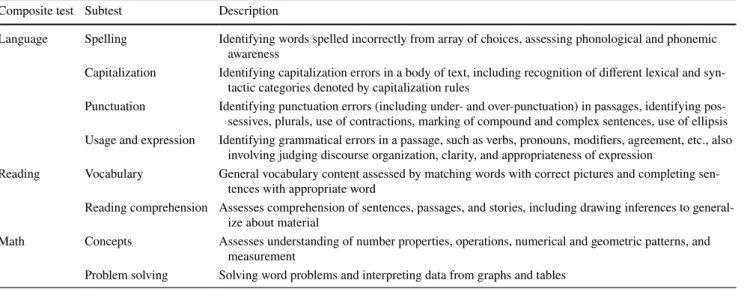
Academic testing scores were obtained from the Iowa Tests of Basic Skills (ITBS; Hoover et al. 2001) and its analog used in high school, the Iowa Tests of Educational Devel-opment (ITED; Forsyth et al. 2001). The ITBS and ITED are nationally standardized, norm-referenced tests that have been administered annually to Iowa school children since the 1950s (Hoover et al. 2001). The ITBS (administered in grades K-8) and ITED (grades 9–12) (hereafter referred to simply as the ITBS) were developed at the University of Iowa. Childhood testing records from all grades available (K-12) were obtained from the Iowa Testing Programs at the University of Iowa with participants’ consent. These tests assess core skills in language, reading, and math each year. Examples of language, reading, and math subtests with representative items are presented in Table 2.
Personality and Language Features of the BAP
Socially aloof and rigid personality features of the BAP were assessed with the Modified Personality Assess-ment Schedule (MPAS; Tyrer 1988). The M-PAS is a
semi-structured interview that probes for the presence of subtle personality traits that are thought to mirror the core social and restricted/repetitive domains of ASD, and has been used extensively in prior studies of the BAP (Losh et al. 2008; Piven et al. 1997a, b). Subject inter-views were consensus coded from video by two inde-pendent raters, with coding based on concrete examples of trait endorsement. M-PAS data were only collected with the ASD parent group, given the study focus on defining phenotypic associations within families of indi-viduals with ASD. Thirty-nine percent of the ASD parent group was rated as positive for the social BAP, and 28% were positive for the rigid BAP. These rates are roughly comparable to those reported in prior work (e.g., Piven et al. 1997a, b).
The Pragmatic Rating Scale (PRS; Landa et al. 1992) was used to assess pragmatic language in parents. The PRS was coded from a 20-min semi-structured conversa-tional interview, in which participants responded to con-versational probes about their own lives with an examiner who was trained to elicit conversation by commenting and asking follow-up questions to tap various pragmatic skills. The PRS has been used extensively in studies of the BAP (Landa et al. 1992; Losh et al. 2008; Piven et al.
1997b), and consists of 25 operationally-defined items assessing the quality and content of conversational lan-guage (e.g., refraining from tangential speech, being neither too vague nor too detailed in conversational con-tributions, etc.). Two blinded independent raters coded each language sample, and consensus scores were deter-mined through discussion. Parents of individuals with ASD averaged a PRS score of 9.95 (SD = 6.65), and controls averaged 5.96 (SD = 4.5). Accounting for minor
Table 2 Description of subtests for language, reading, and math composite scales of the ITBS
Over the time span that parents were administered the ITBS, there have been some minor changes in forms and subtest definition Composite test Subtest Description
Language Spelling Identifying words spelled incorrectly from array of choices, assessing phonological and phonemic awareness
Capitalization Identifying capitalization errors in a body of text, including recognition of different lexical and syn-tactic categories denoted by capitalization rules
Punctuation Identifying punctuation errors (including under- and over-punctuation) in passages, identifying pos-sessives, plurals, use of contractions, marking of compound and complex sentences, use of ellipsis Usage and expression Identifying grammatical errors in a passage, such as verbs, pronouns, modifiers, agreement, etc., also
involving judging discourse organization, clarity, and appropriateness of expression
Reading Vocabulary General vocabulary content assessed by matching words with correct pictures and completing sen-tences with appropriate word
Reading comprehension Assesses comprehension of sentences, passages, and stories, including drawing inferences to general-ize about material
Math Concepts Assesses understanding of number properties, operations, numerical and geometric patterns, and measurement
differences in the PRS over time, these rates are compa-rable to scores reported in prior studies (e.g., Piven et al.
1997a, b; Losh et al. 2008).
Social Cognition
The Reading the Mind in the Eyes Test-Revised Version (Baron-Cohen et al. 2001) was administered as a measure of advanced social cognition. The Eyes Test requires par-ticipants to infer complex cognitive and emotional states based on viewing only the eye region of the face, with 4 potential answers.
Assessment for Children with ASD
All children with ASD had received a clinical diagno-sis of ASD using the DSM IV or DSM 5, and confirmed by medical records. Whenever possible diagnoses were also informed by gold standard diagnostic instruments, the Autism Diagnostic Interview-Revised (ADI-R) (Lord et al. 1994) or the Autism Diagnostic Observation Sched-ule (ADOS) (Lord et al. 2000). Raw scores of the ADI-R were summed for the diagnostic algorithms (which focus on behaviors at 4–5 years of age) to create summary scores for the overall diagnostic score, and for social, communica-tion, and restricted/repetitive domains.
Data Analysis
Estimates of academic skills and development over time were determined using hierarchical linear models (HLM; Raudenbush and Bryk 2002; Singer and Willett 2003). HLM allows for the estimation of fixed and random effects for model parameters. The fixed effects are the parameters for the sample as a whole, while the random effects are the parameters for each individual. The ran-dom effects were used to estimate and control the non-independence in the model arising from the clustering of data (Burchinal et al. 2006); in this case, the clustering of data within participant, resulting from their repeated measurement. Standard regression diagnostics were pro-duced for primary HLM analyses (e.g., residuals plots, normal q–q plots) to screen that model assumptions were met. No violations of normality or heteroscadicity assumptions were evident. Random effects provide val-ues for individual intercepts (i.e., performance, centered at third grade due to sparse data in earlier grades) and slopes (i.e., change over time). For a portion of families, data were available for both parents in a family, giving rise to non-independence for those data. HLM were run including random effects to account for the nesting within families. In all cases, the relevant family level effects were all essentially zero, suggesting that the within
family nesting was not a significant source of variance and did not impact the model. To help control Type I error rates, interactions were not interpreted unless sig-nificant at p < .05. When interactions were not sigsig-nificant, only main effects are reported. For all analyses, p values are two-tailed.
In order to compare academic achievement and devel-opment between groups, a series of models were con-ducted for each of the test composites: language, read-ing, and math. Each analysis included group (ASD parent versus control), time, and their interaction as predictors of achievement on the ITBS. The dependent variables were scaled to indicate grade level. Due to sparse data in grades K-2, data were centered at third grade, and there-fore group effects can be interpreted as the separation of the groups at that time point. A one-grade change per year was expected for each of the ITBS domains, repre-sented by slope. HLM estimates of individual intercepts and slopes were exported for correlations examining rela-tionships between parents’ early academic profiles and phenotypes in adulthood, as well as clinical symptom severity in parents’ children with ASD.
Results
Both the ASD parent group and controls performed sig-nificantly above grade level in each domain overall (all t
values >4.90, ps < .0001). However, the ASD parent group performed significantly lower than controls on the language composite, and showed marginally significant differences in reading and math. They also showed a significantly slower rate of growth in math, and marginally significantly slower growth in language and reading (See Table 3).
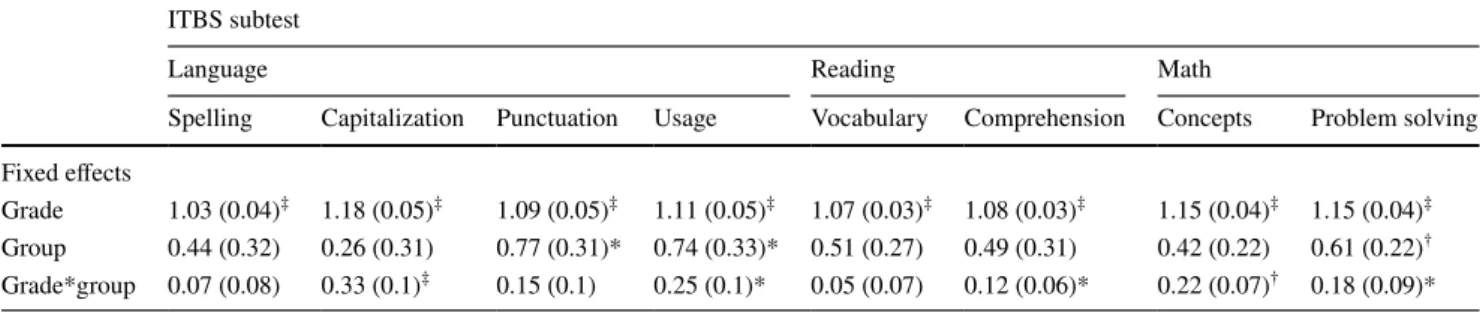
On subtests in the language domain, the ASD par-ent group scored significantly lower than controls in
Table 3 Language, reading, and math composite performance across grades and groups
Grade is the amount of change expected each year. Group indicates the mean difference between groups. Grade*Group is the difference in the rate of change between groups
ITBS composite score
Language Reading Math
Group and grade comparisons, fixed effects
Grade 1.06 (0.04)
p < .0001 1.08 (0.03)p < .0001 1.11 (0.04)p < .0001
Group 0.74 (0.29)
p = .01 0.50 (0.28)p = .08 0.51 (0.27)p = .05 Grade*group 0.12 (0.07)
Punctuation and Language Usage, and showed signifi-cantly slower growth in Language Usage. Slower growth was also noted in the Capitalization subtest. In the read-ing domain, no group differences on subtests were noted, but the ASD parent group showed slower growth in the Comprehension subtest. Finally, in the math domain, the ASD parent group showed lower performance and slower growth in the Problem Solving subtest, and slower growth in Math Concepts (see Table 4).
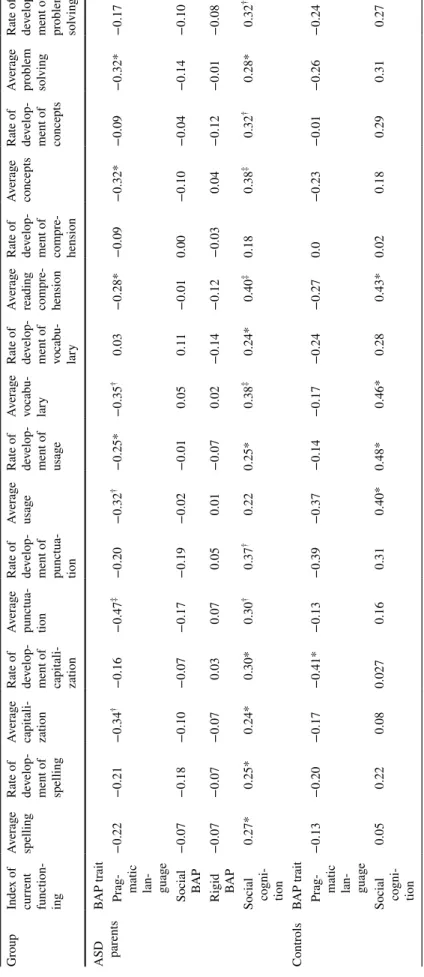
Associations Between Parents’ Childhood ITBS Performance and ASD Endophenotypes in Adulthood
A fractionated pattern of childhood development across domains, with more rapid growth in some domains and more static growth in others, was associated with the pres-ence of the socially aloof trait of the BAP in adulthood in parents of individuals with ASD (r = .26, p < .05). There were no associations with the rigid dimension of the BAP, but the pragmatic language feature of the BAP was associ-ated with relatively lower childhood language and reading scores (but not math) in the ASD parent group (r = −0.38, p < .001; r = −0.32, p < .01, respectively). Finally, perfor-mance on the Eyes Test of social cognition was associated with performance across domains in the ASD parent group (language r = .30, p < .01; math r = .28, p < .05; reading r = .41, p < .001) as well as with the rate of development in the language domain (r = .32, p < .01). No associations were detected between ITBS performance and pragmatic language in controls; however, controls’ performance on the Eyes Test was positively related to overall performance in the reading domain (r = .46, p < .05), but no other ITBS scales. Correlations with ITBS subscales followed the same general pattern as for the composite variables (see Table 5).
Associations Between Parents’ Childhood ITBS and ASD Symptom Severity in Children
Parents’ childhood ITBS performance was significantly associated with clinical symptom severity in children who
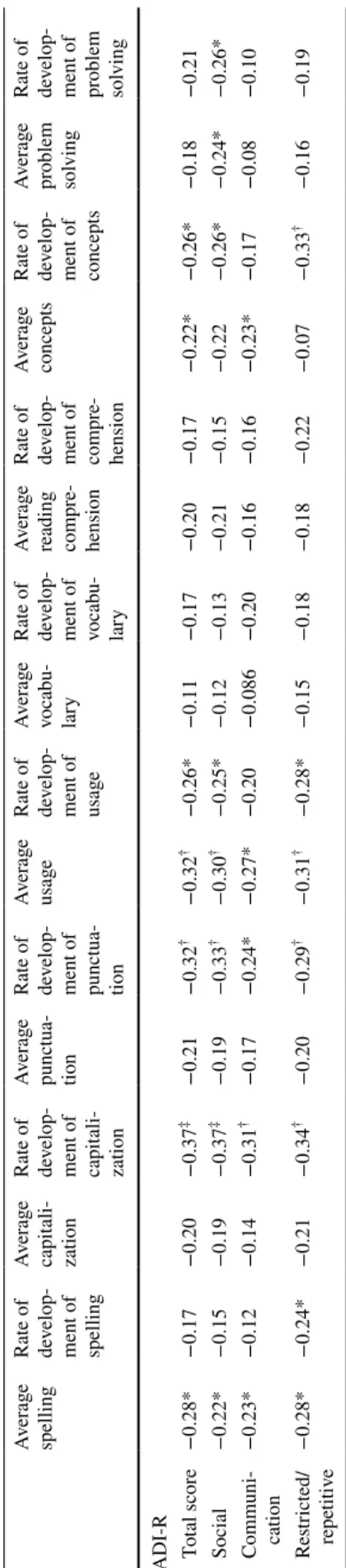
were diagnosed with ASD (see Table 6). As illustrated in Fig. 1, relatively lower language performance, and slower rates of development in language and math in parents were associated with more severe ASD symptoms in children. These relationships were largely consistent across the sub-scales of language and math as well, with ASD symptom severity correlating particularly robustly with the rate of development in the language subtests of Capitalization, Punctuation, and Usage (see Table 7). Additionally, a frac-tionated rate of development across domains in parents was associated with increased severity of repetitive behaviors among children with ASD.
Models detected no group differences between mothers and fathers, and no differences in parent–child correlations were detected. Although only 17 families were multiplex, we expanded mixed models to examine interactions with multiplex or simplex family status, and found no signifi-cant interactions with group or change over time. Patterns of association between parent and child characteristics, and parent childhood and adulthood characteristics were similar between multiplex and simplex families.
Discussion
Making use of retrospective, longitudinal academic data, this study investigated childhood development in parents of individuals with ASD across the academic domains of language, reading, and math, with the goal of examining childhood profiles in parents that may consititute develop-mental endophenotypes reflecting genetic liability to ASD. Selected differences from controls were observed in ITBS performance, though they were quite subtle, with both groups performing above grade level overall. This is con-sistent with evidence that features of the BAP are subclini-cal in nature, do not involve functional impairment, and are observed in only a subset of parents (Losh et al. 2010,
2012; Martin et al. 2010; Piven et al. 1997b).
More significant were findings that childhood ITBS profiles predicted ASD endophenotypes in adulthood
Table 4 Performance on ITBS subtests across grades and groups
Notes: All Random Effects are significant. *p < .05, †p < .01, ‡p < .001
ITBS subtest
Language Reading Math
Spelling Capitalization Punctuation Usage Vocabulary Comprehension Concepts Problem solving Fixed effects
Grade 1.03 (0.04)‡ 1.18 (0.05)‡ 1.09 (0.05)‡ 1.11 (0.05)‡ 1.07 (0.03)‡ 1.08 (0.03)‡ 1.15 (0.04)‡ 1.15 (0.04)‡
Group 0.44 (0.32) 0.26 (0.31) 0.77 (0.31)* 0.74 (0.33)* 0.51 (0.27) 0.49 (0.31) 0.42 (0.22) 0.61 (0.22)†
Table
5
ITBS subtes
ts associated wit
h ASD endopheno
types in par
ents
*p
<
.05,
†p <
.01,
‡p <
.005 Gr oup Inde x of cur rent function -ing Av er ag e spelling
Rate of develop
-ment of spelling
Av er ag e capit ali -zation
Rate of develop
-ment of capit
ali -zation Av er ag e punctua -tion
Rate of develop
-ment of punctua
-tion Av er ag e usag e
Rate of develop
-ment of usag
e Av er ag e vocabu -lar y
Rate of develop
-ment of vocabu
-lar y Av er ag e
reading com
pr
e-hension
Rate of develop
-ment of com
pr e-hension Av er ag e concep ts
Rate of develop
-ment of concep
ts Av er ag e pr oblem sol ving
Rate of develop
-ment of problem solving
ASD par
ents BAP tr ait Pr ag
-matic lan- guag
e −0.22 −0.21 −0.34 † −0.16 −0.47 ‡ −0.20 −0.32 † −0.25* −0.35 † 0.03 −0.28* −0.09 −0.32* −0.09 −0.32* −0.17
Social BA
P −0.07 −0.18 −0.10 −0.07 −0.17 −0.19 −0.02 −0.01 0.05 0.11 −0.01 0.00 −0.10 −0.04 −0.14 −0.10
Rigid BA
P −0.07 −0.07 −0.07 0.03 0.07 0.05 0.01 −0.07 0.02 −0.14 −0.12 −0.03 0.04 −0.12 −0.01 −0.08
Social cogni
-tion 0.27* 0.25* 0.24* 0.30* 0.30 † 0.37 † 0.22 0.25* 0.38 ‡ 0.24* 0.40 ‡ 0.18 0.38 ‡ 0.32 † 0.28* 0.32 † Contr ols BAP tr ait Pr ag
-matic lan- guag
e −0.13 −0.20 −0.17 −0.41* −0.13 −0.39 −0.37 −0.14 −0.17 −0.24 −0.27 0.0 −0.23 −0.01 −0.26 −0.24
Social cogni
(social and language features of the BAP, and social cog-nition), and clinical symptom severity in children with ASD. These findings contribute to a substantial body of literature documenting a constellation of phenotypes
occurring in parents that may reflect genetic liability to ASD, or the BAP, and associated neuropsychological traits (Adolphs et al. 2008; Billeci et al. 2016; Losh et al.
2009, 2010; Losh and Piven 2007). By characterizing Table 6 Correlations between parents’ childhood ITBS language, reading, and math composite scores and their children’s ASD symptoms
ASD symptoms were assessed using the ADI-R (diagnostic algorithm). *p < .05, †p < .01; ap = 0.05
Childhood parental phenotypes Average
lan-guage ability Language devel-opment rate Average read-ing ability Reading devel-opment rate Average math ability Math devel-opment rate Variability in rates of develop-ment
ASD symptoms in children
Overall symptoms −0.28* −0.30† −0.16 −0.18 −0.20 −0.26* −0.09
Social −0.24* −0.34† −0.17 −0.15 −0.22 −0.27* 0.08
Communication −0.24* −0.26* −0.13 −0.20 −0.16 −0.17 0.00
Restricted/repetitive −0.27* −0.34† −0.17 −0.22a −0.16 −0.30* 0.24*
Fig. 1 Patterns of childhood development on ITBS language and math among parents of individuals with ASD predict levels of symp-tom severity in children with ASD. Lower average language (a), and slower rates of language (b) and math (c) predicted higher symptom
associated phenotypic markers in childhood, before indi-viduals’ status as a parent of a child with ASD could be known, findings may shed light on the developmen-tal precursors of the BAP and provide measurable phe-notypes in childhood that could potentially be targeted in family- and molecular-genetic studies of ASD, where such putative endophenotypes in relatives can help to identify more etiologically homogeneous subgroups.
Whereas differences from controls were subtle, the lan-guage domain seemed to stand out in differentiating the ASD parent group’s performance from that of controls who were screened for family and personal history of ASD and developmental delays. Together with a fractionated, or uneven, rate of development across domains, the ASD parent group’s performance on language-related tests was also notable in most robustly predicting features of the BAP in adulthood and ASD symptom severity in children. The ASD parent group displayed consistent differences across language subtests, with relatively lower scores and slower development in the language composite subtest of Lan-guage Usage, lower scores in Punctuation across grades, and slower growth on the Capitalization subtest over time. Performance in these subtests, and rate of growth over time in particular, also stood out as strong correlates of symp-tom severity in children with ASD, and of features of the BAP in adulthood.
The skills tapped by these subtests involve impor-tant aspects of grammatical language ability. For exam-ple, the Language Usage subtest examines the ability to detect grammatical errors in extended passages, as well as judgments of discourse organization and clarity. The Punctuation and Capitalization subtests tap more detailed grammatical knowledge required for integrating different sentential elements within and across utterances (e.g., dif-ferentiating declarative from interrogative statements and marking breaks and pauses across and within sentences with different punctuation; distinguishing personal pro-nouns and proper versus common pro-nouns through capitaliza-tion differences). It is perhaps also of note that both math subtests on which differences were noted (Math Problem Solving and Concepts) and for which associations with child symptom severity also emerged, are relatively heavy in language demands, involving interpretation of lengthy and densely composed word problems. It may be that subtle differences in language related skills in childhood consti-tute a genetically meaningful phenotype evident in a sub-group of families. The significance of the language domain to ASD genetics is supported by the identification of sev-eral risk loci associated specifically with language pheno-types in ASD (Bartlett et al. 2014) along with the strong overlap of ASD and specific language impairment (SLI), where overlapping behavioral and neurocognitive phen-toypes have been noted in both ASD and SLI, together with
Table 7 Cor relations be tw een par ents ’ c
hildhood ITBS subscale per
for
mance and t
heir c
hildr
en
’s ASD sym
pt
oms
*p
<
.05,
†p <
.01,
‡p <
.001 Av er ag e spelling
Rate of develop
-ment of spelling
Av er ag e capit ali -zation
Rate of develop
-ment of capit
ali -zation Av er ag e punctua -tion
Rate of develop
-ment of punctua
-tion Av er ag e usag e
Rate of develop
-ment of usag
e Av er ag e vocabu -lar y
Rate of develop
-ment of vocabu
-lar y Av er ag e
reading com
pr
e-hension
Rate of develop
-ment of com
pr e-hension Av er ag e concep ts
Rate of develop
-ment of concep
ts Av er ag e pr oblem sol ving
Rate of develop
-ment of problem solving
ADI-R Tot
identification of shared language phenotyes in unaffected parents (Ruser et al. 2007; Tager-Flusberg 2016).
Knowledge of such childhood expressions of latent lia-bility in patterns of academic performance across major curricular domains of language, reading, and math (and perhaps language in particular), a generation removed from affected individuals, may help to advance neural and genetic research by stratifying individuals and families to examine biological factors differentially associated with genetically meaningful developmental phenotypes in par-ents. The use of data from commonly administered stand-ardized tests in this way could be rapidly translated to large scale studies where they may afford increased power and sensitivity for detecting gene–behavior relationships. To this end, recent work examining a wide range of pheno-types in a large sample of adolescents found that academic variables cosegregated significantly with genome-wide polygenic scores (Krapohl et al. 2016). In ASD, such deep phenotyping in family members could be a powerful means to decompose complex traits into genetically meaningful features, or endophenotypes, that may penetrate diagnos-tic boundaries and offer more tractable targets for study than complex clinical syndromes (Insel 2014), and help to inform different etiologic pathways, perhaps leading ultimately to new knowledge of the pathogenetics of ASD (Parikshak et al. 2015).
A significant factor to consider in future work con-cerns the relative homogeneity of the participant groups included. Subjects were necessarily drawn exclusively from the state of Iowa due to restrictions on the availability of academic records. And, while we made a concerted effort to include a representative ASD parent sample, recruiting over an extended period of time in both rural and metro-politan areas, these findings should be replicated in larger, more diverse population samples. Further, our control sample was relatively small, and controls were screened for personal and family history of ASD and language and cognitive delays, resulting in a control group who would be expected to have performed well on childhood academic testing. Although the most significant findings emerged from within-individual and within-family associations not impacted by the control sample, larger and more heteroge-neous control groups should be included in future studies to replicate and determine the specificity of these findings, including whether associations between childhood aca-demic performance and ASD endophenotypes may also exist in the general population.
In sum, by making use of valuable archival data, this study performed the first retrospective, longitudinal inves-tigation of directly assessed childhood academic devel-opment in parents of individuals with ASD. Specific and early–emerging patterns of skill development were detected that appear to reflect genetic liability to ASD.
These childhood phenotypes in parents appear very subtly expressed but were predictive of ASD endophenotypes in adulthood, and patterns of ASD symptom severity in chil-dren with ASD, and may therefore hold utility for studies of the cognitive and biological basis of ASD.
Acknowledgments This work was funded by grants from the National Institutes of Health (R01DC010191-01A1, R01MH091131), the National Science Foundation (BCS-0820394), and Autism Speaks (1337). We are grateful to Joseph Piven, MD, University of North Carolina, who contributed to the conception and design of this work. We thank Jan Misenheimer, BS, University of North Carolina, for her work in management of the data, Frank Fleming, BS, University of Iowa, for assistance with recruitment and data collection, and Nancy Andreasen, MD, University of Iowa, for her assistance with recruit-ment of controls. Ms. Misenheimer was compensated for her work on this manuscript. Our sincerest gratitude to all participating families.
Author Contributions ML conceived of the study, obtained fund-ing, and participated in the study design and coordination, and drafted the manuscript; GEM participated in the design and coordination of the study, as well as manuscript preparation. MAL participated in analysis and interpretation of the data, as well as drafting the manu-script; JK participated in preparing the manumanu-script; JS participated in statistical analysis and interpretation of data, and manuscript prepara-tion; SB assisted with academic score retrieval and interpretation of academic testing data; TW participated in participant recruitment. All authors read and approved the final manuscript.
Compliance with Ethical Standards
Conflict of interest Dr. Molly Losh, Dr. Gary E. Martin, Michelle Lee, Dr. Jessica Klusek, Dr. John Sideris, Dr. Sheila Barron, and Dr. Thomas Wassink all declare that there are no conflicts of interest to disclose.
Open Access This article is distributed under the terms of the Creative Commons Attribution 4.0 International License (http:// creativecommons.org/licenses/by/4.0/), which permits unrestricted use, distribution, and reproduction in any medium, provided you give appropriate credit to the original author(s) and the source, provide a link to the Creative Commons license, and indicate if changes were made.
References
Adolphs, R., Spezio, M. L., Parlier, M., & Piven, J. (2008). Distinct face-processing strategies in parents of autistic children. Current Biology: CB, 18(14), 1090–1093.
American Psychiatric Association (2013). Diagnostic and statistical manual of mental disorders: DSM-5 (5th ed.). Arlington, VA: American Psychiatric Association.
Baron-Cohen, S., Ring, H., Chitnis, X., Wheelwright, S., Gregory, L., Williams, S., … & Bullmore, E. (2006). fMRI of parents of chil-dren with Asperger Syndrome: A pilot study. Brain and Cogni-tion, 61(1), 122–130. doi:10.1016/j.bandc.2005.12.011.
Baron-Cohen, S., Wheelwright, S., & Jolliffe, T. (1997). Is there are a ‘language of the eyes’? Evidence from normal adults and adults with autism or Asperger Syndrome. Visual Cognition, 4, 311–332.
Bartlett, C. W., Hou, L., Flax, J. F., Hare, A., Cheong, S. Y., Fermano, Z., … & Brzustowicz, L. M. (2014). A genome scan for loci shared by autism spectrum disorder and language impairment.
American Journal of Psychiatry, 171(1), 72–81. doi:10.1176/ appi.ajp.2013.12081103.
Bernier, R., Gerdts, J., Munson, J., Dawson, G., & Estes, A. (2011). Evidence for broader autism phenotype characteristics in parents from multiple-incidence autism families. Autism Research, 5(1), 13–20. doi: 10.1002/aur.226.
Billeci, L., Calderoni, S., Conti, E., Gesi, C., Carmassi, C., Dell’Osso, L., … & Guzzetta, A. (2016). The broad autism (endo)pheno-type: Neurostructural and neurofunctional correlates in parents of individuals with autism spectrum disorders. Frontiers in Neu-roscience, 10, 346. doi:10.3389/fnins.2016.00346.
Bolton, P., Macdonald, H., Pickles, A., Rios, P. A., Goode, S., Crow-son, M., … & Rutter, M. (1994). A case-control family history study of autism. Journal of Child Psychology and Psychiatry, 35(5), 877–900.
Burchinal, M., Nelson, L., & Poe, M. (2006). Growth curve analysis: An introduction to various methods for analyzing longitudinal data. Monographs of the Society for Research in Child Develop-ment, 71, 65–87.
Forsyth, R. A., Ansley, T. N., Feldt, L. S., & Alnot, S. D. (2001). Iowa Tests of Educational Development. Rolling Meadows, IL: River-side Publishing Company.
Gottesman, I. I., & Gould, T. D. (2003). The endophenotype concept in psychiatry: Etymology and strategic intentions. The American Journal of Psychiatry, 160(4), 636–645.
Hogan-Brown, A. L., Hoedemaker, R. S., Gordon, P. C., & Losh, M. (2014). Eye-voice span during rapid automatized naming: Evi-dence of reduced automaticity in individuals with autism spec-trum disorder and their siblings. Journal of Neurodevelopmental Disorders, 6(1), 33. doi:10.1186/1866-1955-6-33.
Hoover, H., Dunbar, S., & Frisbie, D. (2001). Iowa Tests of Basic Skills, Form A. Iowa City, IA: The Riverside Publishing Company.
Insel, T. R. (2014). The NIMH Research Domain Criteria (RDoC) Project: precision medicine for psychiatry. American Jour-nal of Psychiatry, 171(4), 395–397. doi:10.1176/appi. ajp.2014.14020138.
Investigators, D. D. M. N. S. Y. P., & CDC, C. f. D. C. a. P. (2014). Prevalence of autism spectrum disorder among children aged 8 years—Autism and developmental disabilities monitoring net-work, 11 sites, United States, 2010. MMWR Surveillance Sum-maries, 63(2), 1–21.
Krapohl, E., Euesden, J., Zabaneh, D., Pingault, J. B., Rimfeld, K., von Stumm, S., … & Plomin, R. (2016). Phenome-wide analysis of genome-wide polygenic scores. Molecular Psychiatry, 21(9), 1188–1193. doi:10.1038/mp.2015.126.
Landa, R., Folstein, S. E., & Isaacs, C. (1991). Spontaneous narrative-discourse performance of parents of autistic individuals. Journal of Speech and Hearing Research, 34(6), 1339–1345.
Landa, R., Piven, J., Wzorek, M. M., Gayle, J. O., Chase, G. A., & Folstein, S. E. (1992). Social language use in parents of autistic individuals. Psychological Medicine, 22(1), 245–254.
Lord, C., Risi, S., Lambrecht, L., Cook, E. H., Leventhal, B. L., DiLavore, P. C., … & Rutter, M. (2000). The autism diagnostic observation schedule-generic: A standard measure of social and communication deficits associated with the spectrum of autism.
Journal of Autism and Developmental Disorders, 30, 205–223. Lord, C., Rutter, M., & Le Couteur, A. (1994). Autism diagnostic
interview-revised: A revised version of a diagnostic interview
for caregivers of individuals with possible pervasive develop-mental disorders. Journal of Autism and Developmental Disor-ders, 24(5), 659–685.
Losh, M., Adolphs, R., & Piven, J. (2011). The broad autism phe-notype. In G. Dawson, D. Amaral & D. Geschwind (Eds.),
Autism spectrum disorders (pp. 457–476). Oxford: Oxford University Press.
Losh, M., Adolphs, R., Poe, M. D., Couture, S., Penn, D., Baranek, G. T., & Piven, J. (2009). Neuropsychological profile of autism and the broad autism phenotype. Archives of General Psychia-try, 66(5), 518–526.
Losh, M., Childress, D., Lam, K., & Piven, J. (2008). Defining key features of the broad autism phenotype: A comparison across parents of multiple- and single-incidence autism families.
American Journal of Medical Genetics Part B: Neuropsychi-atric Genetics, 147B(4), 424–433. doi:10.1002/ajmg.b.30612. Losh, M., Esserman, D., & Piven, J. (2010). Rapid automatized
naming as an index of genetic liability to autism. Journal of Neurodevelopmental Disorders, 2(2), 109–116. doi:10.1007/ s11689-010-9045-4.
Losh, M., Klusek, J., Martin, G. E., Sideris, J., Parlier, M., & Piven, J. (2012). Defining genetically meaningful language and personality traits in relatives of individuals with fragile X syndrome and relatives of individuals with autism. American Journal of Medical Genetics Part B: Neuropsychiatric Genet-ics, 159B(6), 660–668. doi:10.1002/ajmg.b.32070.
Losh, M., & Piven, J. (2007). Social-cognition and the broad autism phenotype: Identifying genetically meaningful phenotypes.
Journal of Child Psychology and Psychiatry, 48(1), 105–112. doi:10.1111/j.1469-7610.2006.01594.x.
Lowe, J. K., Werling, D. M., Constantino, J. N., Cantor, R. M., & Geschwind, D. H. (2015). Social responsiveness, an autism endophenotype: Genomewide significant linkage to two regions on chromosome 8. The American Journal of Psychia-try, 172(3), 266–275. doi:10.1176/appi.ajp.2014.14050576. Martin, G. E., Losh, M., Klusek, J., & Harris, A. (2010). Pragmatic
language and social cognitive overlap in children with autism and fragile X syndrome. Paper presented at the International Meeting for Autism Research, Philadelphia, PA.
Murphy, M., Bolton, P., Pickles, A., Fombonne, E., Piven, J., & Rutter, M. (2000). Personality traits of the relatives of autistic probands. Psychological Medicine, 30(6), 1411–1424.
Norton, E. S., & Wolf, M. (2012). Rapid automatized naming (RAN) and reading fluency: Implications for understanding and treatment of reading disabilities. Annual review of psychol-ogy, 63, 427–452. doi:10.1146/annurev-psych-120710-100431. Ozonoff, S., Young, G. S., Belding, A., Hill, M., Hill, A., Hutman,
T., … & Iosif, A.-M. (2014). The broader autism phenotype in infancy: When does it emerge? Journal of the American Acad-emy of Child and Adolescent Psychiatry, 53(4), 398–407. Parikshak, N. N., Gandal, M. J., & Geschwind, D. H. (2015).
Sys-tems biology and gene networks in neurodevelopmental and neurodegenerative disorders. Nature Reviews Genetics, 16(8), 441–458. doi:10.1038/nrg3934.
Pilowsky, T., Yirmiya, N., & Gross-Tsur, V. (2007). Neuropsycho-logical functioning of siblings of children with autism, sib-lings of children with mental retardation of unknown genetic etiology. Journal of Autism and Developmental Disorders, 37, 537–552.
Piven, J., Palmer, P., Jacobi, D., Childress, D., & Arndt, S. (1997a). Broader autism phenotype: Evidence from a family history study of multiple-incidence autism families. American Journal of Psy-chiatry, 154(2), 185–190.
Journal of Medical Genetics Part B: Neuropsychiatric Genetics, 74(4), 398–411.
Piven, J., Wzorek, M., Landa, R., Lainhart, J., Bolton, P., Chase, G. A., & Folstein, S. (1994). Personality characteristics of the parents of autistic individuals. Psychological Medicine, 24(3), 783–795.
Raudenbush, S. W., & Bryk, A. S. (2002). Hierarchial linear models: Applications and data analysis methods. Thousand Oaks, CA: Sage Publications.
Ruser, T. F., Arin, D., Dowd, M., Putnam, S., Winklosky, B., Rosen-Sheidley, B., … & Folstein, S. (2007). Communicative com-petence in parents of children with autism and parents of chil-dren with specific language impairment. Journal of Autism and Developmental Disorders, 37(7), 1323–1336. doi:10.1007/ s10803-006-0274-z.
Singer, J. D., & Willett, J. B. (2003). Applied longitudinal data analy-sis: Modeling change and event occurrence. New York: Oxford University Press.
Tager-Flusberg, H. (2016). Risk factors associated with language in autism spectrum disorder: Clues to underlying mechanisms.
Journal of Speech Language and Hearing Research, 59(1), 143– 154. doi:10.1044/2015_JSLHR-L-15-0146.
Tick, B., Bolton, P., Happé, F., Rutter, M., & Rijsdijk, F. (2015). Heritability of autism spectrum disorders: A meta-analysis of twin studies. Journal of Child Psychology and Psychiatry. doi:10.1111/jcpp.12499.
Tyrer, P. (1988). Personality assessment schedule. In P. Tyrer (Ed.),
Personality disorders: Diagnosis, management, and course. Lon-don: Butterworth and Company.