MOTORIC FLUENCY IN ACTIONS: EFFECTS ON METAMEMORY AND MEMORY
Jonathan A. Susser
A thesis submitted to the faculty at the University of North Carolina at Chapel Hill in partial fulfillment of the requirements for the degree of Master of Arts in the Department of Psychology.
Chapel Hill 2014
iii ABSTRACT
Jonathan A. Susser: Motoric Fluency in Actions: Effects on Metamemory and Memory (Under the direction of Neil W. Mulligan)
iv
ACKNOWLEDGEMENTS
v
TABLE OF CONTENTS
LIST OF TABLES ... vii
LIST OF FIGURES ... viii
LIST OF ABBREVIATIONS ... ix
CHAPTER 1: INTRODUCTION ...1
Metamemory Background ...1
Fluency Effects in Metamemory ...3
The Case of Motor Fluency ...8
Action Memory and the Enactment Effect ...13
Action Memory and Metamemory...18
Present Experiments...20
CHAPTER 2: EXPERIMENT 1A ...25
Method ...26
Results and Discussion ...27
CHAPTER 3: EXPERIMENT 1B ...32
Method ...32
Results and Discussion ...33
vi
Method ...37
Results and Discussion ...38
CHAPTER 5: EXPERIMENT 2 ...41
Method ...41
Results and Discussion ...43
CHAPTER 6: GENERAL DISCUSSION ...46
APPENDIX: STIMULI USED IN EXPERIMENT 2 ...53
vii
LIST OF TABLES Table
1. Median reaction times (and SE) in seconds for Experiment 1a ...28
2. Mean recall performance (and SE) for Experiment 1a...29
3. Median reaction times (and SE) in seconds for Experiment 1b ...34
4. Mean recall performance (and SE) for Experiment 1b ...35
5. Median reaction times (and SE) in seconds for Experiment 1c ...38
6. Mean recall performance (and SE) for Experiment 1c...40
viii
LIST OF FIGURES
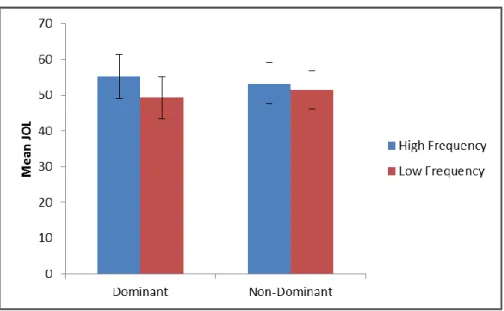
Figure 1 - Mean item-by-item JOLs by condition in Experiment 1a. Errors bars are ±1 SE ...28
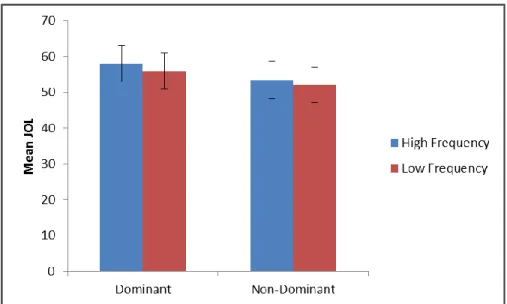
Figure 2 - Mean item-by-item JOLs by condition in Experiment 1b. Errors bars are ±1 SE ...34
Figure 3 - Mean aggregate JOLs by condition in Experiment 1c. Errors bars are ±1 SE ...39
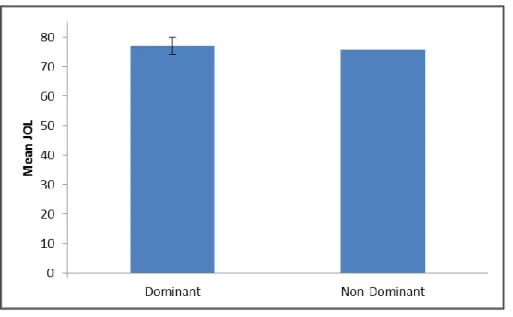
Figure 4 - Mean aggregate JOLs by condition in Experiment 2. Errors bars are ±1 SE ...44
ix
LIST OF ABBREVIATIONS JOL Judgment of learning
1
CHAPTER 1: INTRODUCTION Metamemory Background
2
The most frequent measure used by researchers to assess monitoring is the judgment of learning (JOL), which amounts to a prediction about future remembering, or a rating of
confidence in memory performance. In a typical study on metamemory, participants learn a list of items one-by-one in preparation for a later memory test. Studies employing immediate JOLs ask participants to rate their confidence in remembering an item immediately after learning it. Usually, ratings are made on a scale from 0 (not at all confident) to 100 (extremely confident). Other studies use delayed JOLs in which participants study a list of items, generally cue-target word pairs, and are then re-presented with each cue and asked to rate their confidence in being able to remember the target (for a review, see Rhodes & Tauber, 2011). The above-mentioned JOLs are called item-by-item measurements because they are made on each individual stimulus. Aggregate JOLs can also be utilized in which participants make overall predictions about all of the items studied after the learning phase. These measures usually ask participants to judge the percentage or number of items they think they will remember on the later test.
Treating JOLs as predictions of subsequent memory performance, researchers often differentiate between two types of metamemorial accuracy: absolute accuracy and relative accuracy. Absolute accuracy, or calibration, refers to overall levels of recall and how these compare with peoples’ average predictions. When item-by-item JOLs are used, researchers compute the mean JOL whereas when aggregate JOLs are used, the one overall prediction is utilized. This value is then compared to a person’s recall performance. For example, if a participant predicts he/she will remember 45% of the items and recall is likewise 45%, he/she has perfect calibration. Overconfidence and underconfidence can be easily computed by comparing participants’ predictions with their memory accuracy. Relative accuracy, or
3
to others. In other words, it shows whether people can effectively discriminate to-be-remembered items from those not later remembered (e.g., Dunlosky & Metcalfe, 2009). Relative accuracy is often assessed by computing a Goodman-Kruskal gamma correlation between participants’ JOLs and recall (Nelson, 1984). A third way to examine accuracy is to compare patterns across JOLs and recall. For example, if a manipulation has similar effects on JOLs and recall then people would seem to be sensitive to the effect of that variable. However, it is also possible for a
manipulation to have an effect on JOLs and not recall, recall but not JOLs, or opposite effects on the two. In these latter cases, peoples’ awareness of factors influencing memory is shown to be poor.
Fluency Effects in Metamemory
As mentioned above, much research has been devoted to investigating how people predict their memory and what information they use to form those predictions. One overarching group of cues that research has examined is processing fluency. According to Alter and Oppenheimer (2009), processing fluency is described as “…the subjective experience of ease with which people process information…” (p. 219). Examples of processing fluency can be found across a wide variety of domains including linguistics, perception, and within higher-order processes. Importantly, these different forms of fluency typically produce consistent effects on a number of judgments, such as truthfulness, liking, evaluation, and confidence (for a review, see Alter & Oppenheimer, 2009). Specifically, the results suggest that information that is processed more fluently is believed to be more truthful, better liked and evaluated, and associated with higher confidence.
4
memory predictions. The types of fluency that have been investigated can be broadly divided into input fluency, or fluency associated with information entering the cognitive system, and the less-examined output fluency, associated with information being produced by the system. One example of input fluency is encoding fluency, or the ease with which material is learned. Studies have demonstrated relationships between how easily material is encoded and peoples’ JOLs for that material (e.g., Koriat, 2008; Koriat & Ma’ayan, 2005; Miele, Finn, & Molden, 2011). This pattern of results has recently become known as the easily learned, easily remembered (ELER) heuristic (Koriat, 2008), and proposes that items for which the encoding process is easier and ends quicker will receive higher memory predictions compared to more difficult items. As mentioned above, it is important to note that the use of encoding fluency as a cue can occur even when this information is unrelated to actual recall performance (but see Koriat, 2008).
Robinson, Hertzog, and Dunlosky (2006) examined the cue of encoding fluency in both younger and older adults. Encoding fluency was operationally defined as how quickly
5
formation was not associated with actual cued-recall performance, indicating that this form of encoding fluency acted as a type of metacognitive illusion.
Aside from imagery formation, work examining encoding fluency has also used self-paced study time and number of trials to acquisition as indicators of ease of processing. For example, Koriat (2008, Experiment 3) had participants study unrelated word pairs at their own pace and make JOLs for each one. The study phase was followed by a cued-recall test, and this study-test cycle was repeated three more times for a total of four cycles. Results showed that study time was used as a cue for JOLs such that as study time increased, peoples’ JOLs decreased. In contrast to imagery-fluency, this encoding fluency cue was actually diagnostic of recall performance, with the finding that words that were studied longer were less likely to be remembered. In another experiment (Experiment 4), Koriat had participants study word pairs until they could successfully recall them (using a dropout procedure) and the number of trials to acquisition was recorded. Delayed JOLs were then taken after all pairs were perfectly recalled, and this was followed by a final cued-recall test on every pair. As was seen with self-paced study time, JOLs again were sensitive to encoding fluency such that they decreased as the number of trials to learn the pair increased. Recall performance followed this same pattern, with items needing fewer study trials being better remembered than items requiring more trials. In this study it was found that the items that were studied for less time or that took fewer trials to learn were better recalled, demonstrating that encoding fluency was diagnostic of future memory
performance.
Another form of input fluency that has been shown to inform memory predictions is
6
presented either in large (48 pt.) or small (18 pt.) font, under the assumption that the larger words would be perceived more fluently than the smaller words (but see Mueller, Dunlosky, Tauber, & Rhodes, 2014). After studying each word, participants provided a JOL, rating their confidence in remembering the word on a later recall test. The researchers found that the larger words were given higher JOLs than the smaller words, despite the fact that there was no difference in actual recall between the two types of items. This finding was maintained across multiple experiments, and was even apparent when participants were warned that font size is not related to memory performance. Thus, Rhodes and Castel (2008) concluded that the greater perceptual fluency of large words led to predictions of better memory, a type of metamemorial illusion given that font size had no effect on actual recall (see also, Rhodes & Castel, 2009; Susser et al., 2013; cf. Mueller et al., 2014).
A more stringent test of the perceptual fluency hypothesis was conducted by Besken and Mulligan (2013a) who found a crossed double dissociation between JOLs and memory performance using the perceptual interference manipulation. In this manipulation, words are presented very briefly and then backward masked. The mask disrupts visual processing of the words, and therefore is known to affect perception. The impaired visual processing of masked items requires that the word-processing system rely on higher-level processing such as
phonology, meaning, and abstract lexical information. The differential processing of higher-level perceptual information for masked items enhances their later recall compared to items presented without backward masks (see Hirshman, Trembath, & Mulligan, 1994 for details).
7
2500 ms with no masking. In accordance with the perceptual fluency hypothesis, participants provided higher JOLs (both using aggregate and item-by-item JOLs) for the intact items; however, recall performance was enhanced for the masked items. This result provides strong evidence for the perceptual fluency hypothesis because a direct reversal was found between objective memory performance and subjective ratings of memorability. Further, it indicates that perceptual fluency as a metacognitive cue may provide information that is not simply
uninformative, but in fact counter to actual memory performance.
In terms of output fluency as a guide for peoples’ predictions, research has mainly focused on retrieval fluency, or the latency to retrieve responses from memory. Benjamin et al. (1998) had participants study and respond to general knowledge trivia questions. The time it took
participants to generate an answer to each question was recorded by having participants press a key as soon as the answer was mentally retrieved. This was used as the measure of retrieval fluency. Participants also provided a JOL for each response, predicting their likelihood of being able to recall the answer on a later memory test. Finally, after a distractor task, participants had to free recall the answers to the questions they had previously generated. Results showed that the participants were more confident in their ability to remember the answers which they were quicker at retrieving in the encoding phase of the experiment. However, actual recall
8
2001). However, aside from retrieval fluency, other forms of output fluency have not been extensively examined in the metamemorial literature.
The Case of Motor Fluency
As mentioned earlier, there are many other types of fluency that have been studied in different domains of social, cognitive, and metacognitive research but that, as of now, have not been investigated in the specific context of metamemory (Alter & Oppenheimer, 2009). One such type has been termed body feedback or articulation fluency which, according to Alter and Oppenheimer, represents a type of embodied cognitive fluency. Specifically, it is thought that people can use proprioceptive information, such as the ease of carrying out bodily movements, as cues for judgments (e.g., Yang, Gallo, & Beilock, 2009). For the purposes of the current project, I will refer to this type of fluency as motoric fluency (see also, Hayes, Paul, Beuger, & Tipper, 2008) and group it within the output-fluency cluster of cues. This is because motoric fluency represents the ease of outwardly performing bodily actions.
9
Importantly, the manipulation check revealed that the disfluent conditions were perceived as more difficult than the fluent condition. There were no differences in overall level of affect. Although the disfluent conditions were associated with greater levels of anger, frustration, and irritation, these did not impact any of the other results. Regarding ratings of diagnosticity and evaluations, overall, people in the disfluent conditions provided lower ratings of diagnosticity and evaluated the apartment more negatively. However, these effects were moderated by participants’ internal focus, such that the above pattern of results only held for participants high in self-consciousness. The opposite pattern was found for people low in self-consciousness, such that increased difficulty was associated with greater diagnosticity of the statements and better apartment evaluations. It is also interesting to note that no recall differences were found across the four writing conditions. While these results overall depict the impact of motoric fluency on judgments, the influence of individual differences is noteworthy and consistent with Miele et al. (2011) who found that the effect of encoding fluency on JOLs depended on participants’ views of intelligence.
Briñol and Petty (2003, Experiment 4) also used a handedness manipulation to assess
judgments regarding the relationship between overt body movements and persuasion and attitude change. Their self-validation hypothesis proposes that overt behaviors can affect peoples’
10
who used their non-dominant hands. Taken together with the results of Petrova (2006), these findings indicate that motoric fluency, particularly when defined through the use of a handedness manipulation, is another form of fluency that can influence a variety of judgments.
Hayes et al. (2008) examined whether a different manipulation of motoric fluency, the ease of moving objects across a table, would influence affective responses. Participants moved basic grocery-store objects to a location on a table that either had a direct and open path (i.e., a fluent motion), or was impeded by some other object that needed to be avoided (i.e., a disfluent motion). They then rated their liking of the object that was manipulated and moved. Results revealed that actions in the disfluent condition took longer to perform, demonstrating that fluency was impacted. Interestingly, objects in the fluent condition received more positive
responses than those manipulated in the disfluent condition. This result provides further evidence that motoric fluency can impact judgments. While secondary to their main analyses, the
researchers also had a handedness manipulation (whether the motion was performed with
participants’ left or right hands). Actions performed with participants’ left hands took longer than those performed with the right hands to complete (all participants were right handed). No
difference was found in liking responses across handedness, though, numerically, objects received more positive evaluations in the right hand condition.
11
time known to the participants, and feedback was given regarding their accuracy and time. The acquisition phase was completed once participants successfully performed 30 trials of each pattern. At numerous points throughout acquisition, participants were asked to predict how well they thought they would perform the pattern when tested the next day. Specifically, they had to estimate how close in time they would complete the appropriate keystrokes to the goal time noted previously. Twenty-four hours later, during the retention phase, participants first were asked to recall (i.e., draw) the patterns and the goal times associated with each one, and again, they predicted their performance as they had earlier. For testing, participants had to perform six trials (three blocked and three random) of each pattern in as close time to the goal time as possible. During testing they were presented with the pattern but not the goal time.
12
fluency, judgments in this experiment may have reflected pure difficulty of the task. Still, the results further demonstrate the impact of motor information on metacognitive judgments.
Importantly, motoric fluency, which can be viewed as a type of output fluency, has been chiefly absent from the study of metamemory. A primary reason for this is that the majority of the above-mentioned studies on fluency effects in metamemory were based on the learning of verbal materials and information. Two recent exceptions to this exist, however, and relate metamemorial processes to proprioceptive information. Alban and Kelley (2013) investigated how the subjective physical weight of study materials influences peoples’ memory predictions. Across multiple experiments the researchers varied the weight of either the stimuli being learned (by placing words on pillow boxes of different weights) or peoples’ JOLs (by having participants write predictions on a heavy or light clipboard). Results indicated that participants consistently judged the heavier materials as being more memorable, and this occurred even when weight was made salient. Further, weight was not valid as a metamemorial cue, as this variable did not have an effect on either recall or recognition performance.
13
experiment, though, the opposite pattern was found: item-by-item JOLs tended to be higher for information learned with the furrowed brow. Again, no difference was found in the aggregate JOLs.
The authors attributed the discrepant results to the influences of data- and goal-driven effort. When effort is data driven, with certain items inherently necessitating more effort to learn, it tends to be negatively related to JOLs (i.e., less confidence with increased effort). Experiment 1 emphasized data-driven attribution, as the items in the effort condition were more difficult to learn. When goal driven, with certain items being deemed more important to learn, effort can have a positive impact on JOLs (i.e., greater confidence with increased effort to learn material). Experiment 2 included a time-pressure manipulation to induce participants to attribute mental effort to goal-driven processes and increase JOLs in the effort condition. Overall, taken together with the results of Alban and Kelley (2013), the findings suggest that motoric information is incorporated into judgments of future memory performance.
The above-reviewed studies indicate that motoric fluency has been found to impact different types of judgments, and that metamemory research more specifically has begun to investigate certain motoric influences on JOLs. However, it is important to more-directly examine motoric actions in metamemory since, within the episodic memory literature more broadly, actions have been thoroughly investigated in comparison to the learning and remembering of verbal stimuli. Action Memory and the Enactment Effect
14
this area of research indicates that actions can enhance memory. In a typical experiment on enactment, participants are presented with simple action phrases, such as break the toothpick, which they try to remember. Participants listen to these phrases, listen to them and act them out, or listen to them and watch an experimenter act them out. This encoding phase is then followed by a memory test of either recognition or recall. Findings from this line of studies generally demonstrate better memory retention of the performed actions (subject-performed tasks or SPTs) compared to the verbal learning of those actions (verbal tasks or VTs) or watching an
experimenter perform them (experimenter-performed tasks or EPTs). This result is called the enactment or SPT effect. Since the early examinations of the phenomenon in the early 1980s, various theoretical views and conceptualizations have been proposed to account for the enhanced memory performance of SPTs and how and why they may differ from memory for verbal
information (for a review, see Engelkamp, 1998).
In his initial investigations of enactment, Cohen (e.g., 1981, 1983) set out to examine whether certain memory “laws” commonly demonstrated with verbal materials could also be generalized to memory performance for actions. For example, with verbal information, a typical pattern of results is serial position effects on immediate tests of free recall. Specifically, a primacy effect is found such that the first few stimuli presented in a list of items are better retained than items presented in the middle of the list; a recency effect occurs when stimuli presented at the end of a list are better remembered than those presented in the middle.
15
1998 for discussion about a different process involved in SPT recall). Over multiple experiments Cohen (1981) examined the shape of serial position curves for actions and words. Participants learned either individual words, performed SPTs, watched EPTs, or learned the instructions of actions and were required to immediately recall them. Results demonstrated that all stimuli demonstrated the recency effect, with enhanced memory for the last few items learned. A primacy effect was demonstrated in the word, EPT, and instructions conditions; however, no primacy effect was found for the SPTs.
In this same set of experiments, Cohen (1981) studied another memory “law”, the levels of processing effect (Craik & Tulving, 1975), which has been found to influence memory
16
Results indicated that SPT recall did not vary across orienting condition – memory performance was similar whether participants focused on deeper or shallower aspects of the action. Importantly, pilot testing with the same manipulation using EPTs did show the typical levels of processing effect, with deeper processing being associated with better memory. Based on the results regarding the serial position curves, levels of processing effects, and others such as the effects of presentation time on action memory (e.g., Kausler, Lichty, Hakami, & Freund, 1986), Cohen suggested that memory for SPTs was non-strategic and more automatic than for verbal information. Whereas verbal information can be strategically controlled and integrated with memory strategies, Cohen believed that actions were free from the effects of these types of elaborative processes.
Other researchers have also examined the effects that different types of actions have on memory performance. Most of these have studies stayed within the levels of processing
framework to investigate how more elaborate or complex actions are remembered (e.g., Helstrup, 1987; Nilsson, Nyberg, Kormi-Nouri, & Rönnlund, 1995). In verbal learning, enhancing the elaborative processing associated with stimulus materials can aid memory performance (e.g., Craik & Tulving, 1975). As an example, having people study the word watch using the sentence frame, The man hobbled across the room and picked up the valuable watch off the mahogany table,aids memory compared to a simple sentence such as, He dropped the watch.Helstrup (1987) had participants learn and perform actions in either a simple or complex form. For
17
that there was no effect of complexity on recall or recognition performance: people performed equally well when the actions were simple and complex. This pattern of findings is not consistent with typical levels of processing results using verbal materials, which demonstrates that
increased elaboration aids recall (Craik & Tulving, 1975). Therefore, the findings of Helstrup indicate another example of memory for actions differing from memory for verbal materials.
Similarly, Nilsson et al. (1995) manipulated the complexity of SPTs and VTs by altering the commands as well as the actions to-be-performed. This is in contrast to Helstrup (1987) who solely manipulated the action sequences. In Nilsson et al.’s elaboration manipulation, rather than including additional actions with each item, the researchers instead specified a way to perform the task. For example, participants were either presented with wave your hands in its simple form or wave your hands like a conductor in its complex and more elaborate form. After studying or performing VTs or SPTs, participants completed free and cued recall tests. Results indicated that in free recall complexity had no effect on peoples’ memory for SPTs. In cued recall the more simple commands were actually remembered better than the complex ones. This was in contrast to the pattern of results of the VTs, which indicated a non-significant benefit of complexity on memory performance.
The above-described studies demonstrate that elaborations on enactment do not seem to enhance the recall of SPTs (cf. Zimmer & Engelkamp, 1999). These findings have partially been attributed to the already-rich encoding experience of SPTs and extensive item-specific
18
memory performance. The prior research provides support for the idea that actions may be differentially influenced by various experimental manipulations as compared to verbal materials. Therefore, to build on this line of research it is of interest to investigate whether a fluency or difficulty manipulation has any impact on action memory. The effect of processing fluency and difficulty on memory for verbal materials is discussed below in the Present Experiments
subsection.
Action Memory and Metamemory
As noted earlier, Cohen (e.g., 1981, 1983) was interested in seeing whether memory for actions differed from memory for verbal materials. In addition to testing this by investigating serial position curves and levels of processing effects, he also examined how metamemorial processes compare in these different domains (e.g., Cohen 1983, 1988; Cohen & Bryant, 1991). These early studies provide insight into the metamemorial workings of action memory; however, they had a number of confounds which leaves some conclusions open to varying interpretation. In addition, for reasons that are unclear, much of this initial research on metamemory and enactment is not cited in the traditional metamemorial literature (e.g., Dunlosky & Metcalfe, 2009), and instead seems to be confined more to memory research on the enactment effect.
In an early study looking at metamemorial processes in actions, Cohen (1983, Experiment 2) had participants learn individual words auditorily or visually, learn action instructions
(equivalent to a VT condition), watch the experimenter perform actions (EPTs), or perform the actions themselves (SPTs) using a between-subjects design. After studying each item,
19
recall, for the words and VTs, followed by EPTs, and then SPTs. Further, resolution of the SPTs did not differ from 0. It is important to note, though, that participants’ JOLs were collapsed and sorted only by whether the item would be recalled or not. Manipulating the data in this way does not allow for a more fine-grained analysis of resolution. More recent metamemory research incorporates a larger JOL scale which enables researchers to better understand peoples’ relative accuracy. The current study will do likewise.
Cohen and Bryant (1991) went beyond just comparing metamemory of SPTs and VTs or EPTs and instead investigated if people were sensitive to quantitative and qualitative changes specifically within performed actions. The researchers manipulated the length and complexity of actions and had participants make predictions about their memorability. The actions were either short typical SPTs (e.g., put the yarn through the hoop; ~5 seconds each), longer repeated tasks (e.g., bounce the ball multiple times; ~30 seconds each), or longer multi-step SPTs (e.g., untie your right shoe, take it off, untie you left shoe, take it off, put both shoes back on and tie them up; ~30 seconds each). These different actions were presented in intermixed fashion, and after performing each one, participants made a JOL. This encoding phase was followed by a free recall test.
20
predictions were sensitive to quantitative but not qualitative differences in the actions. However, the stimuli in the three conditions were all different, leading to potential item-selection
confounds that could have impacted the findings and make the results difficult to interpret. It is important for future research to better control for this variable so that stronger conclusions can be drawn.
Considering the dearth of metamemorial research conducted on action memory, it is useful to further examine this area of study, especially taking into account some of the more recent
findings in metamemory regarding fluency effects on JOLs. Such an investigation will allow us to assess whether similar cues inform metamemorial predictions about actions and verbal material.
Present Experiments
Based on the above-reviewed research on metamemory and memory for actions, it is evident that much needs to be learned about the relationship between the two domains, and the current research begins to bridge that gap. While prior studies have looked at metamemorial aspects of enactment (e.g., Cohen, 1983, 1988; Cohen & Bryant, 1991), this research has not gotten much exposure in the field of metamemory. With the recent increasing interest and advancement in metamemorial investigations of processing fluency, examining motoric fluency is a natural and important extension, and one that has not previously been undertaken.
Therefore, the current study examined the effects of motoric fluency on both metamemory judgments and memory performance. Similar to Petrova (2006) and Briñol and Petty (2003), the primary manipulation of motoric fluency was handedness. Participants either engaged in the task with their dominant (fluent) or non-dominant (disfluent) hand. Experiment 1a used verbal
21
either hand. After writing each word, participants rated how likely they were to remember it on a later free recall test. The encoding phase was followed by a distractor task and then the memory test. Experiments 1b and 1c followed the same design but incorporated minor changes to further examine motoric fluency. Experiment 2 also used handedness as the motoric fluency
manipulation, but participants performed simple actions with their dominant or non-dominant hands. Examples of such tasks are bounce the ball and erase the mark. This experiment allowed us to better examine metamemory in relation to action memory, as participants encoded and retrieved simple activities.
Considering the prior research on actions and fluency effects, different predictions arise. Regarding memory performance, it is possible that motorically difficult actions (i.e., ones performed with the non-dominant hand) will be better remembered compared to more fluently-performed actions. Support for this possibility stems from research in verbal memory on
desirable difficulties (Bjork, 1994; McDaniel & Butler, 2010). Desirable difficulties are memory strategies and techniques that are more difficult and resource-demanding initially but that lead to better memory performance in the long term. Examples of desirable difficulties that have been studied are generating versus reading items (e.g., Slamecka & Graf, 1978) and practicing retrieval of information rather than restudying it (e.g., Roediger & Karpicke, 2006). Desirable difficulties have also been studied in the perceptual domain. For example, Diemand-Yauman, Oppenheimer, and Vaughan (2011) presented participants with non-fiction text in either a
22
motorically-difficult actions produce a desirable difficulty and enhance memory performance. Contrary to this possibility, Petrova (2006) found that participants’ recall of written statements did not differ depending on whether they were copied down with the or the non-dominant hand. However, there are a couple of reasons that may explain why no memory difference was
observed by Petrova. First, participants completed a number of other judgments and scales on these statements before having to recall them which may have interfered with recall and masked a potential effect of motoric fluency. Second, Petrova utilized a between-subjects design.
Various memory phenomena, such as the generation effect, are modulated by list composition, primarily enhancing recall when manipulated within (mixed list) but not between subjects (pure lists) (McDaniel & Bugg, 2008; Mulligan & Lozito, 2004). Because the motoric fluency
manipulation being used in the current study has not been extensively examined previously, mixed lists and free recall tests will be utilized. If motoric fluency fits in with the other memory phenomena that are influenced by list composition, this design will provide us with a better opportunity of seeing an effect on memory performance if one exists.
On the other hand, as noted previously, research by Cohen and others (e.g., Cohen, 1981; Nilsson et al., 1995) has demonstrated that SPTs do not always behave like verbal materials in response to certain memory phenomena. For example, levels of processing manipulations which have large effects on memory for verbal information (e.g., Craik & Tulving, 1975) do not seem to impact actions as readily (e.g., Cohen, 1981; Helstrup, 1987). This may be because actions are already such a rich encoding experience that they do not benefit from the extra processing
23
implementing disfluent actions and increasing the difficulty of the motor component will not aid memory.
In terms of the effects of motoric fluency on metamemory predictions, we see similar competing possibilities. Much of the extant research on fluency effects in the learning and predictions of verbal information has found that people use fluency as a cue to guide their memory judgments. More specifically, it is often demonstrated that greater levels of processing fluency (i.e., quicker encoding and retrieval, easier perception) are associated with higher JOLs (e.g., Benjamin et al., 1998; Besken & Mulligan, 2013a, b; Hertzog et al., 2006; Rhodes & Castel, 2008, 2009). Simon and Bjork (2001) showed that future performance on a motor task was predicted to be better when the task was initially practiced in a more accurate manner. Further, the easily learned, easily remembered heuristic (Koriat, 2008) suggests that items that are associated with ease of processing will be considered easier to remember. With these ideas in mind it is plausible that metamemory judgments guided by motoric fluency will follow a similar pattern, with the more easily-performed actions being judged as more memorable. This would be in line with the review by Alter and Oppenheimer (2009) which showed that many different types of fluency, including motoric fluency, produce similar effects on various judgments such as truthfulness, confidence, and liking (see Briñol & Petty, 2003; Hayes et al., 2008; Petrova, 2006).
24
across actions, such as increased complexity (Cohen & Bryant, 1991). Therefore, it is also possible that JOLs will not be sensitive to changes in motoric fluency.
25
CHAPTER 2: EXPERIMENT 1A
Experiment 1a was conducted as an initial assessment to examine whether motoric fluency influences JOLs and memory performance. Similar to the manipulation used in Petrova (2006) and Briñol and Petty (2003), participants in the current experiment were required to copy down text with either their right or left hands, which were then matched to hand dominance. Reaction times (RTs) to write down each stimulus were recorded as a measure of motoric fluency. These latencies further served as a manipulation check to make sure we sufficiently manipulated fluency; enabled us to conduct correlational analyses with JOLs to see if the level of disfluency was associated with participants’ predictions; and were used to form appropriate trial lengths for Experiments 1b and 1c. An individual trial consisted of participants being presented a word and hand with which to copy the word, and then the making of a JOL. At the end of all study trials participants recalled as many of the words as they could remember.
26 Method
Participants. Seventeen undergraduates from the University of North Carolina at Chapel Hill participated in exchange for course credit.
Materials and Design. The study list consisted of 40 critical words, half of which were high and half of which were low frequency. The high-frequency words have frequencies between 100 and 500 (mean length of 5.45). The low-frequency words have frequencies of 2 or 3 (mean length of 5.30) (Kucera & Francis, 1967). Four additional words, taken from the same pool of items, were presented at the beginning and end of the list as primacy and recency buffers. Words were presented in lowercase white 18 pt. Arial font on a black background. Written along with each item were the words Right Hand or Left Hand, depending on the condition the word was in. Words in the right hand condition had “Right Hand” presented below the words and to the right side of the screen. Words in the left hand condition had “Left Hand” presented below the words and to the left side of the screen. Writing hand was manipulated within subjects and right hand and left hand items were randomly intermixed. Word frequency was also manipulated within subjects with equal numbers of high- and low-frequency items in the right and left hand conditions. Words were pseudo-randomly intermixed such that no more than two items of one condition were presented consecutively Two versions of the list will be constructed,
counterbalancing words across writing hand.
27
conditions were randomly intermixed. Participants were required to copy down each word in print with the appropriate hand on a sheet of paper provided. They were asked to do so as quickly and accurately as possible. After the word was written down, participants pressed the
Space Bar, and reaction time was recorded from the presentation of the word to the key press as a measure of fluency. Following each item, participants were asked to rate how confident they were in their ability to later remember the word on a scale from 0 (not at all confident) to 100 (extremely confident). Participants were encouraged to use the entire scale and given 5 seconds to type in their prediction.
At the end of the study phase, participants completed a three-minute distractor task consisting of arithmetic problems. This was followed by a recall test in which participants were asked to write down, in any order, as many of the words as they could remember from the first part of the experiment. They were given up to 5 minutes for the test.
In order to assess handedness, the experimenter observed which hand participants used to complete the informed consent forms as well as the recall tests. They were asked to confirm this during debriefing. Depending on the handedness of the participant, right hand and left hand items were matched to dominant and non-dominant.
Results and Discussion
The data of one participant were lost due to experimental error. This participant was replaced, leaving us with a sample size of 16. Further, less than 1% of the JOL data were lost because participants did not input their JOLs in the allotted time.
28
MSE = 5.81 x 10⁶, η2p = .85, a significant main effect of word frequency, F(1, 15) = 5.77, p = .030, MSE = 2.04 x 10⁵, η2p = .28, and no interaction, F<1. The main effect of hand demonstrated that participants took longer to write words with their non-dominant hands (M = 12.40 s, SE = .72) as compared with their dominant hands (M = 6.75 s, SE = .39). Further, the main effect of word frequency demonstrated that low-frequency words took less time to write (M = 9.44 s, SE = .47) than did high-frequency words (M = 9.71 s, SE = .52).
Table 1. Median reaction times (and SE) in seconds for Experiment 1a
High Frequency Low Frequency
Dominant 6.85 (.42) 6.65 (.37) Non-dominant 12.57 (.75) 12.23 (.70)
Next, a 2 (hand: dominant or non-dominant) by 2 (word frequency: high or low) repeated-measures ANOVA was conducted on participants’ JOLs (Figure 1). There was no significant main effect of hand, F<1, no main effect of word frequency, F(1, 15) = 2.50, p = .135, MSE = 93.28, η2p = .14, and no interaction, F(1, 15) = 3.08, p = .100, MSE = 22.65, η2p = .17.
29
Regarding recall performance (Table 2), a 2 (hand: dominant or non-dominant) by 2 (word frequency: high or low) repeated-measures ANOVA revealed no main effect of hand, F<1, no main effect of word frequency, F<1,and no interaction, F(1, 15) = 1.13, p = .305, MSE = 0.03, η2p = .07.
Table 2. Mean recall performance (and SE) for Experiment 1a
High Frequency Low Frequency
Dominant 0.23 (.05) 0.18 (.03)
Non-dominant 0.19 (.03) 0.22 (.04)
To examine the resolution of JOLs, Kruskal-Goodman gamma correlations were computed (Nelson, 1984). When gamma was assessed using all items, resolution was significantly greater than 0, G = .29, SE = .08, t(15) = 3.55, p = .003. Among the dominant items only, resolution likewise was greater than 0, G = .30, SE = .12, t(15) = 2.45, p = .027. Resolution for the non-dominant items approached significance, G = .24, SE = .12, t(15) = 2.10, p = .053. Resolution did not vary across the two types of items, t<1.
By measuring writing times (RTs) for each word, one can assess another relationship between motoric fluency and JOLs. The motoric fluency hypothesis implies that the amount of disfluency produced by writing with the non-dominant hand should predict the extent to which JOLs are reduced. To examine this possibility, difference scores were calculated for each participant between the median RTs for non-dominant and dominant trials (RTnon-dominant – RTdominant) and between the mean item-by-item JOLs for the non-dominant and dominant trials (JOLnon-dominant – JOLdominant) and correlational analyses were run1. There was a
1For purposes of evaluating the motoric-fluency hypothesis, it is not informative to directly
30
significant positive correlation found between the two, r(14) = .46, p = .072. Considering the result is in the positive direction – a result counter to what would be expected of the motoric fluency hypothesis – it is important to note that the result appears to be driven primarily by the data of one participant, and the result does not emerge in the later experiments.
Results from Experiment 1a suggest that the hand-writing manipulation did have an effect on motoric fluency, consistent with Petrova (2006). Specifically, participants took significantly longer to copy down words when using their non-dominant compared to their dominant hands. However, the difference in fluency did not influence participants’ confidence in their memory or their actual recall performance: JOLs and objective memory were both consistent across the two types of items.
Regarding the JOL results, it is important to note the potential influence of presentation time. As seen above, participants spent about twice as long interacting with the non-dominant items than the dominant items. Therefore, while they may have felt more disfluency when using their non-dominant hands, participants may have also picked up on the drastic increase in time they spent with these items. These two influences, disfluency and study time, may have had counteractive effects, with disfluency lowering confidence while study time raising it. To eliminate the differences in total study time across the two conditions, Experiments 1b and 1c implemented fixed trial lengths for all items.
Interestingly, word frequency did not have an influence on JOLs, though, numerically, the pattern was in the expected direction. While some prior research has shown that high-frequency words are judged to be more memorable (Begg et al., 1989; Benjamin, 2003), this result is not
31
always found (Tullis & Benjamin, 2012). The effect of word frequency on metamemory may be weak and inconsistent, and the addition of the handedness manipulation may have additionally interfered with any potential frequency effect. Future research should further examine this relationship.
32
CHAPTER 3: EXPERIMENT 1B
Experiment 1b was conducted in a very similar fashion to Experiment 1a but trial lengths were fixed for all items. This modification was done to ensure that participants were exposed to the words in both conditions for equal amounts of time. Further, due to the overall long RTs and the large discrepancy in RTs based on hand in Experiment 1a, a different set of stimuli were chosen for Experiment 1b, all being four letters in length. This change effectively reduced writing times.
Method
Participants. Seventeen undergraduates from the University of North Carolina at Chapel Hill participated in exchange for course credit.
33
Procedure. The procedure was similar to Experiment 1a aside from a few alterations. Based on the reaction time data from Experiment 1a, trial lengths for all items were fixed at 13 s, and participants needed to copy down the words in the allotted time. This change was made to ensure equal exposure to all items. Participants still pressed the Space Bar after copying down the item to get a measure of their writing time, but each word remained on the screen until the 13 s were up, at which point the screen automatically proceeded to the JOL phase. Participants were informed that they had a limited time to copy down the words, and were given two practice trials to familiarize themselves with the timing and the task. Further, rather than copying all words down on a sheet of paper, on which prior items could be seen, participants were required to write each word down on a single note card which was not visible outside of the appropriate trial. I made this change so that participants could only visibly study words when they were initially presented. Additionally, after the recall test, participants completed the Edinburgh Handedness Inventory (Oldfield, 1971) as an assessment of handedness.
Results and Discussion
One participant took over three standard deviations longer to write down the words than the other participants. This participant was replaced, which resulted in a sample size of 16. Further, 2.1% of the RT data could not be analyzed as participants either failed to remember to press the
Space Bar after writing a stimulus or did not complete the word within the time given. A 2 (hand: dominant or non-dominant) by 2 (word frequency: high or low)
34
words with participants’ dominant hands, but the opposite was true for participants’ non-dominant hands. The main effect of hand demonstrated that participants took longer to write words with their non-dominant hands (M = 8.51 s, SE = .43) as compared with their dominant hands (M = 5.15 s, SE = .32).
Table 3. Median reaction times (and SE) in seconds for Experiment 1b
High Frequency Low Frequency
Dominant 4.99 (.32) 5.30 (.34)
Non-dominant 8.60 (.44) 8.41 (.44)
A 2 (hand: dominant or non-dominant) by 2 (word frequency: high or low)
repeated-measures ANOVA conducted on participants’ JOLs (Figure 2) revealed a significant main effect of hand, F(1, 15) = 11.28, p = .004, MSE = 24.19, η2p = .43, no main effect of word frequency,
F(1, 15) = 2.27, p = .153, MSE = 22.00, η2p = .13, and no interaction, F<1. The main effect of hand demonstrated that participants provided higher JOLs for items written with their dominant hands (M = 56.90, SE = 4.96) as compared with items written with their non-dominant hands (M
= 52.77, SE = 5.04; Figure 2).
35
As was done in Experiment 1a, correlational analyses were conducted to investigate the relationship between differences in RTs and JOLs across item type. Again, difference scores were calculated for each participant between the median RTs for non-dominant and dominant trials and between the mean item-by-item JOLs for the non-dominant and dominant trials. This analysis showed no correlation between the two, r(14) = .07, p = .806.
Finally, a 2 (hand: dominant or non-dominant) by 2 (word frequency: high or low) repeated-measures ANOVA conducted on participants recall performance (Table 4) revealed no main effect of hand, F<1, no main effect of word frequency, F(1, 15) = 1.45, p = .247, MSE = 0.02,η2p = .09, and no interaction, F(1, 15) = 1.67, p = .216, MSE = 0.02, η2p = .10.
Table 4. Mean recall performance (and SE) for Experiment 1b
High Frequency Low Frequency
Dominant 0.17 (.03) 0.18 (.04)
Non-dominant 0.21 (.04) 0.13 (.03)
Across all items JOL resolution was significantly greater than 0, G = .17, SE = .08, t(15) = 2.19, p = .045. Among the dominant items only, however, resolution did not differ from 0, G = .27, SE = .15, t(14)2 = 1.79, p = .096. Similarly, resolution for the non-dominant items was not greater than 0, G = .09, SE = .10, t(14)3<1. Resolution did not vary across the two types of items,
t<1.
Consistent with Experiment 1a, the results of the RT data demonstrated that hand dominance did impact motoric fluency: participants took significantly longer to write words with their non-dominant than non-dominant hands. Unlike Experiment 1a, however, the JOL results did
2The correlation for one participant was not calculated because the participant did not recall any
dominant words.
3The correlation for one participant was not calculated because the participant did not recall any
non-dominant words.
36
suggest that motoric fluency was used as a cue for metamemory judgments, with participants being more confident in their memory for items written with their dominant as compared to their non-dominant hands. This pattern is consistent with other JOL research showing that predictions are sensitive to fluency manipulations (e.g., Besken & Mulligan, 2013a, b; Susser et al., 2013) and research more specifically focusing on the impact of motoric fluency on other, non-memorial judgments (e.g., Hayes et al., 2008; Petrova, 2006). The critical difference between Experiments 1a and 1b was the length of the trials, with the former experiment using self-paced trials, and the latter using fixed-length trials. When trial lengths were no longer confounded across
experiments, the effect of hand dominance was found, possibly indicating that the influence of both motoric fluency and trial length on JOLs was offsetting in the first experiment. As in the prior experiment, however, word frequency did not inform participants’ JOLs.
37
CHAPTER 4: EXPERIMENT 1C
Experiment 1c was similar to Experiment 1b but used aggregate rather than item-by-item JOLs. The reason for this change was because of the potential reactive effect of item-by-item JOLs on recall performance. It has been observed previously (Besken & Mulligan, 2013a; Matvey et al., 2001) that item-by-item JOLs may induce deeper processing which can reduce or eliminate the effect of other encoding variables (e.g., the generation manipulation) on recall. Importantly, prior research has demonstrated that the two types of JOLs produce similar patterns of memory predictions (Besken & Mulligan, 2013a; Susser et al., 2013).
Method
Participants. Sixteen undergraduates from the University of North Carolina at Chapel Hill participated in exchange for course credit.
Materials and Design. The materials and design were identical to Experiment 1b.
Procedure. The procedure was similar to Experiment 1b except for the use of aggregate JOLs instead of item-by-item JOLs. These predictions were made after the distractor phase.
38 Results and Discussion
Participants gave separate aggregate JOLs for dominant- and non-dominant-hand items but not for high- and low-frequency words. Consequently, analyses of the JOLs are limited to the hand variable and did not include word frequency. For completeness, word frequency is still included in the RT and recall results.
A 2 (hand: dominant or non-dominant) by 2 (word frequency: high or low)
repeated-measures ANOVA conducted on participants’ median RTs (Table 5) revealed a significant main effect of hand, F(1, 15) = 120.66, p < .001, MSE = 1.20 x 10⁶ , η2p = .89, no main effect of word frequency, F(1, 15) = 2.11, p = .167, MSE = 1.36 x 105.49, η2p = .12, and no interaction, F<1. The main effect of hand demonstrated that writing times were longer for the non-dominant (M = 7.14 s, SE = .38) than dominant hand (M = 4.14 s, SE = .26).
Table 5. Median reaction times (and SE) in seconds for Experiment 1c
High Frequency Low Frequency
Dominant 4.02 (.24) 4.25 (.28)
Non-dominant 7.12 (.40) 7.16 (.37)
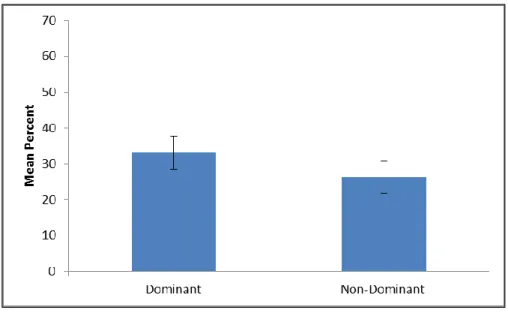
A repeated-measures t-test conducted on participants’ aggregate JOLs (Figure 3)
demonstrated that participants predicted they would remember a greater percentage of the words written with their dominant hands (M = 33.13, SE = 4.74) than with their non-dominant hands (M
39
Figure 3. Mean aggregate JOLs by condition in Experiment 1c. Errors bars are ±1 SE.
As was done in the prior experiments, correlational analyses were conducted to investigate the relationship between differences in RTs and JOLs across item type. Difference scores were calculated for each participant between the median RTs for non-dominant and dominant trials and between the aggregate JOLs for the non-dominant and dominant conditions. This analysis showed no correlation between the two, r(14) = .13, p = .627.
A 2 (hand: dominant or non-dominant) by 2 (word frequency: high or low) repeated-measures ANOVA conducted on participants’ recall performance (Table 6) revealed no main effect of hand, F<1 and no main effect of word frequency, F(1, 15) = 1.90, p = .189, MSE = 0.01, η2p = .11, but a significant interaction between the two, F(1, 15) = 6.91, p = .019, MSE = 0.01, η2p = .32. Follow-up t-tests revealed that, for the dominant hand, participants recalled a greater proportion of the low-frequency items (M = .18, SE = .03) than high-frequency items (M = .09,
40
hands (M = .14, SE = .03) than with their dominant hands (M = .09, SE = .03), t(15) = 1.86, p = .083, d = 0.47. No significant difference in recall performance was found in the low-frequency words, but the trend was in the opposite direction: non-dominant (M = .13, SE = .02) and dominant (M = .18, SE = .03), t(15) = 1.66, p = .118, d = 0.43.
Table 6. Mean recall performance (and SE) for Experiment 1c
High Frequency Low Frequency
Dominant 0.09 (.03) 0.18 (.03)
Non-dominant 0.14 (.03) 0.13 (.02)
As in Experiments 1a and 1b, participants took substantially longer to copy down items with their non-dominant hands than with their dominant hands. Also consistent with Experiment 1b, but now using aggregate JOLs, participants predicted they would remember more of the items they had written in a fluent manner (i.e., with their dominant hands) than in a disfluent manner (i.e., with their non-dominant hands). These findings provide further support that motoric fluency is a cue for memory predictions.
41
CHAPTER 5: EXPERIMENT 2
To further examine the role of motoric fluency on JOLs and memory performance,
Experiment 2 employed simple actions as stimuli, as in the literature on action memory and the enactment effect. Though actions may differ from verbal learning in certain ways with regard to metamemory and memory (e.g., Cohen, 1981, 1983, 1988), using this kind of stimuli allowed us to approach motoric fluency from a different perspective and assess the generality of the results obtained in the previous experiments using verbal materials. Handedness was again used to manipulate motoric fluency. Participants performed actions with either their dominant or non-dominant hands, rated their confidence in their memory for these different types of items, and then recalled the action phrases they performed.
Method
Participants. 25 undergraduates from the University of North Carolina at Chapel Hill participated in exchange for course credit.
42
was used as practice prior to the beginning of the encoding phase (see Appendix for the full list of actions used). Each action was presented with the words Right Hand or Left Hand, depending on condition. Hand was manipulated within subjects and right hand and left hand actions were pseudo-randomly intermixed such that no more than two items of one condition were presented consecutively. Two versions of the list were constructed, counterbalancing actions across hand.
Procedure. Participants were tested individually and seated across from the experimenter at a small conference table. The experiment consisted of three phases: the study phase, the distractor phase, and the test phase. Participants were instructed that they would hear simple action phrases described aloud by the experimenter, and that they should perform and try to remember the entire phrase for a later memory test. During the study phase, a trial began with the experimenter taking an object(s) out from behind a screen and placing it on the table in front of the participant. The experimenter then read aloud the action phrase involving the object and said either Right Hand
or Left Hand, indicating which hand should be used to carry out the action. Participants had eight seconds to perform the action with the appropriate hand, which was a sufficient amount of time for all actions to be completed. After eight seconds, the experimenter removed the object and placed it back behind the screen such that it could not be seen outside of the appropriate trial. Next, participants made a JOL for the action phrase, rating how confident they were in their ability to later remember it, on a scale from 0 (not at all confident) to 100 (extremely confident). Participants were encouraged to use the entire scale and said their prediction aloud to the
experimenter, who recorded it on the computer. Then, the next trial began.
43
were encouraged to try to recall the entire action phrase, but were informed that they should write down any part of the phrase they could remember. They were given up to 5 minutes for the test. After the recall test, participants were given a source memory test for the actions they recalled. Specifically, they were asked to indicate, by writing an L or R next to each response, whether they thought the action was performed with their left or right hands, respectively.
Because source memory performance is not of interest for the current study, these results will not be discussed further.
At the end of the experiment, participants completed the Edinburgh handedness inventory (Oldfield, 1971) to assess handedness.
Results and Discussion
For one participant, 34% of the JOL data were lost due to experimental error. This
participant was replaced, leaving us with an effective sample size of 24. Recall data were scored in two ways: strict and lenient. In the strict scoring, only answers containing both the verb and main object were counted as correct (see below). In the lenient scoring, either the object or verb could be present in order for the item to be counted as correct. For action phrases involving more than one object (e.g., slide the quarter into the piggybank), object recall was scored based on the inclusion of the manipulated object, in this case, quarter.Only results using the lenient data are reported, as both strict and lenient scoring led to the same pattern of results, except where noted.
44
Figure 4. Mean aggregate JOLs by condition in Experiment 2. Errors bars are ±1 SE.
A repeated-measures t-test conducted on participants’ recall performance (Table 7) demonstrated a marginally-significant effect, with participants tending to recall more actions performed with their dominant hands (M = .44, SE = .02) than their non-dominant hands (M = .38, SE = .03), t(23) = 1.70, p = .102, d = 0.35. This pattern was even stronger in the strict-scoring data (p = .056). However, it is important to note that an earlier experiment using the same stimuli with aggregate JOLs showed no effect of hand dominance on recall, and
numerically the data favored the non-dominant-hand condition (46% vs. 41%). Therefore, I am hesitant to interpret this marginally-significant result as reflecting a real or robust effect of hand on memory for actions. Consequently, this aspect of the results will not be discussed further.
45
Using the strict recall data, the non-dominant condition had resolution that was marginally-significantly different from 0, G = .21, SE = .11, t(22)4 = 83, p = .08.
Table 7. Mean lenient recall performance (and SE) for Experiment 2
Dominant 0.44 (.02)
Non-dominant 0.38 (.03)
Using simple actions rather than verbal materials, Experiment 2 showed that the fluency of carrying out these actions did not seem to inform participants’ JOLs, with metamemory
predictions being equivalent across the fluent and disfluent conditions. This contrasts with the results of Experiments 1b and 1c, in which disfluently-written items produced lower JOLs than fluently written items. The lack of fluency effect on JOLs for actions is consistent with prior research demonstrating differences in metamemorial processes between verbal and action stimuli (e.g., Cohen, 1983). Similarly, participants’ resolution was low and did not differ from 0, a result consistent with Cohen who found that participants were poor at predicting memory for actions. Recall performance was marginally better for the dominant as compared with non-dominant condition; however, this pattern was not found in a second experiment. Therefore, consistent with Experiments 1a-c, these results suggest that motoric disfluency as indexed by hand does not strongly, or consistently, impact recall performance. Participants remembered actions performed with their dominant and non-dominant hands similarly well.
4The correlation for one participant was not calculated because the participant did not recall any
46
CHAPTER 6: GENERAL DISCUSSION
Predictions of future memory performance are influenced by a number of factors, some of which are related to actual memory performance and others that are not (e.g., Benjamin et al., 1998; Koriat, 1997; Rhodes et al., 2013; Susser et al., 2013; Tauber & Rhodes, 2010). Processing fluency is one type of cue that has been shown to influence these predictions (Alter &
Oppenheimer, 2009; Benjamin et al., 1998; Besken & Mulligan, 2013a, b). Until recently, however, research has primarily investigated input fluency, reflecting the fluency with which information enters the cognitive system. Output fluency, or the fluency of producing
information, has not been examined as extensively. Across four experiments I investigated a specific type of output fluency, motoric fluency, to see whether it acts as a cue for metamemorial judgments. Importantly, motoric fluency has been found to influence other types of judgments (Briñol & Petty, 2003; Hayes et al., 2008; Petrova, 2006). A secondary goal of the current study was to see if this type of fluency manipulation affects recall performance, as is found in the verbal memory domain (e.g., Diemand-Yauman et al., 2011). Experiments 1a-c used traditional verbal stimuli and had participants copy down words with either their dominant or non-dominant hands. Experiment 2 used simple actions as stimuli to examine motoric fluency in the context of action memory and studies on the enactment effect. This experiment had participants perform actions with their dominant or non-dominant hands. Importantly, objective measures of reaction time demonstrated that the handedness manipulation did indeed influence motoric fluency.
47
hands. That is, motoric fluency impacted memory predictions. This pattern was found both using item-by-item (Experiment 1b) and aggregate JOLs (Experiment 1c). These results suggest that output fluency, similar to input fluency, can inform memory predictions, and the impact of motoric fluency is consistent with research showing that it can guide other judgments, such as ratings of diagnosticity and affect (Hayes et al., 2008; Petrova, 2006).
Experiment 1a found no difference in JOLs for the fluently- and disfluently-processed items. It is important to note that this experiment implemented self-paced rather than fixed-length trials. Because of this design, participants saw the disfluent items for approximately twice as much time as the fluent items. Therefore, it is possible that two competing cues were at play: fluency (in favor of the dominant-hand words which were more fluent) and study time (in favor of the non-dominant-hand words which were presented for more time), such that the effects of these two cues canceled each other out. Prior research has shown that increased study can positively influence JOLs (e.g., Koriat, Ma’ayan, & Nussinson, 2006; Kornell & Bjork, 2009). While the main important difference between Experiments 1a and 1b-c was study time, it is also impossible to rule out another aspect that differed: word length. Experiment 1a used stimuli that varied in length from five to seven letters and Experiments 1b and 1c used words that were all four letters in length. It is not immediately clear why this difference would alter the pattern of results, but future research could examine variability in word length.
Considering the experimental context of the current study, demand characteristics could have influenced the results. The manipulation of hand was quite salient, after all, and participants may have believed something about the nature of the manipulation (or the desires of the
48
fluency on JOLs using the same salient manipulation. One would imagine that if general demand characteristics were playing a role, I would have observed an effect of motoric fluency on JOLs, despite differences in presentation time. Second, a survey-based study was administered to a new group of 60 participants to try to assess beliefs about the hand manipulation (since it is possible that beliefs or theories about memory informed JOLs rather than the experiences of fluency, see Koriat, Bjork, Sheffer, & Bar, 2004; Mueller et al., 2014). The survey provided a detailed description of the previous experimental protocols in which students learned and copied down words with their dominant and non-dominant hands. After reading about the experiment,
participants predicted what percentage of the words of each type the students recalled. Predicted recall was equivalent across the two conditions, but actually numerically in favor of the non-dominant items: non-dominant (M = 46.80, SD = 19.62), non-dominant (M = 49.37, SD = 21.31), t<1. These data further argue against demand characteristics specifically and belief-based accounts more generally. If participants merely consulted their beliefs about the effect of hand dominance, then if anything, JOLs for non-dominant items would not have been higher than for dominant items.
Given the effect of motoric fluency on predictions of memory, we are left with the question,
why? Why would engaging in an activity in a more fluid manner be associated with increased memory confidence for that activity? In their study, Briñol and Petty (2003) proposed that handedness might influence judgments due to the appearance of the product of the writing. Writing with one’s non-dominant hand yields text that looks shaky and less certain, which may reduce confidence in that information. This idea is consistent with the present results, as