Prognostic value of cardiovascular disease status: the Leiden
85-plus study
Petra G. van Peet&Yvonne M. Drewes&
Anton J. M. de Craen&Rudi G. J. Westendorp& Jacobijn Gussekloo&Wouter de Ruijter
Received: 12 January 2012 / Accepted: 7 June 2012
#The Author(s) 2012. This article is published with open access at Springerlink.com
Abstract This study aimed to explore the prognosis of very old people depending on their cardiovascular disease (CVD) history. This observational prospective cohort study included 570 participants aged 85 years from the general population with 5-year follow-up for morbidity, functional status, and mortality. At base-line, participants were assigned to three groups: no CVD history,“minor”CVD (angina pectoris, transient ischemic attack, intermittent claudication, and/or heart failure), or“major”CVD (myocardial infarction [MI], stroke, and/or arterial surgery). Follow-up data were collected on MI, stroke, functional status, and cause-specific mortality. The composite endpoint included cardiovascular events (MI or stroke) and cardiovascu-lar mortality. At baseline, 270 (47.4 %) participants
had no CVD history, 128 (22.4 %) had minor CVD, and 172 (30.2 %) had major CVD. Compared to the no CVD history group, the risk of the composite endpoint increased from 1.6 (95 % confidence interval [CI], 1.1–2.4) for the minor CVD group to 2.7 (95 % CI, 2.0–3.9) for the major CVD group. Similar trends were observed for cardiovascular and all-cause mor-tality risks. In a direct comparison, the major CVD group had a nearly doubled risk of the composite endpoint (hazard ratio, 1.8; 95 % CI, 1.2–2.7), com-pared to the minor CVD group. Both minor and major CVD were associated with an accelerated decline in cognitive function and accelerated increase of disabil-ity score (allp<0.05), albeit most pronounced in par-ticipants with major CVD. CVD disease status in very old age is still of important prognostic value: a history of major CVD (mainly MI or stroke) leads to a nearly doubled risk of poor outcome, including cardiovascu-lar events, functional decline, and mortality, compared with a history of minor CVD.
Keywords Aged 80 and over . Cardiovascular disease . Prevention . Cardiovascular morbidity . Functional status . Mortality
Abbreviations
ADL Activities of Daily Living
BNP Brain natriuretic peptide
CABG Coronary artery bypass grafting
CAD Coronary artery disease
CI Confidence interval
DOI 10.1007/s11357-012-9443-5
P. G. van Peet (*)
:
Y. M. Drewes:
J. Gussekloo:
W. de RuijterDepartment of Public Health and Primary Care, Leiden University Medical Center,
Postzone V0-P, P.O. Box 9600, 2300 RC Leiden, The Netherlands
e-mail: [email protected]
A. J. M. de Craen
:
R. G. J. Westendorp Department of Gerontology and Geriatrics, Leiden University Medical Center, Leiden, The NetherlandsR. G. J. Westendorp
CV Cardiovascular
CVD Cardiovascular disease
GDS Geriatric Depression Scale
HR Hazard ratio
ICD International Classification of Diseases
MI Myocardial infarction
MMSE Mini-Mental State Examination
PAD Peripheral artery disease
PTCA Percutaneous transluminal coronary
angioplasty
SE Standard error
TIA Transient ischemic attack
Introduction
Cardiovascular disease (CVD) is characterized by a high prevalence and incidence up to the highest age groups. Moreover, cardiovascular morbidity is an im-portant cause of disability and, from middle age on-wards, CVD is the leading cause of death (Roger et al.
2011; McDermott2007). Therefore, prevention of car-diovascular events has high priority and risk predic-tion models have been developed.
In daily practice, populations are usually dichot-omized into people with known atherothrombotic CVD, such as coronary heart disease, stroke/tran-sient ischemic attack (TIA), and peripheral arterial disease, and people without those manifest condi-tions, but possibly with risk factors for CVD, such as hypertension, hypercholesterolemia, diabetes, or smoking (Wilson et al.1998; Wilson2011; Graham et al. 2007; Dornbrook-Lavender et al. 2003). Per-sons without manifest CVD theoretically qualify for the so-called primary prevention, be it on a popula-tion scale or on a more personal level when their calculated CVD risk exceeds predefined thresholds (Graham et al.2007; Wald et al.2011). Persons with prior CVD are known to have a high risk of recur-rent CVD (Kerr et al. 2009; Vaartjes et al. 2010; Steg et al. 2007; van Wijk et al. 2005) and should, therefore, receive optimal “secondary prevention,” including lifestyle advice and preventive medication. Despite evidence of its value also in old age, elderly people do not receive optimal preventive treatment even after major events (Arnold et al.2011; Kvan et al. 2006; Bhatt et al. 2006). At very old age, drug interactions, intoxications, and adverse effects can
have serious impact on the quality of life (Banerjee et al.2011) Therefore, further risk differentiation with-in those with prior CVD might help clwith-inicians to select those at the highest risk of recurrent events. In younger age groups, it is already known that patients with prior CVD are at the highest risk of a recurrent cardiovas-cular event (Kerr et al. 2009). Within patients with prior CVD, a recent study showed that a history of ischemic events leads to a greater risk of future events than a history of stable coronary, cerebrovascular, or peripheral artery disease (Bhatt et al.2010). At pres-ent, it is unknown whether these findings can also be applied to patients aged 85 and over.
We hypothesized that subgroups with different risks of recurrent CVD might also be observed within the population of the oldest old. A history of myocardial infarction (MI) or stroke might have a different prog-nosis than a history of relatively“minor”CVD such as stable angina or claudication, TIA, or milder cases of heart failure. This may have clinical consequences for the format and intensity of secondary prevention in these groups of older people.
We investigated whether differences in prognosis exist between very old people with various levels of prevalent CVD, compared to those with no manifest CVD. Since in older populations the outcomes“ mor-bidity” and “functional status” become even more important than mortality, we studied the prognosis not only regarding (cause-specific) mortality, but also with respect to recurrent CVD morbidity and function-al status.
Methods
Study population
The Leiden 85-plus Study is a prospective population-based study in 85-year-old inhabitants of the city of Leiden, The Netherlands. The study design and char-acteristics of the cohort have previously been de-scribed in detail (der Wiel et al.2002; van Exel et al.
2002). In brief, between September 1997 and
Septem-ber 1999, 705 people from the 1912–1914 birth
informed consent and were enrolled. At baseline and yearly up to the age of 90 years, participants were visited at their place of residence to obtain extensive data on health, functioning, and well-being. In addi-tion, a medical history was obtained from the partic-ipant’s primary care physician. For all participants, classic cardiovascular risk factors were determined. The Medical Ethics Committee of the Leiden Univer-sity Medical Centre approved the study.
Prevalence of CVD at age 85 years
For each participant, the primary care physician was interviewed about the history of CVD using a stan-dardized questionnaire, which included questions on present and past cardiovascular pathologies, including MI, stroke, surgery for arterial disease (aorta, carotid, coronary, or peripheral arteries), angina pectoris, TIA, intermittent claudication, and heart failure. An ECG was recorded. The presence of MI on the ECG was defined as the presence of Minnesota Code 1-1 or 1-2 (excluding 1-2-8). Participants were assigned to three different groups according to their CVD status: a group with no known history of CVD (reference group), a group with a history of “minor”CVD, and a group with a history of“major”CVD. Minor CVD was considered present if the primary care physician had recorded a history of angina pectoris, TIA, inter-mittent claudication, and/or heart failure. Major CVD was defined as a history of MI (including MI on baseline ECG), stroke, or surgery for arterial disease (aorta, carotid, coronary, or peripheral arteries). These criteria for minor and major CVD were based on literature in younger age groups (Bhatt et al. 2006; Rosengren et al.1998).
Clinical endpoints
(Non)fatal myocardial infarction
Up to 90 years of age, all incident fatal and nonfatal MIs were annually registered using data from the primary care physician, ECGs, and death registration forms. Incident MI on the ECG was defined as the appearance of Minnesota Code 1-1 or 1-2 or Minne-sota Code 1-3 in combination with the first appearance of Minnesota Code 5-x in the same myocardial area (Macfarlane and Latif1996). A fatal incident MI was
categorized by cause of death codes I21–I23 (Interna-tional Classification of Diseases [ICD]-10).
(Non)fatal stroke
Information on incident stroke was collected annually from the primary care physician up to 90 years of age. A fatal incident stroke was categorized by cause of death codes I61–I69 (ICD-10).
Incident cardiovascular events or cardiovascular mortality
The composite endpoint “incident cardiovascular events or cardiovascular mortality” was defined as fatal and nonfatal MI, fatal and nonfatal stroke, or other cardiovascular mortality.
Mortality
All participants were followed up for mortality until the age of 95 years. Dates and causes of death were obtained from civic and national registries. Causes of death were divided into cardiovascular causes (ICD-10 codes I00–I99) and noncardiovascular causes (all other ICD-10 codes). Assignment of cause of death was done blinded for baseline and follow-up study data.
Functional status
Up to 90 years of age, participants were annually visited by a research nurse at their place of resi-dence. Cognitive function was assessed by the Mini-Mental State Examination (MMSE) with scores ranging from 0 to 30 points (optimal)
(Tombaugh and McIntyre 1992). Disability was
assessed using the Activities of Daily Living (ADL) items from the Groningen Activity Restric-tion Scale with scores ranging from 9 (optimal) to
36 points (Kempen et al. 1996). In those with
MMSE scores above 18, Cantril’s Ladder of Life with a score from 1 to 10 (optimal) points was used as a measure of general well-being (Cantril
Table 1 Baseline characteristics of participants from the Leiden 85-plus Study (n0570), depending on cardiovascular history
Total CVD history p for trenda
570 (100) None 270 (47.4) Minor 128 (22.4) Major 172 (30.2)
Sociodemographic characteristics
Women 379 (67) 195 (72) 93 (73) 91 (53) <0.001
Net monthly income >750€ 276 (49) 147 (55) 52 (41) 77 (45) 0.058 Post primary school education 197 (35) 104 (39) 41 (32) 52 (31) 0.091 Noninstitutionalized living 467 (82) 229 (85) 105 (82) 133 (77) 0.048
Functional status
Cognitive function (MMSE) 26 (22–28) 27 (24–29) 26 (23–28) 25 (19–28) <0.001 ADL disability 10 (9–15) 10 (9–13) 10 (9–15) 10 (9–16) 0.009 Subjective well-being (Cantril)b 8 (7–9) 8 (6–9) 8 (7–8) 8 (7–9) 0.177
Depressive symptoms (GDS)b 2 (1–3) 2 (1–3) 2 (1–4) 2 (1–3) 0.636
Cardiovascular characteristics Classic risk factors
Hypertensionc 325 (58) 134 (50) 87 (68) 104 (64) 0.003
RR systolic, mmHg 154 (143–166) 155 (144–166) 154 (142–168) 153 (141–166) 0.332 Hypercholesterolemiad 123 (22) 59 (22) 30 (24) 34 (22) 0.928
Total cholesterol, mmol/L 5.7 (4.9–6.4) 5.7 (5.0–6.4) 5.8 (4.9–6.4) 5.6 (4.8–6.3) 0.320 HDL cholesterol, mmol/L 1.3 (1.0–1.6) 1.3 (1.1–1.6) 1.3 (1.0–1.5) 1.1 (0.9–1.4) <0.001 BMI, kg/m² 27 (24–30) 27 (25–30) 27 (24–31) 26 (24–29) 0.096
Diabetese 89 (16) 38 (14) 19 (15) 32 (20) 0.151
Smokingf 267 (49) 122 (46) 54 (42) 91 (58) 0.029
Medication use
Blood pressure lowering drugsg 316 (57) 111 (42) 92 (72) 113 (71) <0.001 Anticoagulants/aspirin 162 (28) 28 (10) 46 (36) 88 (51) <0.001
Lipid-lowering drugs 6 (1) 1 (0.4) 2 (1.6) 3 (1.7) 0.15
Cardiovascular history
Angina 109 (19) 0 60 (48) 49 (29)
Transient ischemic attack 75 (13) 0 40 (31) 35 (21) Intermittent claudication 37 (7) 0 12 (10) 25 (15)
Heart failure 74 (13) 0 36 (28) 38 (22)
Myocardial infarction 99 (17) 0 0 99 (58)
Stroke 61 (11) 0 0 61 (36)
Surgery for arterial diseaseh 42 (7) 0 0 42 (25)
Data presented as n (%) for categorical variables, and median (IQR) for continuous variables
CVD = cardiovascular disease; No CVD = participants with no history of CVD; Minor CVD = participants with a history of angina, transient ischemic attack, intermittent claudication or heart failure; Major CVD = participants with a history of myocardial infarction, stroke or surgery for arterial disease ; MMSE = Mini-Mental State Examination (range 0-30); ADL = basic activities of daily living (range 9-36); Cantril = Cantril’s ladder of life (range 0–10); GDS = Geriatric Depression Scale (range 0–15)
a
Chi-square test for categorical variables and Jonckheere-Terpstra for continuous variables;
b
assessed only in participants with MMSE >18;cRR≥160 systolic at baseline or a history of hypertension;dtotal cholesterol≥6.5 at baseline or statin use;ehistory of diabetes, antidiabetic medication use or non-fasting glucose≥11 mmol/L;fcurrent or past smoker;g use ofβ-blockers, ACE inhibitors, diuretics or calciumchannel blockers as reported by the participants pharmacists
h
Statistical analysis
Differences in baseline characteristics between the groups according to CVD status were analyzed with the chi-square test for categorical variables and the Jonck-heere–Terpstra test for continuous variables. Time-to-event curves were constructed with the Kaplan–Meier method and compared using a log-rank test. If no exact time to event was available, the time to event was calcu-lated as halfway that particular year. Mortality and mor-bidity hazard ratios (HR) and corresponding 95 % confidence intervals (CIs) were calculated in a Cox pro-portional hazards model adjusted for sex. The same HRs were calculated in a model with additional adjustments for the use of antihypertensive medication, income, and level of education. Incidence rate was calculated using the timetable method as number of incidents per 1,000 person-years at risk with corresponding 95 % CIs. Differ-ences in cognitive function (MMSE), changes in disabil-ity (ADL), general well-being (Cantril), and depressive symptoms (GDS) were estimated using linear mixed models adjusted for sex and are presented as (predicted) means with standard errors. As a first sensitivity analysis, the stratification in groups according to CVD status was repeated at the age of 90 years, with updated information about incidence of cardiovascular events from 85 to 90 years of age. A second sensitivity analysis was done
with risk groups according to site of CVD: a group with a history of cardiac CVD (angina pectoris and/or MI), a group with a history of cerebrovascular CVD (TIA and/ or stroke), a group with a history of peripheral CVD (intermittent claudication and/or surgery for noncoronary arterial disease), and a group with a history of CVD at multiple sites. Data analysis was performed using SPSS 17.0 for Windows (SPSS Inc., Chicago, IL, USA).
Results
Baseline characteristics
For 570 of the 599 participants, all baseline measure-ments were available. At 85 years of age, 270 (47.4 %) participants had no history of CVD, 128 (22.4 %) partic-ipants had minor CVD, and 172 (30.2 %) particpartic-ipants had major CVD (Table1). Participants with major CVD were more often men (47 versus 27 % for minor CVD and 28 % for no CVD,ptrend<0.001) and more often institu-tionalized (23 versus 18 % for minor CVD and 15 % for no CVD,ptrend00.048). They had higher scores of dis-ability (ptrend00.009) and their MMSE scores were the lowest (ptrend<0.001). Only 36 % of the participants with minor CVD and 51 % of the participants with major CVD used aspirin or oral anticoagulants. Median systolic
Fig. 1 History of CVD and 5-year incidence of the composite endpoint“MI, stroke, and cardiovascular mortality”(left panel), as well as incidence of all-cause mortality (right panel) for three
blood pressure was 154 mmHg (interquartile range
[IQR], 143–166), median total cholesterol was
5.7 mmol/L (IQR, 4.9–6.4). Participants with major CVD had lower HDL cholesterol levels (ptrend<0.001). Use of statins was minimal: no more than 1 % of all participants used lipid-lowering drugs. From all partici-pants with heart failure (n074), more than half (n038 [51 %]) also had a history of major CVD.
At 90 years of age, 303 (53 %) participants were still alive. Follow-up for mortality was complete, and for 296 participants, we completed all clinical meas-urements at 90 years.
Morbidity and mortality
During 5 years of follow-up, 181 (32 %) participants reached the composite endpoint, including 76 (42 %)
fatal and nonfatal MI, 76 (42 %) fatal and nonfatal strokes, and 29 (16 %) additional cardiovascular deaths. Figure 1 shows the Kaplan–Meier curves for the three groups for the composite endpoint“incident cardiovas-cular events or cardiovascardiovas-cular mortality”(left panel) and all-cause mortality (right panel). Overall, during these 5 years, 267 (47 %) participants died; of which, 106 (40 %) died from cardiovascular causes. The incidence rate for“incident cardiovascular events or cardiovascular mortality”increased from 56 (95 % CI, 44–72) per 1,000 person-years at risk in the group with no CVD to 88 (95 % CI, 65–118) in the group with minor CVD and to 164 (95 % CI, 144–199) in the group with major CVD (Table2). The risks for a fatal or nonfatal MI, a fatal or nonfatal stroke, and the composite endpoint increased from 1.7 (95 % CI, 0.9–3.1), 1.7 (95 % CI, 0.9–3.2), and 1.6 (95 % CI, 1.1–2.4), respectively, in participants
Table 2 Five-year hazard ratios and absolute risks of cardiovascular morbidity and mortality, depending on cardiovascular history adjusted for sex (n0570)
CVD history pfor trend HR major versus minor None
(n0270)
Minor (n0128)
Major (n0172)
Morbidity and mortality
Fatal and nonfatal MI
HR 1 1.7 (0.9–3.1) 2.6 (1.6–4.5) 0.001 1.8 (0.97–3.2) No. of events 25 (9.3) 17 (13.3) 34 (19.8)
Incidence rate 23 (15–33) 37 (23–58) 65 (47–90) Fatal and nonfatal
stroke
HR 1 1.7 (0.9–3.2) 3.4 (2.0–5.8) <0.001 2.0 (1.1–3.6) No. of events 23 (8.5) 16 (12.5) 37 (21.5)
Incidence rate 20 (14–30) 35 (21–56) 69 (51–94) CV events or CV
mortalitya
HR 1 1.6 (1.1–2.4) 2.7 (2.0–3.9) <0.001 1.8 (1.2–2.7) No. of events 61 (22.6) 39 (30.5) 81 (47.1)
Incident rate 56 (44–72) 88 (65–118) 164 (144–199)
Mortality Cardiovascular HR 1 2.0 (1.1–3.4) 3.7 (2.3–5.8) <0.001 1.9 (1.2–3.1) No. of events 29 (10.7) 23 (18.0) 54 (31.4)
Incidence rate 25 (18–36) 48 (32–71) 95 (74–122)
Noncardiovascular HR 1 1.5 (1.03–2.3) 1.7 (1.2–2.5) 0.001 1.1 (0.7–1.7) No. of events 66 (24.4) 40 (31.3) 55 (32.0)
Incidence rate 57 (54–72) 83 (62–111) 97 (75–124)
All-cause HR 1 1.7 (1.2–2.3) 2.3 (1.7–3.1) <0.001 1.4 (1.02–1.9) No. of events 95 (35.2) 63 (49.2) 109 (63.4)
Incidence rate 82 (68–100) 131 (104–164) 193 (162–227)
Data are presented as HR with corresponding 95 % CIs, absolute numbers of events (%), and incidence rates as number of incidents per 1,000 person-years at risk with corresponding 95 % CIs
CVDcardiovascular disease,No CVDparticipants with no history of CVD,Minor CVDparticipants with a history of angina, TIA, intermittent claudication, or heart failure,Major CVDparticipants with a history of MI, stroke, or surgery for arterial disease (aorta, carotid, coronary, or peripheral arteries)
a
with minor CVD to 2.6 (95 % CI, 1.6–4.5), 3.4 (95 % CI, 2.0–5.8), and 2.7 (95 % CI, 2.0–3.9), respectively, in those with major CVD. In a direct comparison of the group with major CVD with the group with minor CVD, the risk of the composite endpoint was nearly doubled in the major CVD group (HR, 1.8; 95 % CI, 1.2–2.7).
For cardiovascular mortality, the risks increased from 2.0 (95 % CI, 1.1–3.4) in the minor CVD group to 3.7 (95 % CI, 2.3–5.8) in the major CVD group (ptrend<0.001). For all-cause mortality, the risks rose from 1.7 (95 % CI, 1.2–2.3) in the minor group to 2.3 (95 % CI, 1.7–3.1) in the major group (ptrend<0.001). After adjustment for the use of antihypertensive medication, income, and level of education, all these estimates remained roughly similar (data not shown).
When we analyzed the HRs with 10-year follow-up, we found similar risks for cardiovascular and all-cause mortality: HR, 1.5 (95 % CI, 0.99–2.2) and 1.4 (95 % CI, 1.1–1.8), respectively, for minor CVD and HR, 2.6 (95 % CI, 1.9–3.7) and 2.0 (95 % CI, 1.6–2.5), respec-tively, for major CVD.
Functional status
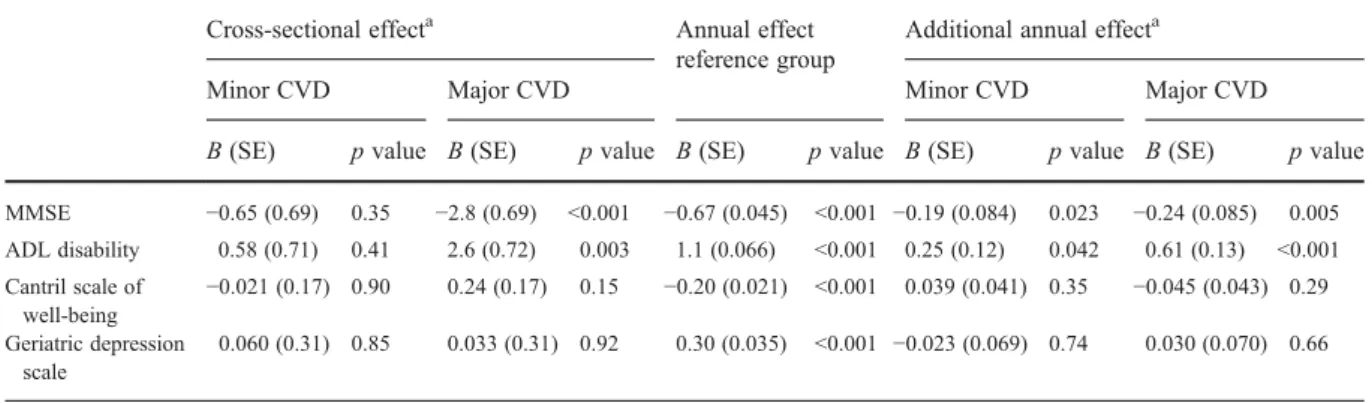
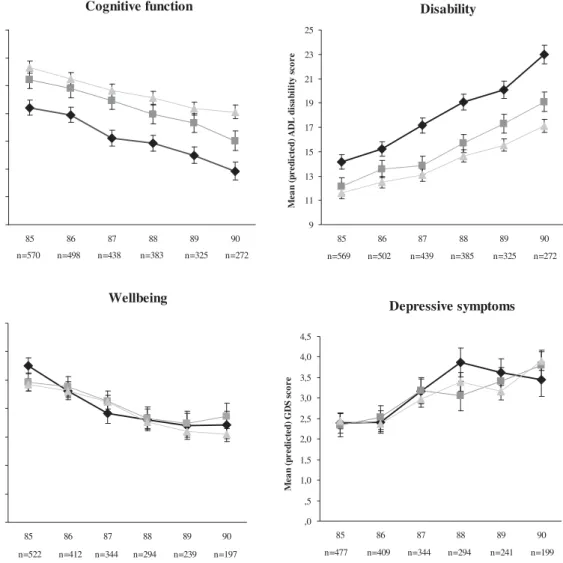
At baseline, there were no differences in functional status between participants with minor CVD and those with no CVD (Table3; Fig.2). But the MMSE score was lower (−2.8 points, p< 0.001) and ADL disability score was higher (2.6 points, p00.003) in
participants with major CVD. Compared to partic-ipants with no CVD, particpartic-ipants with minor CVD had an additional annual decrease in MMSE score of
−0.19 points (p00.023) and increase in ADL disability score of 0.25 points (p00.042) over time. Participants with major CVD had an additional annual decrease in MMSE score (−0.24 points, p00.005) and increase in ADL disability score (0.61 points, p< 0.001). Compared to participants with minor CVD, partic-ipants with major CVD had an additional annual increase in ADL disability score of 0.36 points (p00.023). All other changes in functional status over time were not significant.
Sensitivity analyses
At 90 years of age, participants were recategorized with the updated clinical information from 85 to 90 years of age. Of the participants with complete data at 90 years of age (n0296), 119 (40 %) had no history of CVD, 93 (31 %) had minor CVD, and 84 (28 %) had major CVD. In participants with minor CVD, the 5-year risk for cardiovascular mortality (up to 95 years of age) was not significantly increased (1.1; 95 % CI, 0.6–1.9), but participants with major CVD had a more than twofold increased risk (HR, 2.1; 95 % CI, 1.2– 3.7). For all-cause mortality, the HRs were 1.1 (95 % CI, 0.79–1.5) and 2.1 (95 % CI, 1.5–3.0), respectively. The second sensitivity analysis was done with differ-ent groups according to the site of their CVD. There were
Table 3 Association between history of cardiovascular disease at 85 years of age and (changes in) functional status from 85 through 90 years of age (n0570)
Cross-sectional effecta Annual effect reference group
Additional annual effecta
Minor CVD Major CVD Minor CVD Major CVD
B(SE) pvalue B(SE) pvalue B(SE) pvalue B(SE) pvalue B(SE) pvalue
MMSE −0.65 (0.69) 0.35 −2.8 (0.69) <0.001 −0.67 (0.045) <0.001 −0.19 (0.084) 0.023 −0.24 (0.085) 0.005
ADL disability 0.58 (0.71) 0.41 2.6 (0.72) 0.003 1.1 (0.066) <0.001 0.25 (0.12) 0.042 0.61 (0.13) <0.001
Cantril scale of well-being
−0.021 (0.17) 0.90 0.24 (0.17) 0.15 −0.20 (0.021) <0.001 0.039 (0.041) 0.35 −0.045 (0.043) 0.29
Geriatric depression scale
0.060 (0.31) 0.85 0.033 (0.31) 0.92 0.30 (0.035) <0.001 −0.023 (0.069) 0.74 0.030 (0.070) 0.66
Associations were assessed by linear mixed models adjusted for sex. Scale: MMSE, 0–30 points; ADL disability, 9–36 points; Cantril, 0–10 points; GDS of depressive symptoms, 0–15 points
CVDcardiovascular disease
a
25 participants (4.4 %) with peripheral CVD, 73 (12.8 %) with cerebrovascular CVD, 109 (19.1 %) with cardiac CVD, and 66 (11.6 %) with CVD on more than one site (Table4). HRs were all calculated with the group with no CVD as reference group. The HR for fatal or nonfatal stroke was as high as 3.9 (95 % CI, 2.2–6.9) for those with previous TIA or stroke, and the HR for fatal or nonfatal MI was particularly high (3.4; 95 % CI, 1.9– 6.4) in the group with CVD on multiple sites. The HR for cardiovascular mortality was highest in participants with peripheral CVD (3.8; 95 % CI, 1.7–8.5). In contrast with this high risk of cardiovascular mortality, the HRs for
fatal or nonfatal MI and fatal or nonfatal stroke in partic-ipants with peripheral CVD were low, nearly equal to the group with no CVD (1.0; 95 % CI, 0.23–4.3 and 1.4; 95 % CI, 0.32–5.8, respectively). Except for the above-mentioned HRs, the groups did not differ materially.
Discussion
In this cohort of oldest old from the general population, participants with a history of major CVD had a markedly increased risk of recurrent MI, stroke, and functional
Cognitive function 14 16 18 20 22 24 26 28 Me a n (p r e di c te d ) MMSE s c o r e Disability 9 11 13 15 17 19 21 23 25 M e a n ( p r e d ic te d ) A D L d is a b ilit y s c o r e Wellbeing 5,0 5,5 6,0 6,5 7,0 7,5 8,0 8,5 Me a n (p r e d ic te d ) Ca n tr il s c o r e Depressive symptoms ,0 ,5 1,0 1,5 2,0 2,5 3,0 3,5 4,0 4,5
85 86 87 88 89 90 85 86 87 88 89 90
85 86 87 88 89 90 85 86 87 88 89 90
n=570 n=498 n=438 n=383 n=325 n=272 n=569 n=502 n=439 n=385 n=325 n=272
n=522 n=412 n=344 n=294 n=239 n=197 n=477 n=409 n=344 n=294 n=241 n=199
Me a n (pr e d ic te d ) G D S s c o r e
Fig. 2 Changes in cognitive function, disability, subjective well-being, and depressive symptoms over time as estimated from linear mixed models adjusted for sex. Data are presented as
decline, as well as cardiovascular and all-cause mortal-ity. Patients with a history of minor CVD had a relatively better prognosis: in nonagenarians, a history of minor CVD was not associated with mortality anymore. This implies that, within the group of very old patients who are eligible for secondary prevention, different risk groups can now be identified on the basis of clinical information only. Since the prevention of morbidity and subsequent loss of independency is increasingly impor-tant in the aging Western societies, cardiovascular pre-vention remains essential up to the highest age groups. Our findings underscore the importance of adequate secondary preventive measures in those with a history of major cardiovascular events, since these measures have been shown to be effective up to high ages (Andrawes et al. 2005; Alhusban and Fagan 2011; Castilla-Guerra et al.2009; Asberg et al.2010; Ray et al.2006; Deedwania et al.2007; Shepherd et al.2002; Wenger and Lewis2010; Thomas et al.2010). On the other hand, our results suggest that the potential yield of secondary preventive measures in the oldest old might be less in older persons with a history of minor CVD.
Our study is the first to analyze prognosis based on a history of“minor”and“major”CVD in the general population of the oldest old. This distinction between minor and major CVD is based on the difference in risk of cardiovascular events and mortality after angi-na or TIA compared with the risk after an MI or stroke, which has been described in younger patients (Arima et al.2006; Rosengren et al.1998; Hjemdahl et al. 2006). Our study now also showed a significant
difference in cardiovascular morbidity and mortality between groups with a history of minor and major CVD in participants aged 85 years and over.
Most other studies, performed in younger age groups, have evaluated risks after an event in a specific cardiovascular bed (cardiac, cerebral, or peripheral) (Migliaccio-Walle et al. 2010; Bhatt et al. 2009; Arima et al. 2006; Touze et al. 2005) or observed differences in risk between one or multiple CVD sites (Ferrieres et al.2006; Migliaccio-Walle et al. 2010; Bhatt et al. 2009; Steg et al. 2007). The high risk of recurrent stroke in the group with a history of TIA or stroke that we observed is in line with previous studies (Steg et al. 2007; Arima et al.
2006; Ferrieres et al.2006; Vickrey et al. 2002). In keeping with earlier reports, in the present study, the risk of cardiovascular mortality was remarkably high in participants with peripheral artery disease, whereas cardiovascular morbidity risk in this group was relatively low (Ferrieres et al. 2006; Steg et al.
2007; Arima et al. 2006; Vickrey et al. 2002). In contrast with younger age groups, mortality risks in our study were not higher in participants with multiple-site CVD (Steg et al. 2007; Bhatt et al.
2009; Migliaccio-Walle et al. 2010; Ferrieres et al.
2006). In very old age, it seems that major CVD, rather than multiple CVD, is of prognostic value.
Previous studies have revealed a significant decline in physical functioning after stroke and MI in 70-year-olds (van Jaarsveld et al.2001; Newman et al. 2009) and a negative impact on neurocognitive function
Table 4 Five-year hazard ratios for cardiovascular morbidity and mortality for participants, depending on specific site of cardiovas-cular history adjusted for sex (n0570)
CVD history
None (n0297)
Cardiac (n0109)
Cerebrovascular (n073)
Peripheral (n025)
Multiple sites (n066)
Morbidity Fatal and nonfatal MI 1 2.0 (1.1–3.7) 1.9 (0.96–3.9) 1.0 (0.23–4.3) 3.4 (1.9–6.4) Fatal and nonfatal stroke 1 2.3 (1.3–4.2) 3.9 (2.2–6.9) 1.4 (0.32–5.8) 1.6 (0.68–3.7) CV events or CV mortalitya 1 2.0 (1.4–3.0) 2.3 (1.5–3.5) 1.9 (0.93–3.8) 2.5 (1.6–3.9) Mortality Cardiovascular 1 2.8 (1.7–4.6) 3.0 (1.7–5.3) 3.8 (1.7–8.5) 3.1 (1.7–5.5) Noncardiovascular 1 1.4 (0.90–2.1) 1.5 (0.95–2.4) 1.6 (0.76–3.3) 1.6 (1.0–2.6) All-cause 1 1.8 (1.3–2.5) 2.0 (1.4–2.8) 2.2 (1.3–3.8) 2.0 (1.4–3.0)
Data are presented as HR with corresponding 95 % CIs
CVDcardiovascular disease,Cardiacangina or MI,CerebrovascularTIA or stroke,Peripheralclaudication or operation for non-coronary arterial disease,Multiple sitesCVD on more than one of cardiac, cerebrovascular, or peripheral sites
(Waldstein and Wendell 2010; Newman et al. 2005,
2009). Our study confirmed these data in the very old. Our study has several strengths. First, our results can be easily applied in day to day medical practice. The current electronic medical records provide clinicians a rapid overview of the cardiovascular history without any extra costs or effort. Secondly, our population-based study had a high participation rate (87 %) and no exclu-sion criteria, both allowing our concluexclu-sions to be gener-alized to the oldest old in the general population. Finally, we studied multiple relevant outcomes for an ageing population: mortality, morbidity, and functional status. A limitation might be that CVD history was based on the diagnosis of the primary care physicians, using variable diagnostic standards. However, this reflects clinical reality in primary care and previous research has shown the accuracy of data recorded in general practice to be very high (Hassey et al.2001). In view of the fact that this study was the first to discriminate major and minor CVD in very old age, we recommend that this analysis be repeated in another cohort.
Evidence that medication for secondary cardio-vascular prevention is recommendable up to the highest age groups is increasing (Andrawes et al.
2005; Alhusban and Fagan2011; Castilla-Guerra et al.2009; Asberg et al.2010; Maroo et al.2008; Ray et al. 2006; Deedwania et al. 2007; Shepherd et al.
2002; Wenger and Lewis2010; Thomas et al.2010). In this cohort, the use of secondary preventive med-ication was far from optimal, leaving room for im-provement. From our results, it can be derived that distinct groups are discernible within those who should receive secondary prevention. This is an im-portant finding, since at very old age, polypharmacy (Banerjee et al.2011; Fleg et al.2011), treatment adher-ence (Kvan et al. 2006), and the delicate balance be-tween benefit and harm (Cardenas-Valladolid et al.
2010; Kvan et al.2006; Fleg et al.2011) raise a chal-lenge for clinicians in day to day practice (Anthierens et al.2010; Fried et al.2011). The results of our study may help them to make appropriate treatment decisions, tak-ing all relevant prognostic information into account.
In conclusion, in very old age, the CVD history is an easy tool for clinicians to identify patients who are at high risk for new cardiovascular events, functional decline, and cardiovascular mortality, as well as all-cause mortality. A history of major CVD nearly dou-bles the risk of a recurrent cardiovascular event or cardiovascular mortality compared with a history of
minor CVD. Our results encourage both physicians and 85-year-olds with a history of major CVD to maximize their cardiovascular preventive efforts. However, when adverse effects or harmful interactions arise in a very old patient with minor CVD, the bal-ance between benefit and harm could change and strict continuation of preventive medication might be reconsidered.
Acknowledgments The Leiden 85-plus Study was partly funded by an unrestricted grant from the Dutch Ministry of Health, Welfare and Sports.
Open Access This article is distributed under the terms of the Creative Commons Attribution License which permits any use, distribution, and reproduction in any medium, provided the original author(s) and the source are credited.
References
Alhusban A, Fagan SC (2011) Secondary prevention of stroke in the elderly: a review of the evidence. Am J Geriatr Pharmacother 9:143–152
Andrawes WF, Bussy C, Belmin J (2005) Prevention of cardio-vascular events in elderly people. Drugs Aging 22:859– 876
Anthierens, S., Tansens, A., Petrovic, M., & Christiaens, T (2010) Qualitative insights into general practitioners views on polypharmacy. BMC.Fam.Pract., 11, 65
Arima H, Tzourio C, Butcher K, Anderson C, Bousser MG, Lees KR, Reid JL, Omae T, Woodward M, MacMahon S, Chalmers J (2006) Prior events predict cerebrovascular and coronary outcomes in the PROGRESS trial. Stroke 37:1497–1502
Arnold SV, Spertus JA, Tang F, Krumholz HM, Borden WB, Farmer SA, Ting HH, Chan PS (2011) Statin use in out-patients with obstructive coronary artery disease. Circula-tion 124:2405–2410
Asberg S, Henriksson KM, Farahmand B, Asplund K, Norrving B, Appelros P, Stegmayr B, Asberg KH, Terent A (2010) Ischemic stroke and secondary prevention in clinical prac-tice: a cohort study of 14,529 patients in the Swedish Stroke Register. Stroke 41:1338–1342
Banerjee A, Mbamalu D, Ebrahimi S, Khan AA, Chan TF (2011) The prevalence of polypharmacy in elderly attend-ers to an emergency department—a problem with a need for an effective solution. Int J Emerg Med 4:22
Bhatt DL, Steg PG, Ohman EM, Hirsch AT, Ikeda Y, Mas JL, Goto S, Liau CS, Richard AJ, Rother J, Wilson PW (2006) International prevalence, recognition, and treatment of car-diovascular risk factors in outpatients with atherothrombo-sis. JAMA: J Am Med Assoc 295:180–189
disease: risk factor for adverse ischaemic outcomes in acute coronary syndromes. Eur Heart J 30:1195–1202
Bhatt DL, Eagle KA, Ohman EM, Hirsch AT, Goto S, Mahoney EM, Wilson PWF, Alberts MJ, D'Agostino R, Liau CS, Mas JL, Röther J, Smith SC, Salette GV, Contant CF, Massaro JM, Steg P (2010) Comparative determinants of 4-year cardiovascular event rates in stable outpatients at risk of or with atherothrombosis. JAMA: J Am Med Assoc 304:1350–1357
Cantril H (1965) The pattern of human concerns. Rutgers Uni-versity Press, New Brunswick
Cardenas-Valladolid J, Martin-Madrazo C, Salinero-Fort MA, Carrillo de-Santa PE, Abanades-Herranz JC, de Burgos-Lunar C (2010) Prevalence of adherence to treatment in homebound elderly people in primary health care: a de-scriptive, cross-sectional, multicentre study. Drugs Aging 27:641–651
Castilla-Guerra L, Fernandez-Moreno MC, Alvarez-Suero J (2009) Secondary stroke prevention in the elderly: new evidence in hypertension and hyperlipidemia. Eur J Intern Med 20:586–590
de Craen AJ, Heeren TJ, Gussekloo J (2003) Accuracy of the 15-item geriatric depression scale (GDS-15) in a community sample of the oldest old. Int J Geriatr Psychiatry 18:63–66 Deedwania P, Stone PH, Bairey Merz CN, Cosin-Aguilar J,
Koylan N, Luo D, Ouyang P, Piotrowicz R, Schenck-Gustafsson K, Sellier P, Stein JH, Thompson PL, Tzivoni D (2007) Effects of intensive versus moderate lipid-lowering therapy on myocardial ischemia in older patients with coronary heart disease: results of the Study Assessing Goals in the Elderly (SAGE). Circulation 115:700–707 der Wiel AB, van Exel E, de Craen AJ, Gussekloo J, Lagaay
AM, Knook DL, Westendorp RG (2002) A high response is not essential to prevent selection bias: results from the Leiden 85-plus study. J Clin Epidemiol 55:1119–1125 Dornbrook-Lavender KA, Pieper JA, Roth MT (2003) Primary
prevention of coronary heart disease in the elderly. Ann Pharmacother 37:1654–1663
Ferrieres J, Cambou JP, Gayet JL, Herrmann MA, Leizorovicz A (2006) Prognosis of patients with atherothrombotic dis-ease: a prospective survey in a non-hospital setting. Int J Cardiol 112:302–307
Fleg JL, Aronow WS, Frishman WH (2011) Cardiovascular drug therapy in the elderly: benefits and challenges. Nat Rev Cardiol 8:13–28
Fried TR, Tinetti ME, Towle V, O'Leary JR, Iannone L (2011) Effects of benefits and harms on older persons' willingness to take medication for primary cardiovascular prevention. Arch Intern Med 171:923–928
Graham, I., Atar, D., Borch-Johnsen, K. et al. (2007). European guidelines on cardiovascular disease prevention in clinical practice: full text. Fourth Joint Task Force of the European Society of Cardiology and other societies on cardiovascular disease prevention in clinical practice (constituted by rep-resentatives of nine societies and by invited experts). Eur.-J.Cardiovasc.Prev.Rehabil., 14 Suppl 2,S1-113.
Hassey A, Gerrett D, Wilson A (2001) A survey of validity and utility of electronic patient records in a general practice. BMJ 322:1401–1405
Hjemdahl P, Eriksson SV, Held C, Forslund L, Nasman P, Rehnqvist N (2006) Favourable long term prognosis in
stable angina pectoris: an extended follow up of the angina prognosis study in Stockholm (APSIS). Heart 92:177–182 Kempen GI, Miedema I, Ormel J, Molenaar W (1996) The assessment of disability with the Groningen Activity Re-striction Scale. Conceptual framework and psychometric properties. Soc Sci Med 43:1601–1610
Kerr AJ, Broad J, Wells S, Riddell T, Jackson R (2009) Should the first priority in cardiovascular risk management be those with prior cardiovascular disease? Heart 95:125–129 Kvan E, Pettersen KI, Landmark K, Reikvam A (2006) Treat-ment with statins after acute myocardial infarction in patients > or080 years: underuse despite general accep-tance of drug therapy for secondary prevention. Pharma-coepidemiol Drug Saf 15:261–267
Macfarlane PW, Latif S (1996) Automated serial ECG compar-ison based on the Minnesota code. J Electrocardiol 29 (Suppl):29–34
Maroo BP, Lavie CJ, Milani RV (2008) Secondary prevention of coronary heart disease in elderly patients following myo-cardial infarction: are all HMG-CoA reductase inhibitors alike? Drugs Aging 25:649–664
McDermott MM (2007) The international pandemic of chronic cardiovascular disease. JAMA: J Am Med Assoc 297:1253– 1255
Migliaccio-Walle, K., Stokes, M., Proskorovsky, I., Popovici-Toma, D., & El-Hadi, W. (2010). Evaluation of the consequences associated with diffuse vascular disease history in patients diagnosed with peripheral arterial disease: estimates from Sas-katchewan health data.BMC.Cardiovasc.Disord., 10,40. Newman AB, Fitzpatrick AL, Lopez O, Jackson S, Lyketsos C,
Jagust W, Ives D, Dekosky ST, Kuller LH (2005) Dementia and Alzheimer's disease incidence in relationship to car-diovascular disease in the Carcar-diovascular Health Study cohort. J Am Geriatr Soc 53:1101–1107
Newman AB, Arnold AM, Sachs MC, Ives DG, Cushman M, Strotmeyer ES, Ding J, Kritchevsky SB, Chaves PH, Fried LP, Robbins J (2009) Long-term function in an older co-hort—the cardiovascular health study all stars study. J Am Geriatr Soc 57:432–440
Ray KK, Bach RG, Cannon CP, Cairns R, Kirtane AJ, Wiviott SD, McCabe CH, Braunwald E, Gibson CM (2006) Bene-fits of achieving the NCEP optional LDL-C goal among elderly patients with ACS. Eur Heart J 27:2310–2316 Roger VL, Go AS, Lloyd-Jones DM et al (2011) Heart disease
and stroke statistics—2011 update: a report from the Amer-ican Heart Association. Circulation 123:e18–e209 Rosengren A, Wilhelmsen L, Hagman M, Wedel H (1998) Natural
history of myocardial infarction and angina pectoris in a general population sample of middle-aged men: a 16-year follow-up of the Primary Prevention Study, Goteborg. Sweden J Intern Med 244:495–505
Shepherd J, Blauw GJ, Murphy MB, Bollen EL, Buckley BM, Cobbe SM, Ford I, Gaw A, Hyland M, Jukema JW, Kamper AM, Macfarlane PW, Meinders AE, Norrie J, Packard CJ, Perry IJ, Stott DJ, Sweeney BJ, Twomey C, Westendorp RG (2002) Pravastatin in elderly individuals at risk of vascular disease (PROSPER): a randomised controlled trial. Lancet 360:1623–1630
outpatients with atherothrombosis. JAMA: J Am Med Assoc 297:1197–1206
Thomas JE, Tershakovec AM, Jones-Burton C, Sayeed RA, Foody JM (2010) Lipid lowering for secondary prevention of cardiovascular disease in older adults. Drugs Aging 27:959–972
Tombaugh TN, McIntyre NJ (1992) The mini-mental state ex-amination: a comprehensive review. J Am Geriatr Soc 40:922–935
Touze E, Varenne O, Chatellier G, Peyrard S, Rothwell PM, Mas JL (2005) Risk of myocardial infarction and vascular death after transient ischemic attack and ischemic stroke: a systematic review and meta-analysis. Stroke 36:2748–2755 Vaartjes, I., van Dis, I, Grobbee, D. E., & Bots, M. L. (2010). The dynamics of mortality in follow-up time after an acute myocardial infarction, lower extremity arterial disease and ischemic stroke.BMC.Cardiovasc.Disord., 10,57 van Exel E, Gussekloo J, Houx P, de Craen AJ, Macfarlane PW,
Bootsma-van der Wiel A, Blauw GJ, Westendorp RG (2002) Atherosclerosis and cognitive impairment are linked in the elderly. The Leiden 85-plus Study. Athero-sclerosis 165:353–359
van Jaarsveld CH, Sanderman R, Miedema I, Ranchor AV, Kempen GI (2001) Changes in health-related quality of life in older patients with acute myocardial infarction or
congestive heart failure: a prospective study. J Am Geriatr Soc 49:1052–1058
van Wijk I, Kappelle LJ, van Gijn J, Koudstaal PJ, Franke CL, Vermeulen M, Gorter JW, Algra A (2005) Long-term sur-vival and vascular event risk after transient ischaemic attack or minor ischaemic stroke: a cohort study. Lancet 365:2098–2104
Vickrey BG, Rector TS, Wickstrom SL, Guzy PM, Sloss EM, Gorelick PB, Garber S, McCaffrey DF, Dake MD, Levin RA (2002) Occurrence of secondary ischemic events among persons with atherosclerotic vascular disease. Stroke 33:901–906
Wald NJ, Simmonds M, Morris JK (2011) Screening for future cardiovascular disease using age alone compared with multiple risk factors and age. PLoS One 6:e18742 Waldstein SR, Wendell CR (2010) Neurocognitive function and
cardiovascular disease. J Alzheimers Dis 20:833–842 Wenger, N. K. & Lewis, S. J (2010) Use of statin therapy to
reduce cardiovascular risk in older patients. Curr.Geron-tol.Geriatr.Res., 915296
Wilson PW (2011) Prediction of cardiovascular disease events. Cardiol Clin 29:1–13