RECEIVED4 May 2015 REVISED23 October 2015 ACCEPTED26 October 2015 PUBLISHED ONLINE FIRST3 December 2015
Design simplicity influences patient portal
use: the role of aesthetic evaluations for
technology acceptance
Allison J Lazard1, Ivan Watkins2, Michael S Mackert3, Bo Xie4, Keri K Stephens5, Heidi Shalev6
ABSTRACT
...
ObjectiveThis study focused on patient portal use and investigated whether aesthetic evaluations of patient portals function are antecedent vari-ables to varivari-ables in the Technology Acceptance Model.MethodsA cross-sectional survey of current patient portals users (N¼333) was conducted online. Participants completed the Visual Aesthetics of Website Inventory, along with items measuring perceived ease of use (PEU), perceived usefulness (PU), and behavioral intentions (BIs) to use the patient portal.
ResultsThe hypothesized model accounted for 29% of the variance in BIs to use the portal, 46% of the variance in the PU of the portal, and 29% of the variance in the portal’s PEU. Additionally, one dimension of the aesthetic evaluations functions as a predictor in the model – simplicity evalu-ations had a significant positive effect on PEU.
ConclusionThis study provides evidence that aesthetic evaluations – specifically regarding simplicity – function as a significant antecedent vari-able to patients’ use of patient portals and should influence patient portal design strategies.
...
Keywords: eHealth, patient portals, web aesthetics, technology acceptance model
INTRODUCTION AND BACKGROUND
As chronic disease rates increase, there is an increasing need for dis-ease management healthcare in the United States. However, health-care providers have limited resources (eg, time) to meet the needs of the growing populations that require continued care and health main-tenance (eg, patients with diabetes and obesity). This has resulted in a healthcare environment that demands greater efficiency in patient communication. Many healthcare providers are hoping that electronic health (e-health), defined as digital media and online communication technologies to aid patient care, will be help meet this demand.1 Patient portals, electronic health records (EHRs), and healthcare pro-vider websites represent some existing digital communication tactics. These digital solutions allow for secure, asynchronous patient-provider communication that can improve the efficiency of such communica-tions and potentially reduce the demands on providers’ resources.2,3
A patient portals provides a “secure online website that gives pa-tients convenient 24-hour access to personal health information from anywhere with an Internet connection.”4Patient portals are distinct from EHRs; healthcare organizations exclusively own, maintain, and update their EHR, while patients can interact with their own health in-formation on patient portals.4Patient portals can potentially improve
health outcomes by improving patients’ access to and management of their health information. However, many individuals enrolled in patient portals do not use them, and the barriers to adoption and continuance – actual use after enrollment – of patient portal use remain unclear.5
Despite large financial investments in developing patient portals and patients’ good intentions, patient portals are only used by small percentages of patient populations. The lack of attention given to the influence of the design of patient portals is likely a contributing factor to the lack of widespread use of patient portals. Patient portals, like all other e-health applications, rely on interface design to convey
information and provide patients with the functionality they need to communicate with their healthcare providers. Interface design, often equated to visual appeal or aesthetics, has a significant impact on users’ emotional and rational evaluations of e-health applications, especially as regards the users’ involvement in the application, the application’s perceived usability, the users’ trust in the application, and the application’s credibility.6–10Visually pleasing aesthetics also increase the likelihood of patients sustaining use of the portal – even when there are usability flaws that prevent users from performing de-sired tasks.11Thus, investigations of how aesthetics influence the use of e-health applications can inform actionable strategies for patient portal developers, process experts, and the clinicians who advise them, to improve the design and accessibility of e-health applications.12
Using the Visual Aesthetics of Website Inventory (VisAWL) to mea-sure four unique facets of aesthetic evaluations (simplicity, diversity, colorfulness, and craftsmanship13), this study investigated whether users’ aesthetic evaluations function as antecedent variables to the Technology Acceptance Model (TAM), a framework with useful con-structs for understanding technology adoption and continuance.14–16
Better understanding the relationship between aesthetics and technol-ogy acceptance will shed light on how design strategies can improve users’ perceptions of and increase their subsequent use of e-health applications. Aesthetics are a critical part of converting application viewers to application users, a necessary step to increase the likeli-hood of widespread adoption of e-health applications by the general public.
Technology Acceptance Model
The TAM predicts behavioral intentions (BIs) for technology usage through the perceived ease of use (PEU) of the technology, the
Correspondence to Allison Lazard, PhD, UNC School of Media and Journalism, Carroll Hall, CB 3365, Chapel Hill, NC 27599, USA; [email protected]; Tel:þ1-919-843-8304.
VC The Author 2015. Published by Oxford University Press on behalf of the American Medical Informatics Association. All rights reserved.
For Permissions, please email: [email protected] For numbered affiliations see end of article.
BRIEF
technology’s perceived usefulness (PU), and user attitudes toward the technology.14Studies investigating the adoption of health information
technology have specifically focused on PEU and PU.12,17,18PEU repre-sents an individual’s assessment of the effort necessary to operate a technology, and PU represents an individual’s perception of the bene-fits that could likely be accrued from actually using a technology.14 While the PEU–PU–BIs relationship is consistently supported, there is less evidence that PEU has a direct effect on BIs.15,19–21Thus, the fol-lowing hypotheses and research question guided our investigation of the TAM as the fundamental framework for future patient portal use, while controlling for past behavioral influences on BIs.
Hypothesis 1 (H1):PU has a positive effect on BIs to use the patient portal.
Hypothesis 2 (H2):PEU has a positive effect on PU.
Research Question 1 (RQ1):Does PEU have a positive effect on BIs to use the patient portal?
Web Aesthetics
Research on human–computer interactions has increasingly recog-nized that users’ pleasurable reactions to technology interfaces influ-ence their actual use of the technology, beyond its usability. Web aesthetics are sensory experiences of pleasure or beauty resulting from an interface design.6 Aesthetic evaluations are often made quickly; hold constant; and impact the perceived (as well as actual) usability of the technology, the users’ satisfaction, and their intentions to revisit a website.22Grounded in interactionist aesthetics, in which the objective properties of a website are reflected in users’ subjective appraisals of the website, the four validated facets of VisAWL – simplicity, diversity, colorfulness, and craftsmanship – have been empirically shown to affect website usability.13
Simplicity is the perception that a website exhibits orderliness, bal-ance, and clarity – the concepts of figural goodness defined by Gestalt psychology.6Higher levels of perceived simplicity are positively
asso-ciated with increased fluency, ease of processing, and improved task performance.23Diversity is the perception of the complexity, visual richness, and dynamics of the website. Although diversity provokes users’ interest, too much diversity can create tension or negative arousal.24Colorfulness is an evaluation of the coherence of color se-lection and placement in a website’s design. Craftsmanship reflects the users’ perceptions of the skill and care used in the creation of the website. Therefore, we pose the following hypotheses and a research question about the less-studied facets of VisAWL.
Hypothesis 3 (H3): Simplicity will have a positive effect on PEU.
Hypothesis 4 (H4): Diversity will have a negative effect on PEU.
Research Question 2 (RQ2):Does colorfulness or craftsman-ship have a positive effect on PEU?
METHODS
Procedure
A cross-sectional survey of patient portal users was conducted online, as approved by the relevant institutional review board. Participants were recruited through a link on a regional clinic’s patient portal web-site landing page. All participants were enrolled users of a regional clinic’s patient portal and had the ability to regularly use the portal and
view its aesthetics. Over 38 000 patients were enrolled portal users prior to the study. Data were collected over 6 months, during which time approximately 8000 users in the study enrolled each month. After giving informed consent, the study participants responded to items measuring TAM variables and completed VisAWL. Lastly, demographic information about the study participants was collected. The items used in this study were part of a larger data collection activity.
The patient portal, introduced in July 2013, has a prototypical de-sign with a navigation bar on the left side of the screen, the main con-tent in the center of the screen, and information about the clinic and log-in information in the top banner, exhibiting mid-level visual com-plexity. The top banner also displays images of a laptop and mobile a phone with the patient portal loaded. Current news, updates, and tips are displayed at the top of the main content area. Users can send messages, make appointments with their healthcare providers, view their medical records, or check billing and insurance information, all of which are tasks that can be selected from a text-based navigation bar on the left side of the screen or by clicking large buttons, containing text and icons, in the main content area. The site is primarily white, gray, and purple – the clinic’s brand colors. No updates were made to the portal’s design during the data collection activities for this study.
Measures
The following previously validated measures were used. Item wording was adapted to reflect the use of the “patient portal.” PEU measured, with three items, whether the portal was easy “to use,” “to do what I want,” and was “clear and understandable.”19Three items measured PU, by offering the study participants the chance to agree/disagree that the portal would “improve,” “enhance,” or be “useful” for manag-ing one’s healthcare.19Three items measured BIs by asking study participants about their intentions, predictions, and plans to use the patient portal in the next month.19Aesthetic evaluations were mea-sured with VisAWL’s 18 items.13All of the items were measured with
a Likert-type scale, ranging from strongly disagree (1) to strongly agree (7), and were reverse-coded if they were negatively framed, so that positive numbers represent higher levels of agreement. A single item measured the study participants’ past use of the patient portal, ranging from not at all (1) to very often (5).
Data Analysis
Structural equation modeling was used to test the hypotheses and in-vestigate the research questions, because this analytical procedure of-fers a more robust test of effect decompositions, estimates of model fit, and controls for error than traditional path modeling.25The struc-tural equation modeling analysis was conducted with an a priori speci-fied path model (Figure 1) in Mplus v6.12. In the model, hypotheses are represented as solid arrows and research questions as dotted ar-rows, for ease of interpretation.
RESULTS
Descriptive Statistics of the Sample
A total of 333 enrolled patient portal users participated in this study. Participants ranged from 18–87 years (mean¼51.91, standard devia-tion [SD]¼14.20) and were mostly (72%) female. Education levels in-cluded high school to some college (29%), bachelor’s degree (35%), master’s degree (27%), and doctoral or professional degree (9%). Participants identified as white (84%), African American (4%), Asian (3%), or multiracial/other (8%). Most participants (82%) rated their general health as good to excellent; fewer indicated their health was fair (14%) or poor (3%). Participants reported having used the patient portal for<3 months (56%), 3–6 months (24%), 6–9 months (13%),
BRIEF
or>9 months (8%). Most participants (56%) reported occasional use of the patient portal, and others claimed rare (13%), often (26%), or very often (5%) use of the patient portal.
Model Testing
The hypothesized model (Figure 1) fits the data quite well, according to common fit statistics, when controlling for past use – isolating rela-tionships beyond those from this predictor of repetitive future inten-tions (likelihood ratio v2¼11.323, df¼8, P¼.184; Akaike information criterion [AIC]¼2712.312; comparative fit index [CFI]¼
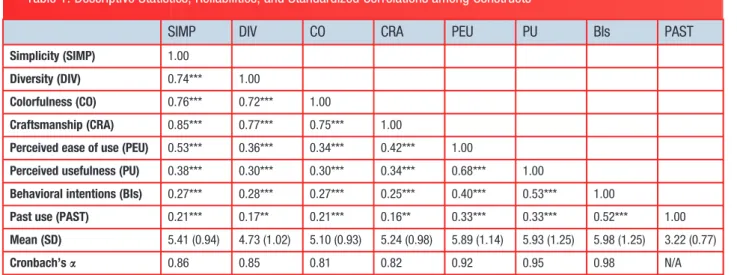
0.994; root mean square error of approximation [RMSEA]¼0.035; standardized root mean square residual [SRMR]¼0.029). Standardized correlations are shown inTable 1. The model accounts for 29% of the variance in the criterion variable of BIs for patient portal use, 46% of the variance in PU, and 29% of the variance in PEU, with-out controlling for past use (and inflating the values). The variance when controlling for past use is 41% for BIs, 48% for PU, and 34% for PEU.
Three of the four hypotheses (H1, H2, and H3) were supported with our model, when controlling for past use. Our findings indicated that PU had a significant positive effect on BIs (H1; b¼0.403, P<.001) and that PEU had a significant positive effect on PU (H2; b¼0.641, P<.001), as predicted. Importantly, aesthetic appraisals functioned as a significant predictor for one of the proposed relation-ships. Users’ evaluations of simplicity had a significant positive effect on PEU (H3;b¼0.624,P<0.001). H4 was unsupported.
The model did not yield support for either research question. The PEU of the patient portal was not significantly related to BIs (RQ1). Furthermore, neither the aesthetic evaluation of colorfulness nor of craftsmanship was a significant predicator of PEU (RQ2).
DISCUSSION
Patient portals, building on decades of development in telemedicine and e-health research and practice, have the potential to be a corner-stone of patient-centered care in coming years. Indeed, the Healthy People 2020 initiative includes objectives related to increasing the pro-portion of patients who use the Internet to keep track of personal
health information and communicate with their healthcare providers.26 To actually deliver on this promise, however, patient portals must be designed so that patients perceive them to be both useful and easy to use, because repeated use of patient portals is imperative to reduce demands on healthcare providers’ resources.18Although patient
por-tals, similar to other websites, are displayed in a browser, meaning that patients’ aesthetic appraisals are susceptible to all the variations of individual displays (eg, window size, scrolling requirements), healthcare providers have an additional challenge when trying to in-crease users’ engagement with patient portal – healthcare providers must often depend on patient portal design and functionality that is set by third-party developers. Thus, this study is an important step toward determining how aesthetic evaluations of patient portals contribute to patients’ intentions for continued use of the portals, filling a gap in the literature with evidence that can be shared among providers and portal developers to determine best practices for the design and develop-ment of patient portals.27
This study integrated multifaceted aesthetic evaluations with the TAM to understand predictors of patient portal use. We found support for the well-established PEU–PU–BIs relationship, further demonstrat-ing the applicability of this model for understanddemonstrat-ing the adoption of e-health technologies.12,17,18 No direct relationship between PEU and BIs was found, which provides evidence that this relationship is likely mediated through PU; this is, perhaps, a consequence of the increased prevalence of digital technology and users’ increased aptitude for computer use.28
More importantly, our findings showed that simplicity aesthetics are an antecedent to the TAM, mirroring the evidence of generic portal use.29The four facets of aesthetics explained almost 30% of the vari-ance in PEU, with simplicity having the greatest impact on this aspect of the TAM. The simplicity evaluations elicited from the study popula-tion provide empirical corroborapopula-tion that designing patient portals to in-crease users’ perceptions of orderliness and clarity can indirectly influence patient portal BIs.
These findings provide clear guidance for the focus of patient por-tal user testing – perceptions of simplicity. Above all other aesthetic appraisals, perceptions that the design of the patient portal is Figure 1:Final model with parameter estimates of the paths while controlling for past use (PAST).
BRIEF
well-structured, cohesive, and easy to understand are influential indi-cators for patient portal BIs and could likely be influential factors for improving the adoption of other e-health technologies. Isolating sim-plicity as a crucial aspect of patient portal design also provides a clear next step for identifying objective structural design features that lead to positive user evaluations of patient portals. Research and practice should base user testing and actionable design strategies around these findings. Structural features, such as graphic elements, lines, or color breaks that visually distinguish content, are simple design tech-niques that should be explored as ways of increasing users’ simplicity ratings of patient portals and, hence, improving the perceived usability of and the likelihood of actual use of patient portals.
Using a well-known model to test the relationship between aes-thetic evaluations of patient portal design and other factors influencing patient portal use was a logical first step. Future research should ex-pand our results by examining objective design features as well as pa-tients with different health literacy levels or computer experience. Although the negative relationship between diversity and PEU was not significant in our model, our study’s population of current users might have suppressed this relationship, because this population was not deterred by the site’s current objective visual complexity. Investigations of how visual complexity – both feature complexity and design complexity – influences users’ perceptions of patient portals and actual patient use of patient portals would illuminate whether the amount of information (feature complexity)orthe amount and the or-ganization of information (design complexity) are barriers to patient portal use.30On the one hand, additional information (including cues
for functionality) presented in well-designed layouts with a sophisti-cated use of color, graphics, and typography may emphasize informa-tion hierarchy, distinguish content, and increase PU and ease of use at-a-glance. Conversely, additional information that is not well orga-nized, or is visually unappealing to a user, may overwhelm and deter use. Although some researchers have linked objective design features, such as design structure and color, to positive aesthetic evaluations, others have been unable to replicate these findings.31 Indeed, the non-significant relationship for colorfulness may indicate that tailoring the patient portal to a clinics’ brand colors does not greatly affect users’ aesthetic evaluations – a positive finding that means that de-signers can make the branding of a site easily identifiable without sacrificing the quality of the users’ aesthetic evaluations. Future stud-ies should also explore how factors that are likely context- and
population-specific, such as the perceived relevance of imagery and mental models for structural designs (eg, prototypicality), influence users’ perceptions of and engagement with patient portals.32
There are limitations in this study that must be acknowledged when considering our results’ implications for research and practice. The study sample was recruited from current users of a patient portal, who might be different, in systematic ways, from nonusers (eg, they are more likely to adopt new technology); it is difficult to know how these two groups might vary in terms of their aesthetic evaluations of the patient portal, but future research could investigate this by inviting non-portal users to look at or use the patient portal for the first time and provide evaluations of the portal at that time. The clinic involved in this study is the largest private healthcare provider in a major metro-politan city and thus likely reasonably represents the health conditions and status of the broader population; still, future research should di-rectly assess how users’ health status may relate to their evaluations of a patient portal. Additionally, although the TAM provides a parsimo-nious framework to isolate the influence of aesthetics on patients’ use of patient portals, more robust iterations of this theory, such as the Unified Theory of Acceptance and Use of Technology, that account for voluntariness19may be more useful for studying the influence of aes-thetics on patient portals and other e-health applications used by healthcare practitioners.
CONCLUSION
As technology becomes more ubiquitous, evaluations of beauty and pleasure may continue to have a stronger relationship with users’ ini-tial and long-term decisions to use a piece of technology. This study provides evidence that aesthetic evaluations – specifically of simplicity – function as a significant antecedent variable for patients’ portal use. These findings provide an empirical evaluation of one dimension of aesthetic appraisal, which developers and process experts should fo-cus on to improve patient portal designs and increase patient use of patient portals.
CONTRIBUTORS
A.J.L., I.W., M.S.M., H.S., B.X., and K.S. conceptualized and designed the study; A.J.L., I.W., M.S.M., and H.S. collected the data; A.J.L., I.W., and M.S.M analyzed the data and wrote the initial draft manuscript; B.X. and K.S. assisted with data analysis and interpretation; and all authors contributed to the manu-script revisions.
Table 1: Descriptive Statistics, Reliabilities, and Standardized Correlations among Constructs
SIMP DIV CO CRA PEU PU BIs PAST
Simplicity (SIMP) 1.00
Diversity (DIV) 0.74*** 1.00
Colorfulness (CO) 0.76*** 0.72*** 1.00
Craftsmanship (CRA) 0.85*** 0.77*** 0.75*** 1.00
Perceived ease of use (PEU) 0.53*** 0.36*** 0.34*** 0.42*** 1.00
Perceived usefulness (PU) 0.38*** 0.30*** 0.30*** 0.34*** 0.68*** 1.00
Behavioral intentions (BIs) 0.27*** 0.28*** 0.27*** 0.25*** 0.40*** 0.53*** 1.00
Past use (PAST) 0.21*** 0.17** 0.21*** 0.16** 0.33*** 0.33*** 0.52*** 1.00
Mean (SD) 5.41 (0.94) 4.73 (1.02) 5.10 (0.93) 5.24 (0.98) 5.89 (1.14) 5.93 (1.25) 5.98 (1.25) 3.22 (0.77)
Cronbach’sa 0.86 0.85 0.81 0.82 0.92 0.95 0.98 N/A
SD, standard deviation, NA, not applicable **Significance atP<.01. ***P<.001.
BRIEF
FUNDING
This research received no specific grant from any funding agency in the public, commercial, or not-for-profit sectors.
COMPETING INTERESTS
None.
REFERENCES
1. Eysenbach G. What is e-health?J Med Internet Res.2001;3(2):e20. 2. Lin CT, Wittevrongel L, Moore L,et al., An Internet-based patient-provider
communication system: randomized controlled trial.J Med Internet Res.
2005;7(4):e47.
3. Ammenwerth E, Schnell-Inderst P, Hoerbst A. The impact of electronic pa-tient portals on papa-tient care: a systematic review of controlled trials.J Med Internet Res.2012;14(6):e162.
4. Office of the National Coordinator. What is a patient portal?http://www. healthit.gov/providers-professionals/faqs/what-patient-portal. Accessed March 2, 2015.
5. Kruse CS, Argueta DA, Lopez L,et al. Patient and provider attitudes toward the use of patient portals for the management of chronic disease: a system-atic review.J Med Interent Res.2015;17(2):e40.
6. Lavie T, Tractinsky N. Assessing dimensions of perceived visual aesthetics of web sites.Int J Hum Comput Stud.2004;60(3):269–298.
7. Creusen M, Snelders S. Product appearance and consumer pleasure. In: Green WD, Jordon PW, eds.Pleasure with Products: Beyond Usability. New York: Taylor and Francis; 2002:69–75.
8. Tuch AN, Presslaber EE, Stocklin M,et al. The role of visual complexity and prototypicality regarding first impression of websites: working towards under-standing aesthetic judgments.Int J Hum Comput Stud.2012;70:794–811. 9. Hazzenzahl M. The interplay of beauty, goodness, and usability in interactive
products.HumComput Interact.2004;19(4):319–349.
10. Lindgaard G, Fernandes G, Dudek C,et al. Attention web designers: you have 50 milliseconds to make a good first impression! Behav Inform
Technol.2006;25(2):115–126.
11. Lindgaard G, Dudek C. User satisfaction, aesthetics and usability: beyond reductionism. IFIP 17th World Computer Congress. Montreal, Canada: Kluwer Academic Publishers, 2002.
12. Or CK, Karsh B. A systematic review of patient acceptance of consumer health information technology.JAMIA.2009;16(4):550–560.
13. Moshagen M, Thielsch MT. Facets of visual aesthetics.Int J Hum Comput
Stud.2010;68(10):689–709.
14. Davis FD. Perceived usefulness, perceived ease of use, and user accep-tance of information technology.MIS Quarterly.1989;13:319–340. 15. Venkatesh V, Bala H. Technology Acceptance Model 3 and a Research
Agenda on Interventions.Decision Sci.2008;39(2):273–315.
16. Venkatesh V, Thong JYL, Chan FKY,et al. Extending the two-stage informa-tion systems continuance model: Incorporating UTAUT predictors and the role of context.Inform Syst J.2011;21(6):527–555.
17. Wilson EV, Lankton NK. Modeling patients’ acceptance of provider-delivered e-health.JAMIA.2004;11(4):241–248.
18. Or CK, Karsh B, Severtson DJ,et al. Factors affecting home care patients’ acceptance of a web-based interactive self-management technology.
JAMIA.2011;18:51–59.
19. Venkatesh V, Morris G, Davis G,et al. User acceptance of information tech-nology: toward a unified view.MIS Quarterly.2003;27(3):425–478. 20. King WR, He J. A meta-analysis of the technology acceptance model.Inform
Manag.2006;43(6):740–755.
21. Kim D, Chang H. Key functional characteristics in designing and operating health information websites for user satisfaction: an application of the extended technology acceptance model.Int J Med Inform.2007;76(11): 790–800.
22. Cyr D, Kindra G, Dash S. Website design, trust, satisfaction, and e-loyalty: the Indian experience.Online Inform Rev.2008;32(6):773–790.
23. Moshagen M, Muscha J, Go¨ritz A. A blessing, not a curse: experimental evi-dence for beneficial effects of visual aesthetics on performance.
Ergonomics.2009;52(10):1311–1320.
24. Berlyne DE.Studies in the New Experimental Aesthetics: Steps Toward an Objective Psychology of Aesthetic Appreciation. Washington: Hemisphere Pub. Corp.; 1974.
25. Kaplan D.Structural Equation Modeling: Foundations and Extensions. 2nd ed. Thousand Oaks: Sage; 2008.
26. US Department of Health and Human Services. Health People 2020 -Improving the Health of Americans 2015.http://www.healthypeople.gov/ 2020/default.aspx. Accessed March 2, 2015.
27. Otte-Trojel T, de Bont A, Rundall TG,et al. What do we know about developing patient portals? a systematic literature review. JAMIA.
2015:1–7.
28. Venkatesh V, Davis FD. A model of the antecedents of perceived ease of use: development and test.Decision Sci.1996;27(3):451–481.
29. van der Heijden H. Factors influencing the usage of websites: the case of a generic portal in The Netherlands.Inform Manag.2003;40(6): 541–549.
30. Lazard A, Mackert M. User evaluations of design complexity: the impact of visual perceptions for effective online health communication.Int J Med
Inform.2014;83:726–735.
31. Seckler M, Opwis K, Tuch AN. Linking objective design factors with subjec-tive aesthetics: an experimental study on how structure and color of web-sites affect the facets of users’ visual aesthetic perception.Computer in
Human Behav.2015;49:375–389.
32. Lazard A, Mackert M. E-health first impressions and visual evaluations: key design principles for attention and appeal. Commun Design Quarterly.
2015;3(4):25–34.
AUTHOR AFFILIATIONS
...
1School of Media and Journalism, University of North Carolina, Chapel Hill, USA2
School of Information, The University of Texas, Austin, USA
3Stan Richards School of Advertising and Public Relations, Center for Health
Communication, The University of Texas, Austin, USA. School of Public Health, The University of Texas Health Science Center, Houston, USA
4School of Nursing & School of Information, The University of Texas, Austin,
USA
5Department of Communication Studies, Center for Health Communication, The
University of Texas, Austin, USA
6
Austin Regional Clinic