THE INFLUENCE OF PRINCIPAL LEADERSHIP ON LITERATE PRACTICES IN A MIDDLE SCHOOL:
AN INVESTIGATION AND FRAMEWORK
INTO A PRINCIPAL’S LEADERSHIP IN MIDDLE SCHOOL LITERACY INSTRUCTION
Travis W. Duncan
A dissertation submitted to the faculty of University of North Carolina at Chapel Hill in partial fulfillment of the requirements for the degree of Doctorate of Educational Leadership in the
School of Education.
Chapel Hill 2019
Approved by: Eric Houck Martinette Horner
iii ABSTRACT
Travis W. Duncan: The Influence of Principal’s Leadership on Literate Practices in a Middle School: An Investigation and Framework into a Principal’s Leadership in Middle School
Literacy Instruction
(Under the direction of Dr. Eric Houck)
This study investigates how a middle school principal influences literacy instruction.
This qualitative, instrumental case study uses Nicholls’s (1987) meta, macro, and micro levels of
leadership as a lens to house the large field of educational leadership into a framework that is
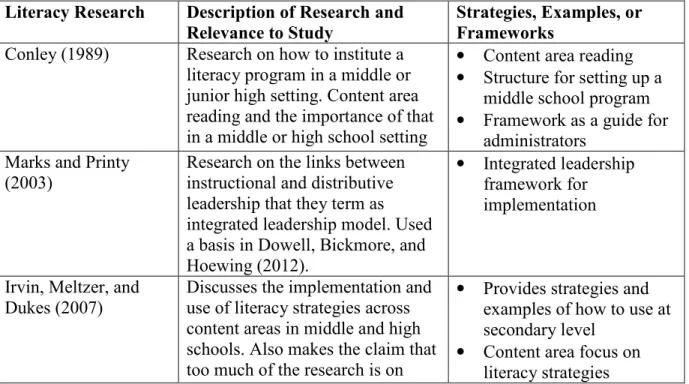
merged with Dowell, Bickmore, and Hoewing (2012) and other literacy leadership research
(Conley, 1989; Hall, Burns & Edwards, 2011; Irvin, Meltzer, & Duke, 2007; Marks & Printy,
2003) to analyze how the principal’s leadership influences literacy instruction.
The findings suggest that the principal worked mostly within the macro levels of
leadership, and the principal used instructional, distributive, cultural, and human resource
leadership. The findings are similar to the integrated leadership approach emphasized in literacy
leadership, but have additional references to cultural and human resource leadership (Marks and
Printy, 2003). There was evidence of planning in regards to literacy instruction with specific
strategies employed and structures created school-wide to create a culture around literacy
strategies and literate practices. Examples of the structures created were a literacy block,
professional development, and an instructional leadership team who focused on collaborative
planning. There is evidence of teacher leadership and empowerment, as reported by the
principal’s instructional leadership team and teacher participants, who stated that the principal
iv
ACKNOWLEDGEMENTS
To my current and past students, teachers, and professors: I believe that I would never
have gotten this far without being pushed by all of you. To my current and former students and
teachers: I feel that working with you all has pushed me to want to complete this study and
dissertation. You have made me want to investigate and learn from those investigations. As an
administrator now and a former reading intervention teacher, I know that the impact of literacy
has the power to minimize gaps and create opportunity. What I do now affects all of my students,
and it affects my current, former, and future practice—not necessarily always in that order.
To Dr. Erick Houck: thank you for staying with me through the many thousands of drafts.
Thank you for having the patience and feedback needed to complete this study, and, of course, to
read very long-winded drafts. Thank you to Dr. Martinette Horner for reading drafts and
providing feedback that helped me to frame a complete proposal that I never thought would
actually happen. Thank you to Dr. Brian Gibbs for reading over the final methodology analysis
and to the whole team in meeting to make the manuscript thorough.
To those professors along the way through my coursework in Educational Leadership and
this study: Dr. Leigh Hall, Dr. Fenwick English, Dr. George Noblit, Dr. Catherine Marshall, and
Dr. Linda Tillman. Dr. Leigh Hall, thank you for being patient with me and really getting down
to the focus on literacy instruction as well as a thorough methods on case study research in the
beginning. Without your guidance early on in this process, this dissertation would not have been
possible. To Dr. Linda Tillman, who I began this conversation and work with, what seems like
v
you to all my other readers: Dr. Denise Tillery, Dr. Martinette Horner, Dr. Brian Gibbs, and Dr.
Christopher Scott. Your input and feedback was invaluable.
Thank you to the teachers and the principal, Mr. Stone, at Red Laurel Middle School (Mr.
Stone and Red Laure Middle School are pseudonyms for the school and principal in this study). I
have learned a lot in a short time from all of you. And, to Mr. Stone: May I be as brave as you
are in your trust of your staff and their own expertise to create a truly cooperative leadership
team where teachers feel empowered. To trust means you have to allow for mistakes and you
must know yourself as a leader. I feel I have learned much more from you all than I planned. It
was valuable and informative.
Lastly, I would like to thank myself. I have learned, maybe more recently than ever, that
you have to get your own self correct before you can lead anyone else. Throughout this whole
planning and study, my life has changed quite a bit. Things have come up and I have still
persevered. Although, at times, I doubted not only if I would ever complete this study, but almost
everything in my life. I have learned that in order to succeed and to lead others effectively, you
have to know who you are and you have to stay true to that. It’s the process, and how you use
vi
TABLE OF CONTENTS
LIST OF TABLES ……….x
LIST OF FIGURES ………...xi
CHAPTER I: INTRODUCTION ………..1
Background……….1
Statement of Problem……….……….2
Research Question………...5
Theoretical and Methodological Framework………...6
Assumptions……….8
Limitations………9
Definitions of Terms……….9
CHAPTER II: LITERATURE REVIEW ………...12
Introduction………..12
Meta, Macro, and Micro Levels of Leadership………13
Meta Leadership: Moving to Action……….14
External development leadership………..15
Parent and community involvement………..16
Ethical and moral leadership………..18
Social justice leadership……….20
Macro Level Leadership: Linking the Individual to the Entity………..23
Transformational leadership………24
Transactional leadership………..26
Distributive leadership………26
vii
School culture and identity………...28
Efficacy and empowerment………..31
Instructional leadership………....32
Curriculum, instruction, and assessment……….35
Human resource leadership………..35
Professional development and teacher evaluation………36
Micro Level Leadership: Managing Day-to-Day………...37
Managerial leadership………...38
Managing day-to-day school tasks………..40
Strategic leadership……….41
Principal’s Role in Middle School Literacy Leadership and Instruction………42
Literacy in the Middle School Setting: Literacy in Content Areas……….43
Literacy Leadership for Middle School Principals………..46
Impact of Teacher Perceptions of Their Principals………..52
Summary………..55
CHAPTER III: METHODS ………57
Introduction: Case Study Method………57
Research Site and Participants……….59
Selection of Site Participants………60
Role of Researcher………61
Data Collection………..63
Observations………..63
Interviews………...65
Documents……….67
Data Coding and Analysis……….68
Coding the data collected………..71
CHAPTER IV: FINDINGS AND ANALYSIS ………74
viii
Overview of Research………74
Research Question……….75
The Site and Its Leadership………75
About Red Laurel Middle School………..76
Mr. Stone: The Principal of Red Laurel Middle School………80
The Survey and the Selected Teachers………...85
Teacher A: Ms. April………...87
Teacher B: Ms. May……….89
Teacher C: Ms. Grey……….90
Teacher D: Ms. Pink………..92
The Findings from the Data Collected………..94
Principal and Teacher Interviews………...94
Principal and Teacher Observations………....104
Document Analysis……… ………….109
School Improvement Plan………111
Lucy Calkins Curriculum Books and Planners………112
Principal and Administrator Walkthrough Tool………..115
Analysis of Findings………116
Meta, Macro, & Micro Levels of Leadership………..117
Principal Leadership and Literacy Instructional Framework………...122
Meta levels of visioning a literacy instructional focus………...….132
Macro levels with a distributive approach to literacy instruction..……..135
Micro levels of managing the literacy focus……….………..145
Literacy leadership framework: A comparison example ………...…….147
Summary………..150
CHAPTER V: DISCUSSION ……….152
Introduction………..152
ix
Significance………..161
Implications………..162
Limitations………...163
Future Research………...164
APPENDIX A: TEACHER SURVEY ………...168
APPENDIX B: FIELD NOTES FORM FOR PRINCIPAL OBSERVATIONS ………...171
APPENDIX C: OBSERVATION FORM FOR TEACHER OBSERVATIONS ………..172
APPENDIX D: PRINCIPAL INTERVIEW QUESTION STEMS – INITIAL INTERVIEW …...173
APPENDIX E: TEACHER INTERVIEW QUESTION STEMS – INITIAL INTERVIEW…175 APPENDIX F: PRINCIPAL INTERVIEW QUESTION STEMS – SECOND INTERVIEW..177
APPENDIX G: TEACHER INTERVIEW QUESTION STEMS – SECOND INTERVIEW ..178
APPENDIX H: PRINCIPAL INTERVIEW QUESTION STEMS – FINAL INTERVIEW….179 APPENDIX I: TEACHER INTERVIEW QUESTION STEMS – FINAL INTERVIEW ……180
APPENDIX J: CODEBOOK FROM FINDINGS ………181
APPENDIX K: LITERACY LEADERSHIP MATRIX ………198
x
LIST OF TABLES
2.1 META LEVEL LEADERSHIP………...15
2.2 MACRO LEVEL LEADERSHIP………23
2.3 FOUR CATEGORIES TO ASSESS SCHOOL CULTURE………30
2.4 MICRO LEVEL LEADERSHIP………...38
xi
LIST OF FIGURES
2.1 DISTRIBUTED LEADERSHIP……….27
3.1 DATA MAP FOR MR. STONE’S LEADERSHIP AND INFLUENCE ON LITERACY INSTRUCTION………..………..70
4.1 DEMOGRAPHICS OF RED LAUREL MIDDLE SCHOOL………77
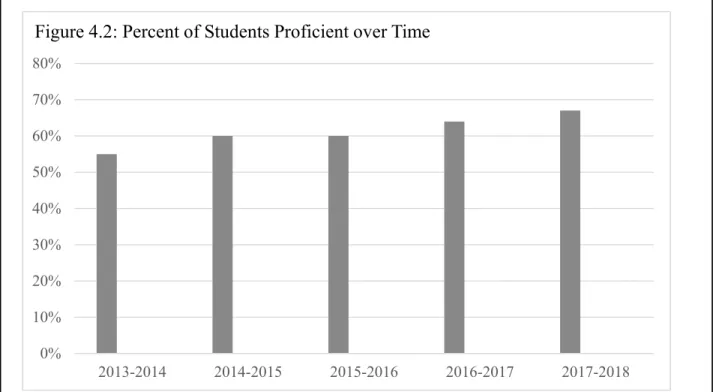
4.2 PERCENT OF STUDENTS PROFICIENT OVER TIME……….79
1
CHAPTER I: INTRODUCTION Background
There are over 100,000 people employed as principals in the United States. Each has to
be able to manage not only the day-to-day, managerial tasks of running a school, but they are
also responsible for student growth, proficiency, and tailoring a school culture (Lynch, 2012).
The principal must be a manager and a leader; they have to encompass all areas of leadership
including micro, macro, and meta levels of leadership (Nicholls, 1987). Throughout the history
of the principalship, the role of the principal has been the most dynamic, changing, and complex
in education (Rousmaniere, 2013). The original role of the principal was a lead teacher that
focused on instruction; however, over time the role changed to an administrative capacity where
the principal was more connected with managing and less connected with student learning. Now
a principal is responsible for being an instructional leader in addition to all the other
administrative capacities already expected. Superintendents value a variety of characteristics
when hiring new principals. Among these characteristics are instructional, cultural, and
administrative skills. However, instructional leadership, people person skills, and ethical
leadership capacities are described as most important (Yusof, N., et al, 2011).
Principals are expected to know that instruction is vital to student success. Literacy
instruction is one area that is vital to student success and has lasting impacts well beyond middle
school. The Alliance for Excellent Education reports that “as many as 8 million fourth through
twelfth graders struggle to read at grade level” (Biancarosa & Snow, 2006, p. 3). In May 2016,
2
performance on the NAEP assessments of 17 year olds has remained relatively flat overall” (p.
2). From the January 2017 U.S. Department of Education on the Implementation of Title I and
Title IIA Initiatives, all subgroups have remained relatively flat or showed little increase in
fourth, eighth, and twelfth grade NAEP reading scores, except the subgroup ELL (English
Language Learners), who have actually decreased at eighth and twelfth grades (Troppe et al,
2017). It is also estimated that businesses spend as much as 3 billion to provide basic writing and
reading classes to their employees (College Board, 2004). Strickland and Alvermann (2004)
reported that “close to 50% of all incoming ninth graders…cannot comprehend the texts that
their teachers expect them to read” (p.3).
Knowing that the principal’s job is very dynamic and influences the quality of instruction
and that literacy skills are important for student success, this study investigates how a principal
influences literacy instruction in a middle school. This study provides insight to aspiring and
practicing principals as well as contributes to the field of educational leadership and its influence
on literacy instruction.
Statement of Problem
There is an abundance of research into principal’s literacy leadership in an elementary
school, but there is little research into the area of principal’s leadership for literacy instruction in
middle schools. Studies indicate that reading and literacy instruction often decline when students
reach the middle school setting (Snow, 2002). Often the focus becomes centered on the content
of the subject and not on how to maneuver text(s) or reading in content areas. This study
specifically examines a middle school principal, Mr. Stone, who focuses on literacy. It portrays a
portrait of how this particular principal’s leadership influences literacy instruction. Since literacy
3
study gives valuable perspective into how principal preparation programs can prepare aspiring
and practicing principals.
Content area literacy is vital to any middle school literacy instruction since the structure
of a middle school is organized by content areas, such as math, social studies, health, science,
etc. Literacy instruction is as much about learning how to decipher how to read a text as it is
about comprehending the message of a reading passage. This means that students must
understand the structures of a text in order to interpret and understand the text. Literacy
instruction in middle school teaches students how to access that information by purposefully and
explicitly teaching specific text features or strategies that enable students to understand passages
aligned to that content area (Conley, 1989; Irvin, Meltzer, & Duke, 2007; Hall, Burns &
Edwards, 2011; Dowell, Bickmore, & Hoewing, 2012). Any teacher in the middle school
building can and will have to deliver literacy strategies in the classroom regardless of their
content area. Teachers are expected by the evaluation instrument used in North Carolina, the
North Carolina Educator Evaluation System (NCEES), to deliver a wide variety of literacy
strategies regardless of their content area.
This study presents possible opportunities for a middle school principal to close or
minimize achievement gaps. Across the nation, achievement gaps are visible not only between
different racial subgroups, but also between students from low socioeconomic and high
socioeconomic status. There is a large achievement gap between students of color, particularly
African American students and white students (Wood and Burz, 2013). This gap is in overall
proficiency as well as in reading scores. To close the achievement gaps in these subgroups,
4
linguistically responsive to students’ needs (Strickland & Alvermann, 2004; Hall, Burns, &
Edwards, 2011).
Aside from minimizing the achievement gap in their schools, and providing valuable
missing research information for middle school principals, the most impactful finding this study
provides is how principal leadership might influence teacher instruction in literacy based on this
one case. Research indicates that principals do not have a direct impact on student achievement,
however, principals do have a direct impact on the effectiveness of the instruction that teachers
deliver (Leithwood & Jantzi, 2006). A principal and her or his leadership is second only to the
teacher’s instruction where student learning and achievement are concerned (Leithwood, et al,
2004, p. 5). Robinson (2011) establishes that “leading teacher learning and development” and
“establishing goals and expectations” had the largest effect size on student outcomes than any
other factor (p. 9).
The single most important factor, based on prior studies, to student’s success is the
quality of the instruction they receive from the teacher. In a study by Whalstrom (2012), it
revealed that principals often use “two complimentary behaviors to influence instruction”, [1] a
focus on building or setting the tone for the school culture, and [2] they take action into
developing conversations about individual teacher growth (p. 68-69). The study revealed that
most often the level of engagement on individual teacher growth was much lower at secondary
level than at the primary level. The study also indicated that secondary school teachers very
seldom reported that principals delivered hands-on instructional leadership when compared to
elementary school principals, who did deliver hands-on, engaging instructional leadership in the
5
This study provides relevant case-based data for schools of educational leadership in
training future or current principals in middle schools in not only literacy instruction, but also
leadership practices as well. While this may be just one case, at one time, at one particular
middle school, it provides valuable insight on the implication of principal leadership and a
literacy framework and lens for literacy leadership.
This study provides information in three vital areas: [1] where there are gaps in the
available research between elementary and middle school research, [2] perspective on how
principal leadership influences literacy instruction, and [4] how schools of education or other
leadership programs can train or coach practicing or aspiring principals to build a school culture
around literacy strategies and literate practices. This case study provides an account on how this
principal influences literacy instruction. It provides information on an example of a specific case
where a principal focuses on literacy instruction in a middle school. In this way, the case is
limited to this particular middle school and principal; however, it provides valuable information
on principal leadership for literacy instruction that can be applied in similar situations.
Research Questions
This case study investigates how a principal’s leadership influences literacy instruction.
The main research question that is addressed is: How does a principal’s leadership influence
literacy instruction in a middle school setting? Other research questions that are related to the
main question that are also addressed in minor ways are: How is this literacy leadership and the
principal’s leadership decisions interpreted and perceived by teachers? How does the principal’s
6
Theoretical and Methodological Framework
Using grounded methodology, this case study merges Nicholls (1987) organization of
meta, macro, and micro levels of leadership and Conley, (1989); Marks and Printy, (2003); Irvin,
Meltzer, and Duke, (2007); Hall, Burns, and Edwards, (2011), and Dowell, Bickmore, and
Hoewing (2012) literacy leadership. Based on the findings and research, this study proposes an
emerging framework and lens that is similar to and builds upon research in literacy leadership.
Grounded methodology means that analysis will be derived from the data that is collected in this
study. This grounded approach is based on social constructivist notions that all meaning is
situated within the context of that social and cultural system (Fletcher, 2011; Clarke, 2005). For
this study, grounded theory is used as “a methodology for developing theory that is ‘grounded’
within the data” (Glesne, 2011, p. 21).
This study examines one middle school, Red Laurel Middle School in North Carolina. It
began with a principal pre-screening interview to select the principal and school site. The
principal pre-screening interview was used to determine whether or not the principal and site was
a good choice for this study. Then, a teacher survey was used to select four teachers in the
building. Principal interviews, teacher interviews, observations of the teachers and principal, and
documents were collected. Analysis was conducted to find patterns as they align to the micro,
macro, and meta levels of leadership and literacy frameworks for leadership were examined in
the literature review. Micro, macro, and meta levels of leadership were selected with the
purposeful intent to house a large body of educational leadership research in such a way that it
was not only encompassing of the research, but also still relatable and practical to principals. The
7
empirical and theoretical research from educational leadership to converge an emerging
framework.
To gauge how the principal, Mr. Stone, influenced literacy instruction, I created a
framework for understanding what was happening at this middle school by combining Nicholls
(1987) lens on educational leadership with the research from Dowell, Bickmore, and Hoewing
(2012) and others who provide a frameworks for literacy leadership. Dowell, Bickmore, and
Hoewing (2012) conducted an empirical study where they collected feedback from interviews
and surveys from experts and leaders in literacy on what is needed to create an effective literacy
program in schools. Their research indicated that there were five areas of a successful literacy
program in schools: [1] content knowledge, [2] knowledge of best practices spanning
developmental age ranges and content areas, [3] providing school structure to support literacy,
[4] literacy environment and management systems, and [5] developing a literacy mission and
monitoring and evaluation of literacy instruction (p. 12). This framework along with other
research on literacy leadership for a successful program in literacy was used to guide the
analysis. These elements are merged with the meta, macro, and micro levels of educational
leadership described in the literature review to provide a focus on the data and a rich description
of the principal’s leadership.
In the beginning of this study it was predicted, based on the literature, that Mr. Stone
would be a leader who would not only be engaged in sound instructional leadership, but also
strong transformational and cultural leader who focused on transformational leadership. It was
also predicted that Mr. Stone would use all the elements of the literacy framework provided by
Dowell, Bickmore, and Hoewing (2012) in fairly proportional ways to the findings in that study.
8
leadership, and much more evidence of instructional, distributive, cultural, and human resource
leaderships. The findings did show that Mr. Stone does use distributive leadership in more ways
than was originally predicted. There is also a large amount of evidence in the areas of cultural
and human resource leadership. There was also evidence of all elements from the literacy
framework; however, there was more evidence of structures and materials to support literacy
instruction within the environment than the Dowell, Bickmore, and Hoewing (2012) and other
studies in literacy leadership have revealed. The most interesting finding was the use of building
and developing trust in the school with teachers. This was not something that was predicted to be
found. Although, Mr. Stone had no clear and defined literacy vision statement, the impact of his
cultural leadership throughout the school was clear and more profound than was originally
expected. There was less evidence of an instructional leadership that uses strong expectations
and lists that must be seen in each classroom, and more evidence of discussion and teacher
leadership than was originally expected.
Assumptions
This study makes a few assumptions based on research and experience. It assumes that
literacy is fundamental to a student’s immediate and future successes, and that the principal has a
direct impact on the teacher’s delivery and instruction, but not a direct impact on achievement. In
other words, the impact comes through affecting the teachers and their instruction. This study
assumes that the principal is the leader, driver, and formulator of the school culture, and that the
school culture has a large impact on instruction. It also assumes that teacher perceptions of the
principal have an impact upon the school culture and therefore the instruction that students
receive. This case study assumes that the central office of the district where this principal is
9 Limitations
The limitations of this case study are that the data derived comes from one particular,
middle school. This means that the data is reflective of this particular school, and not necessarily
all schools. It is an instrumental case that represents only one principal and what is happening at
this middle school. The data lends valuable information, insight, and first hand experiences to
schools leaders who are in similar situations. Another limitation of the study is the scope of time.
This study was conducted in one school year and not over many years or at different sites. If the
case study were to be extended over several years and/or at different school sites, the data may
provide more perspective(s) in different situations and with findings that span longer periods of
time.
This study does not seek to make causal relationships or comparisons to the principal’s
focus on literacy or his own leadership style and student achievement. This can be seen as a
limitation in some ways due to the impact of student achievement and students testing today. The
background of the researcher as a middle school administrator also adds an element of bias in the
way in which the data is analyzed. If another researcher from a different background analyzed he
data, then the data may have been analyzed or focused on in a different way.
Definitions of Terms
The following terms are used throughout this study. These definitions are listed in
alphabetical order and are provided for understanding and reference.
Achievement Gaps – The gaps between different groups of students’ test scores and educational
outcomes. There are gaps between students of color and white students as well as students from
poverty and students who do not come from poverty. Research shows that students who come
10
Case Study – A comprehensive study based upon observations, interviews, surveys, and
document analysis. A qualitative approach to a research question.
Cultural Leadership – Leadership that affects the school culture and climate.
Grounded Theory – Theory that is based upon the data that is derived from one particular area. In
this case study, it will be the data that is gathered from this one school, one location at this
particular time. The theory will be based upon the data collected.
Human Resource Leadership – Based on the use of social and human capital in a school
building. The ability to hire, place, and use staff in ways that function on their strengths or talents
in order to build capacity within the building.
Instructional Leadership – Leadership that has firm understanding of effective teaching,
curriculum, and delivery practices in education. Principals who exhibit this type of leadership
have a strong, visible hand in the creation and carry out of the instruction that takes place in their
building.
Literacy –In its foundation, it is the ability for students to read, write, speak, understand, and use
language (oral and/or written) to interpret meaning about an issue, text, situation, or other
stimuli. For this study, literacy will focus on the use of literate practices and strategies through
different text(s) and text features that students encounter in respective, middle school, content
areas: social studies, science, math, health, etc.
Meta level leadership – Using Nichols (1987) work on leadership, this area of leadership is
broader leadership that is used to affect large scale change. This can be thought of as the large
11
Macro level leadership – Using Nichols (1987) work on leadership, this area of leadership is
focused on how the individual is linked to the organization. This area is focused on areas such as
school culture and climate.
Micro level leadership – Using Nichols (1987) work on leadership, this area of leadership is
focused on the day-to-day leadership, such as managerial leadership.
Perceptions – The way that staff, students, community, and parents view things. Perceptions are
based on people’s prior knowledge of and their current understanding of an issue.
Principal – The leader in an educational, school setting. In this case, the leader of the middle
school in the study.
School Culture – The overarching belief and norms system in place at this particular school. This
is how the school building operates and how problems are dealt with and the system, procedures,
plans, beliefs that are part of the fabric of the school building and the people in the building.
School Climate – The feel of a school building and the overall staff morale. This is an indicator
of the larger school culture; a symptom of the school culture. An analogy would be that school
climate is the temperature/feel of the building, while culture is the overarching system indicative
and that creates the school climate.
Transformational Leadership – Leadership that affects large scale change. Transformational
leadership looks for a change both within the person itself as well as the whole impact within the
12
CHAPTER II: LITERATURE REVIEW Introduction
Research around literacy instruction and leadership focuses mostly on elementary
schools, not middle or high schools. This study is important, because it adds valuable insight into
principal’s leadership and how it influences literacy instruction in a middle school. For this
study, the vast amount of literature around educational leadership is organized through the lens
of Nicholls’s (1987) meta, macro, and micro leadership levels.
Robinson (2011) conducted a large-scale best evidence synthesis on the impact of
principals on student achievement. In her book, Student Centered Leadership, her research
shows that principals can affect five leadership areas with the most significant effect sizes on
student achievement. Those five areas are [1] establishing goals and expectations (.42), [2]
resourcing strategically (.31), [3] ensuring quality teaching (.42), [4] leading teacher learning and
development (.84), and [5] ensuring an orderly and safe environment (.27). She also found that
there were three key leadership capabilities that encompassed all five leadership domains: [1]
applying relevant knowledge, [2] solving complex problems, and [3] building relational trust
(Robinson, 2011, p. 15-17).
In a similar finding by Leithwood and Louis (2012), they conclude that “leadership
affects student learning when it is targeted at working relationships, improving instruction, and,
indirectly, student achievement” (p. 234). They found that principals that had the greatest impact
13
specifically in the areas of teacher knowledge, skills, motivation, and on ensuring supportive
working conditions. They summarize that “at the school level, leadership has an effect on
students primarily when it engenders a strong community of learners, typically known as a
professional community” (p. 231). The findings also suggest that principals who focused on
ways to build school cultures based on shared leadership and learning were far more efficient
than those who focused on one-on-one teacher development.
Marzano, Waters, and McNulty (2005) conducted a meta-analysis based on compiled
studies about effective principals or school leaders and created a list of 21 responsibilities
common among all of them. All characteristics they identified indicated a statistically significant
relationship to student achievement. Their data revealed that principals “can have a dramatic
influence on the overall academic achievement of students” (p. 64) as well as show a positive
correlation between the behaviors of principal’s and students’ academic achievement. Situational
awareness had the strongest correlation, with a value of .33, and flexibility with a correlation
value of .28 as the second highest (Marzano, Waters, & McNulty, 2005).
Meta, Macro, and Micro Level Leadership
For this case study, Nicholls’s (1987) meta, macro, and micro levels of leadership are
used as a lens to frame research around educational leadership. Using these levels of leadership
to examine a principal’s leadership narrows a large body of literature in order to investigate the
principal and how his or her leadership influences literacy instruction. It provides a way to gauge
which principles of leadership the principal employs.
Nicholls (1987) examines leadership from two perspectives. One perspective is that
leadership is more of an influence process, directed at individuals, which does not include the
14
an organization’s success. Within those two perspectives, Nicholls suggests that there are three
levels of leadership: meta, macro, and micro. Meta level leadership “exerts influence on
individuals by linking them to environment through visioning which creates the psychological
ground for common action” (p. 18). Macro leadership is concerned with the executive action that
creates organizational success. Micro level leadership “focuses on the choice of leadership style
to create an efficient working atmosphere and obtain willing cooperation in getting the job done”
(p.20).
Using Nicholls’s definitions of meta, macro, and micro leadership provided a lens for
analyzing principal leadership. This is not a very common use of these leadership principles, but
it is allows a practical, yet theoretical lens, into leadership theories employed by principals that
encompasses the variety of things that principals must focus on every day.
Meta Level Leadership: Moving to Action
Meta leadership is described by Nicholls (1987) as being about moving people to take
action that will have an impact on political or social arenas. It is “widespread and appears in
many forms, from the grand and significant to the humble and fleeting: messiahs, crusaders,
statesmen, mavericks and ringleaders” (p. 19). Nicholls gives the examples of Martin Luther
King, Jr. and Adolf Hitler as meta leaders who were able to use a “visioning effect” on their
followers. This “visioning effect” is made up of the following four components:
(i) perceive patterns or trends in the environment, be it social, political or military; (ii)
articulate, focus and integrate the pattern with (iii) their own conviction and personal
beliefs while having the (iv) empathy to understand feelings, hopes, fears and ambitions
15
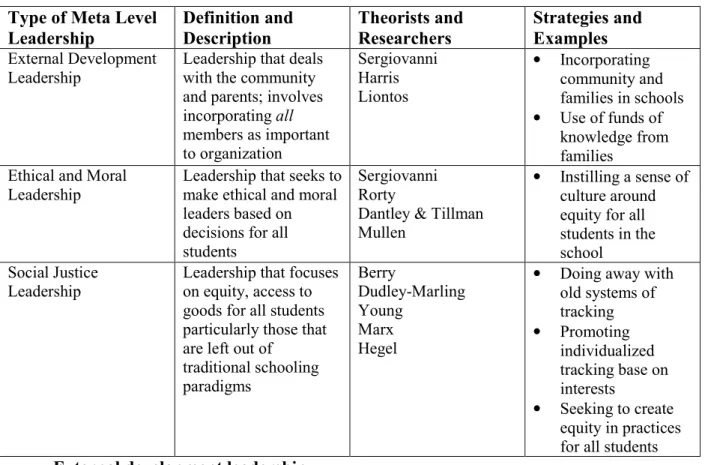
The rest of this section explains components of educational leadership from literature and
research studies that fall under meta levels of leadership, such as, external development,
ethical and moral, and social justice. Table 2.0 provides a snapshot of meta levels of
leadership with examples and definitions.
Table2.1. Meta Level Leadership
Type of Meta Level Leadership Definition and Description Theorists and Researchers Strategies and Examples External Development Leadership
Leadership that deals with the community and parents; involves incorporating all members as important to organization Sergiovanni Harris Liontos • Incorporating community and families in schools
• Use of funds of
knowledge from families
Ethical and Moral Leadership
Leadership that seeks to make ethical and moral leaders based on decisions for all students
Sergiovanni Rorty
Dantley & Tillman Mullen
• Instilling a sense of
culture around equity for all students in the school Social Justice
Leadership
Leadership that focuses on equity, access to goods for all students particularly those that are left out of
traditional schooling paradigms Berry Dudley-Marling Young Marx Hegel
• Doing away with
old systems of tracking
• Promoting
individualized tracking base on interests
• Seeking to create
equity in practices for all students External development leadership.
External development leadership works with forces outside the school building that have
an impact on the school’s performance. These external forces include – but are not limited to –
parents, community members, community organizations, and local universities that have
political, moral, or other vested interests in the school’s success or lack thereof. Effective school
leaders who work in challenging environments understand that the school is a part of the
16
Sergiovanni (2009) identified seven functions of leadership that were present in his study
on school leadership. He examined magnet, traditional, year-round, charter, and other various
school types to investigate leadership traits that were common in all of them. One of those
features was external development leadership. To Sergiovanni, external development represents
the school in the community, connecting to public relations, recruiting parents and students, and
always advocating for the school. In this way, much of what happens in the school is connected
or concerned with the community.
Parent and community involvement.
A large portion of external development centers on involving the parents and community
in decisions made at the school level. Involving the community can take on many forms and
varies across the functions of the school from PTA organizations to working with other
community organizations. How the community defines leadership impacts the role of the
principal a great deal in all school settings.
Community and parent involvement are part of the shared decision making model
described by David (1989). The shared decision making model encourages the use of leadership
that empowers not only teachers in the building, but also the parents and community members to
be part of the decision making team (David, 1989). This model is suggested as a way to improve
school culture and community approval, and to transform school improvement.
Liontos (1991) discusses the role that schools can have in involving more at-risk families.
She describes at-risk families and parents as those of students who are minorities, poor, or come
from other cultural backgrounds which are different from white, middle class families. Her study
suggests that the relationships of poor and minority students to the school or school system have
17
have the same effect for families from poor or minority areas. Liontos (1991) outlines things that
can be done to work with at-risk families. A lot of these are contained in some aspect in the role
of Title I, the federal program intended to create equitable educational opportunties. Some
examples include programs that teach about other cultures, always involving the families
(including stepparents or even grandparents), understanding that all community members need to
feel empowered, and collaborating with other community agencies such as social workers since
schools cannot always provide the resources needed outside of the school.
In her book, Involving At-Risk Families in their Children’s Education, Liontos (1992),
states that one of the biggest obstacles of working with at-risk families is that their relationship
with schools has not always been positive. They may feel that schools have traditionally been
places where they are called in to discuss problems, and not places where they can get resources
or work with their child’s educators to help mold their education. She argues that principals and
school districts often do not have the appropriate strategies or structures for helping low-income
parents become involved. A few strategies that Liontos suggests are establishing a caring
environment, involving parents in activities they can later duplicate and share with children,
giving parents a sense of ownership by consulting with them, and paying attention to format.
The literature on parent and community involvement makes it clear that there is a
connection between student achievement and community and parent involvement. Jeynes (2007)
showed a link between family involvement and student academic achievement. Gordon & Louis
(2012) establish that creating structures to help at-risk families become involved will provide a
sense of ownership and empowerment to those families.
Throughout the literature on parent and community involvement there is a connection
18
parent and community involvement. Parents and community members are seen as integral to
changing anything in the school context. Leithwood, Harris, & Strauss (2010) found that
turnaround principals understand the enormous impact a community has on the success of
students and incorporate strategies for the community to be involved. Leaders who make positive
change are effective at improving academic achievement for students and view a school as being
part of the community (Harris, 2002).
Many times it has been assumed that communities and families from poverty are not
interested in being a part of the school (Gordon & Louis, 2012). The research does not support
this view. Some families, communities, and parents may not know how to engage in the school
community, but that does not mean they do not want to participate. Principals and districts have
to work to create structures in schools that allow parents to become active members in the school
community.
Ethical and moral leadership.
Ethical and moral leadership is another example of meta level leadership. It is leadership
that strives to make a more influential impact on society through school culture. Moral
leadership as described by Owens & Valesky (2007) is made up of three issues: [1] “the
relationship between the led is not one merely of power, but of mutual needs, aspirations, and
values, [2] the followers have latitude in responding to the initiatives of leaders, and [3] leaders
take responsibly for delivering on their commitments” (p. 281). Sergiovanni (1992) describes
moral leadership as leadership that appeals to the moral authority, primarily. Sources of authority
are described as the following:
• Bureaucratic – “hierarchy, rules and regulations, mandates, role expectations”; based on
19
• Psychological – “motivations, technology kills, human relations, and leadership”; uses
the idea that “teachers respond as required when rewards are available…”
• Technical-rational – “evidence defined by logic and scientific research.”; “teachers are
required to comply in light of what is considered to be the truth.”
• Professional – “informed craft, knowledge and personal expertise”; teachers often
“respond to this authority in light of common socialization, professional values, accepted
tenets of practice, and internalized expertise.”
• Moral – “felt obligation and duties derived from widely shared community values…and
ideals”; “teachers respond to shared commitments and felt interdependence.” (p. 36-39)
The moral authority in the primary sense is defined “by community’s centers of shared values,
beliefs, and commitments” (p. 39). Leadership that is based on moral authority first will always
take into consideration the followers and their community’s beliefs, norms, and practices. In this
sense, the leader relies heavily on the prescribed notions of what it means to be a leader and how
a particular community may define that role. The leader will also rely on the perceptions of
teacher and others to make decisions.
Mullen (2011) draws a clear distinction between moral and transactional leadership. She
states that the difference is in the way that the leaders conduct business. Moral leaders empower
subordinates, while transactional leaders continue to work within the system to follow the
system’s directions. Moral leadership moves beyond promoting teacher leadership in the school
to also promote moral responsibility in teachers and students.
Dantley and Tillman (2006) argue that moral leadership seeks to address change that is
based on “a critical theoretical and moral frame that dares to interrogate the rituals” such as
20
presuppositions and assumptions that craft administrative practices in schools” (p. 26). It is not
merely enough to focus on pushing school employees to be leaders and making change in the
culture of the school, if that change is not going to question the status quo or challenge
“presuppositions and assumptions” within the school culture. Dantley (2003) cautions that there
are still patriarchal, white-dominant notions in the definitions imposed by Burns (1978) on
transformational and moral leadership. Principals have to be moral agents, because they are
making decisions for the larger school culture. In order to promote moral leadership, leaders
actively investigate and research “the strategies used by challengers to raise often-silenced and
ignored voices and needs” (Marshall & Gerstl-Pepin, 2005, p. 5).
Social justice leadership.
Social justice leadership is another example of meta level leadership. The history of
social justice in education has had a relatively recent beginning. Social justice strives to bring
about social, community, or political change. Its roots lie in religion, law, and politics (Berry,
2005; Soho, Merchant, & Lugg, 2011). A recent debate among researchers and philosophers
centers around defining social justice in education: What does it look like? Who does it include?
What is the intended purpose? And from whom are these things created? Just as the desire to
define social justice is a debate, the very act of naming or defining social justice too precisely
weighs heavy on many theorists’ minds.
Dudley-Marling (2012) explains there are many varying ideas about social justice. He
explains that to many, social justice means “working with vulnerable or at-risk populations” (p.
42). He continues that others may “take a more systemic view of social justice, focusing on the
role of schooling in ameliorating the inequitable distribution of social and economic goods in our
21
Most researchers focus more on the idea of questioning the practices that educators do to
specifically address injustices including the achievement gap, unequal distribution of goods and
services in our schools, and overall biases in curriculum and instruction. Social justice education
is not merely the act of working with at-risk or high needs populations, but working to challenge
the practices in education that unevenly distribute goods and services across the system.
Brian Barry’s (2005) book Why Social Justice Matters, describes social justice as
determining if the there is an equal distribution of rights. He states since there is “trivially a
global distribution of rights, opportunities and resources, it must be permissible to enquire into
the justice or injustice of this distribution” (pp. 33-34). Young (1990) argues that “it is a mistake
to reduce social justice to distribution only” (p. 15). While she does attest social justice is about
distributive paradigms of goods and services for everyone in society, it is much more than that.
She makes it clear that it is not only about a distribution of goods, but also about power and
decision-making processes. Further, Young (1990) claims that “the predominant focus on the
distribution of wealth, income, and positions is that such a focus ignores and tends to obscure the
institutional context within which those distributions take place” (p. 22). Social justice in
education is no different. The distribution of goods has to be considered, of course; however, the
decision-making system and power structure also must be considered to make lasting impacts
instead of temporary fixes.
Dantley and Tillman (2010) state that social justice in education is “about deconstructing
realities to disclose the multiple ways schools and their leadership reproduce inequitable
treatment of individuals because their identities are outside the celebrated dominant culture” (p.
22). This means that school leaders must push for deep social change and actively educate the
22
education completely (Arnove, 2009). Marshall & Gerstl-Pepin (2005) present strategies and
theories on how to change educational policies and practices to create a more socially just school
system. They state that in order to understand social justice and politics in education, “it is
important to understand power, the ability to control a group, individual, or structure to exercise
control or authority” (p. 4).
One example of such strategies is that school leaders and school districts can reduce or
eliminate the achievement gap between students from poverty and those not from poverty by
doing away with old systems of tracking. Noddings (2012) explains that tracking has historically
been a way we have created socially unjust schools because most tracking programs were based
not necessarily on merit, but on race, class, or perceptions of teachers. She provides that tracking
itself may not have been the problem, but the design. If we want to create more socially just
schools in the democratic sense, then we have to provide a variety of opportunities for all
students (Noddings, 2012). Students could follow tracks they are interested in or where they have
shown abilities, but they should be allowed to switch tracks at any time during their schooling.
This is one example of challenging the practices that are currently in place.
These meta levels of leadership provide larger lenses for educational leadership. Macro
levels of leadership provide leadership that can focus on vision, school culture, and planning.
Meta level leadership may hold more theoretical stances on educational leadership, while macro
level leadership uses theoretical approaches to put ideas into practice. Both meta and macro level
leadership have implications on literacy instruction in the way in which principals carry out the
plan at the school. Literacy instruction around meta level leadership principles would inhibit
pieces of equity or social justice, while literacy instruction around macro levels of leadership
23
Macro Level Leadership: Linking the Individual to the Entity
Macro level leadership concerns itself with the long-range plans, goals, and how to
achieve them. This level of leadership is seen as the more understood and more traditional role of
leadership. Nicholls (1987) describes both of the remaining levels of leadership, macro and
micro leadership, as being used through organizations. Macro leadership focuses “on individuals
by linking them to the entity—be it the whole organization or just a division, department or
group” (p. 20). Macro level leaders ask of their followers: What is this organization all about?
Where do I fit in? How am I valued and judged? What is expected of me? Why should I commit
myself? In the process, the leader creates committed members of the organization. According to
(Avery 2011), a leader’s role at the macro level uses planning for the future and how followers
will help the organization achieve these plans.
The rest of this section describes the literature on educational leadership as it pertains to
macro levels of leadership. Some of the areas of educational leadership that are described are
transformational, transactional, distributive, cultural, instructional, and human resource
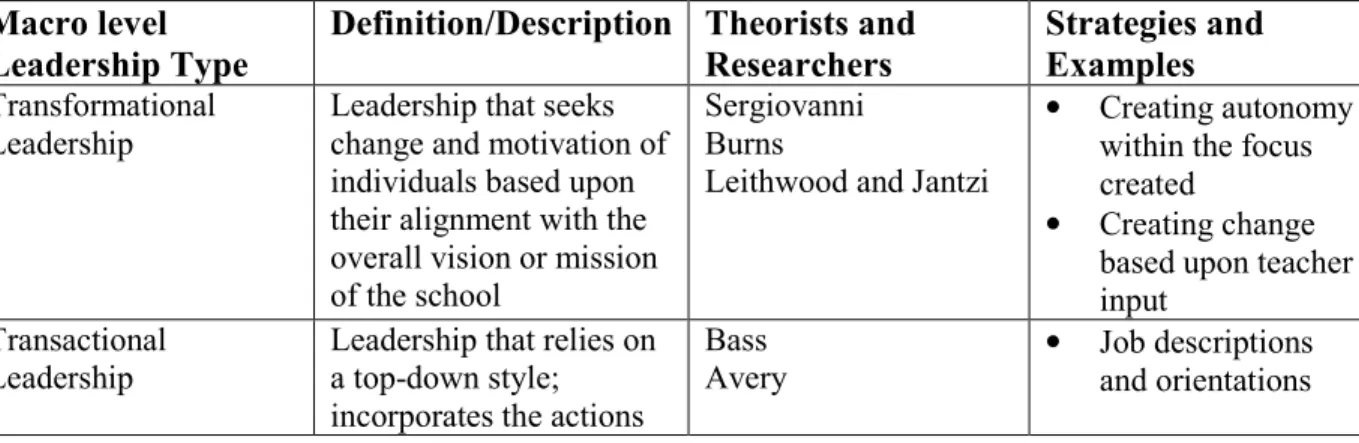
leadership – all of which are considered to link the organization to the individual. Table 3.0
shows macro level leadership examples, descriptions, and strategies that are provided in the
literature.
Table 2.2. Macro level Leadership
Macro level Leadership Type
Definition/Description Theorists and Researchers
Strategies and Examples Transformational
Leadership
Leadership that seeks change and motivation of individuals based upon their alignment with the overall vision or mission of the school
Sergiovanni Burns
Leithwood and Jantzi
• Creating autonomy
within the focus created
• Creating change
based upon teacher input
Transactional Leadership
Leadership that relies on a top-down style; incorporates the actions
Bass Avery
• Job descriptions
24 of followers in return from directives of leaders
created for each member
• Functions and
tasks laid out for teachers
Distributive Leadership
Leadership that relies on other individuals, such as the teacher, in the school to share leadership responsibilities
Sillane, Halverson, & Diamond
• Creating structures
for teachers to be part of the school
• Engaging teachers
and community in decision making processes Cultural Leadership Shaping and molding the
school culture
Sergiovanni Chirachello
• Creating school
focus
• Designing
strategies to align with the school focus
Instructional Leadership
Leadership that deals directly with instruction and learning in the classrooms. Includes literacy leadership and other effects on
curriculum, instruction, and assessment.
Marks & Printy Sergiovanni Leithwood & Jantzi
• Creating a school
focus on literacy
• Providing
professional development and coaching
• Providing feedback
from walkthroughs on instructional techniques Human Resources
Leadership
Relationship between the workers and the
organization; relying on human capital and investing in their abilities
Sergiovanni Bolman & Deal Denver
• Putting the right
people in the right positions
• Relying on teacher
skills when necessary
Transformational leadership.
The term transformational leadership is a word that is fraught with ambiguity. It is often
associated with any leader who seeks change from the norm; however, real transformational
leadership looks and acts in more complex ways than just being different. One of the first
researchers to use the term transformational leadership was James MacGregor Burns (1978).
Burns (1978) defined transformational leadership as “a process in which leaders and followers
25
transformational leader is one who seeks out motives in its followers and motivates them to want
to work and be a part of the organization (Owens & Valesky, 2007). Transformational leaders
who wish to truly operate outside of traditional paradigms have to ask themselves: Who receives
the benefit of such changes? What is being directly changed? This change is for whom? And,
whom does this change exclude? And, more importantly, what social values, norms, and beliefs
does this change reinstitute or perpetuate?
As described in meta level of leadership, Sergiovanni (1992) describes leadership as
having five sources of authority for supervisory policy and practice. Sergiovanni argues that
transformational leaders rely heavily on the moral and professional authority as the tenants of
sound leadership practice. Both professional and moral sources of authority encompass the
understanding that transformational leaders more concerned with the concept of power to rather
than power over (Sergiovanni, 1990).
As described in meta level leadership, Sergiovanni (1992) explains that our mindscapes
are important in establishing a school culture. For Sergiovanni, objective worlds do exist, but the
“truth” about the world is dependent upon how we see and view the world through our own eyes
(p. 8-9). How a principal sees her- or him-self and the world will affect the way in which they
lead a school building. Sergiovanni’s description of truth echoes Nietzsche (1887). Nietzsche
argued that truth is determined by the person; by their perception of the message. Truth is
determined by our society and by individuals in our society; thus, it is important to understand
that what is considered wrong or right depends a great deal upon the community in which the
school resides and the principal’s own mindscapes. A principal’s understanding of their truth(s),
play an important role in transformational leadership. English (2008) offers that leaders have to
26
defines you will impact the decisions that are made at the school. Being cognizant of that is
vitally important to transformational leadership.
Transactional leadership.
Bass (1998) describes transactional leadership as being about the "transaction or
exchange that takes place among leaders, colleagues, and followers” (p. 4). Transactional
leadership is about what goods, services, or ideas a follower may receive and/or provide to an
organization. Most of the literature around transactional leadership is about maintaining the
status quo, instead of changing the status quo. Transactional leadership is considered more
top-down instead of bottom-up leadership; it is about the interaction of the conditions or rewards that
one receives as result of their role. Avery (2011) contends that followers are involved more
under transactional leadership than under the classical paradigm.Burns explained that
transactional leaders offer jobs, security, and cooperation in exchange for following the leaders’
mission (Owens, 2007). In a principal’s leadership, this can be seen in the way a mission is
delivered and enacted in terms of tasks aligned with the overall mission.
Distributive leadership.
Distributive leadership investigates where all three (the follower, the leader, and the task)
intersect with one another. Spillane, Halverson, and Diamond (2007) provide that distributive
leadership is based on distributive psychological theory. They describe distributive
leadership as not only the followers’ skill, ability, or charisma, but as something “best
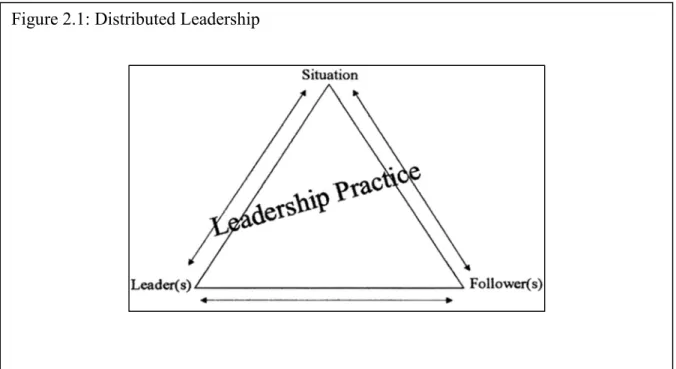
understood as a practice distributed over leaders, followers, and their situation” (p.11). Figure 2.1
shows Spillane, Halverson, & Diamond’s theory of distributive leadership in a diagram. It clearly
shows that distributive leadership happens only where the interaction of leader, follower, and
27
tasks that are asked from a leader to a follower. Teachers, department chairs, and others in the
school building are all considered leaders in their tasks as they align with their positions.
Futrell’s (2011) study indicates that more districts are moving to shared or distributive leadership
models than in the past.
Cultural leadership.
Sergiovanni (1984) prescribes cultural leadership as being centered around and
contingent upon building a unique school mission and vision. This cultural leadership is capable
of keeping all vested parties focused on the overall identity. A principal who is a cultural leader
assumes the role that motivates, encourages, and taps into followers’ resources to build a school
defined by their common practices, norms, and values. Some activities that are associated with
cultural leadership include, but are not limited to: “socializing new member to the culture; telling
stories and maintaining or reinforcing myths, traditions, and beliefs; explaining ‘the way things Figure 2.1: Distributed Leadership
28
operate around here’; developing and displaying a system of symbols over time; and rewarding
those who reflect this culture” (p. 10-11).
Sergiovanni (1984) defines a school’s culture as common values, norms, and beliefs that
all members of the organization believe. In order for a principal to be effective at building a
culture within a school, he or she has to not only give clear attention to detail, but also support
the school and constantly reinforce the school. Cultural leadership centers itself around the
following questions about the school organization: “What is this school about? What is important
here? What do we believe in? Why do we function the way we do? How are we unique? How do
I and others fit into the scheme of things?” (Sergiovanni, 2007, p. 13). In this study, cultural
leadership will be inspected as it relates to the literacy mission and its components in the middle
school principal.
School culture and identity.
Schein (1985) describes organizational culture as both invisible and visible in certain
aspects of daily work. For example, artifacts and creations are often the most visible and include
such things as tools, buildings, art, and speech patterns. Things that are not visible include the
nature of human nature, activity, and relationships. Schein’s model of culture describes these
invisible elements of organizational culture as precocious and other forms of culture that are
visible as not entirely decipherable. In a school setting, the culture is based upon what teachers
believe, what students believe, and what, as an organization, can be accomplished and what
cannot be accomplished (Owens & Valesky, 2007). Peterson and Deal (2002) describe school
culture as unwritten rules and assumptions in a school setting.
Picucci, Brownson, and Kalhert (2002) conducted a study with seven middle schools
29
performance. This study showed that the defining and shaping of school culture was vitally
important to changing the performance of students, regardless of their backgrounds. Some of the
striking features found in all seven of the middle schools studied was that each school had
established a culture of equity and high achievement. Each middle school also held strong
relationships between performance and culture throughout the entire school. Another common
feature in these schools was that building a school culture took place over years, instead of short
periods of time. Almost all the schools went through restaffing patterns where teachers left
because they didn’t like the change or they were not in agreement with the direction of the
school. In one of the schools, 20% of the school’s teachers, 25 of the 125, left to find another job
in another school (Picucci, Brownson, & Kalhert, (2002). Principals at all of the seven schools
also implemented a shared leadership culture, but held strongly to their visions of achieving
equity and excellence.
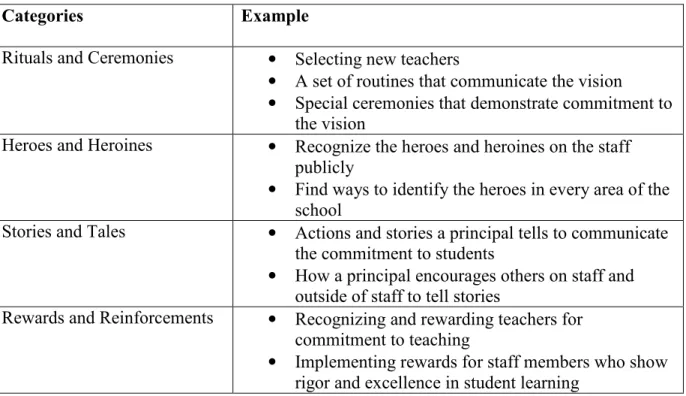
Williamson and Blackburn (2009) suggest four categories to use as a guide to shape
school culture after interviewing principals who changed or shaped school culture. Table 2.3
shows the four categories that can shape a school culture, rituals and ceremonies, heroes and
heroines, stories and tales, and rewards and punishments, with examples for each category. One
principal who was interviewed responded about hiring new teachers as a ceremony and ritual that
a set of questions they asked of every single candidate. The principal responded, “if they’re
listening carefully, they will understand that this school values the success of every student and
expects every student to succeed in a rigorous and challenging environment’” (p. 60-61). An
example of heroes and heroines was brought to light by one principal who shared that he uses
every opportunity possible to celebrate teachers’ success around student achievement by using a
30
change the story or the culture of the school. One principal from Denver discussed how she
asked her teachers to snitch on teachers who were doing great things in their classroom and share
it with the faculty. Another principal interviewed used a system of name it, claim it, and explain
it during the faculty meetings. He would take digital pictures and put them on an overhead at
faculty meetings and then have the teacher who did the example, stand up, and claim the item
and explain to the staff what it was about.
Table 2.3. Four Categories to Assess School Culture
Categories Example
Rituals and Ceremonies • Selecting new teachers
• A set of routines that communicate the vision • Special ceremonies that demonstrate commitment to
the vision
Heroes and Heroines • Recognize the heroes and heroines on the staff publicly
• Find ways to identify the heroes in every area of the school
Stories and Tales • Actions and stories a principal tells to communicate the commitment to students
• How a principal encourages others on staff and outside of staff to tell stories
Rewards and Reinforcements • Recognizing and rewarding teachers for commitment to teaching
• Implementing rewards for staff members who show rigor and excellence in student learning
Adapted from Williamson and Blackburn (2009).
Cultural leadership is important to literacy leadership in a middle school because of the
impact that a school’s common values, assumptions, and practices can have on literacy
instruction in the content areas. Research shows that effective literacy leadership is across the
entire school and this means that it has to become or already be established as part of the school
31 Efficacy and empowerment.
School culture must have a firm foundation in efficacy and empowerment of all vested
members including students, teachers, and community members. Principals must find ways to
empower teachers within in the building and bring in community members to become vital
components of the school culture. Teacher empowerment, based on the literature, can begin from
creating school structures that allow teachers to become leaders while the school leaders step
back. Chirichello (2004) provides data from surveys conducted from 2000-2003 around what
principals do, what teachers think they do, as well as what principals would like to do.
Chirichello’s study provides that collective or shared leadership creates more empowerment for
teachers. Principals have to be able to give up some of their responsibilities in order to empower
teachers in the school building. Principals cannot do it alone, and teachers appreciate having
leadership roles in doing what they feel comfortable doing.
Empowerment in schools also entails empowering students, parents, and community
members as well as teachers. Any traditional, top-down view of leadership that places the
principal at the top while all other members are merely followers will disable empowering
teachers and other key members to have choices in decision-making. Empowering teachers can
include anything from permitting followers to ask questions after a decision is made, offering a
tentative decision subject to possible change after discussion, presenting the problem, making a
decisions only after discussion with them, and creating opportunities for followers to lead
discussions and other areas in the organization (Owens & Valesky, 2007, p. 317).
Bennis (1989) presents that empowerment is the collective effect of leadership. In