THE DYNAMICS OF PIPED-WATER AND SEWER DEVELOPMENT IN JAKARTA, INDONESIA (1945-2015): A CASE STUDY USING MULTILEVEL PERSPECTIVE
Nur „Aisyah Nasution
A thesis submitted to the faculty at The University of North Carolina at Chapel Hill in partial fulfillment of the requirements for the degree of Master of Science in the Department of Environmental Science and Engineering in The Gillings School of Global Public Health.
Chapel Hill 2016
ii © 2016
iii
ABSTRACT
Nur „Aisyah Nasution: The Dynamics of Piped-Water and Sewer Development in Jakarta, Indonesia (1945-2015): A Case Study using Multilevel Perspective
(Under the direction of Dale Whittington)
Inadequate access to water and sanitation has been characterized as a challenge to
developing infrastructure and public health in Jakarta, Indonesia. Access to piped-water network has only increased from 10% to 48% between 1975 to 2015. Sewer coverage, which is only available to 2% of population, has been mostly stagnant since 1989. Drawing on interview, documentation approaches and the application of a multilevel perspective, we documented factors that contributed to water and sanitation from 1945 to 2015. We found that there has been no substantial change in piped-water and sewer coverage in Jakarta. This is because regime actors have not changed their cognitive routines, formal rules, or norms despite political and economic changes that occurred as Indonesia moved from a centralized to decentralized system. This case study found that decentralization does not improve piped-water and sewer
iv
ACKNOWLEDGMENTS
My research project would not have been possible without the support of many people. I wish to express my gratitude to my advisor, Dr. Dale Whittington, for his guidance, patience and invaluable assistance throughout this research. I also wish to express my deepest gratitude to Dr. Pete Kolsky and Dr. Jamie Bartram for their essential insight and advice on the project. My sincere gratitude goes to all the people who provided me with important information, valuable explanations and helpful discussions during my research: Basah Hernowo, Risyana Sukarma, Nugroho Tri Utomo, Danny Sutjiono, Rudi Willem, Winarko Hadi, Irma M. Setiono, Trigeany Linggoatmodjo, Kris Tutuko, Budiman Arief, Oswar Mungkasa, Handy B. Legowo, Nur Endah Shofiani, Foort Bustraan, Tofikurochman, Rooswitha Situmorang, Hidajat E. Liestianto, Ati Angkasa, Tomihara Takayuki, Pratama S Adi, Arif Maulana, Fadly Haley Tanjung, Hartuti Kartika S., Riza Taftazani, Vika Eka Lestari, Aldy K. Mardikanto, Ahda Megawati Hasunia, Atet Wijoseno, and Camelia Indah. I am also greatly indebted to Lydia Morris and Claire Tipton for their proofreading, which has profoundly improved my thesis.
v
TABLE OF CONTENTS
LIST OF TABLES ... ix
LIST OF FIGURES ... x
LIST OF ABBREVIATIONS ... xii
CHAPTER 1 : INTRODUCTION ... 1
CHAPTER 2 : METHOD ... 7
2.1. Case Study ... 7
2.2. Data Collection ... 7
CHAPTER 3 CASE STUDY : THE DYNAMIC OF WATER AND SANITATION DEVELOPMENT IN JAKARTA FROM 1945 TO 1966 ... 16
3.1 Landscape Level ... 16
3.1.1 Political Condition ... 16
3.1.2 Economic Condition ... 17
3.1.3 Social and Health Condition ... 17
3.2 Regime Level ... 18
3.2.1 Enabling Factors for Water and Sanitation Development at Regime Level ... 19
3.2.2 Constraining Factors for Water and Sanitation Development at Regime Level ... 21
3.3 Niche Level ... 23
3.3.1 Enabling Factors for Water and Sanitation Development at Niche Level ... 23
vi
3.4 Summary of Water and Sanitation Development during 1945-1966 ... 27
CHAPTER 4 CASE STUDY: THE DYNAMIC OF WATER AND SANITATION DEVELOPMENT IN JAKARTA FROM 1966 TO 1998 ... 30
4.1 Landscape Level ... 30
4.1.1 Political Condition ... 30
4.1.2 Economic Condition ... 32
4.1.3 Social and Health Condition ... 33
4.1.4 International Development Policy for Water and Sanitation Development ... 33
4.2 Regime Level ... 34
4.2.1 Enabling Factors for Water and Sanitation Development at Regime Level ... 36
4.2.2 Constraining Factors for Water and Sanitation Development at Regime Level ... 40
4.3 Niche Level ... 48
4.3.1 Enabling Factors for Water and Sanitation Development at Niche Level ... 48
4.3.2 Constraining Factors for Water and Sanitation Development at Niche Level... 49
4.4 Summary of Water and Sanitation Development during 1966-1998 ... 55
CHAPTER 5 CASE STUDY: THE DYNAMIC OF WATER AND SANITATION DEVELOPMENT IN JAKARTA FROM 1998 TO 2015 ... 58
5.1 Landscape Level ... 58
5.1.1 Political Condition ... 58
5.1.2 Economic Condition ... 60
5.1.3 Social and Health Condition ... 61
5.2 Regime Level ... 63
5.2.1 Enabling Factors for Water and Sanitation Development at Regime Level ... 70
vii
5.3 Niche Level ... 98
5.3.1 Enabling Factors for Water and Sanitation Development at Niche Level ... 98
5.3.2 Constraining Factors for Water and Sanitation Development at Niche Level... 99
5.4. Summary of Water and Sanitation Development during 1998-2015 ... 101
CHAPTER 6 : ANALYSIS ... 103
6.1 The Interplay between Three Multiple Levels (Landscape, Regime, and Niche) ... 103
6.2 The Application of MLP in Jakarta ... 115
6.3 Typology of Change on Piped-Water and Sewer System in Jakarta ... 116
CHAPTER 7 : CONCLUSIONS ... 118
APPENDIX I: LIST OF INTERVIEWEE ... 123
APPENDIX II: INSTITUTIONAL FRAMEWORK IN WATER AND SANITATION IN INDONESIA (BASED ON THE CURRENT GOVERNMENT STRUCTURE FOR THE PERIOD OF 2015-2019) ... 125
APPENDIX III: WATER SUPPLY AND SANITATION DEVELOPMENT IN JAKARTA DURING OLD AND NEW ORDER ERA (1945-1998) ... 127
APPENDIX IV : WATER PRODUCTION FACILITIES IN JAKARTA ... 132
APPENDIX V: PAM JAYA SHARE TO JAKARTA GOVERNMENT ... 133
APPENDIX VI: THEME OF THE FIVE YEAR PLANS (1969-1999) ... 134
APPENDIX VII: GROWTH OF BOTTLED WATER INDUSTRY AND GROWTH OF REFILLED WATER INDUSTRY IN INDONESIA ... 136
APPENDIX VIII: WATER QUALITY OF RIVER AND GROUNDWATER IN JAKARTA ... 137
APPENDIX IX: SERVICE TARIFF AND CONNECTION FEE IN PDPAL JAYA ... 139
viii
ix
LIST OF TABLES
Table 1. Definition of Each Level of Analysis in Multi-Level Perspective ... 5
Table 2. Main Actors and (Inter) Actions in Transition Pathways ... 14
Table 3. Health Conditions in Indonesia in 1948-1961 ... 18
Table 4. Summary of Water and Sanitation Development during 1945-1966 ... 29
Table 5. National Water Rate Structure Issued in 1984 ... 46
Table 6. PAM Jaya Water Tariff in 1975 and 1983 ... 47
Table 7. Water Price of Vended Water (constant price based on 2000) ... 53
Table 8. Summary of Water and Sanitation Development during 1966-1998 ... 57
Table 9. Water Expenses by Income Group, as a Proportion of Income ... 67
Table 10. The Water Tariff for Each PDAM Consumer Group ... 89
Table 11. Summary of Water and Sanitation Development during 1998-2015 ... 102
Table 12. Summary of Water and Sanitation Development during 1945-2015 ... 113
x
LIST OF FIGURES
Figure 1.Case Study Method... 11
Figure 2. A Dynamic Multi Level Perspective on System Innovation ... 13
Figure 3. Groundwater Extraction and Number of Registered Wells in Jakarta (1879-2007) ... 24
Figure 4. Pejompongan I and II Water Treatment Plants and Its Distribution Line ... 28
Figure 5. Administrative Map of Jabodetabekk and Its Urban Expansion (1993-2010) ... 31
Figure 6. Number of Reported Deaths and Number of Reported Cholera Cases in Indonesia .... 32
Figure 7. Volume of Septage Emptied and Number of Customers With Septic Tank Emptying (1996-2013) ... 38
Figure 8. Wastewater Infrastructure in Jakarta ... 44
Figure 9. Corruption Perception Index in Indonesia (1996-2015) and B to B Investment in Water Supply Sector (2011-2014) ... 59
Figure 10. Infant and Under-5 Mortality Rate in Indonesia and Jakarta (1970-2012) ... 62
Figure 11. Jakarta Real GDP per Capita, Population of Jakarta, with Piped-Water Connection, and Population with Sewer Connection (1975-2015) ... 64
Figure 12. Proportion of Jakarta's Households with Access to Main Drinking Water Source (1990-2014) ... 65
Figure 13. Proportion of Jakarta's Households with Access to Basic Sanitation Facilities (1993-2014) ... 65
Figure 14. Sewerage Zones for Each Target Development Year ... 70
Figure 15. Water Supply and Sanitation (Wastewater, Solidwaste, and Drainage) Investment per Capita from Central Budget (2005-2016) ... 73
Figure 16. Community Complaints Reported to the Legislature of Jakarta (2000-2013) ... 75
Figure 17. Service Area of PALYJA and AETRA ... 80
xi
Figure 19. Customer Connections and Tariff Band ... 88
Figure 20. Trend on the Proportion of PAM Jaya Customers (2000-2014) ... 88
Figure 21. The Number of Public Hydrants (1982-2015) ... 91
xii
LIST OF ABBREVIATIONS
ADB Asian Development Bank.
Ausaid Australian Agency for International Development.
Bappenas Badan Perencanaan Pembangunan Nasional (Indonesian National Development Planning Board).
BNA Basic Needs Approach.
BPAL Badan Pengelola Air Limbah (Jakarta Wastewater Enterprise).
BPKP Badan Pengawas Keuangan Pemerintah (Board of Supervisors Finance and Development)
BPLHD Badan Pengelola Lingkungan Hidup Daerah (Jakarta Environmental Management Agency).
BPS Badan Pusat Statistik (Indonesian Statistics Board).
BPPSPAM Badan Pendukung Penyediaan Sistem Air Minum (Water Supply System Support Board).
CBO Community Based Organization. CPI Corruption Perception Index.
DEWATS Decentralized Wastewater Treatment. DKI Jakarta Special Region of Jakarta.
GDP Gross Domestic Product
IBRD International Bank for Reconstruction and Development. IBT Increasing Block Tariff.
ICW Indonesian Corruption Watch.
xiii
IPA Instalasi Pengolahan Air (Water Treatment Installation). ITB Institute Technology of Bandung.
JICA Japan International Cooperation Agency. JUDP Jakarta Urban Development Project. JWSRB Jakarta Water Supply Regulator Body. ITN International Training Network.
IUIDP Integrated Urban Infrastructure Development Plan. KIP Kampungs (village) Improvement Program.
KMMSAJ Koalisi Masyarakat Menolak Swastanisasi Air Jakarta (People Coalition against Jakarta Water Privatization)
KemenPUPR Kementerian Pekerjaan Umum dan Perumahan Rakyat (Ministry of Public Works and Public Housing).
KPK Komisi Pemberantasan Korupsi (Corruption Eradication Commission). LCWSS Low-Cost Water Supply and Sanitation.
MDGs Millennium Development Goals. MLP Multilevel Perspective Framework.
NRW Non-Revenue Water
NSG National Sanitation Strategy and Guidelines.
OECD Organization for Economic Co-operation and Development. PAM Jaya Perusahaan Air Minum Jaya (Jaya Water Supply Corporation).
PDAM Perusahaan Daerah Air Minum (Local Government Owned Company for Water Supply).
PDPAL Jaya Perusahaan Daerah Pengolahan Air Limbah Jaya (Jakarta‟s Company for Wastewater Treatment).
xiv
Pokja AMPL Kelompok Kerja Air Minum Penyehatan Lingkungan (Water and Sanitation Working Group).
PPP Public Private Partnership.
PPSP Percepatan Pembangunan Sanitasi Perkotaan (Acceleration of Urban Sanitation Development).
PTO Penyesuaian Tarif Otomatis (Automatic Tariff Adjustment). RCA Restated Cooperative Agreement.
REPELITA Rencana Pembangunan Lima Tahun (Five-Year Development Plans). Riskesdas Riset Kesehatan Dasar (National Basic Health Research).
RPJMD Rencana Pembangunan Jangka Menengah Daerah (Regional‟s Midterm Development Plan).
SDGs Sustainable Development Goals.
SII Standar Industri Indonesia (Indonesia Industrial Standard). SSK Strategi Sanitasi Kota (City Sanitation Strategies).
UNDP United Nations Development Programme.
USAID United States Agency for International Development. UNICEF The United Nations Children's Emergency Fund. WHO World Health Organization.
1
CHAPTER 1 : INTRODUCTION
Water and sanitation are fundamental to life and are important basic human needs. Over the past few decades, providing “water and sanitation for all” has become one of the central international development goals included in the Millennium Development Goals (MDGs) and Sustainable Development Goals (SDGs). While critical end-goals, there are many challenges to achieving universal access to water and sanitation including institutional weaknesses (Gandy, 2008); corruption and rent seeking (Davis, 2004; Lovei and Whittington, 1993); insufficient regulation (Johnstone, 2014), colonial legacy (Kooy and Bakker, 2008), lack of investment (Hutton and Bartram, 2007), and governance failure (Bakker et. al., 2008).
Jakarta, the capital city of Indonesia has experienced substantial economic growth since the-1990s. However, its piped water and sewer coverage has been much slower to improve. There are many households, both poor and rich, that do not have access to piped water or a sewer network. Piped-water and sewer coverage in Jakarta are much lower than in other large
Indonesian cities, such as Surabaya, Medan and Banjarmasin as well as in other Southeast Asian countries.
2
(US$1.4 billion) per year, which was approximately 1.3% of Jakarta‟s gross domestic product (GDP) in 2012. This amount is the equivalent to approximately Rp.1.7 million (US$139) per person per year, which is three times more than the cost for the rest of the country (Water and Sanitation Program [WSP], n.d.). These statistical trends, however, cannot fully explain the delays in piped water and sewer system improvement in Jakarta.
The human right to have proper water and sanitation is a complex issue, and each country has had different degrees of development over time. For example, the success of developed countries in providing water supply and sewer services was highly related to the emergence of germ theory (Hamlin, 1992, 1998; Melosi, 2000, 2011; Tarr et al., 1984). Furthermore, the history of water and sewer development in developed countries, such as the United States, United Kingdom, the Netherlands, and Japan has important implications. For example delays in water and sewer development caused a series of waterborne epidemics to occur in the early 19th century (Geels, 2005, 2006; Gosho, 2014; Hamlin, 1992, 1998; Melosi, 2000, 2011; Tarr et al., 1984). As a result, many lives were lost and other public health threats hindered economic growth in the developed countries listed above.
3
technological urban sanitary and organizational systems (Melosi, 2000); and political power and control of society over water sources (Melosi, 2011).
Although pathways to the development of water and sanitation infrastructure have been well-documented in developed countries, such documentation has not occurred in Jakarta. Western scholars have attempted to explain the lack of water development in Jakarta as a failure in governance (Bakker et. al., 2008), poor outcome of colonial and post-colonial governmentality (Kooy and Bakker, 2008), absence of sufficient regulations (Braadbaart, 2007; Jensen, 2005), urbanization (Chifos and Suselo, 2000), or corruption (Crane, 1994; Lovei and Whittington, 1993; Server, 1996). However, these studies only analyzes one or two factors at a time, thus in-depth studies regarding water and sanitation development in Jakarta are still needed.
Throughout Indonesia, the amount of literature on water and sanitation history is limited. There is only one study, led by Kooy (2008), that has attempted to analyze water supply
4
While Hamlin (1998), Melosi (2000 and 2011), and Tarr (1996) use descriptive
approaches to describe historical case studies on water, sanitation, and public health sectors and factors that contribute to the transformation of these sectors, there are other approaches to describe historical case studies that focus on socio-technological transition. Such literature uses multi-level perspectives (MLP) to present the socio-technical transition of sewer, water supply, and personal hygiene in the Netherlands (Geels, 2005, 2006). MLP has become one approach to understanding the challenges and possibilities of achieving a more developed socio-technological system (Lawhon and Murphy, 2012) and gives structure to the description of historical case studies. Key principles in MLP are (i) taking a multi-actor approach in a long-term perspective, (ii) analyzing the learning process at a niche level, and (iii) identifying problems that span in multiple domains, levels, and actors. MLP used three different levels of analysis to describe factors that contribute to system transformation: (i) landscape such as economic and political condition; (ii) regime such as regulations, normative, and cognitive1 aspect of actors including problems in organizational level that hamper the improvement of the system; and (iii) niche where R& D, innovation and learning process occur.
To understand why slow progress of piped-water and sewer development has occurred in Jakarta as well as respond to the lack of literature describing such development in this city, this thesis aims to explain and analyze the dynamic of piped-water and sewer development in Jakarta from 1945 until 2015 using the MLP framework, using Geels‟ MLP work as a model (2005, 2006). Taking a historical perspective can help explain the chronological shifts of water and sanitation development in Jakarta over a longer time span. Furthermore, historical case studies
1Cognitive are actors‟ routines and capabilities that are based on particular understandings about how things should
5
are essential to produce evidence-based analysis to prevent poor policy-making (Sadoff et al., 2015). Thus, analysis within the context of a country‟s historical setting is crucial.
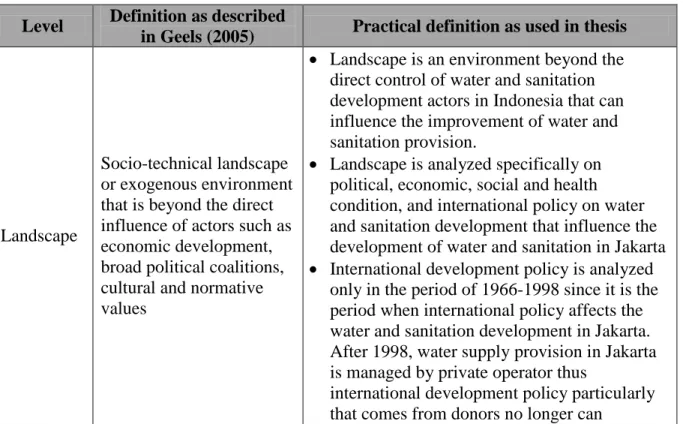
To explain the slow improvement of piped-water and sewer development in Jakarta and to analyze the factors that enabled and constrained its development from 1945 (when Indonesia gained its independence) to 2015, three different levels of analyses were used: landscape, regime, and niche (Geels 2005, 2006). The dynamic of piped-water and sewer development will be presented in three development phases based on the changes in the Indonesian government system (landscape) particularly the political and economic systems. The first development phase is from 1945-1966 when Indonesia was ruled by President Soekarno. The second development phase is from 1966 to 1998 when President Soeharto led the country. The third development phase is during the Reform Era from 1998 to 2015. Table 1 describes the definition of the level of analysis as used in this thesis.
Table 1. Definition of Each Level of Analysis in Multi-Level Perspective
Level Definition as described
in Geels (2005) Practical definition as used in thesis
Landscape
Socio-technical landscape or exogenous environment that is beyond the direct influence of actors such as economic development, broad political coalitions, cultural and normative values
Landscape is an environment beyond the direct control of water and sanitation development actors in Indonesia that can influence the improvement of water and sanitation provision.
Landscape is analyzed specifically on political, economic, social and health condition, and international policy on water and sanitation development that influence the development of water and sanitation in Jakarta
International development policy is analyzed only in the period of 1966-1998 since it is the period when international policy affects the water and sanitation development in Jakarta. After 1998, water supply provision in Jakarta is managed by private operator thus
6
intervention the policy making for water supply provision policy in Jakarta. While for sanitation sector, there is no international development policy has been affecting the policy of sanitation development in Jakarta since 1998.
Regime
Socio-technical regime where institutional arrangements and formal regulations are created and where engineers and designers share their cognitive routines such as roles, way of thinking, and way of doing. Regime is situated at the level of organizational field which show the behavior,
perception, and action of actors as part of
communities.
Regime level refers to the dominant practices, technologies, and rules embedded at an organizational level (institutions and infrastructure) which shape technological innovation. Regime provides stability and reinforcement to the prevailing socio-technical systems including factors that enable and constrain the improvement of water and sanitation in Jakarta such as government and donor policies and activities, regulation, problem in organizational level, etc.
Regime level in this thesis will mostly describe government and donor policies and activities. They are the dominant actors in water and sanitation provision in Jakarta.
Niche
Technological niche and the locus of radical innovations around new system may develop
Niches is the level or area that can facilitate the interactions between actors that support radical innovation and experimentation. Niche act as safe environments in which breakthrough development can grow, different from the selection process that occurs at regime level.
7
CHAPTER 2 : METHOD
2.1. Case Study
A single-case study was employed as a research strategy. The case study strategy is especially conducive to understanding the transformation of technology and society (Geels, 2005). The case study in this thesis aims to describe and analyze how water and sanitation conditions in Jakarta have changed over time. The rationale for selecting single-case study design rather than a multiple-case design is based on the characteristic unique to Jakarta. For example, Jakarta is the only province in Indonesia where 100% of its population lives in urban areas, it is home to all of the approximately 300 ethnicities in Indonesia, and its GDP accounts for 17% of Indonesia‟s GDP. Additional reasons for using a single-case study are replication logic. The period of analysis for this paper is 1945 to 2015. The year 1945 was chosen as the starting point of analysis because this was the year Indonesia gained its independence.
2.2. Data Collection
The sources data collected for this paper are: documentation, archival records, and interviews.
1. Documentation
8
written reports, administrative documents of governments and donors, formal water and
sanitation studies in Indonesia as a whole and/or Jakarta specifically, and articles in mass media. 2. Archival records
Archival records are used to present precise and relevant quantitative data (Yin, 2003). Archival records used in this paper include: organizational records such as population, water and
sanitation access, and budget over a period of time; list of foreign aid projects; and survey data such as census records or data previously collected about Jakarta and/or Indonesia as a whole. For this case study, national and regional survey and census data from the Indonesia National Statistical Bureau are used.
3. Interviews
Interviews are an essential source of evidence for case studies because key respondents share facts and their insights and opinions about events and situations.
a. Selection process
Key respondents from governmental and non-governmental arenas were interviewed. The potential respondents were identified previously during the writer‟s experience working in water and sanitation in Indonesia. To minimize bias, respondents were chosen from different institutions or organizations involved in decision making, policy planning, and advocacy of water and sanitation in Indonesia and/or Jakarta. These individuals are knowledgeable about current situations and past situations about the development of water and sanitation in Jakarta over the period covered by this study. Because this paper aims to describe water and
9 b. Respondents
Of the 27 key respondents that were contacted, 8 respondents were from the government and 19 respondents were from non-government arenas (see APPENDIX I for The List of
Interviewee). Respondents from the government include central and local governmental officials while non-government respondents were donors, a water supply operator and its private partner, a water supply regulator, a sewer operator, and a consulting firm. Nineteen respondents were interviewed and 8 respondents could not be reached or declined to participate.
c. Interview designs
10
option to ask questions or to say anything that was on their minds not previously covered during the interview. This study was reviewed by The University of North Carolina at Chapel Hill Institutional Review Board (study number: 15-2943) and it was determined that the study did not require IRB approval.
d. Interviews
In-depth semi-structured interviews were conducted by phone or Skype for 30 to 120 minutes per person after obtaining their verbal consent. Some follow up questions were also asked to solicit specific responses. Interviews were conducted from November 2015 to March 2016. One interview was conducted in English and 18 interviews with Bahasa Indonesia.
Interviews were recorded using a tape recorder and were transcribed together with notes taken during the discussions with respondents, providing the corpus of data for text analyses. The small number of respondents made it feasible to carry out the analysis without using computer tools for coding. The interview transcripts were read to identify statements on specific topics including factors, issues, and events influencing water and sewer development in Jakarta. Then, the interview results were used in combination with the data and
11
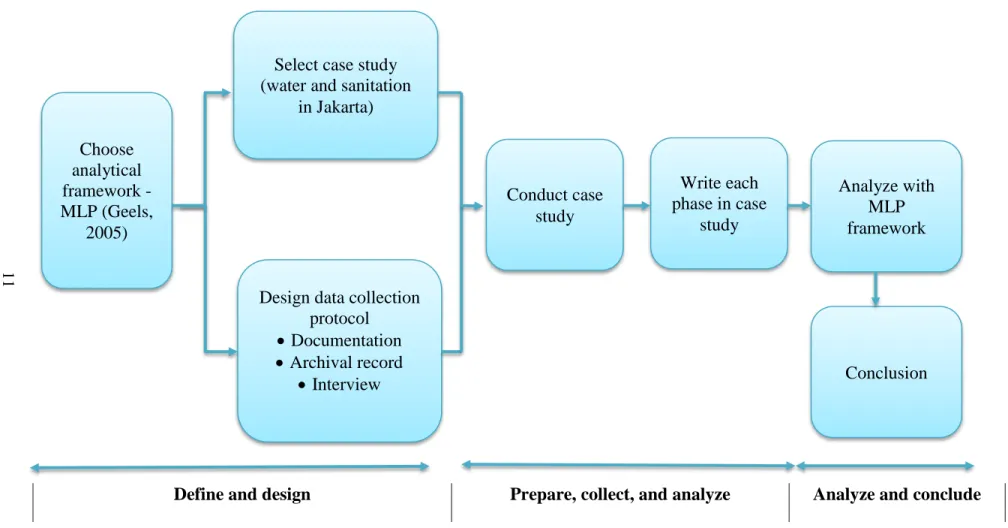
Figure 1.Case Study Method
Define and design Prepare, collect, and analyze Analyze and conclude
Source: author adopted from COSMOS Corporation cited in Yin, 2003 Choose
analytical framework - MLP (Geels,
2005)
Select case study (water and sanitation
in Jakarta)
Design data collection protocol
Documentation
Archival record
Interview
Conduct case study
Write each phase in case
study
Analyze with MLP framework
Conclusion
12
.3 Data Analysis
Multilevel Perspective as Analytical Framework
A multilevel perspective (MLP) framework was used to both analyze the information collected and to present the case study on water and sanitation development in Jakarta. The MLP has been used in similar historical case studies to analyze the transition of water supply and hygiene in the Netherlands (Geels, 2005) and the transition of cesspools to sewer systems in the Netherlands (Geels, 2006). The MLP is the most relevant framework to describe the case study because it allows the writer to frame many factors that contribute to the dynamic and changing processes of water and sanitation in Jakarta at broader aggregation levels and in the desired time interval (1945-2015). Therefore, the MLP was expected to reveal key stages and changes in water and sanitation development in Jakarta. The framework aims to capture, organize, and examine various factors that directly or indirectly contributed to water and sanitation development pathways in Jakarta.
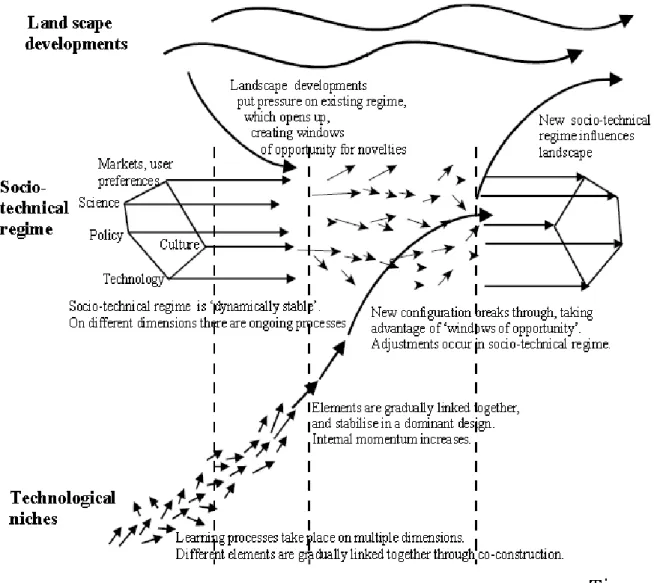
The MLP stresses „no simple cause or driver in system transitions‟ (Geels and Kemp, 2007:444). The key point of MLP is that system innovations come about through the interplay between dynamics processes at three levels in different development phases (Geels, 2006). According to Geels (2006), it was necessary to meet a set of conditions for regime
transformation - from cesspool to sewer system - as what occurred in the Netherlands. These conditions include: (i) regime insiders change their cognitive beliefs, behavioral norms, and regulations and (ii) increased pressure from outsiders. Figure 2 illustrates the dynamic at three different level of analysis in MLP.
13
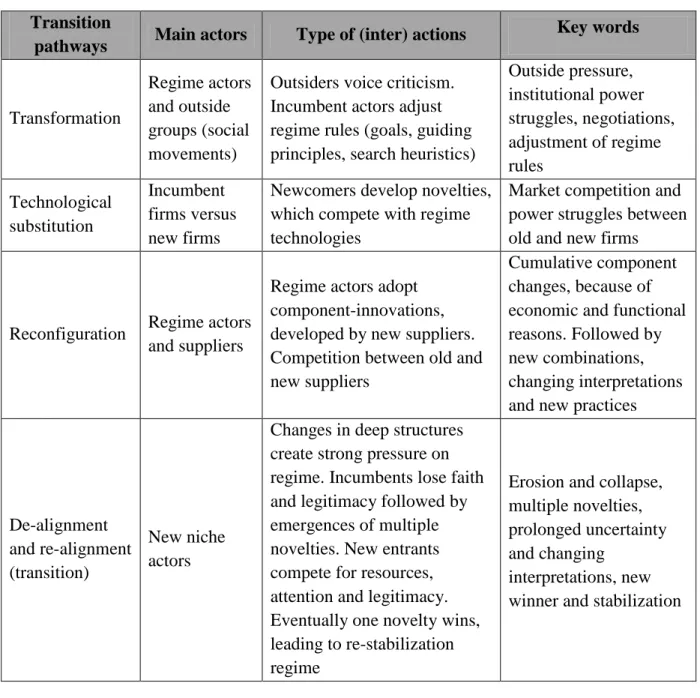
Furthermore, analyses were also conducted based on type of transition pathways (Table 2) as described by Geels and Kemp (2007). Table 2 summarizes the type of transition pathways based on main actors and type of interactions that contribute to regime transformation.
Figure 2. A Dynamic Multi Level Perspective on System Innovation
14
Table 2. Main Actors and (Inter) Actions in Transition Pathways
Transition
pathways Main actors Type of (inter) actions
Key words Transformation Regime actors and outside groups (social movements)
Outsiders voice criticism. Incumbent actors adjust regime rules (goals, guiding principles, search heuristics)
Outside pressure, institutional power struggles, negotiations, adjustment of regime rules Technological substitution Incumbent firms versus new firms
Newcomers develop novelties, which compete with regime technologies
Market competition and power struggles between old and new firms
Reconfiguration Regime actors and suppliers
Regime actors adopt component-innovations, developed by new suppliers. Competition between old and new suppliers
Cumulative component changes, because of economic and functional reasons. Followed by new combinations, changing interpretations and new practices
De-alignment and re-alignment (transition)
New niche actors
Changes in deep structures create strong pressure on regime. Incumbents lose faith and legitimacy followed by emergences of multiple novelties. New entrants compete for resources, attention and legitimacy. Eventually one novelty wins, leading to re-stabilization regime
Erosion and collapse, multiple novelties, prolonged uncertainty and changing
interpretations, new winner and stabilization
Source: Geels and Schot, 2007
15
16
CHAPTER 3 : CASE STUDY : THE DYNAMIC OF WATER AND SANITATION DEVELOPMENT IN JAKARTA FROM 1945 TO 1966
3.1 Landscape Level
3.1.1 Political Condition
The political system under the Old Order Era2 was known as Demokrasi Terpimpin or Guided Democracy (1958-1966), which is a democratic government with increased autocracy. After Indonesia gained its independence from Japan in August 17th, 1945, The Government of Indonesia focused its efforts on political development, with 70% of the Indonesian national budget allocated to the military (Yazid, 2014). As the new government primarily focused on growing the military sector, water and sanitation development received low priority.
Nevertheless, the first development of piped-water supply in Jakarta happened under the direction of President Soekarno (1945-1966) as an attempt to create political stability and to create a new image of Indonesia through the development of Jakarta as the capital city of Indonesia.
17
3.1.2 Economic Condition
Indonesia experienced modest economic progress in the early years of independence (Hill, 1996). However, the economy did not expand from 1961 to 1964 and inflation reached 600% (Hill, 1996). Poor economic growth, high inflation rate, political instability and an inability to wipe out colonial economic legacies led to many negative effects, including infrastructure maintenance neglect. Consequently, there was serious damage to infrastructure including water supply networks that had been built during Dutch colonial era (Ravestejein and Kop, 2008).
3.1.3 Social and Health Condition
Health, water, sanitation, and hygiene development had low political priority during Soekarno‟s presidential era. The central government only spent approximately Rp.416.5million per year (US$2.1million per year) for health development, roughly 5.2% of the national budget. The goal of health development under President Soekarno was to abolish the different treatment received by native verses non-native Indonesians (Hill, 1996).3 Policies to improve public health involved implementing curative actions such as building health care facilities and increasing the number of doctors. Preventive actions for the development of water and sanitation were not considered a priority, despite high mortality rates in infants and adults during this period. Table 3 illustrates the health condition in Indonesia from years 1948-1949 and 1960-1961.
3 As a result of different treatment to native and non-native Indonesians (The Dutch, The Chinese and The Arab), in
18
Table 3. Health Conditions in Indonesia in 1948-1961
Health Indicators 1948-1949 1960-1961
Number of hospital beds (number per 1,000 people) 0.8 0.8 Number of doctors (number per 1,000 people) 0.016 0.028 Infant mortality (number per 1,000 people) 115 to 300 125 Maternal mortality (number per 1,000 people) 12 to 16 N.A Crude death rate (number per 1,000 people) 10 to 15 21 Crude birth rate (number per 1,000 people) 20 to 30 N.A Source: Leimena, 1953, World Bank, 1974, Hill, 1996
3.2 Regime Level
As developing water and sanitation systems was not a priority during President Soekarno‟s era, urban condition in Jakarta deteriorated with little money invested for urban management (Ravestejein and Kop, 2008). Electricity connections were limited, piped water networks were broken, drainage and canals were clogged with sewage and solid waste, and no maps were available to locate and repair the water network system (Argo, 1999; Kop, 2008b). Sanitation was viewed as a private business or household responsibility (World Bank and Ausaid, 2013).
19
3.2.1 Enabling Factors for Water and Sanitation Development at Regime Level
The Government of Indonesia’s Development Policy to Develop Sizeable Projects
President Soekarno guided development policies in an effort to create an Indonesia that was different from the colonial East Indies. This included molding Jakarta into a town different from Batavia4 and developing it into the greatest city possible (Cybriwsky and Ford, 2001). To
achieve this development goal, the Government of Indonesia developed sizeable projects such as constructing large water treatment facilities in several big Indonesian cities, including in Jakarta, to support economic development. During President Soekarno‟s era, Indonesia increased its water production capacity from 3.000 l/s in 1945 to 9.000 l/s in 1968. Piped-water supply (private and shared) coverage increased from 8% to 19% (KemenPUPR, 2015) during the same time period.
As a way to obtain international recognition and modernize Jakarta, President Soekarno wanted to build a water supply network that could support his plan to host the 1962 Asian Games (Hill, 1996).5 At the same time, the Major of Jakarta, Sjamsurizal, felt that water supply had become one of the main problems in Jakarta due to rapid population growth and the increasingly ruptured water supply network (interview, government official).
To implement the vision of the President and to tackle water supply problems, the Major with the assistance of the Ministry of Health planned to build a 1,000 l/s water supply treatment plant, called Instalasi Pengolahan Air (IPA) Pejompongan I.6 The government realized that to
4 Batavia is the name of Jakarta during the colonial period of Indonesia (before 1945). 5
The plan also included to host Conference of New Emerging Forces (CONEFO) in 1966. However, this event was never held.
6 During the colonial era the Dutch had established Gemeentelijk Waterleiding Bedrijf (town water supply
20
implement such a big and modern water project, it would need a reputable contractor (interview, government official). Due to the lack of water supply engineers in Indonesia, Degremont, a company from France was chosen as the planner and the executor for the project (interview, government official).
The Establishment of Environmental Health Units under Ministry of Public Works
The Government of Indonesia established anEnvironmental Health Unit under Directorate General of Water Resources in Ministry of Public Works to carry out the project of
Pejompongan I in 1952 (KemenPUPR, 2015). Ir. Lie Tjong Hian was assigned to be the head of the Environmental Health Unit. His main responsibility was to carry out the development of IPA Pejompongan I project, the first water supply project in Indonesia after independence of the nation (KemenPUPR, 2015). Because water and sanitation development was of low interest among Indonesian engineers, he only had six staff members, to help him implement water supply projects until 1961.
One of the reasons why there was limited interest among engineers could be explained by a lack of understanding of environmental health and sanitary engineering at the time
(KemenPUPR, 2015). Due to the lack of engineers, many large piped-water systems in big Indonesian cities including in Jakarta were developed with the assistance of Degremont (KemenPUPR, 2015).
21
3.2.2 Constraining Factors for Water and Sanitation Development at Regime Level
The Dual Function of Water Supply Operators as Mandated in Law No.5/1962
The Government of Indonesia issued Law No.5/1962 on Local Government Companies during Soekarno‟s era as the fundamental legal basis for the establishment of local water supply companies (PDAMs) including the establishment of PAM Jaya, a water supply operator for Jakarta. According to the law, PDAM is a company that belongs to the local government. Its fundamental arrangement is determined by local regulation, or in other words, by the
Mayor/Regent or local legislature.7 Generally, the Mayor/Regent appointed a civil servant with no business experience as managing director of a PDAM, while the local government intervened with the day-to-day management of PDAMs (World Bank, 2006).
PDAM has three obligations: to provide water supply services, to act as a public utility, and to provide money for local revenue (Law No.5, 1962). These obligations have put PDAMs in difficult situations, particularly because most local governments do not want to allocate their money to the expansion of PDAM services (particularly for the expansion of distribution
networks which is the main responsibility of local governments) while they have to provide basic services to the community through cross subsidies with limited ability to draw on local
government funds. (interview, government official). Furthermore, the full cost of recovery is not emphasized. The trend of making PDAMs a source of local revenue complicates how they provide their services.
The management of PDAMs is quite complex as many central government agencies are responsible for their operation (see APPENDIX II for Institutional Framework in Water and Sanitation in Indonesia). Technical aspects such as the development of infrastructure and the
22
provision of raw water are the responsibility of the Ministry of Public Works. Managerial and institutional aspects are the responsibility of the Ministry of Home Affairs, financial and investment aspects are under the jurisdiction of the Ministry of Finance, and quality drinking water assurance is the responsibility of the Ministry of Health (see APPENDIX II).
Lack of Health Education and Preventive Action
Curative action was more prioritized than preventive action during Soekarno‟s
presidential era. J.Leimena, a physician who served as the first Minister of Health for Indonesia (1946-1956) had noted the necessity of good sanitation for gaining better public health and controlling communicable diseases that were endemic to Indonesia such as malaria and
hookworm.8 In his plan, he stressed the integration of curative and preventive action to improve public health (Leimena, 1953; Murakami, 2015).
While the Government of Indonesia was aware of that, because of such issues, greater attention was paid to curative actions as they more readily repaired damage sustained from wars (increasing the number of doctos, building hospitals, and other health care institutions, etc.). Preventive action to improve public health during President Soekarno era relied on conventional medical wisdom emphasizing the same techniques of courteous coercion, regulation, and
reliance on curatives previously used by the Dutch government in the colonial era (Gouda, 2009).
8 From colonial era until Soekarno‟s era, sanitation sector was defined as water supply, sewerage, refuge disposal,
23
3.3 Niche Level
3.3.1 Enabling Factors for Water and Sanitation Development at Niche Level
Development Aid and Technical Assistance from France
Many large water treatment plants (WTP) in Indonesia use material and technology from the country of France, as both the French Government and the French-based company
Degremont have been involved in many water supply projects in Indonesia since 1957. Projects include the development of IPA Pejompongan I in Jakarta as well as several WTP projects in the capitals of provinces such as Bandung, Semarang, and Banjarmasin (KemenPUPR, 2015). Due to political instability in the 1950s, only the Government of France was willing to provide loans for the development of IPA Pejompongan I. The company Degremont acted as a liaison to convince the Government of France to fund IPA Pejompongan I project. Degremont also
constructed all but the smallest water treatment plants in Jakarta and WTP Cisadane in Tangerang (Martijn, 2005). While the type of technology used in IPA Pejompongan I was conventional compared to similar projects in developed countries, it was considered modern technology for Indonesia (KemenPUPR, 2015).9 Due to the heavy influx of migrants to Jakarta, in 1962 the Government of Indonesia invested in the development of the second largest water supply treatment in Jakarta, IPA Pejompongan II, with a capacity of 1,000 l/s.10
9
The raw water came from Ciliwung River which routed through the city from Banjir Kanal Barat (West Flood Canal, built by the Dutch in 1923) then it pumped to water treatment plant in Pejompongan, Karet in Central Jakarta. From pipe transmission, the water is treated in coagulation unit (baffled channel) and flocculation unit (tube settler) before distributed to consumers.
10 The technology used in Pejompongan II was a slightly more modified than Pejompongan I. Pejompongan II has
24
3.3.2 Constraining Factors for Water and Sanitation Development at Niche Level
Lack of Sanitary Engineers and Ill-Suited Engineering Approach
During the 1950‟s and 1960‟s there was insufficient number of Indonesian engineers and urban planners (Van Roosmalen, 2008). Furthermore, after transfer of power from the
Netherlands to Indonesia in 1957, the number of Dutch‟s urban experts, city administrators and sanitary engineers decreased creating insufficient control and maintenance of public works infrastructure including water supply networks (Van Roosmalen, 2008). The condition of
existing water networks further deteriorated due to a lack of spare parts, as the water system built during the Dutch during colonial period had been manufactured in Germany (Argo, 1999). To cope with the failing piped water system, people increasingly relied on ground water supplies. By 1950 the number of registered wells had grown to approximately 90 wells (Argo, 1999; Kementerian Koordinator Bidang Perekonomian, 2014) (Figure 3).
Figure 3. Groundwater Extraction and Number of Registered Wells in Jakarta (1879-2007)
25
Beside insufficient numbers of Indonesian engineers and planners, another constraining factor for water and sanitation development during the early stages of independence was the lack of capacity for engineers and urban planners. This lack of capacity was caused by difference in civil engineering works in Indonesia verses the Netherlands (Ersten, 2008). Most public works projects in Indonesia were executed under direct control of the government. Engineers were not only responsible for implementing technical designs, but also for managing non-technical aspects of the project, such as labor recruitment and organizing worker accommodations. In contrast, engineers in the Netherlands were only responsible for implementing technical designs (Ersten, 2008). These non-technical skills, were not adequately covered for Indonesian engineers at Bandung Technical College.11 Furthermore, a senior Dutch urban planner, Thijsse in Ersten (2008), mentioned that the lack of competence of personnel correlated with inadequate education and lack of publications and manuals on city planning applicable to the Indonesian context. Ersten had frequently proposed plans to improve the capacity of Indonesian planners by adding a sanitation and hygiene course to the urban development curriculum in Indonesia. However, the civil engineering curriculum continued to be based on that of the Technical College in Delft, Netherlands (Van Roosmalen, 2008).
The Growth of Informal Water Vending
The water vending industry first grew in the northern part of Jakarta in response to a lack of clean drinking water. Previously, the northern communities of Jakarta satisfied their domestic water needs by taking water from ponds as ground water in the area was brackish and unfit to drink (Susantono, 2001). Beginning in 1952, people who lived in the Tanjung Priok port, North
11 Bandung Technical College was the former of Institute Technology of Bandung (ITB), the first technical college
26
Jakarta had to buy water from vendors at prices ranging from Rp.0.33 (US$0.0016) to Rp.200 (US$1) per jerrican (1 jerrican = approximately 20 liters) depending on the distance required to deliver the water (Bappenas, UNICEF, and Yayasan Dian Desa, 1990). Vendors bought water from the PAM center or public hydrants at prices ranging from Rp.0.083 (US$0.0004) to Rp.6.25 (US$0.03) per jerrican. The vendor then ported around 12-20 jerricans worth of water with a single-axle handcart and visited neighborhoods in need of their services. These vendors, mostly immigrants from Central Java, came to Jakarta in search of sanctuary and jobs during the Darul Islam movement at the beginning of the 1950s (Bappenas, UNICEF, and Yayasan Dian Desa, 1990). While vendors lived scattered across Jakarta, many settled in North Jakarta, where the proportion of household using vended water was the largest compared to other areas of Jakarta. These vendors had few marketable skills because they had been farmers in the past but were willing to do anything to survive (Susantono, 2001).
Informal water vending continued to grow in Jakarta not only to fill the gap left by formal services but also to provide better perception of water in the areas where piped-water was
available. With subsidies from the central government, public hydrants were developed to give the poor access to water, particularly to those who lived in North Jakarta.12 However, due to the rapid expansion of Jakarta‟s population, hydrants were not always available where needed. This is where water vendors filled the gap, by transporting water from hydrants to houses in need (Susantono, 2001).
12
27
3.4 Summary of Water and Sanitation Development during 1945-1966
By the end of the Soekarno era (1966), the water production capacity in Jakarta had increased tenfold from 315 l/s to 3,315 l/s. However, only 12% of the population had access to a piped-water supply, although the volume of water supply available in Pejompongan I was considered adequate to meet city demand (Kooy, 2008). Water use was unmetered. A flat rate of Rp.100-200 per month (US$0.241-0.482) was applied (Kooy, 2008). The combination of high water use, lack of metering, and the flat tariff contributed to the financial burden of water operations (PAM Jaya) especially after the enactment of Law No.5/1962 on Local Companies (KemenPUPR, 2015). The poor bore much of the burden in that they had no piped-water access. Poor households were served by only 230 public hydrants. They had to buy water from a vendor or rely on shallow wells or exposed sources such as polluted canals and drainage ditches (World Bank, 1974).13 Figure 4 illustrates the location of Pejompongan I and II water treatment plants and their distribution pipelines.
The development of IPA Pejompongan I is regarded as one of the greatest achievements of water supply development in Indonesia although its services were only enjoyed by specific groups of people (Kooy and Bakker, 2008).14 Investment made by the central government to increase water production capacity was not accompanied by an investment from PAM Jaya and/or the central government to expand distribution networks and improve non-technical aspects of piped-water supply provision in Jakarta.
13 The water tariff was a flat rate without metering of Rp.100-200 per month (US$0.241-0.482) or about Rp.10-20
per m3 (US$0.024-0.048 per m3). In contrast, wwater from vendors could reach up to Rp.440 per m3 (US$1.06 per m3). Some households in North and East Jakarta ended-up paying water vendors 5 to 44 times the flat rate water tariff or more than 10% of their household income (World Bank, 1974).
14 These groups of customers are household in the city suburb (Kebayoran Baru), hotels and buildings along Jalan
28
Figure 4. Pejompongan I and II Water Treatment Plants and Its Distribution Line
Source: Martijn, 2005
29
Table 4. Summary of Water and Sanitation Development during 1945-1966
Landscape Level Regime Level Niche Level
Water Supply Coverage in 1966 Sanitation Coverage in 1966 Political: guided democracy (a democratic government with increased autocracy) Economic: economy did not expand and inflation reached 600%
Social and health: Health, water, sanitation, and hygiene development had low priority International policy on water and sanitation development:- Enabling factors for water and sanitation development Constraining factors for water and sanitation development Enabling factors for water and sanitation development Constraining factors for water and sanitation development Piped-water: approximately 10% households; (ii) flat tariff; (iii) water tariff: Rp.200
(US$0.67-1) per month per HH Non-piped water: 25% use private well, 42% use common well, 19% use carried water, and 4% use other sources
30
CHAPTER 4 : CASE STUDY: THE DYNAMIC OF WATER AND SANITATION DEVELOPMENT IN JAKARTA FROM 1966 TO 1998
4.1 Landscape Level
4.1.1 Political Condition
The macro political culture under the President Soeharto era was characterized by authoritarian rule. After the “Old Order” of Soekarno, the political focus changed from political development to economic and social development under “New Order” of Soeharto. Defense through the achievement of political stability, economic development, and equity were pivotal concepts under the New Order cultural policy, known as The Development Trilogy. The
government implemented numerous development programs with the continued use of foreign aid money including the development of water and sanitation infrastructure.
The authoritarian system was highly centralized with the main financial and policy making responsibilities at the central government level in Jakarta. The central government provided 80% of the investment for development (World Bank, 1984) and was the height of its power. There were high levels of corruption, nepotism, and collusion in governmental circles which affected the delivery of services to communities. The local government often had a substantial amount of money granted to them through lobbying and collaboration with different agencies. In the late 1990s, Indonesia was among the top five countries with the highest
31
Under the Soeharto era, the modernization of Jakarta initiated during the Soekarno era continued but with altered goals. The development of Jakarta in an effort to foster national prestige under President Soekarno changed to an effort to enable economic growth under President Soeharto (Cybriwsky and Ford, 2001). Figure 5 shows the urban expansion of Jakarta from 1993 to 2010 which affected the growth of its peripheral areas by form in Greater Jakarta (aka Jabodetabek, an acronym that stands for Jakarta, Bogor, Depok, Tangerang and Bekasi regencies). This extensive growth further threatened the public infrastructure conditions in Jakarta.15
Figure 5. Administrative Map of Jabodetabekk and Its Urban Expansion (1993-2010)
Source: Pravitasari et. al., 2015
15
32
4.1.2 Economic Condition
The Indonesian economy continued to grow rapidly during the Soeharto era without much improvement in water and sanitation services, where GDP grew by an average of 5-7% annually from the late 1960s to the late 1990s (BPS, 2000). Water, sanitation, and health sector did not receive much attention during the beginning of New Order era with high incidence of cholera in the beginning of the 1970s (Figure 6). The proportion of the national budget spent on the water and sanitation sector from 1968 to 1973 was Rp.16billion (US$50million) or about Rp.698 (US$2.13) per capita (Presidential Decree No.319, 1968).
Figure 6. Number of Reported Deaths and Number of Reported Cholera Cases in
Indonesia
Source: WHO, 2015
0 10,000 20,000 30,000 40,000 50,000 60,000
1960 1962 1964 1966 1968 1970 1972 1974 1976 1978 1980 1982 1984 1986 1988 1990 1992 1994 1996 1998 2000 2002 2004 2006 2008 2010 2012
Cases
Year
33
4.1.3 Social and Health Condition
Despite a high degree of centralization, the health and social sectors were subsequently improved under the era of President Soeharto, especially in the 1970s and 1980s. Life
expectancy rose from 48 years in 1950 to 65 years in 1997 and infant mortality decreased from 200 per 1,000 in 1950 to 52 per 1,000 in 1997 (BPS, 2015a and Kristiansen and Santoso, 2006). Death rates in children younger than 5 years old fell from 218 to 60 between 1971 and 1999 (BPS, 2015a). Poverty incidence declined 50-60% during the 1960s (Hill, 1996) to 24% in 1998 (Aulia, F., personal communication, September 4, 2015). Limited room for dissenting in policy-making and policy implementation was considered to be a key in alleviating poverty and health improvements (Indonesia Investment, 2016).
4.1.4 International Development Policy for Water and Sanitation Development
34
The investment required to achieve IDWSSD in urban areas was estimated to be approximately US$1.7 billion or 3-fold higher than the national budget during 1974-1979 (REPELITA II). Given the government‟s limited resources, the financial gap was to be funded through multilateral developmental bank loans and water tariff improvements (World Bank, 1983).
Beside BNA the Government of Indonesia also established a new policy in the mid-1980s to improve the use of local government resources in the development of urban infrastructure. This urban development reform was known as the Integrated Urban Infrastructure Development Plan (IUIDP). Reforms carried out under the IUIDP to increase local revenue included
improvement in the property tax and PDAM accounting systems, as well as changes in tariff mechanism for water supply and electricity (World Bank, 1987). Under these reforms, the water tariff in Jakarta was increased from Rp.235 per m3 (US$0.14) in 1987 to Rp.516 (US$0.31) per m3 in April 1988 (World Bank, 1990b). PAM Jaya also retained and reinvested their share of profits in the piped-water supply system expansion in Jakarta.16
4.2 Regime Level
The city of Jakarta experienced an even greater population growth in the 1960s and early 1970s (approaching 6% annually), which caused a considerable strain on its already inadequate water and sanitation services. Jakarta had a housing stock of 486,000 units and only a few houses had electricity in 1969 (World Bank, 1974). Of these dwellings, 68% had no private sanitation facilities, only 32% of households had a private toilet (albeit with sub-standard pit privy or septic
16 Based on Law No.5/1962 on Local Government Companies, PDAMs have to return 55% of their profit to local
35
tanks) and only 35% of households had access to private piped-water connections and/or private well (World Bank, 1974).
There are three main drinking water sources in Jakarta: (i) piped water (private and public taps); (ii) vendor-supplied water; and (iii) private and public wells. Only 10% of households in the city had private piped water supply in their homes, 40% of the households bought water from water vendors at a relatively high-price and more than 50% of the population relied on
groundwater wells, which were often contaminated by sewage seepage and increasing salinity due to depletion of the fresh water aquifer (World Bank, 1974). By the late 1980s, 32% of households relied on vendors for drinking water and more than 40% of these households belonged to the low income households (income less than Rp.130,000 per month or US$78 per month) (Kooy, 1998). At the end of 1988, there were 1,100 public hydrants in Jakarta, delivering on the average 13.6 m3 per day per hydrant (Martijn, 2005).
Groundwater with high salinity was commonly found in the northern part of Jakarta where the majority of poor people resided (BPS, Jakarta 2015).17 Affluent households opted to connect to piped water if their groundwater was saline, but poorer households generally bought drinking water from vendors while continuing to use well water for other purposes (Alberini et al., 1996). Ninety-eight percent of households in North Jakarta depended on water vendors. More affluent households living in Central Jakarta had the highest proportion of households with piped water supplies. In 1973, the water tariff was flat without metering and was Rp.100-200 per month (US$0.241-0.482). At the same time water from vendors was Rp.440 per m3 (US$1.06 per m3). Approximately 40% of the households living in North and East Jakarta bought water from vendors at rates 5 to 44 times more per m3 than the piped-water tariff or more than 10% of their
17 The northern part of Jakarta has been estimated to be part of Jakarta where high percentage of low income resides
36
household income (World Bank, 1974). Average water use was estimated to be 80l/capita/day while poor households living in kampungs consumed about 45 l/capita/day (World Bank, 1974).
Because there were no sewer systems, middle, and upper income households had privies or septic tanks, the majority of which the majority were substandard or simply functioning as holding tanks for sewage. One-half of the population already used flush toilets although only 32% of the population owned a private toilet (World Bank, 1976). Most of the effluent of the sub-standard septic tanks was deposited directly into open canals and drainage ditches. Poor households in kampungs used rivers or canals for bathing, washing, and defecating as very few public toilets were available. Subsequently, canals and rivers were heavily polluted with sewage and solid waste.
4.2.1 Enabling Factors for Water and Sanitation Development at Regime Level
The Government of Indonesia’s Development Policy on Low Cost Technology to
Provide Water and Sanitation Access to the Poor
Aware of water-borne diseases, the Government of Indonesia initiated the Water Supply and Sanitation Sector Study with funding from WHO/IBRD in 1971-1977. One of the
37
presented as solutions. These recommendations were incorporated into several project designs during the 1970s and 1980s. This program is known as Kampung Improvement Program (KIP) and the majority of funding came from the World Bank. The strategy of KIP was rooted in the colonial slum cleaning activities that were received and expanded in 1969 by Ali Sadikin, the Governor of Jakarta (Chifos, 1996).
The government chose an “appropriate technology” policy or low cost technology solution as a way to provide basic infrastructure and implement the trilogy development policy of Soeharto (political stability, economic development, and equity) particularly the equity principle. In other words, the government chose to accelerate the provision of water and sanitation services throughout the country and to ensure national resources were distributed evenly across income groups and regions. The policy objective was to lower investment costs and make the technology more affordable to the poor while also providing low cost services to poor customers (World Bank, 1994). The low cost principle was applied until the 1980s when the Government of Indonesia embarked upon BNA and IUIDP approaches. There were no technical guidelines or standard for developing low cost water and sanitation options when the government implemented KIP in the 1970s and1980s. While the World Bank realized that the standards used for the KIP were not ideal solutions, this option was thought to be a vast improvement over the existing conditions (World Bank, 1976).
Around 31,000 additional units of leaching pits were built via KIP I and III in 1980.18 There was no sewage treatment plant in Jakarta at that time. In the absence of any rational standards governing the pit privy design in Indonesia, little was known on how pit privies or septic tanks generated biological and chemical pollution into ground and surface waters (World
38
Bank, 1976). It was hoped that sewage would be treated via anaerobic and aerobic bacterial decomposition in a 2 m3 pit volume for a 5-year life time period (World Bank, 1976). Later in 1984, the government built the first sewage treatment plant in Pulo Gebang with a capacity of 300m3/day to serve the eastern part of Jakarta. The second, sewage treatment plant was built in Duri Kosambi in 1995 for the western part of Jakarta with capacity of 300m3/day (Japan International Corporation Agency, JICA, 2009).19 These two treatment plants treated less than one-third of their planned capacity, with only 30% of septic tanks and pits in Jakarta emptied as a consequence (WSP, n.d.) (Figure 7).
Figure 7. Volume of Septage Emptied and Number of Customers with Septic Tank
Emptying (1996-2013)
*Estimated number of septic tanks and/or pits in Jakarta in 2015 is 2.17 million (WSP, n.d.) Source: BPS Jakarta, 2000-2014
19 Pulo Gebang was planned to serve the whole of East Jakarta and 50% each of West Jakarta, South Jakarta, North
Jakarta, and Central Jakarta. Duri Kosambi on the other hand was planned to serve the whole of West Jakarta along with 50% each of East Jakarta, South Jakarta, North Jakarta, and Central Jakarta.
0 20,000 40,000 60,000 80,000 100,000 120,000 140,000
0 500,000 1,000,000 1,500,000 2,000,000 2,500,000 3,000,000 3,500,000
1996 1997 1998 1999 2000 2001 2002 2003 2004 2005 2006 2007 2008 2009 2010 2011 2012 2013
m
3/year
Unit
Year The number of households in Jakarta (unit)
39
The Enactment of Law No.11/1974 on Irrigation: The First Law Governing the
Water Sector
An important regulatory achievement established by the water sector during the Soeharto era in 1974 was the enactment of Law No.11/1974 which stated irrigation and water use priorities. The first priority was for domestic water purposes such as drinking water, flushing, etc.; the second priority was agriculture and irrigation. Under this law, water was considered a social good and was managed in a partial-fragmental approach with the government as the dominant actor.
The Separation of Regulator and Operator Function of Water Supply in Jakarta
The water regime in Jakarta began to rise in late 1960, marked by the separation of management between regulators and water supply operators (PAM Jaya) initiated by the Governor Ali Sadikin in 1968. This separation was also in response to the enactment of Law No.5/1962. Prior to 1968, Jakarta‟s water supply operator was under the management of Jakarta‟s Public Works Agency. In 1973, Jakarta‟s Water Supply Company-PAM Jaya was established as a regional water supply enterprise for the Jakarta province responsible for the management and operation of production facilities and for generating revenue for operation and maintenance of the system.
The establishment of PAM Jaya as a semi-autonomous water operator was an effort to encourage local government to operate and manage the distribution system and service
40
connection in their home while the true connection fee was only Rp.200,000-Rp.300,000 (US$22,7-34,1) (ICW, 2000).
After PAM Jaya became a semi-autonomous operator, the old management practice changed from un-metered and low charges for water to metered water and a cost-recovery (covering operation and maintenance costs) based tariff structure. A new regulation known as “meterisasi” or metering program was imposed during the 1970s to introduce meter and monitoring devices. The “meterisasi” program was also introduced as a result of the central government program for expanding the distribution pipe line for IPA Pejompongan I and II in the beginning of 1970s (interview, government official). Integrated records of actual
consumption and numbers of customers were maintained and an actual list of customers was recorded for the first time in 1975 (Bakker et al., 2006). Around 90,000 meters were installed by 1975 (Kooy, 2008). Furthermore, a new water tariff structures was introduced in 1975. This structure changed from a flat tariff of Rp.200 per month (US$0.48) to Rp.2,000-3,000 per month (US$4.8-7.2 per month) based upon the actual volume consumed by customers (Kooy, 1998). In 1974, non-revenue for water was estimated to be 40% of total water supply (World Bank, 1974).
4.2.2 Constraining Factors for Water and Sanitation Development at Regime Level
Lack of Public Health Approach in Water and Sanitation Provision
The low cost development policy through the implementation of KIP faced many
problems. KIP suffered from poor physical planning and link to the city-wide infrastructure. The evaluation of KIP after 20 years showed sanitation received low priority and that the use of public sanitation facilities was limited due to the top-down approach of the program
41
conditions and needs. There was failure to involve households in location planning, lack of maintenance training programs, and there no financial or in-kind contributions (Haryatiningsih, 1996; World Bank, 1994). One of national government officials conceded that“We realized we
needed to generate community demand before building sanitation facilities, however, many times
we were too impatient to implement such a community based-program” (interview, government official).
The knowledge taught to sanitary engineers during education was among the reasons why the decentralized system suffered from poor physical planning and lack of ties to the centralized system. The education of sanitary engineers in Indonesia mostly incorporated the technologies and approaches used in developed nations with only the hardware aspects of these technologies taught at universities (Slamet, 1991). Most engineers did not prioritze non-technical aspects of low cost technology, nor did they believe public health considerations were their responsibility, but the responsibility of the Ministry of Health (Ouano, 1980). Regarding the roles of sanitary engineers and public health practitioners, a senior government official explained that the effort to integrate sanitary engineering and public health in water and sanitation development projects had been attempted since the government established the National Policy Development of
Community-Based Water Supply and Environmental Sanitation in 2003. This policy mainly aimed to better implement water supply and sanitation provision in rural areas. However, the role of engineers in providing water and sanitation systems in urban areas was still the dominate role compared to the role of a public health specialist. The same government official stated that “This condition [the dominant role of engineers in urban areas] happens since government policy is
still mainly focused on technical outputs [shown by the number of infrastructure that has been