ENGAGING BROAD-LEVEL STAKEHOLDERS IN IMPROVING MENSTRUAL KNOWLEDGE AND HYGIENE PRACTICES AMONG ADOLESCENT GIRLS IN INDIA:
A STAKEHOLDER ANALYSIS
By Sheila V. Patel
Undergraduate Honor’s Thesis
Department of Health Policy & Management Gillings School of Global Public Health
University of North Carolina
April 25, 2014
Approved:
1
Table of Contents
Executive Summary ... 2
Introduction ... 4
Research Question ... 6
Literature Review ... 7
Awareness & Knowledge ... 7
Hygiene Management ... 7
Information Sources ... 9
Emotional & Health Consequences ... 9
Social Consequences ... 11
Study Contribution ... 11
Methods ... 13
Social Ecological Framework ... 13
Stakeholder Identification & Interviews ... 14
Findings ... 17
Current Efforts to Improve Menstrual Knowledge and Hygiene Management ... 17
Fragmented Nature of Current Efforts ... 19
Developing a More Formal Community ... 20
Culture of Silence around Menstruation ... 22
Menstruation Not Perceived As an Issue ... 22
The Symptoms of Limited Resources ... 23
Power & Leadership in Building a Community ... 24
Discussion ... 26
Collaboration Theory ... 26
Communities of Practice ... 27
Addressing the Challenges ... 29
Limitations ... 30
Conclusion ... 30
Acknowledgements ... 31
Appendix I: Interview Guide... 32
2 Executive Summary
Many Indian girls entering puberty are ignorant about menstruation, a natural
physiological process that requires appropriate management during early adolescence. This is coupled with poor understanding of how to manage periods. In India, this is due to a combination of factors: the adults around them often lack proper information, the education system does not adequately teach adolescents about health and development, and the culture discourages discussion of sexuality and reproduction.
This study aims to understand current broad-level initiatives led by government officials, United Nations agencies, product manufacturers, non-governmental organizations, and
researchers that are serving the menstrual needs of adolescent girls in India. Specifically, this study looks at what partnerships have already been formed, utilized, or could be established, to enhance their menstrual knowledge and hygiene practices. The following objectives were investigated: (1) the current efforts of stakeholders groups; (2) the interests and positions of stakeholder groups in cross-collaborating with one another; and (3) the ways in which collaboration between stakeholder groups could best function sustainably.
A stakeholder analysis design was used to explore these objectives. Representatives of each stakeholder group were selected using purposive sampling methods. Each was interviewed using a semi-structured interview guide via email correspondence, phone, or Skype.
Transcriptions of the interviews were inductively coded for themes and then analyzed. The broad types of activities these stakeholder groups are currently engaged in
3
steady communication. There was a clear desire to develop a platform to share information concerning current efforts, findings, and lessons learned with one another. Some challenges identified in moving forward with this include the culture of silence that surrounds menstruation in India, failure to recognize menstruation as an issue worth addressing, and limited resources.
4 Introduction
Adolescence, defined by the World Health Organization as the period of life between ages 10 and 19, is a time of emotional, physical, and social transformation. The sexual and reproductive health (SRH) of this population has been traditionally overlooked by the public health community, perhaps because they are yet to be viewed as sexual beings in many cultures.1 There are approximately 120 million girls between the ages of 10 and 19 in India,2 and less than 40% of them have access to relevant SRH advice and resources.3 More specifically, many Indian girls entering puberty are ignorant about menstruation, a natural physiological process that requires appropriate management during early adolescence.4
Adolescent girls in India and other low- and middle- income countries may face menstrual-related challenges for a variety of reasons: the adults around them often lack proper information, the education system does not adequately teach adolescents about health and development, and the culture discourages discussion of sexuality and reproduction.5 This combination of factors can cloud the topic of menstruation with a dirty and shameful
connotation, which often leaves girls unprepared and unsure of how to cope or seek assistance when they have their first menstrual cycle, known as menarche.5
The consequences of being ill-informed and mismanaging menstruation can have far-reaching and long-lasting emotional, physical, and social impacts on girls. Premenstrual symptoms such as back pain, swelling of the breast, and irritability are common symptoms experienced by menstruating girls in India.6-11 A majority of this population also suffers from dysmenorrhea, or painful periods and excessive blood flow that interfere with daily
6,8,11-5 12,15
and can lower self-confidence,18-19 making it more difficult for young Indians to act in agency when, for example, it comes to unwanted sexual encounters or early marriage. Restrictions on activities of daily living,11,20 modification of diet,6,9,11,17,19,21 disruption of household work,7,13,17,22-24 and exclusion from religious practices6-8,13,17,19,22-25 are also common menstrual experiences of Indian girls. When adolescents should be focusing on their education and normal social interactions, they are instead forced to deal with inhibiting physical symptoms and face the negative social consequences of their natural physiological development.
6 Research Question
This study aims to understand current broad-level initiatives led by government officials, United Nations agencies, product manufacturers, non-governmental organizations, and
researchers that are serving the menstrual needs of adolescent girls in India. Specifically, what partnerships have already been formed, utilized, or could be established, to enhance their
menstrual knowledge and hygiene practices. This stakeholder analysis investigates the following: (1) the current efforts of stakeholders groups; (2) the interests and positions of stakeholder
7 Literature Review
Awareness & Knowledge
Among adolescent girls, one systematic review found that complete lack of awareness of menstruation prior to its onset was more common in India than in other low- and middle-income countries.5 A study from the Indian state of West Bengal reported that a third of participants had no prior knowledge of menstruation during menarche, compared to nine out of every ten
participants in Rajasthan; indicating a wide range in awareness across the country.7,14,17-19,21,26-27 In assessing girls knowledge of menstruation, many had incomplete understanding and held common misconceptions. For example, studies reported as few as 18% of girls in
Maharashtra and as many as 86% of those in West Bengal who recognized menstruation as a physiological process.7-8,14,17-19,24 Some girls considered menstruation to be a curse, disease, or representation of sin, rather than a normal bodily function.8,14,17,23 A majority of young girls in India are also unaware of the origins of menstrual blood.13,17,24,26 Furthermore, only among a third of adolescents in Karnataka understood that menstruation is associated with the capacity to conceive.14 Girls who reside in rural India and girls who are not enrolled in school had less awareness and knowledge about menstruation than their more urban, educated counterparts.7,26 The incomplete understanding of menstruation among Indian girls leaves them unprepared to properly manage their cycle.
Hygiene Management
8
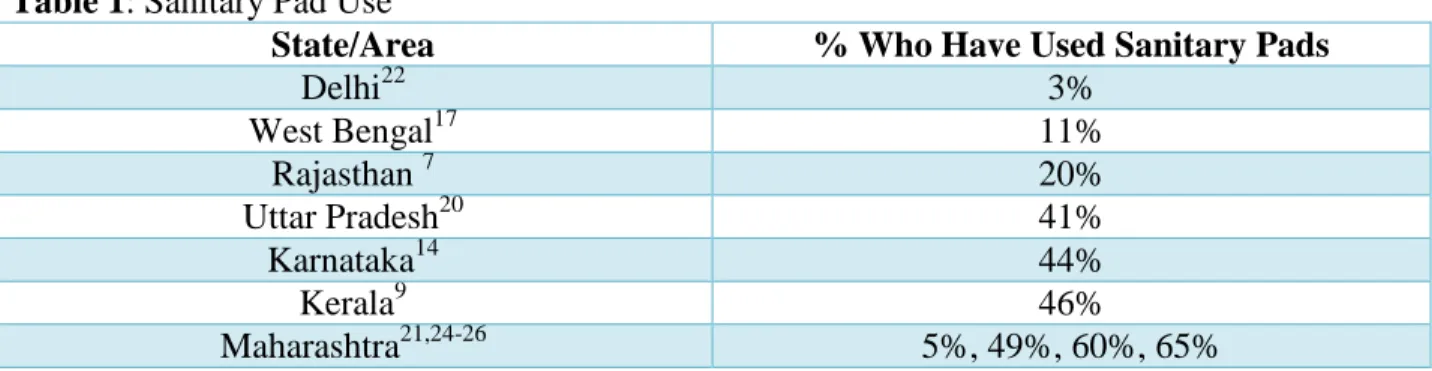
Table 1: Sanitary Pad Use
State/Area % Who Have Used Sanitary Pads
Delhi22 3%
West Bengal17 11%
Rajasthan 7 20%
Uttar Pradesh20 41%
Karnataka14 44%
Kerala9 46%
Maharashtra21,24-26 5%, 49%, 60%, 65%
While a majority of girls reported using scraps of cloth in Madhya Pradesh,23 Maharashtra,13,21,24 and Rajasthan,7 many cited using a combination of absorbents that included both hygienic materials and recycled cloth.9,17 Participants reported preferring cloth and other alternatives to sanitary pads because they were cheaper and more readily available.22,24 A majority of mothers in a studied slum area of Jharkhand also believed that sanitary pads cause infections.18
9
Information Sources
The limited knowledge of menstruation and appropriate management practices among Indian adolescents may be a result of the silence that traditionally surrounds menstruation and associated topics (e.g. sexual intercourse) in India.29 The observed proportion of young girls seeking information from their mothers was more than half in Gujarat,19 Jharkhand,18
Karnataka,14,27 Maharashtra,24-26 and Rajasthan.7 Peers are another important source of
information, and may even be more important than mothers in some parts of the country.16,21-22 Teachers tend to be underutilized sources of information as many girls fail to learn about menstruation and its management in school.7,16,19,21,24,26 The proportion of girls who cited receiving information on menstruation in school was less than 1% across the Indian states of Madhya Pradesh, Chhattisgarh and Uttar Pradesh.30 Finally, a small proportion of girls learned about menstruation through media and internet sources.13,16
Whether by a relative, peer, or other community member, the information on menstrual health and hygiene provided to young girls is not always timely nor is it adequate. Researchers found that mothers in India who did provide their daughters with information often did not do so until after menarche was reached.7,17,21,22,26 Additionally, limited information is provided to girls at the time of their first period and it is given only once.22 Girls in Delhi noted feeling ashamed and confused when inquiring about menstruation22 and in the state of Punjab, nearly all desired more information.6
Emotional & Health Consequences
10
impure13 or dirty,19 and many reported feeling “disgusting” while menstruating.18 Additional anxiety may stem from irregular periods, reported by a third of girls in India,7,11,14,25 and lack of preparedness.19 In contrast, these negative emotions may be balanced by the more positive belief that menarche symbolizes womanhood and the sense of happiness and pride that accompany maturation.8
Regardless of their feelings toward menstruation, a majority of girls in India experience some physical consequences. Reproductive tract infections, for example, have been associated with poor hygiene management.31 Commonly reported premenstrual symptoms include back and abdominal pain, fatigue, headaches, swelling of the breasts, mood swings, and irritability.6-11 Additionally, premenstrual syndrome was reported among 63% of this population in Delhi.11 Multiple studies found dysmenorrhea, characterized by a painful period and excessive blood flow that interfere with daily activities, among the majority of girls.6,9,11-15 A notable number of girls in West Bengal also suffered from depression during their periods.16 A majority of
adolescent girls questioned did not connect the problems they experienced with their menstrual cycle.16
11
Social Consequences
The frequency and magnitude of poor management of menstrual symptoms have additional consequences on the social lives of young girls. Menstrual pain and difficulty managing it are also reasons for missing school (Table 2).
Table 2: School Absenteeism
State/Area % Who Have Stayed Home Due to
Period/Pain
Haryana8 14%
West Bengal17 16%
Delhi11 17%
Maharashtra15 23%
Andhra Pradesh12 49%
In Maharashtra, girls living in rural areas were more likely to miss school in comparison to girls in urban areas.15 Dysmenorrhea was also associated with school absenteeism in Andhra
Pradesh11 and Punjab.6 Girls who did attend school reported poor concentration and reduced performance.6 Among adolescent girls who are employed in Delhi, a quarter missed work because of their cycle.11
Activities of daily living, in general, were restricted by menstruation among two fifths of those questioned in Delhi11 and nine out every ten girls in Uttar Pradesh.20 Modification of diet was observed in Delhi,11 Gujarat,19 Kerala,9 Maharashtra,21 Punjab,6 and West Bangalore.17 Household work was disrupted for girls in multiple Indian states as well.7,13,17,22,23,24 Other restrictions observed across India include abstaining from participating in religious activities as well as from entering specific areas of their homes.6-8,13,17,19,22-25
Study Contribution
12
13 Methods
This investigation uses the stakeholder analysis design outlined by Schmeer (2000).32 Stakeholder analyses are used by health researchers to systematically gather and analyze qualitative information regarding the interests, resources, and power of key informants. This study identifies and assesses these areas in addition to the current efforts of stakeholder groups in improving young girls’ menstrual experiences in India. The main data source for this assessment
is stakeholder interviews that were conducted in February and March 2014 via email correspondence, phone, and/or Skype.
Social Ecological Framework
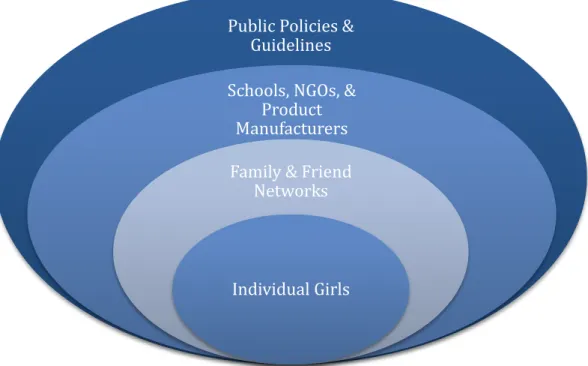
Research concerning the menstrual needs of Indian girls has traditionally focused on interpersonal interactions and exchange of information with family, friends, and, to some extent, teachers. A broader scope, however, is needed to better meet the diverse needs of these young girls. In understanding that individual decisions and behaviors are affected by elements on multiple levels beyond the interpersonal, this study will employ the social ecological model (SEM)33 as a theoretical framework to investigate policies and programs that have been implemented in India to address menstrual knowledge gaps and poor hygiene management among adolescent girls.
14
Public Policies & Guidelines
Schools, NGOs, & Product Manufacturers
Family & Friend Networks
Individual Girls
stakeholders within these institutions might interact to influence girls’ menstrual experiences. Finally, the broader societal level includes government officials and policy-makers.
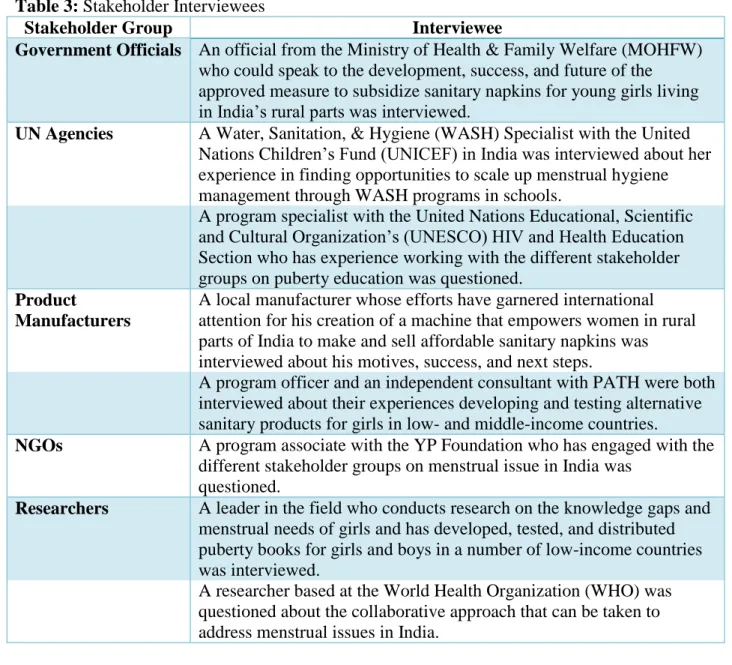
Five groups of broad-level stakeholders were selected for the purpose of this analysis: (1) government officials; (2) United Nations (UN) agencies; (3) product manufacturers; (4) non-governmental organizations (NGOs); and (5) researchers. The decisions and efforts made by these groups are believed to have a greater societal impact that influences the inner circles of the SEM and the potential to enhance the menstrual knowledge and hygiene practices of Indian girls.
Figure 1: Social Ecological Model
Stakeholder Identification & Interviews
15
Table 3: Stakeholder Interviewees
Stakeholder Group Interviewee
Government Officials An official from the Ministry of Health & Family Welfare (MOHFW) who could speak to the development, success, and future of the approved measure to subsidize sanitary napkins for young girls living in India’s rural parts was interviewed.
UN Agencies A Water, Sanitation, & Hygiene (WASH) Specialist with the United
Nations Children’s Fund (UNICEF) in India was interviewed about her experience in finding opportunities to scale up menstrual hygiene management through WASH programs in schools.
A program specialist with the United Nations Educational, Scientific and Cultural Organization’s (UNESCO) HIV and Health Education Section who has experience working with the different stakeholder groups on puberty education was questioned.
Product
Manufacturers
A local manufacturer whose efforts have garnered international attention for his creation of a machine that empowers women in rural parts of India to make and sell affordable sanitary napkins was interviewed about his motives, success, and next steps.
A program officer and an independent consultant with PATH were both interviewed about their experiences developing and testing alternative sanitary products for girls in low- and middle-income countries.
NGOs A program associate with the YP Foundation who has engaged with the
different stakeholder groups on menstrual issue in India was questioned.
Researchers A leader in the field who conducts research on the knowledge gaps and
menstrual needs of girls and has developed, tested, and distributed puberty books for girls and boys in a number of low-income countries was interviewed.
A researcher based at the World Health Organization (WHO) was questioned about the collaborative approach that can be taken to address menstrual issues in India.
For each group of stakeholders, semi-structured interviews were conducted using an interview guide with questions addressing the objectives listed below in regard to improving menstrual understanding and hygiene practices of adolescent girls in India:
(1) The current efforts and influence of stakeholders groups
(2) The interests and positions of stakeholder groups in cross-collaborating with one another (3) The ways in which collaboration between stakeholder groups could best function
16
The interview guide was broken down into three sections, on current initiatives, external landscape, and partnerships and collaboration (Appendix I). The semi-structured nature of the interviews ensured each of these areas of interest was covered while simultaneously allowing the conversations to build naturally.35
17 Findings
Current Efforts to Improve Menstrual Knowledge and Hygiene Management
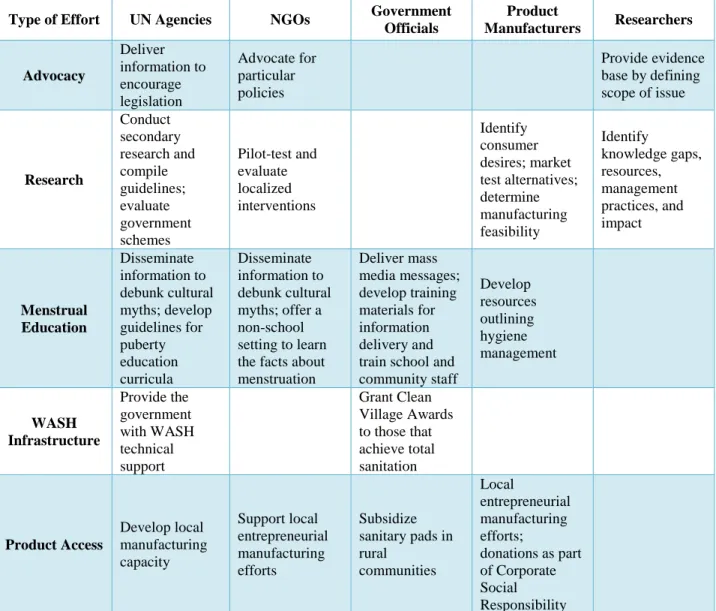
Table 4 shows the variety of current efforts being pursued in India by the stakeholder group representatives, and demonstrates a growing concern regarding issues surrounding the management menstruation. All stakeholder groups are engaged in multiple areas, indicating that there is overlap of each group’s areas of focus.
Table 4: Current Stakeholder Efforts in India
Type of Effort UN Agencies NGOs Government
Officials
Product
Manufacturers Researchers
Advocacy Deliver information to encourage legislation Advocate for particular policies Provide evidence base by defining scope of issue
Research Conduct secondary research and compile guidelines; evaluate government schemes Pilot-test and evaluate localized interventions Identify consumer desires; market test alternatives; determine manufacturing feasibility Identify knowledge gaps, resources, management practices, and impact Menstrual Education Disseminate information to debunk cultural myths; develop guidelines for puberty education curricula Disseminate information to debunk cultural myths; offer a non-school setting to learn the facts about menstruation Deliver mass media messages; develop training materials for information delivery and train school and community staff Develop resources outlining hygiene management WASH Infrastructure Provide the government with WASH technical support Grant Clean Village Awards to those that achieve total sanitation Product Access Develop local manufacturing capacity Support local entrepreneurial manufacturing efforts Subsidize sanitary pads in rural communities Local entrepreneurial manufacturing efforts;
donations as part of Corporate Social Responsibility
18
stakeholder groups engages in more than one of the domains identified in Table 4. To emphasize the breadth of efforts required, stakeholders commented:
Menstrual hygiene management is beyond sanitary napkins, beyond distribution. (UN Official)
There is a requirement for looking at this issue in a more holistic manner. (Product Manufacturer)
Current initiatives by UN agencies and NGOs in India include advocating for policies that require psychosocial support for adolescent girls in the school setting. This ranges from having at least one female teacher trained to provide menstrual support in every school, to having a menstrual hygiene management council in every school to allow girls to openly discuss
menstruation. Other efforts centered on advocacy include delivering information packages to key decision makers that stress the importance of addressing menstrual-related issues experienced by young girls across the country.
The evidence in these packages comes largely from literature reviews and other
secondary research conducted by UN agencies. These reviews are based on primary research in India that explores the misconceptions held by adolescent girls, their sources of information, the impact of their periods on school attendance, and hygiene management practices. Additionally, UN agencies evaluate the impact of government schemes among smaller populations to ensure strong flagship programs, before they are rolled out nationally. NGOs also pilot-test and evaluate small scale interventions, such as peer-to-peer education and the impact of comprehensive puberty education. Product manufacturers conduct their own research regarding culturally acceptable and appropriate product design for Indian girls.
19
done by distributing accurate information to girls, as well as their primary information sources, that counter those misconceptions. Knowledge gaps are further addressed through mass media messages produced by the government. The government also endeavors to train support staff in schools and communities as comprehensive and supportive resources for girls. In making decisions regarding puberty education, the government looks to UN agencies for guidance in developing school-based puberty education curricula. NGOs further provide open forums for girls to discuss the physiological process and proper management in a non-school setting.
In both schools and communities, the government is partnering with UN agencies to ensure adolescent girls are gaining access to private facilities with clean water and sanitary methods for product disposal. The government grants Clean Village Awards on a state-level to villages that achieve collective goals like universal toilet coverage and school sanitation coverage. An evaluation by UN agencies revealed areas for strengthening the scheme, leading these agencies to provide the government with technical support in this area.
To increase adolescent girls’ access to hygienic products in India, the government
enacted a scheme to subsidize sanitary pads in impoverished rural communities. While this initiative supports large-scale private sector manufacturers, UN agencies and NGOs are supporting local production activity by helping local manufacturers develop their capacity to produce affordable and high quality products. Private sector manufacturers also make product donations to areas with low access as part of their Corporate Social Responsibility.
Fragmented Nature of Current Efforts
Interviewees asserted that they reach out across stakeholder groups and sectors when they are aware of others’ initiatives and can clearly see the benefit of supporting one another.
20
manufacturers, UN agencies and NGOs, and UN agencies and researchers have been utilized to improve the menstrual experiences of adolescent girls in India. Mostly, however, interviewees described their efforts in the overall field as fragmented, indicating the rarity of a convening body to ensure steady communication. For instance:
One company is looking at manufacturing products, one is looking at distribution, and one is looking at awareness generation. This needs to be brought together.
(NGO Advocate)
I feel that one of the most critical issues for menstrual hygiene management is that there is a lack of clear leadership.
(UN Official)
Developing a More Formal Community
Interviewees expressed a desire for a platform to share information concerning efforts, findings, and lessons with one another. There was consensus that the various groups would benefit from such a learning medium. Stakeholders commented:
There needs to be a central level platform where people can come and discuss these issues together…and see what other people are doing to learn from each other. (Product Manufacturer)
Somebody needs to take the lead in coordinating some efforts and identifying the different skillsets of the bodies that are involved.
(Product Manufacturer)
Multiple stakeholders referenced the likelihood of duplication of work that may result from improper communication across groups. One major area of duplication was in reference to data collection. An interviewee stated:
“There is a lot of duplication and I don’t see this research coming together in one platform.”
(UN Official)
21
applied the issue of duplication to product development, citing an example in which the same alternative products have been independently designed and developed by different groups. Had this been communicated through a shared platform, resources could have been better. For example, one stakeholder noted:
It is almost like people in different silos across the country are working on the same thing and probably are just reworking something that people have already worked on. That is why there is a need to share and learn.
(Product Manufacturer)
When discussing the different skills that stakeholder groups possess, which may be helpful in supporting one another’s efforts and also better utilized through coordinated
endeavors, interviewees emphasized the following: funding and reach into rural communities with worse outcomes by the Indian government; funding, advocacy, and technical guidance by UN agencies; consumer research and modeling by product manufacturers; community
representation and mobilization by NGOs; and expertise and evidence-generation by researchers. Beyond expressing a desire to convene a working group, some interviewees articulated interest in using such a platform to hold one another accountable for their individual
responsibilities in the wider arena. This suggested that some stakeholder groups may not be doing all they can or should to effectively address menstrual-related issues. As one stakeholder shared:
The Indian central government has put puberty, menstrual hygiene and menstrual health on its public health agenda. Some state governments have taken this up more actively than others.
(Researcher)
22
really come to light. Another, however, whose work is more localized, has experienced resistance when attempting to have these particular types of conversations with various representatives of the identified stakeholder groups.
Culture of Silence around Menstruation
While these interviews represented growing interest in the area of menstruation, many reiterated that menstruation is still not being discussed by key individual stakeholders within some of these groups:
People don’t talk about this issue. I feel like that’s a barrier, that people are
uncomfortable talking about menstruation—this basic thing that happens to half of us in the world.
(Product Manufacturer)
There is a whole culture of silence not only at the level of adolescent girls, but it cuts across the girls to society at large—the mother, the father, and I would say definitely the policymakers.
(UN Official)
The silence around this issue in India is likely a result of its taboo nature. There was
disagreement between interviewees about whether the country’s male-dominated leadership
amplifies this.
Menstruation Not Perceived As an Issue
Stakeholders emphasized that not only is menstruation not talked about, but it is not seen as an issue that needs to be addressed. The interviewees voiced that perhaps the issue of
menstrual hygiene management has not garnered support as rapidly as other issues because the direct health impact is still uncertain. These individuals, however, recognized menstrual-related issues as important to address for the purposes of keeping adolescent girls in school and
improving future outcomes related to health and livelihood. For example:
23
society, for a culture, in terms of the health of that girl as a woman and of her potential children and increased income generation possibilities…that is the most compelling argument I see for [menstrual education and hygiene management].
(Product Manufacturer)
This disregard has resulted in the perception that limited resources are being devoted to improving the menstrual experiences of adolescents in India. Stakeholders commented:
When ranking priorities, do kids need a desk to sit at or a book about puberty, they probably need a desk, but really they need both. It often comes down to competing resources.
(Researcher)
It would be helpful to have someone in countries reminding [stakeholders] of the importance… but we don’t have the funding to pay for that and there are better uses of the money we do get.
(Researcher)
The Symptoms of Limited Resources
A challenge in convening these stakeholder groups, tied to limited resources, is the perceived competition between groups. There is competition between the social entrepreneurship of women’s groups selling locally-made products and the subsidization of products made by
international private companies as well as between the WASH and education sectors for the limited resources devoted to this issue. This in turn prevents the scale-up of these individual initiatives to national-level practice.
Collaboration on national endeavors is believed to be further hindered by the additional lack of non-financial resources like appropriate research:
We immediately reviewed the data there was on menstruation in low resource settings and how girls and women manage menstruation. There was not much.
(Product Manufacturer)
We have smaller studies...which have been done and may be state specific. We don’t have any pan-Indian national data.
24
In the literature that does exist, impact relies heavily on how school attendance is affected by menstruation. One interviewee, a researcher, identified potential indicators that have been largely overlooked by research: comfort during their period in school, girls’ levels of participation in
class, self-efficacy around managing menstruation comfortably, and stress levels when they have their period and don’t have sufficient facilities to manage.
Power & Leadership in Building a Community
When asked about stakeholder group influence, interviewees agreed that the backing of UN agencies and the government is necessary to put and keep this issue on the agenda. For example:
Having some global groups, like the World Health Organization, make some strong statements about the importance of menstrual hygiene would be very helpful. (Product Manufacturer)
The movers and shakers are the Ministries—the government has a huge influence as far as any program in India is concerned…In India, nothing happens without the
government. (UN Official)
The emphasis on government involvement was found to be in direct contention with the
challenge of encouraging male officials to speak up and engage in the issue of menstruation. The interviews further revealed disagreement concerning which stakeholder group should lead the coordination and collaboration of efforts:
To bring different stakeholders together, a coordinating body needs to have authority. This can only be done by the government at national, state and district levels.
(Researcher)
If the government takes over something like this, [the discussion] becomes very narrow. So, the government is definitely not the best option to steer such a working group. (Product Manufacturer)
25
One interviewee suggested allowing the different groups to spearhead the different sectors involved (e.g. education, infrastructure), and create separate but open mediums for sharing and learning. Another suggested tackling the issue on a state by state basis, to increase opportunities for female government officials to take on a leadership role and champion efforts in their states. Others credited the field’s infancy as the reason they were hesitant to offer suggestions regarding
26 Discussion
As menstrual-related issues continue to gain attention in India, more and more entities are looking to become involved in the problem-solving process. The variety of issues and current efforts identified, however, are interdisciplinary and require these champions to work with one another across sectors to realize their shared goals. The ultimate goal of this analysis was to encourage fully integrated efforts by developing an appropriate strategy for enhancing current collaborations and increasing future collaborations between the identified stakeholder groups. The qualitative data collected, however, did not support this aim. Interviewees across stakeholder groups were unsure of what this type of full integration would involve, how to get there, and how it would best function. This is in part due to the infancy of the field. At this point, smaller steps would likely be more appropriate in helping these stakeholder groups meet their shared
objectives of improving the menstrual experiences of adolescent girls in India.
Collaboration Theory
It is through collaboration that conversations between stakeholder groups can takes place, resources can be consolidated, similar initiatives can be informed and improved, and progress can be sustained. While collaboration theory recognizes that these benefits are absolutely necessary to address any complex social issue, it is also founded on the principle that collaboration can take place on a continuum of low to high integration.37 There are three potential points of integration: (1) cooperation, (2) coordination, and (3) collaboration.38
Cooperation is a low level of integration through which stakeholder groups share information in order to aid one another’s efforts, and coordination is a more integrated process by which
27
achieve common goals. Based on this study, there may be greater benefits to improving cross-stakeholder cooperation and coordination at this time—rather than jumping into a highly integrated level of collaboration.
Communities of Practice
Developing a community of practice is one way to move forward that would allow stakeholder groups in India to interact on multiple levels of this, or a similar, continuum of integration.
Communities of practice are groups of people who share a concern, a set of problems, or a passion for a topic, and who deepen their knowledge and expertise in an area by
interacting on an ongoing basis.39
Members of this type of collaborative effort do not interact daily, but choose to do so periodically because they recognize the value of their relationships.39
By emphasizing peer consultation, communities of practice encourage cooperation to increase collective insight.40 For the stakeholder groups working in India to improve the menstrual experiences of adolescent girls, this could start virtually, as simple as an online dashboard. Since current work is described as fragmented, a formal sharing mechanism to keep champions within the various stakeholder groups informed of current efforts and best practices or to widely disseminate data on indicators and impact is a good place to start. Additionally, because communities of practice are made up of peers that emphasize knowledge over authority, the individual endeavors of the different stakeholder groups have the capacity to be of higher technical quality.40
A community of practice, virtual or otherwise, can go further by providing a space for the champions of this issue to coordinate activities across stakeholder groups. Successful
28
capabilities to their advantage.40 This is an opportunity for groups to learn from the UN agencies’ expertise in advocacy and the NGOs’ community perspective, as well as utilize the government’s broad distribution network, the product manufacturers’ innovation, and the researchers’ ability to design sound methods in generating data. If not to take full advantage of the skills at their
disposal, the various members can still use this forum to align their efforts and minimize duplication—a major concern of the interviewees in this study.
Among interviewees, leadership in organizing a community of practice for these stakeholder groups remains unclear. Literature on collective impact initiatives indicate a requirement for a separate backbone organization to manage and support such an endeavor.41 Establishing and sustaining a community requires time, which members likely do not have to spare. Rather, an entirely separate staff dedicated to logistical and administrative planning, managing, and supporting may be necessary to ensure the community’s success.41
This would require a large financial investment, either by an external funding body or shared across members.
29
could be (1) informed through interactions that involve researchers who have identified
knowledge gaps and misconceptions, and officials from the Ministry of Education who have the capability to push educational materials to schools across India, as well as (2) shared with NGOs who might be spearheading education efforts in non-school settings. Simultaneously, NGOs can coordinate the participating groups in engaging in menstrual education activities without
overlapping or competing for girls’ attention. Convening the stakeholder groups in this manner
and providing each with ownership over different areas promotes accountability through positive peer pressure. This is a step toward ensuring that each stakeholder group is doing everything they can and should to improve the menstrual experiences of adolescent girls in India.
Addressing the Challenges
30
Limitations
A two month data collection period limited the number of key informants that could be interviewed within each group, making it difficult to generalize findings to entire stakeholder groups or specific entities within those groups. Additionally, interviews of private sector product manufacturers and potential large-scale donors would have been helpful in mapping the
landscape of current efforts and understanding future possibilities in improving the menstrual experiences of adolescent girls in India.
Conclusion
The likelihood of being ill-informed and mismanaging menstruation in India is high and can have far-reaching and long-lasting emotional and physical impacts that significantly
influence the social lives of adolescent girls. Research concerning the menstrual experiences of Indian girls has traditionally focused on interpersonal interactions and exchange of information with family, friends, and, to some extent, teachers. This study’s consideration of the social
31 Acknowledgements
32 Appendix I: Interview Guide
Stakeholder Groups’ Initiatives
1. What are the major concerns and goals of your stakeholder group, around this issue? 2. How have you tackled this issue?
a. Barriers in development and implementation b. Overcoming barriers
3. What lessons have been learned from these efforts?
4. What do you and other government officials hope to do to address this issue?
5. What action channels are open, but have not yet been taken, that you would consider?
External Landscape
1. What have other stakeholder groups done to address this issue?
2. How successful have these efforts been? Are the root causes being addressed? 3. How did you learn about these initiatives?
Partnerships & Collaboration
1. What skills or resources (human, financial, material) might your stakeholder group bring to a collaborative effort on this issue?
2. What skills or resources (human, financial, material) might other stakeholder groups bring to a collaborative effort on this issue that you think would be especially helpful? 3. Which potential partners (government officials, UN agencies, product manufacturers,
NGOs, researchers) have the ability to make or break any future collaboration? 4. What partnerships have you utilized in past and current efforts?
a. Benefits b. Best practices c. Barriers
d. Areas for improvement
5. Which stakeholder groups are you interested in partnering with? a. Benefit
b. Medium
6. Whose responsibility is it to maintain such partnerships? a. Required resources
33 References
1. United Nations Population Fund (1997). UNFPA and Adolescents. Retrieved from http://www.unfpa.org/public/home/sitemap/icpd/International-Conference-on-Population-and-Development/unfpa_and_adolescents.
2. Census Data (2011). Retrieved from http://censusindia.gov.in.libproxy.lib.unc.edu.
3. Dixon-Mueller, R (2011). The sexual and reproductive health of younger adolescents. World Health Organization.
4. Chong E, Hallman K, Brady M (2005). Investing when it counts. Population Council. 5. Chandra-Mouli, V, Patel SV (2013). Systematic review: knowledge and understanding of
menarche, menstrual hygiene and menstrual health among adolescent girls in low- and middle-income countries [draft].
6. Chaudhuri A, Singh A (2012). How do girls deal with dysmenorrhea? Journal of Indian Medical Association 110: 287-291.
7. Khanna A, Goyal RS, Bhawsar R (2005). Menstrual practices and reproductive problems: a study of adolescent girls in Rajasthan, India. Journal of Health Management 7(1): 91-107 8. Kumar G, Kundan M (2011). Psycho-social behavior of urban Indian adolescent girls during
menstruation. Australasian Medical Journal 4(1): 49-52.
9. Nair MKC, Chacko DS, Darwin MR, Padma K, George B, et al (2012). Menstrual disorders and menstrual hygiene practices in higher secondary school girls. Indian Journal of Pediatrics 79: 74-78.
10. Patil MS, Angadi, MM (2011). Menstrual pattern among adolescent girls in rural area of Bijapur. Al Ameen Journal of Medical Sciences 6(1): 17-20.
11. Sharma P, Malhotra C, Taneja DK, Saha R (2008). Problems related to menstruation amongst adolescent girls. Indian Journal of Pediatrics 75(2): 125-129.
12. Avasarala AK, Panchangam S (2008). Dysmenorrhoea in different settings: are the rural and urban adolescent girls perceiving and managing the dysmenorrhoea problem differently? Indian Journal of Community Medicine 33(4): 246-249.
13. Nemade D, Anjenaya S, Gujar R (2009). Impact of health education on knowledge and practices about menstruation among adolescent school girls of Kalamboli, Navi-Mumabi. Health and Population: Perspectives and Issues 32(4): 167-175.
14. Shanbhag D, Shilpa R, D’Souza N, Josephine P, Singh J, et al (2012). Perceptions regarding menstruation and practices during menstrual cycles among high school going adolescent girls in resource limited settings around Bangalore city, Karnataka, India. International Journal of Collaborative Research on Internal Medicine and Public Health 4(7): 1353-1362
15. Thakre SB, Thakre SS, Ughade S, Thakre AD (2012). Urban-rural differences in menstrual problems and practices of girl students in Nagpur, India. Journal of the Indian Academy of Pediatrics 49: 733-736.
16. Ray S, Ghosh T, Mondal PC, Basak S, Alauddin M, et al (2011) Knowledge and information on psychological and gynaecological problems among adolescent school girls of eastern India. Ethiopian Journal of Health Science 21(3): 183-189.
17. Dasgupta A, Sarkar M (2008). Menstrual hygiene: how hygienic is the adolescent girl? Indian Journal of Community Medicine 33(2): 77-80.
34
19. Tiwari H, Oza UN, Tiwari R (2006). Knowledge, attitudes and beliefs about menarche of adolescent girls in Anand district, Gujarat. Eastern Mediterranean Health Journal 12(3-4): 428-433.
20. Avachat SS, Phalke DB, Phalke VD (2011). Impact of sex education on knowledge and attitude of adolescent school children of Loni village. Journal of Indian Medical Association 109: 808-811.
21. Dongre AR, Deshmukh PR, Garg BS (2007). The effect of community-based health
education intervention on management of menstrual hygiene among rural Indian adolescent girls. World Health Population 9(3): 48-54.
22. Garg S, Sharma N, Sahay R (2001). Socio-cultural aspects of menstruation in an urban slum in Delhi, India. Reproductive Health Matters 9(17): 16-25.
23. Kushwah SS, Mittal A (2007). Perceptions and practice with regard to reproductive health among out-of-school adolescents. Indian Journal of Community Medicine 32(2): 141-143. 24. Thakre SB, Thakre SS, Reddy M, Rathi N, Pathak K, et al (2011). Menstrual hygiene:
knowledge and practice among adolescent school girls of Saoner, Nagpur District. Journal of Clinical and Diagnostic Research 5(5): 1027-1033.
25. Shitole A, Patnaik B, Pandey A, Patil R (2012). A study of practical aspects of menstrual hygiene—a rural community based study. Online International Interdisciplinary Research Journal 2(6): 64-70.
26. Bobhate PS, Shrivastava SR (2011). A cross sectional study of knowledge and practices about reproductive health among female adolescents in an urban slum of Mumbai. Journal of Family and Reproductive Health 5(4): 119-126.
27. Udgiri R, Angadi MM, Patil S, Sorganvi V (2010). Knowledge and practices regarding menstruation among adolescent girls in an urban slum Bijapur. Journal of Indian Medical Association 108: 38-40.
28. Dhingra R, Kumar A, Kour M (2009). Knowledge and practices related to menstruation among tribal Gujjar adolescent girls. Journal of Ethnobiology and Ethnomedicine 3(1):43-48. 29. Burgers L, Lhalungpa S (2008). Sharing simple facts. United Nations Children’s Fund India. 30. Mahon T, Fernandes M (2010). Menstrual hygiene in South Asia: a neglected issue for
WASH (water, sanitation and hygiene) programmes. Gender & Development 18(1): 99-113. 31. Sumpter C, Torondel B (2013). A systematic review of the health and social effects of
menstrual hygiene management. PLoS ONE 8(4): e62004.
32. Schmeer K (2000). Stakeholder analysis guidelines. Policy toolkit for strengthening health sector reform. The Latin America and Caribbean Regional Health Sector Reform Initiative. 33. McLeroy KR, Bibeau D, Steckler A, Glanz K (1988). An ecological perspective on health
promotion programs. Health Education Quarterly 15(4): 351-377.
34. Maxwell J. Designing a qualitative study. In: Bickman L, Rog DJ, eds. The SAGE Handbook
of Applied Social Research Methods. 2nd ed. Thousand Oaks, CA:SAGE; 2008: 214-253.
35. Patton MQ. Qualitative interviewing. In: Laughton CD, Axelsen DE, Peterson K, eds.
Qualitative Research and Evaluation Methods. 3rd ed. Thousand Oaks, CA: SAGE; 2002:
339-427.
36. Ulin PR. Qualitative data analysis. In: Robinson ET, Tolley EE, eds. Qualitative Methods in
Public Health: A Field Guide for Applied Research. 1st ed. San Franciso, CA: Jossey-Bass;
2005: 139-174.
35
38. Peterson NL (1991). Interagency Collaboration Under Part H: The Key to Comprehensive, Multidisciplinary, Coordinated Infant/Toddler Intervention Services. Journal of Early Intervention 15(1): 89-105.
39. Wenger E, McDermott RA, Snyder W. Cultivating Communities of Practice, A Guide to Managing Knowledge. Harvard Business Press; 2002.
40. McDermott R (2007). Building healthy communities. Inside Knowledge 10(9): 14-19. 41. Kania J, Kramer M (2011). Collective impact. Stanford Social Innovation Review.