STRANGE BEDFELLOWS: CONSERVATIVE GOVERNMENTS AND FAMILY POLICY IN CANADA AND GERMANY, 2005 – 2015
Rahim Mohamed
A dissertation submitted to the faculty at the University of North Carolina at Chapel Hill in partial fulfillment of the requirements for the degree of Doctor in
Philosophy in the Department of Political Science
Chapel Hill 2018
Approved by:
John D. Stephens
Liesbet Hooghe
Evelyne Huber
Rahsaan Maxwell
ii
iii ABSTRACT
Rahim Mohamed: Strange Bedfellows: Conservative Governments and Family Policy in Canada and Germany, 2005 – 2015
(Under the Direction of John D. Stephens)
This dissertation contributes to the literature on recent and ongoing family policy reforms
in affluent countries by comparing the respective family policy agendas of right party-led
governments in Canada and Germany between 2005 and 2015. My comparative assessment of
reforms enacted by the governments of Stephen Harper and Angela Merkel, respectively,
indicates that an increased cross-national salience of the financial and logistical challenges faced
by modern (i.e.: dual-earner and single-parent) families presents right-of-center parties with an
incentive to utilize family policy proposals instrumentally to broaden their electoral appeal. This
gives vital context to large-n statistical research that indicates a weakening of partisanship as an
explanatory variable for recent family policy developments.
The study also finds that differences in the specific policies implemented by each
government can ultimately be traced back to the domestic discursive context. Germany presented
the more favorable environment for comprehensive, women’s employment supporting reforms
due to a widespread perception of the low domestic birth rate as a threat to intergenerational
‘sustainability’. The cause was also helped by the presence of credible policy spokeswoman
Ursula von der Leyen, who championed a progressive package of reforms while, at the same
time, embodying a traditional image of maternity that appealed to conservatives. By contrast, the
iv
exemplified by the Harper government’s signature Universal Child Care Benefit
(UCCB). Harper later launched two children’s activity tax credits crafted to appeal to
families in critical suburban ‘swing ridings’. Although both opposition parties proposed a
national daycare strategy as an alternative to Harper’s agenda, the idea has only limited
popular appeal due to the questionable record of the country’s only standalone provincial
daycare program, based in Québec, and a silencing of feminist perspectives in the
national policy dialogue. Lastly, I find that an ancillary discourse linking family policy to
the cultural integration of migrants was visible in Germany but not in Canada. This
finding is substantiated in Chapter 5 via a statistical topic analysis of over 450 relevant
v
ACKNOWLEDGEMENTS
I would first like to thank my advisor, John D. Stephens, for his guidance throughout the
process of researching and (re-)writing this dissertation—as well as his endless patience with the
multitude of missteps I have made along the way. Starting from my participation in his Welfare
States seminar back in the spring of 2011, John has nourished my interest in social policy and
continually challenged me to be more rigorous in my thinking. I feel truly fortunate to have been
able to study under one of the field’s foremost experts. I owe a similar debt of gratitude to the
other members of my committee: Liesbet Hooghe, Evelyne Huber, Rahsaan Maxwell, and
William Keech. Each of you has, in your own way, made an indispensable contribution to this
project. Sections of this manuscript have been presented at various conferences and workshops
over the years and, through this process, have been improved tremendously. I thank Alain Noël,
Malliga Och, and Laura Dean in particular for reading early drafts of my work and offering
helpful feedback.
Like many (if not most) of the other graduate students in my department, I have
benefitted greatly from the generous financial support of Thomas M. Uhlman. Without having
received an Uhlman Summer Research Fellowship in 2016, I would not have been able to
conduct the fieldwork necessary for the completion of this dissertation. Moreover, my time in the
field would not have been anywhere near as fruitful without the guidance of both Martha
Friendly (A.K.A. ‘The Mothership’) and Sandra Griffin—who jointly gave me the lay of the land
vi
compiling the set of newspaper articles analyzed in Chapter 5. Thanks go out to as each of my
twenty-five interviewees as well.
On a more personal note, I give thanks to the many cherished friends and colleagues I
have accumulated through my journey in graduate studies. In Chapel Hill: John Lappie, Kris
Cubero, Clyde Ray, Chris Clark, Apurba Chakraborty, Brian Overington, Micah Levinson, Lydia
Miller-Anderson, Graeme Robertson, Jim Stimson, Kevin Roach, Guzel Garifullina, Wayne
Faust, Preston Triplett, Jessica Bridgers, Joseph Higgins, and Marissa Wojcinski. In
Winston-Salem: Jack Amoureux, Charles Kennedy, Michael Pisapia, Peter Siavelis, Kathy Smith, Elide
Vargas, Will Waldorf, Helga Welsh, Robert Whaples, and Betina Wilkinson. It has been a
bumpy ride (to say the very least), but the personal ties that I have forged throughout make it all
worthwhile. This, regrettably, includes some people I have lost along the way: Thomas Carsey,
David Coates, Tarik Farooq, Naveed Hajee, Chanelle Morgan, and my eldest brother Aneez—
may you all rest in peace. Lastly, I thank my brother Riaz, sister-in-law Reina, and parents,
Nasim and Shiraz. You have all been incredibly supportive of my educational endeavors and I
viii
TABLE OF CONTENTS
LIST OF TABLES ... xi
LIST OF FIGURES ... xii
LIST OF ABBREVIATIONS ... xiii
CHAPTER 1: INTRODUCTION ...1
Section 1.1 – Project Outline and Contribution ...4
Section 1.2 – A Note on Case Selection and Comparability ...9
Section 1.3 – Plan of the Dissertation ...15
CHAPTER 2: THE PUZZLE...16
Section 2.1 – The Extant Literature ...17
Section 2.2 – New Perspectives ...26
Section 2.3 – Lacunae and Research Puzzle ...34
Section 2.4 – Hypotheses ...41
ix
CHAPTER 3: THE POLITICS OF FAMILY POLICY IN CANADA ...59
Section 3.1 – Early History ...60
Section 3.2 – The Universal Family Allowance ...62
Section 3.3 – The Canada Assistance Plan and its Policy Legacy ...71
Section 3.4 – The Royal Commission on the Status of Women ...73
Section 3.5 – The Push for a National Daycare Program: Take One ...79
Section 3.6 – Québec’s Family Policy ‘Breakthrough’ ...86
Section 3.7 – The ‘Children’s Agenda’ Pivot ...98
Section 3.8 – Child Care Goes Federal, Yet Again ...101
Section 3.9 – The Genesis of the Child Benefit ...109
Section 3.10 – Family Policy and the Harper Agenda ...111
Section 3.11 – Conclusions and Key Takeaways ...124
CHAPTER 4: THE POLITICS OF FAMILY POLICY IN GERMANY...126
Section 4.1 – Early History ...128
Section 4.2 – Unification ...132
Section 4.3 – The Red-Green Coalition (1998 – 2002) ...136
x
Section 4.5 – The Betreuungsgeld Debate ...146
Section 4.6 – Conclusion and Key Takeaways ...151
CHAPTER 5: A TOPIC MODEL OF MEDIA FRAMING OF THE UCCB AND BETREUUNGSGELD ...153
Section 5.1 – Topic Modeling in Political Science ...154
Section 5.2 – Methodology and Data ...157
Section 5.3 – Results ...163
Section 5.4 – Discussion ...170
CONCLUSION ...171
APPENDIX 1: LIST OF INTERVIEWEES ...180
APPENDIX 2: TOPICS, KEYWORDS AND EXEMPLAR DOCUMENTS (Chap. 5) ...182
xi
LIST OF TABLES
Table 1 – Cost of center-based child care by province ...93
Table 2 – “What should the government do?” (survey question) ...98
Table 3 – Sample Document Term Matrix ...156
Table 4 – Keywords and exemplar documents from “court challenge” ...163
xii
LIST OF FIGURES
Figure 1.1 – Governing party seat share in Canada and Germany ...10
Figure 1.2 – Legislative seat share in Canada (2006) and Germany (2005) ...12
Figure 1.3 – Fertility rate (bpw) by region, 2000-13 ...13
Figure 1.4 – Female labor force participation (%) in Canada and Germany ...14
Figure 2 – Federal Spending on Child Care (2004-05/2016-17) ...40
Figure 3.1 – Women’s Program Funding, 1973-2009 ...85
Figure 3.2 – Regulated Daycare Spaces, Québec ...97
Figure 3.3 – A standard UCCB Check...110
Figure 3.4 – Confidential letter sent from Harper to Conservative caucus ...121
Figure 3.5 – Children’s benefit expenditures under the Harper government ...122
Figure 4.1 – Betreuungsgeld recipients by Land ...149
Figure 4.2 – “Betreuungsgeld” (political cartoon) ...150
Figure 5.1 – Graphical representation of LDA ...158
Figure 5.2 – Intertopic distance map: Germany...164
xiii
LIST OF ABBREVIATIONS
AfD Alternativ für Deutschland
BNA British North America Act
bpw births per woman
BQ Bloc Québecois
CAD Canadian Dollars
CAP Canada Assistance Plan
CATC Child Activity Tax Credit
CCB Child Tax Benefit
CCED Child Care Expense Deduction
CCTB Canada Child Tax Benefit
CCF Co-operative Commonwealth Federation
CDU Christian Democratic Union
CFTC Child Fitness Tax Credit
CHA Comparative Historical Analysis
CPE Centres de la Petite Enfrance
CSU Christian Social Union
CTB Child Tax Benefit
DM Deutsche Mark
DTM Document Term Matrix
FDP Free Democratic Party
G8 Group of Eight
xiv
GNP Gross National Product
JCPC Judicial Committee of the Privy Council
LDA Latent Dirichlet Allocation
MDGs Millennium Development Goals
MI-MNCH Muskoka Initiative on Maternal, Newborn and Child Health
MP Member of Parliament
NAC National Action Committee on the Status of Women in Canada
NATO North Atlantic Treaty Organization
NCA National Children’s Agenda
NCB National Child Benefit
NCC National Citizen’s Coalition
NDP New Democratic Party
NSRs New Social Risks
OECD Organization of Economic Cooperation and Development
PC Progressive Conservative
PISA Program for International Student Assessment
PQ Parti Québécois
RCSW Royal Commission on the Status of Women in Canada
REAL Realistic Equal Active for Life Women of Canada
SPD Social Democratic Party
1
CHAPTER 1: INTRODUCTION
The late twentieth century was a time of great pessimism for the future of the welfare state. The turbulent 1970s—which saw commodities shocks, economic stagnation, and
persistent inflation—motivated right-of-center governments in the United States and Britain to pursue vast liberalizing agendas, creating a template for like-minded reformers elsewhere. Such reforms hollowed out existing social safety nets and, through a “starve the beast” logic,
reduced the number of revenue generating tools available to policymakers. A corresponding shift occurred in the ideational realm, where the interventionist macroeconomic philosophy of Keynesianism gave way to monetarism and other neo-classical dogma. These developments led to a broad academic consensus that the conventional welfare state had reached its apex and that the new challenge for progressives would be to simply preserve existing social programs (Stephens, 2015, p. 274). One leading scholar characterized the prevailing social policy environment as one of “permanent austerity” (Pierson, 1998).
But the rumors of the welfare state’s demise were in fact greatly exaggerated as broad demographic and cultural shifts have created a demand for new forms of social insurance. In fact, post-industrial governments are now beginning to spend substantially on policies designed to mitigate problems created by the process of welfare state maturation itself. Several of these “new social risks” stem from the steady decline of the high-wage male breadwinner
2
(Taylor Gooby 2004; Bonoli 2005). The post-industrial shift to less well-compensated service employment and the coeval rise of feminist sentiments have led more women to pursue work outside of the home, often on a full-time basis. This has subsequently placed pressure on the state to provide extended support for aspects of child rearing that have historically been carried out by stay-at-home mothers.
Accordingly, the past three decades have seen a broad, cross-national uptick— particularly among the affluent Organization for Economic Cooperation and Development (OECD) countries—in spending in the domain of family policy, defined broadly here as state intervention intended to lower the financial and time burden of raising children, especially for
women. Examples include publicly-subsidized daycare, parental leave entitlements, and family cash allowances.In fact, Ferragina & Seeleib-Kaiser (2015) identify, since the mid-1990s, an empirical trend of family policy expansion in all rich OECD countries—with the exception of the United States.1 “The [OECD-wide] changes in family policy have been remarkable and are
grosso mondo in line with some of the demands feminist scholars made many decades ago,” write Ferragina and Seeleib-Kaiser. “This development is even more remarkable if we take into account the parallel retrenchment that is taking place in other social policy domains” (p. 18, italics in the original).
Pivotally, Ferragina and Seeleib-Kaiser uncover a declining partisan effect over the 2000s (p. 20), signifying broad-based political support for the new family policy programs. Their large-n statistical filarge-ndilarge-ngs are echoed ilarge-n a large-number of recelarge-nt qualitative studies, which argue that the
1 Ferragina and Seeleib-Kaiser measure growth in family allowances, parental leave durations, day care, and other
3
de-alignment of traditional party cleavages has led both right and left parties to court ‘floating’ female voters, often using family policy concessions as an inducement (Wiliarty 2010; Morgan 2013). These findings are also consistent with the hypothesis that stagnating birth rates have forced traditionally conservative regimes to begrudgingly implement policies designed to enable women to reconcile child rearing with labor force participation (Seeleib-Kaiser and Toivonen 2011; Oliver and Mätzke 2014). Nevertheless, much remains to be explained about the nature of the ongoing “silent revolution” of family policy expansion (Ferragina and Seeleib-Kaiser 2015), especially in cases where new policies defy long-established welfare regime trajectories (see Esping Andersen 1990).
I shed new light on this phenomenon here through a comparative analysis of family policy expansion in two unlikely cases, Canada and Germany. What makes this a worthwhile comparison is that, in both countries, substantial, path-shifting, and unforeseen family policy reforms have recently been pursued at the direction of right party led governments. These are the Christian Democratic Union (CDU)-led government of Angela Merkel in Germany (2005 – present) and Canada’s recently unseated Conservative government, led by Stephen Harper (2006 – 2015).2 The German and Canadian reforms unfolded over a similar timeframe, roughly
2005 through 2015, which facilitates a paired comparative assessment of the cases.
2 Between 2005 and 2009, Merkel’s CDU shared power with the rival Social Democrats (SDP) in a Grand Coalition
4
1.1. Project Outline and Contribution
This study utilizes a multi-method approach—consisting of qualitative causal process-tracing, elite interview findings, and automated text analysis—to uncover the antecedents and motivations behind right government led family policy reform processes in Canada and
Germany. It also seeks to explain the unique trajectory of each process: broadly, the Canadian reforms have followed a familial, transfer-based Christian Democratic path while the German ones embody a Nordic-style universalism (Esping Anderson 1990). To be precise, Harper’s ‘refamilialization’ (see Findlay 2015) of family policy consisted of a flat-rate monthly child benefit,3 the introduction of spousal income tax splitting,4 and numerous boutique child tax
credits. By contrast, the Merkel government more fully endorsed the dual earner model of employment by universalizing access to daycare (for children between the ages of one and three), tying maternity leave benefits to income, and introducing new, dual carer supporting provisions for paternal leave.5
3 Canada’s Universal Child Care Benefit (UCCB) was initially a payment of $100 per month per child available to all
parents with children under the age of six. It was increased to $160 per month—with an additional $60 payment for each child between the age of six and seventeen—shorty before the 2015 federal election.
4 Income splitting is a policy that allows the higher earning spouse in a household to transfer a certain amount of
his or her income to the lower earning spouse for tax purposes. It differs from joint taxation as both partners are technically still taxed as individuals.
5 The CDU-led coalition’s Elterngeld (“parental allowance”) replaced the pre-existing flat rate parental leave
5
To be clear, the historically Bismarckian6 CDU and the broadly neoliberal Conservative
Party of Canada7 are not ideologically identical, nor would one expect them to approach family
policy the same manner. This is nevertheless a worthwhile comparison as, over the past decade, both parties have implemented path-breaking family policy reforms in a manner that broke with national precedents. In fact, it could be argued that the implementation of a Nordic-style family policy package may have been more likely in Canada, where universalistic social programs like single-payer health care have a stronger historical basis (Maioni 1997; Mahon 2008).
I find that, in both cases, the family policy initiatives were part of a larger political
rebranding process necessitated by periods of electoral failure. Time outside government in the 1990s and early 2000s motivated both the Conservatives and the Christian Democrats to retool policy pitches to persuadable voters (see Hillygus and Shields 2008). In the case of Canada, party strategists used sophisticated microtargeting techniques imported from the United States to isolate and engage the ‘soft conservative’ families that populate the country’s burgeoning suburban and exurban communities. Further, the policy innovation of ‘boutique’ family tax credits allowed the Conservatives to craft targeted policy appeals to increasingly narrow segments of the population (Delacourt 2016).
6 Like other Christian democratic parties in Continental Europe the CDU has, since the 1990s, begun to shed its
Bismarckian dogma and embrace various growth-promoting structural reforms (see Hinrichs 2010).
7 The Conservative Party of Canada was formed in 2003 through the merger of the center-right Progressive
6
The efforts of Germany’s CDU were more expressly designed to appeal to modernized female voters who had been alienated over time by the party’s stubborn social conservatism (Clemens 2009; Seeleib-Kaiser 2010; Fleckenstein 2011; Morgan 2013). The Merkel
Government emphasized the extent to which the new policies would allow women to reconcile work and family life, with the added bonus of boosting Germany’s long-stagnating domestic birth rate. The visibility of women in the party’s upper echelon gave credibility to this sales pitch (see: Wiliarty 2010; von Wahl 2011; Mohamed 2013).
While these specific mobilizational strategies differed—owing primarily to the different incentives imbedded in each country’s respective electoral system—both stories reflect the de-alignment of traditional partisan cleavages and the increasing importance of issue competition (Carmines and Stimson 1989; Green-Pedersen 2007; Morgan 2013; Hobolt and de Vries 2015; Schwander 2018) in mature democracies. As such, both cases are important examples of how modern parties (and especially right parties) can utilize new family policies instrumentally to build viable electoral coalitions.
While an important finding in itself, this leaves the ancillary puzzle of why family policy reforms followed different trajectories in each country. Answering this question necessitates a thorough examination of the timbre of each domestic policy discourse. Accordingly, I use a novel automated text analysis technique, topic modelling, in chapter five to parse out dominant frames in each country’s print media coverage of family policy over the past decade (2005 – 2015). I focus in particular on the contrast between the respective debates surrounding two similar monthly benefit programs for parents with pre-primary school aged children: The
7
to emphasize these policies because doing so allows me to both simplify the data collection process (thereby minimizing the potential for error in my analysis) and succinctly illustrate the differing normative contexts in each country. To be precise, I believe that the tonal differences in the press coverage of Canada’s (popular) child benefit and Germany’s (polarizing) child allowance get at the heart of why family policy reforms ultimately followed different trajectories in each country.
On the German side, two narratives in particular stand out. One is the construal of the Betreuungsgeld as a retrograde ‘stove bonus’ that ignored both evolving gender roles and a clear public demand for more employment-friendly family policies. Gender remained at the forefront of the discourse due, in part, to the visibility of Merkel and other prominent female politicians in the public sphere. A second persistent storyline presented the child allowance as a potential barrier to both the labor market participation of migrant women and the intercultural education of their toddler-aged children. Stories that embraced this narrative often emphasized the supposed ‘self-segregation’ of migrants from Turkey and other Muslim majority countries.
8
contrast to the German coverage, there was no perceptible discourse tying the issue to the socio-cultural integration of immigrants and their children. This despite Canada sustaining the sixth largest per capita immigrant population in the OECD (“Foreign Born Population” 2016) and arguably its most ethno-culturally diverse populace (Fearon 2003).8
The empirical results of my content analysis support my overarching argument that two factors were instrumental in shaping the discourse in Germany, and therein creating a public opinion environment that was more favorable to the employment-supporting family policy reforms (and more hostile to the continuation of a conservative trajectory). The first was the visibility of women—such as Chancellor Merkel and Family Ministers Ursula von der Leyen (2005 – 2009) and Kristina Schröder (2009 – 2013)—in the CDU leadership structure. News stories were often framed around the life experiences of these women, who themselves had experienced the trade-offs between work and family aspirations. This sparked a broader discourse about how to make such trade-offs less severe. Secondly, the efforts to tie the issue to the (non-)integration of migrant communities reflected an increasingly open ambivalence towards multiculturalism in the German zeitgeist. The salience of these themes tilted German public opinion even further against the Betreuungsgeld. By contrast, with such frames non-existent in Canada, there was less of a groundswell for universal daycare9 and other maternal
employment-supporting family policies. This allowed the Harper Government to proceed with
8 Canada ranks first among industrialized countries in Fearon’s (2003) index of ethnic diversity. The index measures
diversity using a composite measure of the number of distinct ethnic groups comprising more than one percent of the population and linguistic heterogeneity.
9 There’s some evidence that popular enthusiasm for universal daycare in fact waned as concerns surrounding the
9
an electorally advantageous strategy of doling out highly visible family benefits to pivotal ‘swing voters’, ultimately coaxing the other parties to follow its lead.
In sum, this project reaffirms pre-existing scholarship that emphasizes the significance of substantive women’s representation (particularly at the cabinet level) as a catalyst for the adoption of women-friendly family policies (Atchison and Down 2009; Mavisakalyan 2012; Morgan 2013) but also uncovers a heretofore underexplored relationship between the politics of migration and family policy.10 It is evident from my analysis that one of the most perceptible
discourses in favor of the Nordic model (and, just as importantly, against the creation of a new direct payment to parents) in Germany involved the assimilation of migrant communities. Yet this frame was completely absent in Canada, where citizens are more broadly supportive of the notion of multiculturalism.
1.2. A Note on Case Selection and Comparability
Canada and Germany are a suitable pairing for this project because the two countries exhibit a number of parallels that are relevant to the topic at hand. Centrally, both were
governed by strong conservative leaders through the time period in focus (2005-2015). Stephen Harper and Angela Merkel followed broadly similar political trajectories since each came to power in the mid-2000s. Through incremental gains forged via three electoral victories apiece, Harper and Merkel were each able to parlay precarious governing minorities into formidable ruling blocs. Harper’s final administration was a comfortable majority government,
10 Notwithstanding a sizeable literature on welfare chauvinism in present-day Europe. See Van Der Waal et al.
10
commanding 54% of all seats in Canada’s Parliament. Similarly, Merkel’s CDU-CSU alliance fell just short of an outright legislative majority in Germany’s latest federal election (2013), netting slightly over 49% of total Bundestag seats (see Figure 1.1).11
Figure 1.1 – Governing party seat share in Canada and Germany (2005-2013)
Theoretically, one would not expect large-scale family policy reforms to rank high on a right-party’s governing agenda—especially when such reforms reflect a departure from past approaches. Issues like child care and family tax subsidies have the potential to divide the socially conservative and neoliberal wings of modern right parties and, as such, would be an area for leadership to avoid. Moreover, the strongest advocates of family policy expansion have historically been feminists and organized labor groups (Huber and Stephens 2001), two
constituencies that would be unlikely to support a conservative political party under most circumstances. At face value, conservative governments would have little strategic incentive to prioritize and prime new social spending for families. It is therefore puzzling that Harper and Merkel governments would each devote considerable financial and political resources to both
11 Though not a nominal majority, the CDU-CSU’s 2013 margin of victory gave Merkel a strong popular mandate to
govern, especially considering Germany’s proportional system of voting. 0.35
0.4 0.45 0.5 0.55
"2005/06" "2008/09" "2011/13"
Governing Party Seat Share
11
expanding the scope of family policy and emphasizing their respective accomplishments in the area.
The cases also share a number of core institutional similarities. Canada and Germany are both bicameral12 and highly-decentralized federal entities. The latter is especially significant as
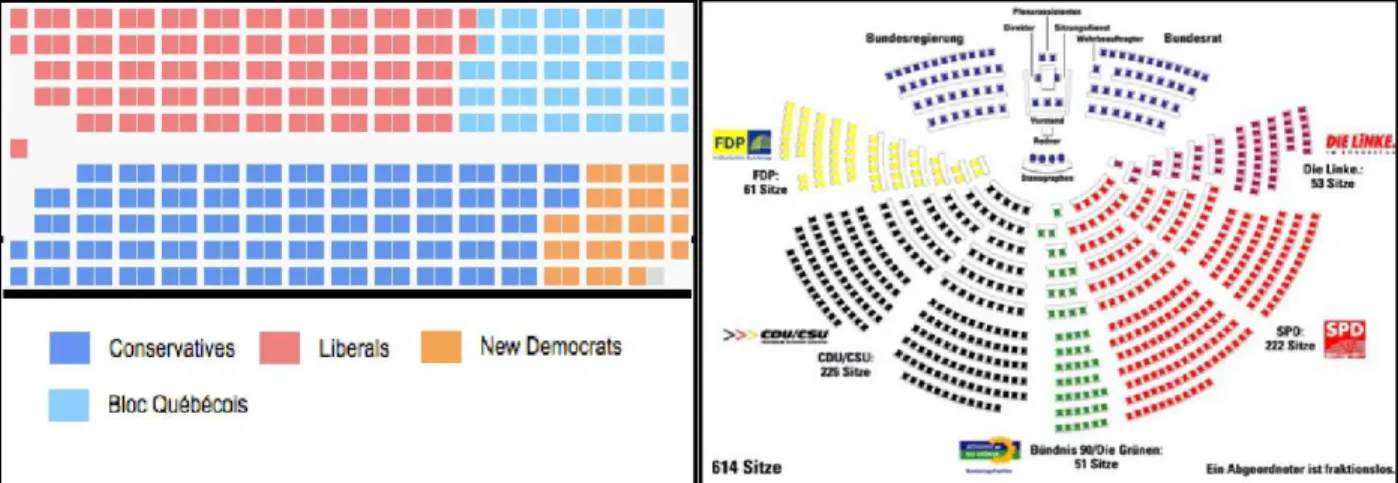
subnational governments in both countries retain significant jurisdiction over social policy, creating a potential veto point for the relevant reforms. Moreover, although Germany uses a proportional system of voting and Canada a majoritarian one, both countries have produced robust multiparty systems at the federal level. There are four electorally relevant political parties in Canada and five in Germany (see Figure 1.2for an illustration). Both countries are also home to influential and well-respected constitutional courts (Vanberg 2004; Songer 2008).13
Given the financial commitment associated with family policy expansion, it is also worth noting that Canada and Germany have been the two top-performing G-7 economies since the global financial crisis of 2007/08.14 This means that, unlike many of their neighbors, neither has faced
overwhelming pressure to enact austerity measures, leaving the door open to at least modest increases in social spending.
12 Germany is more strongly bicameral than Canada, but this does not greatly complicate my research designs as
family policy reforms have gone further in Germany, where they would theoretically be more difficult to implement.
13 One court case of relevance to this study is The German Constitutional Court’s unanimous decision in June 2015
to strike down the Betreuungsgeld, a controversial monthly subsidy to stay-at-home parents. The court ruled that Germany’s federal government lacked the spending authority to distribute the subsidy (Gesley 2015).
14 Canada and Germany have been the only two G-7 countries to retain a Triple-A credit rating throughout the
12
Figure 1.2 - Legislative Seat Share in Canada (2006) and Germany (2005) (Wikimedia Commons)
Further, Canada and Germany each fall below cross-national benchmarks in the relevant domain of fertility, as Figure 1.3 illustrates. Canada lags all other liberal welfare states with a total fertility rate that has hovered around 1.6 births per woman (bpw) since 2000.15 Moreover,
Germany’s demographic plight has been well documented as it recently supplanted Japan as home to the world’s lowest domestic birth rate (BBC 2015). As noted by Seeleib-Kaiser and Toivonen (2011), dwindling birth rates may push ideologically conservative governments into pursuing social policies that make it more practical for women to reconcile work with
reproduction.While there is more evidence of this being the case in Germany than in Canada, it is nevertheless theoretically important to note that low domestic birth rates could be construed as a social problem in either country.
13
Figure 1.3 – Fertility rate (bpw) by region, 2000-13 (World Bank)
This stated, one notable asymmetry is the fact that Germany has historically lagged Canada in the category of female labor force participation—although it has caught up
considerably over the 2000s (see Figure 1.4). This could affect the distribution of family policies in one of two ways: A preponderance of women in the workforce could motivate the Canadian government to pursue accommodating family policies or, conversely, German policymakers may be inclined to implement such policies in order to coax more women into working outside of home. The data indicate the latter as Germany’s female labor participation rate has
increased by nearly 10% since 2000. This suggests that the recent family policy reforms have enabled more German women to pursue paid employment. However, one area where this trend is reversed is in the political realm, where Germany comes much closer to gender parity. Presently, 37% of German federal legislators and 26% of Canadian ones are female (World Bank 2015).16 Accordingly, I argue here that some of the variation between the two cases can be
16 Two of Germany’s four largest parties, the SPD and Greens, have established formal quotas for the
14
explained by higher levels of participation and visibility of German women in both party organizations and electoral office.
Figure 1.4 – Female labor force participation (%) in Canada and Germany, 2000-2014 (OECD.stat)
Lastly, and perhaps most pivotally, the respective narratives of family policy reform in Germany and Canada display a temporal symmetry, which makes them amenable to this type of research design. At the beginning of the twenty-first century, the policy options of universal daycare and direct family cash transfers were each on the table in both countries. Yet it was daycare that ultimately won out in Germany and cash transfers that prevailed in Canada. In other words, the Merkel and Harper governments went in opposite directions. This symmetry provides me with a unique opportunity to go back to critical junctures in each country and trace
out sources of variation. This, I contend, is the core strength of my chosen research design and its application to this topic.
56 58 60 62 64 66 68 70 72 74 76
2000 2001 2002 2003 2004 2005 2006 2007 2008 2009 2010 2011 2012 2013 2014
15
In sum, Germany and Canada demonstrate a robust set of similarities that are relevant to the topic at hand. Critically, both were home to incumbent conservative governments that, over the observed timeframe, uncharacteristically pushed to expand family policy. This makes my cases a suitable paring for a comparative study of why, when, and how right governments may pursue social policy expansion.
1.3. Plan of the Dissertation
The rest of the dissertation proceeds as follows. In chapter two I provide a review of the extant literature and more formally elucidate my puzzle and its theoretical significance.
16
CHAPTER 2: THE PUZZLE
Since the late twentieth century, some of the most substantial additions to the welfare state edifice have come in the form of new family policies. Yet the recent episodes of family policy expansion that have occurred across rich OECD countries have taken shape in a manner that cannot be fully accounted for by conventional theories of the welfare state. The
partisanship-oriented theories that have elucidated other epochs of social policy expansion (Pierson 1995, 1996; Huber and Stephens 2001) provide only limited insight into how these new reforms have unfolded (see Mätzke and Ostner 2010a,2010b). Gender-based explanations emanating from the feminist literature offer a similarly incomplete view (Lambert 2008; Atchison and Down 2009; Atchison 2010). The inability of existing approaches to fully grapple with this “silent revolution” of family policy expansion (see Ferragina and Seeleib-Kaiser 2015) necessitates a focused examination of how this process has taken root in unlikely
environments.
In this chapter, I illustrate the shortcomings of the existing mainstream and feminist social policy literatures in terms of explaining recent and ongoing family policy reform patterns. Accordingly, I introduce two newer literatures—namely, issue entrepreneurship and the
17
of my country cases, present my research hypotheses, and outline the basic logic of my comparative analytical strategy.
2.1. The Extant Literature
The recent innovations in family policy are typically viewed as one aspect of the ongoing adaptation of mature welfare states to the emergence of new social risks (NSRs). (Taylor-Gooby 2004; Bonoli 2005). In contrast to the “old” social risks that the first generation of welfare state institutions were built to address (i.e.: aging, sickness, and disability), NSRs are largely a product of state maturation itself. To be precise, NSRs stem from concurrent demographic,
macroeconomic, and cultural transformations ongoing in most affluent countries. These include population aging, the phasing out of the male-breadwinner manufacturing economy in favor of a lower wage services-oriented jobs environment, and the breakdown of the traditional
gendered division of labor.17 The last of these is arguably the primary catalyst for the recent
changes to family policy. With women taking a more active role in all aspects of the formal economy—out of both choice and necessity—and subsequently devoting less time to household activities, post-industrial governments have come under increasing pressure to devise policies that make it easier for parents (mothers in particular) to balance paid work with their child rearing obligations. This is an especially strong policy imperative in countries that have seen declining birth rates and increasing financial strains on social supports for older citizens over the past several decades (See: Henninger et al. 2008; Seeleib-Kaiser and Toivonen 2011).
18
The recent family policy reforms are also related to the advent of the social investment policy paradigm (itself a response to the increasing salience of NSRs). Proponents of the social investment approach advocate strategic investments in human capital aimed at generating better long-run economic outcomes. Many of them argue that investments in various family policies do just this as they simultaneously allow women to become fuller participants in the economy and may provide young children with healthier emotional and intellectual
environments (for instance, through high quality, center-based daycare or subsidies to make extra-curricular activities more affordable),18 leading to better career opportunities later in life
(Jenson and Saint-Martin 2003; Esping-Andersen 2009). Although it is important to note that not all of the recent family policy reforms are consistent with social investment objectives (Schwander 2018),19 the ideational shift (among both policymakers and experts) to the
paradigm has undoubtedly promoted a more child and youth centered social policy discourse that favors family policy interventions over other forms of social spending (see: Jenson 2008, 2009).
The project’s focus on family policy—a domain that, to feminists and other critical observers, is intrinsically linked to the liberation of mothers and other female caregivers from the “private sphere” of domestic exploitation—also necessitates proper engagement with the
18 There is some evidence of the opposite being the case in the Canadian context. Baker et al. (2015) find that the
introduction of universal child care in the province of Québec generated a “sizeable negative shock in non-cognitive skills” among young residents. Versus their contemporaries in other provinces, Québecois children who came of age following the introduction of the program in 1997 were found to have poorer health outcomes, lower life satisfaction, and a higher propensity for criminal activity later in life. The study, which was published just prior to Canada’s 2015 election, attracted significant media attention during the campaign (see: Gordon 2015).
19 Schwander (2018, p. 25) identifies Germany’s Betreuungsgeld as a recent family policy reform that violates social
19
long-running feminist20 literature on gender and the welfare state. While I do not anticipate my
findings to bear significant implications for feminist scholars, it is nevertheless necessary for me to acknowledge the origins of this agenda within the gender studies tradition. As such, I begin with a review of gendered perspectives on the welfare state and their influence on how family policy has subsequently been studied.
Gender and the welfare state
Feminist scholars have long approached the archetypal welfare state with a marked ambivalence. This unease is rooted in the observation that the bulk of mainstream welfare state theory has been built on an initially unstated assumption of the industrial male worker as its core microsocial unit of analysis. This, feminists argue, has led analysts of the welfare state— especially those working within Esping-Andersen’s (1990) “welfare regimes” paradigm—to focus too narrowly on the effects of social policies on the well-being of working class males, turning a blind-eye to their reverberating impacts on women, both within and outside of the labor force (Morgan 2001, p. 107). Relatedly, feminists have criticized the modern welfare state for generally reinforcing the traditional separation of the public and domestic spheres,
essentially ceding the latter as off-limits to state intervention.21 This is especially problematic
for feminists, who view the two realms as inherently connected by a patriarchal social structure
20 Following O’Connor et al. (1999, p. 10) I use the term “feminist” here to “describe scholarship that uses gender
as an analytic category and/or focuses on the situation of women.”
21 The obvious exception here is the Scandinavian welfare state, which has long embraced a dual earner household
model characterized by generous parental leave policies and universal daycare. Some feminists have nevertheless criticized this model for making many parental benefits contingent on labor force participation, thereby
20
that ascribes monetary value to male industrial labor but not female household labor (Pateman 1988).
A second generation of feminist work perceived the welfare state more charitably as an imperfect yet potentially valuable resource for feminist reformers. This view was heavily shaped by Norwegian political scientist Helga Hernes’ (1987) conceptualization of the “women-friendly state”, which Hernes defines as one that “would not force harder choices on women than on men, or permit unjust treatment on the basis of sex.” (p. 15). Central to this definition is the imperative of social policies that empower women to balance motherhood with labor market participation and other life aspirations: “In a woman-friendly state women will continue to have children, yet there will also be other roads to self-realization open to them.” (p. 15). Hernes saw her native Norway and its Scandinavian neighbours as the states that came closest to embodying this ideal, generally echoing the sentiment of “Nordic exceptionalism” espoused by some of her mainstream counterparts (Esping-Andersen 1990, 2002; Stephens 1995). Her pioneering work nevertheless launched a robust research agenda on the prospects for positive feminist engagement with the state.
One offshoot is comparative state feminism, which focuses on the potential influence of sympathetic state institutions, especially those with a formal mandate to advance women’s causes. Analysts of state feminism (Stetson and Mazur 1995; McBride and Mazur 2010), or “feminism from above”, contend that women’s movements can strategically use such entry points to gain access to policy arenas and subsequently attain their policy objectives (McBride and Mazur 2010, p. 5). The framework has since been used more broadly to identify
21
reformers (McBride and Mazur 2010, pp. 5-6). Scholars of state feminism have accordingly identified periods of left government as crucial windows for would-be reformers (McBride and Mazur 2010; O’Connor 2015). Leading feminist scholar Julia O’Connor (2015) in fact uses the example of Canada under the Harper government to substantiate this point, writing: “the key influence [in developing gender equality structures] is the strength of left-parties, and, more broadly, non-right parties, as illustrated by the Canadian federal level” and “[t]he role of right-wing parties in the retrenchment of women’s policy machinery is most strongly evident in Australia [under John Howard] and Canada.” (p. 494).
Though certainly no friend to state feminists, Harper nonetheless showed a desire to be perceived as attentive to the needs of at least a certain subset of Canadian women by making family policy a focal point of his governing agenda. Rather than sweep women’s issues under the rug entirely—as feminist theory would have predicted for a neoliberal right party—Harper chose instead to stake his political fortunes on his own vision of family-friendly social policy.22
Interestingly, Harper and his surrogates frequently utilized a discourse of “choice” rooted in liberal feminism to frame the reforms (Richardson 2012; Rinehart 2008). The feminist view also clashes with the governing record of Germany’ Christian Democrats who, as I will discuss in further detail below, have assertively claimed credit for a sweeping set of universalistic family policy reforms implemented during their time at the helm of government.
22 Harper showed similar instincts by spearheading a major G8 initiative on maternal and child health. The
22
As mentioned above, scholars have also utilized overlapping literatures on NSRs and social investment to explain recent patterns of family policy reform. The latter concept, which posits a positive association between strategic social spending (especially early investments in human capital) and long run economic development, presents an especially strong logical basis for the utilization of various family policy instruments. It also gives politicians a powerful rhetoric of ‘common sense’ with which to frame new initiatives (Morel et al. 2012, pp. 8-9; Hemerijck 2015, p. 253). Accordingly, I now turn to the rise of the social investment paradigm and its relevance to my research topic.
Social Investment and New Social Risks
Although the concept of social investment can be traced back to the Nordic political thought of the interwar years (Myrdal and Myrdal 1934), the idea has enjoyed a renaissance over the past two decades due to widespread disillusionment with both neoliberal and Keynesian approaches to social policy.23 Social investment can be generally understood as a
hybrid of the two schools, presenting a positive relationship between activation-oriented social spending and the long-run neoliberal objectives of economic growth and market efficiency.
As its name indicates, social investment’s defining feature is its future-orientation. Its proponents argue accordingly that prudent investments in human capital—especially when directed to children and youth—will result in better socio-economic outcomes down the road (Morel et al. 2012, p. 11); for instance, that investments in better public education will
23 The term ‘social investment’ was formally coined by British sociologist Anthony Giddens, a principal architect of
23
ultimately produce a more highly-skilled and adaptable workforce. This view gives primacy to daycare and other social services for pre-primary aged children, particularly in light of recent scientific research that finds that a child’s earliest years are its most critical for cognitive and emotional development (National Scientific Council on the Developing Child 2004).24 Such
interventions have the additional benefit of ‘activating’ female workers, whose child-rearing obligations would otherwise sideline them from the labor market. In all, social investment provides a powerful economic rationale for the implementation of child and family-supporting policies.
Social investment is not without its detractors. In fact, some of the most trenchant criticisms of the paradigm come from feminist scholars, who object to its instrumentalization of gender equalization policies—centrally those that cater to working women—as a rather crude means to attain various economic ends, such as increasing the taxpayer base and boosting domestic birth rates. This gives second-billing to the more foundational social justice aspects of the feminist agenda (Morel et al. 2012, p.16). Some feminists have also argued that the child-centric character of social investment essentially reduces women to their reproductive
capacities (Jenson 2009). In other words, social investment prioritizes the function of women as mothers, caregivers, and workers over their personal needs as citizens. One more purely
economic objection to social investment is that, in its emphasis on activation-oriented human capital building, it helps to normalize the low wage environment surrounding unskilled and semi-skilled jobs in the neoliberal economic paradigm (McKeen 2007, p. 60).
24 Since the late 1990s the OECD and other expert groups have increasingly used the term Early Childhood
24
Such reservations have not slowed social investment’s momentum. In fact, the cross-national diffusion of the social investment paradigm—promoted heavily by the EU and OECD— (see White 2011),coupled with an increasing tendency for political parties to actively court female voters (Morgan 2013), has made family policy the site of much recent political activity. Reconciliation-oriented family policies like equitably compensated maternity leave and pre-kindergarten programs have garnered broad-based political support. Some governments have also embraced the more contentious social investment oriented position that widely-available public daycare, accessible from infancy, constitutes vital ‘early childhood education’ that will ultimately help young children become more cognitively and emotionally equipped for formal schooling (Heckman 2006; Morgan 2012; cf. Baker et al. 2015). Others, acting on more
conservative political motives, have reluctantly pursued generous family policies in an attempt to shore-up lagging domestic birth rates (Seeleib-Kaiser and Toivonen 2011; Oliver and Mätzke 2014).
Accordingly, a strong pattern of family policy expansion was traced out empirically in a recent study by Ferragina and Seeleib-Kaiser (2015). Using a statistical mapping technique called multiple correspondence analysis the authors found that all rich OECD countries, with the exception of the United States, have made significant investments in family policybetween 1980 and 2008 — precisely the time period when the welfare state was purportedly in retreat. Ferragina and Seeleib-Kaiser call this ongoing phenomenon a “silent revolution”.
25
globalization (Iversen and Cusack 2000; Olsen 2007), or common socio-economic and demographic pressures (i.e.: NSRs) (Bonoli 2005). However, efforts to test the convergence hypothesis empirically show that domestic political alignments and institutional legacies still condition country-specific responses to the external and internal pressures to create new family policies (Gauthier 2002; Schmidt and Starke 2011; Mahon et al. 2012; Kazepov and Ranci 2017). Partisan arrangements in particular can be pivotal in shaping family policy regimes. For
instance, Rianne Mahon et al. (2012) find that, due to the continued influence of the agrarian, socially conservative Center Party, Finland has followed a more transfer-based, conservative family policy trajectory than the other Nordic countries (p. 425).
In sum, despite the hype surrounding social investment as an ideologically unifying paradigm, the extant literature continues to present domestic politics as a key driver of family policy outcomes. Moreover, new social risks centered theories, which posit population aging, declining fertility rates, and other demographic pressures as the main drivers of family policy reform fail to explain the timing and composition of policy changes—which, again, shifts the analytical focus to domestic political contestation. Low birth rates, for instance, may persist for decades before being constructed as a political problem by policy elites (Seeleib-Kaiser and Toivonen 2011). 25
25 Despite a low domestic birth rate, Canada’s high intake of immigrants has allowed it to sustain an annual
26
2.2. New Perspectives
Issue Competition
As a cross-national policy ‘convergence’ based on common ideational and structural pressures appears unlikely, scholars have consequently devoted significant attention to the within-country partisan politics of family policy. Much of this work focuses on the electoral incentives of office-seeking parties to deliver new family policies, especially as part of a broader strategy to attract younger female supporters (Annesley 2010; Williarty 2010; von Wahl 2011; Morgan 2013). The general argument here is that a cross-national rise in female labor force participation, coupled with the deterioration of traditional class and religion-based political cleavages (see Lipset and Rokkan 1967), has motivated parties to target politically unattached female voters—namely young and highly-educated women.26 They have done this through a
two-pronged approach: first by recruiting more women as candidates and operatives and, secondly, by priming political issues calculated to appeal to working women. These mechanisms are, of course, interconnected as it is often the women within party organizations who identify and champion women-friendly policies (Williarty 2010; Morgan 2013). Female candidates themselves may benefit electorally from a heightened public salience of family policy as it has been shown, in the American political context, that voters often unconsciously perceive women as more competent at dealing with “feminine” issues relating to compassion and social welfare (Herrnson et al. 2003; Huddy and Terkildsen 1993).
26 Older women and those who have remained outside of the labor force remain a core voting constituency for
27
While left and center parties have generally been the more enthusiastic proponents of new family policies (Hemerijck 2015, p. 253),27 the literature on issue competition and family
policy (see Schwander 2018 for a review) provides at least one important case study of a right party taking the lead: the reform agenda pursued in Germany by CDU-affiliated Family Minister Ursula von der Leyen. During her time at the helm of the family ministry between 2005 and 2009, von der Leyen oversaw a ‘Swedification’ of Germany’s parental leave system and a sizeable expansion of the availability of publicly-subsidized child care for children under three— becoming one of the country’s most visible political figures in the process. Though controversial within the CDU/CSU itself, the family policy agenda resonated with voters and helped the party regain its historical advantage among women in the 2009 election.28
Given von der Leyen’s anomalous image as a married, conservative mother of seven who nevertheless championed the most progressive set of family policy reforms in Germany’s history, her performance as family minister has naturally been the focus of a number of recent scholarly accounts. This literature emphasizes the relevance of leadership (von Wahl 2011), the inclusion of women in internal party decision-making structures (Wiliarty 2010, 2013), and party competition (Fleckenstein 2011; Morgan 2013; Seeleib-Kaiser 2010), but also
characterizes the German case as something of a ‘perfect storm’ made possible by the presence of a female (and Eastern) chancellor and an uncommonly skilled family minister (see von Wahl 2011). These studies are important, and I echo several of their findings here, but I hope to offer
27 Schwander (2018, p. 9) argues that center-left parties have been quicker to embrace social investment-oriented
family policy reforms due, in part, to increased electoral competition from “left-libertarian” (i.e.: Green) parties.
28 Women were 0.2% less likely than men to vote for the CDU in the 2005 election and 4.8% more likely (versus
28
further insight into the incipient phenomenon of ‘family policy reform from the right’ by
juxtaposing the German narrative with Canada’s experience with family policy under the Harper Government (2006 – 2015).
Although nowhere near as ‘female-friendly’ as the policy package delivered by von der Leyen, the family policies put in place by the Harper government still constituted a substantial investment of both financial and political capital and, collectively, meaningfully altered the trajectory of Canada’s family policy regime. Identifying child care as a potential weak spot for the then governing Liberal Party (Interviewee no. 1, 17 June 2016), the Harper Conservatives made their proposed universal child benefit a focal point of their first successful election campaign. They were rewarded for this strategy when an errant soundbite on the benefit from a top Liberal strategist29 proved to be one of the campaign’s major gaffes. Once in office,
Harper continued to use family policies instrumentally to attract new voters, showing a special affinity for microtargeted ‘boutique’ family tax credits. The significance of family policy to Harper’s governing agenda was ultimately reflected in dollars as federal support for child care grew almost tenfold (Malanik 2015, p. 3) under Harper and total federal spending on child benefits reached approximately one percent of GDP (Malanik 2016, p. 6).
In sum, the Canadian case presents a timely addition to the incipient issue competition literature as it provides a scenario in which a modern conservative party used family policy in a politically advantageous manner, yet without embracing an especially feminist political
29 This refers to Liberal Party communication director Scott Reid’s televised assertion that parents would blow the
29
orientation. This indicates that there are a number of possible strategies and potential constituencies for parties that seek to utilize new family policies electorally.
The Migration-Social Policy Nexus
Some of the remaining gaps can be addressed by incorporating a final literature that explores how Western welfare states have responded to new pressures posed by non-Western immigration. Recent influxes of foreigners have challenged welfare states by complicating the historically language and ethnicity-based claims on shared community membership that have been used to justify redistributive social policies (Kymlicka 2015, p.4). Further, some migrant populations retain cultural values that are perceived to be inconsistent with the principles embodied in Western welfare regimes, for instance female participation in the full-time labor market. Some observers have also expressed concerns that generous social policies may produce an unintended “magnet effect”, attracting economically draining or otherwise socially undesirable benefit-seeking immigrants (Bauböck and Scholten 2016, p. 5). The specter of parasitic “free rider” migrants, although empirically dubious,30 is now a common trope in
European political discourses and has been a boon to right wing populist parties throughout the continent. These parties, and increasingly the mainstream right parties that compete against them for votes, have embraced the philosophy of welfare chauvinism: a distinct form of welfare
30 Empirical studies show consistently that migrants to OECD countries pay more in taxes and social security
30
state dualism that’s premised on systematically excluding immigrants from various welfare benefits and social services.
At face value, this suggests that ethno-cultural diversification steadily erodes the social solidarity necessary to sustain a redistributive welfare state. However, while the notion of a “progressive’s dilemma” between multiculturalism and a functional welfare state is now ubiquitous in both academic and popular discourses, serious empirical work reveals a more complicated dynamic at play. Opinion surveys show that people consistently view immigrants as less deserving of welfare benefits than nationals (Van Oorschot 2000, 2006), but this anti-immigrant sentiment appears to be strongest in the liberal31 and conservative welfare states
(Van Der Waal et al. 2013, pp. 12, 15), where entitlements are already most meager and selective, respectively. Moreover, there doesn’t appear to be any stable empirical relationship between a given country’s ethnic heterogeneity and natives’ opinions on whether or not immigrants should be entitled to social benefits (Der Waal et al. 2013, p. 12). If the
“progressive’s dilemma” hypothesis were valid, we would expect to see the most negative attitudes towards immigrant benefit-seekers in the most ethnically diverse and generous welfare states.
As the opinion data indicate, immigration has generated more sophisticated feedback effects in the Nordic welfare states. The Nordic countries have, in particular, struggled to reconcile their universalistic, dual earner supporting welfare state institutions with the
traditional male breadwinner/female caregiver norms held by various immigrant groups, most
31 One exception to this general pattern is Canada, where studies of public opinion have consistently “remarkably
31
visibly those who arrived from Muslim-majority countries (Langvasbråten 2008; Vuori 2009; Joppke 2014). This, paradoxically, may be pushing the Nordic welfare states in an even more universalistic direction as the imperative of ‘activating’ underemployed migrant women has been invoked in recent Scandinavian social policy debates (Langvasbråten 2008; Grødem 2016). There is, in fact, some evidence that this frame was used successfully by progressives to help roll back ‘cash for care’ schemes and other stay-at-home parent supporting initiatives
introduced by the center-right governing coalitions that held power across the Nordic countries at various points in the late 1990s and 2000s (Bungum and Kvande 2013; Grødem 2016). At the same time, the gap between the enrollment of national and non-national children in daycare has narrowed significantly within the region (Andersen 2007, p. 261; Bremberg 2009, p. 679).
32
with the traditional notions of defined gender roles that are putatively held within various migrant communities (p. 2).
Grødem finds that, in both Norway and Sweden, expert committees on integration played an important agenda setting role in highlighting the alienating effect that various family policies had on migrants (and especially migrant women). These committees also helped facilitate a cross-partisan, evidence-based consensus on relevant reforms, which ultimately took place rapidly and with “remarkably little debate” (p. 10).32 The situation is more
complicated in Denmark, where immigration is more heavily politicized. However, even here welfare chauvinists, led by the right-populist Danish People’s Party, have focused on making it more difficult for migrants to qualify for conditional cash benefits (pp. 9-10).33 Access to more
universalistic social services, such as daycare, has even been enhanced for most migrant families in Denmark (Andersen 2007, p. 262).
Grødem’s observes that homemaker-supporting ‘cash-for-care’ allowances are a more contentious issue for both nativists and integrationists. She notes that the debate over whether to provide direct cash benefits to stay-at-home parents was “already heated” before questions
32 In Sweden, where the experts found that lengthy parental leave entitlements impeded the incorporation of
migrant women into the labor force, the government and opposition parties agreed to reduce the number of leave days available following the child’s fourth birthday by 80% (from 480 days to 96 days) (Grødem 2016, p. 8). In Norway, the integration committee findings led to activation-oriented reforms of single parent and disability allowances (Grødem 2016, pp. 6-7).
33 Most visibly, Denmark’s center-right governing coalition (2001 – 2011) introduced a diminished social assistance
33
related to migrant integration were introduced, pitting feminists and social investment
advocates against the libertarian and socially conservative proponents of parental “freedom of choice” (p. 10).34 Grødem nevertheless acknowledges that the increased visibility of migrant
integration as a political issue has affected the rhetorical strategies that parties use to defend their respective positions on cash-for-care allowances. For instance, the leader of Sweden’s centrist Folkpartiet cited his concerns about a ‘poverty trap’ for immigrant women as a
rationale for his party’s decision to withdraw its support from the cash-for-care alliance in 2016. This defection effectively killed the program (p. 9).
Grødem’s research presents a key point of departure for this study, as I effectively test whether her findings travel outside of the Scandinavian countries. As I will explain in further detail below, I find that integration was a non-trivial consideration in Germany’s family policy debate but was largely absent in the Canadian policy discourse. This explains, in part, why Germany’s ‘cash for care’ scheme (the Betreuungsgeld) failed while, in Canada, a similar program (the UCCB) not only survived but was embraced by the opposition parties and largely retained by the successor government. In all, my findings reaffirm the connection that Grødem makes between migration discourses and family policy. Moreover, like Grødem, I identify (in the German case) a dynamic wherein concerns over the integration of migrants are used to support universalistic family policy reforms—a direct contradiction of the welfare chauvinism hypothesis. This phenomenon is even more striking in Germany, which lacks Scandinavia’s long tradition of gender egalitarianism.
34 Populist right parties in Scandinavia have generally supported cash-for-care allowances (Grødem 2016, p. 9;
34
2.3. Lacunae and Research Puzzle
As noted in the previous section, one particular shortcoming of both the feminist and social investment literatures on family policy is that they each have little to say about what specific circumstances may motivate mainstream conservative parties to take the lead on family policy expansion. While reforms have taken place across different regime types, the protagonists in these narratives are most often left and center parties. Merkel’s Christian Democratic government is generally presented as an outlier case, with perhaps too much credit ascribed to the presence of women in key elective and civil service positions (Williarty 2010; von Wahl 2011; Fleckenstein 2011; Morgan 2013). For instance, one prominent scholar calls Germany’s family policy paradigm shift “a women’s revolution from above” (von Wahl 2011).
Although I do not contest the well-supported assertion that women’s representation— in both elective office and high-ranking civil service positions—fosters the development and implementation of women-friendly policies (Stetson and Mazur 1995; Childs and Krook 2009; Atchison and Down 2009), I believe that the effect of officeholder gender has been overstated in multiple scholarly accounts of the CDU’s reorientation towards family policy. Even without Chancellor Merkel and other women in high office, the CDU would have had significant electoral incentives to change its tone.
35
2014, p. 2) that any electorally-viable party would ultimately have to address. Accordingly, Clemens (2009) traces the first stirrings of the CDU’s social policy modernization back to 1998, four years before Angela Merkel became the chair of the party.
The women’s representation narrative is also inconsistent with the governing record of Merkel’s second administration, active from 2009 to 2013. The liberal-conservative coalition, which consisted of the CDU/CSU alliance and the libertarian Free Democratic Party (FDP), was generally ambivalent about work-family reconciliation policies and ultimately acceded to a widely-panned CSU proposal to subsidize stay-at-home mothers through a monthly cash transfer called the Betreuungsgeld35 (Henninger and von Wahl 2014). This despite once again
having both a female chancellor and a female family minister.36 In sum, even if female
leadership was a necessary condition for Germany’s observed family policy paradigm shift, it evidently was not a sufficient one.
The Harper government’s decisive action on family policy is an even more confounding puzzle, which fits none of the extant theoretical explanations. The usual suspects of women’s political mobilization and demographic challenges do not apply here. Women were noticeably absent from Harper’s inner circle, in terms of both his cabinet ministers and his leading advisors (Ditchburn 2013). This came as Canada’s national women’s movement, starved of public
35 The German Constitutional Court struck down the Betreuugsgeld in July 2015, ruling unanimously that the
federal government did not have the spending authority to distribute the subsidy (Eddy 2015).
36 The polarizing Kristina Schröder inherited the family portfolio from von der Leyen, who in turn went to the Labor