Pesticides: Perceived Threat and Protective Behaviors Among
Latino Farmworkers
AnnMarie Lee Waltona, Catherine LePrevostb, Bob Wongc, Laura Linnand, Ana Sanchez-Birkheadc, and Kathi Mooneyc,d
aSchool of Nursing, The University of North Carolina at Chapel Hill, Chapel Hill, North Carolina,
USA
bDepartment of Applied Ecology, North Carolina State University, Raleigh, North Carolina, USA cCollege of Nursing, The University of Utah, Salt Lake City, Utah, USA
dGillings School of Global Public Health, The University of North Carolina at Chapel Hill, Chapel
Hill, North Carolina, USA
Abstract
Objectives—The purpose of this study was to assess the knowledge and beliefs of 72 Latino farmworkers in North Carolina about the threat of health effects of pesticides, including cancer. It sought to explore relationships between threat perceptions and pesticide protective behaviors observed in the field.
Methods/Results—Utilizing stepwise multiple regression, the authors found that years worked in agriculture in the United States was associated with decreased use of protective clothing.
Conclusion—Pesticide protective behaviors in the field may be improved by utilizing moderately experienced farmworkers (<10 years) as lay advisors to reinforce training.
Keywords
Latino migrant and seasonal farmworkers; pesticide protective behaviors; threat of cancer; threat of illness
Introduction
Exposure to pesticides has been linked to deleterious health effects for agricultural
workers,1–7 including delayed neuropathy,7 DNA damage and mutations,8 thyroid disease,9 diabetes,10,11 Parkinson’s disease,-7,12 and several cancers.13,14 Two of the most commonly used pesticides in North Carolina tobacco production15 are carbaryl and pendimethalin. Carbaryl has been associated with cutaneous melanoma16 and may be associated with
non-CONTACT AnnMarie Lee Walton [email protected]; School of Nursing, The University of North Carolina at Chapel Hill,
HHS Public Access
Author manuscript
J Agromedicine
. Author manuscript; available in PMC 2017 June 30.Published in final edited form as:
J Agromedicine. 2017 ; 22(2): 140–147. doi:10.1080/1059924X.2017.1283278.
A
uthor Man
uscr
ipt
A
uthor Man
uscr
ipt
A
uthor Man
uscr
ipt
A
uthor Man
uscr
Hodgkin lymphoma (NHL),17 whereas pendimethalin has been associated with lung cancer.18
Several pesticide protective behaviors (PPBs), including using gloves,12,19–21 washing hands,12,19,22 wearing long sleeves,20 wearing boots,20 and wearing a combination of long sleeves, long pants, shoes, and a hat,19 have been found to be effective in decreasing pesticide exposure and risk for pesticide-related illness. Several farmworker studies have evaluated the effectiveness of protective clothing and hand washing19,22,23 and found reduction in dermal pesticide exposures. The Worker Protection Standard (WPS) mandates that farmworkers be taught PPBs, including the following: washing hands before eating, drinking, smoking, or using the toilet; wearing protective clothing; showering and changing clothes immediately after work; and washing work clothes separately from other laundry.24
Early surveys of Latino farmworkers in North Carolina found that they were more likely to identify acute effects of pesticide exposure (e.g., nausea, vomiting) than long-term effects of low-level exposure to pesticides.25,26 In one of these studies, it was found that few
farmworkers believed that adverse health effects from pesticide exposure would last more than 1 day.26 Research conducted with farmworkers in the southeastern United States suggests that farmworkers believe that some individuals are more susceptible to pesticide illness based on age and gender.25–27 In a study conducted in the Yakima Valley of Washington, farmworkers who had pesticide training within the last 5 years and those who lived in labor camps practiced more protective behaviors at work.28 A lack of knowledge and information regarding the causes of cancer and its prevention, detection, and treatment among Wisconsin farmworkers has been associated with their fatalistic attitudes toward cancer.29
According to the Health Belief Model (HBM),30 perceived susceptibility and perceived severity, which taken together constitute perceived threat, are expected to correspond to an increase in protective behaviors.31 Modifying factors, called cues to action, increase the likelihood that one will engage in protective behaviors.31 In this study, we explored perceived susceptibility, perceived severity, and several modifying factors. Specifically, the study goal was to describe the extent to which Latino farmworkers perceive exposure to pesticides as a cause of illness generally, and cancer specifically, and to explore the
relationships among threat perception, personal characteristics, training, and experience with use of PPBs in the field.
Methods
Participants
Seven growers from one of the largest tobacco production counties in North Carolina were approached about this study. These growers were identified based on their having previously participated in a safety intervention called Certified Safe Farm focused on injury reduction. Three of those seven growers agreed to provide access to their farms to approach the farmworkers working for them. After obtaining institutional review board approval, 72 farmworkers were approached, agreed to participate, and provided informed consent.
A
uthor Man
uscr
ipt
A
uthor Man
uscr
ipt
A
uthor Man
uscr
ipt
A
uthor Man
uscr
Measures
The Health Belief Model guiding this study proposes that perceived susceptibility to an illness and perceived severity of the illness are crucial to one’s health-related behaviors. Two threat questionnaires were developed by the authors and verbally administered in Spanish. Instruments were validated for Spanish translation by using two independent translators, one was a bilingual speaker whose parents were farmworkers and who lived closed to the farms in the study and the other was a couple, one of whom was a native English speaker living in a Spanish-speaking country and the other a native Spanish speaker. Responses were captured by a 4-point Likert scale, with response options of strongly disagree (1), disagree (2), agree (3), and strongly agree (4); the authors consulted literature and other researchers who recommended fewer response options for groups with low literacy levels like the farmworkers in our study.32 Item scores were totaled (range: 5–20), with higher scores indicating higher perceived threat. Items were also analyzed individually.
Illness Threat Questionnaire (ITQ)
The 5-item ITQ, guided by the HBM and developed by the investigators, assessed perceived severity and susceptibility to illness in general, knowledge about health problems as a result of pesticide exposure, and efficacy of PPBs. The Cronbach’s alpha was .670. An additional item that was not part of the summary score measured familiarity with people with illness as a result of pesticide exposure.
Cancer Threat Questionnaire (CTQ)
The 5-item CTQ, guided by the HBM and developed by the investigators, assessed perceived severity and susceptibility to cancer, knowledge about cancer risk, and efficacy of PPBs. The Cronbach’s alpha was .697. An item that was not part of the summary score measured familiarity with people with cancer as a result of pesticide exposure.
Participant characteristics
Demographic data were collected verbally by participant self-report as part of the questionnaire administration. Items captured personal characteristics, agricultural
experience, worker status, education and English proficiency, pesticide training, and cancer in farmworkers’ families.
Observational checklist
An observational checklist was also developed to record the use of PPBs by farmworkers during a workday.33 The behaviors included in the checklist were identified from the US Environmenal Protection Agency (EPA) “Protect Yourself from Pesticides” brochure developed to address WPS criteria34: wearing long pants, a long-sleeved shirt, shoes, and socks, and washing hands and face before eating and drinking. Use of gloves, water-resistant outerwear, and hats, although not included in the EPA brochure, were also captured. In every 30-minute block, the primary investigator noted “yes,” “no,” or “could not be observed” for each behavior for each participant being observed. Observed behaviors were then aggregated from an individual observation level (a 30-minute time period) to how often they occurred at a person level, and then placed into one of three categories: none of the time (0% of the
A
uthor Man
uscr
ipt
A
uthor Man
uscr
ipt
A
uthor Man
uscr
ipt
A
uthor Man
uscr
observations), all of time (100% of the observations), or some or most of the time (>0% and <100% of the observations).
Two observed behavior summary scores (clothing and washing) were calculated. The observed clothing summary score included three items from the EPA brochure (wearing long pants, long sleeves, closed shoes) as well as gloves (not required but efficacious) and two others (hats, water-resistant outerwear), for a maximum summary score of 6. Four possible behaviors constituted the summary score for observed washing behavior (washing hands before drinking, washing face before drinking, washing hands before eating, and washing face before eating), for a maximum summary score of 4.
Data collection
For each observation day, the primary investigator observed up to eight farmworkers. The observation period included the entirety of the workday (6–12.5 hours). There were a total of 1,442 observation points.
The two questionnaires were administered on a subsequent weekend evening at the farmworkers’ homes or labor camp. A native Spanish speaker whose parents were farmworkers and who grew up near farms in the study was trained to administer the
questionnaires with the primary investigator present.33 Farmworkers received a $25 gift card and a hat from a local farmworker service agency after participation.
Analyses
Questionnaire data were recorded by the interviewer on paper and audio recorded. All data were managed using REDCap electronic data capture tools.35 For quality assurance, 10% of the data were reviewed by the primary investigator, with 100% accuracy found. Data were analyzed in SPSS version 22.36 Descriptive statistics of demographic and outcome variables were assessed using means and ranges for continuous variables, and frequencies and counts for categorical variables.
Stepwise multiple regression was utilized to predict mean observed clothing and washing behavior summary scores from blocks of independent variables (personal characteristics and perceptions of threat). The block of personal characteristics included in the regression were age; whether or not the farmworker was in the United States on a work contract; year of experience in agriculture in the United States, outside of the United States, and in tobacco, respectively; education level; and year of last pesticide training. These characteristics were selected because we believed age, whether or not one was in the United States on an H-2A visa, experience, education, and recency of training could most impact protective behavior. The block of threat perceptions included questionnaire items related to perceived
susceptibility, perceived severity, and perceived efficacy of PPBs with regard to both illnesses and cancer. Perceived susceptibility of families was not included, because of a lack of variability in the sample. Knowledge about pesticides was not included, because we recognized that knowledge about illness caused by pesticides would have been a more precise measure and more consistent with the cancer etiology question on the CTQ. Finally, knowing others who became sick or developed cancer was not included, because it emerged as a separate factor in early factor analyses of the instrument. The forward stepping method
A
uthor Man
uscr
ipt
A
uthor Man
uscr
ipt
A
uthor Man
uscr
ipt
A
uthor Man
uscr
was used for the personal characteristics block of variables, and the enter method was used for the perceptions of threat blocks of variables.
Results
Participant characteristics
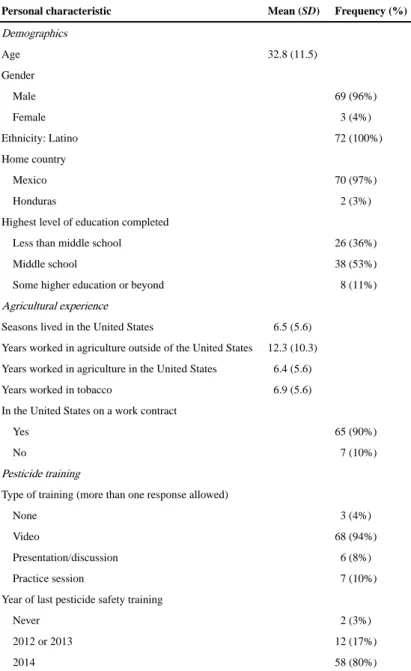
Farmworkers were predominantly male (96%) from Mexico (97%) and with an average age of 33 years; most had no more than a middle-school education (89%) (see Table 1). The majority (90%) were in the United States on a work contract and had worked in agriculture an average of 12 years outside of and 6 years inside the United States. Almost all reported some pesticide safety training experience within the EPA-regulated time frame (97%).
Illness threat
On the ITQ, the majority of farmworkers (n = 62, 86%) agreed or strongly agreed that working around pesticides could cause health problems for themselves, although fewer (n = 52, 72%) believed working around pesticides could cause health problems for their families (see Table 2). Most reported that health problems caused by pesticides were serious (n = 59, 82%), and all (n = 72, 100%) reported that PPBs (specifically clothing) were efficacious in decreasing risk of illness. Just over half (n = 43, 58%) said that they knew a lot about pesticides. The mean illness threat summary score was 15.0 out of a maximum of 20 (range: 8–20, SD = 2.3). On the single item that was not included in the summary score, 49
farmworkers (68%) reported knowing someone who had developed health problems as a result of pesticide exposure.
Cancer threat
On the CTQ, the majority of farmworkers (n = 61, 84.5%) agreed or strongly agreed that working around pesticides increased their cancer risk, although fewer (n = 48, 67%) believed working around pesticides could increase cancer risk for their families (see Table 3). Most (n = 66, 91.5%) reported that cancer was a serious illness, and most (n = 68, 94.5%) reported that PPBs were efficacious in decreasing one’s risk of cancer. Half of the farmworkers (n = 36, 50%) reported that they knew a lot about how one gets cancer. The mean cancer threat summary score for farmworkers was 14.9 out of a maximum 20 (range: = 7–20, SD = 2.3; see Table 4). For the single item that was not included in the summary score, 37
farmworkers (52%) reported knowing someone who had developed cancer as a result of pesticide exposure.
Observed PPBs
With a maximum of 6, the mean summary score for observed clothing behaviors was 4.8. Taken independently, the mean observed clothing behavior score was 3.5 out of 4 for the three behaviors included in the EPA brochure plus gloves, and 1.3 out of 2 for the two other behaviors, showing more compliance with behaviors included in the brochure (and gloves).
Some observational data for washing were missing: two farmworkers (3%) were never observed drinking, and a larger proportion (n = 30, 42%) were never observed eating in the field. Therefore, their washing before drinking or eating behaviors could not be observed.
A
uthor Man
uscr
ipt
A
uthor Man
uscr
ipt
A
uthor Man
uscr
ipt
A
uthor Man
uscr
The mean summary score for observed washing behaviors was only 0.3 out of 4.0 (see Table 4).
Predicting PPBs
Stepwise multiple regression analyses were conducted to evaluate how well the personal characteristics and perceptions of threat predicted observed behaviors. First, clothing summary scores were examined. The forward stepping method indicated that personal characteristics (in particular, years worked in US agriculture) accounted for a significant amount of the clothing behavior variability (R2 = .125, F(1, 69) = 9.897, P = .002); those who had more years of agricultural experience in the United States were more likely to have lower observed clothing behavior scores (standardized beta coefficient = −354; P = .002). The second block of variables (individual threat perceptions for illnesses and cancer), analyzed with the enter method, showed that there was no contribution to predicting clothing behavior variance (R2 change = .094, F(6, 63) = 1.27, P = .284). More years of agricultural experience in the Unites States was the only variable related to observed clothing behavior scores.
A stepwise multiple regression analysis was also conducted to predict the observed washing summary score from threat perception and personal characteristics utilizing the same variables as for clothing behaviors. The forward stepping method indicated that personal characteristics (in particular, year of last pesticide training) accounted for a significant amount of the observed washing behavior variability (R2 = .122, F(1, 39) = 5.404, P = .025): those who had more recent pesticide training were less likely to engage in washing
behaviors (standardized beta coefficient = −.349, P = .025). The second block (individual threat perceptions), analyzed with the enter method, showed no contribution to predicting washing behavior variance (R2 = .153, F(6, 33) = 1.162, P = .350). Recency of pesticide training was the only variable related to observed washing scores.
Discussion
Personal characteristics
The majority of farmworkers in this study were in the United States on a work contract and were moderately experienced in agriculture (6 years worked in the United States and 12 years outside of the United States, on average). Almost all farmworkers in the study (97%) reported receiving pesticide training. This finding is similar to the high rates of training among North Carolina farmworkers recently reported by Levesque et al.,37 and a dramatic increase from the rates of 35% and 75% reported in 1999 and 2009, respectively.38,39 Video training was the most common method (94%) for pesticide education, although some workers also reported participating in discussions and practice sessions. All farmworkers who reported receiving training reported receiving it within the previous 5 years, as required by the EPA at the time of this study. In January 2017, training about required protections became an annual requirement.
A
uthor Man
uscr
ipt
A
uthor Man
uscr
ipt
A
uthor Man
uscr
ipt
A
uthor Man
uscr
Illness and cancer threat from pesticide exposure
Farmworkers perceived a substantial threat to health from pesticide exposure; they reported believing that pesticides could cause serious health problems. The finding that one quarter of farmworkers did not perceive a risk to their families from their own pesticide exposure must be interpreted with caution. The majority of farmworkers were living in labor camps and not living with family during the study. They may have interpreted the question in a temporal way, meaning that there was not a risk to their family at the present time because they were separated from family.
The vast majority of farmworkers agreed that pesticides increased one’s risk of cancer and that cancer was a serious illness. Although prior studies about farmworkers’ perception of cancer threat have been limited, this appears to be a significant increase in the awareness of cancer risk from pesticide exposure; Lantz et al.28 reported a lack of knowledge and information about the causes of cancer.
Nearly all farmworkers agreed that protective clothing was efficacious in minimizing exposures. We did not specifically ask about protective washing behaviors, which is an important area to explore in the future. From our field observations, farmworkers were much more adherent to using protective clothing than to engaging in protective washing.33 To improve protective washing behaviors, it would be important to know the degree to which beliefs about the efficacy of hand and face washing play a role in the adoption of these practices. In addition to beliefs about the efficacy of washing, future research should examine self-efficacy of engaging in washing behaviors.
Predicting PPBs
Although the predictive ability of our regression model must be interpreted with caution due to small sample size, more years of agricultural experience in the United States accounted for nearly 10% of the variance in observed clothing behavior, more than any aspect of perceived threat. Prior studies have found that farmworkers who have worked more than 10 years in agriculture (country not specified) are less likely to wear protective clothing (hats, socks, gloves).37 It was also found in a recent evaluation study of a pesticide safety
curriculum that farmworkers with more years of agricultural experience were less responsive to training.40 Viewing our results in a scatter-plot (not shown) suggests that clothing
behaviors scores are higher for those with fewer than 9 years of experience in the United States, supporting the prior findings that, after a point, protective clothing behavior declines. Farmworkers with less than 9 years of experience who practice PPBs might be ideal lay educators for pesticide safety training beyond the current video method. Future interventions for the most experienced farmworkers deserve attention.
Our findings suggest, counterintuitively, that recency of training was related to fewer washing behaviors; however, one farm that reported annual video training but had not yet shown the video for the year had the most workers who engaged in washing behaviors, contributing to what may be a spurious finding.
A
uthor Man
uscr
ipt
A
uthor Man
uscr
ipt
A
uthor Man
uscr
ipt
A
uthor Man
uscr
Limitations
The limitations of this study include its small sample size, a bias toward workers on safety-motivated farms, and exploring only one crop in one geographic region. The ITQ did not differentiate short- from long-term illness. Likewise, the PPBs in the instruments only included clothing behaviors and not washing behaviors. Both are important given differences previously reported in observed clothing and observed washing behaviors.33
Perceived threat may not be the most significant modifying factor of protective behavior. Other factors to include are the provision and availability of supplies,26,28,41–44
psychological variables (e.g., fatalistic beliefs and perception of control), cues to action (e.g., advice from coworkers), and self-efficacy in carrying out the behaviors. More details about provision and availability of supplies can be found in another manuscript reporting related study results.33 In this study, it appeared that threat alone was not a significant predictor of behavior.
Conclusions
New contributions to the literature
We found that farmworkers perceive a threat of illness from pesticides and a greater cancer risk than previously reported, but using our instruments, these did not appear to be predictive of behavior.28 Farmworkers also perceive that clothing PPBs are effective in minimizing risk. This study suggests that there is a window of experience (less than 10 years) in which use of protective clothing is at its peak; future interventions should explore the utilization of farmworkers with moderate experience (7–9 years) as lay advisors to reinforce and improve PPBs in the field.
Acknowledgments
The authors are most grateful to the farmworkers and growers who participated in this research.
Funding
Dr. Walton was supported by the National Institute of Nursing Research of the National Institutes of Health under award numbers T32NR013456 and T32NR007091. She was also supported by an American Cancer Society Doctoral Scholarship (DSCNR-13-276- 03), an Oncology Nursing Society Doctoral Scholarship, and a Jonas Nurse Leader Scholarship.
References
1. Centers for Disease Control and Prevention. Farm worker illness following exposure to carbofuran and other pesticides—Fresno County California, 1998. MMWR Morb Mortal Wkly Rep. 1999; 48(6):113–116. [PubMed: 10073919]
2. do Pico GA. Lung (agricultural/rural). Otolaryngol Head Neck Surg. 1996; 114:212–216. [PubMed: 8637735]
3. Villarejo D. The health of US hired farm workers. Annu Rev Public Health. 2003; 24:175–193. [PubMed: 12359914]
4. Villarejo D, McCurdy SA. The California Agricultural Workers Health Survey. J Agric Saf Health. 2008; 14:135–146. [PubMed: 18524281]
A
uthor Man
uscr
ipt
A
uthor Man
uscr
ipt
A
uthor Man
uscr
ipt
A
uthor Man
uscr
5. Saw L, Shumway J, Ruckart P. Surveillance data on pesticide and agricultural chemical releases and associated public health consequences in selected US states, 2003–2007. J Med Toxicol. 2011; 7:164–171. [PubMed: 21544678]
6. Mills PK, Dodge J, Yang R. Cancer in migrant and seasonal hired farm workers. J Agromedicine. 2009; 14:185–191. [PubMed: 19437276]
7. Roberts, JR., Reigart, JR. Recognition and Management of Pesticide Poisonings. 6th. 735K13001. , editor. Washington, DC: US Environmental Protection Agency; 2013.
8. Glass R. Chronic and long-term effects of pesticides use in agriculture: current knowledge and limits. Toxicol Lett. 2008; 180(Suppl):S21.
9. Goldner WS, Sandler DP, Yu F, Shostrom V, Hoppin JA, Kamel F, LeVan TD. Hypothyroidism and pesticide use among male private pesticide applicators in the agricultural health study. J Occup Env Med. 2013; 55:1171–1178. [PubMed: 24064777]
10. Montgomery MP, Kamel F, Saldana TM, Alavanja MC, Sandler DP. Incident diabetes and pesticide exposure among licensed pesticide applicators: Agricultural Health Study, 1993–2003. Am J Epidemiol. 2008; 167:1235–1246. [PubMed: 18343878]
11. Starling AP, Umbach DM, Kamel F, Long S, Sandler DP, Hoppin JA. Pesticide use and incident diabetes among wives of farmers in the Agricultural Health Study. Occup Environ Med. 2014; 71:629–635. [PubMed: 24727735]
12. Furlong M, Tanner CM, Goldman SM, Bhudhikanok GS, Blair A, Chade A, Comyns K, Hoppin JA, Kasten M, Korell M, Langston JW, Marras C, Meng C, Richards M, Ross GW, Umbach DM, Sandler DP, Kamel F. Protective glove use and hygiene habits modify the associations of specific pesticides with Parkinson’s disease. Environ Int. 2015; 75:144–150. [PubMed: 25461423] 13. Weichenthal S, Moase C, Chan P. A review of pesticide exposure and cancer incidence in the
Agricultural Health Study cohort. Environ Health Perspect. 2010; 118:1117–1125. [PubMed: 20444670]
14. Alavanja MC, Ross MK, Bonner MR. Increased cancer burden among pesticide applicators and others due to pesticide exposure. CA Cancer J Clin. 2013; 63:120–142. [PubMed: 23322675] 15. North Carolina Cooperative Extension Service. 2014 Guide Flue-Cured Tobacco. Raleigh, NC:
North Carolina Cooperative Extension Service; 2014.
16. Dennis LK, Lynch CF, Sandler DP, Alavanja MC. Pesticide use and cutaneous melanoma in pesticide applicators in the agricultural heath study. Environ Health Perspect. 2010; 118:812–817. [PubMed: 20164001]
17. Mahajan R, Blair A, Coble J, Lynch CF, Hoppin JA, Sandler DP, Alavanja MCR. Carbaryl exposure and incident cancer in the Agricultural Health Study. Int J Cancer. 2007; 121:1799–1805. [PubMed: 17534892]
18. Alavanja MC, Dosemeci M, Samanic C, Lubin J, Lynch CF, Knott C, Barker J, Hoppin JA, Sandler DP, Coble J, Thomas K, Blair A. Pesticides and lung cancer risk in the agricultural health study cohort. Am J Epidemiol. 2004; 160:876–885. [PubMed: 15496540]
19. Salvatore AL, Bradman A, Castorina R, Camacho J, López J, Barr DB, Snyder J, Jewell NP, Eskenazi B. Occupational behaviors and farmworkers’ pesticide exposure: findings from a study in Monterey County, California. Am J Ind Med. 2008; 51:782–794. [PubMed: 18702096]
20. Hernandez-Valero MA, Bondy ML, Spitz MR, Zahm SH. Evaluation of Mexican American migrant farmworker work practices and organochlorine pesticide metabolites. Am J Ind Med. 2001; 40:554–560. [PubMed: 11675624]
21. Quandt SA, Hernandez-Valero MA, Grzywacz JG, Hovey JD, Gonzales M, Arcury TA. Workplace, household, and personal predictors of pesticide exposure for farmworkers. Environ Health Perspect. 2006; 114:943–952. [PubMed: 16759999]
22. Curwin BD, Hein MJ, Sanderson WT, Nishioka M, Buhler W. Acephate exposure and decontamination on tobacco harvesters’ hands. J Expo Anal Environ Epidemiol. 2003; 13:203– 210. [PubMed: 12743614]
23. McCurdy SA, Hansen ME. Assessment of azinphosmethyl exposure in California peach harvest workers. Arch Environ Health. 1994; 49:289–296. [PubMed: 8031187]
24. US Environmental Protection Agency. 40 CFR 170: Worker protection standard: Final rule. Washington, DC: US Environmental Protection Agency; 1992.
A
uthor Man
uscr
ipt
A
uthor Man
uscr
ipt
A
uthor Man
uscr
ipt
A
uthor Man
uscr
25. Quandt SA, Arcury TA, Austin CK, Saavedra RM. Farmworker and Farmer Perceptions of Farmworker Agricultural Chemical Exposure in North Carolina. Hum Organ. 1998; 57:359–368. 26. Elmore RC, Arcury TA. Pesticide exposure beliefs among Latino farmworkers in North Carolina’s
Christmas tree industry. Am J Ind Med. 2001; 40:153–160. [PubMed: 11494343]
27. Flocks J, Monaghan P, Albrecht S, Bahena A. Florida farmworkers’ perceptions and lay knowledge of occupational pesticides. J Community Health. 2007; 32:181–194. [PubMed: 17616011] 28. Strong LL, Thompson B, Koepsell TD, Meischke H. Factors associated with pesticide safety
practices in farmworkers. Am J Ind Med. 2008; 51:69–81. [PubMed: 18033725]
29. Lantz PM, Dupuis L, Reding D, Krauska M, Lappe K. Peer discussions of cancer among Hispanic migrant farm workers. Public Health Rep. 1994; 109:512–520. [PubMed: 8041851]
30. Rosenstock I. Historical origins of the Health Belief Model. Health Educ Monogr. 1974; 2:328– 335.
31. Viswanath, K., Orleans, CT., Glanz, K., Rimer, BK. Health Behavior and Health Education: Theory, Research, and Practice. San Francisco, CA: Wiley; 2008.
32. Bernal H, Wooley S, Schensul JJ. The challenge of using Likert-type scales with low-literate ethnic populations. Nurs Res. 1997; 46:179–181. [PubMed: 9176508]
33. Walton AL, LePrevost C, Wong B, Linnan L, Sanchez-Birkhead A, Mooney K. Observed and self-reported pesticide protective behaviors of Latino migrant and seasonal farmworkers. Environ Res. 2016; 147:275–283. [PubMed: 26918841]
34. US Environmental Protection Agency. Protect Yourself From Pesticides—Guide for Agricultural Workers [in Spanish]. Washington, DC: US Environmental Protection Agency, Office of Prevention Pesticides and Toxic Substances; 2006.
35. Harris PA, Taylor R, Thielke R, Payne J, Gonzalez N, Conde JG. Research electronic data capture (REDCap)—a metadata-driven methodology and workflow process for providing translational research informatics support. J Biomed Inform. 2009; 42:377–381. [PubMed: 18929686] 36. IBM SPSS Statistics for Windows [computer program]. Armonk, NY: IBM Corp; 2013. Released 37. Levesque DL, Arif AA, Shen J. Effectiveness of pesticide safety training and knowledge about
pesticide exposure among Hispanic farmworkers. J Occup Enc Med. 2012; 54:1550–1556. 38. Arcury TA, Quandt SA, Austin CK, Preisser J, Cabrera LF. Implementation of EPA’s Worker
Protection Standard training for agricultural laborers: an evaluation using North Carolina data. Public Health Rep. 1999; 114:459–468. [PubMed: 10590768]
39. Arcury TA, Grzywacz JG, Chen H, Vallejos QM, Galván L, Whalley LE, Isom S, Barr DB, Quandt SA. Variation across the agricultural season in organophosphorus pesticide urinary metabolite levels for Latino farmworkers in eastern North Carolina: project design and descriptive results. Am J Ind Med. 2009; 52:539–550. [PubMed: 19517490]
40. LePrevost CE, Storm JF, Asuaje CR, Arellano C, Cope WG. Assessing the effectiveness of the pesticides and farmworker health toolkit: a curriculum for enhancing farmworkers’ understanding of pesticide safety concepts. J Agromedicine. 2014; 19:96–102. [PubMed: 24911684]
41. Ciesielski S, Loomis DP, Mims SR, Auer A. Pesticide exposures, cholinesterase depression, and symptoms among North Carolina migrant farmworkers. Am J Public Health. 1994; 84:446–451. [PubMed: 8129063]
42. Whalley LE, Grzywacz JG, Quandt SA, Vallejos QM, Walkup M, Haiying C, Galván L, Arcury TA. Migrant farmworker field and camp safety and sanitation in eastern North Carolina. J Agromedicine. 2009; 14:421–436. [PubMed: 19894164]
43. Austin C, Arcury TA, Quandt SA, Preisser JS, Saavedra RM, Cabrera LF. Training farmworkers about pesticide safety: issues of control. J Health Care Poor Underserved. 2001; 12:236–249. [PubMed: 11370190]
44. Arcury TA, Quandt SA, Cravey AJ, Elmore RC, Russell GB. Farmworker reports of pesticide safety and sanitation in the work environment. Am J Ind Med. 2001; 39:487–498. [PubMed: 11333410]
A
uthor Man
uscr
ipt
A
uthor Man
uscr
ipt
A
uthor Man
uscr
ipt
A
uthor Man
uscr
A
uthor Man
uscr
ipt
A
uthor Man
uscr
ipt
A
uthor Man
uscr
ipt
A
uthor Man
uscr
ipt
Table 1
Farmworker personal characteristics.
Personal characteristic Mean (SD) Frequency (%)
Demographics
Age 32.8 (11.5)
Gender
Male 69 (96%)
Female 3 (4%)
Ethnicity: Latino 72 (100%)
Home country
Mexico 70 (97%)
Honduras 2 (3%)
Highest level of education completed
Less than middle school 26 (36%)
Middle school 38 (53%)
Some higher education or beyond 8 (11%)
Agricultural experience
Seasons lived in the United States 6.5 (5.6)
Years worked in agriculture outside of the United States 12.3 (10.3)
Years worked in agriculture in the United States 6.4 (5.6)
Years worked in tobacco 6.9 (5.6)
In the United States on a work contract
Yes 65 (90%)
No 7 (10%)
Pesticide training
Type of training (more than one response allowed)
None 3 (4%)
Video 68 (94%)
Presentation/discussion 6 (8%)
Practice session 7 (10%)
Year of last pesticide safety training
Never 2 (3%)
2012 or 2013 12 (17%)
A
uthor Man
uscr
ipt
A
uthor Man
uscr
ipt
A
uthor Man
uscr
ipt
A
uthor Man
uscr
ipt
T ab le 2Illness-threat responses of f
armw ork ers. Item Str ongly disagr ee n (%) Disagr ee n (%) Agr ee n (%) Str ongly agr ee n (%) T otal N (%) W
orking around pesticides can cause health problems.
1 (1.5) 9 (12.5) 47 (65) 15 (21) 72 (100) W
orking around pesticides increases one’s f
amily’s risk for health problems.
4 (6)
16 (22)
38 (53)
14 (19)
72 (100)
Health problems caused by pesticides are serious.
4 (5.5) 9 (12.5) 44 (61) 15 (21) 72 (100) I kno
w a lot about pesticides.
2 (3)
28 (39)
31 (43)
11 (15)
72 (100)
Using pesticide protecti
v
e beha
viors (e.g., wearing long-slee
v
ed shirts, long pants, and w
ork
boots) w
ould decrease one’s risk for health problems.
0 0 40 (56) 32 (44) 72 (100) I kno
w people who ha
v
e de
v
eloped health problems after w
orking with pesticides.
a 6 (8) 17 (24) 33 (46) 16 (22) 72 (100)
A
uthor Man
uscr
ipt
A
uthor Man
uscr
ipt
A
uthor Man
uscr
ipt
A
uthor Man
uscr
ipt
T ab le 3 Cancer-threat responses of f
armw ork ers. Item Str ongly disagr ee n (%) Disagr ee n (%) Agr ee n (%) Str ongly Agr ee n (%) T otal N (%) W
orking around pesticides increases one’s risk for cancer
. 2 (3) 9 (12.5) 46 (64) 15 (20.5) 72 (100) W
orking around pesticides increases one’s f
amily’s risk for cancer
. 2 (3) 22 (31) 38 (53) 10 (14) 72 (100)
Cancer is a serious illness.
1 (1.5) 5 (7) 37 (51.5) 29 (40) 72 (100) I kno
w a lot about ho
w one gets cancer
. 4 (5.5) 32 (44.5) 32 (44.5) 4 (5.5) 72 (100)
Using pesticide protecti
v
e beha
viors (e.g., wearing long-slee
v
ed shirts, long pants, and w
ork
boots) w
ould decrease one’s risk for cancer
. 1 (1.5) 3 (4) 36 (50) 32 (44.5) 72 (100) I kno
w people who ha
v
e de
v
eloped cancer after w
orking with pesticides.
a 3 (4) 32 (44.5) 32 (44.5) 5 (7) 72 (100)
A
uthor Man
uscr
ipt
A
uthor Man
uscr
ipt
A
uthor Man
uscr
ipt
A
uthor Man
uscr
ipt
Table 4
Summary scores for observed pesticide protective behaviors and for perceived threat.
Score of interest Possible range Median Mean Actual range
Observed clothing behaviors (n = 71) 0–6 5 4.81 3–6
Observed washing behaviors (n = 41) 0–4 0 0.256 0–1.5
Illness threat (n = 72) 5–20 15 15.04 8–20