THE REBELS’ RESOURCE CURSE
Chelsea L. Estancona
A dissertation submitted to the faculty of the University of North Carolina at Chapel Hill in partial fulfillment of the requirements for the degree of Doctor of Philosophy in the Department of Political Science.
Chapel Hill 2018
Approved by:
Navin A. Bapat
Cameron Ballard-Rosa
Mark J.C. Crescenzi
Stephen Gent
ABSTRACT
Chelsea L. Estancona: The Rebels’ Resource Curse (Under the direction of Navin Bapat)
This dissertation challenges the conventional assumption that rebel groups become stronger and present a greater threat to the state when they gain access to lucrative natural resources. I argue that militants’ ability to first profit from primary commodities and then translate this profit into military and political gains should not be taken as given. I propose that, instead, rebels’ success is conditional on both group structure and groups’ connection with key actors in the commodity’s supply chain. I consider the steps needed for rebel groups to build and maintain commodity markets in order to profit.
The first chapter explores the tension between the theoretical gains rebels should make from operating in areas with natural resources and the empirical reality that groups experience much greater variation in their conflict outcomes. I argue that a group’s ability to translate primary commodity profit into political gains is conditioned on whether or not the group is centrally controlled. I apply a competing risks model to a new dataset that pairs militant group characteristics with geo-referenced access to natural resources such as petroleum, diamonds, drugs and gold. I find that for groups without strong central organization, increasing access to resource-rich territory decreases the group’s chances of survival. I further find that regardless of group structure, primary commodity access decreases the probability that groups will negotiate with the state.
state’s agricultural credit program to coca farmers, demonstrating that this intervention minimized the number of hectares of coca to which the FARC had access.
ACKNOWLEDGEMENTS
They say it takes a village to raise a child. I’d argue that a village is also necessary for surviving and producing a dissertation. My list of those whose support, input, and guidance I’m thankful for is extensive, and these acknowledgements are by no means exhaustive. To all in my W&M, UNC, EITM, ICPSR, Journeys, Peace Science, and Odum communities: thank you.
I am first grateful to my family. More than anyone else, my mom, Cheryl Estancona, encouraged me to pursue my early curiosity (about everything) and to turn this curiosity into a career. She also taught me that it’s more important to be kind than to be right – a guiding principle that I’m grateful for every day. My dad, Craig Estancona, probably unwittingly provided the inspiration for my research. Debating the efficacy of the U.N. and telling stories about Pablo Escobar may not be your average father-daughter conversation, but it seems to work for us. Though we’ve pursued different career paths, his support means the world to me. Finally, my grandmothers, Phyllis Cody and Joyce Estancona, have long been my examples of the faith that I hope guides the way I study the world. To each of them: te amo tanto.
This document owes its existence – and I owe my continued enthusiasm for this subject matter and career path – to my truly amazing committee members. My advisor and chair, Navin Bapat, de-serves particular thanks for his dedication to my development as a scholar. His advisor, Cliff Morgan, asked me early on in graduate school if I was afraid of Navin. At the time, I lied when answering that I wasn’t: I knew Navin’s reputation for incisive, unapologetic commentary on students’ work. Yet it’s precisely his toughness that I am most grateful for now. Navin somehow never wavered in the high standard he kept for my research, which always provided the encouragement I needed. His substantive knowledge and career advice made me a better political scientist and academic citizen. I could not ask for a better example of the advisor I hope to be.
students seeking paper advice. I can’t thank him enough for instilling this dedication to theory-driven scholarship, as well as for all of the times he made himself available to talk through even the smallest of problems. I remain completely in awe of Stephen’s ability to quickly dissect a model – whether game theoretic or statistical – during a meeting and then offer focused, encouraging advice about how to make changes. I am also grateful to him for providing me my first opportunity to TA a methods class. Cameron’s consistent enthusiasm for discussing my research was always uplifting when I hit what I often perceived as insurmoutable roadblocks. I am specifically thankful for his economic expertise and his patience when dealing with this IPE novice. Despite that I was not a graduate student at his institution, Dave always took time to read and provide detailed comments on my work, often suggesting methodological variety that I had not previously considered for my research.
Beyond my dissertation committee, I have had the privilege of learning from many incredible scholars at UNC. Layna Mosley provided me with research opportunities and mentorship throughout my graduate school career, and convinced me that I’m more of an IPE scholar than I often think. Justin Gross and Brice Acree, as my first methods professor and TA respectively, suffered through countless questions and helped me find an unexpected passion for statistics. Santiago Olivella patiently encouraged and guided my first real application of Bayesian modeling and RStan, all while dispensing valuable lessons about how to best teach quantitative methodology. Finally, Tom Carsey taught me that no matter how fancy the method, its efficacy relies on the strength of the theory driving it. He will always be my example for who I want to be at the front of the classroom, and he is missed. I am also particularly grateful for the mentorship and friendship of some (pardon the language) kick-ass female IR colleagues at UNC. Elizabeth Menninga has made incredible efforts to encourage and advise me, even answering all of my early questions via phone while trekking between APSA hotels. Lindsay Reid has always made herself available as a sounding board for struggles both pro-fessional and personal with emergency french fries as needed. Menevis Cilizoglu has commiserated over far too many cups of coffee, somehow always weighing in with needed practical advice (and deciphering handwriting). Lucia Bird has been an amazing coauthor and friend, and I’m not sure what I would’ve done without her as a fellow IR cohort member.
Sparks, Jelle Koedam, Anthony Chergosky, and Cliff Keller: thank you, always. I thank Andrew Tyner for listening with patience whenever I made mountains out of molehills and for reminding me that sometimes (always?) dessert is the answer. I am also grateful to Daniel Gustafson and Rob Williams for tough questions, shared code and shared beer. I thank both Eric Hansen and Emily Carty for their excellent examples and for reminding me in their own ways that life exists outside of Hamilton Hall. To Bailee Donahue, Claire Dunn, Kate McKiernan, and Kelsey Shoub I say simply this: the best boats really are friend boats.
TABLE OF CONTENTS
LIST OF TABLES . . . x
LIST OF FIGURES . . . xi
CHAPTER 1: INTRODUCTION . . . 1
CHAPTER 2: REBEL INFRASTRUCTURE, PRIMARY COMMODITY ACCESS, AND GROUP OUTCOME . . . 4
Introduction . . . 5
Rebels and Resource Wealth . . . 7
Data and Testing . . . 12
Conclusion . . . 22
CHAPTER 3: REBEL PRIMARY COMMODITY MARKETS AND NEGOTIA-TION IN CIVIL WAR . . . 26
Introduction . . . 27
Natural Resources, the Balance of Power, and Conflict Negotiation . . . 28
Rebels’ Economic Partnerships: the Importance of Local Investors . . . 32
Modeling Negotiation in Resource-Driven Conflict: A 3-Player Game . . . 35
Model Solution and Implications . . . 38
Cross-National Data and Testing . . . 43
Sub-State Empirical Test: Local Investors in Colombia . . . 49
Conclusion . . . 55
CHAPTER 4: REBEL PRIMARY COMMODITY MARKETS, PRICE SHOCKS, AND SUPPLIER VICTIMIZATION . . . 57
Commodity Prices and Intrastate Conflict . . . 59
Drug Price Shocks, Bargaining, and Civilian Victimization . . . 62
Coca Shocks and the Colombian Conflict . . . 65
U.S. Coca Price, FARC and Paramilitary Civilian Victimization . . . 67
Conclusion . . . 75
CHAPTER 5: CONCLUSION . . . 78
APPENDIX A: SUPPORTING INFORMATION FOR CHAPTER 2 . . . 82
Descriptive Statistics and Additional Tables . . . 82
Results and Tables, Bayesian Analysis . . . 88
APPENDIX B: SUPPORTING INFORMATION FOR CHAPTER 3 . . . 90
Incomplete Information Solution . . . 90
Complete Information Solution . . . 92
Statistical Models . . . 93
APPENDIX C: SUPPORTING INFORMATION FOR CHAPTER 4 . . . 99
Descriptive Statistics and Additional Tables . . . 99
LIST OF TABLES
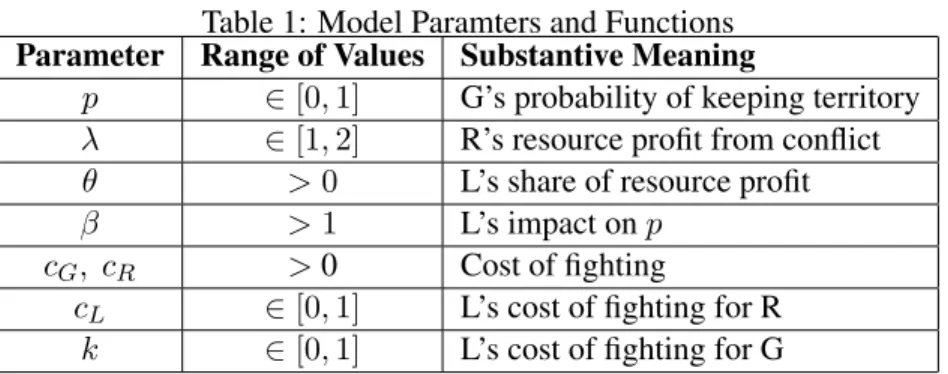
1 Model Paramters and Functions . . . 39
2 Duration Models: Dependent Variable = Time to Negotiation . . . 47
3 Value of Agricultural Credits Provided by Colombian Government . . . 52
4 OLS: Impact of Government Provided Agricultural Credits on FARC’s Coca Crop . . . 53
5 FARC Civilian Victimization after Negative Price Shocks to Cocaine . . . 72
6 Paramilitary Civilian Victimization after Positive Price Shocks to Cocaine . . . 72
7 Predicted Counts of FARC Victimization . . . 75
8 Predicted Counts of Paramilitary Victimization . . . 75
A.1 Descriptive Statistics, Continuous Independent Variables . . . 82
A.2 Lognormal Distribution (Failure) . . . 84
A.3 Cox PH Model (Failure) . . . 85
A.4 Lognormal Distribution (Rebel Victory) . . . 85
A.5 Cox PH Model (Rebel Victory) . . . 86
A.6 Lognormal Distribution (Negotiation) . . . 86
A.7 Cox PH Results (Negotiation) . . . 87
B.1 Descriptive Statistics, Continuous Variables . . . 93
B.2 Additional Models, DV=Time to Negotiation . . . 95
B.3 Additional Models, DV=Time to Negotiation . . . 96
B.4 OLS: Impact of Agricultural Credits on FARC-Supported Coca Farming, Year F.E. . . 97
C.1 Distribution of Municipalities’ Ln(GDPPC) . . . 99
LIST OF FIGURES
1 Hazard of Group Failure, Low Central Control . . . 16
2 Hazard of Group Failure, High Central Control . . . 16
3 Hazard of Military Victory, Low Central Control . . . 17
4 Hazard of Military Victory, High Central Control . . . 17
5 Hazard of Negotiation, Low Central Control . . . 18
6 Hazard of Negotiation, High Central Control . . . 19
7 Hazard of Group Failure, Low Central Control. . . 20
8 Hazard of Group Negotiation, Low Central Control . . . 21
9 Hazard of Group Failure, High Central Control. . . 22
10 Hazard of Group Negotiation, High Central Control. . . 23
11 Hazard of Group Victory, Low Central Control . . . 24
12 Hazard of Group Victory, High Central Control. . . 25
13 Conflict Duration for Groups With and Without Natural Resources . . . 30
14 Three Player Game Tree . . . 38
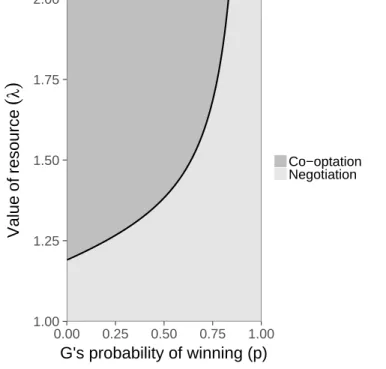
15 Negotiation vs. Co-Opting as a function of Rebel Benefits from Resource Access . . . 42
16 H1: Hazard of Negotiation, Increasing Natural Resource Access . . . 48
17 H2: Hazard of Negotiation, Increasing State Capacity . . . 50
18 Impact of Government Provided Agricultural Credits on FARC’s Coca Crop . . . 54
19 FARC victimization, 20% Negative Price Shocks Marked . . . 73
20 Paramilitary victimization, 20% Positive Price Shocks Marked . . . 74
A.1 Histogram, Frequency of Low/High Control . . . 82
A.2 Histogram, Group Outcomes . . . 83
A.3 Histogram, Frequency of Rebel Strength Relative to Government . . . 83
A.4 Histogram, Frequency of Group Duration in Years . . . 84
B.1 Distribution of Groups’ Territorial Control . . . 94
B.3 Survival Function, Cox PH Model, H2 . . . 96
B.4 Agricultural Credits Given to FARC-Controlled Departments vs. Others . . . 98
CHAPTER 1: INTRODUCTION
Does engaging in the production and sale of natural resources help militant groups accomplish their political aims? Some of the most lethal and long-standing rebel organizations have held territory that contains lucrative primary commodities. As a recent example, the Islamic State’s participation in the oil trade provided the group with the funding necessary to build and maintain the equivalent of state institutions from 2014 to 2017. Even now, as the group has gradually been forced out of oil-rich territory, the organization persists as an insurgent threat due to its economic investments (Mansour and Al-Hashimi, 2018). The groups’ engagement in oil production, smuggling, and sales therefore contributed to their rapid military and political advancement as well as their longevity by providing the means for ongoing, low-intensity fighting.
The group has been considered an exceptional evil, with then Secretary of State John Kerry calling the fight against IS the “challenge of our time” in 2015 (Morello, 2015). This merits consideration of whether the conditions under which IS cultivated and increased their oil market – and in turn, their territorial ambitions – are reminiscent of those faced by other militant groups.
First, the hierarchical and centrally controlled structure of the group’s forces ensured accountability among fighters and leaders to budget appropriately. This meant that the profit earned from selling oil went toward maintaining the group’s fighting forces as well as wages and provision of public goods. Further, the group capitalized on existing smuggling networks to transport oil through Turkey and into the international market - the group could only profit if oil crossed out of IS territory. Despite the presence of sanctions, the militant group consistently found international buyers for their product, meaning that barring changes to their supply of oil, they could count on fairly consistent income. Finally, at the height of their power, the group’s share in the regional oil market ensured that they were able to dictate price, meaning that they did not face uncertainty about price volatility that might impact their reallocation of profit.
avoided pitfalls such as profit-hungry leaders or rapid and unexpected changes to their oil networks due to global price shocks. Thankfully, the international coalition’s airstrikes have largely cut off the militants’ access to this lucrative primary commodity and limited their capacity to engage in violence against local communities and others abroad. Yet, the unusual degree of rapid attention and effort from the international community might be seen as a form of political success, even as it reduces the group from a state-like entity to an insurgency that, still fueled by natural resources, may persist for years into the future.
The outcome of the conflict with the Islamic State remains to be seen. Predicting based on other resource-rich groups’ outcomes yields mixed results. The RUF in Sierra Leone, for example, financed in part by the diamond trade, negotiated a ceasefire and eventual peace agreement with the state. Sendero Luminoso in Peru, after becoming heavily involved in drug production and trafficking, was largely defeated as a political organization but continued with some criminal activity and is experiencing a resurgence nearly 20 years later. The FARC in Colombia became involved in the drug trade as well, using it to finance their activities for 60 years before participating in 4 years of peace talks with the Colombian state to gain a place as a legal political party. Each of these groups differed in its organizational structure, its development of relationships with suppliers and transporters, and the capacity of the states they faced.
These examples illustrate that militant groups’ access to primary commodity wealth through oil, diamonds, drugs, or other resources is no guarantee of military and political success. The varied empirical record of group outcomes, however, remains underconsidered in the theoretical literature. Previous research discusses how natural resources amplify militants’ power against the state without questioning whether such shifts in militants favor will always occur. This literature abstracts away from important conditions - such as those discussed in light of the Islamic State’s success - whose presence or absence may fundamentally impact the outcomes of groups fighting in resource-rich territory. What dictates whether groups can successfully produce and invest profit from primary commodities? Phrased differently, under which conditions are natural resources beneficial to militant groups – and when can they become a curse?
groups, like commodity-rich states, are subject to the resource curse due to weaknesses in the primary commodity markets on which they rely. In doing so, I add an overlooked strategic dimension. I explore how militant groups bargain with suppliers, transporters, refiners, or other ‘local investors’ necessary to take the lucrative commodities from production to sale, and how the state might undermine militant-investor deals to limit rebel groups’ power.
CHAPTER 2: REBEL INFRASTRUCTURE, PRIMARY COMMODITY ACCESS, AND GROUP OUTCOME
Abstract
Introduction
“We are not drug traffickers. The FARC is a guerrilla army of men and women who are fighting 24 hours a day to change the country. The rest of what they say is lies.”
- Former FARC Spokesman Ra´ul Reyes, 2001
Can resources ever be a ‘curse’ for militant groups? Academics and policymakers alike stress the benefits rebel actors receive from gaining access to territory with lucrative natural resources. Groups as regionally and ideologically diverse as the Afghan Taliban, Peru’s Shining Path, and Sierra Leone’s RUF saw increases in their military capacity due to such access. For a current and policy salient example, one need look no further than the dramatic progress of the Islamic State until 2017 and subsequent resilience as an insurgency even after territorial losses. Defeating IS relies on understanding their funding capacity – in particular, their access to oil fields and black markets through which they market and sell this resource (Simpson and Philips, 2015). Resource access, then, is seen as critical to militants’ success, and preventing this access is the primary recommendation for stamping out violent group threats.
As the above quote suggests, however, the windfall of funding groups gain from controlling natural resources can be a double-edged sword. The FARC, the primary leftist rebel group in Colombia, increasingly faced accusations of placing greater priority on their drug profits than on the progress of the rebellion against the state. The group transitioned from local taxation of growers to full-fledged control of coca production, transport, and international sale – with sections of the group’s military apparatus dedicated to managing this business activity (Holmes, 2008). While this expansion increased the group’s revenue and access to capital, it also limited their ability to pursue their initial goals of Marxist revolution. Participation in the drug trade decreased the group’s civilian support and prevented the Colombian state and international community from viewing them as valid participants in the political process. The group’s involvement with narcotics was often cited as the primary roadblock on the way to the peace process – both in getting to negotiations, as previous Colombian presidents viewed the group as purely criminal – and in making any accomplishments in the Havana talks (Otis, 2014).
to the FARC’s gradual control of coca. Leaders divert resources away from insurgent activities and re-invest profits toward increased personal gain, leading to conflict with other factions within the organization and an overall lack of focus in the Taliban as a whole (Azam, 2016). Although the FARC and Taliban are relatively large groups with long lifespans, they have faced internal or external issues that divert them away from ‘success’ in the form of military victory or (until recently, in the Colombian case) negotiation with the state. These negative outcomes resulting from resource access are not deterministic, however. As a contrasting example, the SPLA in the Sudanese civil war remained largely focused on their separatist agenda (despite access to mining and oil resources), leading to the creation of South Sudan in 2011 (Lyman, 2015).1 What, then, might help us understand why some groups can successfully convert resource access into political gains while some become sidetracked by profits?
The literature on the resource curse provides a theoretical parallel. This scholarship contends that the states expected to achieve high levels of economic development due to an abundance of natural resources are often the most underdeveloped or unevenly developed. Authors suggest first that access to these resources provides little incentive to develop sustainable economic and political institutions to manage the translation of resource wealth into development (Sachs and Warner, 2001). Doing so requires strong institutions that encourage accountability among state leaders and maintain focus on appropriate allocation of profits. If resource-wealthy states often experience strife and setbacks due to a focus on commodity driven wealth, should we not consider that militant organizations might also encounter these challenges?
Toward this aim, this paper proposes a theory to better understand the conditions under which rebel groups2are able to capitalize on natural resources to advance their political goals. I argue that whether or not a group is centrally controlled has a conditioning effect on a militant group’s ability to successfully build markets to gain natural resource profits and apply these profits toward their political goals. I expect that when groups with weak organizational structure access natural resource wealth, this will negatively affect their chances of survival and success, as they become
1The SPLA did receive external support while fighting, which may have offset possible negative effects of natural
resource access. However, the group also made use of these local natural resources. Further, and more broadly, there is significant variation in outcomes for groups that both receive external aid and profit from natural resources, as many groups in this paper’s data have both sources of revenue. This indicates that even among groups with external sponsorship, natural resource wealth still drives differing outcomes.
trapped by the same resource curse that affects disorganized states. Well organized and centrally controlled groups, however, are able to convert natural resource wealth into strength that increases their chances of survival and growth.3 I further argue that the perceived positive effects of natural resource wealth for groups can have an important disadvantage: while these resources can (at least temporarily) increase a group’s power in relation to the state, they also can make negotiation less possible due to increased commitment problems and a negative perception of the groups’ goals.
This paper proceeds as follows: In the next section, I discuss the current state of the literature on natural resources, civil wars and the parallels of the resource curse in states. I then present my hypotheses and clarify my approach to building the necessary dataset in the third section. The fourth section presents the results from my quantitative analysis and discusses their implications. The fifth concludes.
Rebels and Resource Wealth
This paper builds on substantial literature about the role of natural resources in intrastate conflict while continuing the trend in conflict literature of temporally and spatially disaggregating the level of analysis. The foundational scholarship on resources used a much coarser lens, applying state-level measures of oil endowments (Collier and Hoeffler, 2004a; Fearon, 2005; Fearon and Laitin, 2003; Douma, 2001; Berdal and Malone, 2000) and finding that resource rich states tend to be more conflict prone. These authors propose two explanations - either resource endowments occur in weak states that are less able to contain rebellion, or the prospect of financial gain sufficiently offsets the costs of fighting for rebels. But at the state level, the presence of natural resources appears to have the same effect in either circumstance.
Variation in multiple sub-state factors affect a group’s control of certain commodities, which in turn impacts conflict outcomes. From both a theoretical and empirical standpoint, explaining how certain groups benefit from resource revenue while others do not requires a more narrow unit of analysis than the state level. Theoretically, all groups operating within a particular state cannot be expected to have the same structure, strategic interaction with the government, or ability to translate
3
resource gains into military gains. For data collection, the state is far too broad of a geographical unit to establish which groups can effectively access resources (given their location) and which cannot. Acquiring a more nuanced understanding about militant groups’ strategy and resulting outcome with regards to resources requires a narrower focus.
Existing work first disaggregates by natural resource type to examine the effects on conflict duration and severity (Ross, 2004; Lujala, 2009, 2010). Importantly, these studies employ a conflict level of analysis to assess severity and duration rather than looking at the group-level implications of natural resource access. These papers hypothesize that different resource types can differently affect a group’s capacity to engage in conflict, but do not present a theory of variation betweengroupsthat might explain whether natural resource access generates success or failure. Additional literature (Fjelde and Nilsson, 2012; Arnson and Zartman, 2005; Beardsley and McQuinn, 2009; Wright, 2015) demonstrate that rebels make strategic choices about attaining, extracting and employing natural resource wealth based on their anticipation of other actors’ choices. However, this research assumes that rebels can profit from access to natural resources without carefully considering the steps needed to do so and the conditions under which they may not. Thus, we can expect that natural resource access does change the trajectory of militant groups, but additional investigation is needed to understand the conditions under which such access results in progress toward the group’s political goals.
When rebel groups put aside fighting to engage in economic activity, neither the state nor the rebels can fully anticipate if this investment will pay off. External factors such as fluctuations in price and internal factors such as corruption or fragmentation can impact militants’ ability to create favorable commodity markets and militants’ application of the profit earned. As demonstrated in the literature above, while natural resource revenue can prolong groups’ activities and strengthen them relative to the state, such wealth also provides an opportunity for rebel leaders to line their pockets – much like profit-driven state or military leaders. A group’s leadership may decide to hoard some of the profits from the group’s investment, leaving less for increasing military capacity and accomplishing political goals against the state. Groups that contain multiple factions may see internal squabbles over control of the group’s assets. Just as natural resources can be either a boon or a downfall for developing states, militant groups can similarly experience diverging outcomes.
of a militant group by minimizing the importance of building social capital (2005). While Weinstein’s theory is related to this paper’s argument, it differs in an important way: I argue that even among groups with natural resource access, there are still important differences in group outcomes resulting from internal organization, rather than suggesting a group caneitherhave successful social ties or corrupt, resource-driven fighters. Staniland, in a similar paper, (2012) links group resource-driven fragmentation and failure to the social ties upon which a group is built. His qualitative argument does not, however, account for the importance of variation in the internal structure of the group. Cunning-ham (2013) suggests that fragmentation within broader movements affects bargaining processes with the state. This indicates that if natural resource access can encourage group corruption, fragmentation, and failure, this should influence when we observe negotiation versus other types of state and group interaction. Similarly, Christia (2013) shows how changing intra- and inter-group power dynamics are the primary driver of changes in group composition and resulting behavior. Though this literature suggests that internal power shifts can affect group behavior, additional consideration is needed to determine the conditions under which natural resource access might drive these power shifts, and how such access results in different group outcomes.
Natural resources can both benefit and harm rebel groups by increasing a group’s capacity relative to the state while incentivizing internal corruption and infighting. This indicates a need for more comprehensive theory of when negative vs. positive outcomes should occur. The current literature predominantly focuses onconflictoutcomes rather than group-level outcomes, and even research generated at the group level stops short of comprehensively and systematically considering how natural resource access might affect a range of group outcomes. Possible group outcomes include decisive military victory against the state, reaching negotiations with the state, and failure due to military defeat, fragmentation, or no/low activity (Fortna, 2015). Military victory and negotiation are relatively rare outcomes for militant groups due to the asymmetry of power between rebels and the states they fight, while group failure overall is a more common outcome. Primary commodity wealth might be assumed to narrow the gap between militant groups’ and states’ power, making the first two outcomes more likely, but access to primary commodities is no guarantee of groups’ success. I argue that to better assess the conditions under which variation in the success or failure of groups might be expected, we should turn to the resource curse literature in states.
groups’ capacity to use natural resources. Sachs and Warner (2001) see the resource curse as a budgeting problem through which the investment in the natural resource in question crowds out other growth-inducing activities: therefore, natural resources inadvertently harm growth. This point clarifies that accessing resources themselves does not necessarily lead to a lack of growth – but rather that whether or not states can successfully allocate additional profits affects their progress. When relating this problem to rebel groups, ‘growth’ is a parallel for battlefield gains, achieving concessions, or more broadly as progress towards achievement of their political goals against the state. Rebel groups suffering from the resource curse, then, fail to appropriately allocate profits toward continuing and advancing the fight.
Robinson, Torvik and Verdier (2006) suggest that having the proper institutions in place prior to a natural resource’s discovery is crucial for a state to avoid the resource curse. Successful states possess institutions that increase accountability and competent management of profits (i.e. democratic governance, checks and balances, and changing leadership). Rebel groups can also make use of governance structures to dictate action, communicate among members, and guard against corruption (Gates, 2002). Similarly, the structure and internal governance of a group at the time the group accesses and establishes markets for natural resources will influence whether these commodities help or harm a group’s progress toward its goals. Well-structured militant groups, like well-structured states, will be able to control the management of resource production and the application of resource profits, helping them avoid collapse.
monitored. I expect that this element of central control is what dictates whether or not a group can successfully allocate resource gains toward fighting efforts. In short, I expect that the effect of natural resource wealth on group failure is conditioned on group structure. This logic leads to my first hypothesis:
H1: Increasing natural resource access decreaseshighly centrally controlled groups’ proba-bility of failure butincreasesthis probability for groups with low central control.
Given this risk of group failure, why might groups still invest in the production or trade of natural resources? As mentioned, the literature suggests that natural resource access does generally increase group capacity, particularly for groups without any other form of funding. Just as with states, natural resources increase a group’s revenue – although often not in a sustainable manner if poorly managed or if exogenous factors decrease a group’s access. This indicates that resource access can increase all groups’ ability towinagainst the state, as without such resource profits a group is often unable to fund basic mobilization. However, militant groups’ military success against states is a very rare outcome, as few groups accomplish their political goals by soundly defeating the state. Thus, investing in natural resource production can be a risky strategy for groups – it increases the rare possibility of military victory, but can be fraught with risks of internal collapse or group distraction if the group is poorly organized. Pursuing natural resource profits may appear to be a beneficial strategy for all groups, and indeed can be expected to increase the probability of the rare outcome of victory. However, this rare outcome is accompanied by an increased risk of failure when the group is unable to weather internal corruption or leadership struggles. This leads to my second hypothesis:
H2: Increasing natural resource access increases both types of groups’ probability of mili-tarily defeatingthe state.
considerable difficulty striking stable peace settlements with certain resource dependent groups. In contrast, groups that are able to successfully manage resource profits may see substantial gains in their power relative to the state, leading governments to extend concessions to these types of powerful militant actors. This implies that only groups with high levels of central organization can be expected to apply and manage resource gains in a manner that leads to increased chances of negotiation. Just as the fate of states that are dependent on single commodities are tied to that commodity’s performance on the international market, rebel groups focused on profits from a single resource type can be prone to changes in power as their economic base shifts. This can lead to commitment problems as the state will be unwilling to sit down with a group that may be far weaker or stronger in the future (Fearon, 1996; Powell, 2006; Carter, 2010).
Another risk for groups lies in the state’s willingness to harm their reputation by negotiating with economically focused militant actors. Groups that access natural resource wealth are often perceived as criminal groups focused solely on wealth acquisition rather than any real political goals (Kalyvas, 2015). This can mean that state leaders’ hands are tied by domestic constituents or international supporters who will punish leaders that negotiate with ‘criminals’ – or that leaders can better employ this argument to delegitimize rebel claims and avoid making concessions. From the perspective of poorly organized groups, a desire to continue extracting resource rents (rather than reach a peaceful and politically expedient outcome) may prevent them from committing to negotiations. My third hypothesis is thus:
H3: Increasing natural resource accessincreaseshighly centrally-controlled militant groups’ probability of reaching negotiation, butdecreasesthis probability for groups with low central control.
Data and Testing
fragmentation that leads to group termination. My unit of analysis, then, is the group-year, as I am interested in group-level outcomes. My data pairs time-invariant information about group charac-teristics such as the group’s level of central control with yearly measures of location-specific group activity and access to different resource types. I employ the existing Non-State Actor (NSA) Data (Cunningham, Gleditsch and Salehyan, 2009) and UCDP Geo-Referenced Event Data (Sundberg and Melander, 2013) for group characteristics and group location. I match this with geo-referenced data about the location and yearly discovery of different natural resource types: petroleum, gold, gems, and drugs (Tollefsen, Strand and Buhaug, 2012). These spatial data allow me to identify when and where militant groups gain access to natural resources and their subsequent conflict outcomes at an unprecedented level.
I consider these different possible outcomes with competing risks analysis, and thus my de-pendent variable is the time until each possibility: failure, negotiation, or military victory. This approach is in keeping with Fortna (2015), who employs competing risks analysis for a similar set of rebel group outcomes. The ‘failure’ outcome includes the possibility of military defeat by the state, as well as failure due to a lack of activity or being absorbed by another group. I aggregate these failing outcomes from the NSA data (Cunningham, Gleditsch and Salehyan, 2009). The negotiation outcome includes ceasefires as well as peace agreements and captures the idea that the state should only be willing to stop fighting and discuss concessions with certain types of groups. Finally, the military victory outcome records the rare instances in which militant groups are able to militarily defeat the state, as these groups usually face such a power asymmetry that outright battlefield victory is unlikely.4
My first independent variable is a measure of group structure and control. I modify the NSA’s measure, which codes a group’s degree of central control (none, low, moderate, high).5I collapse this variable into a dichotomous measure of whether the group has no/low central control or moderate/high central control.6 In the data, groups with no or low control are those with poor communication and accountability across their constituent parts, such as the ONLF (Ogaden National Liberation
4
Full tables or plots of descriptive statistics for the variables discussed in this section , including the number of occurrences of each outcome in the data, can be found in the appendix.
5
In the description of the data, this is coded as “the extent to which a central command exercises control over the constituent groups of an insurgent movement.”
6I make this recoding decision for both practical and theoretical reasons. As might be expected, there are few groups in
Front) in Ethiopia (Ethiopia: Deal with Breakaway ONLF Faction, 2010). These groups are often characterized by frequent leadership struggles and a more horizontal or nonexistent organizational structure. In contrast, well-controlled groups are those with a heirarchical structure that more closely resembles a state military. An example in the data is the LTTE in Sri Lanka, a group with formalized leadership transitions, efficient communication, and high accountability for subgroups or individuals acting against the wishes of the central command (Beardsley and McQuinn, 2009).
For my second independent variable, I rely on the PRIO geolocated and time-varying data on natural resource deposits. This dataset codes the number of deposits of certain natural resources within a grid cell, which is a spatial unit defined with GIS technology by the researcher creating the data. The locations of petroleum, gold, gemstones, diamonds, and drugs are all coded in these data. For my measure of a groups’ degree of natural resource access, I sum the number of grid cells containing at least one natural resource in which the group was active in a given year. This means that a group with activity in a cell with 4 petroleum deposits is considered to have the same degree of resource access as a group present in a cell with 2 drug deposits and 2 gold deposits. Tracking changes from year to year in the number of resource cells to which a group has access is helpful for understanding how changes in group territory can affect the time militant groups are present in the data and each group’s outcome. Because I am interested in the conditional effect of a militant group’s central control on natural resource access, my primary explanatory variable is thus an interaction term between this sum of natural resource cells and the dichotomous measure of whether or not a group has a high level of central control.
I include a number of additional control variables at both the group and country level, as is standard in the civil conflict literature. At the state level, I control for state population and GDP7, in keeping with other work on conflict duration (Collier and Hoeffler, 2004b; Gaibulloev and Sandler, 2014). At the group level, I include a measure of the total number of grid cells to which a group has access in each year of its activity. This variable captures the effect of overall territorial control or territorial access, and allows me to distinguish my results as driven by natural resource access in
also theoretically appropriate, as I hypothesize that poorly controlled groups will see negative effects from natural resource access, while well-controlled groups will be able to benefit.
7
particular.8 I also control for the strength of the group relative to the government using the NSA’s measure, which I collapse into three categories: groups that are weaker than the government, at parity, or stronger.
After matching each group present in the NSA to those active in the GED, including each group’s natural resource access per year, and limiting the sample to groups originating after 1989 (the first year of the GED data), my dataset contains 651 group-year observations. I also remove any conflicts coded as coups in the NSA data and any groups that represent subsets of state forces. There are 178 unique groups in the sample, as many groups are only present for a limited number of years.
To test my hypotheses, I use a set of parametric event hazard models to determine the relationship between natural resource access and degree of central control on group failure, negotiation with the state, or military victory.9 For each model, I assume a lognormal distribution. The lognormal baseline hazard is an appropriate distributional assumption when modeling events for which the hazard of experiencing the event increases in the short term and decreases over time. This is also in keeping with other work modeling militant group outcomes such as negotiation (Bapat, 2005).10 For each model, standard errors are clustered at the group level.
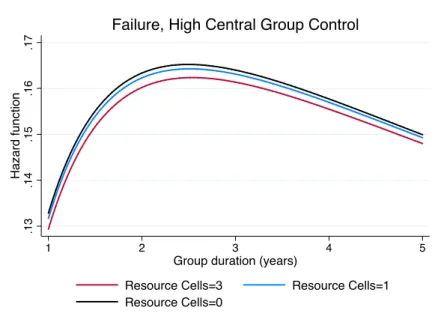
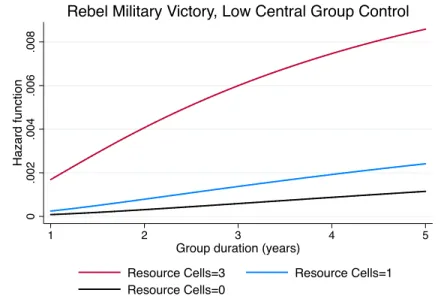
Due to the difficulty in presenting and interpreting interaction terms for event hazard models, I instead include the plotted hazard ratios for each outcome below.11 Each plot represents the hazard of an event (failure, rebel military victory, or negotiation) over a 5- year time period. For each possible outcome, I plot the hazard rates for groups with low central control and high central control in two subsequent graphs. Thus, for each group type, I show the effect of increasing the number of resource cells on the probability of observing each outcome. I vary the number of resource cells to which groups have access and plot the effect of 0 cells (no natural resource access), 1 cell, and 3 cells. These values represent the minimum, mean, and one standard deviation above the mean of the resource cell variable.12
8The correlation between total cells and resource cells for this sample is .3. 9
For the sake of simplicity and in keeping with previous literature, I assume that the risk of each outcome is independent (Fortna, 2015).
10The results are robust to different specifications of the parametric model, and the results of Cox proportional hazards
regression for each outcome can be found in the appendix.
11Full tables for each model can be found in the appendix. 12
Figures 1 and 2 illustrate the effect of natural resource access on militant groups’ likelihood .17 .18 .19 .2 .21 H a za rd f u n ct io n
1 2 3 4 5
Group duration (years)
Resource Cells=3 Resource Cells=1
Resource Cells=0
Failure, Low Central Group Control
Figure 1: Hazard of Group Failure, Low Central Control
.13 .14 .15 .16 .17 H a za rd f u n ct io n
1 2 3 4 5
Group duration (years)
Resource Cells=3 Resource Cells=1
Resource Cells=0
Failure, High Central Group Control
Figure 2: Hazard of Group Failure, High Central Control
resource cells are least likely to fail. These plots indicate support for H1: that the effect of natural resource access is conditioned on whether or not a rebel group can successfully manage resource profits.
Figures 3 and 4 similarly present the effect of natural resource access on the possibility of rebel
0 .002 .004 .006 .008 H a za rd f u n ct io n
1 2 3 4 5
Group duration (years)
Resource Cells=3 Resource Cells=1 Resource Cells=0
Rebel Military Victory, Low Central Group Control
Figure 3: Hazard of Military Victory, Low Central Control
0 .005 .01 .015 .02 H a za rd f u n ct io n
1 2 3 4 5
Group duration (years)
Resource Cells=3 Resource Cells=1
Resource Cells=0
Rebel Military Victory, High Central Group Control
Figure 4: Hazard of Military Victory, High Central Control
victory. As figures 3 and 4 show, increased access to resource cells affects both group types in the same way: it makes them more likely to win. These results demonstrate support for H2. However, this outcome merits further discussion. This is, as noted, a very rare outcome in civil wars regardless of group characteristics or resource acquisition. As demonstrated above, natural resources can have a negative effect on some groups’ survival. Thus, while profits from natural resources may increase a group’s chances of beating the state – particularly for very poor or small groups – this increase can, in essence, be a gamble that is offset by the chance of internal corruption, disbandment, and failure. Finally, the plots corresponding to the third hypothesis about the likelihood of a group reaching
0
.02
.04
.06
.08
H
a
za
rd
f
u
n
ct
io
n
1 2 3 4 5
Group duration (years)
Resource Cells=3 Resource Cells=1 Resource Cells=0
Negotiation, Low Central Group Control
Figure 5: Hazard of Negotiation, Low Central Control
.03
.04
.05
.06
.07
.08
H
a
za
rd
f
u
n
ct
io
n
1 2 3 4 5
Group duration (years)
Resource Cells=3 Resource Cells=1 Resource Cells=0
Negotiation, High Central Group Control
Figure 6: Hazard of Negotiation, High Central Control
hurts their chances of getting to the negotiating table (Figure 6).
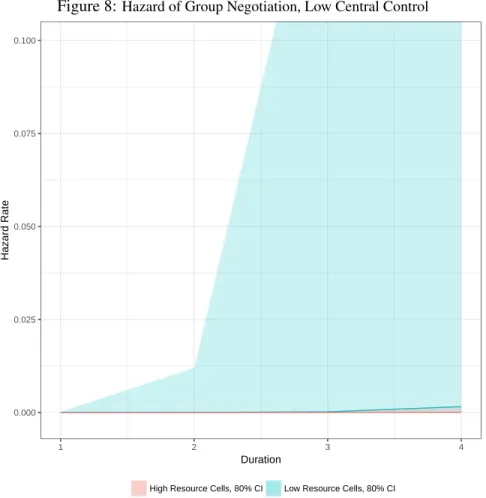
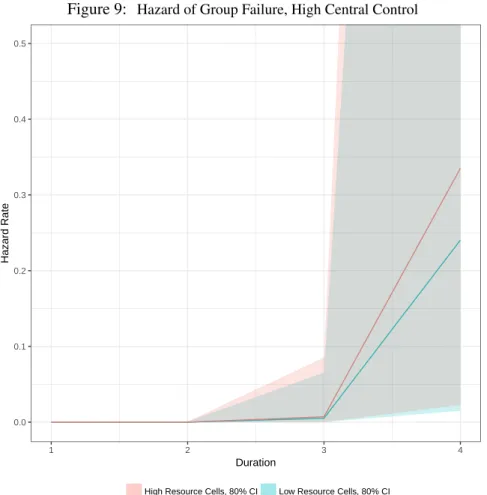
While the direction of these relationships – exempting the negotiation outcome – is as hypothe-sized, further investigation is needed into the statistical significance of the resource sum and central control measures as predictors of group outcome. Due to the difficulty in producing measures of confidence from standard parametric duration and competing risks models, I turn to Bayesian competing risks models13. This estimation choice allows me to include credible intervals for the subhazard of each type of group termination, while accounting for within-conflict variation and time varying covariates. I then plot the hazard of each type of termination for groups with high central control and low central control, varying their access to lucrative natural resources.
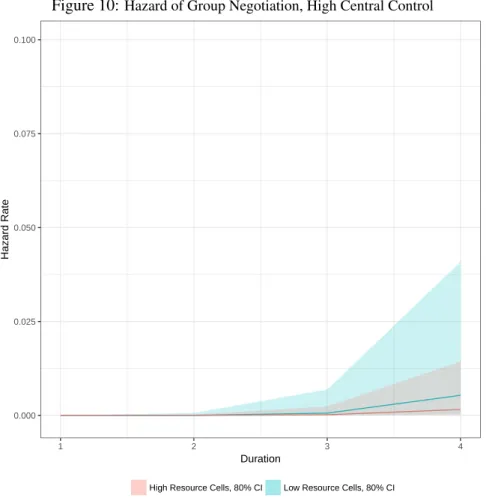
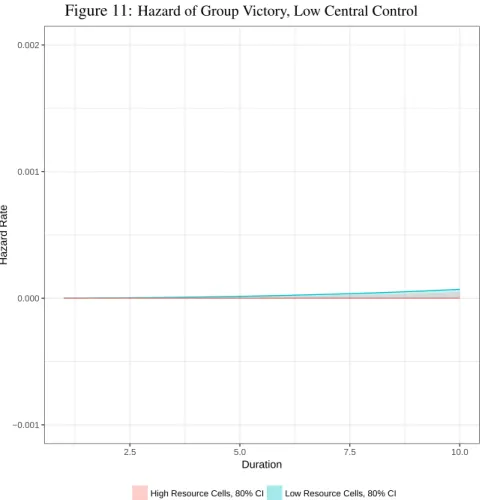
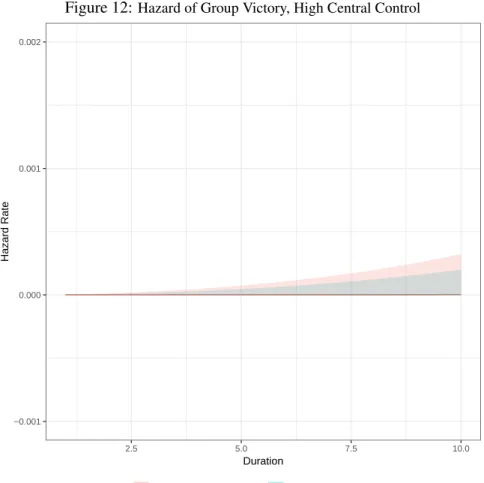
Below are the plotted hazard rates for each outcome (Failure, Military Victory, and Negotiation) with 80% credible intervals. Of immediate note is the size and overlap of the credible intervals. While the direction of these relationships are consistent with the frequentist models, these credible intervals provide additional important information and opportunities for further development. First, better empirical distinction between centrally controlled and non centrally controlled groups is needed in the data, as similar groups can be characterized in either way. Second, limited observations combined with a large amount of variation in groups’ duration (1 year to 20+ years) means that these
13Full information about these models’ specification can be found in this chapter’s appendix. A Weibull baseline hazard,
models struggle to estimate groups’ duration with statistical confidence. This indicates that a more sophisticated way to measure time until each outcome may be needed to better understand the hazard of group failure within the first few years. Finally, while these results do convey minimal substantive information, they are an important step toward better capturing a data generating process in which groups’ duration until multiple possible outcomes is jointly estimated.
Figure 7:Hazard of Group Failure, Low Central Control
0.0 0.1 0.2 0.3 0.4 0.5
1 2 3 4 5
Duration
Hazard Rate
High Resource Cells, 80% CI Low Resource Cells, 80% CI
Figure 8:Hazard of Group Negotiation, Low Central Control
0.000 0.025 0.050 0.075 0.100
1 2 3 4
Duration
Hazard Rate
High Resource Cells, 80% CI Low Resource Cells, 80% CI
should prefer not to waste resources in early fighting – but also still wish to avoid negotiation with groups’ whose future is uncertain. As the first two figures show, natural resource access can result in militant groups’ collapse. Similarly, exogenous price shocks and price volatility can provide an uncertan economic environment for rebel groups in the same way volatile commodities affect state development. Given these sources of uncertainty resulting from natural resource investment, govern-ments’ unwillingness to negotiate with groups that are dependent on steady profit is understandable, but provides an important opportunity to investigate the circumstances under which such negotiation can occur.
Figure 9: Hazard of Group Failure, High Central Control
0.0 0.1 0.2 0.3 0.4 0.5
1 2 3 4
Duration
Hazard Rate
High Resource Cells, 80% CI Low Resource Cells, 80% CI
capacity. When combined, these results paint a fairly detailed picture of how the ‘resource curse’ functions for rebel groups. Resources can be a tempting windfall of revenue that can increase the chances of military success. However, only certain groups are able to capitalize on these economic gains and translate them into success towards their political goals – much like states, the proper ‘governing institutions’ must be in place for this to occur. Finally, natural resource access can be a curse in that it obstructs the primary pathway for militant groups to receive political concessions: negotiation.
Conclusion
Figure 10:Hazard of Group Negotiation, High Central Control
0.000 0.025 0.050 0.075 0.100
1 2 3 4
Duration
Hazard Rate
High Resource Cells, 80% CI Low Resource Cells, 80% CI
are able to mitigate chances of internal corruption and fragmentation by appropriately budgeting economic gains and ensuring their application towards group survival and progress. Militant groups without such central control, however, experience the opposite effect: increasing their access to natural resources makes them more likely to fail due to such internal power struggles and improper allocation of revenue.
Figure 11:Hazard of Group Victory, Low Central Control
−0.001 0.000 0.001 0.002
2.5 5.0 7.5 10.0
Duration
Hazard Rate
High Resource Cells, 80% CI Low Resource Cells, 80% CI
becomes less possible as natural resource access increases.
Figure 12:Hazard of Group Victory, High Central Control
−0.001 0.000 0.001 0.002
2.5 5.0 7.5 10.0
Duration
Hazard Rate
High Resource Cells, 80% CI Low Resource Cells, 80% CI
CHAPTER 3: REBEL PRIMARY COMMODITY MARKETS AND NEGOTIATION IN CIVIL WAR
Abstract
Introduction
How does access to primary commodities affect rebels’ chances of negotiating with the state? Groups that profit from natural resources– such as the FARC and the Islamic State – are some of the most durable and powerful militant organizations (Humphreys, 2005; Lujala, 2010). Yet, accruing power and fighting capacity by producing and selling resources such as drug crops and oil reserves rarely leads the group to the negotiating table. Resource-driven conflicts often last much longer, with states refusing to negotiate with rebel actors that pursue economic endeavors. Why, then, if resource profits enable these groups to become far more powerful threats, do states delay negotiation?
This study develops an explanation of how natural resources affect governments’ willingness to offer negotiation and militant groups’ propensity to accept. I consider a source of uncertainty about the future balance of power between the militants and government: rebels’ capacity to build a market for the production, distribution and sale of primary commodities. I demonstrate how a rebel group’s ability to use natural resource revenue to buy off key local actors – including farmers or miners, distributors, public officials, community leaders – can prolong conflict and diminish the already rare outcome of negotiation. These local investors take on varied roles dependent on commodity type, existing market structure, and militant groups’ degree of involvement, but are universally necessary for resource-rich groups to generate profit. I use the term ‘local investors’ to capture the variety of militants’ economic partners without limiting their purpose or possible involvement to specific conflicts.
For example, ISIS’ control over oil production in Iraq and Syria and distribution for eventual international sale was dependent on middlemen to refine and smuggle oil outside of ISIS-controlled territory (Faucon and Albayrak, 2014). Similarly, as the Taliban has increased their control over the heroin trade from taxation of poppy farmers to participation in reform and transport, their partnerships have expanded to include smugglers and corruptible local political officials (Mashal, 2017). As such, this study addresses local investors in a generalizable framework that captures the prevalence and importance of such relationships in intrastate war.
support affords is not guaranteed. Militant groups’ control of lucrative territory achieved through locals’ support is therefore tentative at best. When community leaders’ partnership allows rebels to increase profits, their power relative to the state also increases, suggesting that negotiation should become more likely. However, accepting political concessions in negotiations robs militant groups of future profits and with it the local support augmenting the rebels’ power. When militant groups can expect to continue profiting from conflict due to cooperation from local investors, a broader range of offers made by the government is unlikely to appease the group, as political concessions become less appealing in comparison. States, meanwhile, seek to prevent local investors from striking this deal with militant groups by offering tax cuts, economic credits, arms for self defense, or other means of encouraging loyalty and incentivizing local actors to resist rebels’ attention. This further prolongs conflict, as states respond to rebels’ increased strength locally as a substitute for conflict-level negotiation.
Below, I review the relevant literature about natural resources and intrastate conflict, focusing on how rebels strike deals with local investors and how states undermine these deals, making negotiation less likely. I then consider government, rebel, and local investor interaction to assess how changes in the value of natural resources available to rebel groups and the resulting balance of power affect the probability of negotiation leading to conflict resolution. I test my argument at two levels of analysis: with a duration analysis of negotiation across intrastate wars and a micro-level analysis of local investors’ participation in the FARC’s development of coca markets.
Natural Resources, the Balance of Power, and Conflict Negotiation
Negotiation in any civil war is a rare outcome (Kaplow, 2016; Walter, 1997). Conflict processes such as negotiation can be further complicated by the presence of natural resource wealth in conflict zones. This means that identifying the conditions under which negotiation can be expected is an even more complex endeavor in such conflicts.14 Natural resources have differing effects on conflict negotiation depending on the level of analysis and the assumed theoretical mechanism motivating the conflict (Wennmann, 2011; Rustad and Binningsbo, 2012; Humphreys, 2005). If natural resources are used to effectively close the gap between government and rebel groups’ probability of winning, such
14
resource profits may be positively associated with negotiated outcomes, as states may be motivated to negotiate with strong groups that will pose a future threat to their security. However, others note that wealth gained from primary commodities influences rebel actors to continue fighting to enable future profit if they cannot fully defeat the state (Humphreys, 2005; Jonsson, Brennan and O’Hara, 2016).15 Two differing mechanisms, then, can affect negotiation in conflicts with natural resources: militant groups may be motivated to fight to maintain their access to profit, and shifts in the balance of power can affect states’ and militants’ bargaining process. Additional scholarship is necessary to differentiate and synthesize these mechanisms.
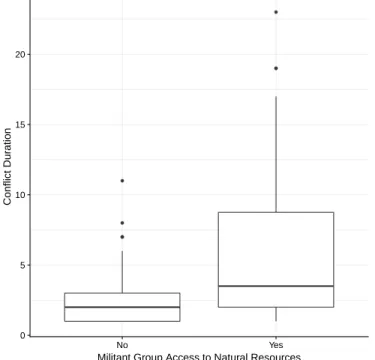
It is well established in the literature that natural resources affect the onset and duration of intrastate conflicts (Ross, 2004; Fearon and Laitin, 2003; Berdal and Malone, 2000; Sorens, 2011; Thies, 2010; Lujala, 2010). As Figure 13 below illustrates, the average duration of conflicts involving militant groups with no access to lucrative natural resources is just over two years, while conflicts in which militants have such access on average last nearly six years. As also evidenced in Figure 13, there is substantial variation in the survival of groups that benefit from natural resources. This variation provides an opportunity to investigate the characteristics of long-lasting groups and to better consider reasons for the delays in conflict termination related to resource access.
In all intrastate conflicts, changes in the balance of power between rebel groups and states affect conflict duration and whether or not negotiation is achieved (Gent, 2011; Clayton, 2013). Stronger rebels are better able to gain the state’s attention and overcome bargaining problems stemming from their lack of credibility. However, differing foundations of rebel strength may have diverging effects on the state’s willingness to negotiate, depending on the durability of rebel power.
This suggests that it is first necessary to consider now natural resource wealth impacts the balance of power between rebel groups and states. Access to primary commodities can aid militants by providing the direct benefits of profit, which groups can apply towards additional weapons or troops, or indirect benefits such as territorial control as a byproduct of involvement in resource production. States are most often willing to bargain with ‘established’ rebel groups such as those with consistent natural resource access through their control of territory (Kaplow, 2016). Given the literature about
15This may be dictated by whether or not any proposed peace agreements allow the rebels some share of continued
Figure 13: Conflict Duration for Groups With and Without Natural Resources
● ● ●
●
● ●
●
0 5 10 15 20
No Yes
Militant Group Access to Natural Resources
Conflict Dur
ation
the balance of power in civil wars, if natural resources narrow the difference in power between the state and the rebel group and allow the group to be percieved as a real threat, negotiation should be more likely as weak groups grow in strength. When militant groups translate natural resource wealth into fighting capacity, they should be expected to capitalize on this positive shift and pursue negotiation from a rare position of strength.16 Such an outcome is conditional, however – and it is necessary to considerhowmilitant groups are able to profit from primary commodities and when they successfully translate this profit to military strength.
Additional relevant scholarship points to commitment problems as a key explanation for why parties in intrastate conflict find it difficult reach the negotiating table (Walter, 1997). If a militant group must surrender its arms – the source of its bargaining power – in the process of conflict resolution, their ability to prevent the government from reneging on agreed concessions in the future is limited. When groups profit from primary commodities, getting to negotiation may be aided by a positive shift in power. Paradoxically, then, although primary commodity profits can increase weak groups’ power and make negotiation more likely, for militants negotiating also means giving up any access to future profit and with it the source of militants’ power. Control of their economic gains is
16
by definition a byproduct of conflict, requiring the group to remain active to ensure future wealth. If militant groups weigh the benefits of a negotiated outcome against the costs of continued conflict (Kaplow, 2016), rebels with economic profits from resource production and sale will find the political concessions of negotiation even less appealing, as primary commodity wealth offsets these costs. Despite the costs imposed by fighting, the economic benefits of territorial occupation and natural resource investment can make ongoing conflict beneficial for militant groups. The presence of lucrative commodities has an effect not only on the characteristics of civil wars writ large but also on individual group strategy, goals and the state response to these changing dynamics (Snyder and Bhavnani, 2005; Weinstein, 2005; Staniland, 2012). The RUF in Sierra Leone, for example, notoriously delayed settlement and disarmament with the state to continue accessing diamond mines (Farah, 2000). If and when groups are able to profit from access to natural resources, this windfall affects their available strategies – provided that they are also able to effectively manage these profits. Even if rebels’ increased capacity persuades states to offer negotiation, militant groups must consider that negotiating will lead them to lose the strength enabling them to counter the state: their projected economic profit accrued by partnering with local investors. Because rebels should be expected to weigh the costs of fighting against the benefits of primary commodity wealth in this way, it is next important to consider the conditions under which natural resource access can truly be beneficial to rebels’ wealth, capacity, and aims.
Despite the literature describing how natural resources amplify militant groups’ power, similar commodities have been shown to harm states’ development rather than aiding their growth. As research in comparative political economy demonstrates, states with ineffective institutions are unable to manage and reallocate profit from the oil or other resources contained in their territory (Sachs and Warner, 2001; Robinson, Ragnar and Verdier, 2006). Thus, increased development is not a foregone conclusion for states with primary commodity wealth. Instead, states that should be expected to convert resource wealth into development are often harmed rather than helped by such resource endowments.
sale of primary commodities and ensure that resource profits are reinvested into fighting. Further, like resource rich states, such groups are even more prone to poor management, infighting and corruption that drives collapse rather than growth and increased capacity. Groups that fail to manage resource investment face a resource curse similar to states, as poorly governed groups (those without central leadership) arelesslikely to survive if they have access to natural resources, while primary commodities increase well governed groups’ ability to survive.
This means that resource access is not enough to ensure militant groups’ growth or increased capacity. Further, the argument that rebels’ natural resource wealth will even the balance of power and encourage negotiation is conditional. Rebels must first ensure that they can generate profits from primary commodities, which means not only being able to access the resource in question but also to sell it. Doing so requires access to resource markets, generally through cooperation with existing economic actors. In particular, for militant groups to generate profit that influences their relative strength, they must rely on investors. Evaluating the effect of natural resource wealth on group outcomes such as negotiation, then, requires consideration of the economic partnerships on which rebel strength relies.
Rebels’ Economic Partnerships: the Importance of Local Investors
2016; Peters, 2010).
The suggestion that rebel groups orchestrate agreements and cooperation with local investors is in keeping with literature about state-building in conflict environments, which details the interactions between local leaders and rebels to set up wartime institutions (Arjona, 2015; Mampilly, 2011). Natural resource wealth allows groups to form partnerships with investors, as militants can provide such actors with economic benefits – particularly benefits that the local licit economy may not be able to match. For example, in some Colombian municipalities, the rebel-led illicit economy eclipsed the licit economy during the conflict as community actors invested and participated in FARC or ELN-led drug production (Rangel Suarez, 2000).
This implies that the details of these militant-investor partnerships vary with conflict characteris-tics, resource type, and current local economic conditions. However, the need for militants to produce, transport, and market any primary commodities in the territory to which they have access remains constant across resource-driven conflicts. The RUF relied on smugglers to transport diamonds into Liberian markets (Rupert, 1999) much in the same way the Islamic State relied on middlemen to move oil into Turkey (Faucon and Albayrak, 2014). Similarly, both the FARC and the Taliban established relationships with drug crop growers and drug refiners to build their respective coca and opium empires. In each of the above rebel-investor ‘deals’, militants incentivized individuals or groups to partner with them over the state or other existing economic partners. Variation in conflict conditions will impact the scale and content of the incentives rebels must provide local investors,17 but the presence of such deals can be considered a generalizable phenomenon. While further investi-gation about the specific nature of these partnerships is merited in additional scholarship, it is first appropriate to consider the conditions under which militants can establish such commodity markets and subsequently profit from them.
Militants’ fighting capacity increases as a result of local investors’ cooperation and their resulting profits, making negotiation with the state more plausible as the group’s perceived threat grows. How-ever, the partnerships underlying shifts in rebels’ power will dissolve if rebels enter negotiations with the state, implying that the foundation for such negotiation disappears, increasing the commitment problems discussed above. These local investors will no longer be able to profit from the illicit
17
market they have helped to build if a settlement between the state and militants occurs. Maintaining deals between supporting investors and militants and the success of these illicit economic endeavors is dependent on continued conflict. The militant group’s presence is necessary to provide security against the state’s efforts to reestablish economic control and to maintain the expected amount of profit gained and shared with these investors. To maintain their newfound profits and power, militants must be able to assure local investors that they will continue to receive a portion of natural resource revenues.
Rebels are therefore incentivized to avoid negotiation when they can establish and profit from economic relationships with local investors. This is not only because primary commodities only gained through war are lucrative, but also because the investors on which these groups rely will abandon their partnerships if rebels begin talks with the state. It is next important to consider how this interaction between militants and local economic actors affects states’ counterinsurgency strategy and their willingness to offer negotiation. The balance of power argument suggests that rebels’ economic partnerships enable them to become more powerful in relation to the state, prompting state offers of negotiation.
the provision of arms or training to encourage the creation of pro-government militias (PGMs).18 These mechanisms through which governments seek to draw economic support away from militants all function as encouragement to protect the territory from rebel access.
Both states and rebel organizations, then, vie for the support of key local actors - namely, rebels’ possible investors. Governments do so to maintain their territorial control and prevent rebel groups from establishing lucrative economic relationships that make them more powerful relative to the state. Rebels do so to maintain access to natural resources, continue fighting the state, and increase their economic and possibly military capacity. This localized competition can fuel resilient conflicts, as the rebels’ base of power is tentative, making it difficult for them to strike a deal with the state through negotiation. Although natural resources increase rebel capacity and even the current balance of power, negotiation becomes less likely due to increased commitment problems – both between the state and the militant group, and between militants and their investors. The availability of deals between local investors and rebels, driven by the prospect of resource profits, affects whether or not a rebel group would accept negotiation from the government. Similarly, if governments can regain key territorial assets by encouraging local investors to defect from economic relationships with rebels, this decreases their willingness to offer concessions to a rebel group. Thus, local investors are a central and under-considered driver of both mechanisms through which natural resources can increase conflict duration.
If natural resource wealth makes it even more challenging to reach intrastate conflict negotiation, under what conditionsdowe observe negotiated outcomes between militant groups and the states they fight? The literature reviewed here suggests that militant’s access to natural resource wealth can affect the prospect of an agreement in several key ways. Given changing factors such as differences in resource access and value, the characteristics of local investors, and different states’ capacity to influence these investors, the specific conditions under which negotiation should occur remain unclear. In the next section, I develop a model to better explain this conflict outcome in resource-driven intrastate wars, focusing on how natural resource value and states’ relative strength affect when militants reach negotiation.
18Such incentives differ with state capacity, the type of conflict, and the nature of the local investors. To capture states’