MAJOR DISASTER RECOVERY PLANS
Béla SZAKÁL, Zsolt CIMER [email protected]
Abstract
Since the Government Decree 219/2011. (X. 20.) on the response to major-accidents involving dangerous substances (hereinafter referred to as “Decree”) came into effect, we have participated in the preparation of many Major Disaster Recovery Plans (hereinafter referred to as “MDRP”) or in many cases – although the documentation was not prepared by us – we had the opportunity to study the conditions. Although this number is not applicable as the basis of a representative research, some conclusions can be drawn. In this material we examine to what extent it was proper to extend the range of establishments involving dangerous substances; what actual danger these “MDRP-establishments” really mean; and on what fields the application of some regulatory improvements should be considered.
Key words
SEVESO II. Directive, major-accidents involving dangerous substances, Major Disaster Recovery Plans, safety culture, risk analysis, safety documentations.
MDRP must be prepared by the operators of those establishments where the index of dangerous substances (under the scope of the Decree) present at the site is between 0,25 and 1 examined for lower tier (for flammable, toxic or ecotoxic substances) in case they do not meet all of the statutory exempt requirements. Furthermore, MDRP must also be prepared by the operators of those considered priority establishments by the Decree.
The first question is whether it was reasonable to extend the scope of the Decree with a new group beside the already existing lower and upper tier hazardous establishments, considering the relevant SEVESO II. Directive does not imply any regulatory requirements regarding the regulation of these establishments.
We are trying to answer the above question based on our non-representative experience.
Based on our professional industrial safety practice (which we have developed by preparing the safety documentation of lower and upper tier hazardous establishments) we can state that big and medium sized establishments – with no consideration to the very few exceptions – usually have a high level of safety culture, especially the domestic sites of foreign-owned, multinational companies. It can be said that dangerous processes are regulated, the spheres of responsibility and competence are obvious, the technologies are safe, maintenance is high-leveled, quality management systems are active and well-documented, etc. However, when we were examining the correspondence to statutory criteria, sometimes we found some non-correspondence and in more cases we had to recommend risk-decreasing measures. We also experienced that the level of endangerment does not (only and primarily) depend on the weight of dangerous substances present, but the technology applied, the conditions, the location, the sensibility of environment and many other factors as well.
Consequently, the establishments below threshold level (below-threshold establishments) does not necessarily mean lower hazard based on the smaller weight of dangerous substances present in them. According to our non-representative experience, these
usually small considering their size as well. They are overrepresented at poor safety culture (as an exaggeration we could say in some cases there is no safety culture at all). It means the technologies are unregulated; there are no or very incomplete technological documentations (technological descriptions, plans, instructions, etc.); the regulation of technological elements, systems with safety purpose is missing as well as the regulation considering the work of employees working with dangerous technologies and substances (sometimes there are no job descriptions or they are lack of the relevant spheres of responsibility and competence); there are no quality management systems, certifications. It is also common (and this is the most frightening) that these establishments are often located in the middle of the settlements, in a densely built and populated environment. In case of most below-threshold or priority establishments (in cold-storage plants, food industrial units, cooled warehouses), the tanks of deep-frozen condensed ammonia used as cooling substance (Fig. Nr. 1.) are considered as the main danger.
Fig. 1
Ammonia tank (directly next to the neighboring dwelling-house)
On the other hand, we have also seen below-threshold establishments where we found it very hard even to identify any hazard. Although, these establishments did not meet (all) the statutory requirements of exemption from the obligation of preparing an MDRP, endangering factors could hardly be identified. The dangers of these establishments are not bigger for an outsider than those at any other establishments that do not belong under the SEVESO-regulation. So extending the scope of the regulation for these establishments can be considered as an unjustified (tax-like) burden.
Summarizing the above: Extending the scope of establishments regulated by the Decree can be justified, however, the scope of exemptions from the obligation of preparing an MDRP should be widened. It is recommended to apply a less strict approach to the obligation of MDRP preparation.
The second question to answer is that whether the method set by the Decree to analyze the below-threshold establishments is proper.
The statutory method for danger evaluation: after the danger identification we determine the consequences (air blast wave, heat or toxicity indicators) in residential area and in case of public establishments. If these are smaller than the criterion values determined in the authority’s guidance (Fig. Nr. 3.), the safe operation of the establishment is proven. If the indexes of consequences are higher than the criterion values, the operator can carry out a quantity risk analysis (just like in case of safety analysis or safety report). If the risk analysis shows that the individual and societal risks are acceptable, safety is proven. If they are not acceptable, risk-decreasing measures are recommended (which can be quite expensive sometimes), with that the correspondence to the licensing criteria can be achieved. But can the consequence-based correspondence analysis be considered equivalent to the risk analysis? Let’s examine.
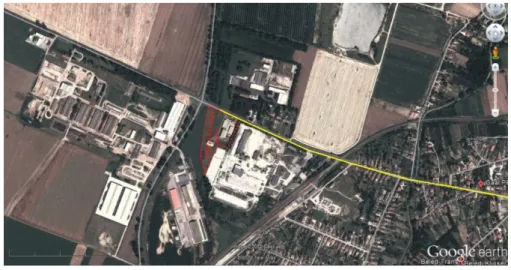
We assume that there are neighboring businesses with many employees and dwelling houses in the surrounding of the below-threshold (or priority) establishment.
Fig. 2 Example for the above
If we examine the lines of events containing expansion of ammonia resulting in major accident, it can easily be proven that the criterion values of consequences do not reach the dwelling zone. The Decree obligates only to that! But what about endangering the more hundreds of employees working in the neighboring business? If we examined the correspondence of societal risks (where employees of the neighboring business must be taken into account) we would not correspond to the licensing criteria. But in our example we do not examine it because of the above: the Decree does not make it compulsory. So we do not have to deal with it, but we wonder if the employees of the neighboring establishment how would deal with a possible ammonia cloud…
Of course the situation can be the opposite as well: e.g. the consequences exceed the licensing criteria in the dwelling zone neighboring our establishment but the individual risk (criterion) curves do not reach the dwelling houses and we correspond to the criteria of societal risk as well. As experienced, for that reason in most establishments we still apply quantity risk analysis in case of MDRP too, as it is the only way to meet the licensing requirements.
Furthermore, there is no danger zone in case of MDRP. The Decree does not forbid building in the neighboring area threatened by endangering effects. Even if we correspond to the licensing criteria, a school, church, shopping center or a block of flats can be built there tomorrow, and then we will not meet the requirement. Nothing protects the operator in this case.
Summarizing the above: Based on the Decree a simplified method shall be applied to analyze the hazards of MDRP-establishments (or simplified according to the assumed purpose of the legislation). However, in our opinion this method is not suitable to prove the safe operation in every case. There are contradictions between this method and the risk analysis set forth as an alternative. The safety documentations filed by the below-threshold establishments do not have any resettlement effect.
The next question is whether the Decree could be modified in order to have both a correct selection of establishments concerned and a correct hazard analysis method without violating the interests of neither the operation nor those endangered.
In connection to the first question: the requirement of corresponding to the conjunctive conditions set by 34. § (2) of the Decree is too strict, it does not take the extent of danger into consideration properly. We would recommend a more flexible approach, e.g. the application of a filtering method. The method is as follows: indexes are to be generated based on the type and quantity of dangerous substances present, the technological conditions applied, the way of setting and the indicators describing the endangered territory (such as dwelling houses, public establishments, neighboring businesses, distance and protection of the infrastructural elements sensitive to the effects in question, population number). With the determination of these indexes and comparison with the criterion numbers we could filter the establishments that are not dangerous to the neighborhood. On the other hand, the establishments not passing the filter must strictly prove their safe operation and their expected organization in the form of MDRP. The approach of this method would be similar to the “Dutch filter” used at danger identification. Developing a method like the above is part of the research program of our Institute. After finishing the project we would like to introduce the method to the professional public.
In connection to the second question: in our opinion resettlement (local developing) planning is necessary in the surroundings of MDRP-establishments too, as it is the basic interest of both the endangered people and the endangering operators. The solution to this problem is not easy. The results of consequence analysis do not provide a way to such a solution as the method related to safety report and safety analysis does. In case of safety report and safety analysis, the danger zones are based on the individual risks of injury. But in MDRP risk analysis is not even applied (only if we cannot do otherwise because of non-correspondence). We would like to suggest a method (also developed within the framework of an Institute project) which can – basically empirically – connect danger zones and the likelihood of death generated by each consequence value.
Effect Criteria (disjunctive) Comment Fire effect
1.
Heat flux < 8kW/m2 In case of steam fire: Max. concentration < ARH/2
The endangerment (hazard) is acceptable if the value of the heat flux is less than 8kW/m2 in the closest dwelling area, public establishment or building for public presence for the line of events resulting in the most serious consequences; or in case of steam fire the value of the maximum concentration is less than ARH/2.
2. Likelihood of death < 1%
According to the Probit analysis: see comment no. 1. The endangerment (hazard) is acceptable if the likelihood of death based on probit is less than 1% in the closest dwelling area, public establishment or building for public presence for the line of events resulting in the most serious consequences. 3.
Licensing criteria of safety report and safety analysis for individual and societal risks
Annex VII. to Government Decree 219/2011. (X. 20.), point 1.5-1.6
Intoxication
1. Max. concentration < ERPG-3
The endangerment (hazard) is acceptable if the concentration is less than ERPG-3 in the closest dwelling area, public establishment or building for public presence for the line of events resulting in the most serious consequences.
If there is no ERPG-3 value for the substance or product in question, other valid data regarding irreversible health damage can be used that the authority approved.
2. Likelihood of death < 1%
According to the Probit analysis: see comment no. 1. The endangerment (hazard) is acceptable if the likelihood of death based on probit is less than 1% in the closest dwelling area, public establishment or building for public presence for the line of events resulting in the most serious consequences. 3.
Licensing criteria of safety report and safety analysis for individual and societal risks
Annex VII. to Government Decree 219/2011. (X. 20.), point 1.5-1.6
Air blast wave
1. Overpressure < 10 kPa 2.
Licensing criteria of safety report and safety analysis for individual and societal risks
Annex VII. to Government Decree 219/2011. (X. 20.), point 1.5-1.6
Environmental pollution
1. The existence of technical
and organizational conditions Conditions in comment Figure 3
Résumé
We examined: the implementation of the Major Disaster Recovery Plans confirmed prior expectations. We found the small plants do not pose a lesser risk, because less of a safety culture, and the plant is often in the center of city. Many of these plants is not dangerous, so the Major Disaster Recovery Plan is unnecessary. Be drawn from the holdings of other methods that produce a Major Disaster Recovery Plan.
References
[1] (CCPS) CENTER FOR CHEMICAL PROCESS SAFETY. Guidelines for Chemical Process Quantitative Risk Analysis. New York: A.I.Ch.E., Center for Chemical Process Safety, 1989. ISBN 0-8169-0402-2.
[2] FAIRMAN, MEAD, WILLIEMS. Environmental Risk Assessment. London: Monitoring and Assessment Research Centre, King’s College London. ISBN 92-9167-080-4.
[3] LEES, F. P. Loss Prevention in the Process Industries. Second Edition, London: Butterworth-Heinemann, 1996. ISBN 0-7506-1547-8.
[4] TNO. Committee for the Prevention of Disasters. CPR 18E. Guidelines for Quantitative Risk Assessment. The Director-General of Labour, The Netherlands, 1999, Purple Book.
[5] PAPADAKIS, G. A. and A. AMENDONA. Guidance on the preparation of a safety report to meet the requirements of Council Directive 96/82/EC (SEVESO II). JRC EC 1997.
[6] MICHISON, Neil and Sam PORTER. Guidlines on Major Accident Prevention Polidy and Safety Management System as required by Council Directive 96/82/EC (Seveso II.). Major Accidents Hazard Bureau, Italy 1998.
[7] PAPADAKIS, Georgios A. and Sam PORTER ed. Guidance on Inspections as required by article 18 of the council directive 96/82/ec (SEVESO II). Luxembourg, 1999. ISBN 92-828-5898-7.
[8] RIB. Committee for the Prevention of Disasters. CPR 20. Report on Information Requirements. The Director-General of Labour, The Netherlands, 1999.
[9] CHRISTOU, M. D. and S. PORTER. Guidance on Land Use Planing as required by council directive 96/82/ec (SEVESO II). JRC EC 1999.
[10] SIMON, Ernst. Referenzszenarien und ihre Bedeutung für die Raumordnung. Graz: Landesbaudirektion, 2000. P. 10.
[11] CANADIAN SOCIETY FOR CHEMICAL ENGINEERING CSCHE. Risk Assessment – Recommended Practices. Ottawa, 2004. ISBN 0-920804-92-6.
[12] FABBRI, L., M. Struckl és M. WOOD. Guidance on the preparation of a safety report to meet the requirements of Council Directive 96/82/EC as amended by Directive 2003/105/EC (SEVESO II). JRC EC 2005.
[13] KÁTAI-URBÁN, Lajos and József SOLYMOSI. Overview of consequence modelling in process industry. Academic and Applied Research in Military Science. 2006, 3, pp. 407-416. ISSN 1588-8789.
[14] VASS, Gyula and László HALÁSZ. Assessment of the Land-use Planning Practices Applied in the Vicinity of EU Seveso Establishments. Academic and Applied Research in Military Science. 2007, 6 (1), pp. 77-88. ISSN 1588-8789.
Information about authors Zsolt Cimer (1975)
is a head specialist of General Directorate of Disaster Management of the Ministry for Local Government and Regional Development where he specializes in hazardous substances and industrial accidents.
He is a graduate of the Faculty of Chemical Engineering of the Technical University in Budapest, where he obtained the title of Engineer in Chemistry (1999). Currently he is completing a doctoral degree program at the University of National Defence in Budapest.
He is a co-author of 2 professional publications. He participated in drafting of security documents in more than 20 companies with hazardous production. He is also a member of the Association of Hungarian SEVESO experts.
Béla Szakál (1952)
is a Director of the Institute for Protection against Fires and Disasters, Faculty of Civil Engineering of Miklos Ybl in Budapest, University of St. Istvan in Gödöle, Hungary. He specializes in hazardous substances and industrial accidents.
He is a graduate of the Academy of Forest Technology in St. Petersburg, Faculty of Chemical Technology, where he obtained University Engineering Degree (1975). Habilitation in 1992 (obtained a title “Associate Professor”). He completed Scientific Postgraduate Studies in 2002 (obtained a Ph.D. title). Appointment as a Professor (2006).
He is a co-author of 4 publications, and a wide range of contributions in professional journals. He participated at conferences with international participation in Hungary and abroad. Under his leadership, the security documentations have been developed in more than 20 enterprises with hazardous production. He is a Chairman of the Association of Hungarian SEVESO experts, a co-author of the Hungarian law "SEVESO 2", a member of many professional commissions, associations, etc.