Attachment D:
RFID Technology Overview
ThefollowingsectionsprovideanoverviewtoRFIDtechnology,theapplicationsin whichtheyarecurrentlyusedandotherconsiderationsofRFIDtechnologyasitmight beappliedtotheUS‐VISITIncrement2Cproblem.RFIDtechnologywasfirstusedin WorldWarIIforidentification,friendorfoe(IFF)systems,andhasbeenavailablein oneformoranothersincethe1970’s.Thereisnoonedefinitive“RFIDtechnology”; thereisawiderangeoftechnicalsolutionsrangingfromsimple,inexpensive,and commontothosewithmorefunctionality,performanceandcost.RFIDispartofour dailylives–incarkeys,tolltags,accesscards…Thissectionwillprovideanoverview ofthistechnologyanditsapplications.
1.1 RFID Tag Technology Description
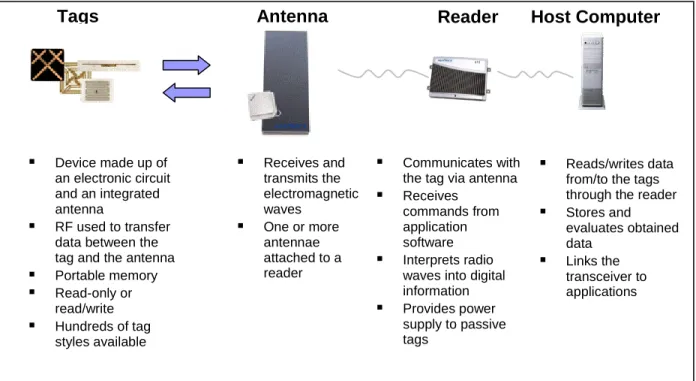
Initssimplestformincommonusetoday,anRFIDsystemconsistsoffourelements,as showninFigure3‐1.TheRFIDtagelementconsistsofanantennaintegratedwitha microchip.TheRFIDreaderandantennatransmitanelectromagneticRFsignal.This signalisreceivedbytheRFIDtagviathetag’santenna.Theenergyinthereceived signalprovidesthepowertothetagthatallowsthemicrochiptooperate.Thisis referredtoasa“passive”tag.
Tags Antenna Reader Host Computer
Device made up of Receives and Communicates with Reads/writes data an electronic circuit transmits the the tag via antenna from/to the tags and an integrated electromagnetic Receives through the reader antenna RF used to transfer waves One or more commands from application Stores and evaluates obtained
data between the antennae software data
tag and the antenna attached to a Interprets radio Links the Portable memory reader waves into digital transceiver to
Read-only or information applications
read/write Provides power
Hundreds of tag supply to passive
styles available tags
Figure D-1 Components of a Passive RFID System
ThisdatafromthemicrochipisthenaddedtoanRFsignalthatis“reflected”bythetag backtothereaderthroughthereaderantenna.Thisprocessisreferredtoaspassive backscatter.Thereadercontainstheelectronicstoreceivethissignalfromthetag,
extracttheRFIDtag’scodefromthesignal,andreturnittoitsdigitalform,andprovide thatreturnedcodetoahostcomputer.
Passivetagssystemsarereadertalkfirst.Thetagsaremuteuntilasignalisreceived fromareader.Also,onlyonereaderatatimecanenergizeapassivetag;ifmorethan onereadertriesto“lightup”apassivetagaconditionknownas“readercollision” occurs.
PassiveRFIDsystemscanreadmultipletagsatonce.Inaprocesscalled“singulation,” thereaderwillrapidlycyclethroughtagsanddeterminewhichonesarepresent.There aremanymethodsofsingulation,buttheprincipleofidentifyingasingletagisthe same.Thisisveryimportantwhentryingtoquicklyidentifyalltagsinthereader’s field,andisalsoimportantwhentryingtospeaktospecifictags.
ThesimplestpassiveRFIDtagshavemicrochipsthatcontainasinglebit.Thesetagsare referredthroughouttheworldaselectronicarticlesurveillance(EAS)tagsandareused topreventshoplifting.Othertagscontainasimpleread‐onlynumericcodeorserial number.Thecode,whichisstoredinmemoryonthemicrochip,canbewrittentothe tagatthetimeoffirstuseorappliedatthetimetheRFIDtagismanufactured.Thecode isusedtoreferenceinformationstoredelsewhere,suchasinadatabase.Severaltag codingstandardsexist,andaredetailedinthe“standards”section(Section3.9). Generallyspeaking,themorefunctionalityembeddedonatag,thesloweritis,the shortertherangeandthehighertheprice.ThereareRFIDtagsthathavegreater amountsofmemory,storageandfunctionality.Forinstance,sometagshaveseparate areasfordifferentuserstoaccess.Othertagshaveencryptionandsecurityfeatures.Still othertagsincludemicrochipswhoseserialnumberiswrittentothechipbytheuser ratherthanatthepointofRFIDtagfabrication.Thispermitsgreaterflexibilityinthe informationthatiswrittentothetagandwhenitiswritten.Therearetagsforalmost everyapplication–indeed,thereareseveralthousandtagtypesinexistenceatthis time.However,itisnotpossibletodaytogetlowcost,longrange,highspeedpassive RFIDtagswithencryptionandhighsecurity.
Intermsofcost,passiveRFIDtagsrangefrom$0.25upto$10.00,dependingon
functionality,packaging,andapplication.Serialnumber,read‐onlytagstendtobethe leastexpensive.ThepricesofpassiveRFIDtagsarehighlydependentonthevolumeof tagsordered–thepricesmentionedhereareforlargeorders(inthetensofmillions). Lowervolumeswillgenerallyleadtomuchhigherpertagprices.Thereispotentialfor evenlowerpricesforsimpletagsasstandardssolidifyandaslargernumbersoftagsare usedintheindustry.SomepreliminaryresearchfromsourcessuchasAdvanced
MarketingResources,GartnerandRFIDJournalindicatethatapassivetagwithread‐
onlyserialnumberwillapproach$0.05by2008.
InacommonapplicationofRFIDtechnologytoday,RFIDtagsarecombinedintoan adhesivelabelthatcanbeappliedtopackagingforproductsintheconsumerpackaged goodssupplychain.Astheproductsaremovedfrommanufacturertowarehouseto retailer,theproductscanbetrackedtoaidinsupplychainmanagementandinventory control.RapiduptakeofRFIDintheretailsupplychainisdrivingstandardsacrossall industriesandisalsopushingthecostofRFIDdown.
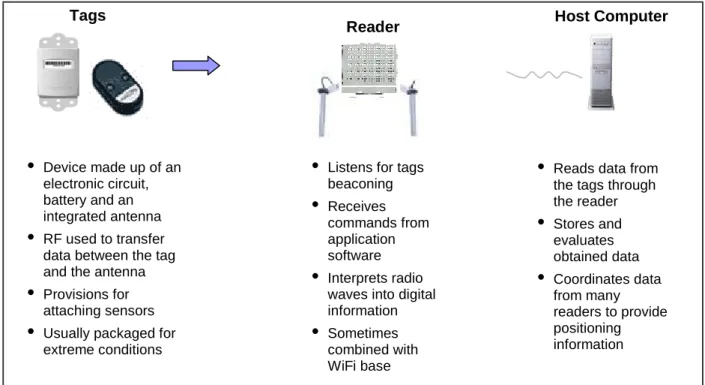
Moreadvancedtagsarealsoavailable.Thesetagsmayincludesmallbatteries.These “active”tags,asdepictedinFigure3‐2,allowthemtobroadcastastrongersignalthat
canbereceivedatgreaterdistancesthanthe“passivetags”poweredonlybythesignal receivedfromthereader/antennasystem.Akeydifferentiatorbetweenactiveand passivetagsisthestyleofcommunications.Anactivetagtalksfirst–thatis,itbeacons. Sincethetagisnotdependingonareadertobeenergized,andbecausesignal
processingtechnologyissopowerful,activetagscanbereadatmuchgreaterranges thanpassivetags.Activetagscanalsobeusedforpositioning–determiningtheXYZ locationofthetag–throughaprocessoftriangulation.
Tags Host Computer
•
Device made up of an•
Listens for tags•
Reads data fromelectronic circuit, beaconing the tags through
battery and an
integrated antenna
•
Receives commands fromthe reader
•
Stores and•
RF used to transfer application evaluatesdata between the tag software obtained data
and the antenna
•
Interprets radio•
Coordinates data•
Provisions for waves into digital from manyattaching sensors information readers to provide
•
Usually packaged for extreme conditions•
Sometimes combined with positioning information WiFi base ReaderFigure D-2 Components of an Active RFID System
Sincethereisacommunicationschannelinvolved,activetagscanbeintegratedwith sensordevices,suchastemperature,locationormotionsensors.Thesedevicescantake samplesfromthesensors,storethem,andsendthembacktothereaderalongwiththe standardbeaconsignal.
Athirdclassoftagsexists,alternatelyreferredtoassemi‐active,semi‐passive,or
batteryassisttags.Thesetagsareakintopassivetagsinthattheyarereadertalkfirst.A batteryispresentthoughforoneoftworeasons.Eitheritisprovidinga“boost”forthe tag,allowingittobereadandrespondindifficultRFenvironments,oritisusedto powerasensor.Suchsensorscancollectdataevenwhenthetagisnotpowered.This dataisthentransmittedbacktothereaderwhenthetagisread.Thisisamuchslower readprocessthanstandardtagreading.Thebatteryandsensorportionsofsemi‐passive tagscandrivecostsintothe$5.00‐10.00range.
1.2 RFID Reader Technology Description
ThesecondmajorcomponentofRFIDsystemsisthereader.Forpassivetags,readers energizethetagswithenergy,receivetheresultsandfrequentlyhandlethelow‐level anti‐collisionalgorithmsthatallowreaderstoreadmorethanonetagatatime.For
activetags,readersareresponsibleforlisteningforthetags’beaconing,andfor communicatingwithotherreaderstodeterminepositioning.
Readersaregenerallycontrolledviaasoftwareapplicationprogramminginterface (API)thatisprovidedbythereadermanufacturer.Generally,theAPIalsoallowsfor configuringthereader’sreadcycle,powerorothersettings.TheAPIsoftwarelibraries foragivenreadermaybepricedseparatelyforthereader,althoughmanyproviders bundlethesoftware.
1.3 RFID Antennae Technology Description
AntennaearethethirdmajorcomponentofandRFIDsystem.Thesecanrangegreatly incost,dependingonfunctionality,applicationandbaseoperatingfrequency.Whether itisashelf,mat,portal,wandordirectionalantenna,differentantennaearerequiredfor differentapplications.
Dependingonhowmanyantennaearerequired,oneormanymultiplexersmaybe necessary.Amultiplexerallowsmanyantennaetobephysicallyconnectedtoareader. Aconfigurationusingmultiplexersmayalsorequireanadditionalcommunications cardsuchasanRS‐485.Manyreaderscontainbuiltinmultiplexers,andexternal varietiesarealsoavailable.
Cablingforthesystemsisanimportantaspectofperformance.Althoughthereare generallyfewerlimitsonthedistancebetweenreaderandhostcomputer,thereare signaldegradationeffectsinthecablesconnectingreadersandantennae.High‐grade RFcablesforthispurposecanbeexpensive,andcanhavedistancelimitations.
Thecombinationofthereader,antennae,andmultiplexersetupissometimesreferred toasa“readpoint.”
1.4 Host Controller
Thehostcontrollerisgenerallyadesktoporlaptopcomputer,positionedclosetothe readers.Thiscontrollerservestwomainfunctions.First,itisreceivingdatafromthe readersandperformingdataprocessingsuchasfilteringandcollation.Secondly,it servesasadevicemonitor,makingsurethereaderisfunctioningproperly,securelyand withuptodateinstructions.Hostcontrollersareconnectedtoreadersthrough
networkingtechnologiessuchasTransmissionControlProtocol/InternetProtocol (TCP/IP)orsometimesthroughserialconnectivity.Generallyspeaking,onecontroller canmanageseveralreaders,withtheratiobeingdependentonthedatavolumefrom thosereaders.
1.5 RFID Middleware
RFIDmiddlewareissoftwarethatfacilitatescommunicationbetweenRFIDreadersand enterprisesystems.Itcollects,filters,aggregatesandappliesbusinessrulesondata receivedfromreaders.Middlewareisalsoresponsibleforprovidingmanagementand monitoringfunctionality ‐ensuringthatthereadersareconnected,functioning
properly,andareconfiguredthecorrectway.Middlewaremayalsocontainalocalized datastoreforarchivalofreadevents.
HostcomputersandreadersmaycommunicatewitheachotherviatheEPCglobal ReaderProtocol1.0standard,althoughthisisnotcommonasofyet.Eachmiddleware vendormustprovidefirmwareforallsupportedreaders.Deployedeithercentrallyor locally,middlewarecanbemanagedthroughuser‐friendlyinterfaces,similartoa standardsoftwareapplication.Also,middlewarediffersinitsimplementationstyle ‐
middlewaremaybeimplementedonahostcomputer,acentralserver,oronintelligent readers.
1.6 Other RFID Technology Considerations
1.6.1 Frequency
RFIDsystemsoperateinseveralregionsoftheRFspectrum.DifferingregionsoftheRF spectrumtendtobeusedforspecificapplications.Noonefrequencyisgoodforall applications,geographies,ortypesofoperatingenvironments.WithintheU.S.,theFCC regulatesthefrequenciesandtheirassociatedcharacteristics.Thesefrequencies
generallyfallintoFCC’sPart15rules,whichgoverntheuseofunlicensedradio
transmitters(suchascordlessphones,babymonitors,orgaragedooropeners)butthere arealsoPart90regulations,whichallowforhigherpowertransmissionsasspecific physicallocations.Therearepower,bandwidthandgainregulationsassociatedwithall ofthesefrequencies.Soeventhoughacommonfrequencymaybeavailable,thepower levelsallowableatthatfrequencymaynotbethesame.Thissectionfocusesonthose frequenciesgenerallyinuseforpassiveRFID.ActiveRFIDsystemsuseslightly differentstandards,butforEntry/Exitpurposeswedonotcoverthose.
AfrequencyusedinveryearlyRFIDimplementationswasthelowfrequency(LF)band of125‐133kilohertz(kHz).Thisfrequencyisinwideuseforpetrecovery,cattletagging andaccesscards.MostLFtagsnowaresoldforcarimmobilizationsystems–anRFID chipinthekeyletsareaderinthesteeringcolumnknowit’sOKtostartthecar.
AnotherpopularuseforLFsystemsistimingformarathons,triathlonsandbikeraces. RangesforLFsystemsarefairlylow,ontheorderofinchesuptotwofeet.
Theclosestthingtoacommon,worldwidefrequencytodayisthe13.56Megahertz (MHz)band,alsoknownashighfrequency(HF).Thisisavailableinmostpartsofthe world,albeitwithvariationsinrestrictions.HFsystemsareveryfrequentlyusedfor smartshelfapplications,accesscontrol,andsmart‐cards.Relatedtechnologiessuchas near‐fieldcommunicationsalsousethesameHFband.HFhastheadvantageofavery tunablefieldshapesothatitsreadpatterncanbepreciselycontrolled.Ithasthe
disadvantageofarelativeshortreaddistance(threefeetatmost).Thislimitationmakes HFlesssuitableforvehicle‐basedexit.
MoreusefultoEntry/Exitintermsofreadrangeandspeedsaretagsoperatingat roughly915MHz,orultra‐highfrequency(UHF).UHFhasahigherrangeandfaster datatransferratethanHF.TheUHFspectrumisnotuniversallyavailableatthesame frequencyandpowerlevelsworldwide.However,intheU.S.,itisavailableatapower levelthatallowsforreadrangesofupto30feetwithgooddatatransferspeeds.
Finally,microwavefrequenciesarealsousedintheRFIDrealm.Themainfrequencyis 2450MHzor2.45Gigahertz(GHz)althoughtherearesomesystemsavailableinthe5.8 GHzband.2.45GHzisthesamebandaswirelessLANs(orWiFi),andBluetooth.
MicrowavetagshavetheadvantageofbeingsmallerthanUHFtags,butgenerallyhave shorterranges.MicrowavetagsarenotingeneraluseintheU.S.,butaremore
prevalentinJapan.
1.6.2 Accuracy
RFIDreadersandtagsdonothave100%accuracyinallinstances.Environmental issues,themake‐upoftheitemsbeingtaggedandthevolumesoftagstoberead,all impactreadaccuracies.Accuracycanbeimprovedbyapplyingalayeredapproachto acquiringtheRFIDdata.
RFIDoffersmanyadvantagesovermanualorsemi‐automateddatacollection processes.Anyshortcomingsinaccuracycanbemitigatedthroughtheuseof redundantreaders,informationauditingandprocessredesign.Additionally, minimizingthenumbersoftagsinareader’sfieldofviewincreasesaccuracy– thousandsoftagswillnotbereadaswellasdozensorhundreds.
TheenvironmentalinfluenceofmetalcandefinitelyimpactreadabilityofRFIDtags. Metalreflectsradiowaves,sothatinahighlymetallicenvironment,theRFsignalwill bereflectedandconfusebothreadersandtags.However,withproperdesignand tuning,thepresenceofmetalcanbeusedtoincreaseaccuracyandperformance.
WateralsohasadeleteriouseffectonRFIDreadaccuracy.Waterabsorbsradiowaves, andthehumanbodyismostlycomprisedofwater.Themostcommonapproachisto addsomespacingbetweenthetagandtheliquid.Thisgivestheradiowavesroomto maneuver,sotospeak,andgettothetag.Alittleairspacegoesalongway.For Entry/Exitscenarios,wehavetestedanumberofconditionsthatinvolvewater
absorptionsuchasplacementofthetagnearabody,orholdingofthetaginsideahand.
1.6.3 Interference
AsRFIDsystemsproliferate,moreoccurrencesofinterferencewillbeexperienced. Dependingonthefrequenciesandpowersused,devicessuchasphones,wireless handsetsandindustrialequipmentmaybeaffected.Sincewidespreadimplementation ofRFIDtechnologyhasnotbeenundertakenbefore,itisdifficulttostatewhatwillbe impacted.Goodengineeringandpropertuningwillberequired.
TheperceivedhealthconcernsofRFmayalsocomeintoplay.Whilethereisno evidencethatthereareanynegativeeffectsatthepowerandfrequencylevels associatedwithRFID,noonehasdeployedlarge‐scaleimplementationsyet.More researchandmonitoringwillbeneededtoaddressthepublic’sconcernsinthismatter.
1.7 Current RFID Applications
ThereareseveralareasinwhichRFIDtechnologyisbeingappliedtoday.Theseare summarizedinthefollowingsections.
1.7.1 SENTRI/NEXUS
DHScurrentlyusesRFIDtechnologyonthenorthernandsouthernbordersinsupport ofthreeseparateprograms:NEXUSonthenorthernborder,SENTRIonthesouthern border,bothpartoftheDCLprogram,andtheFASTprogramforcommercialvehicles
onbothborders.Historically,eachhasusedauniquecombinationofactive transpondersandpassiveRFIDtagsandreaderstomeetitsidentificationgoals. NEXUSisanimplementationoftheDCLprogramthatallowsprescreened,low‐risk travelerstobeprocessedwithlittleornodelaybyUnitedStatesandCanadianborder officials.Approvedapplicantsareissuedphoto‐identificationandaproximitycard,and makeadeclaration.Theyarethenreleased,unlesschosenforaselectiveorrandom secondaryreferral.
TheNEXUS/DCLprogramutilizesRFIDcardstoqueryGlobalEnrollmentSystem (GES)tovalidatetheenrollmentofavehicle’spassengersforbordertravel.TheNEXUS IntermecRFIDsystemhasverylimiteddata,constrainedtoreadinga64‐bit
Identification(ID).TheGESdatabaseusesthe64‐bitIDasakeyintotheGESsystemto retrievedatathatisreturnedtotheOfficerclientworkstation.AlthoughtheNEXUS RFIDsystemhasthecapabilitytowriteupto110bytestotheRFID,thatcapabilityis limitedbytheGESdatabase.VideosurveillanceimagesarealsocapturedintheNEXUS lanes,althoughthisinformationisonlystoredlocally.
BothSENTRIandNEXUSareusingtagsintheUHFband.
1.7.2 E-Passport
TheU.S.GovernmentPrintingOffice(GPO)istestingelectronicpassports(e‐passports) embeddedwithRFIDchipsthattheagencyhopestomakestandardwithinthenext year.Tocarryoutthetests,theGPOawardedfourcompanieswithcontractstoprovide 13.56MHzRFIDchipstotestthee‐passportsystem.ThechipscomplywiththeISO 14443Aand14443Bstandards.
Theeight‐week‐longtestingprogram,whichbeganinOctober2004,involvesthe
NationalInstituteofStandardsandTechnology(NIST).TheGPOwillmanufacturetest passportsembeddedwithRFIDchips.NISTwilltestthepassportsfordurabilityaswell asensuretheymeetsecurityandelectronicrequirements.Someofthesetestsverifythat thechipscanwithstand10yearsʹ ofnormalwearandtearandstampingbycustomsʹ
officersandstillremainfunctional.
1.7.3 Toll Collection
Inmanystates,tollcollectionforvehiclestravelingatornearhighwayspeedsis accomplishedthroughtheuseofactiveRFIDtags.Therearemanysystemsavailable today:EZPass(WestVirginia,Maryland,Delaware,Pennsylvania,NewJersey,New YorkandMassachusetts),I‐PASS(Illinois),SunPass(Florida)andFasTrak(California). Thesesystemsmayrunatanynumberoffrequencies,but915MHzand5.8GHzare frequentlyused.Thesesystemsareoftenlinkedtoacreditcard,allowingforstored valuestobereplenishedwithoutneedformanuallyhandlingthetags.Somecardtypes storevalueaswell.
1.7.4 Payment Systems
Sony’sFelicacardandPhilipsViVOTechareexamplesofNearFieldCommunications devices(essentiallyHFRFIDwithimproveddataspeeds)usedforpaymentsystems. Anemergingapplicationofthistechnologyistouseamobilephoneenabledwithan RFIDchipforpayments.Stillotherpaymentsystemsuseasmallkeyfob(e.g.,
ExxonMobil’sSpeedPass)linkedtoacreditcardaccountforpayment.Thisstyleof RFIDapplicationtendstoinvolveheavilyencryptedtagswithmorefunctionalityand memoryandgenerallyusetheHFbandwithgreatlyreducedranges.
1.7.5 Supply Chain
Apopular,emergingapplicationofRFIDisintheareaofsupplychainvisibility.The trendistoattachanRFIDtagcontainingauniqueidentifiertoanobjectatitspointof manufacture.Thistagwouldthenbereadatvariousintervalsuptoitspointofsale. Manufacturers,retailersandthirdpartylogisticsprovidersareindifferingstatesof pilotsonproducts,withthemajortargetbenefitsbeingreductionininventory,a decreaseinmaterialhandlingtime,saferandmoresecuresupplychains,andpotential postsaleapplications.
MajorretailerssuchasWal*Mart,BestBuyandAlbertsonsareleadingthecharge, mandatingusageofRFIDtagsoncasesandpalletsinsidethenexttwoyears.
Furthermore,theU.S.DepartmentofDefense(DoD)hasissuedsimilarmandatesforits suppliers,alsoatthecaseandpalletlevel.TheseretailersandtheDoDareallspecifying theuseofUHFbandchipsintheEPCglobalstandard(seeSection3.8)
1.7.6 Access Control
AverycommonapplicationforRFIDisaccesscontrol.Contactlessbadgesareinusein almosteveryofficeandfacility.ThisstyleofRFIDbadgetendstoworkintheLForHF band,andgenerallyhaveverylowreadranges.Thesesystemstendtoutilizevery proprietaryformats,networksandprotocols.Thetagsaregenerallypackagedina sealedIDcardformat.SomeIDtagshavethinfilmbatteriesaswellforencryptionand informationstorage.
1.7.7 Animal Tracking
RFIDhasalonghistoryofbeingusedforanimaltracking.Fromlivestockmanagement (foranimalmovement,feeding,health,andmarketvisibility)topettracking,RFIDis relativelymatureinthisfield.Animaltrackingcanbeconsideredoneofthelargest implementationsofassetmanagementusingRFID.Generallyspeaking,lowfrequency tagsareusedforanimaltracking.
1.8 Security, Privacy, and RFID Technology
AnRFIDSecurity/Privacystudyhasbeenconductedinconcertwiththe2CRF
FeasibilityStudyandhasresultedinanSBASecurityandPrivacywhitepaper,whichis includedasAttachmentHtothisdocument.Thiswhitepaperdiscussesallknown securityandprivacyissuesthatarisefromtheproposeduseofRFIDtechnologyinUS‐
VISITandassessesthecapabilityofavailabletechnologytoresolvethoseissues.This security/privacystudyalsoprovidesthebasisforthesubsequentsecurityanalysisand evaluationofindividualRFIDproducts.
1.8.1 Security
TheRFIDback‐endtagdatabaseandtheassociatednetworkcanandcertainlywilluse existingsecuritymechanisms.Dependingonthedesignofthereadersandtags,these devicescanleveragethesecuritymechanismsalreadyinplaceinthenetworkand database.AnumberofRFIDsecurity ʺmodelsʺ havebeenpostulated.Forexample,RSA
Security,Inc.hasdevelopedasetofRFIDSecurityandPrivacy ʺAttributesʺ thatinclude tagprivacy,tagauthenticity,readersecurity,andtagdatabasesecurity.Authorization andauthenticationcanbesupportedwithcertaintypesofRFIDtagsbutthereare cost/benefittradeoffs.
ItispossiblethatthenatureoftheinterconnectionortheinteractionbetweentheRFID readerandtheexistinginfrastructurecouldintroduceanexploitablevulnerability,but ifsecuritybestpracticesandrequirementsareobservedinintegratingtheproductwith thenetwork,thiscanbeminimized.
1.8.2 Privacy
Theamountofinformationgatheredaboutindividualsisgrowingthroughthe
proliferationofsurveillancecamerasandsensors;microchipsandRFIDtagsembedded indevicesandproducts;wirelessdevicesthatprovidelocationdata;andsmartcards andinteractiveTVthatcantrackviewingandbuyingpreferences.Advancesin
electronictechnologiesallowcompaniesandgovernmentagenciestostoreandprocess largeamountsofinformationaboutindividuals.TheInternetprovidestheultimate copierdevice,makingthisinformationeasilyavailabletomillions.Duetothe commercialvalueofpersonaldata,governmentsandcompanieshaveconsiderable financialincentivestotakethetimetogatherinformationandtousemachine‐learning technologiesanddata‐miningtechniquestoinfercustomerpreferencesbasedonthis information
AlthoughthenumberoforganizationsusingRFIDisincreasing,resistancefromprivacy groupstotaggingtechnologiesattheconsumerlevelsuggeststhechallengesahead.As aresultofconsumerresistance,severalretailershavedecidedtoforegotheuseofRFID tagsattheretaillevelatthistime.InApril2003,clothingretailerBenettonGroup
announcedthatitwaspostponingplanstoembedRFIDtagsinoneofitsclothinglines. InMarch2004,METROAG,thefifthlargestretailerintheworld,decidedtoabandon theuseofRFIDchipsinitsloyaltycardsafterprotestsfromprivacygroups.METRO continuestouseRFIDtagsinsupplymanagementapplications.Thesedecisions signaledtomanycompaniesthattheyneededtodomoreaboutprivacythanjust understandrelevantlegislation.Theyneedconsumerstotrustthemtoprotecttheir personalinformation.
OnNovember20,2003,agroupof45consumerprivacyandcivilrightsorganizations fromaroundtheworldissuedapositionstatementonRFID1.Thesegroupsidentified privacyandcivillibertiesthreatsposedbyRFIDtags,andcalledfortheapplicationof FairInformationPrinciples,suchasthosecodifiedinthePrivacyGuidelinesofthe OrganizationforEconomicCo‐operationandDevelopment(OECD).Thegroupsalso calledforaflatprohibitiononhumantrackingorontheuseofRFIDtagsinanyway thatwouldreduceanonymity.
–
1 RFID Position Statement of Consumer Privacy and Civil Liberties Organizations, November 20, 2003, available at <http://www.privacyrights.org/ar/RFIDposition.htm>.
TheSBAlong‐termvisionincludestheuseofaSelfVerifyingDevice(SVD)thatwill utilizethesameRFIDinfrastructure,butwilladdtheabilitytobiometricallyverifyan individualandsendasingle,encryptednumberforidentificationpurposes.Several near‐termstrategiescanbeusedtomitigateprivacyconcernsraisedbyRFIDtags:
labeltagsandreaderssothatthepublicisawarethattheyarebeingused discusstheoperationoftagsintheprivacypolicy
providesecuritysafeguardsforthedatagatheredthroughthetags
publicizethatnopersonalinformationisstoredontheRFIDtagandthattagserial numbersareunique
makeavailableshieldedsleevesthatpreventeavesdropping
educatethepubliconRFIDtechnology,includingthepotentialforeavesdropping andhowtopreventit,forexamplewithshieldedsleeves.Thiswouldcomplement currentEPCglobaloutreacheffortsofthiskind.
makeknowntothepublicthatpersonalinformationassociatedwiththeRFIDtag numberissecurestoredbehindfirewalls
Additionally,EPCglobal,whichincludesasecurityworkinggroup,andotherstandards groupsareawareofsecurityandprivacyissues,andareexpectedtointroducemore securityfeaturesinthestandardsinthefuture.Itcanbeexpectedthatencryptionof dataontagswillappearaspricesoftagscomedown.
Governmentagencieshaveaparticularlydelicatebalancetoachieve–maintaining privacywhilstprotectingournation’sbordersandpeople.TheSecurityandPrivacy whitepaperdiscussesknownsecurityandprivacyissuesthatarisefromtheproposed useofRFIDonUS‐VISITandassessesthecapabilityofavailabletechnologytoresolve theseissues.
1.9 Standards
Thereareseveralareasofstandardsthatneedtobereviewedforacomplete
understandingofRFIDtechnology.Thesestandardsfrequentlyalignwithapplications suchastollcollectionoranimaltracking.Thissectionwilldiscussthevariousstandards bodiesandtheirrelativecontributionstotheavailablestandards.
1.9.1 ISO
OneofthemajorstandardsbodiesintheworldistheISO.ISOisanorganizationofthe nationalstandardsinstitutesof146countries,onthebasisofonememberpercountry, withaCentralSecretariatinGeneva,Switzerland,thatcoordinatesthesystem.
ISO isanon‐governmentalorganization:itsmembersarenot,asisthecaseinthe UnitedNationssystem,delegationsofnationalgovernments.Nevertheless,ISO occupiesaspecialpositionbetweenthepublicandprivatesectors.Thisisbecause,on theonehand,manyofitsmemberinstitutesarepartofthegovernmentalstructureof theircountries,oraremandatedbytheirgovernment.Ontheotherhand,other
membershavetheirrootsuniquelyintheprivatesector,havingbeensetupbynational partnershipsofindustryassociations.
Therefore,ISOisabletoactasabridgingorganizationinwhichaconsensuscanbe reachedonsolutionsthatmeetboththerequirementsofbusinessandthebroaderneeds ofsociety,suchastheneedsofstakeholdergroupslikeconsumersandusers.
ISOmanagesseveralstandardsrelatedtotheareaofRFID.ISO11784/11785relatesto animaltracking.ISO14443A/14443BrelatestoproximitystyleRFIDwhileISO15963 relatestovicinitytagging.ISO18000pertainstoradiofrequencyidentificationforitem management,andcontainssixsubsectionscoveringdifferingfrequencyranges.There aremanyotherISOstandardsrelatingtotestmethods,APIsandconformance
standards.
1.9.2 INCITS
TheInternationalCommitteeforInformationTechnologyStandards(INCITS)isthe primaryU.S.focusofstandardizationinthefieldofInformationandCommunications Technology(ICT)encompassingstorage,processing,transfer,display,management, organization,andretrievalofinformation.Assuch,INCITSalsoservesastheAmerican NationalStandardsInstituteʹs(ANSI)TechnicalAdvisoryGroupforISO/IECJoint TechnicalCommittee1(JTC1).JTC1isresponsibleforinternationalstandardizationin thefieldofinformationtechnology.INCITSisaccreditedbyANSIandoperatesunder itsrules,designedtoensurethatvoluntarystandardsaredevelopedbytheconsensusof directlyandmateriallyaffectedinterests.
1.9.3 ICAO
TheInternationalCivilAviationOrganization(ICAO)isanotherstandardsbody
creatingRFIDrelatedstandards.In2003,ICAOspecifiedthetechnicalrequirementsfor RFIDtechnologyusedinelectronicpassports.Thesespecificationswerepublishedin ICAODoc9303,andarethefocusoftheePassportactivitiestakingplacewithin DepartmentofState.
1.9.4 NIST
TheNISTisanon‐regulatoryfederalagencywithintheU.S.CommerceDepartmentʹs TechnologyAdministration.NISTʹsmissionistodevelopandpromotemeasurement, standards,andtechnologytoenhanceproductivity,facilitatetrade,andimprovethe qualityoflife.NISTiscurrentlyworkingonRFIDtechnologyintheconstruction industry,andhastiesintosmartcardtechnologythroughitsencryptionstandards.
1.9.5 EPCglobal
AnotherveryvisiblestandardsbodyapplicabletoRFIDdevicesisEPCglobal. EPCglobalwasformerlyknownastheAuto‐IDCenter,originallystartedat
MassachusettsInstituteofTechnology(MIT).TheAuto‐IDCenteroriginallysoughtto bringusersofRFIDtogetherwithtechnologyproviderstocreateanitemidentification standardaswellastopromotetechnologiestocarrytheidentification.This
identificationstandard,knownastheElectronicProductCode,canbethoughtofasa serializedversionofthecommonUniversalProductCode(UPC)foundonmany
consumergoods.However,akeydistinctionisthatwhiletheUPCdesignatesaclassof items(i.e.,allcopiesofacertainproductsoldintheU.S.willhaveacommonbarcode)
theEPCdesignatesaninstanceofanitem(e.g.,eachcopyofthatCDwillbeidentifiable fromothers).
TheEPC,a96bitnumber,isexpectedtoprovideanaddressspaceofroughly30trillion trillionuniqueidentifiers.AllusersoftheEPCglobalsystemwillalsohavecontrolover theiraddressspace–norepeatingwillbeallowed.
InOctoberof2003,theAutoIDCenterformallyclosedupoperationsandtransferred activitiestoanon‐profitentityknownasEPCglobal.EPCglobalisajointventure
betweenEANInternationalandtheUniformCodeCouncil(UCC).EANInternationalis atradeorganizationfoundedinthe1970’sthatwasestablishedtocoordinatethe
“EuropeanArticleNumbering”systemforidentifyingproducts,similartotheUPC managedbytheUCC.MITandotherworldwideuniversitiescontinuetobeinvolved withEPCglobalaspartof“Auto‐IDLabs.”
EPCglobalissomewhatuniqueinthatitisanorganizationthatispromotingdefacto specificationscomparedtoaformalstandardsorganization.Itfollowsstandards developmentmethodologiesfromtheWorldWideWebConsortium(W3C)butisnot directlycreatingstandards.Theplanhoweveristomergethespecificationscreated withintheEPCglobalprocesstoISOforformalstandardsratification.
EPCglobalhasanumberofspecificationsforRFID,namelyClass0/Class1UHFand Class1/HF.ThelatterisequivalenttotheISO15963standard.Anewspecification knownasUHFGeneration2(commonlyreferredtoas“Gen2”)hasbeenmovedto candidatespecificationstatusandisexpectedtomovetoISOdraftstandards immediatelyuponfinalratification.
EPCglobal’sUHFGen2isthespecificationthattheU.S.DoDandmostretailersaround theworldarecoalescingaround.Sinceitisbecomingadefactostandard,andbecause somanytechnologyprovidersareplanningorhaveannouncedproductionofGen2 products,theRFFeasibilityteamisfavoringthisstandardasthekeyguidelinefor technologyselection.
1.10 Resources
RFIDisahottechnologytopic,andthereistremendoushype,disinformation,and generalnoiseontheweb.Belowareseveralwebsiteswithgoodinformationfor reference. http://www.incits.org http://www.iso.org http://www.epcglobalinc.org/index.html http://www.aimglobal.org/ http://www.rfidjournal.com http://www.rfid‐handbook.de
OnEPCglobalsecurityandprivacytopicssee:
1.11 Summary
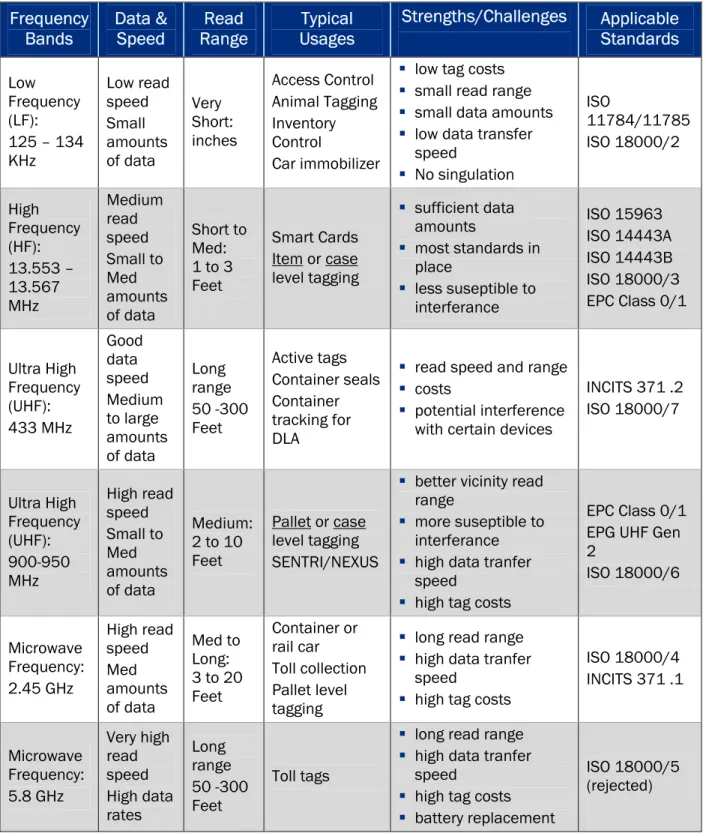
ThefollowingtablesummarizeskeyRFIDfrequencies,standards,applicationsand decisioncriteria:
Frequency Data & Read Typical Strengths/Challenges Applicable
Bands Speed Range Usages Standards
Low Frequency (LF): 125 – 134 KHz Low read speed Small amounts of data Very Short: inches Access Control Animal Tagging Inventory Control Car immobilizer
low tag costs small read range small data amounts low data transfer speed No singulation ISO 11784/11785 ISO 18000/2 High Frequency (HF): 13.553 – 13.567 MHz Medium read speed Small to Med amounts of data Short to Med: 1 to 3 Feet Smart Cards Item or case level tagging sufficient data amounts most standards in place less suseptible to interferance ISO 15963 ISO 14443A ISO 14443B ISO 18000/3 EPC Class 0/1 Ultra High Frequency (UHF): 433 MHz Good data speed Medium to large amounts of data Long range 50 -300 Feet Active tags Container seals Container tracking for DLA
read speed and range costs
potential interference with certain devices
INCITS 371 .2 ISO 18000/7 Ultra High Frequency (UHF): 900-950 MHz High read speed Small to Med amounts of data Medium: 2 to 10 Feet Pallet or case level tagging SENTRI/NEXUS
better vicinity read range
more suseptible to interferance high data tranfer speed
high tag costs
EPC Class 0/1 EPG UHF Gen 2 ISO 18000/6 Microwave Frequency: 2.45 GHz High read speed Med amounts of data Med to Long: 3 to 20 Feet Container or rail car Toll collection Pallet level tagging
long read range high data tranfer speed
high tag costs
ISO 18000/4 INCITS 371 .1 Microwave Frequency: 5.8 GHz Very high read speed High data rates Long range 50 -300 Feet Toll tags
long read range high data tranfer speed
high tag costs battery replacement
ISO 18000/5 (rejected)