98
THE INFLUENCE OF TAGETES ERECTA L. ROOT EXTRACT ON THE
PHISIOLOGY OF BRASSICACEAE L. FAMILY PLANTS
BUSE DRAGOMIR LUMINITA, NICOLAE ION
University of Craiova
Key words: aqueous extract, seed, seedling, photosinthesis, transpiration
ABSTRACT
Tagetes erecta L. is an annual plant how exhibits nematocidal, fungicidal and insecticidal activity, and its roots have been used in agriculture for nematode control for a long time.
Present results showed that extracts of Tagetes erecta roots influences seed germination and seedling growth of Brassica oleracea.
For seedling, these effects are influenced of extract concentration , but the 5-6 leaf stage plants are not influenced by this.
The respiration and transpiration processes are slightly reduced, and the photosynthesis has normal values regardless of concentration of the extract.
INTRODUCTION
Tagetes erecta L. is an ornamental plant, annual herb, 0.4 to 1 meter high.
Leaves are 4 to 11 centimeters long, very deeply pinnatifid, with lanceolate lobes, coarsely and sharply toothed, 1 to 2.5 centimeters long.
Heads are solitary, 2.5 to 3.5 centimeters long, 2 to 4 centimeters in diameter, long-peduncled, with the peduncle thickened upward. Involucre is green.
Flowers are pale to deep yellow. Ray flowers are 1-seriate, female, the ligule entire or 2-toothed, short or long. Disk flowers are perfect, regular, tubular limb usually somewhat enlarged.
Fruits are achenes, linear, narrowed below, compressed or angled, 6 to 7 millimeters long.
Study of stems and flowers showed that he contain ß-caryophyllene, terpinolene, (E)-ocimenone, ß-ocimene, piperitenone and Z-ocimene, and limonene.
Flowers contain a volatile oil and a yellow coloring-matter, quercetagetin.
Twenthy-two naturally occurring compounds with various carbon skeletons were isolated from the flowers of T. erecta by systematic phytochemical investigation: sitosterol,daucosterol,quercetagetin et all. (Li-Wei Xu et all, 2011)
Study of essential oils of Tagetes erecta yielded piperitone (50.7%), piperitenone, (E)-ß-ocimene from the leaf oil and 1,8-cineole (23.1%), a-pinene, a-terpineol, piperitone and sabinene from the flower oil.
Now, the plant is used for biological control of nematodes in crops.
One of the most damaging group of plant-parasitic nematodes is the root-knot nematodes. It may attack on a broad range of vegetable, fruit, and ornamental crops causing swellings or galls on the roots. If there is a severe infestationof root-knot nematodes, the plant may be stunted,wilt, or die.( Dixit et all, 2013).
Tagetes erecta exhibits nematocidal, fungicidaland insecticidal activity,and its roots have been used in agriculture for nematode control for a long time.
One such treatment strategies is the planting of cover crops that can reduce nematode populations. A cover crop is a crop that is grown before the main cash crop is planted..
99
Above all, volatile terpenoids and phenols are major compounds for allelopathy. Allelopathy relates to succession of plants and to overcropping trouble.(Yatagai M,2007)
MATERIAL AND METHODS
Two hundred grams of fresh roots was introduced in 1000 ml distilled water and was shaken for 24 hours by a rotary shake at room temperature to obtain 20% concentration of aqueous extract.
The solution was diluted with distilled water to obtain the concentrations of 2%, 5% and 10%. In this experiment, 100 seeds of Brasica oleracea var. capitata and respectively Brasica oleracea var.botrytis were placed on filter paper in Linhard germinating recipient.
Solutions have been applied during the experiment by sprinkling. Then, Linhard germination vessels was maintained at 250 C and for determine the energy and faculty germination of seeds, they were counted at 4 and 7 days. Were considered germinated seeds with the root length of 2 mm.
The germination faculty is the percentage of germinated seeds, and the germination energy is the speed of germination process.
At the end of test, length and fresh weight of roots were measured.
To the plants with 5-6 leaf, it was determined the influence of extract on the process of respiration, transpiration, and photosynthesis.For this purpose, plants grown in vegetation pots with capacities 2000 cc were sprayed with aqueous extract ,and one hour after each spray were determined the photosynthesis, respiration and transpiration, with Lci analyzer.
RESULTS AND DISCUSSIONS
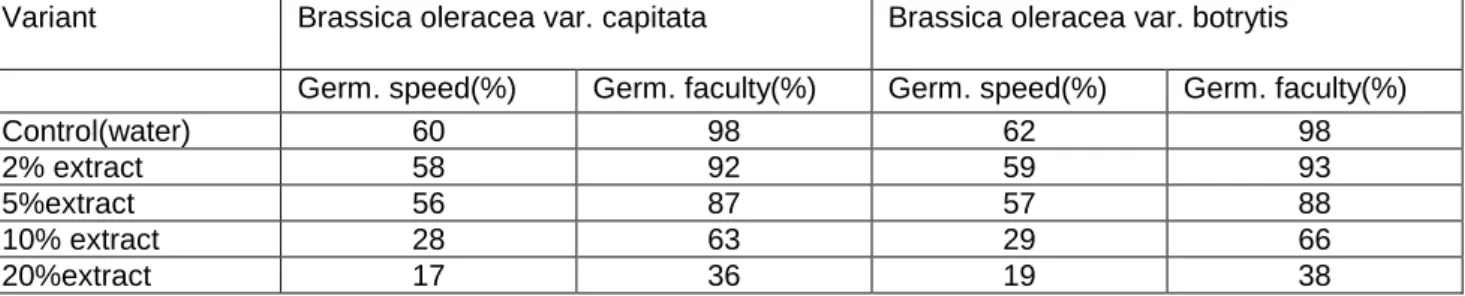
Germination percentage of Brasica oleracea seeds in control variant (water) were significantly higher than that of seeds in treatments with extract of Tagetes erecta roots.
The seed germination was reduced to the 2% and 5% extract concentration. However, a higher concentration to this extract (20%) has a strong inhibitory effect on seed germination.
Differences in germination energy among control variant and variants with extract treatments were significant (table no 1).
Length of root at sedling of Brassicaceae species was significantly decreased with increasing extract concentration. However, in seedling of Brassica oleracea, more long roots were obtained from 2% extract concentration ( table no 2).
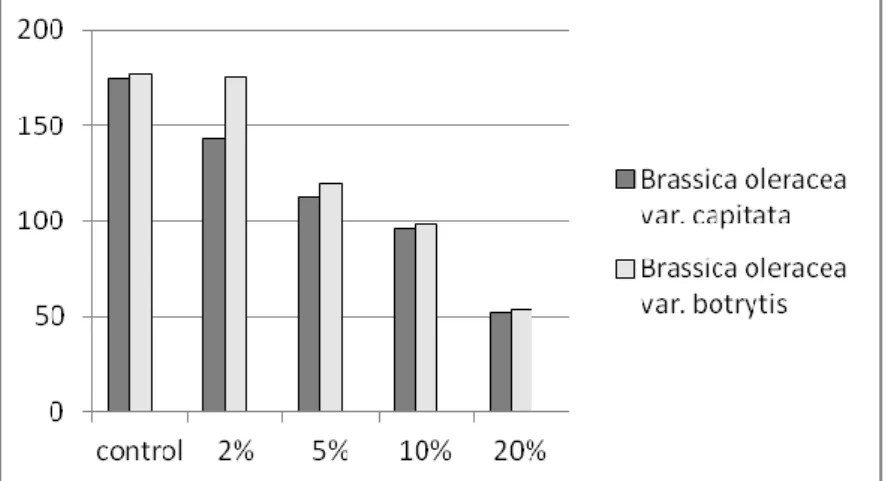
The fresh weight of roots was reduced with increasing extract concentration at 2% to Brasica oleracea var. capitata and 5% to Brasica oleracea var botrytis. This indicated that Brasica oleracea var. botrytis is more resistant species than B. oleracea var. capitata (gr.1).
Table no 1 The influence of Tagetes erecta root extract on the germination process
Variant Brassica oleracea var. capitata Brassica oleracea var. botrytis
Germ. speed(%) Germ. faculty(%) Germ. speed(%) Germ. faculty(%)
Control(water) 60 98 62 98
2% extract 58 92 59 93
5%extract 56 87 57 88
10% extract 28 63 29 66
100
Table no 2 The influence of Tagetes erecta root extract on the fresh weight and lenght of
Brassicaceae seedlings roots
Variant Brassica oleracea var. capitata Brassica oleracea var. botrytis
fresh weight (mg) Length of root(mm) fresh weight (mg) Length of root(mm)
Control(water) 175 8 177 10
2% extract 143 9 176 12
5% extract 112 5 120 7
10% extract 96 4 98 4
20%extract 52 2 54 1
The results showed the effect of Tagetes erecta extract on the growth of seedlings. Similary, Smith and Martin (1994), Ben-Hammouda et all (1995),Soheila Porheidar Ghafarbi et all (2012) found that aqueous extracts of several species have suppressed seedling growth in target plants more than seed germination.
Indeed, the radicle growth was more sensitive to alleloochemicals than the coleoptiles growth. This is in agreement with Ahn and Chung (2000, cited by Soheila, 2012), who found that the length and dry weight of roots of Echinochloa cruc-galli were more affected by hull extract than the shoots.
Gr. 1. The influence of Tagetes erecta root extract on the fresh weight of Brasicaceae seedlings roots (mg)
101
Gr. 2. The intensity of photosynthesis (µmolCO2/m 2
/s)
The results show that the plants are not negatively influenced by the concentration of 20%. A slight increase in respiration is observed (gr. 4) , but transpiration (gr. 3) and photosynthesis (gr.2) does not change at all.
Gr.3. The intensity of transpiration (mmol H2O/m 2
/s)
Gr. 4. The intensity of leaf respiration (µmolCO2/m 2
/s)
BIBLIOGRAPHY
1. Ben- Hammounda M.et all, 1995, A chemical basis for differential Allelopatic potential of Sorgum hybrids on weat, J. Chem Ecol.21, 1919-1921
2. Dixit Priyanka et all, 2013- A brief study on marigold (Tagetes species), A revive, International Research Journal of Pharmacy, Lucknow, India,pp 42-46
3. Farjana Nikkon et all,2009, Insecticidal activity of Tagetes erectaL.against Tribolium castaneum, Research Journal of agriculture and Biological sciences, 748-753
4. Li-Wei Xu et all, 2011, Chemical constituents from Tagetes erecta flowers, Chemistry of Natural compounds, vol.47,pp 281-282
102
6. Smith A E, Martin LD, 1994, Allelopatic characteristics of three coolseason grass species in the forage ecosystem, Agron Journal86, pp 243-246
7. Soheila Porheidar Ghafarbi et all ,2012, Allelopatic effects of Weat seed extracts on seed and seedling growth of eight selected weed species, International Journal of Agriculture and crop sciences, pp 1452-1457