203
COMPARATIVE STUDY BETWEEN ROMANIAN AND FOREIGN WINTER
WHEAT VARIETIES REGARDING YIELD POTENTIAL, DURING 2004-2011
PERIOD ON THE LUVOSOIL FROM SIMNIC
OLARU LIVIU1, PĂUNESCU GABRIELA2, ONCICĂ FRAGA2
1 University of Craiova, Agriculture & Horticulture Faculty Craiova 2
Agricultural Research & Development Station Simnic
Key words: wheat varieties, average yield, maximum yield, t test
ABSTRACT
During eight years 2004-2011 have been tested over 100 wheat varieties with different origin, on the luvosoil from ARDS Simnic. Data were calculated using t test to compare two series with different numbers. On average the Rumanian varieties obtained yield by 4310 kg/ha. In general the yield difference between Romanian and foreign wheat varieties was significant for the first group. Mainly the Romanian varieties were superior those coming from Austria, ex-soviet space, from USA, other countries of the EU (Bulgaria, Spain, Italy, U.K., Czech Republic, Portugal) and Israel showing significant yield differences. We did not find significant differences among Romanian and French, Hungarian or Serbian varieties. The highest average yield was recorded by Glosa (5504 kg/ha) and maximum yield was recorded by Gruia (8420 kg/ha), both Romanian varieties.
INTRODUCTION
All over the world a big part of the yield increase at wheat is the attribute of the new cultivars with high productive potential (Mustătea & Săulescu, 2011).
Wheat production is influenced by genotype, environmental conditions and the interaction of these two factors (Peterson et al. 1992).
Also, yield increase in the last five decades was the result of a combination involving management, genetic gain and climatic conditions (McCaig & DePaw, 1995).
In generally, farmers chosen cultivars with improved characteristics and restricted those with lower yield potential, limited biodiversity and influenced by adverse effects of the climatic conditions and pathogens.
In Canada, for instance, they have the tendency to select more after agronomic considerations like improvement of yield, of vegetation period and lodging resistance and less after protein content and diseases resistance (Walburger et al., 1999).
In Kansas, wheat producers select significantly the cultivars with productive characteristics like yield stability, variety oldness and only at the end after quality performances (Barkley & Porter, 1996).
Many cultivars are spread and trade by commercial companies, included on the market with an aggressive marketing, before tests and evaluations for performances on appropriate locations (Thomason & Phillips, 2006).
There for are necessary these kind of studies.
MATERIAL AND METHOD
204
profundity studies, avoiding so unpleasant experiences with financial losses connected with this technological part of the plant cultivation activity -the selection of the variety.
Have been studied:
Romanian varieties: Albota 69, Alex, Aniversar, Beti, Boema, Ciprian, Crina, Delabrad, Dor, Drobeta, dropia, Eliana, Esential, Faur, Flamura 85, Fundulea 4, Gabriela, Gasparom, Glosa, Grandios, Gruia, Iasi 2, Izvor, Livada, Lovrin 34, Magistral, Moldova 83, Rapid, Romulus, Simnic 30, Simnic 50, Trivale and Voronet.
Wheat varieties from French: Andalou, Apache, Autan, Azimut, Aztec, Cezanne, Defence, Enesco, Exotic, Guadalupe, Isengrain, Meunier, Oratorio, Orqual, Renan, and Texel.
Cultivars created in Austria and Germany: Agron, Bitop, Brutus, Capo, Cornelius, Cubus, Dunai, Esquisit, Exclusiv, Fridoline, Josef, Nathan, Moldau, Optimus, Paulus, Pegassos, SW Maxi and Saturnus.
From Hungary: Carolina, GK David, GK Elet, GK Miska, GK Mura, GK Petur, GK Othalom, GK Pinka, GK Gobe, GK Hargita, GK Hattyu, GK Kalasz, GK Verecke, Linda, MV Madrigal, Mandolin, Mv Emese, Mv Mambo, Mv Mariska, Mv Martina, Mv Plma, Mv Kolo, Mv Pesma, Mv Magvas, Mv Marsall, Mv Palatos, Mv Toborzo, Kiskun Serina
Wheat varieties from ex-soviet space: Bezostaia, Demetra, Khvylya, Kjajna, Kroshka, Krasnodar, Mironovskaia 61, Novokubanska, Ofeliya, Strumok, Vesta, Karlygash, Georgia 1
From countries of the European Union: Spain, Holland, Bulgaria, Great Britain were tested: Albatros, Acrobat, Bancal, Bercy, Cordiale, Giava, Meritto, Negev, Pinzon, Pobeda, Preloma, Rheia
The tested varieties from Serbia were: Evropa, Frini, Kristina, Liliana, Mina, Novisad 7000, Partizanka, Renesansa, Romansa, Stamena
From USA and Mexico: Columna, Hoff, Masson, Orion, Patton, Piopio, Rowhide, Solomon, Vista, Vorona
From Israel have been tested: Bhash, Dariel, Galil, Hzera 305, Shoham It was applied the following technology:
Previous crop it was the pea
Planting was realized during the optimal period with 550 g.k./m2; 12,5 cm distance
between rows; 4-5 cm planting depth and seed rate calculated for each variety depending on germination, purity and 1000 kernel weight.
The seed was chemically treated before planting using specific products. Were used complex fertilizers with NPK formula in 200 kg/ha dose In spring the crop was fertilized with ammonium nitrate – 200 kg/ha In spring we used specific herbicide to control weeds competition We also applied treatments against pests.
Data were collected from comparative cultures, micro cultures and demonstrative plots
It was calculated the yield obtained during each year, average yield for the whole experimental period and maximum yield pointed out during testing.
It was calculated t test that allows comparing two data series different like number. If calculated ,,t,, was lower than critic ,,t,, the differences were not significant but when calculated t was higher then critic t, the differences were significant.
205
RESULTS AND DISCUSSIONS
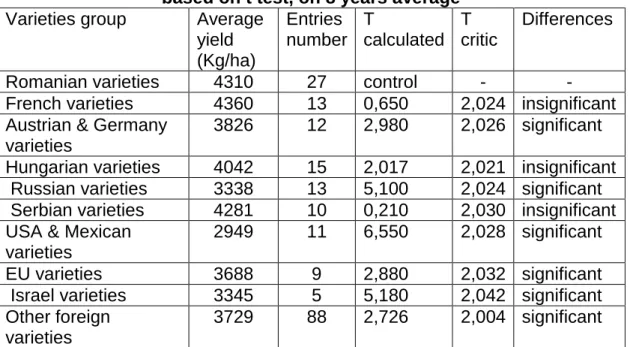
On average during testing period, the Romanian varieties obtained 4310 kg/ha, a diminished yield by the 2007 dry year production (table 1)
Table 1 Yield differences between Romanian and foreign wheat varieties
based on t test, on 8 years average
Varieties group Average
yield (Kg/ha)
Entries number
T
calculated T critic
Differences
Romanian varieties 4310 27 control - -
French varieties 4360 13 0,650 2,024 insignificant
Austrian & Germany varieties
3826 12 2,980 2,026 significant
Hungarian varieties 4042 15 2,017 2,021 insignificant
Russian varieties 3338 13 5,100 2,024 significant
Serbian varieties 4281 10 0,210 2,030 insignificant
USA & Mexican varieties
2949 11 6,550 2,028 significant
EU varieties 3688 9 2,880 2,032 significant
Israel varieties 3345 5 5,180 2,042 significant
Other foreign varieties
3729 88 2,726 2,004 significant
Although the French varieties had a 50 kg/ha yield increase it was not enough to obtain significant differences. These varieties were the only of the whole experiment with the average yield higher then Romanian cultivars. In the same category of varieties with insignificant yield differences comparative with the Romanians were those coming from Hungary and Serbia. These results suggest that Romanian, French and Hungarian varieties are equal at average yield obtained during experimental period (8 years).
Inferior to the Romanian varieties were tested cultivars from Austria and Germany (on average 3826 kg/ha), from ex-soviet space (on average 3338 kg/ha), USA and Mexico (on average 2949 kg/ha), from other countries of the EU (on average 3688 kg/ha) or from Israel (on average 3729 kg/ha).
If we consider all these proveniences like a group- foreign varieties group-and we compare it with Romanian varieties group, t test shows this last group superiority against the first regarding yield potential.
Researches conducted by Păunescu Gabriela & Boghici Nicoleta (2008) on a group with 66 Romanian and foreign varieties, during 2005-2007 on the Simnic soil showed also like this one, that Romanians average yield (4225 kg/ha) was higher comparative with the Hungarians (3644 kg/ha), the Austrians (4166 kg/ha), Russians (3819 kg/ha), French (4034 kg/ha), Israel (3064 kg/ha) and also higher then the average yield of the varieties with other different origins (3725 kg/ha).
Another study conducted by Egesel et al. (2012), during two years, on wheat varieties from Bulgaria, Serbia, Hungary and Russia showed that yield level oscillated from 3571 to 4324 kg/ha and the best variety , ZA-77 was a Serbian one.
206
Nicoleta, 2008). Maximum yields were obtained more in 2004 and less in 2005 for all tested origins (Table 2).
Table 2 Maximum yields obtained by tested varieties during 2004-2008
Variety Yield (kg/ha) Year
Gruia 8420 2004
Cezanne 8270 2004
Glosa 7780 2004
Izvor 7710 2004
Madrigal 7760 2004
Mariska 7660 2004
Exotic 7560 2005
Preloma 7220 2004
Orion 7110 2004
Cubus 7005 2005
The highest maximum yield was recorded by a Romanian variety Gruia-8420 kg/ha, followed by a French wheat Cezanne with 8270 kg/ha, the only with yields over 8000 kg per ha. On the same list there are another two Romanian cultivars (Glosa and Izvor), two Hungarians (Madrigal and Mariska), a French variety (Exotic), a Bulgarian one (Preloma), an American (Orion) and an Austrian wheat (Cubus).
Most of the varieties with over 3000 kg/ha were from Romania-7, from French-3 followed by USA and Hungary with one cultivar (Table 3).
Table 3 Wheat varieties with average yield over 3000 kg/ha during 2004-2011
No. Variety Minimum average yield obtained during 2004-2011
1 Albota 69 3300
2 Alex 3500
3 Aztec 3370
4 Boema 3090
5 Cezanne 3010
6 Crina 3130
7 Exotic 3704
8 Flamura 85 3060
9 Glosa 3330
10 Gruia 3100
11 Martina 3380
12 Orion 3670
13 Romulus 3040
CONCLUSIONS
On eight years average the yield differences between Romanian and foreign wheat varieties were significantly in the favour of the Romanians.
207
The differences were not significant between Romanians and French, Hungarian and Serbian varieties. The highest average yield was recorded by Glosa (5504 kg/ha) and the maximum yield level belongs to Gruia (8420 kg/ha), both Romanian varieties.
REFERENCES
Barkley, A.P., L.L. Porter, 2007- The Determinants of Wheat Variety Selection in Kansas, 1974 to 1993. American Journal of Agricultural Economics 78:202–11.
Egesel C.O., Kahrıman F., Tümer A.I., Çolak Ç, 2012 - Yield and quality
characteristics of some foreign bread wheat (Triticum aestivum l.) cultivars in Turkey .
Romanian Agricultural Research No. 29, www.incda-fundulea.ro Print ISSN 1222-4227; Online ISSN 2067-5720
McCaig, T.N., R.M. DePauw. 1995 - Breeding Hard Red Spring Wheat in Western Canada: Historical Trends in Yield and Related Variables.’’ Canadian Journal of Plant Science 75:387–93.
Mustătea, P., N.N. Săulescu, 2011 - Estimation of genetic trends in yield and
agronomic traits of recent Romanian winter wheat (Triticum aestivum L.) cultivars, using
direct comparisons in multiyear, multi-location yield trials, Romanian Agricultural Research, 28: 17-24.
Păunescu, Gabriela, Ofelia Nicoleta Boghici, 2008 - Performance of several wheat cultivars under contrasting conditions of water stress, in central part of Oltenia. Romanian Agricultural Research 25: 13-18 ISSN 1222-4227
Peterson, C.J., Graybosch, R.A., Baenziger, P.S., and Grombacher. A.W., 1992 - Genotype and environment effects on quality characteristics of hard red winter wheat. Crop Sci., 32: 98-103.
Thomason W.E.,Phillips S.B., ,2006 - Methods to evaluate wheat cultivar testing environments and improve cultivar selection protocols. Field Crops Research, vol. 99 issues 2-3 pg 87-95.