THE ORGANIZATION AND TECHNICAL EQUIPMENT OF AN
ECO-FRIENDLY LANDFILL FOR URBAN WASTE MATTER
AVRAMESCU A.M. DOBRE C.G. 1)U. P. Bucharest / Romania
E-mail: [email protected]
Keywords: urban waste, landfill, eco-friendly
ABSTRACT
The paper outlines the totality of measures taken in order to determine, provide and coordinate the tools for building, expanding and exploiting an urban waste matter landfill. In order to solve the waste issue we must start with the flow circuit, from the generating factors to the final processing. Urban waste matter is mainly generated by the large public. In Romania, due to the extremely low level of civic education, the public is less receptive to new and not willing to take responsibility for its actions. The research described in this paper is aimed for the construction of an eco-friendly landfill having as model the Iridex landfill. This eco-friendly landfill is made from a number of cells that are closing after becoming full. We based our choice on technical and economic benefits.
INTRODUCTION
The waste consist in the raw material, matter and products rejected during the manufacturing cycles or resulting from human activity. As it cannot be reused as such, needs to be subjected to different transformations. The management of urban waste is an important factor of economic and social development due to the fact that the waste matter is a potential source of pollution, but it also could be an important energy or secondary raw material source [5, 9]. The present trend in managing the urban waste is based on two aspects: reducing the waste volume and minimizing the danger of the environmental pollution. The waste management strategy is based on multiple approaches, like preventing the accumulation in volumes of the waste matter, solving the waste problem back to its source and promoting the reuse and recycling of waste materials [1, 8, 15, 19].
Dealing with the waste issue consists in addressing the circuit flow from the generating source to the final processing. Urban waste is mainly generated by the large public. In Romania, due to the extremely low level of civic education, the public is less receptive to new and not willing to take responsibility for its actions. In order to know the size of the steps to be taken in managing the urban waste we must assess the type of the waste materials [2, 9, 17, 20]. Compared to other European countries, Romania has an average rank in the waste matter chart, but the annual quantity to deal with is higher when compared with other EU countries (according to a 1998 report).
- inflammable waste (paper, cardboard, plastics, rubber, wood, textile, bones etc.); - inert waste (metal, glass, clay etc.);
- fine waste (ashes, cinder, debris, dust etc.).
Street waste is made of dust, clay (60-80%); leaves, wood (5-8%); paper, cardboard (2-4%); constructions debris (3-5%), mineral and vegetal waste (0.1-0.2%); animal feces (1-2 %); others (2-4%). The daily street waste rate is 0.1-0.25 tons/ha. Figure 1 presents the percent of different types of waste, according to the JICA (Japan International Cooperation Agency) research from 1995 to 1997.
Fig. 1. The main waste matter generators in Bucharest area [3]
The primary pre-collect of household waste consist in gathering and storing the waste in small recipients (trash cans) at the generating point (households). Starting from this stage there must be operated a good selection for a differential collect. Secondary pre-collect of household waste is a preamble of the actual pre-collect and it is done by the inhabitants or the institutions staff (offices, restaurants, stores etc.). It consists in gathering the waste and storing it in containers or bins located in special points serving the residential area or the public institutions area [4, 9]. The street pre-collect could be a manual operation – done by the workers of city halls or local administration or via sanitation units, a semi-mechanical aggregate that sweeps and cleans the streets [16, 17].
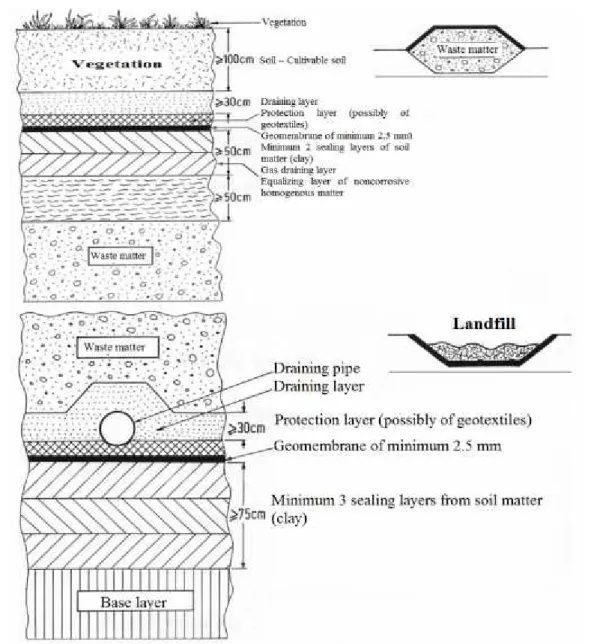
Fig. 2. The vertical structure at the base and at the top of a landfill
Depending on the technology used, the landfills could be built in different ways. In the ordinary landfill category (without a special processing of the waste matter) fall the ones where the brute waste is compacted as usual, without a special processing. The daily collect of waste is discharged in the landfill on a small enough area in order to enable the spreading, allotting and compacting of the waste matter [7]. Therefore, only a small fraction of the landfill is exposed to rain and other elements. The first step in organizing a landfill is to uncover the vegetation layer used later for covering another landfill or even the same landfill. The landfill could be filled up frontally or annularly. When filled up frontally, the layers are perpendicular on the filling sense, with different discharging points for the trucks on either side of the landfill [14]. Every new waste layer must start in the same spot as the first in order to expose them equally to rain and other atmospheric elements. When filled up annularly, the waste is stored in concentric circles from the edge to the center.
unpleasant smell emanations due to anaerobic fermentation, minimizing the fire risk, a diminished tamp down of further layers and a better general aspect of the landfill [13, 18].
The landfill of the third category is a system in which the waste is grinded before storage. The compacting must be light in order to enable the aerobic fermentation of the grinded material. The grinding and sieving must adjust the waste to a certain size in order to allow for the air to circulate. If the grinding is too fine, the aerobic fermentation cannot take place equally in the whole waste mass [1, 6, 9, 17, 19]. If the grinding is too large it facilitates the anaerobic fermentation and unpleasant smell emanations. The decay process has two stages. The first stage is very fast. When the waste composition is very heterogeneous, the decay is irregular and takes place starting from the surface layers to the deep ones [2, 10]. Its speed depends on the way oxygen penetrates the waste mass. Therefore, it is critical for the air to be able to circulate within all the waste mass for a rapid decay of organic matter. The particles grinded must have the size of about 50 mm. In order to settle them, there are now two different methods: by settling them in very thin layers (of 30-40 cm) for a good air circulation, followed by compacting process or piling them up for a few months, in order to be sent later to the landfill [7]. This system is no longer requiring the technology of covering the landfill, as it is the case for the other two types of landfills. Here, there is no need for an intermediate or final covering.
Fig. 3. The system design of an eco-friendly landfill of household waste [3]:
1. soil; 2. compacted clay layer; 3. PEHD geomembrane; 4. filtering/protection geotextile layer; 5. filtering gravel layer; 6. filtering/protection geotextile layer; 7. sand; 8. waste matter; 9. leaching collecting system; 10. biogas collecting system;
11. leaching pumping station; 12. leaching pool; 13. leaching treating system; 14. ground water pit; 15. weighting machine; 16. waste moving trucks
The advantages of that method of organizing a landfill are as follows [12, 17, 20]: - a doubled storage capacity due to decreasing with 50% of the waste volume; - the possibility for a better controlled waste storage and a natural fermentation compost; the two methods could be used in parallel;
- an improved sanitary aspect of the soil; - the soil is more stable;
- the soil could be cultivated faster, especially the infertile, arid or humid soils.
the fermented waste [4, 8, 11]. Therefore, on the same land we could have light constructions like sport fields, parks etc. It is also possible for the land to be used for agriculture. In Romania, such is the use of numerous fields, many of them being excellent recreation areas.
RESULTS AND DISCUSSIONS
The solution is chosen based on technical and economical reasons, being applied through the STEM method, with the benefit of including in the „C” set of the analyzed characteristics all the parameters affecting both positively and negatively the facility in service: quantifiable parameters (kw, ha/h, t/ha; t/h etc.) and non-quantifiable parameters, expressed through qualitative assessment (very good, good, significant, very significant etc.) [3]. In order to apply this method, there a few steps to be followed:
A. The listing of all the technologies analyzed, choosing the technologies with the same function that are from the same class of technologies (in order to be compatible). For the present research, we will assess the characteristics of five landfills: IRIDEX and GLINA in Bucharest, plus TIMIS, DEVA and PLOIESTI. Afterwards, we make a chart having on its columns the „m” set of technologies assessed U = {U1, U2, ... Um} and on its lines the „n” set of the performances (characteristics) we study. The result is the calculation of the total utility of the facility in service C = {C1, C2, .... Cn}.
B. The C set of the characteristics (selection criteria) is divided in two subsets: - subset „n1” (jn1) of the characteristics that we wish to have the greatest values (maximal criteria subset);
- subset „n2” (j n2) of the performances that we wish to have the least values (minimal criteria subset). Therefore, n1 + n2 = n.
We consider the characteristics C1, C5 and C6 n2 as being minimal criteria, and the characteristics C2, C3, C4 and C7n1 as being maximal criteria.
C. The next step is to create a matrix of the facilities, with the values Uij (0≤Uij≤1) being as follows:
- in the n1(j n1) subset, the value Uij=1 is granted to the technology having the greatest performance of its characteristic j, and Uij=0 to the technology where the same characteristic has the smallest performance;
- in the n2 (j n2) subset, the value Uij=1 is granted for the technology having the smallest value of its criterion j, and Uij =0 to the technology where the same criterion has the greatest value.
Other technologies having the j characteristic between maximum and minimum values (min Xij < Xij < max Xij) will be ranked as 0<Uij<1.
D. The next step is to obtain the performance ranking vector based on the significance of the characteristics in service:
- (C1 I C7) P (C2 I C3 I C6) - (C2 I C3 I C6) P (C4 I C5) - (C1 I C7) PP (C4 I C5)
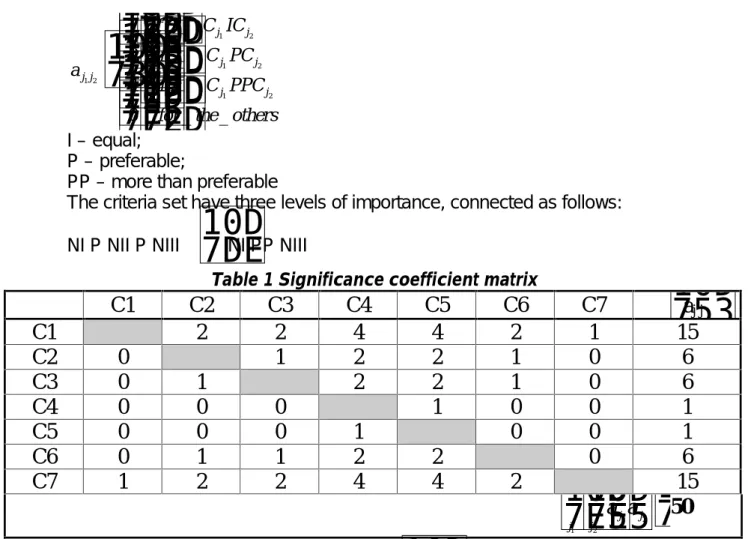
E. The next step is a matrix (nxn) A=[nxn], having on its lines j1 values and on its columns j2 values: j1, j2 =1,2,3,…,n. Here, every characteristic is assessed with a significance coefficient based on the performance ranking vector. Therefore, we compare each of the criteria based on their significance for the facility in service. These significance coefficients are as follows:
others the for PPC C if PC C if IC C if a j j j j j j j j _ _ 0 4 2 1 2 1 2 1 2 1 2 1
I – equal; P – preferable;
PP – more than preferable
The criteria set have three levels of importance, connected as follows:
NI P NII P NIII NI PP NIII
Table 1 Significance coefficient matrix
C1
C2
C3
C4
C5
C6
C7
a
j jC1
2
2
4
4
2
1
15
C2
0
1
2
2
1
0
6
C3
0
1
2
2
1
0
6
C4
0
0
0
1
0
0
1
C5
0
0
0
1
0
0
1
C6
0
1
1
2
2
0
6
C7
1
2
2
4
4
2
15
1 2 2 1 j j j ja
a
50
F. The next step is to obtain the rate j of the characteristics, based on their significance for the facility in service:
1 2 2 1 1 2 1 1 j j j j j j j j ja
a
a
where:0<j<1 andj=1
Then we assess the total significance of the technologies analyzed and we establish the final ranking, based on the following formula:
i i i i U i U U i j j ij U
U
U
U
U
U
) ( )(
,...,
,...,
min
max
2
where i=1,2,…,m and j2=j=1,2,…,n.
Finally, we chose the technology with the best rank, because it is the most efficient technology.
We make the decision:
max
(i)U
Ui.
3
,
0
50
15
71
12
,
0
50
6
6 32
02
,
0
50
1
54
These values lead to the following rates for the landfills in question:
8206 , 0 3 , 0 1 12 , 0 1 02 , 0 1 02 , 0 1 12 , 0 49 , 0 12 , 0 69 , 0 3 , 0 73 ,
0
Iridex U 331 , 0 3 , 0 0 12 , 0 1 02 , 0 5 , 0 02 , 0 0 12 , 0 81 , 0 12 , 0 69 , 0 3 , 0 07 ,
0
Glina U 592 , 0 3 , 0 1 12 , 0 5 , 0 02 , 0 0 02 , 0 5 , 0 12 , 0 1 12 , 0 85 , 0 3 , 0
0
Timis U
73
,
0
3
,
0
1
12
,
0
0
02
,
0
0
02
,
0
5
,
0
12
,
0
0
12
,
0
1
3
,
0
1
DevaU
6896 , 0 3 , 0 1 12 , 0 1 02 , 0 1 02 , 0 0 12 , 0 33 , 0 12 , 0 0 3 , 0 7 ,0
Ploiesti
U
Therefore, we managed to obtain the rank for every landfill analyzed. The top is IRIDEX, with the value UIridex=0,8206. Based on all the criteria and significance coefficients, the final rank is as follows:
Glina Timis
Ploiesti Deva
Iridex
U
U
U
U
U
CONCLUSIONS
The solution was chosen based on technical and economical reasons, being applied through the STEM method, with the benefit of including in the „C” set of the analyzed characteristics all the parameters affecting both positively and negatively the facility in service.
In order to obtain a good result with recycling and reuse of the waste matter, we need to address the civic education of every citizen with means ranging from personal responsibility to fines and taxes. Also, we must provide the cities with special waste containers having different compartments for glass, paper, metal, plastic etc. Other important measures in that respect are: developing the collecting network of the waste matter; reorganizing the collect and transportation as two different services; providing mechanical or semi-mechanical devices for the selection of the waste matter; establishing a network for collecting and selling the waste matter: and supporting the use of recycled items in agriculture, industry and trade market.
BIBLIOGRAPHY
1. Agovino M., Ferrara M., Garofalo A., 2016 – An exploratory analysis on waste management in Italy: A focus on waste disposed in landfill. Land Use Policy, Volume 57, 30 November 2016, pp. 669-681;
2. Ali M., 2006 – Editorial: urban waste management as if people matter. Habitat International, vol. 30, pp. 729–730;
Peninsular Malaysia and the behavior towards heavy metal exposure. CATENA, vol. 147, pp. 25-31;
5. Beatley T., 1994 – Ethical land use: principles of policy and planning. The Johns Hopkins University Press, Baltimore;
6. Bolan R.S., 1983 – The structure of ethical choice in planning practice. Journal of Planning Education and Research, 3 (no. 1) (1983), pp. 23–34;
7. Campos M.J.Z., Hall C.M., 2013 – Organizing waste in the city: international perspectives on narratives and practices.Policy Press, Chicago, IL (2013), pp. 1–18; 8. Chuanfu Wu, Takayuki Shimaoka, Hirofumi Nakayama, Teppei Komiya, Xiaoli Chai, 2016 – Stimulation of waste decomposition in an old landfill by air injection. Bioresource Technology, vol. 222, pp. 66-74;
9. Fatma A. El-Gohary, G. Kamel, 2016 – Characterization and biological treatment of pre-treated landfill leachate. Ecological Engineering, Volume 94, September 2016, pp. 268-274;
10. Calabresi G., Bobbitt P., 1978 – Tragic choices. W.W Norton&Company, New York;
11. Gil M.V., Oulego P., Casal M.D., Pevida C., Pis J.J., Rubiera F., 2010 -Mechanical durability and combustion characteristics of pellets from biomass blends. Bioresource Technology, vol. 101, pp. 8859–8867;
12. Harnik P., Taylor M., Welle B., 2006 – From Dumps to destinations: the conversion of landfills to parks.Places, vol. 18, no. 1, pp. 83–88;
13. Hassler U., Topalovic M., Grun A., 2014 – Constructed land: Singapore 1924– 2012.ETH Zurich DArch and Future Cities Laboratory, Zurich, Switzerland, pp. 14–22; 14. Head B.W., Alford J., 2015 – Wicked problems: implications for public policy and management.Administration & Society, vol. 47 (no. 6), pp. 711–739;
15. Hoornweg D., Bhada-Tata P., 2012 –What a waste: a global review of solid waste management.World Bank, Washington, D.C;
16. Hua Chen, Ying Sun, Xiuxiu Ruan, Ying Yu, Minying Zhu, Jia Zhang, Jizhi Zhou, , Yunfeng Xu, , Jianyong Liu, , Guangren Qian, 2016 – Advanced treatment of stabilized landfill leachate after biochemical process with hydrocalumite chloride (Ca/Al–Cl LDH).Bioresource Technology, Volume 210, June 2016, pp. 131-137;
17. Li-na Wu, Da-wei Liang, Ying-ying Xu, Ting Liu, Yong-zhen Peng, Jie Zhang,
2016 – A robust and cost-effective integrated process for nitrogen and bio-refractory organics removal from landfill leachate via short-cut nitrification, anaerobic ammonium oxidation in tandem with electrochemical oxidation. Bioresource Technology, Volume 212, July 2016, pp. 296-301;
18. M.J. Hird, 2013 – Waste, landfills, and an environmental ethic of vulunerability. Ethics & the Environment, vol. 18 (no. 1), pp. 105–124;
19. Md Iskander S., Brazil B., Novak J. T., He Z., 2016 – Resource recovery from landfill leachate using bioelectrochemical systems: Opportunities, challenges, and perspectives.Bioresource Technology, Volume 201, February 2016, pp. 347-354;
![Fig. 1. The main waste matter generators in Bucharest area [3]](https://thumb-us.123doks.com/thumbv2/123dok_us/8069989.2137636/2.892.127.761.288.586/fig-main-waste-matter-generators-bucharest-area.webp)
![Fig. 3. The system design of an eco-friendly landfill of household waste [3]: 1. soil; 2](https://thumb-us.123doks.com/thumbv2/123dok_us/8069989.2137636/4.892.88.808.488.858/fig-design-eco-friendly-landfill-household-waste-soil.webp)