Volume 1 Number 4, October-December 2016
onlinejournal.org.uk
Licensed Under Creative Commons Attribution CC BY
1
Developing The Lesson Plan Of An Outdoor
Learning Of Natural Science
Hidayati, Trisharsiwi, Zainnur Wijayanto
Sarjanawiyata Tamansiswa University, Kusumanegara street no. 157 Yogyakarta, Indonesia
E-mail: [email protected]
Received: 26/10/16 - Accepted: 22/11/16 DOI: http://dx.doi.org/10.19239/ijrev1n4p1
Abstract: The purpose of the research is to develop the lesson plan of an outdoor learning of natural science in Taman Dewasa Junior High School Yogyakarta. The research uses research and development approach, namely, a one-year study with a qualitative research design. Informants in this research, principals, classroom teachers and students of Taman Dewasa Junior High School Yogyakarta. Data are collected by using observation, in-depth interviews, and documentation. The data are analyzed by using qualitative analysis of flow method. Data validity is examined by using methods and sources triangulations. Result: Planning learning is poured into forms RPP. Writing lesson plans in advance is started with the designing (1) learning objectives based on the analysis of SK and KD, (2) the problem situation created by the students, (3) techniques and procedures assessment process and the learning outcomes that will be applied, and (4) operational measures learning. Implementation of learning consists of introductory, core and cover. Preparation of assessment of learning, namely the evaluation process and evaluation of learning outcomes is done authentically based on the cognitive, psychomotor, religious, and social. Assessment process undertaken to assess the participation of students during the learning process. Assessment is based on the work of students in solving problems worksheets, controlled exercise, exercise self-reliant, and independent tasks
Keywords: development, plan, natural-science
Introduction
Learning of Natural Science in Taman Dewasa Junior High School Yogyakarta, is still largely centered on the teacher. This is called teaching activities, not a learning activity. The dominance of teachers in learning looks very clear. Judging from the methods used, teachers tend to use the lecture method, protests, tasks, exercises. Associated with the dominance of teaching activities, the question arises whether the activity of learning science in Taman Dewasa Junior High School Yogyakarta effective?. Sutama (2011: 28) says, learning ineffective because (1) the teacher is less gain a better understanding Content Standards, (2) learning tends text book oriented and less related to the daily life of students, and (3) the teacher in teaching tend to be less the capability of beginning students.
Based on the above reasoning, the teacher should also focus on learning strategies that suit the need of developing a learning management that can lead students to understand
Volume 1 Number 4, October-December 2016
onlinejournal.org.uk
Licensed Under Creative Commons Attribution CC BY
2
Research Methods
The research uses research and development approach, namely, a one-year study with a qualitative research design. Informants in this research, principals, classroom teachers and students of Taman Dewasa Junior High School Yogyakarta. Data are collected by using observation, in-depth interviews, and documentation. The data are analyzed by using qualitative analysis of flow method. Data validity is examined by using methods and sources triangulations.
Results and Discussion
a. Research Result
Natural science lesson plans (RPP) relating to the initial plan of learning, classroom management, media management, management science teaching materials, teaching materials IPA management and interaction management. The result of the development of lesson plan of an outdoor learning of natural science in Taman Dewasa Junior High School Yogyakarta are outlined below.
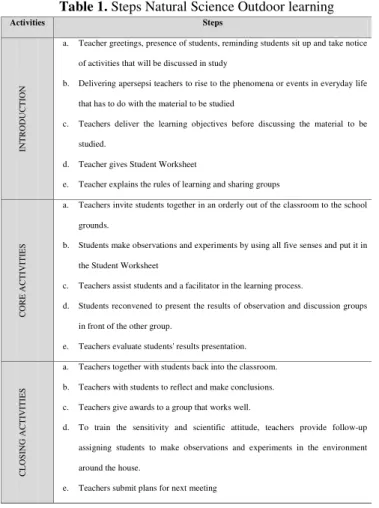
Lesson plan natural science writing outdoor learning contains Identity: school, class / semester, the subjects, the number of meetings; I. Standard of Competence; II. Basic Competencies; III. Indikacors; IV. Purposes, V. Character of students is expected. VII. Learning materials; VIII. Learning methods; IX. Lesson: Introduction, Core Activities, Closing; X. Learning Resources; XI. Learning Outcomes Assessment: Assessment of performance and learning outcomes. Here are the steps of outdoor learning:
Table 1. Steps Natural Science Outdoor learning
Activities Steps
IN
T
R
O
D
U
C
T
IO
N
a. Teacher greetings, presence of students, reminding students sit up and take notice
of activities that will be discussed in study
b. Delivering apersepsi teachers to rise to the phenomena or events in everyday life
that has to do with the material to be studied
c. Teachers deliver the learning objectives before discussing the material to be
studied.
d. Teacher gives Student Worksheet
e. Teacher explains the rules of learning and sharing groups
C
O
R
E
A
C
T
IV
IT
IE
S
a. Teachers invite students together in an orderly out of the classroom to the school
grounds.
b. Students make observations and experiments by using all five senses and put it in
the Student Worksheet
c. Teachers assist students and a facilitator in the learning process.
d. Students reconvened to present the results of observation and discussion groups
in front of the other group.
e. Teachers evaluate students' results presentation.
C
L
O
S
IN
G
A
C
T
IV
IT
IE
S
a. Teachers together with students back into the classroom.
b. Teachers with students to reflect and make conclusions.
c. Teachers give awards to a group that works well.
d. To train the sensitivity and scientific attitude, teachers provide follow-up
assigning students to make observations and experiments in the environment
around the house.
e. Teachers submit plans for next meeting
Preparation of an evaluation instrument on outdoor learning of natural science starts from defining the purpose of the evaluation is summarized in basic competency achievement goals and indicators studied. Furthermore, the restrictions on the material to be evaluated. This is done so that in the test instrument there are no materials outside the goal. This restriction leads to a basic competency. Preparation of an evaluation-based science learning outside the classroom, which is the performance evaluation and the evaluation of learning outcomes is done authentically based on aspects of cognitive, affective, psychomotor, and social. Authentic assessment is a form of behavioral assessment / performance of students during the learning process comprehensively in real situations.
Volume 1 Number 4, October-December 2016
onlinejournal.org.uk
Licensed Under Creative Commons Attribution CC BY
3 a performance, observation, experimentation, discussion
and presentation, namely engagement and activity
of students in groups or individual
or student participation during the learning process. During the process of group work, the teacher can perform assessment of social aspects. In this activity students are required to work together. Affective and psychomotor aspects of the assessment made at the time the students do activities and observed by using the observation sheet. Involvement and activity of students in a group is assessed using the guidelines of the observation. The participation of students is seen in present observations and experimentation of the group as well as in providing feedback or a question in the discussion results of the group work.
Assessment results are based on the student's work such as solving problems student worksheets, sheets tasks or exercises that include controlled exercise, exercise self-contained (daily test) and the task independently. Especially for independent exercises, contains three types of matter, namely the type of questions that have been discussed thoroughly, type of questions that have been awarded but not yet fully covered, and the type of questions that have not been granted. Chores relating to the application of scientific attitude of students, ie assigning students to make observations and experiments in the environment around the house is related teaching materials.
b.Discussion
Development of lesson plan Natural science is based on Content Standards (SI), which contains the syllabus and adapted to the conditions of the school and students. Preparation of the implementation plan is a planning stage. Writing lesson plans in advance is started with the designing (1) learning objectives based on the analysis of SK and KD, (2) the problem situation created by the students, (3) organization of resources and logistics, (4) techniques and procedures authentic assessment process and learning outcomes will be applied, and (5) steps in learning activities.
Learning steps preceded the introduction, the core activities and closing activity. Preliminary activities are activities of conditioning students to be ready for learning. The activities include: (a) deliver learning objectives, and basic materials that will be studied as well as the learning procedure, (b) Apperception, namely through the question and answer recalls the previous material and rise to the phenomena or events in everyday life, (c) provide motivation that will
stimulate the curiosity of students. This is in accordance with the opinion of Lynch and Dorothy (2003: 1-4), that learning is not only to transfer knowledge, but the process of constructing knowledge. Learning is a process not just memorizing a concept that is so, but learning must experience. Wandemberg (2016) also said that “the education provided in this century must go beyond humanism to make the student fully develop their potential benefit themselves and society by improving the quality of life and environment (Ibid) more and more”.
Volume 1 Number 4, October-December 2016
onlinejournal.org.uk
Licensed Under Creative Commons Attribution CC BY
4 After that the teacher provides questions related to basic
competency that has been studied earlier. Thus it can be seen the extent to which the student has to make efforts to solve the problems faced. Find is important in the learning process, because with finding a solution to their own problems, students have their own satisfaction and not easily forgotten. This is in accordance with the opinion of Suherman (2012: 11-54), that the finding, the ability to think independently to be trained and become accustomed.
Third, Closing Activities. This stage is an activity to analyze and evaluate the problem solving process includes: (a) personal reflections by asking the students about things that have been mastered, the material is not well understood, the root cause has not mastered, and alternative solutions to the next action, (b) students are given tasks related to daily life by making observations and experiments in the environment around the house. Teachers and students of reflection with to conduct a discussion, about the things that had just learned. Teachers and students together make a summary.
Teachers strengthening or suppression of material that has been taught, so students have the same understanding. The results of a study show that effective classroom management that one way is to use reinforcement to students. Ummu H.A. (2012: 87-100) stated that in order to manage the activities in the classroom in order to be effective, as follows shows how far the teachers to follow the ongoing activities in the classroom, to overcome overlap situation effectively, maintaining the smoothness and continuity of teaching, involving students in a variety of exciting activities, shows the attitude catch, dividing attention, focus, clear instructions and reprimands and provide reinforcement.
Teachers hold a judgment properly, including the assessment process and outcome assessment. Assessment is not only done at the end of the semester, the end of the year or the final exam butalso executed when the assessment of the learning process takes. This is in accordance with the results of Sri Budiyati, Sutama and Sabar N (2013) which stated that the assessment is not only assess the end result, but also to assess the process. Teachers make an assessment when students work together in making observations and experiments as well as group work and student activity in asking was also assessed by teachers. As for the evaluation of science teaching is done authentically based on the cognitive, psychomotor, religious, and social. Assessment process undertaken to assess the participation of students during the learning process. Assessment is based on the work of students in solving problems worksheets, controlled exercise, exercise self-reliant, and independent tasks.
Instructional media used by teachers from their own teacher-made, from the school, and the environment around the school. Learning media created by the creativity of teachers. Preparation of teaching materials and refers attention Competence Standard and Basic Competence established by National Education Minister Regulation No. 22 of 2006 on the Content Standards. Furthermore, determining the form of teaching materials, any material that will be taught require instructional materials vary. To teach the material sometimes accordance with demonstrations, textbook or worksheet. For the foresight in the analysis required. Lesson plan attached with teaching materials in the form of students' worksheets.
Conclusion
The development of lesson plan an outdoor learning of natural science in Taman Dewasa Junior High School Yogyakarta, namely stage 1: student orientation on circumstances problems, phase 2: organize students to learn outside of the classroom, stage 3: guiding individual and group investigations, stage 4: presenting the results of observation and discussion groups, and stage 5: analyzing and evaluating the process that has been done in learning.
Acknowledgements
Various acknowledgments we need to convey to all parties. Our gratitude goes to ditlitabmas DIKTI through KOPERTIS Region V which has helped in funding the cost of multiyear research through competitive grants. Our gratitude goes to the Dean of FKIP and Chairman of UST Research Institute and its staff, which has provided comfort and encouragement so that we can conduct the research. Acknowledgements also go to the principals and teachers of SMP Taman Dewasa Kota Yogyakarta, which has helped the research process so that it runs according to plan.
References
Carin, A.A., & Sund, R.B. (1980). Teaching modern science. New York: Merril Publishing Company.
Depdiknas. (2008). Bahan Ajar Cetak: Pengembahan IPA SMP. Jakarta: Dierjendikti Depdiknas.
Depdiknas. (2008). Bahan Ajar Cetak: Strategi
Volume 1 Number 4, October-December 2016
onlinejournal.org.uk
Licensed Under Creative Commons Attribution CC BY
5 Kuslan, L.I., & Stone, A.H. (1968). Teaching Children
Science: An Inquiry Approach, Belmount: Wadsworth
Publishing Company. Inc.
Lynch Richard L. & Dorothy Harnish. (2003). Contextual Teaching and Learning: Lessons Learned from Teacher
Preparation through Novice Teaching. University of
Georgia
Park, Hye Sook & Kyoo Hong Park. (2001). Analysis of the Mathematical Dispotition of the Mathematically Gifted
Students in the Midlle School of Korea. Seowon
University Cheongju, Chungbuk 361-742, Korea.Journal.http://proquest.umi.com/pqdweb?did=6 90191641&sid=4&fmt=4&client
id=80413&RQT=309&Vname=PQD.
Sri Budiyati, Sutama, & Sabar N. 2013. Pengelolaan Pembelajaran Kontekstual di Sekolah Menangah Kejuruan. Delta Jurnal Ilmiah Pendidikan Matematika
FKIP Universitas Pekalongan. 1(2), 9-12.
Sutama. (2011). Pengelolaan Pembelajaran Matematika Berbasis Aptitude Treatment Interaction. Pidato
Pengukuhan Guru Besar, Disampaikan pada Sidang
Senat Terbuka UMS, Sabtu, 8 Januari 2011
Ummu H. A. (2012). Menciptakan Lingkungan yang Positif untuk Pembelajaran. Jurnal Magistra. No. 79. Th. XXIV, 87-100.
Wandemberg J.C. (2016). National Plan for Comprehensive Education with Environmental Emphasis.
International Journal of Research and Education