_______________________________________________________
Lidia Aprileny Hutahaean , Siswandari, Harini
1Sebelas Maret University, Surakarta, Indonesia
Abstract : This study was aimed to conduct need analysis towards the development of interactive e-module based on Contextual Teaching and Learning (CTL) for the students of class X of SMA. This study was an initial research included in the development model of Four-D by Thiagarajan, et al. This study was limited at the define stage (need assessment) coming from the results of the observation, the interview, and the documentation. The define stage was conducted with: a) curriculum analysis, b) analysis of students’ characteristics, c) material analysis, and d) specifying instructional objectives. The data analysis was conducted descriptively and interpretatively. The subjects of the research were the economics teachers and the students of class X of SMA Negeri 6 Pematangsiantar. The result of the analysis showed that the curriculum used in SMA Negeri 6 Pematangsiantar was the 2013 curriculum in which the implementation emphasized on the use of the innovative learning media and strategy. From the characteristic of the cognitive development, the students of class X of SMA could study using Contextual Teaching and Learning. Besides, the students and the teachers were enthusiastic with the development of more interactive learning model. The material that was taught was the material of the Basic Concepts of Economicsby referring to the syllabus used by the school. The final objective that was achieved in this development research was to improve the economics learning outcomes of the students of SMA Negeri 6 Pematangsiantar. This study was the part of the development research of the interactive e-module based on CTL as the learning media of the students of class X of SMA to improve the economics learning outcomes of the students.
Keywords: e-module; contextual teaching and learning; economics
I. Introduction
The development of science and technology brings a new paradigm towardsthe print learning media like modules. Nowadays, technology products have provided alternatives in the form of modules that can be used and accessed by students using computers, laptops, or smartphones as the major devices, known as electronic module (e-module). According to Nurmayanti (2015), e-module is a form of presenting independent teaching materials to achieve certain learning objectives which are systematically arranged into the smallest learning unit which is presented in an electronic format, in which there are animations, audio, navigation that make the users more interactive with the program. The use of e-module in the learning process is more effective than the print module, effective to improve the understanding of concepts, to improve the learning outcomes, to provide the insight into interactions, to motivate and encourage the students to be active in the learning process, as well as to foster the students’ creativity (Woo, 2014; DeWitt, et al., 2014; Prastowo, 2015; Imansari and Sunaryantiningsih, 2017; Fonda and Sumargiyani, 2018).
display of the interactive multimedia in e-module will make the students to be more freely in choosing, synthesizing, and elaborating the knowledge they want to understand (Rita, 2014). The learning using the interactive multimedia emerges and develops based on the emerging problems in the technology implementation in the learning process and boredom as well as the lack of delivering the communicative learning material in the classroom that can motivate the students (Daryanto, 2010).
Regarding the use of the interactive e-module as the learning media, the integration with the strategy in the form of the learning method or model to support the learning process. One of the appropriate learning strategies used in e-module is the contextual learning (Contextual Teaching and Learning) (Dewi, et al., 2012). Through the integration of CTL with the learning media in the form of the interactive e-module, the students will be able to build relevancy to find meanings so that it can improve the knowledge, achieve the high academic standard, and deepen the insight (Alwasilah, 2014).
The development of the interactive e-module based on Contextual Teaching and Learning (CTL) has the orientation towards the learning outcomes. Alwasilah (2014) revealed that when making the relevancy betweenthe lessons and the students’ lives, all students progress rapidly and the achievements of the good students improve. This is in line with the opinion of Susanto (2014) that CTL is directed to assist the students to achieve the academic excellence, the skills, the development of attitude and moral in accordance with the expectations of the society. In addition, Department of National Education (2003) stated that the CTL approach presents a contextual learning that guides the students to connect the concepts they get with the daily life so that they will understand more about the concepts than what they learn by memorizing. The understanding of the learning materials will give an impact on the improvement of the students’ learning outcomes.
Choosing the CTL in the learning process is to overcome the students’ difficulties in understanding the learning materials. One of them is economics. As the core of the social science program, economics is the important subject to be deeply learned and reviewed. The economics need as the focus of the school level learning indicates that economics have the significant impacts on the students as the educated community (Adu, et al., 2014). The economics learning is the continuous learning that has the development and the high relevancy with the everyday community environmental conditions. Therefore, economics is a branch of social science in which the object is the dynamic society and needs the dynamic approach. It takes a model that is always rooted in the context in which the economy originates and should be relevant and supports the learning objectives. Contextual Teaching and Learning (CTL) is the right answer for more meaningful economics learning. CTL is not only a learning strategy that connects the teaching materials with the students’ social conditions, but also able to satisfy the brain’s need to connect the new information with the existing knowledge that can stimulate the physical formation of the brain in order to respond the environment (Johnson, 2014).
CTL can be implemented in any curriculum, any subject, and any classroom (Department of National Education in Trianto, 2009) so that it can create a chance to arrange the learning media in accordance with the stages of CTL. Based on the previous research, the result showed that the interactive e-module based on CTL could assist the students to understand more about the taught materials (Siamy, et al., 2018; Anafidah, et al., 2017; Selvia, 2014). Although some researches did not come from the same area of expertise, but the result of this research could be used to compare or support the development on the conducted research.
_______________________________________________________
on Contextual Teaching and Learning (CTL) in accordance with the needs of the economics teachers and students of class X at SMA Negeri 6 Pematangsiantar.
II. Methodology
This research was a research of the development model of Four-D by Sivasailam Thiagarajan, Dorothy S. Semmel, and Melvyn I. Semmel that consisted of four stages, namely the stage of define, design, develop, and disseminate. This research was still limited at the define stage, known as the need analysis. The activities at this stage were conducted to define the requirements of the product development in accordance with the user’s needs. According to Mulyatiningsih (2011), in the context of the module development, the define stage is conducted with: a) Curriculum analysis, b) Analysis of students’ characteristics, c) Material analysis, and d) Specifying of objectives.
The data collection was conducted using these three ways:
a) Interview. Interview was conducted with the economics teachers and students of class
X at SMA Negeri 6 Pematangsiantar. The interview was conducted to obtain the data regarding the implementation of the economics learning at school and the curriculum at school, review the use of the learning media and learning model, and explore the students’ opinions regarding the daily learning as well as the students’ participation in the learning process.
b) Observation. Observation was conducted at class X of SMA Negeri 6 Pematangsiantar
to obtain the data regarding the students’ learning activities in the classroom.
c) Documentation. The data collected through the documentation consisted of the data regarding the curriculum, the syllabus, and the students’ economics learning outcomes. The data was analyzed interpretatively and descriptively by arranging the data systematically, organizing the data into categories, synthesizing, and drawing conclusions.
III. Discussion 3.1 Curriculum Analysis
Analyzing needs in this research started from analyzing the curriculum implemented at
school, analyzing Core Competencies (KI) and Basic Competencies (KD) that must be
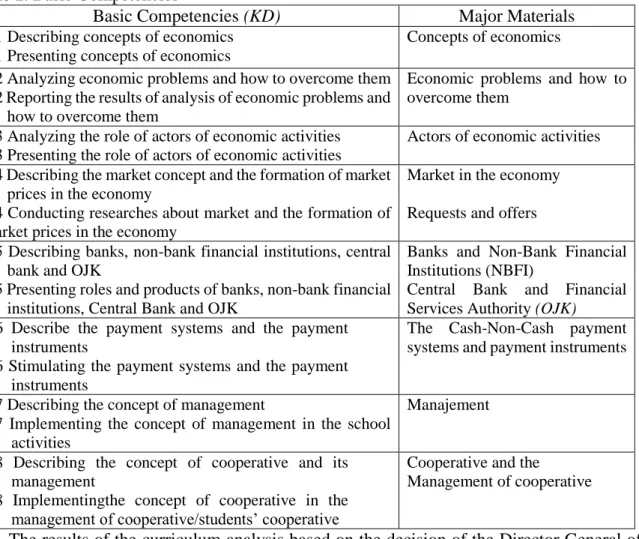
mastered by the students, as well as choosing the learning materials. The curriculum implemented at SMA Negeri 6 Pematangsiantar was the 2013 curriculum. Core Competencies, Basic Competencies, and major materials of the Economics for class X of SMA in the 2013 Curriculum were described below.
KI 1 Living and practicing the adhered teachings of the religion
KI 2 Living, practicing honesty, discipline, responsibility, caring (mutual assistance, cooperation, tolerance, peace), politeness, responsiveness and proactivity, and showing attitude as part of the solution to various problems in interacting effectively with the social and natural environment as well asplacing oneself as a reflection of the nation in the world association
KI 4 Processing, reasoning, and presenting in the concrete and abstract realm related to the development of what has learned at school independently, as well as being able to use methods in accordance with scientific rules.
Table 1. Basic Competencies
Basic Competencies (KD) Major Materials
3.1 Describing concepts of economics 4.1 Presenting concepts of economics
Concepts of economics
3.2 Analyzing economic problems and how to overcome them 4.2 Reporting the results of analysis of economic problems and how to overcome them
Economic problems and how to overcome them
3.3 Analyzing the role of actors of economic activities 4.3 Presenting the role of actors of economic activities
Actors of economic activities
3.4 Describing the market concept and the formation of market prices in the economy
4.4 Conducting researches about market and the formation of market prices in the economy
Market in the economy
Requests and offers
3.5 Describing banks, non-bank financial institutions, central bank and OJK
4.5 Presenting roles and products of banks, non-bank financial institutions, Central Bank and OJK
Banks and Non-Bank Financial Institutions (NBFI)
Central Bank and Financial Services Authority (OJK)
3.6 Describe the payment systems and the payment instruments
4.6 Stimulating the payment systems and the payment instruments
The Cash-Non-Cash payment systems and payment instruments
3.7 Describing the concept of management
4.7 Implementing the concept of management in the school activities
Manajement
3.8 Describing the concept of cooperative and its management
4.8 Implementingthe concept of cooperative in the management of cooperative/students’ cooperative
Cooperative and the
Management of cooperative
The results of the curriculum analysis based on the decision of the Director General of Primary and Secondary Education Number 330/D.D5/KEP/KR/2017 indicate that there are
four Core Competencies (KI) and sixteen Basic Competencies (KD) in economics for class X
of SMA. In general, KD in economics is categorized into four directions, namely spirituality,
attitude, knowledge, and skills.
The theme of the 2013 curriculum is to produce the productive, creative, innovative, affective Indonesian people; through strengthening the integrated attitudes, skills, and knowledge (Mulyasa, 2014). To make this happen, in implementing the curriculum, teachers are required to professionally design the effective and meaningful learning (fun), organize the learning, choose the right learning approach, determine the procedures for learning and the formation of competencies effectively, and set criteria for success.
_______________________________________________________
The Regulation of the Minister of Education and Culture of the Republic of IndonesiaNumber 81A of 2013 regarding the curriculum implementation stated that the learning must be related to the opportunities given to the students to construct knowledge in their cognitive process. The learning strategy that can fulfill those requirements is Contextual Teaching and Learning. Johnson (2014) formulated eight components of CTL, namely (1) building relevancy to find meanings, (2) conducting the independent learning, (3) doing meaningful works, (4) working together, (5) thinking critically and creatively, (6) helping the individual’s growth and development, (7) achieving high standards, and (8) using authentic assessment. A classroom is said to use the CTL approach if applying those eight components in the learning. In addition, CTL is in accordance with the 2013 curriculum because there are the learning strategies that facilitate the students to be more actively involved in the learning.
3.2 Analysis of Students’ Characteristics
The students of class X of SMA are in the age of 16 years included in the adolescent phase, in which the process of the brain growth reaches the perfection functionally and cognitively. Adolescence is a phase of life in which the capacity to acquire and use knowledge efficiently reaches its peak. According to Piaget, in terms of the cognitive development, teenagers enter the formal operational stage that already have the ability to think abstractly, reason logically, and draw conclusions from the available information (Jahja, 2011). However, Piaget’s theory of the cognitive development also received criticism that the cognitive abilities could emerge more slowly than Piaget’s estimates. Sometimes teenagers still think concretely operationally or just master the formal operations (Santrock, 2009). Thus, at this stage, the students of class X of SMA still think based on the concrete things in the daily life. Therefore, the appropriate learning to make the students connect the learning materials with the daily life is Contextual Teaching and Learning (CTL). On the other side, the economics is also closely related to the daily life so that the CTL approach is considered appropriate to be used in the learning process.
Based on those analysis, the use of the CTL approach in the learning media is expected to attract the students’ interest to observe the pictures in order to concretize the abstract things, build the students’ understanding (constructivist) in accordance with the objectives that will be achieved, analyze the presented important information and conclude the information, stimulate the students’ courage to tell their experiences related to the learning materials as well as to write the little important information based on the stories or the dialogues they have read, and support the students’ ability to formulate and ask questions related to the materials.
One of the alternatives in smoothening the economics teaching process is by using information and communication technology as the learning media. Scott (2011) offered the economics learning using the tablet computer that was able to improve the students’ involvement and make the learning more dynamic. The learning using information and communication technology can assist the teachers in delivering the teaching materials and help the students to understand the learning materials (Munir, 2013).
3.3 Material Analysis
At this stage, the analysis is conducted by doing observation to obtain the major materials that need to be taught, collect and choose the relevant materials (Mulyatiningsih, 2011). Based on the observation conducted at SMA Negeri 6 Pematangsiantar, the teaching materials in the form of the print media like the Economics textbooks that were used were still not understood well by the students because the language style was too complex and tended to only be a collection of knowledge descriptions. Even if there were several problems wrote in the book, they have never been experienced or known by the students so that they tended to be strange to be understoodby the students at SMA Negeri 6 Pematangsiantar.
The interrelation of the teaching materials used with the real conditions madethe students still unable to understand the material of the Basic Concepts of Economics. This kind of teaching resulted in a lack of the development of the abilities and potential of the students because theories were not enough to understand the material of Economics. This is clearly not in line with one of the objectives of the Economics required in the Regulation of the Minister of National Education Number 23 of 2006, which is to understand a number of concepts to connectincidents and problems that occur in the environment of individuals, households, societies and countries. The impact of the discrepancy is that the students feel difficult to understand the concepts of Economics so that they must memorize what are in the textbook.
The economics is a learning that studies all aspects of economy, human’s behaviors, and economic incidents or phenomena (including problems) occurred in the society. The economic concepts are the things that are often encountered in the economic activities and taught in the Economics at the level of the formal education. The basic knowledge of economics can be understood easily if the basic concepts have been understood. Therefore, the understanding of the concepts is the major foundation so that the learning can proceed at the higher level.
3.4 Specifying Instructional Objectives
The last step at the define stage is to specific the instructional objectives and the competencies that want to be achieved. This is useful to limit the researcher so as not to deviate from the initial objective when developing the product (Mulyatiningsih, 2011). This stage is conducted by specifying the results of the material analysis becoming the indicators of the learning achievement and then becoming the instructional objectives. The objective that wanted to be achieved in this development research was to improve the students’ economics learning outcomes at SMA Negeri 6 Pematangsiantar.
_______________________________________________________
IV. Conclusion
The implementation of the 2013 curriculum at SMA Negeri 6 Pematangsiantar emphasized on the innovation of the use of various learning media like the interactive module that supported the learning process, then packed with Contextual Teaching and Learning to perfect the development of the learning media in the form of e-module.
The students’ characteristics were viewed from the cognitive development. The students of class X of SMA were at the adolescent phase and enabled to learn using Contextual Teaching and Learning. In addition, the students and teachers were enthusiastic in developing more interactive and innovative learning media in accordance with the current development.
The economics material that needed to be taught was the Basic Concepts of Economics, by referring to the syllabus used at school. The major material of the basic concepts of economics
was taught at the first semester of class X of SMA which was KD of 3.1 and 4.1. The objective
that wanted to be achieved was to improve the economics learning outcomes of the students of class X at SMA Negeri 6 Pematangsiantar.
References
Adu, E. O., Galloway, G., & Olaoye, O. (2014). Teachers’ characteristics and students’ attitude
towards economics in secondary schools: Students’ perspectives. Mediterranean Journal
of Social Sciences, 5(2), 455-462.
Alwasilah, C. (2014). CTL (Contextual Teaching and Learning) Menjadikan Kegiatan
Belajar-Mengajar Mengasyikkan dan Bermakna. Kaifa Learning: Bandung.
Anafidah, A., Sarwanto, &Masykuri, M. (2017). Pengembangan modul fisika berbasis CTL pada materi dinamika partikel untuk meningkatkan keterampilan berpikir kritis siswa
kelas X SMAN 1 Ngawi. Jurnal Inkuiri, 6(2), 29-40.
Daryanto. (2010). Media Pembelajaran. Bandung: Satu Nusa.
Departemen Pendidikan Nasional. (2003). Pendekatan Kontekstual (Contextual Teaching and
Learning). Depdiknas: Jakarta.
Dewi, M. R., Rachmadiarti, F., &Wisanti. (2012). The development of teaching and learning (CTL)-based ecosystem module for learning biology in X-class of senior high school.
Biology Education, 1(1), 11-14.
DeWitt, D., Siraj, S., & Alias, N. (2014). Collaborative mLearning: A module for learning
secondary school science. Educational Technology & Society, 17(1), 89–101.
Fonda, A. & Sumargiyani. (2018). The developing math electronic module with scientific approach using kvisoft flipbook maker pro for xi grade of senior high school
students.Infinity Journal of Mathematics Education, 7(2), 109-122.
Hutahaean, L. A. (2018). Contextual Teaching and Learning (CTL) dalam Pembelajaran
Ekonomi. Prosiding Seminar Nasional Pendidikan Ekonomi, Surakarta: UNS. ISBN
978-602-60061-2-7.
Imansari, N. & Sunaryantiningsih, I. (2017). Pengaruh penggunaan e-modul interaktif terhadap hasil belajar mahasiswa pada materi kesehatan dan keselamatan kerja. Jurnal Ilmiah Pendidikan Teknik Elektro, 2(1), 11-16.
Jahja, Y. (2011). Psikologi Perkembangan. Jakarta: Kencana.
Johnson, E. B. (2014). Contextual Teaching and Learning: Menjadikan Kegiatan
and why it’s here to stay). Penerjemah Ibnu Setiawan, Penyunting Ida Sitompul. Bandung: Kaifa.
Mulyasa, E. (2014). Pengembangan dan Implementasi Kurikulum 2013. Bandung: Remaja
Rosdakarya.
Mulyatiningsih, E. (2011). Riset Terapan Bidang Pendidikan dan Teknik. Yogyakarta: UNY
Press.
Munir. (2013). Multimedia dan Konsep Aplikasi dalam Pendidikan. Bandung: Alfabeta.
Nurmayanti, F. (2015). Pengembangan Modul Elektronik Fisika dengan Strategi PDEODE
pada Pokok Bahasan Teori Kinetik Gas untuk Siswa Kelas XI SMA. Prosiding
Simposium Nasional Inovasi dan Pembelajaran Sains. Bandung: ITB.
Prastowo, A. (2015). Panduan Kreatif Membuat Bahan Ajar Inovatif. Jogjakarta: DIVA Press.
Rita, J. (2014). Pengembangan pembelajaran multimedia interaktif berbasis internet pelajaran
bahasa inggris. Jurnal Teknologi Informasi & Komunikasi dalam Pendidikan, 1(2),
2355-4983.
Santrock, J. W. (2009). Educational Psychology. 4thed. New York: The McGraw-Hill
Companies.
Scott, R. H. (2011). Tableau économique: Teaching economics with a tablet computer. The Journal of Economic Education, 42(2), 175–180.
Selvia, A. (2014). Pengembangan perangkat pembelajaran dengan pendekatan contextual
teaching and learning berbantuan modul interaktif. Chemistry in Education, 3(2),
140-146.
Siamy, L., Farida, &Stazali, M. (2018). Media belajar matematika berbasis multimedia
interaktif dengan pendekatan contextual teaching and learning. Desimal: Jurnal
Matematika, 1 (1), 113-117.
Susanto, A. (2014). Pengembangan Pembelajaran IPS di Sekolah Dasar. Jakarta:
Prenadamedia Group.
Trianto. (2009). Mendesain Model Pembelajaran Inovatif – Progresif. Jakarta: Kencana
Predana Media Group.
Uno, N. S., Wahjoedi, & Haryono, A. (2016). Penggunaan Media Pembelajaran Berbasis
Multimedia Interaktif dalam Pengajaran Ekonomi Berwawasan Indonesia. National
Conference on Economic Education, pp. 1022-1035, ISBN: 978-602-17225-5-8.
Woo, T. K. (2011). Developing quality learning materials for effective teaching and learning
in an ODL environment: Making the jump from print modules to online modules. Asian