Volume 1 Issue 7, November 2014
210
Data Redundancy and Compression Methods
for a Disk-Based Network Backup System
Mr.G.S.Karmukilan II Year M.E (CSE) Shree venkateshwara Hi-Tech
Engg college,gobi [email protected]
Dr.T.Senthil prakesh Professor & HOD Shree venkateshwara Hi-Tech
Engg college,gobi [email protected]
Mr.J.Senthil Assistant professor Shree venkateshwara Hi-Tech
Engg college,gobi [email protected]
ABSTRACT-Traditionally backup has been performed on tapes. With the price of disk becoming cheaper and CPUs becoming faster, the use of disk-based network backup system to replace or augment tape-based backup becomes realistic. More interestingly, random access nature of disks allows redundancy of data to be taken into consideration for more efficient network transmissions and data storage at the backup system. In this paper, we consider the type of redundancy that can be exploited and study different types of compression techniques suitable to achieve improved network efficiency and storage efficiency during the backup. One form of redundancy we exploit is the similarities between different versions. Such efficiencies are never before achievable using tape-based solutions. We also implemented a working disk-based network backup system called "A-Backup system", which applies the technologies discussed in the paper. Such a system is capable of achieving over l0x compression in both network utilization and data storage during backup.
Keywords: backup system, data storage, disk based network, transmissions
1 INTRODUCTION
Cloud computing has become a popular topic in the academe and industry, aiming to provide application software, data, and even hardware as a service hosted in data centers. The power of cloud computing has also been recognized to address the above challenges faced by the PC paradigm. While there are different types of usage, the models can be roughly classified into the following two categories.
The first category is to host the applications, such as Sales force, Google Docs, in data centers, and then deliver them to end users through the web browser or other special utilities. This new paradigm can sharply reduce the cost of software maintenance and management by centralizing all of them in the data centers. However, these application programs in cloud computing are specialized and dedicated, making it very difficult for traditional applications (e.g., MS Windows Media Player 10, and Quake to be hosted and delivered. In addition, this just solves the maintenance and management issues of specific applications, which are not concerned with traditional OSes, e.g., Windows.
The other category is a virtual machine (VM) based thin client approach emerging as virtual desktop solutions in data centers, such as Xen Desktop and VMware View,which create virtual PCs/desktops (i.e., instances of Windows) on the server or server blade with virtualization technology. Thus, the user has a complete virtual PC in the data center or cloud, but only consumes a fraction of the resources of the server. The virtual desktop can be accessed from any client devices, such as normal PCs, thin clients, and mobile devices, through a
remote display protocol, e.g., remote desktop protocol (RDP), independent computing architecture (ICA), and virtual network computing (VNC). Compared with traditional thin-client systems, a virtual PC/desktop can guarantee and isolate user performance and improve security. However, as a type of thin client, it is very hard to support graphics-intensive multimedia applications due to the huge network bandwidth needed to transfer video display data, even in an enterprise environment.
2 RELATED WORK
There has been extensive research on distributed and cloud computing platforms. Our work is mostly related to systems such as cloud computing systems, thin clients, network file systems, and VM-based systems.
Volume 1 Issue 7, November 2014
211 Sun Ray 1, VNC [10], and Mobiles. In the thin-client system paradigm, all computing tasks are performed at the central server, while a client works only as a user interface by performing display and keyboard/mouse input/output functions.. Recently developed VM-based thin-client approaches in cloud computing, such as Xen Desktop [6] and VMware View [7], also leverage the thin-client model to access the virtual PC or desktop hosted in data centers. This virtual PC or desktop is hosted by a VM created and run within a server. Although approach can guarantee and isolate user performance and achieve higher security with the help of VM technologies, it is still hard to support graphics-intensive applications due to the large network bandwidth needed to transfer video display data over the Internet. Without local hard disks, a diskless computer usually downloads an OS kernel image from the remote server. Hence, it cannot support OSes that do not have clear kernel images, such as Windows, and does not support booting from heterogeneous OSes. Furthermore, the Vdisks perceived by TransCom users can be flexibly mapped to the Vdisk image files on the server. Such flexibility allows TransCom to share OS and application software across clients to reduce the storage and management overhead while still isolating personal files for user privacy. The iSCSI protocol has been used to access disk blocks through network communication. In particular, the iBoot project at IBM has proposed a method that can remotely boot a commodity OS through iSCSI.For better performance, TransCom can potentially adopt iSCSI to replace the current VDAP, but may need to modify it in order to fit the small-size client BIOS memory.
The concept of resource virtualization has been introduced a long time ago, but has just been recently adopted to address security, flexibility, and user mobility. For example, commercial products such as VMware have extended the concept of VM to support multiple commodity platforms. The disks in these VMs are also virtualized, but they reside in the local host machine and are accessed through the file system of the host OS. In contrast, TransCom virtual disks are located in the remote server, with different types of Vdisks for sharing and isolating data among users. VM-based stateless thick-client approaches, such as internet suspend/resume (ISR), use virtual machine technology together with a network file system to support user mobility. Each ISR client runs OSes and applications on top of a pre-installed VMware on the host OS. The use of VM supports heterogeneous OSes, but it also introduces additional performance overhead due to the virtualization of all hardware resources, including the CPU and memory, whereas in TransCom, client OSes are running directly on top of the CPU, memory, and graphics resources. SoulPad is another project that uses VM concept for mobility, with a portable storage device for storing
the entire VM image. The collective project proposed a cache-based system management model based on VMs to reduce the management tasks of desktop computing. Similar to TransCom, it also uses different types of virtual disks, among which an immutable system disk is presented to protect it against outside threats. Compared with collective, TransCom uses a COW semantics file instead of COW disks. Moreover, TransCom adopts on-demand block-level disk access instead of using network file systems, such as NFS, to access and cache disk images
3 OS-INDEPENDENT REMOTE BOOT
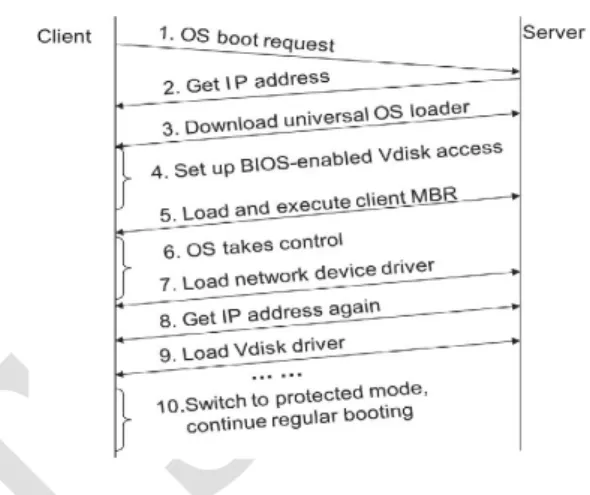
Fig. 3.1. The remote OS boot process of a TransCom client
Volume 1 Issue 7, November 2014
212 BIOS-enabled Vdisk access will no longer work due to its real-mode memory management. Most modern OSes access memory in protected mode. Once in control, the modern OS will bypass the BIOS real-mode disk access functions and replace them with its disk device drivers for improved performance. Hence, the booted OS will not be able to access those memory segments that store the BIOS functions in real mode, including the specialized Vdisk access instructions installed by the universal OS loader.Since the Vdisk driver relies on the network functions, we switch the device driver loading order so that the network devices are launched first for establishing connections to the server (steps 7 and 9). Another important detail is to enable the DHCP client before the Vdisk driver is activated. This is because the IP address obtained under real mode will no longer be accessible after the OS switches to the protected mode. Therefore, after loading network drivers, the TransCom client needs to contact the server again using DHCP to re-obtain its IP address (step 8). By the time that the real-mode access fails, all the required modules for accessing Vdisks, including the network interfaces and the Vdisk driver, will have been loaded into the memory. Once the OS switches to the protected mode, all disk access goes through the Vdisk driver as if there existed a physical local disk (step 10). The OS can resume the rest of the boot procedures until all the other required modules are up and running normally.
4 ACCESSING VDISKS
The core concept of TransCom is the notion of Vdisks. From a user or application’s perspective, there is no difference between accessing data from a Vdisk and from a local hard disk. The actual contents in Vdisks reside at the remote server, and will be fetched to the client on demand. In this section, we describe the detailed process of accessing data from Vdisks as well as how data are organized and shared across different clients.
4.1.VDISK AND VDISK ACCESS PROTOCOL Vdisks are flat addressable block-based virtual storage devices located beneath the file systems. Each block has 512 bytes. A TransCom client can be configured to access data from one or more Vdisks, with each corresponding to a Vdisk image located on the server. A Vdisk image consists of one or more files, depending on the required disk size. To manage the Vdisks of different clients, the TransCom server sets up a Vdisk management database to maintain the mappings between a client’s IP address and the corresponding Vdisk images. Administrators can configure the quotas of client Vdisks using a TransCom application tool that updates the server’s Vdisk management database. Vdisk images are regular flat files located
Volume 1 Issue 7, November 2014
213 acknowledging the completion of the process. If the client request is a read request, the server will also attach the requested disk data in the reply.
4.2 DISK ORGANIZATION AND DATA SHARING
The disk-level remote data access provides a wide spectrum of design space to share data across different clients at the server. At one extreme end, we can perform coarse-grained sharing based on an entire disk. This solution is simple but not efficient in disk utilization. At the other extreme end, we can perform fine-grained sharing based on each disk block, which could be efficient in disk utilization, but may result in high management overhead due to information booking and access control. TransCom shares data at the granularity of files since they are the most natural units for sharing and access control in convention. To maximize disk utilization, we would like TransCom to support the sharing of system files, including OS and application software, which would be used by multiple clients, while isolating user files that involve private user data.
4.3 THIN-CLIENT PEFORMANCE
How well do thin clients perform under different network conditions, and for what kinds of applications are they best suited? To answer these questions, we apply HCI guidelines to a set of three application traces under a variety of network conditions to determine how often each application’s response time is crisp, annoying, or unacceptable.
4.4 SHARING SYSTEM FILES
It would be difficult to use the existing remote file system solutions to share the above defined system files, mostly because certain system files are also user-specific, containing customizable configuration
Fig. 4.4.1 Vdisk mappings
Fig. 4.4.1 Vdisk mappings C and D are user-perceived Vdisks for storing system files and user files, respectively. Cr, C’r ,and Dr are server perceived Vdisks for storing shared system files, customized system files, and user files, respectively. The file redirector is a file system agent for redirecting user perceived Vdisk requests to server-perceived Vdisk requests. Entries, yet having fixed path names for OSes or applications to work correctly. However, client users need to write or modify these system files, resulting in conflicts. For example, the World Soccer Winning 11 game must save the user-specific game progress information in a subdirectory. In order to share such software with NFS-like solutions, users will need to change the directory locations. This potentially requires OS or application software modification and is often impossible in practice. TransCom uses a file system level agent called file redirector to map user-perceived Vdisks into server-perceived Vdisks for sharing system files. The set of system files is specified by the system administrator, with prior knowledge of potential TransCom usage scenarios. From a user’s perspective, each client is configured with two types of Vdisks, one for storing shared system files and another for user files. From the server’s perspective, each client has three types of Vdisks. The existence of these three types of Vdisks is transparent to the users.
4.5 MONO DISK
It is used to store OS and application files that are shared across all clients in a TransCom system. The mono disks of different clients are mapped to a single Vdisk image at the server. Thus, mono disk is for read-only files.
4.6 SHADOW DISK
Each client has a shadow disk that is used to store the customized or written system files. The shadow disk maps to a client or user-specific Vdisk image at the server. The corresponding data are private and will not be shared by other client machines. Therefore, the shadow disk is, in essence, a copy-on-write (COW) disk for isolating written user-specific configuration files and system files.
4.7 PRIVATE DISK
Volume 1 Issue 7, November 2014
214 accessed is on the system disk, the file redirector will redirect the request to the shadow disk in the following two cases: (1) a read request to a system file that already has a customized copy on the shadow disk, and (2) a write request to a system file (in this case, a copy of the file will be created first on the shadow disk before being written). Otherwise, the file redirector will redirect the request to the mono disk. The file redirector therefore supports the dynamic redirection of system files for enabling file system level COW semantics. This software agent will be loaded from the mono Vdisk as part of the underlying file system.
5 PROBLEM STATEMENT
The first category is to host the applications, such as Sales force, Google Docs, in data centers, and then deliver them to end users through the web browser or other special utilities. However, these application programs in cloud computing are specialized and dedicated, making it very difficult for traditional applications to be hosted and delivered. In addition, this just solves the maintenance and Management issues of specific applications, which are not concerned with traditional OSes, The other category is a virtual machine (VM) based thin client approach emerging as virtual desktop solutions in data centers, such as Xen Desktop and VMware View, Which create virtual PCs/desktops (i.e., instances of Windows) on the server or server blade with virtualization technology. The virtual desktop can be accessed from any client devices, such as normal PCs, thin clients, and mobile devices, through a remote display protocol, e.g., remote desktop Protocol (RDP), independent computing architecture (ICA), virtual network computing (VNC). However, as a type of thin client, it is very hard to support graphics-intensive multimedia applications due to the huge network bandwidth needed to transfer video display data, even in an enterprise environment. It is shown that the annual cost of managing a PC can be up to five times the cost of deploying it. All files and data are stored on the local disks of individual machines, they may be lost once the corresponding device is damaged or compromised, and requiring distributed data backup and restoration services. If sensitive server data are fetched and cached at local disks, they will be potentially available to the public or to attackers who have access to the machine. It is very hard to support graphics-intensive multimedia applications due to the huge network
6 CLIENT IMPLEMENTATION
We choose Windows XP as the Windows client OS to show back compatibility on low-end hardware. For Linux client OS, we adopt RedFlag Desktop There are three major implementation modules for supporting TransCom clients under different OSes:
(1) universal OS loader, (2) Vdisk driver, and (3) file redirector.
Fig no: 6.1 Trans com server architecture
6.2 TRANSIENT THIN-CLIENT MODE The time to transfer a suspended VM’s memory image is a lower bound on resume. Even with a pure demand–fetch policy for the disk image, the state corresponding to a VM’s entire physical memory must be available at the resume site before execution begins. To overcome this limitation, we’re building on techniques that we’ve developed to transparently morph between thin- and thick-client execution modes. Our work to date has confirmed the feasibility of using VMs as the basis of morphing between thin-client execution during the resource-intensive computational phases of an application and thick client execution during its interaction-intensive phases. We plan to exploit this capability to achieve the lowest possible resume latency. Upon resume, execution begins in thin-client mode. During an initial brief period of user interaction, sufficient VM state is transferred in the background to switch to thick-client mode with a demand– fetch policy. For some extremely brief sessions, the user might suspend before execution switches to thick-client mode.
6.3 VDISK DRIVER
Volume 1 Issue 7, November 2014
215 service for reobtaining the client IP address before loading the Vdisk driver. While the Linux kernel already provides DHCP facility, the DHCP client provided by Windows XP operates in user mode, and will not be launched until the kernel boots successfully. Therefore, for Windows, we also implement a DHCP client driver in the kernel mode to enable IP configuration before the kernel initializes TCP/IP. The currently implemented Vdisk driver uses a time-out value of 100 ms for sending remote disk requests to the server. It does not support device driver level cache or read ahead functions. Such optimization can potentially increase performance, and is a topic of our ongoing work.
6.4 FILE REDIRECTOR
The file redirector is a file system agent that intercepts all file system calls. For Windows XP, it is implemented as a file system driver sitting on top of the device driver chain for handling file system operations. It intercepts the I/O request packet (IRP) from the built-in Windows I/O manager to perform the redirection, as described in Section IV-B. For Linux, we modify the open() file system call provided by the virtual file system of the Linux kernel, by maintaining a dirty table that records the mappings between the modified system files and their corresponding shadow disk versions.
7 SERVER IMPLEMENTATION
The TransCom server is implemented as a multi-process program, with each multi-process listening on a dedicated port, handling different types of client requests (Fig no: 6.1). Specifically, there are three disk request handler processes handling the requests for three different types of disks. Each process maintains a request queue per TransCom client, and serves queues in a round-robin fashion. Conceptually, there is only one Vdisk management database at the TransCom server. However, in the implementation, each disk request handler deals with a dedicated Vdisk management database implemented as a file. For shadow disks and private disks, the TransCom server maintains one Vdisk image per client disk. The default mono disk size is 8 GB, and the default shadow disk and private disk sizes are set to 1 GB per disk The boot manager handles boot requests with a DHCP service and a TFTP service for clients to obtain IP addresses and to download the universal OS loader, respectively. System administrators can log in from a preconfigured special client to submit disk quota requests to the server and change the number of user disks. After that, a client must then reboot to reflect the changes. The server is implemented in C++ for both Windows and Linux. The Windows server OS is Windows 2003 Server (SP1) edition, and the Linux server OS is Red Flag DC Server 5.0
8 CONCLUSION
We performed both test-bed experiments and real-usage experiments to evaluate TransCom. The results demonstrate that by using a powerful server, TransCom clients can achieve comparable or even better disk and application performance than regular PCs with local hard disks. It is more scalable than traditional thin-client systems and other recently developed VM-based cloud computing systems. Future work includes further optimizing TransCom performance, supporting multiple servers, increasing the system robustness, enhancing the system security, and supporting more types of devices and networks.
REFERENCES
[1]“Understanding Full Virtualization, Para virtualization, and Hardware Assist,” White Paper, VMware Inc., Sept. 2007.
[2] B. Hayes, “Cloud computing,” Commun. ACM, vol. 51, pp. 9–11, July 2008. Available: http://doi.acm.org/10.1145/1364782.1364786 [3] I. Foster, Y. Zhao, I. Raicu, and S. Lu, “Cloud computing and grid computing 360-degree compared,” in Proc. 2008 Grid Computing Environments Workshop, pp. 1–10.
[4] “Sales force platform,”
http://www.salesforce.com, 2012.
[5] “Google Docs,” https://docs.google.com/, 2012. [6]“CitrixXenDesktop,”http://www.citrix.com/virtu alization/desktop/ xendesktop.html, 2012.
[7] I. VMware, “VMware View 4.5, Modernize Desktop and Application Management, V.2.0, Brochure,” http://www.vmware.com/files/pdf/ VMware-View-45-DS-EN.pdf, 2012.
[8] B. Cumberland, G. Carius, and A. Muir, “Microsoft Windows NT Server 4.0, Terminal Server Edition: Technical Reference,” Microsoft Press, 1999.
[9] I. Boca Research, “Citrix ICA Technology Brief, Technical White Paper,” Boca Raton, 1999. [10] T. Richardson, Q. Stafford-Fraser, K. R. Wood, and A. Hopper, “Virtual Network Computing,” IEEE Internet Computing, vol. 2, no. 1, pp. 33– 38, 1998.
[11] P. M. Chen, E. K. Lee, G. A. Gibson, R. H. Katz, and D. A. Patterson, “RAID: high-performance,
reliable secondary storage,” ACM Computing Surveys, vol. 26, no. 2, pp. 145–185, 1994.
12] R. J. T. Morris and B. J. Truskowski, “The evolution of storage systems,” IBM Systems J., vol. 42, no. 2, pp. 205–217, 2003.
Mr.G.S.Karmukilan received the B.E (CSE) degree from the
VELALAR COLLEGEOF
ENGINEERING AND
Volume 1 Issue 7, November 2014
216 Erode, India in 2013-2015, His research interests include, Data Mining, and Networks.
Dr.T.Senthil Prakash received the Ph.D. degree from the PRIST University, Thanjavur, India in 2013 and M.E(CSE) degree from Vinayaka Mission’s University, Salem , India in 2007 and M.Phil.,MCA.,B.Sc(CS) degrees from Bharathiyar University, Coimbatore India, in 2000,2003 and 2006 respectively, all in Computer Science and Engineering. He is a Member in ISTE New Delhi, India, IAENG, Hong Kong...IACSIT, Singapore SDIWC, USA. He has the experience in Teaching of 10+Years and in Industry 2 Years. Now He is currently working as a Professor and Head of the Department of Computer Science and Engineering in Shree Venkateshwara
Hi-Tech Engineering College, Gobi, Tamil Nadu, and India. His research interests include Data Mining, Data Bases, Artificial Intelligence, Software Engineering etc.,He has published several papers in 17 International Journals, 43 International and National Conferences