156
SOME PROPERTIES OF FERMENTED MILK PRODUCT WHICH WAS
PRODUCED FROM DIFFERENT MILK TYPES BY USING CHICKPEA
NURAY GÜZELER*, ELIF ARI, ÇAĞLA ÖZBEK
Cukurova University Food Engineering Department Adana Turkey, [email protected]
key Words: Cow milk, goat milk, sheep milk, chickpea, fermented milk
ABSTRACT
In this research, fermented milk products which were similar with yogurt and produced by clotting of cow, goat and sheep milks with chickpea were stored at 4±1ºC. The effects of using different milk types on pH, titration acidity, dry matter content, fat content, protein content, ash content, acetaldehyde content, tyrosine content, total volatile fatty acids, water holding capacity, serum separation, viscosity, curd firmness, L, a, b values and sensory properties were investigated.
According to obtained results; the effects of using different milk types were found significant (p<0.05) on pH, titration acidity, dry matter content, fat content, protein content, ash content, acetaldehyde content, tyrosine content, total volatile fatty acids, water holding capacity, serum separation, viscosity, curd firmness, L, a, b values, appearance, consistency properties, odor and taste properties.
As a result of sensory analysis; when appearance, consistency (by spoon), consistency (in mouth), odor and taste properties were considered, fermented milk product which was produced by goat milk was the most desired product.
INTRODUCTION
Although the most known milk type is cow milk in Turkey, mainly four types of milks are consumed and these are cow, ewe, goat and water buffalo milks (FAO, 2003; Besler and Unal, 2006). However, the greatest part of milk production and consumption belongs to cow milk in both our country and the world (Terin, 2014). For this reason, cow milk has a great importance for dairy technology. The composition of cow milk changes mainly with race and many other factors. The average composition of cow milk may be expressed as 4% fat, 8.9% non-fat dry matter, 4.6% lactose, 3.3% protein, 2.6% casein, 0.70% mineral components, 87.10% moisture, 31% fat in dry matter, 0.17% organic acids and 0.15% other components (Gursoy, 2017).
Goat milk has high quality protein, essential fatty acids, fat, carbohydrate (lactose), various vitamins and minerals. Beside of these components, goat milk contains many bioactive components such as nucleotides, free amino acids and polyamines further than cow milk (Brandao et al., 2017). According to researches which are about goat milk, it is very precious in terms of its composition, nutritional value and some other properties (Lacin, 2005). It was specified that goat milk had 3.8% fat, 8.9% non-fat dry matter, 4.1% lactose, 3.4% protein, 2.4% casein and 0.8% ash content (Onur, 2015).
Ewe milk is an important income source especially in many Asian and European countries. Because of its high fat and protein contents, production of some ewe cheeses that are worldwide famous was performed in Israel, Italy and France. The ewe milk has high prices in our country (Sahin and Akmaz, 2004). It is widely used in making of yogurt and cheese because of its high dry matter, fat and protein contents (Metin, 2001; Posecion et al., 2005; Ozer, 2006; Ocak et al., 2009). It was stated that ewe milk had 7.9% fat, 12% non-fat dry matter, 4.9% lactose, 6.2% protein, 4.2% casein and 0.9% ash contents (Onur, 2015).
157
increase researches about functional products in dairy industry. However further researches about this subject is required. There are three different approaches for functional dairy product production:
• Prebiotic, probiotic and symbiotic dairy product,
• Enriched dairy product,
• Energy-reduced dairy product (Sezen and Koçak, 2006).
At this research which is within enriched milk product, chickpea was used as
enrichment agent. Chickpea (Cicer arietinum) is a leguminous species of Cicer belonging to
the Faboideae subfamily of the leguminous (Fabaceae) family (Singh, 1997). Beside of its
rich protein, mineral and vitamin content, its dietary fiber content is also very important (Peksen and Artik, 2005). It is known that chickpea protein isolates are used for enrichment of the products such as cheese, bread and meat products (Sanchez-Vioque et al., 1999).
Although chickpea is generally used as yeast in dough production, information about yogurt (fermented milk) production by using chickpea present at the media lastly and it becomes more common. Yogurt production which is performed by clotting of milk by chickpea may be applied domestically at homes. At this research, yogurt-like fermented milk product which was produced by clotting of cow, goat and ewe milks by using chickpea was stored at 4±1ºC. The effects of using different milk types on some physical, chemical and sensory properties of fermented milk product were examined.
MATERIAL AND METHOD MATERIAL
In the production of fermented milk product which was obtained by using chickpea, raw cow, goat and ewe milks that were supplied from Cukurova University Faculty of Agriculture, Research and Application Farm Animal Husbandry Branch were used. Chickpea (Kocbasi) was supplied from the local markets. Milk powder which was used for enhancing dry matter amount was supplied from Pınar A.Ş. Polypropylene boxes of 200 grams were used as packaging materials.
METHOD
This research was performed at Cukurova University Agricultural Faculty Food Engineering Department Dairy Technology Laboratory. Some preliminary experiments were applied for determining the amount of chickpea which would be used in the production of the fermented milk product. For this purpose, 5, 10 and 15 grams of chickpeas were tried for 200 ml of milk and using of 10 grams of chickpea was found proper in terms of curd firmness (penetrometer values), serum separation and appearances of the samples. In another preliminary experiment, chickpeas were added to milk with three different ways; as directly, boiled and ground. The fermented milk product samples which were obtained by boiled and ground chickpeas had dark yellow color and had further serum separation. Therefore using chickpeas directly was found more appropriate.
While fermented milk product production, 3% of milk powder was added to milk and
it was heated to 90℃ for 5 minutes. At the first step, 10 gram of chickpea was used for 200
ml of milk and chickpea yeast was obtained. Then the same process was performed four times by using this chickpea yeast and fermented milk product was obtained at totally five
steps. In the main production, the product which was obtained at the last (5th) step was used
158
was performed in three replications and some physical, chemical and sensory properties of the samples were examined.
Dry matter amounts were determined by gravimetric method (IDF, 1982). Fat contents of ice cream samples were determined by Gerber method (TSE, 2006). Protein contents of samples were determined by Micro Kjeldahl method (IDF, 1993). Ash content
was found by burning of the samples at 550℃ and calculating percentage of remaining ash
(Kurt et al., 2007). Acidity analyses were performed according to alkali titration method and the results were expressed as lactic acid % (TSE, 2006). pH values were determined by using Testo 230 pH meter (Cemeroglu, 1992). For determining serum separation (%) values, 25 gram of the sample at 4±1ºC was filtered by coarse filter paper for 120 minutes, weighed the filtrate and results multiplied with 4 (Konar, 1980; Tamime et al., 1996). For determining
the viscosities of the samples, 15th and 30th seconds viscosity values were measured at
+4°C at 100 rpm (Gassem et al., 1991). Penetrometer values were determined by using Sur Berlin Pnr p penetrometer (Alagoz, 1992). Acetaldehyde contents of samples were determined by iodometric method according to Less and Jago (1969). Tyrosine contents were determined by spectrophotometric method according to Hull (1947). Total volatile fatty acid contents were determined according to Kosikowski (1978). Water holding capacities were calculated by centrifuging 5 gram of sample at 4500 rpm at 10°C for 30 minutes, removing supernatant and weighing pellet (Wu et al., 2001). In the color analysis, Hunter Lab Color Flex color meter was used (Kahyaoglu et al., 2005). Sensory analyses of the samples were performed by panelist group that had 7 members. They were performed according to TS 1330 yogurt notification (TSE, 2006). Statistical analyses were performed by using SPSS 21.0 version in terms of Duncan multiple comparison tests (Duzgunes et al., 1987).
RESULTS AND DISCUSSION
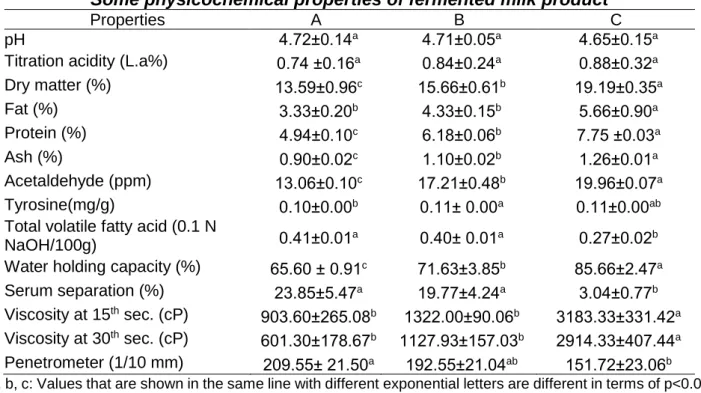
Some physicochemical properties of fermented milk product which was produced by using chickpea were given at Table 1.
Table 1 Some physicochemical properties of fermented milk product
Properties A B C
pH 4.72±0.14a 4.71±0.05a 4.65±0.15a
Titration acidity (L.a%) 0.74 ±0.16a 0.84±0.24a 0.88±0.32a Dry matter (%) 13.59±0.96c 15.66±0.61b 19.19±0.35a Fat (%) 3.33±0.20b 4.33±0.15b 5.66±0.90a Protein (%) 4.94±0.10c 6.18±0.06b 7.75 ±0.03a
Ash (%) 0.90±0.02c 1.10±0.02b 1.26±0.01a Acetaldehyde (ppm) 13.06±0.10c 17.21±0.48b 19.96±0.07a Tyrosine(mg/g) 0.10±0.00b 0.11± 0.00a 0.11±0.00ab Total volatile fatty acid (0.1 N
NaOH/100g) 0.41±0.01a 0.40± 0.01a 0.27±0.02b Water holding capacity (%) 65.60 ± 0.91c 71.63±3.85b 85.66±2.47a Serum separation (%) 23.85±5.47a 19.77±4.24a 3.04±0.77b Viscosity at 15th sec. (cP) 903.60±265.08b 1322.00±90.06b 3183.33±331.42a Viscosity at 30th sec. (cP) 601.30±178.67b 1127.93±157.03b 2914.33±407.44a Penetrometer (1/10 mm) 209.55± 21.50a 192.55±21.04ab 151.72±23.06b a, b, c: Values that are shown in the same line with different exponential letters are different in terms of p<0.05 level of significance.
159
Using of different milk types in the production of fermented milk product had statistically significant effects on dry matter, fat, protein, ash, acetaldehyde, tyrosine, total
volatile fatty acid contents, water holding capacity, serum separation, viscosities at 15th and
30th seconds and penetrometer values (p<0.05). However, there was no significant effect
on pH and titration acidity values of fermented milk product samples (p>0.05). When pH values of the samples were evaluated, the highest value was determined in A sample and B and C samples followed it respectively. As expected, conversely pH values, the highest titration acidity value was determined in C sample and B and A samples followed it respectively. The highest dry matter amount was seen in the sample that was obtained by ewe milk and the samples obtained by goat and cow milks followed it. The dry matter amounts of the samples were proportional with the dry matter amounts of milks that were used as raw materials in the production. Similarly, fat, protein and ash contents of samples were proportional with the milks and the highest values were recorded in C, B and A samples respectively. The amount of acetaldehyde is about flavor properties of yogurts. According to the obtained results, C sample has the highest amount of characteristic flavor and B and A samples followed it respectively. It is known that tyrosine amount is used for determining the total amino acid content which is released by proteolysis. According to the obtained results, C and B samples had the similar tyrosine content, but A sample had lower values. When the total volatile fatty acid contents of the samples were evaluated, the highest values were recorded in A, B and C samples respectively. The highest water holding capacity was seen in the sample obtained by ewe milk and the samples obtained by goat and cow milks followed it respectively. Serum separation amounts were found inversely proportional with water holding capacities of the samples as expected and the least amount of serum separation was seen in C sample. In parallel with these results, the sample obtained by ewe milk had the highest consistency and viscosity values and the samples obtained by goat and cow milks followed it respectively. According to the penetrometer analysis, the hardest sample was found as C sample. The color properties of fermented milk products were shown at Table 2.
Table 2 Color properties of fermented milk product
Properties A B C
L 92.78±0.50b 94.05±0.58a 93.50±0.37ab
a -4.10±0.34a -4.40±0.41a -5.78±0.29b
b 10.57±1.04b 10.81±0.61b 17.50±1.54a
a, b: Values that are shown in the same line with different exponential letters are different in terms of p<0.05 level of significance.
When the color properties of fermented milk products were evaluated, it was determined that using different milk types had statistically significant effects on these properties (p<0.05). The highest L value, brightness, was seen at the sample which was obtained by goat milk and samples which were obtained by ewe and cow milks followed it respectively. Low a value is expressed as high amount of green color in the sample. In this situation, the lowest a value was determined in the sample which was obtained by ewe milk and the samples which were obtained by goat and cow milks followed it respectively. High b value is expressed as high amount of yellow color in the sample. The highest b value was determined in the sample which was obtained by ewe milk and the lowest value was recorded in the sample which was obtained by cow milk.
160
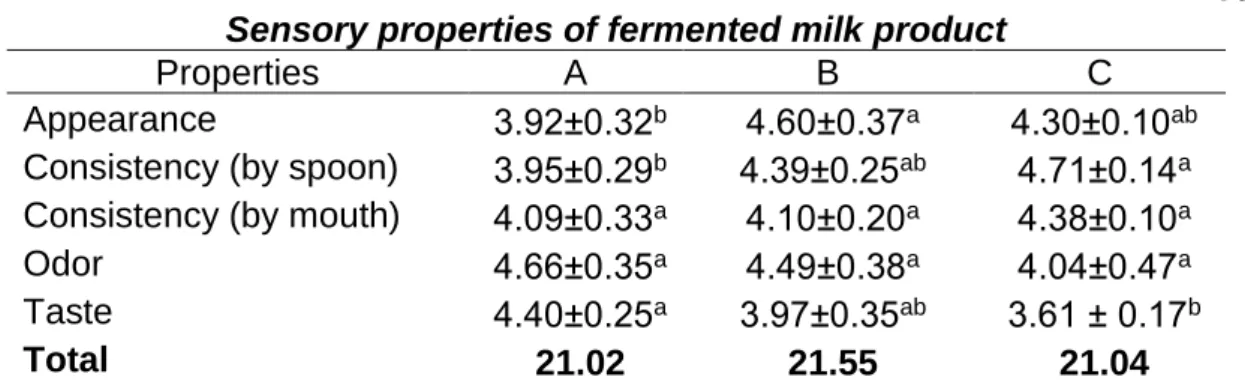
consistency by mouth (5 points), odor (5 points) and taste (5 points) properties were scored by the panelists.
Table 3 Sensory properties of fermented milk product
Properties A B C
Appearance 3.92±0.32b 4.60±0.37a 4.30±0.10ab
Consistency (by spoon) 3.95±0.29b 4.39±0.25ab 4.71±0.14a
Consistency (by mouth) 4.09±0.33a 4.10±0.20a 4.38±0.10a
Odor 4.66±0.35a 4.49±0.38a 4.04±0.47a
Taste 4.40±0.25a 3.97±0.35ab 3.61 ± 0.17b
Total 21.02 21.55 21.04
a, b: Values that are shown in the same line with different exponential letters are different in terms of p<0.05 level of significance.
When the sensory properties of fermented milk product were evaluated, the effects of using different milk types on appearance, consistency (by spoon) and taste properties were found significant (p<0.05). However, it had no significant effect on consistency (by mouth) and odor properties. The most liked fermented milk product in terms of appearance was chosen as the sample obtained by goat milk and the sample obtained by cow milk had the lowest points. The highest points in terms of consistency properties belonged to the sample obtained by ewe milk and the sample obtained by cow milk had the lowest points again. It is determined that the most liked fermented milk product in terms of odor and taste properties was the sample obtained by cow milk and the least liked sample was obtained by ewe milk. When they were generally evaluated, the most desired sample was obtained by goat milk and the samples obtained by ewe and cow milks followed it respectively.
CONCLUSION
When the general properties of fermented milk product were evaluated, the highest nutritional value was determined in the sample which was obtained by ewe milk and fermented milk products obtained by goat and cow milks followed it respectively. When the physical properties of the samples were compared, it was determined that the sample obtained by ewe milk has the highest viscosity and the samples obtained by goat and cow milks followed it respectively. In terms of color and appearance, when L, a and b values were considered, samples obtained by goat and cow milks were more desired than sample obtained by ewe milk because of its yellowish-greenish color. The sample obtained by cow milk was preferred by the panelists in terms of odor and taste properties. It was determined that the sample obtained by goat milk was the most liked sample in terms of general sensory properties. It can be advised that preferential goat milk, cow milk and ewe milk may be used for production of fermented milk product that is obtained by using chickpea.
BIBLIOGRAPHY
1. ALAGÖZ, A., 1992. Sütlerin Mikrodalga Fırın, Su Banyosu ve Ev Tipi Elektrikli Pastörizatörde İşlenmelerinin, Yoğurt Kalitesine Etkileri Üzerinde Karşılaştırmalı Bir Araştırma. Cukurova University Master Thesis, Adana, p.76.
2. BESLER, H. and ÜNAL, S., 2006. Ankara’da Satılan Sokak Sütlerinin Bazı Vitaminler Açısından değerlendirilmesi ve Ev Koşullarında Uygulanan Kaynatmanın Süreye Bağlı Olarak Vitaminlere Olan Etkisi. IV International Nutrition and Dietetic Congress, Congress Book, p.216.
161
4. CEMEROĞLU, B., 1992. Meyve Sebze İşleme Endüstrisinde Temel Analiz Metotları, Biltav Publication, Ankara, p.381.
5. DÜZGÜNEŞ, O., KESICI, T., KAVUNCU, O. and GÜRBÜZ, F., 1987. Araştırma ve Deneme Metotları (İstatistik Metotları 2). Ankara University Agricultural Faculty Publication, Ankara, p.381.
6. FAO, 2003. Country Pasture/Forage Resource Profiles; Turkey.
http://www.fao.org/ag/agp/agpc/doc/counprof/turkey.htm, Access date: 01.09.2017.
7. GASSEM, M. A. and FRAK, J. F., 1991.Physical Properties of Yoghurt Made from Milk Tread with Proteolytic Enzymes. Journal of Dairy Science, 74: 1503-1511. 8. GÜRSOY, A., 2017. Sütün Bileşimi ve Özellikleri. Ankara University Agricultural
Faculty Dairy Technology Department Milk Chemistry and Biochemistry Cours
Sheet, http://cv.ankara.edu.tr/duzenleme/kisisel/dosyalar/06012015013030.pdf,
Access date: 22.03.2017.
9. HULL, M.E. 1947. Studies on Milk Proteins. II. Colorimetric Determination of The Partial Hydrolysis of the Proteins in Milk. Journal of Dairy Science, 30: 881-884. 10. IDF, 1982. Determination of the Total Solid Content (Cheese and Processed
Cheese).
11. IDF, 1993. Milk Determination of Nitrogen Content. IDF 20B, International Dairy
Federation: 41, Brussels, 12p.
12. KAHYAOĞLU, T., KAYA, S. and KAYA, A., 2005. Effects of Fat Reduction and Curd Dipping Temperature on Viscoelasticity, Texture and Appearance of Gaziantep Cheese. Food Science and Technology International,11(3): 191-198.
13. KONAR, A., 1980. İnek, Keçi, Koyun ve Manda Sütlerinin Çeşitli Sıcaklık
Derecelerinde ve Değişik Sürelerde İşlenmelerinin Yoğurt Kalitesine Etkileri Üzerinde Araştırmalar. Cukurova University Agricultural Faculty Food Science and Technology Department, Associate Professorship Thesis, Adana, p.165.
14. KOSIKOWSKI, F.V., 1978. Cheese and Fermented Milk Foods, Ithaca. NewYork,
304p.
15. KURT, A., ÇAKMAKÇI, S. and ÇAĞLAR, A., 2007. Süt ve Mamülleri Muayene ve Analiz Metotları Rehberi. Atatürk University Publication, No: 252/D, p.254.
16. LAÇIN, A., 2005.Kahramanmaraş Bölgesindeki Keçi Sütünde Eser Element Analizi, K.S.Ü, MSc Thesis, Kahramanmaraş, p. 32.
17. LESS, G. J. and JAGO, G. R., 1969.Methods for the Estimation of Acetaldehyde in Cultured Dairy Products. Australian Journal of Dairy Technology, 24: 181-185. 18. MEHENKTAŞ, C. and BAYAZ, M., 2004.Fonksiyonel Gıdalar: Önemi ve Üretiminde
Kullanılan Teknikler. Gıda, 29 (5):367-371.
19. METİN, M., 2001. Süt Teknolojisi Sütün Bileşimi ve İşlenmesi. E.Ü. Engineering Faculty Publication, No: 33, Bornova-İzmir, p.802.
20. OCAK, E., BINGÖL, M. and GÖKDAL, Ö., 2009.Van Yöresinde Yetiştirilen Norduz Koyunlarının Süt Bileşimi ve Süt Verim Özellikleri. YYÜ Agricultural Science Journal, 19(2):85-89.
21. ÖNÜR, Z.Y., 2015. Keçi ve Koyun Sütlerinin Kimyasal Bileşimleri. Gıda, 40(6):363-370.
22. ÖZER, B., 2006.Yoğurt Bilimi ve Teknolojisi. Sidas Medya, 488p, Şanlıurfa.
23. PEKŞEN, E. and ARTIK, C., 2005. Antibesinsel Maddeler ve Yemeklik Tane
Baklagillerin Besleyici Değerleri, OMÜ Agricultural Faculty Journal, 20(2): 110-120.
24. POSECION, N.C., CROWE, N.L., ROBINSON, A.R. and ASIEDU, S.K., 2005.The
Development of a Goat’s Milk Yogurt. Sci. Food Agric., 85, 1909-1913.
162
Composition, Functional Properties and Protein Characterization. Food Chemistry, 64, 237-243.
26. SEZEN, F. and KOÇAK, C., 2006. Fonksiyonel Süt ürünü ve Teknolojisindeki
Gelişmeler. Turkey 9. Food Congress; 24-26 May, Bolu, 90p.
27. SINGH, K.B., 1997. Chickpea, Field Crops Research 53: 161-170.
28. ŞAHİN, E.H. and AKMAZ, A., 2004. Koyunlarda Süt Verim Özellikleri ve Kontrolü. Vet. Sci. Journal, 20(1):5-11.
29. TAMIME, A.Y., BARRANTES, E. and SWORD, A. M., 1996. The Manufacture of Set Type Naturel Yogurt Containing Different Oils-I. Compositional Quality Microbiological Evaluation and Sensory Properties. Journal of the Society of Dairy Technology, 49 (1).
30. TERİN, M., 2014. Dünya Süt ve Süt ürünü Üretim, Tüketim, Fiyat ve Ticaretindeki Gelişmeler. Iğdır Üniversitesi Journal of Natural Science Institute. 4(3): 53-63.
31. TSE, 2006.TS 1330, Yogurt Standard. Turkish Standards Institute, Ankara.