189
THE INFLUENCE OF COVER CROP IN NO TILLAGE TECHNOLOGY
OSICEANU M., DOBRE M., OSICEANU SILVIA
Keywords: cover crop, no till, mulch, soil, water
ABSTRACT
The present paper presents the results of an experiment located at the Botanic Garden of University of Craiova, where there were researched three types of mulch layer within no till technology. This way, the no till soil has been sown in early spring by pea (V1), the mixture between pea and triticale (V2) and triticale (V3). The other variants have been plowing (V1), taken as control and without mulch layer. The best results have been given by the plowed variant and the lowest by the variant without mulch layer. The treatment with pea mulch layer gave 6.400 kg/ha as compared with 7.900 kg/ha with plowed treatment. There were made determinations of soil moisture, bulk density and plant height.
INTRODUCTION
No till technology is one of the most researched way to crop the land after World War II due to its advantages. The way this technology should be introduced include a very comprehensive documentation, suitable machineries, crop rotation, the use of herbicides and last but not least, the change of mentality. Very few events in agriculture history have been having such a tremendous impact as no-tillage does. The importance of this change gives the dimension of a real revolution in nowadays world agriculture. While thousands of years people have cultivated the land using plowing, as basis tillage, in the last decades there has appeared this new method that sow the seed directly into the soil. It seems, at the first sight, unbelievable, against our ancestors habits but the results have proven that through this technique the soil maintains its fertility and the yields are even higher. Additionally, the expenses are reduced, a farmer can work a larger surface and he can earn better. Increasingly more researchers consider the tillages a harmful operation for the soil. Sprague M. and Triplett G. (1986) found more than 30 civilizations whose birth, rise and fall depended on soil fertility which was lost because of more oxidative environment created by the plough after 40-60 generations (1,000-1,500 years). When, first time, a farmer (Harry and Lawrence Young from Herndon, Kentucky) had the daring idea to try to crop the land without plowing, lot of odds and challenges arose. Farmer’s mentality has been being the first; old habits die hard.
The soil produces most of the humanity food. By conventional agriculture which is based on plowing, the soil loses, annually, 1-1.5% from its humus pool making obligatory the using of fertilizers in order to maintain productivity. The no till practice determines a lower mineralization rate and, in a long term, it is sounder to mineralize less from an increasing pool than a higher mineralization that inflicts losing of organic matter from the soil. In USA, 50% of the fertilizer is used to maintain the level of the yields. After taking in use the virgin soils, during only a generation, the humus content of the soil has decreased by half. This is the reason why the new environment created by the residue layer is preferred because the soil structure is improved, the soil breathes itself, determining a lower rate of the mineralization during the early phase in the spring due to the lowered soil temperature but higher in summer when more water is available into the soil.
MATERIAL AND METHOD
The experiment was located at the Botanic Garden of University of Craiova in 2017
190
plowed soil in autumn and drilled after seedbed preparation by harrowing, v2= no till soil and drilling in the spring with seedbed preparation only on the row of plants without any mulch layer, v3= no till with mulch layer of pea cover crop v4= no till with mulch layer of triticale plus pea cover crop and v5 = no till with mulch layer of triticale cover crop. The tillage have been done manually as well as the sowing. The cover crops were sown at 15
th
of march 2017 and they were destroyed by 3.5 l of Roundup (glyphosate) herbicide at 25 april when the triticale cover crop was at yearing phase and the pea cover crop was at blooming stage. These cover crops were, chopped after one week and left on the soil surface as mulch layer. The seedbed was prepared only on the width of 10 cm and a depth of 10 cm. There was applied Mistral herbicide (nicosulfuron) when the corn plants reached 10 cm height. During the vegetation period there were made soil moisture determinations at two dates: 15 of june and 10 of july. There were, also, made soil bulk density determinations and soil texture determination at the laboratory. There was made weed number determination before and after herbicide application. At harvest the corn plants were measured as height. The yield was weighted by plots and the results have been statistically interpreted by Fisher analysis of variance.
RESULTS AND DISCUSSIONS
After sowing at 5th of May 2017, the corn plants emerged 5 days later in very good
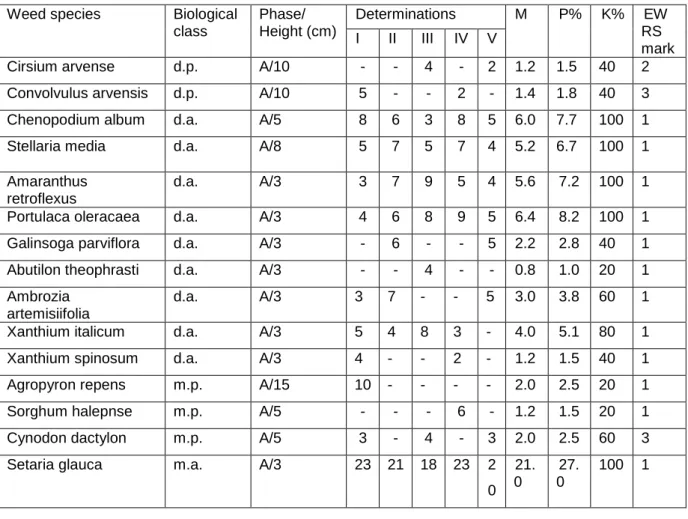
condition due to rainfall. The nicosulfuron herbicide active ingredient has controlled very well both the dicotyledonous and monocotyledonous weeds. This herbicide has, also, a good action in soil preventing further weed emergence. The weeding degree and the effect of this herbicide expressed by EWRS marks are presented below.
Table 1
The weeding degree and the effect of nicosulfuron herbicide active ingredient applied on corn crop in 2017
Weed species Biological class
Phase/ Height (cm)
Determinations M P% K% EW
RS mark I II III IV V
Cirsium arvense d.p. A/10 - - 4 - 2 1.2 1.5 40 2
Convolvulus arvensis d.p. A/10 5 - - 2 - 1.4 1.8 40 3
Chenopodium album d.a. A/5 8 6 3 8 5 6.0 7.7 100 1
Stellaria media d.a. A/8 5 7 5 7 4 5.2 6.7 100 1
Amaranthus retroflexus
d.a. A/3 3 7 9 5 4 5.6 7.2 100 1
Portulaca oleracaea d.a. A/3 4 6 8 9 5 6.4 8.2 100 1
Galinsoga parviflora d.a. A/3 - 6 - - 5 2.2 2.8 40 1
Abutilon theophrasti d.a. A/3 - - 4 - - 0.8 1.0 20 1
Ambrozia artemisiifolia
d.a. A/3 3 7 - - 5 3.0 3.8 60 1
Xanthium italicum d.a. A/3 5 4 8 3 - 4.0 5.1 80 1
Xanthium spinosum d.a. A/3 4 - - 2 - 1.2 1.5 40 1
Agropyron repens m.p. A/15 10 - - - - 2.0 2.5 20 1
Sorghum halepnse m.p. A/5 - - - 6 - 1.2 1.5 20 1
Cynodon dactylon m.p. A/5 3 - 4 - 3 2.0 2.5 60 3
Setaria glauca m.a. A/3 23 21 18 23 2
0 21. 0
27. 0
191
Digitaria sanguinalis m.a. A/3 5 14 13 8 2
0 12. 0
15. 5
100 1
Echinochloa crus-galli m.a. A/3 6 - - 6 - 2.4 3.1 40 1
Total number of weeds/square meter 77.6
These results show that this herbicide is very suitable for notill corn crop having a very good control against most weed species except Cynodon dactylon and Convolvulus arvensis.
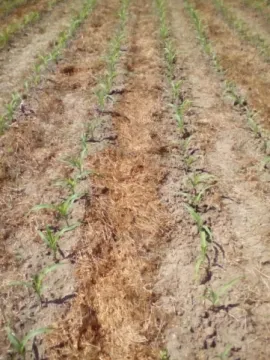
Figure 1. The effect of nicosulfuron herbicide on corn crop in no till system with pea cover crop in 2017 at Botanic Garden of University of Craiova
The soil mosture was highly influenced by both tillages and the species of the cover
crop. There were made two determinations, at 15th June and 10th of July. There were, also,
made soil bulk determinations. The results are presented in the table below.
Table 2
The soil moisture and the bulk density in function of soil tillages and cover crop species at Botanic Garden in 2017
Treatment Soil depth (cm)
15 June 10 July
Soil moisture, %
Soil bulk density, g/cm3 at 5-15 cm depth
Soil moisture, %
Soil bulk density, g/cm3
V1 0-10 13.9 1.30 12.9 1.35
10-20 14.3 13.5
V2 0-10 13.5 1.45 12.5 1.44
10-20 14.5 12.8
V3 0-10 14.3 1.27 13.5 1.35
10-20 14.0 13.8
V4 0-10 14.5 1.33 12.8 1.30
10-20 14.7 13.0
V5 0-10 14.8 1.30 13.4 1.35
10-20 14.9 13.9
192
is the reason why the plowed soil gives good yields. The no till bare soil records the lowest soil moisture data because of losing water quickly. The phenomenon that conducts to this result is explained by smaller pores into the shallow layer of 3-5 cm that extracts the water from below, where the soil pores are larger. This fact determines the rapid loss of soil water, tough soil, poorly developed root system and reduced or no yield.
At 15 October the experimental plots have been harvested and the yield has been weighted for each treatment. There also have been made height measurements of the harvested corn plants. The results are presented in the table below.
Table 3
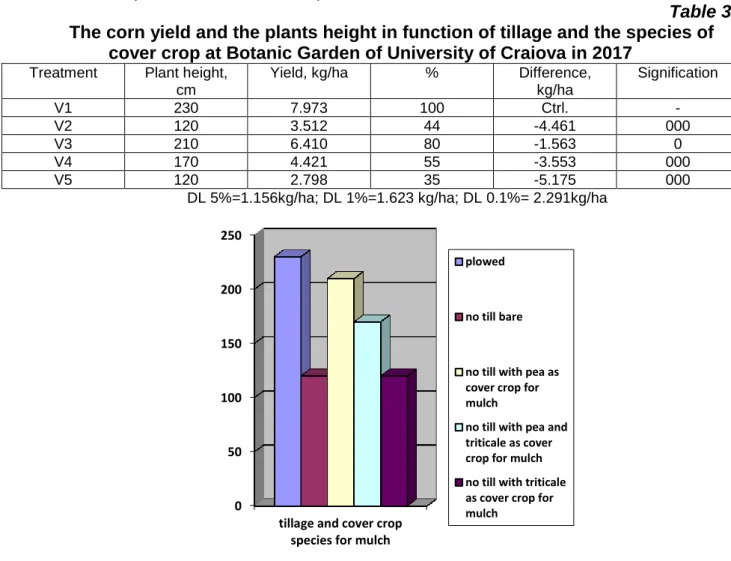
The corn yield and the plants height in function of tillage and the species of cover crop at Botanic Garden of University of Craiova in 2017
Treatment Plant height, cm
Yield, kg/ha % Difference,
kg/ha
Signification
V1 230 7.973 100 Ctrl. -
V2 120 3.512 44 -4.461 000
V3 210 6.410 80 -1.563 0
V4 170 4.421 55 -3.553 000
V5 120 2.798 35 -5.175 000
DL 5%=1.156kg/ha; DL 1%=1.623 kg/ha; DL 0.1%= 2.291kg/ha
Figure 2. The Corn plants height in function of tillage and cover crop species
From these results we can conclude that tillage gave the best results for corn crop in 2017 in this experiment due to very good soil conditions that permitted water to be kept into the soil at plant disposal. This treatment, also, recorded the highest plant, of 230 cm.
No till treatment with pea as cover crop proved to be the best of three cover crop treatments due to better soil coverage and nitrogen supplying. This effect can be seen in figure below.
0 50 100 150 200 250
tillage and cover crop species for mulch
plowed
no till bare
no till with pea as cover crop for mulch
no till with pea and triticale as cover crop for mulch
193
Figure 4. Corn plants in no till with pea cover crop mulch
The plant height, also, shows good plant condition due to mulch coverage and quality.
The mixture between pea and triticale has not fully covered the soil surface by mulch because of not enough vegetal mass given by triticale species. This influence can be explained by the fact that the mixture of pea and triticale has been sown in the spring, at the beginning of March. In fact all three cover crops have been sown in early spring but the pea crop has given a richer vegetal mass and nitrogen.
The using of triticale species as cover crop alone has given lower results in terms of soil coverage, nitrogen content because of straw which resulted in lower yield and shorter plants. This treatment can be seen in the figure below.
Figure 5. No till corn plants with triticale cover crop mulch.
194
results in extracting the water from soil depth and losing it through simple evaporation instead to be used by plants.
CONCLUSIONS
Water is the key element in no till technology. It is the „blood” of plants. The more and richer in nutrients for plant metabolism, the better.
1. Tillage creates best plant conditions into the soil but they are not sustainable for long term and they are expensive.
2. No till technique requires a mulch layer which must cover the entire soil surface except the one of the rows where the seedbed is prepared by shallow tillage.
3. Cover crops are needed to ensure both full coverage and nitrogen.
4. The best results have been given by the pea cover crop followed by the mixture between pea and triticale and triticale. These crops have been sown in early spring but they can be sown in autumn.
BIBLIOGRAPHY
1. Dobre M., 2002 - Cercetari privind aplicarea unor variante ale sistemului de lucrari minime pentru porumb pe nisipurile irrigate din Stanga Jiului. PhD thesis, University of Agricultural Sciences and Veterinary Medicine Bucharest, Romania.
2. Elliot E.T. and Colleman D.C., 1988. Let the soil work for us. Ecology Bulletin 39.
3. Popescu C., „Solurile brune luvice si luvisolurile albice din zona de deal si podis a Olteniei şi măsuri pentru creşterea fertilităţii lor.” Lucrări ştiinţifice Seria A XLVII Agronomie USAMV Bucureşti, ISSN : 1222-5339, pg.77-81, 2004
4. Popescu Cristian, Physical and chemical characterization of main soils from north part of Dolj district, Analele Universitatii din Craiova, Agricultura, Montanologie, Cadastru, vol.XLV /1 , 2015, pag 227-231 ,ISSN 1841-8317.
5. Soane B.D. and van Owerkerk C., 1990. Soil compaction in crop production. Pag.
230-245. Elsevier, Amsterdam, The Netherlands, Developments in Agricultural
engineering.
6. Sprague M. and Triplett G., 1986. No tillage agriculture and surface tillage agriculture. Pag 150-165. Editure John Willey and sons.