What is Environmental Management?
Hotels and resorts in the Caribbean use large amounts of water, energy, chemicals, supplies, and disposable items. They also generate lots of waste such as wastewater and solid waste. Because of this, small efficiency gains can lead to large cost savings and
environmental performance improvements.
Environmental management is a systematic approach to finding practical ways for saving water, energy, and materials, and reducing negative environmental impacts. A proactive environmental management program is a win-win-win proposition because it can help a property save money, get recognized for environmental leadership, and preserve and protect unique destinations.
Environmental Management is a Win-Win-Win
Proposition
Win 1 – Save money
Sound environmental management reduces operating costs and improves profitability. According to a recent survey1 of Caribbean hoteliers by PA Government Services, 50% of Caribbean hotels spend over 10% of operating costs on utilities, and 21% spend over 20%. Most hotels can quickly achieve substantial cost savings with a modest investment. Figure 1. shows the actual results from
implementing an environmental program at Sea Splash Resort, a 15-suite property in Jamaica. The property reduced water and electricity consumption by 35% and 24%, respectively, and is now saving almost US$19,000 per year. Sea Splash achieved these savings with a modest investment in simple, low-cost technologies and practices, and has realized an annual return on investment (ROI) of 100%.
DRAFT Produced by PA Consulting Group through the USAID Environmental Audits for Sustainable Tourism Project (EAST) in collaboration with OAS-USAID© Copyright 2001
Figure 1. Cost Savings and performance improvements at Sea Splash, a 15-suite resort in Negril, Jamaica.
1Caribbean Environmental Investment Study, PA Government Services,
Win 2 – Get recognized for environmental leadership
Adopting environmental best practices can help you stand out from the competition and be recognized through certification programs, awards, tour operator programs, and other special promotions. Getting
recognized for your commitment to environmental management can enhance your property’s image with environmentally conscious guests and tour operators. Prominent award programs are shown in Figure 2.
Figure 2. Awards programs are a great way to get your property recognized for its environmental program.
Environmental Award Programs • International Hotel and Restaurant
Association - Environmental Award
• Green Globe 21 Award
• British Airways - Tourism for Tomorrow Award
• Caribbean Hotel Association / American Express - Environmental Awards
• Islands Magazine - Ecotourism Awards
• Pacific Asia Travel Association (PATA) - Green Leaf Awards
• Conservation International - Ecotourism Excellence Award
• Condé Nast Traveler - Ecotourism Award
Win 3 – Protect and preserve destinations Each year more than 30 million tourists flock to the Caribbean to experience the natural and cultural treasures that the region has to offer. The hospitality industry, while a critical engine for economic growth, also puts a tremendous strain on the natural "assets" such as beaches, reefs, rivers, and forests.
A recent poll conducted by Condé Nast Traveler revealed that: • 91% of the respondents were concerned about the environmental
conditions at their chosen destination.
• 50% claimed that the environment had become a factor in their travel planning over the last ten years.
• 25% have changed travel plans because of what they perceived to be an environmental issue at their chosen destination.
Protecting the attractions that bring visitors to your destination helps ensure the long-term sustainability of your business.
How do I get started?
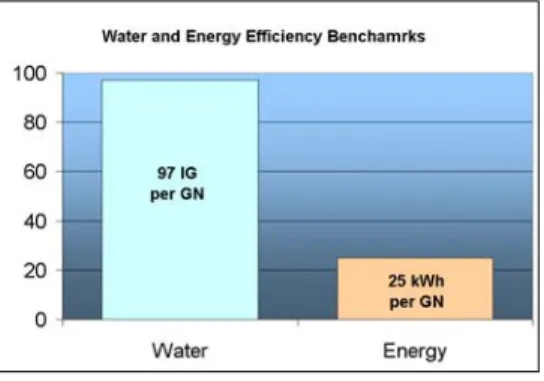
Figure 3. Water and energy efficiency benchmarks for small hotels as defined by the International Hotels Environment Initiative.
Identifying opportunities for cost savings and improved environmental management is best achieved through an
all-encompassing and step-by-step process that addresses all aspects of hotel operations and facilities. A property can begin the process with a rapid assessment known as an Environmental Walk-Through.
What is an Environmental Walk-Through?
An Environmental Walk-Through is a simple rapid assessment of opportunities for improvement at a small property. The Walk-Through is conducted by a single trained assessor who visits the property, inspects its facilities and operations, and identifies a few key opportunities for cost savings and environmental improvement. It typically takes from 4 to 8 hours to complete and costs US$300 to $600, depending on the size of the hotel and the complexity of its facilities and operations.
Focus on no-cost and low-cost opportunities
An environmental management program is based on practical steps to conserve water and energy and minimize waste.2 Typical strategies include:
Figure 4. Faucet aerators and water-efficient showerheads are a low-cost, high payback opportunity for most hotels (photo credit: PA Government Services 2001.)
• Water conservation devices such as efficient shower-heads and faucet aerators (see Figure 4.)
• Energy-efficient lighting and lighting controls
• Weather-stripping and insulation of hot water pipes, refrigerant lines, and air-conditioned areas.
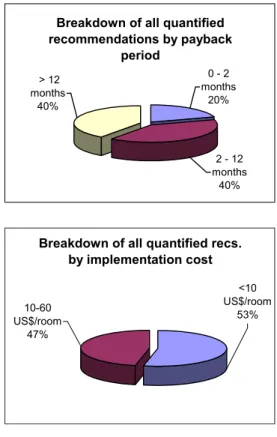
• Timers and occupancy sensors for lighting and A/C equipment Payback periods and implementations costs for these measures at a typical small hotel are shown in Figure 5.
Organizing for success
Breakdown of all quantified recs. by implementation cost 10-60 US$/room 47% <10 US$/room 53%
Breakdown of all quantified recommendations by payback period 0 - 2 months 20% > 12 months 40% 2 - 12 months 40%
Figure 5. Payback period and implementation costs of assessment recommendations at Blue Waters Inn, a
38-room hotel located on the shore of Bateaux Bay at the north end of Tobago.
In addition to engineering “fixes” and efficient equipment, a property can get a quick start by implementing key operational measures such as:
• Adopting an Environmental Policy • Appointing an Environmental Officer • Establishing a “Green Team”
• Establishing a preventative maintenance program
• Adopting best practices (staff procedures) for conservation and waste minimization in hotel operations.
• Developing a utility monitoring program
How do I take my property to the next level?
After implementing the initial steps outlined above, a property may decide to take additional steps to achieve greater cost savings and environmental improvements. This typically involves 1) an Environmental Assessment of your property, 2) the adoption of an integrated tool known as an Environmental Management System (EMS), and 3) seeking third party certification by a recognized program such as Green Globe 21 or Quality Tourism for the Caribbean (QTC).
Environmental Assessments
Depending on the level of detail and analysis a property wants, it can choose two main types of environmental assessments, a Small Hotel Environmental Assessment and a Detailed Environmental
Management Audit.
2 Resources for additional information and technical assistance are
What is a Small Hotel Environmental Assessment?
The Small Hotel Environmental Assessment involves a team of two trained experts working on property for 2-3 days. The team reviews facilities, operations, and baseline performance3 and evaluates the property against a comprehensive list of best practices. The team then delivers a report that lists the best opportunities and provides guidance on how to implement them.
Figure 6. A detailed environmental management audit is a comprehensive analysis of a property’s facilities, equipment,
practices, and procedures.
What is a Detailed Environmental Management Audit?
A Detailed Environmental Management Audit is best suited for larger properties, or those experiencing problems with water and energy use and costs. The detailed audit involves a team of three experts
working on property for a period of three to five days, who look at every aspect of the properties facilities, equipment, practices and procedures and thoroughly analyze utility and product use during the baseline period. The team then develops a comprehensive report that evaluates a large range of options for improving efficiency and reducing costs, and includes detailed information on how to implement the options.
What is an Environmental Management System?
Although improving the efficiency of your property’s facilities and equipment is essential to becoming an environmentally-friendly hotel, “engineering fixes” alone are only part of the puzzle. Your staff is the other part. Some of the most significant water, energy and materials savings are achieved not by installing new equipment, but by
improving standard operating procedures and training and motivating your staff to use resources efficiently. Most of these measures have a very low implementation cost and a payback period of close to zero!
Figure 7. Green Team at Round Hill Hotel in Jamaica. Creating an EMS and establishing a “Green Team” helps you “institutionalize” operating efficiency and
environmental awareness at your property (photo credit: PA Government
Services 2001).
However, training and motivating your entire staff to adopt new procedures or merely be vigilant about reducing waste is a tremendous challenge. It is not something that you will be able to achieve overnight. Instead, it requires a long-term commitment and a continuous process of improvement be integrated in the daily
operations at a pace that is right for each property. An Environmental Management System (EMS) provides a roadmap for making this happen.
An EMS is a framework that helps management assign
responsibilities, motivate staff, implement best practices, and monitor performance. It typically involves a set of activities, led by a core group of staff (the “Green Team”, see Figure 7.) that includes meetings, planning, training, incentive programs, utility monitoring, and reporting progress.
3 Utility and product use during the 12-month period prior to the
Figure 8. Certifying your environmental program can be thought of as a "stamp of approval" for your property's program.
What does it mean to have your environmental program “Certified”?
Certification programs such as Green Globe 21 or Quality Tourism for the Caribbean (currently under development) can be thought of as an official "stamp of approval" of your environmental program. These programs require that you have a third party (an accredited "auditor") come in and evaluate your property against an established set of criteria. Getting certified can help you stand out to environmentally-conscious travelers by "proving" to them that you are as green as you say you are. Because today's travelers and tour operators are
increasingly aware of environmental issues, this could emerge as an important competitive advantage in today's fast-moving marketplace.
About the Small Hotels Toolkit Series This toolkit is one of a series of booklets designed to help small hoteliers improve their business operations, marketing and environmental performance. They are available in both printed and electronic format (STEP Resource Centre or www. caribbeaninnkeeper.com). Toolkits emphasize proven “best practices” appropriate to the Caribbean region, and include numerous case studies and real examples. Toolkits are supported by STEP Coordinators and experienced “coaches” to help hoteliers solve problems, implement desired actions, and secure additional expertise and information.
About STEP
The Small Tourism Enterprises Project (STEP) for the Caribbean provides support and assistance related to marketing, better business management, effective
technology adoption, and improved environmental performance. Major funding comes from the Organization of American States, the United States Agency for International Development, and the governments of participating Caribbean countries.
STEP Walk-in Resource Centres Walk-in Resource Centres include publications, videos, and other materials related to small hotels and the
environment. They also have a computer work station and internet access. Each centre has a trained STEP Coordinator to help you find what you need. STEP will also be making available experienced professionals to provide “coaching” assistance on a number of topics. Contact your STEP Coordinator for information on coaching currently available.
Where Do I Get More Information and Assistance?
Contact CAST:
The Caribbean Alliance for Sustainable Tourism (CAST) offers technical services (walk-throughs, environmental assessments), lists of products and services, as well as videos and publications. CAST is located in San Juan, Puerto Rico and may be contacted by phone (787) 725-9139, fax (787)-725-9108, e-mail:
[email protected] or visit their web site www.cha-cast.com
The following materials are available from CAST:
• Environmental Technologies in Caribbean Hotels: Buying Specifications and Lessons of Experience
• Case Studies: Water, Energy and Solid Waste Management in the Hotel Industry
• Various publications from The Green Bookshelf
• Environmental Management Toolkit for Caribbean Hoteliers Have an Environmental Walk-through Completed:
To schedule an environmental walk-through (which will look at energy, water, solid waste and purchasing practices) contact your country STEP Coordinator or CAST.
Visit Your Virtual Walk-in Resource Centre:
The caribbeaninnkeeper website (www.caribbeaninnkeeper.com) is a virtual walk-in assistance centre, with copies of most of the materials available walk-in centres, as well as additional services and resources.