International Journal of Applied Linguistics & English Literature ISSN 2200-3592 (Print), ISSN 2200-3452 (Online) Vol. 3 No. 5; September 2014
Copyright © Australian International Academic Centre, Australia
The Relationship between EFL Teachers’ Preferences of
Corrective Feedback and Their Attitudes towards
Communicative Language Teaching
Ali Zangoei(Corresponding author) University of Sistan and Baluchestan,
Department of English Language and Literature, Zahedan, Iran E-mail: [email protected]
Ali Derakhshan
English Language and Literature Department, Golestan University, Iran E-mail: [email protected]
Received: 18-03-2014 Accepted: 03-05-2014 Published: 01-09-2014
doi:10.7575/aiac.ijalel.v.3n.5p.82 URL: http://dx.doi.org/10.7575/aiac.ijalel.v.3n.5p.82
Abstract
Despite a laissez-faire approach to errors nowadays, appropriate corrective feedback makes an educational environment more communicative and effective. The present correlational study sought to scrutinize the relationship between EFL teachers’ preferences of corrective feedback (CF) and their attitudes towards principles of communicative language teaching (CLT). To do so, 108 EFL teachers completed a questionnaire containing three parts, e.g. demographic information, attitudes towards principles of CLT (24 items adopted from Chang, 2011) and CF preferences. Results of Chi Square Test confirmed the relationship between these two variables. It was also found that elicitation and metalinguistic feedback were the most frequently selected types by the participants as well as preferences of those EFL teachers who gained higher scores in CLT attitude scale. The findings can provide pedagogical implications to employ particular types of CFs in English classrooms to pave the ways for effective communication in EFL settings.
Keywords: Corrective Feedback (CF); Communicative Language Teaching (CLT); EFL Teachers 1. Introduction
Errors inevitably occur in English as a foreign language (EFL) classes. The importance lies in the fact that how teachers respond to such errors while teaching new materials. Different teachers behave differently to correct their pupils’ errors. Prior to presenting EFL teachers’with different perspectives on employing various types of corrective feedback (CF), it seems worthwhile to introduce different CFs.
1.1 Different Types of Corrective Feedback
According to Lyster and Ranta (1997), there are seven types of feedback which are as follows:
· Explicit Correction: It refers to “the explicit provision of the correct form". As the teacher provides the correct form, he or she clearly indicates that what the student had said was incorrect (e.g., ‘Oh, you mean,’ ‘You should say’)” (p. 46).
Ex: S: He goed.
T: No, you should say he went.
· Recasts: They "involve the teacher’s reformulation of all or part of a student’s utterance, minus the error" (p.46). Ex: S: "He goed".
T: "He went".
· Clarification Requests: "a feedback type that can refer to problems in either comprehensibility or accuracy, or both" (p. 47). Clarification requests include such phrases as "pardon me", "sorry" or "what do you mean by X?"(p.47).
Ex: S: He go to school. T: What?
· Metalinguistic Feedback: Despite its name, Lyster and Ranta (1997) categorize metalinguistic feedback as “either
Ex: S: She wash her dress.
T: "No, it is not correct. If the subject is he, she, or it you have to put "s" at the end of the verb.
· Elicitation:According to Panova and Lyster (2002), elicitation is a corrective technique that “prompts the learner to
self-correct” (p. 584). To do so different strategies are employed by the teacher to elicit the correct form: Ex: Yesterday we go to the swimming pool.
- Fill in the blank strategy: "No, yesterday we…."
- Ask a question: "How do we talk about the past in English?" - Ask to reformulate the utterance: " Please say that again correctly".
· Repetition: It"refers to the teacher’s repetition, in isolation, of the student’s erroneous utterance. In most cases, teachers adjust their intonation so as to highlight the error" (p.48).
Ex: S: " Hegoed". T: "He goed"?
In their initial analysis, Lyster and Ranta (as cited in Lyster&Ranta, 1997, p. 38) considered translation as a separate type of feedback but then they combined this category with recasts due to its infrequent occurrence and the same function served by the former and the latter. This type of CF is defined as follows:
· Translation: Translation can be seen as “a feedback move when it follows a student’s unsolicited uses of the L1”
(Panova&Lyster, 2002, p. 582). Lyster and Ranta (1997) found very few of these moves in their database and so coded translations as recasts due to their similar function of reformulating non-target learner utterances.
Nevertheless, the main objective of the present study is to explore EFL teachers’ preferences of corrective feedback and their attitudes towards communicative language teaching (CLT). To link the variables of the present study, it isalsorequired to introduce CLT.
1. 2 Communicative Language Teaching Approach
One major purpose of learning a language is to communicate. The use of language as a communication tool has been advocated by CLT (Chang, 2011). Recently, as Chang (2011) argues, EFL teachers have been inspired to employ communicative language teaching to enhance their students’ abilities in using English appropriately in the context. Due to the significance of the context in language learning, in general, and in foreign language learning, in particular, the author further emphasizes on this kind of approach to English language learning.
According to Ansarey (2012), CLT concentrates upon assisting learners to create meaning not upon improving grammatical structures or acquiring native –like pronunciation. In other words, learners’ achievement in learning a foreign language depends upon how well they have developed their communicative competences and how much they can employ this knowledge of language in real life contexts.
However, according to Fahim and Montazeri (2013), the dawn of CLT appeared to put negative effects on employing CF in EFL classes. CLT tends to eliminate correction of learners’ linguistic errors and to minimize their stress to communicate through the foreign language in the class. Correction appeared to impose pressure and stress on learners and hinder their production.
With no doubt, second language teachers sound to be afraid of using CF due to the fear of interrupting the communication flow in some activities and of preventing from the learners’ participation (Agudo, 2012). Agudo(2012) asserts that both SLA research and L2 pedagogy have suggested that learners can take significant advantages from CF in communicative classrooms (Ammar&Spada, 2006; Bitchener, 2008;Bitchener&Knoch, 2009; Ellis, Loewen&Erlam, 2005;Leeman, 2003; Li, 2010; Lyster, 2004;Lyster& Saito, 2010; Mackey & Goo, 2007; Russell &Spada, 2006; Shaofeng, 2010; Sheen, 2007).
2. Review of the Related Literature
Farrokhi(2007) scrutinized EFL teachers’ beliefs about CF in relation to their practices in EFL classrooms. It was suggested that there might be a cost for every decision about the effectiveness and the appropriateness of feedback types, specifically in fluency contexts. According to the author, the most effective CF type may hinder communication and conversation. Also, the most appropriate CF type may not be so effective in changing students’ correction. Teachers’ adoption of CF types might depend upon various factors interacting simultaneously and affecting each other in several ways (Farrokhi, 2007).
Samar and Shayestefar (2009) investigated corrective feedback in EFL classrooms. The authors found that metalinguistic and explicit corrections could be usefully incorporated into EFL setting. Although their findings suggest that incidental CFs in Focus-on-Form pedagogy can lead to noticing of linguistic items during meaning-focused interactions.
CLT to be implemented successfully, however, it is important to consult learners in order to match both groups’ views because they are important stakeholders in CLT (Mai Ngoc & Iwashita, 2012).
Chang (2011) investigated EFL teachers’ attitudes toward communicative language teaching in Taiwanese college. It indicated teachers’ positive attitudes toward principles of CLT. These teachers demonstrated CLT characteristics in their beliefs. Furthermore, Taiwanese college English teachers believed that CLT can make English teaching effective and meaningful.
Ansarey (2012) investigated teachers’ attitudes and perceptions with regard to CLT in Bangladesh. It was found that EFL teachers encounter several difficulties in implementing CLT in their classrooms. These difficulties originate from such sources as the teacher, the students, the educational system, and CLT itself. Ansarey's(2012) findings indicate that despite showing keen interest in change and being eager to identify with CLT, teachers are not optimistic about the complete adoption of CLT, and therefore feel that only by overcoming such difficulties and by providing more favorable conditions for the implementing CLT, they can truly take advantages from CLT in their English classrooms. Sheen (2004) conducted a study on corrective feedback and learner uptake in communicative classrooms employing Lyster and Ranta’s(1997) taxonomy of teachers’ corrective feedback moves and learner uptake. The author concluded that recasts were the most widely used corrective feedback type in all four contexts including French Immersion, Canadian ESL, New Zealand ESL and Korean EFL.
Kartchava (2006) points out that novice teachers tend to avoid implementation of corrective techniques risking the chance of disrupting communication meeting the approval of Truscott (1999) and Krashen (1981) believing that teachers should not point out errors during communication so that learners could further concentrate upon the transmission of message during communicative interaction. Nevertheless, the present study aimed at investigating the relationship between EFL teachers’ preferences of CFs (seven types of CFs introduced by, Lyster&Ranta, 1997) and their attitudes toward CLT.
2.1 The Present Study
The present study aimed to link EFL teachers’ preferences of CFs and their attitudes towards CLT. To this end, the following research questions were formulated by the authors:
Q1: Is there any significant relationship between EFL teachers’ preferences of CFs and their attitudes toward CLT? Q2: Which type of CFs is directly related to EFL teachers’ positive attitudes toward principles of CLT?
3. Methodology 3.1 Participants
A sample including 108 EFL teachers teaching English in educational settings of Khorasan Razavi, Iran were selected randomly based on Krejcie-Morgan table (1970) out of 150 teachers. Their age ranged from 24 to 47. Both males and females were asked to take part in the study. Their academic degree ranged from BA to PhD.
3.2. Instrumentations
In order to achieve the required data, a questionnaire including three sections was employed by the researchers. The first section was allocated to participants’ demographic information, e.g. age, degree, gender, and teaching experience. Secondly, in order to check participants’ attitudes towards principles of CLT, an attitude scale, adopted from Chang (2011), was employed by the authors(see Appendix). The questionnaire, consisting of 28 multiple-choice items, was originally designed by Karavas-Doukas (1996) with five-point scales in the Likert format (Chang, 2011). The questionnaire contained both favorable (N=12) and unfavorable (N=12) items. In addition to the attitude scale, the third section asked participants to mark one out of seven types which have been introduced by Lyster and Ranta (1997), e.g. explicit, recast, clarification, metalinguistic CF, elicitation, repetition and translation. In order to achieve the appropriate results the participants were asked to choose only one option regarding their CF preferences.
3.3. Procedure
At the start of the study 108 EFL teachers were selected based on Krejcie-Morgan table (1970) out of 150 teachers. They were from Khorasan Razavi, a province in North East of Iran. Their age ranged from 24 to 45 and their degrees ranged from BA to Ph.D. Concerning the effect of gender both males and females were asked to participate in this study.
The participants received required information regarding the purpose of the study. Then the researcher gathered the participants' electronic emails to send them the instruments to complete. Having developed the final version of the questionnaire, the authors sent it to the participants’ emails.
The completed questionnaires were forwarded to the researchers’ emails almost 15 days after the date of sending. Having employed SPSS (16.0), the data were analyzed and the findings were discussed.
4. Results
The authors analyzed the data collected from the instruments. This section summarizes the descriptive as well as the inferential statistics.
4.1. Descriptive Statistics
4.1.1 Questionnaire Reliability
In order to make sure that the questionnaire is reliable, Cronbach’s Alpha was employed.
Table 1. Reliability of Questionnaire Reliability Statistics
Cronbach’sAlphaa N of Items
.78 24
As Table 1 shows, the questionnaire enjoys a relatively high reliability (α=.78). Therefore, it was employed as the research instrument.
4.1.2 Participants’ Demographic Information
Table 2 shows participants’ information with respect to their degree, gender and teaching experience.
Table2. Participants’ Demographic Information
degree * gender * Teaching Experience Crosstabulation Count
Teaching Experience Gender Total
female Male
-5 Degree BA 8 2 10
MA 3 3 6
Total 11 5 16
5-10 Degree BA 6 4 10
MA 4 9 13
PHD 1 1 2
Total 11 14 25
11-15 Degree BA 4 15 19
MA 2 7 9
PHD 2 1 3
Total 8 23 31
16-20 Degree BA 2 0 2
MA 5 2 7
PHD 2 0 2
Total 9 2 11
+20 Degree BA 2 6 8
MA 4 5 9
PHD 3 5 8
Total 9 16 25
As Table 2 shows and based on gender, 60 males and 48 females participated in this study. In addition, the majority of the participants (N=93) were either BA (N=49) or MA (N=44) and only 15 subjects had PhD degree. Concerning teaching experience, most participants (N=31) had experienced a period of 11 to 15 years of teaching English as a foreign language.
4.2. Results of the Relationship between EFL Teachers’ Attitudes towards CLT and Their CF Preference
To check whether there is a statistically significant relationship between EFL teachers’ attitudes towards CLT and their preference of corrective feedback chi square test was employed and data are shown in Table 3 and Table 4.
Table 3. Results of Frequencies Cf
Observed N Expected N Residual
EXP 1149 1546.7 -397.7
REC 1076 1546.7 -470.7
CLA 1770 1546.7 223.3
MET 2040 1546.7 493.3
ELI 2363 1546.7 816.3
REP 1338 1546.7 -208.7
TRA 1091 1546.7 -455.7
Total 10827
Table 4 shows data related to Chi Square Test.
Table 4. Results of Chi Square Test Test Statistics
Cf
Chi-Square 1.028E3a
Df 6
Asymp. Sig. .000
a. 0 cells (.0%) have expected frequencies less than 5. The minimum expected cell frequency is 1546.7.
Based on data in Table 4, sig is less than .05 (sig=.000) which confirms a statistically significant relationship between CLT scores and type of CF chosen by the participants. Accordingly, it can be concluded that different EFL teachers chose different types of CF. Table 5 clarifies this relationship. As a consequence, the first null-hypothesis denying a statistically significant relationship between EFL teachers’ attitudes towards principles of CLT and their preference of CF type is rejected.
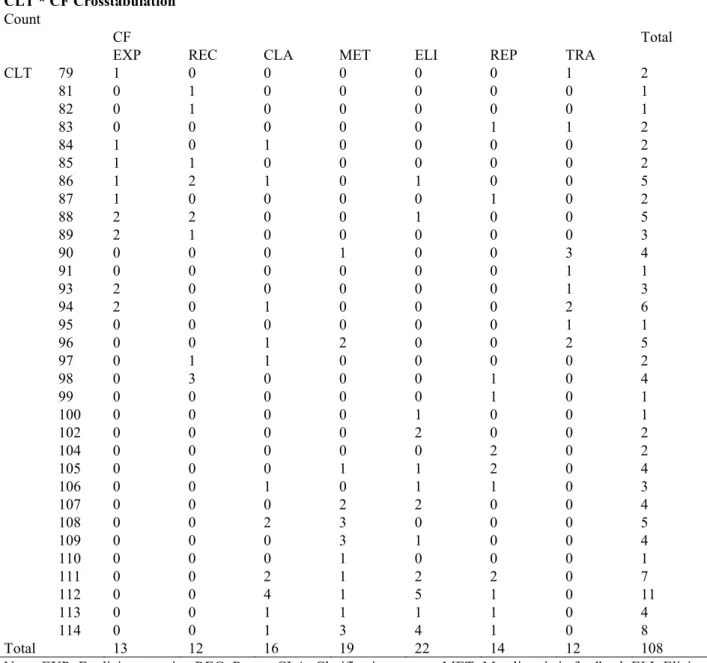
Table 5 shows the EFL teachers’ preferences of CF types and their CLT mean scores.
Table 5. Participants’ CLT& CF CLT * CF Crosstabulation Count
CF Total
EXP REC CLA MET ELI REP TRA
CLT 79 1 0 0 0 0 0 1 2
81 0 1 0 0 0 0 0 1
82 0 1 0 0 0 0 0 1
83 0 0 0 0 0 1 1 2
84 1 0 1 0 0 0 0 2
85 1 1 0 0 0 0 0 2
86 1 2 1 0 1 0 0 5
87 1 0 0 0 0 1 0 2
88 2 2 0 0 1 0 0 5
89 2 1 0 0 0 0 0 3
90 0 0 0 1 0 0 3 4
91 0 0 0 0 0 0 1 1
93 2 0 0 0 0 0 1 3
94 2 0 1 0 0 0 2 6
95 0 0 0 0 0 0 1 1
96 0 0 1 2 0 0 2 5
97 0 1 1 0 0 0 0 2
98 0 3 0 0 0 1 0 4
99 0 0 0 0 0 1 0 1
100 0 0 0 0 1 0 0 1
102 0 0 0 0 2 0 0 2
104 0 0 0 0 0 2 0 2
105 0 0 0 1 1 2 0 4
106 0 0 1 0 1 1 0 3
107 0 0 0 2 2 0 0 4
108 0 0 2 3 0 0 0 5
109 0 0 0 3 1 0 0 4
110 0 0 0 1 0 0 0 1
111 0 0 2 1 2 2 0 7
112 0 0 4 1 5 1 0 11
113 0 0 1 1 1 1 0 4
114 0 0 1 3 4 1 0 8
Total 13 12 16 19 22 14 12 108
Based on data in Table 5, Elicitation ranked first (N=22) and Recast (N=12) and Translation (N=12) ranked last. Metalinguistic CF ranked second (N=19). Clarification (N=16), Repetition (N=14), Explicit (N=13) ranked third to five, respectively. Concerning the data in Table 5, it can be found that those teachers whose CLT scores are high tend to employ Elicitation, Metalinguistic CF, Clarification, and Repetition types of CF and Those participants with low CLT scores tend to use Translation, Recast and Explicit types of CF.
5. Discussion and Conclusion
Based on the data obtained from the instruments, it was found that Elicitation was the most favorable type of CF employed by Iranian EFL teachers during the process of teaching. Metalinguistic feedback was another CF which held the second place. In addition, Explicit and Recast ranked fifth to sixth. According to Shayestefar’s(2009) findings which indicated that Metalinguistic and Explicit corrections could be usefully incorporated into EFL classrooms, these findings supported Metalinguistic feedback and rejected the latter, Explicit CF. Also the present findings differed from those obtained by Sheen (2004) who suggested that recasts were the most frequent feedback type used by their participants.
Regarding participants’ attitudes to CLT and their preferences of CF types, the findings showed that Elicitation and Metalinguistic feedback were adopted by those who gained higher scores in CLT questionnaire. Based on the correlation between EFL teachers’ attitudes towards principles of CLT and their preference of CF, it can be concluded these types of CF, e.g. Elicitation and Metalinguistic feedback can offer a plenty of opportunities to establish communicative activities in EFL classrooms. This finding is in disagreement with Lyster’s (as cited in Russell, 2009, p.188) study suggesting that in communicative-focused classrooms, recasts and repetitions are commonly used alongside other types of interactional feedback. Due to the Recast interference to the learner-centeredness, as its definition implies, it appears that this type of CF was not considered as an effective type by those participants who advocated CLT. Concerning the Recast definition as the teacher’s reformulation of student’s production minus the error, there is not an appropriate opportunity for initiating an effective communication. Since, on one hand, CLT is a learner/student-centered approach (Ansarey, 2012) and, on the other hand, advocators of CLT in this study were aware of more opportunities provided by Elicitation and Metalinguistic feedbacks for establishing effective opportunities compared to those offered by Recast CF. Translation and Explicit were also excluded from the CLT advocators’ favorite CFs, since their application does not result in establishment of an effective communication. Hopefully, the present findings will be helpful for EFL teachers, EFL learners and EFL researchers. Further study is needed to experimentally compare the effects of these seven types of CF on EFL students’ achievement in different areas of English learning.
Acknowledgements
The researchers wish to express their sincere gratitude to those teachers who participated in this study and answered the questions patiently, and they would also like to specially thank anonymous reviewers of the journal for their valuable and helpful comments and suggestions.
References
Agudo, J.D.D.M. (2012). Investigating Spanish EFL students’ beliefs and preferences regarding the effectiveness of corrective feedback.International Journal of Humanities and Social Science, 2(19),121-131.
Ammar, A., &Spada, N. (2006). One size fits all? Recasts, prompts and L2 learning.Studies in Second Language Acquisition, 28, 543-574.
Ansarey, D. (2012). Communicative language teaching in EFL contexts: Teachers attitude and perception in Bangladesh. ASA University Review, 6 (1),61-78.
Bitchener, J. (2008). Evidence in support of written corrective feedback. Journal of Second Language Writing, 17, 102– 118.
Bitchener, J., &Knoch, U. (2009). The contribution of written corrective feedback to language development: A ten month investigation. Applied Linguistics, 31, 193-214.
Chang, M. (2011).EFL teachers’ attitudes toward communicative language teaching in Taiwanese college. Asian EFL Journal Professional Teaching Articles Volume, 53, 17-34.
Ellis, R., Loewen, S., &Erlam, R. (2005).Implicit and explicit corrective feedback and the acquisition of L2 grammar.Studies in Second Language Acquisition, 28, 339–368.
Fahim, M., &Montazeri, M. (2013).The impact of metalinguistic corrective feedback on EFL learners’ levels of
lexical resource and grammatical range and accuracy in their oral proficiency. International Research Journal of Applied and Basic Sciences, 4(7), 1776-1782.
Farrokhi, F. (2007). Teachers’ stated beliefs about corrective feedback in relation to their practices in EFL classes. Research on Foreign Languages Journal of Faculty of Letters and Humanities.49 (2),91- 131.
Karavas-Doukas, E. (1996). Using attitude scales to investigate teachers' attitude to the communicative approach.
Kartchava, E. (2006). Corrective feedback: Novice EFL teachers’ beliefs and practices. Retrieved February 2014 from: http://spectrum.library.concordia.ca/8938/1/MR14169.pdf.
Krejcie, R.V.,& Morgan, D.W. (1970).Determining sample size for research activities.Educational andpsychological measurement. 30, 607-610
Leeman, J. (2003). Recasts and second language development: Beyond negative evidence. Studies in Second Language Acquisition, 25, 37-63.
Li, S. (2010). The effectiveness of corrective feedback in SLA: A meta-analysis. Language Learning, 60 (2),309–365. Lyster, R. (2004). Differential effects of prompts and recasts in form-focused instruction.Studies in Second Language Acquisition, 26, 399-432.
Lyster, R., &Ranta, L. (1997). Corrective feedback and learner uptake: Negotiation of form in communicative classrooms. Studies in Second Language Acquisition, 20, 37–66.
Lyster, R., & Saito, K. (2010). Oral feedback in SLA classroom research: A meta-analysis. Studies in Second Language Acquisition, 32 (2), 265-302.
Mackey, A., & Goo, J. (2007). Interaction research in SLA: A meta-analysis and research synthesis. In A. Mackey (Ed.), Conversational interaction in second language acquisition: A collection of empirical studies (pp. 407-452). Oxford: Oxford University Press
Mai Ngoc, K., &Iwashita, N. (2012).A comparison of learners’ and teachers’ attitudes toward communicative language teaching at two universities in Vietnam. University of Sydney Papers in TESOL, 7, 25-49.
Panova, I.,&Lyster,R. (2002). Patterns of corrective feedback and uptake in an adult ESL classroom.TESOL Quarterly,36,(4), 573- 595.
Rezaei, S., &Derakhshan, A.(2011). Investigating recast and metalinguistic feedback in task-based grammar instruction.Journal of Language Teaching and Research,2,(3), 655-663.
Russell, V. (2009). Corrective feedback, over a decade of research since Lyster and Ranta (1997): Where do we stand today? Electronic Journal of Foreign Language Teaching, 6(1),21-31.
Russell, J., &Spada, N. (2006).The effectiveness of corrective feedback for the acquisition of L2 grammar.A meta-analysis of the research. In J. M. Norris & L. Ortega (Eds.), Synthesizing research on language and teaching (pp. 133-164). Philadelphia: John Benjamins.
Samar, R.G.,&Shayestefar, P. (2009). Corrective feedback in EFL classrooms: Learner negotiation strategies and uptake. Journal of English Language Teaching and Learning, 52(212),107-134.
Shaofeng, L. (2010). The effectiveness of corrective feedback in SLA: A meta-analysis. Language Learning, 62(2), 309-365.
Sheen, Y.H. (2004). Corrective feedback and learner uptake in communicative classrooms across instructional settings. Retrieved January 2014 from: http://ltr.sagepub.com/content/8/3/263.abstract.
Sheen, Y. H. (2007). The effect of focused written corrective feedback and language aptitude on ESL learners’ acquisition of articles. TESOL Quarterly, 41, 255-283.
Appendix:
A: Demographic Information Age
-25 25-35 36-45 +45
Degree
BA MA PHD
Gender
Male Female
Teaching Experience
-5 5-10 11-15 16-20 +21
B: CLT Scale
Participants' responses to principles of CLT
1. Grammatical correctness is the most important criterion by which language performance should be judged.*
SA A U D SD
2. Group work activities are essential in providing opportunities for co-operative relationships to emerge and in promoting genuine interaction among students.
SA A U D SD
3. Grammar should be taught only as a means to an end and not as an end in itself.
SA A U D SD
4. Since the learner comes to the language classroom with little or no knowledge of the language, he/she is in no position to suggest what the content of the lesson should be or what activities are useful for him/her.*
SA A U D SD
5. Training learners to take responsibility for their own learning is futile since learners are not used to such an approach.*
SA A U D SD
6. For students to become effective communicators in the foreign language, the teacher’s feedback must be focused on the appropriateness and not the linguistic form of the students’ response.
SA A U D SD
7. The teacher as “authority” and “instructor” is no longer adequate to describe the teacher’s role in the language classroom.
SA A U D SD
8. The learner-centered approach to language teaching encourages responsibility and self-discipline and allows each student to develop his/her full potential.
SA A U D SD
9. Group work allows students to explore problems for themselves and thus have some measure of control over their own learning. It is therefore an invaluable means of organizing classroom experiences.
SA A U D SD
10. The teacher should correct all the grammatical errors students make. If errors are ignored, this will result in imperfect learning.*
SA A U D SD
11. It is impossible in a large class of students to organize your teaching so as to suit the needs of all.*
SA A U D SD
12. Knowledge of the rules of a language does not guarantee ability to use the language.
SA A U D SD
13. Group work activities take too long to organize and waste a lot of valuable teaching time.*
SA A U D SD
14. Since errors are a normal part of learning, much correction is wasteful of time.
15. The Communicative approach to language teaching produces fluent but inaccurate learners.*
SA A U D SD
16. The teacher as transmitter of knowledge is only one of the many different roles he/she must perform during the course of a lesson.
SA A U D SD
17. By mastering the rules of grammar, students become fully capable of communicating with a native speaker.* 18. For most students language is acquired most effectively when it is used as a vehicle for doing something else and not when it is studied in a direct or explicit way.
SA A U D SD
19. The role of the teacher in the language classroom is to impart knowledge through activities such as explanation, writing, and example. *
SA A U D SD
20. Tasks and activities should be negotiated and adapted to suit the students’ needs rather than imposed on them.
21. Students do their best when taught as a whole class by the teacher. Small group work may occasionally be useful to vary the routine, but it can never replace sound formal instruction by a competent teacher.*
SA A U D SD
22. Group work activities have little use since it is very difficult for the teacher to monitor the students’ performance and prevent them from using their mother tongue.*
SA A U D SD
23. Direct instruction in the rules and terminology of grammar is essential if students are to learn to communicate effectively.*
SA A U D SD
24. A textbook alone is not able to cater to all the needs and interests of the students.
The teacher must supplement the textbook with other materials and tasks so as to satisfy the widely differing needs of the students.
SA A U D SD
SA=Strongly Agree; A= Agree; U=Uncertain; D=Disagree; SD=Strongly Disagree Unfavorable statements are indicated by an asterisk (*).
C: Corrective Feedback Preference
Explicit Recast Clarification Metalinguistic
feedback