Address for correspondence Dr. Chintaginjala Aruna
Department of Dermatology, Venereology & Leprosy, Katuri Medical College & Hospital, Chinnakondrupadu, Guntur, Andhra Pradesh, India. Email: [email protected]
Original Article
Evaluation of serum 25 hydroxy vitamin D
levels in patients with chronic spontaneous
urticaria: a hospital based cross sectional
study in a tertiary care centre
Introduction
Chronic urticaria [CU] is characterised by appearance of wheals either daily or at least twice weekly for more than six weeks’ duration.1 Though CU is not life threatening it
significantly affects the quality of life. Etiology of CU has been attributed to many factors including food, drugs, aeroallergens, infections, contact allergens etc.2 The term chronic spontaneous urticaria (CSU) refers to cases where no cause is found even after thorough history taking and investigations.3 Around 30-40% of CSU cases show evidence of autoantibodies directed against either the high affinity Ig-E receptor, or less commonly the Fc Srinivasa Rao Mudavath, Chintaginjala Aruna, Ramamurthy DVSB, Sridevi K, AL Senthil, Swapna Kameti
Department of Dermatology, Venereology & Leprosy, Katuri Medical College & Hospital, Chinnakondrupadu, Guntur, Andhra Pradesh, India.
Abstract
Background Chronic spontaneous urticaria (CSU) is considered as one of the most difficult to treat condition in dermatology. Several studies showed low levels of vitamin D in these patients and believed to have role in pathogenesis of CSU.Aim To evaluate serum 25 hydroxy vitamin D levels (25-(OH) D) in patients with chronic spontaneous urticarial (CSU) and to know its association with the disease activity.
Material and Method This was a hospital based cross sectional study conducted over 18 months which included 50 cases of CSU and 50 age and sex matched controls. In each case, detailed history and physical examinations were carried out and urticaria activity score [UAS] was calculated. 25-(OH)D level was measured both in cases and controls using enzyme immunoassay method [EIA]. Those with 25-(OH) D levels < 20 ng/mL were labelled as deficient, between 20 and 30 labelled as insufficient and any value > 30 ng/mL were labelled normal. Appropriate statistical tests were done to analyse the data.
Results The mean 25-(OH) D levels among the cases was 34.02 and among the controls it was 48.9, the difference was statistically significant (p value = 0.000771). No significant correlation was observed between 25-(OH) D levels and UAS.
Conclusion Patients with CSU had low serum 25-(OH) D when compared to healthy controls and no correlation was observed between 25-(OH)D and disease activity (assessed based on UAS).
Key words
portion of human Ig-E.4
25-Hydroxy vitamin D plays an important role in maintaining balance between the innate and adaptive immune systems. Anti inflammatory actions of Vitamin D include suppression of Toll like receptor production by monocytes, inhibition of dendritic cell activation by lipopolysaccharides, decreases Th1 cytokine secretion like IL-1, IL-6, IL-12, IL-23, IFN-and inhibition of B lymphocyte function including Ig E secretion.5 Vitamin D also has a role in the induction of tolerogenic cytokines like IL-10 and TGF-α by T-regs, dendritic cells and more interestingly mast cells.6,7 The vitamin D receptor (VDR) finds its expression on several inflammatory cells like T cells, B cells, neutrophils, macrophages, dendritic cells including mast cells.8,9 Vitamin D is known to regulate mast cell maturation via VDR signaling. This is supported by in vivo mice studies, where absence of VDR signaling resulted in accelerated mast cell maturation and increase in dermal mast cells.10 All these functions of vitamin D indicate its role in the pathogenesis of chronic urticaria. It is further supported by studies of Goetz et al. and Sindher et al. in chronic urticaria patients associated with vitamin D deficiency, where improvement occurred following vitamin D supplementation.11,12
So we have taken up this study to find out the association of serum vitamin D levels and CSU.
Materials and Method
Our study was a hospital based cross sectional study involving 50 cases of CSU aged between 18-45 years and equal number of age and sex matched controls. The study was conducted at out patient department of D.V.L. in a tertiary care centre over a period of 18 months [9/2015-3/2017], after obtaining approval from institutional ethical committee. Patients
presenting with complaints of urticaria of six weeks or longer duration were evaluated by taking complete medical history regarding associated angioedema, drugs, aggravating factors, atopy etc. and thorough general and physical examination was carried out. Patients with physical urticarias or urticaria due to drug allergy, food allergy, those who received medications like antihistamines, steroids, immunosuppressants for the past three months, those with co-morbidities like diabetes, hypertension, cerebrovascular attacks, kidney disease, pregnant and lactating mothers were excluded from the study. Cases of CSU and age and gender matched subjects who were not diagnosed with chronic urticaria in the past 5 years (controls) were included in the study after taking an informed consent.
Disease activity was calculated in each case by using urticaria activity score [UAS]. Blood samples were collected after overnight fasting from both cases and controls for measuring serum 25 hydroxy vitamin D using enzyme immunoassay method (EIA). Those with 25-hydroxy vitamin D levels < 20 ng/mL were labelled as deficient and those between 20 and 30 labelled as insufficient and any value > 30 ng/mL was labelled normal.
Statistical analyses were done using SPPS statistical software, version 18 and appropriate tests like Pearson’s Chi-squared test and person test was used to determine the association between serum vitamin D levels and CSU and to evaluate the relation of former with disease activity respectively.
Results
was 31.66±7.79 years where as in controls it was 31.85±8.68 years.
Table 1 Clinical characteristics of cases and controls Characteristics Cases Controls
Age 31.66±7.79 years 31.85±8.68
Gender
[males/females] 21/29 20/30
Duration of
disease [mean] 12.4 ±4 months UAS [mean] 4.06
History of
angioedema [%] 26%
Table 2 Serum levels of 25 hydroxy Vitamin D in Cases & Controls
Vitamin D Cases
(%) Controls (%) P - value
<20ng/mL 14 4
20-29ng/mL 28 14
≥30ng/mL 58 82
Total 100 100
0.000771
In the present study, females (58%) outnumbered males (42%) with a ratio of 1.38:1. Majority of cases had chronic urticaria for more than six months (62%) duration with mean duration being 12.4±4 months. Mean UAS among the cases was 4.06. Characteristics of both cases and controls were detailed in Table 1.
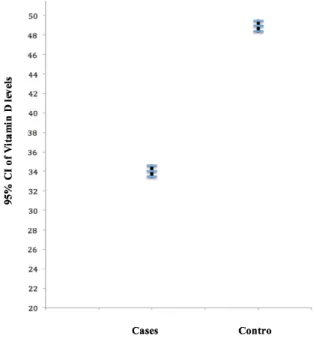
Around 14% of the cases had low serum 25-(OH) D levels but it was only 4% among controls, mean value of serum vitamin D in cases and controls was 34.02 and 48.9 respectively with p value being 0.000771 [OR=3.5; 95% CI= 33.46 – 34.57] details were given in Table 2, Figure 1. Among the cases, there was no correlation between duration of disease and serum 25-(OH) D levels [p -value=0.052513].
The trend of association between UAS and vitamin D levels in patients with chronic urticaria was evaluated. The serum vitamin D levels tended to have no association with UAS in chronic urticaria patients. The chi-square
statistic being 0.8672 and the p-value being 0.351732. Details were shown in Figure 2.
Figure 1 95% CI in cases and controls
Figure 2 The trend of association between UAS and serum 25(OH) D levels in patients
Discussion
occur at all age groups with peak age of onset in adults being between 20 and 40 years.15 In our study we had limited the age of our cases and controls to 18-45 years to avoid the presence of co- morbid conditions so as to reduce bias with vitamin D level alterations in these individuals. Mean age of cases in our study was 31.66 and is in accordance with Deacock SJ et al.15 study on chronic urticaria patients.
In the present study urticaria was associated with angioedema in 26% of the cases, it is in discordance to study by Rather S et al.13 where a higher percentage was noted [40%].
In our study, serum vitamin D levels are deficient or insufficient in high percentage of cases [42%] when compared to controls [28%]. Our study results are in accordance to Rather S et al.13 and Thorp et al.14 on CSU patients. Masoud Movahedi et al.18 performed similar study on large number of patients [114 patients and 187 controls] and found similar results. In Laxmisha Chandrashekar et al.19 study on 45 patients of chronic urticaria vitamin D deficiency was seen in all the patients where as in controls it was 35.5% which is very high compared to other studies. The reason for relatively less significance might be due to the demographic profile of the study population with widespread prevalence of varying degrees (50%–90%) of vitamin D deficiency with low dietary calcium intake in Indian population and the duration (1½ year) of the study with seasonal variation.
In the present study, the serum vitamin D levels showed no correlation with UAS in chronic urticarial patients. Our study results are in discordance to a retrospective study performed by Woo et al.20 on chronic urticaria patients. They found significant negative correlation between the serum 25-(OH) D3 levels and the UAS (p<0.001). Similar negative correlation was
also observed in the studies of Masoud Movahedi et al. and Rather S et al.13,18
Conclusion
This study reveals low levels of vitamin D in patients with chronic urticaria when compared to controls. However, the serum vitamin D levels had no correlation with disease severity (UAS) in chronic urticaria patients. One limitation of the present study was the demographic profile where there is widespread prevalence of varying degrees (50%–90%) of vitamin D deficiency with low dietary calcium intake in Indian population, and the other being small sample size. Therefore, further studies are needed to reinforce this association in different populations. The question whether supplementation with 25-hydroxy vitamin D would lower the systemic inflammation seen in CU needs to be elucidated in further clinical trials.
References
1. Shear S. Andrews’ diseases of the skin: Clinical dermatology. JAMA. 2012; 307: 92. 2. Khan DA. Chronic urticaria: diagnosis and
management. Allergy Asthma Proc 2008; 29: 439-446.
3. Beltrani VS. An overview of chronic urticaria. Clin Rev Allergy Immunol 2002; 23(2): 147-69.
4. Hide M, Francis DM, Grattan CE, Hakimi J, Kochan JP, Greaves MW. Autoantibodies against the high affinity IgE receptor as a cause of histamine release in chronic urticaria. N Engl J Med 1993; 328: 1599-604.
5. Muehleisen B, Gallo RL. Vitamin D in allergic disease: Shedding light on a complex problem. J Allergy ClinImmunol 2013; 131(2): 324–9.
7. Annesi-Maesano I. Perinatal events, vitamin D, and the development of allergy. Pediatr Res 2002; 52(1): 3-5.
8. Baroni E, Biffi M, Benigni F, Monno A, Carlucci D, Carmeliet G, et al. VDR ‑ dependent regulation of mast cell maturation mediated by 1, 25 ‑dihydroxyvitamin D3. J LeukocBiol 2007; 81:250‑62.
9. Searing DA, Leung DY. Vitamin D in atopic dermatitis, asthma and allergic diseases. Immunol Allergy Clin North Am 2010; 30: 397-409.
10. Sandhu MS, Casale TB. The role of vitamin D in asthma. Ann Allergy Asthma Immunol 2010; 105(3): 191-9.
11. Goetz DW. Idiopathic itch, rash, and urticaria/angioedema merit serum vitamin D evaluation: A descriptive case series. W V Med J 2011; 107: 14‑20.
12. Sindher SB, Jariwala S, Gilbert J, Rosenstreich D. Resolution of chronic urticaria coincident with vitamin D supplementation.Ann Allergy Asthma Immunol 2012; 109: 359‑60.
13. Rather S, Keen A,Sajad P. Serum levels of 25-hydroxyvitamin D in chronic urticaria and its association with disease activity: A case control study. Indian Dermatol Online J 2018; 9: 170-4.
14. Masoud Movahedi, Marzieh Tavakol, Armin Hirbod-Mobarakeh, Mohammad Gharagozlou, Asghar Aghamohammadi1,
Zahra Tavakol et al. Vitamin D Deficiency in Chronic Idiopathic Urticaria. Iran J Allergy Asthma Immunol 2015; 14: 222-227.
15. Deacock S J. “An Approach to the Patient with Urticaria.” Clinical and Experimental Immunology2008; 153: 151–161.
16. Allen P Kaplan, chronic urticaria and angioedema, N Engl J Med 2002; 346(3):175-9.
17. Thorp WA, Goldner W, Meza J, Poole JA. Reduced vitamin D levels in adult subjects with chronic urticaria. J Allergy ClinImmunol 2010; 126: 413–14.
18. Movahedi M, Tavakol M, Hirbod-Mobarakeh A, Gharagozlou M, Aghamohammadi A, Tavakol Z et al.Vitamin D deficiency in chronic idiopathic urticaria. Iran J Allergy Asthma Immunol 2015; 14: 222-27.
19. Chandrashekar L, Rajappa M, Munisamy M, Ananthanarayanan PH, Thappa DM, Arumugam B. 25-Hydroxy vitamin D levels in chronic urticaria and its correlation with disease severity from a tertiary care centre in South India. Clin Chem Lab Med 2014; 52: 115–8.