Address for correspondence Dr. Tasleem Arif ,
Postgraduate Department of Dermatology, Sexually Transmitted Diseases & Leprosy, Govt. Medical College (University of Kashmir), Srinagar, J & K India
Email: [email protected]
Original Article
Antibody profile in systemic sclerosis patients: A
cross-sectional study from Kashmir Valley of India
Introduction
Systemic sclerosis (SSC) is a multisystem
autoimmune connective tissue disease with a
variable and unpredictable course.
1The exact
etiology remains unknown, but the role of both
environmental and genetic factors has been
suggested.
2The disease characteristically shows
vasomotor
abnormalities,
fibrosis
and
consequent inflammation.
3It presents with
thickening and fibrosis of the skin and various
other organs like kidneys, lungs, heart and
gastrointestinal tract.
4SSC has been principally
divided into two forms: limited and diffuse SSC.
The limited SSC presents as sclerotic changes of
the distal extremities and face and features like
telangiectasia, calcinosis and late-onset of
pulmonary hypertension. Diffuse SSC involves
the trunk in addition to the extremities, presents
Tasleem Arif*, Mohammad Adil, Iffat Hassan** Postgraduate Department of Dermatology, STD and leprosy, Government Medical College, Srinagar, Jammu and Kashmir, India
** Postgraduate Department of Dermatology, STDs and Leprosy, Jawaharlal Nehru Medical College (JNMC), Aligarh Muslim University (AMU), Aligarh, India
Abstract
Objective This study aimed to find the prevalence of the most common antibodies in patients of systemic sclerosis and to ascertain their prevalence with the limited and diffuse cutaneous variants of systemic sclerosis.Methods Thirty-four patients of systemic sclerosis, attending the dermatology department, diagnosed as per the American Rheumatology Association criteria were recruited for this cross-sectional study. They were classified as having limited and diffuse systemic sclerosis. All patients were subjected to serum estimations of antinuclear antibodies, anticentromere antibodies and anti-Scl70 antibodies. The results were tabulated and analyzed for possible association between disease subsets and antibodies.
Results There were 27 patients with limited disease and 7 with diffuse disease. Antinuclear antibodies were seen in 76.5% of all patients. Anticentromere antibodies were seen in 9 (33.3%) limited disease patients and 1 (14.3%) in diffuse variant. The total prevalence of anticentromere antibodies was 29.4%. Anti-Scl70 antibodies were found in 5 (18.6%) and 3 (42.9%) patients of limited and diffuse disease subset, respectively. Overall, these antibodies were seen in 23.5% patients.
Conclusion Anticentromere antibodies are more common in limited systemic sclerosis while anti-Scl70 antibodies are seen more frequently in diffuse systemic sclerosis. Thus, these antibodies can act as a marker of future disease activity, severity of disease and prognosis.
Key words
with early involvement of various organ systems
of the body and tendon friction rubs.
3The presence of serum autoantibodies against
various nuclear and cytoplasmic antigens has
been described as a hallmark of SSC and has
been referred to as the most evident expression
of humoral dysfunction in these patients.
5,6Apart
from having diagnostic value, these antibodies
also help in classification of the disease into one
of the two major subtypes and therapeutic
response, thus having a prognostic value.
7,8This
study aimed to identify the prevalence of the
three major antibodies found in SSC and to
correlate it with the limited and diffuse subsets
of SSC. The authors couldn’t find any such
study from this part of the world which inspired
them to undertake this cross-sectional study.
Methods
This cross-sectional study was undertaken in the
postgraduate department of dermatology, STD’s
and Leprosy, Government Medical College,
Srinagar, Kashmir, India from January 2012 to
December 2013 (total 2 years duration). There
were 58 patients of systemic sclerosis in total.
Eight patients had only one antibody status
known; six patients couldn’t afford antibody
profiling; five patients had two antibodies done;
two patients were diagnosed as mixed
connective tissue disease, two had overlap with
lupus erythematosus and one with overlap with
dermatomyositis. Out of these 58, only 34
patients of systemic sclerosis, diagnosed on the
basis of the American College of Rheumatology
(ACR) classification criteria, were included in
this study.
9Patients were enquired about the
social and demographic history of their disease
parameters like age, sex, duration of disease and
age of onset. SSC patients were divided into
limited SSC and diffuse SSC according to Le
Roy classification. After this, they underwent
laboratory tests to detect the presence or absence
of antinuclear antibody (ANA), anticentromere
antibody and anti-Scl70 antibody. These tests
were done using the Enzyme Immunoassay
method. Patients suspected to have overlap with
other connective tissue diseases like lupus
erythematosus, or mixed connective tissue
disease were excluded from the study. Patients
with none, one or two antibodies status known
were excluded. Only those patients who were
screened for all the three antibodies were
included in the study. These parameters were
then assessed for any possible correlation
between the positivity of tests and clinical
parameters of the disease. Appropriate statistical
tests were used for analysis. The data were
tabulated and mean, standard deviation and
percentages of the groups were determined.
SPSS software version 20.0 was used for
statistical analysis
Results
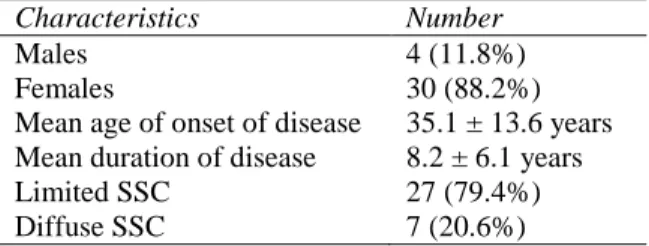
The general characteristics of the patients in the
study have been outlined in
Table 1. A total of
34 patients presented to us during the study
period that satisfied the ACR criteria. Of these,
there were 30 (88.2%) female patients and 4
(11.8%) male patients. The mean age of the
patients was 43.3 years with a standard deviation
of 14.4 years. The mean age of onset of the
disease was 35.1 years, with a standard deviation
of 13.6 years. The mean duration of the disease
was 8.2 years and the standard deviation was 6.1
years.
Table 1 Basic characteristics of the patients in the study (n=34).
Characteristics Number
Males 4 (11.8%)
Females 30 (88.2%)
Mean age of onset of disease 35.1 ± 13.6 years Mean duration of disease 8.2 ± 6.1 years
Limited SSC 27 (79.4%)
Table 2 Antibody profile in systemic sclerosispatients (n=34).
Antibody
Limited (n=27) Diffuse (n=7) Total (n=34)N % N % N %
ANA 19 70.8% 7 100% 26 76.5%
Anticentromere 9 33.3% 1 14.3% 10 29.4%
Anti-Scl 70 5 18.6% 3 42.9% 8 23.5%
The antibody profile of the total number of
patients, as well as, the limited and diffuse
subset of patients has been tabulated in Table 2.
ANA was positive in 26 (76.5%) patients,
anticentromere antibodies were seen in 10
(29.4%) patients and 8 (23.5%) patients out of
the 34 had anti-Scl70 antibodies. Of those 27
patients with limited systemic sclerosis, 19 had
ANA positivity. This formed 70.8% of the
patients in the limited group. 9 patients had
anticentromere antibodies and 5 patients of
limited disease had anti-Scl70 antibodies. Thus,
anticentromere antibodies were seen in 33.3% of
the limited group patients and anti-Scl70
antibodies were seen in 18.6% of the limited
group. ANA was positive in all patients of the
diffuse form of the disease, i.e. 20.6% of the
total number of patients and 100% of the diffuse
group. Anticentromere antibody was seen in 1
patient and anti-Scl70 was seen in 3 patients.
This makes for 14.3% and 42.9% of the patients
with diffuse disease, respectively
.
Discussion
The aim of our study was to identify the
prevalence of the three main antibodies found in
SSC in the regional population and to study
these antibodies in the two disease subsets:
limited and diffuse SSC. Most of our patients
(88.2%)
were
females.
SSC
is
found
predominantly in women and studies have
reported female to male ratios as high as
10:1.
10,11The mean age of onset of disease in our
patients was 35.1 years and they presented to us
after a mean duration of 8.2 years. These
findings are in concordance with other studies
that have reported that SSC is a disease with a
mean onset in the fourth decade of life.
10-12It has
been proposed that SSC patients that present to
the dermatology outpatient departments have
comparatively fewer symptoms and this could
be reason for the long duration of symptoms
seen in our patients before presenting to us.
13Of
the total 34 patients, 27 (79.4%) patients had
limited disease while 7 (20.6%) patients had
diffuse systemic sclerosis. Previous studies also
indicate that the limited type is the predominant
form of the disease.
14,15Antibodies in systemic sclerosis have been
described in 75% to 96% of patients in different
studies.
16,17In many cases, the antibodies predate
the occurrence of the disease manifestations,
thus serving as an alarm.
18Our findings fall in
this spectrum as serum antibodies were seen in
26 (76.5%) of our patients. All of these 26
(76.5%) patients tested positive for antinuclear
antibodies.
Most
studies
have
identified
antinuclear antibodies to be present in around
60-90% patients,
13,19,20with a few case series
showing positivity in slightly more than 90%
patients.
21,22lower percentage of antibodies in this disease
subset than other studies, probably due to ethnic
differences.
24These antibodies are said to be
associated with limited cutaneous disease,
calcinosis and involvement of peripheral vessels
and lesser chances of interstitial fibrosis of the
lungs.
26The anti-Scl70 antibodies, also referred to as
anti topoisomerase antibodies, were seen in 8
(23.5%) patients in the study. These comprised
of 5 (18.5%) patients from limited group and 3
(42.9%) patients from the diffuse group. This
indicates that anti-Scl70 antibodies are more
frequently seen in diffuse systemic sclerosis. An
Iranian study evaluated the presence of this
antibody by various techniques and found that
around 30% patients were positive for these
antibodies.
28A literature search also shows that
this number is somewhere between 30-50%.
25,26The prevalence of anti-Scl70 antibodies in
diffuse subset is highly variable and ranges from
as low as slightly more than 20% to around 70%
of all patients.
24-26This antibody has been
correlated with diffuse skin involvement, greater
disease severity, interstitial lung disease, cardiac
involvement and a worse prognosis.
29Another class of antibodies commonly seen in
systemic sclerosis is the anti-RNA polymerase
III. It has a variable and lower percentage
ranging from 6% to 25% in different regions.
30It
is associated with diffuse disease subset, tendon
friction rubs and severe renal involvement.
31However, due to unavailability this antibody
testing was not done in our patients. A unique
observation seen in SSC is that the presence of
anticentromere
antibodies
and
anti-Scl70
antibodies in a single patient in rare, though the
two are not mutually exclusive.
32This was seen
in our study as well, where we found that
patients having one of the two antibodies tested
negative for the other.
Limitations
There were certain limitations in our study. Only
major antibodies like ANA, anticentromere and
anti-Scl70 were tested. Other antibodies like
RNA polymerase III, endothelial,
anti-centriole antibodies, etc. were not screened for
because
of
unavailability
and
economic
restrictions. The clinical correlation between
various organ system involvement and antibody
positivity could not be studied as the study was
designed to investigate mainly the prevalence of
antibodies and their relation to the disease
subsets.
Conclusion
This study found that a large number of systemic
sclerosis patients have circulating antibodies in
their blood. The anticentromere antibodies are
associated with limited disease subset, which has
a comparatively better prognosis. The diffuse
subset of patients, who have more severe disease
and a poorer prognosis are more likely to test
positive for anti-Scl70 antibodies. Thus, the
estimation of these antibodies can help in the
classification of the disease into limited and
diffuse cutaneous subsets and in turn may help
to predict likely clinical course and estimate the
likely prognosis of systemic sclerosis patients.
References
1. Varga J, Abraham D. Systemic sclerosis: a prototypic multisystem fibrotic disorder. J Clin Invest. 2007;117:557-67.
2. Barnes J, Mayes MD. Epidemiology of systemic sclerosis: incidence, prevalence, survival, risk factors, malignancy and environmental triggers. Curr Opin Rheumatol. 2012;24:165-70.
4. Arif T, Masood Q, Singh J, Hassan I. Assessment of esophageal involvement in systemic sclerosis and morphea (localized scleroderma) by clinical, endoscopic, manometric and pH metric features: a prospective comparative hospital based study. BMC Gastroenterol. 2015;15:24. 5. Lafyatis R, York M. Innate immunity and
inflammation in systemic sclerosis. Curr Opin Rheumatol. 2009;21:617-22.
6. Kraaij MD, Van Laar JM. The role of B cells in systemic sclerosis. Biologics. 2008;2:389-95.
7. Graf SW, Hakendorf P, Lester S, Patterson K, Walker JG, Smith MD et al. South Australian Scleroderma Register: autoantibodies as predictive biomarkers of phenotype and outcome. Int J Rheum Dis. 2012;15:102-9.
8. Hasegawa M. Biomarkers in systemic sclerosis: Their potential to predict clinical courses. J Dermatol. 2016;43:29-38.
9. Subcommittee for Scleroderma Criteria of the American Rheumatism Association Diagnostic and Therapeutic Criteria Committee. Preliminary criteria for the classification of systemic sclerosis (scleroderma). Arthritis Rheum. 1980;23:58-90.
10. Chifflot H, Fautrel B, Sordet C, Chatelus E, Sibilia J. Incidence and prevalence of systemic sclerosis: a systematic literature review. Semin Arthritis Rheum. 2008;37:223-35.
11. Ranque B, Mouthon L. Geoepidemiology of systemic sclerosis. Autoimmun Rev. 2010;9:A311-8.
12. Ruangjutipopan S, Kasitanon N, Louthrenoo W, Sukitawut W, Wichainun R. Causes of death and poor survival prognostic factors in Thai patients with systemic sclerosis. J Med Assoc Thai. 2002;85:1204-9.
13. Sharma VK, Trilokraj T, Khaitan BK, Krishna SM. Profile of systemic sclerosis in a tertiary care center in North India. Indian J Dermatol Venereol Leprol. 2006;72:416-20. 14. Lahcene M, Oumnia N, Matougui N,
Boudjella M, Tebaibia A, Touchene B. Esophageal involvement in scleroderma: Clinical, endoscopic, and manometric features. ISRN Rheumatol. 2011;2011:1-5. 15. Arias Nunez M, Llorca J,
Vazquez-Rodriguez TR, Gomez-Acebo I, Miranda-Filloy JA, Martin J et al. Systemic sclerosis in northwestern Spain: a 19 year
epidemiologic study. Medicine. 2008;87:272-80.
16. Schneeberger D, Tyndall A, Kay J, Sondergaard KH, Carriera PE, Morgiel E et al. Systemic sclerosis without antinuclear antibodies or Raynaud’s phenomenon: a multicenter study in the prospective EULAR Scleroderma Trials and Research (EUSTAR) database. Rheumatology (Oxford). 2013;52:560-7.
17. Hamaguchi Y, Hasegawa M, Fujimoto M, Matsushita T, Komura K, Kaji K et al. The clinical relevance of serum antinuclear antibodies in Japanese patients with systemic sclerosis. Br J Dermatol. 2008;158:487-95.
18. Walker JG, Fritzler MJ. Update on autoantibodies in systemic sclerosis. Curr Opin Rheumatol. 2007;19:580-91.
19. Admou B, Arji N, Seghrouchni F, Missoum H, El Fenniri L, Amghar S et al. Low prevalence of anti-centromere antibodies in scleroderma in Morocco (about 272 cases). Ann Biol Clin (Paris). 2007;65:291-7. 20. Giddon AE, Dore CJ, Dunphy J, Betteridge
Z, McHugh NJ, Paddison PJ et al. Antinuclear antibodies and clinical associations in a British cohort with limited cutaneous systemic sclerosis. J Rheumatol. 2011;38:702-5.
21. Meyer OC, Fertig N, Lucas M, Somogyi N, Medsger TA. Disease subsets, antinuclear antibody profile and clinical features in 127 French and 247 US adult patients with systemic sclerosis. J Rheumatol. 2007;34:104-9.
22. Moinzadeh P, Nihtyanova SI, Howell K, Ong VH, Denton CP. Impact of hallmark autoantibody reactivity on early diagnosis in scleroderma. Clin Rev Allergy Immunol. 2012;43:249-55.
23. Müller CS, Paiva ES, Azevedo VF, Radominski SC, Lima Filho JHC. Perfil de autoanticorpos e correlac¸ão clínica em umgrupo de pacientes com esclerose sistêmica na região Sul doBrasil. Rev Bras Rheumatol. 2011;51:319-24.
24. van den Hoogen F, Khanna D, Fransen J, Johnson SR, Baron M, Tyndall A et al. 2013 classification criteria for systemic sclerosis:
an American college of
rheumatology/European league against rheumatism collaborative initiative. Ann Rheum Dis. 2013;72:1747-55.
clinical evaluation and prognosis. J Dermatol. 2010;37:42-53.
26. Horimoto AMC, da Costa IP. Antibodies in systemic sclerosis and their clinical correlation in patients from a midwestern region of Brazil. Rev Bras Rheumatol. 2015;55:229-39.
27. Mehra S, Walker J, Patterson K, Fritzler MJ. Autoantibodies in systemic sclerosis. Autoimmun Rev. 2013;12:340-54.
28. Behmanesh F, Amin R, Khajedaluee M, Fritzler MJ. Antibody profile in systemic sclerosis. Acta Medica Iranica. 2010;48:12-20.
29. Nihtyanova SI, Denton CP. Autoantibodies as predictive tools in systemic sclerosis. Nature Rev Rheumatol. 2010;6:112-6.
30. Nikpour M, Hissaria P, Byron J, Sahhar J, Micallef M, Paspaliaris W et al. Prevalence, correlates and clinical usefulness of antibodies to RNA polymerase III in systemic sclerosis: a cross-sectional analysis of data from an Australian cohort. Arthritis Res Ther. 2011;13:R211.
31. Vanthuyne M, Smith V, De Langhe E, Praet JV, Arat S, Depresseux G et al. The Belgian systemic sclerosis cohort: correlations between disease severity scores, cutaneous subsets, and autoantibody profile. J Rheumatol. 2012;39:2127-33.